Everyone froze when a furious socialite raised her hand to slap an elderly woman at a luxury charity gala. Nobody dared intervene, not the guests, not the security guards, not even the event organizers who had spent months preparing for the most prestigious evening of the social calendar. But one person stepped forward. A 28-year-old Black waitress quietly caught the woman's wrist before the slap landed.
The ballroom fell completely silent. The wealthy guests mocked her for interfering. They thought she had just destroyed her career over a stranger she had known for less than an hour. What they didn't know was that the elderly woman was the mother of one of the most powerful billionaire tycoons in the country.
And before the night was over, everything would change. Not just for the waitress, not just for the socialite, but for every single person standing in that gilded room who had chosen to look away. Maya Johnson had been working events like this one since she was 22 years old. Six years of white gloves and silver trays.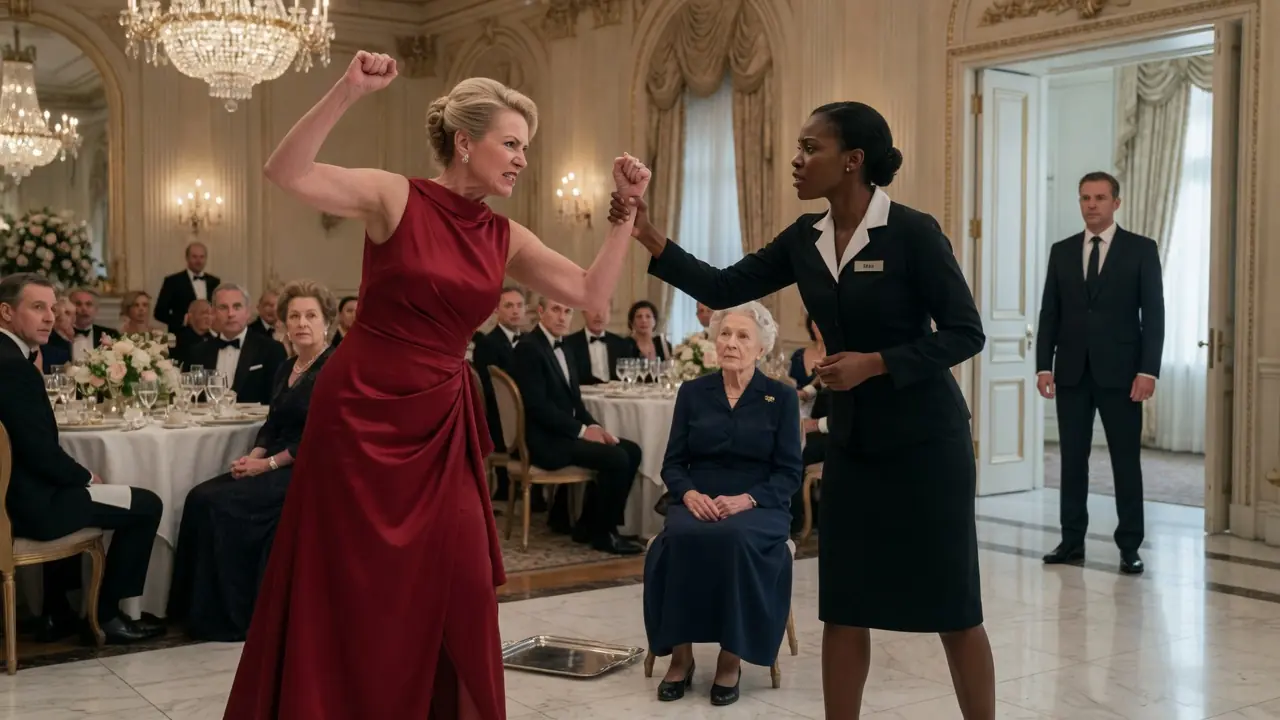
Six years of moving through rooms full of people who could buy her entire apartment building without checking their bank account. She had grown up in a neighborhood where paychecks were counted carefully, and the kind of abundance on display at events like this one existed only in the background of films, a set dressing, a suggestion of a world that wasn't yours. She had put herself through a hospitality certification program by working double shifts at a midtown diner. And when she finally landed the job with Premier Event Services, she had felt the particular quiet pride of someone who had built something with their own hands and knew exactly how heavy it had been.
She had learned early on that the best way to survive in this world, the world of catered galas and crystal chandeliers and $300 floral centerpieces, was to become invisible. Not invisible in a defeated way, but in the professional sense. Present when needed, absent when not, attentive without being intrusive. She was good at her job, better than good if she was being honest with herself, and Maya Johnson had always believed in being honest with herself.
She had steady hands, a precise memory for dietary restrictions, and an instinct for reading a room that her supervisor, a round-faced man named Gerald, had once called a genuine gift. She could tell when a guest wanted conversation and when they wanted to be left alone. She could tell when a glass was about to tip before it tipped. She could tell when a situation was about to shift.
That gift would matter more tonight than it ever had before. The Harrington Grand Hotel rose 40 floors above the city's financial district, and on this particular Friday evening in late October, its fourth-floor ballroom had been transformed into something that seemed almost deliberately designed to remind ordinary people of their ordinariness. The theme of the gala was a night of stars, which Maya privately thought was redundant, given that every person in attendance already considered themselves one. The chandeliers had been replaced with cascading crystal installations that caught the light and scattered it across the ceiling like a living constellation.
Each table was set with hand-painted china that had been imported from a studio in Florence and would never be used again after tonight. The floral arrangements alone cost more than Maya made in three months. She knew this because Gerald had mentioned it twice while briefing the service staff with the specific tone of a man who found such facts both appalling and deeply impressive. Outside the entrance, a line of black cars stretched half a block.
Inside, the air smelled of perfume layered over perfume, expensive and suffocating in a way that Maya had learned to breathe through. She pinned her name tag to her uniform, plain black with small white text that read simply Maya, and she told herself what she always told herself before a shift like this one. Just get through the night. Be professional.
Be invisible. Go home. The guests arrived with a particular kind of confidence that comes not from anything they had done that evening, but from everything they had accumulated over a lifetime. Women in gowns that probably had their own security detail.
Men in suits that cost more than a semester of college tuition. There were senators, their faces familiar from campaign posters and television interviews, working the room with practiced handshakes and manufactured warmth. There were tech founders who had not yet figured out that dressing like they didn't care about money was its own kind of performance. There were socialites whose entire professional identity consisted of being seen at events like this one, which they accomplished by wearing outfits carefully calibrated to be photographed.
But she kept her chin level and her movements precise, and she did her job and she was good at it. It was somewhere between the cocktail hour and the first course that Maya noticed the old woman sitting alone at one of the smaller tables near the back of the ballroom. She almost missed her entirely. The woman was the kind of quiet that rooms like this one tend to swallow whole.
Not the quiet of someone sulking or waiting for attention, but the quiet of someone who had long ago stopped needing the room to acknowledge her. She was perhaps 75, maybe older, with white hair pulled back neatly and hands folded in her lap with the patience of someone who had learned to wait without restlessness. She wore a dress that was clean and carefully pressed, but clearly not purchased at the kind of boutique whose bags were currently hanging from the chairs of every other woman in the room. No jewelry except a small gold pin near her collar, the kind a grandmother receives from a church group and wears to every important occasion for the rest of her life.
She did not belong here in any of the ways that the other guests belonged here, and yet she sat at her table with a stillness that somehow managed to seem more dignified than the performance happening around her. Maya noticed her the way she noticed everything quietly from the corner of her eye, and then she made a decision she could not fully explain even to herself. She changed her route and walked toward the old woman's table. The woman's name, Maya would learn, was Evelyn.
She offered it with a slight smile when Maya introduced herself and asked if she could bring her anything. The smile was the kind that took a moment to arrive, but stayed once it did, warm and unhurried and entirely genuine, the kind of smile you don't see much at events like this one. Evelyn said she would love a cup of tea if it wasn't too much trouble, and Maya said it was no trouble at all, and that was the beginning of it. When she returned with the tea, Maya noticed that the small plate of hors d'oeuvres that should have been at the table was missing.
She couldn't be certain whether it had never arrived or whether someone had cleared it by mistake, and she brought a fresh one without being asked. Evelyn thanked her with a sincerity that was almost startling in its simplicity. Not the performative gratitude of someone who wanted to be seen being gracious, but the real kind, the kind that meant something. Maya checked on her twice more over the next 40 minutes, and each time Evelyn received her with the same quiet warmth, the same unhurried attention.
At one point, Evelyn mentioned, unprompted, that the tea was the best she'd had in some time. Maya laughed a little and said she couldn't take credit for the tea itself, just the delivery. Evelyn said that sometimes the delivery was the whole of it. Maya thought about that for a moment after she moved away.
She thought there was something in it, but the room had eyes, and the room had opinions, and the room had been cataloging Evelyn since she sat down. Maya was not the only one who had noticed the old woman in the unfashionable dress with the sensible shoes and the absence of diamonds. The difference was in what everyone else had done with the noticing. At a table perhaps 15 feet away, a cluster of women had been conducting the specific kind of soft-voiced, sharp-edged social surgery that is the specialty of people who have nothing at stake but their own superiority.
Maya caught fragments as she passed. "Did someone invite their housekeeper?" and the laughter that followed, low and private, designed not to be heard by the wrong person, but not really designed to be inaudible, either. The comments circulated with the speed of something that had been waiting for permission, and permission, apparently, had been granted the moment no one stopped them. Other guests glanced over at Evelyn with the particular expression of people trying to determine whether they needed to concern themselves with something or could safely ignore it.
Most of them decided to ignore it. Evelyn seemed not to hear any of it, or if she did, she gave no indication. She held her teacup with both hands and looked at the room with the expression of someone who had seen a great many rooms in her life and found them all more or less the same. Maya noticed all of this, too.
She felt something stir in her chest, not quite anger, not yet. Something more like a gathering, the kind of stillness before weather changes. The woman who changed everything was named Victoria Langford, and she had been introduced at the start of the evening as one of the gala's principal sponsors, which, as Maya understood from experience, meant she had contributed enough money to the event that the organizers would tolerate almost anything she did. Victoria was perhaps 55, slim in the way that requires daily effort and significant resources, and dressed in the kind of architectural fashion that requires a certain contempt for comfort.
She had the face of a woman who had spent a great deal of time being agreed with, and the bearing that comes from it, the slight forward tilt, the expectation that rooms would arrange themselves around her needs. Maya had been watching her work the ballroom for the better part of an hour, and she recognized the type immediately. Not the most genuinely powerful person in the room, but among the most deliberately visible. Victoria's social capital was performance capital, and tonight she was performing.
When her eyes finally landed on Evelyn, Maya saw something happen in Victoria's expression. Not surprise exactly, more like the sharp interest of someone who has found an irregularity that offends their sense of order. She excused herself from the conversation she was having and crossed the room with the unhurried certainty of someone who has never once considered that she might not be welcome somewhere. Victoria arrived at Evelyn's table with the specific smile of someone who has made up their mind about something and is now going through the formality of explaining it.
She looked at Evelyn with open and unapologetic appraisal, taking in the dress, the absence of jewelry, the sensible shoes. She asked, in a tone that was technically a question but practically a verdict, how exactly Evelyn had come to be at this particular table at this particular event. Evelyn looked up at her calmly and said that she had received an invitation as she assumed most of the guests had. Victoria's smile shifted in a way that didn't change its shape but entirely changed its meaning.
She said that the invitations had been very carefully curated and she was simply trying to understand the connection. Evelyn said there was a connection. Yes. Victoria said she would appreciate if Evelyn could clarify it.
Evelyn said she didn't think that was necessary. Victoria said she thought it was. The exchange was brief and precise and entirely without warmth. And by the time it had concluded the nearby tables had gone quiet in the specific way that people go quiet when they are pretending not to watch something.
A man at the next table had stopped mid-sentence. A woman had set down her fork. Everyone was watching. And everyone had arranged their expressions into the particular blankness of people who did not want to be called upon to have an opinion.
Maya stood near the service station with her tray and watched and the gathering in her chest became something more specific. She recognized what was happening. She had seen different versions of it her whole life. Victoria began to speak more openly then with the confidence of someone who has taken the silence of others as encouragement.
She said that this was a very exclusive event and that certain standards had to be maintained. She said she had a responsibility to the other donors. She said that perhaps Evelyn would be more comfortable somewhere else. Her voice was not raised.
It did not need to be. The cruelty of it was precisely in how measured it was, how reasonable sounding, how fully disguised as concern. The guests at the surrounding tables did not object. Some of them looked away.
A few, shamefully, looked amused. No one said a word in Evelyn's defense. The security guards at the perimeter of the room had noticed the commotion. Maya could see that, but they were looking at each other with the expression of men who had been trained to respond to threats and were not certain this qualified.
The event organizers, in their neat gray blazers, were similarly frozen, aware that something uncomfortable was happening, but acutely conscious of who was paying for the evening. Evelyn sat through all of it with a composure that was, Maya thought, one of the most remarkable things she had ever witnessed in a person. Not the composure of someone who hadn't been hurt. The composure of someone who had decided, long ago, that certain things would not have the power to break her.
She answered each of Victoria's comments briefly and without defensiveness, and she did not look away, and she did not flinch. Then Victoria asked again, more directly, for Evelyn to leave. And Evelyn, with the same quiet steadiness, said no. Something shifted in Victoria, then.
The measured quality went out of her. Her jaw tightened. The performance of reasonableness dissolved, and what was underneath it, impatient, entitled, unaccustomed to being refused anything, came fully to the surface. She stepped toward Evelyn's table.
The guests who had been trying to pretend this wasn't happening stopped pretending. The room held its breath. Victoria reached out and gripped the back of Evelyn's chair, and she leaned in close, and she told Evelyn in a voice that was no longer careful that she could either leave on her own or be removed. Evelyn said nothing.
She simply looked up at Victoria with eyes that were clear and steady and entirely unafraid, and that absence of fear seemed to enrage Victoria more than any response could have. Victoria straightened. Her right hand rose slow at first, then with sudden and violent intention, and the palm was already swinging forward toward the old woman's face when Maya's hand closed around her wrist. The sound it made, the sound of Maya's palm meeting Victoria's wrist, of the slap that didn't land, was quieter than anyone would have expected.
But the silence that followed it was absolute. Every conversation in the ballroom stopped. Every head turned. Maya stood with her fingers locked around Victoria's wrist.
Her tray gone, she had dropped it without noticing. It lay face down on the marble floor somewhere behind her. And she looked directly at Victoria, and she said, in a voice that was entirely level, that no one was going to do that. That was all.
Four words. No one was going to do that. The room absorbed them. Victoria stared at her with an expression that cycled through shock and disbelief, and something that was rapidly hardening into fury.
Evelyn sat very still. And when Maya glanced at her for a fraction of a second, the old woman's face held something that looked like recognition, as though she had been waiting to see what kind of person Maya was, and now she knew. The moment stretched out. No one moved.
No one breathed. The chandeliers scattered their borrowed light across the frozen tableau. And for a long suspended second, the entire weight of the evening balanced on the single fact of Maya's hand around Victoria's wrist, and the choice that had already been made. Victoria pulled her arm back.
She looked at Maya with an expression that had calcified entirely into something cold and deliberate. She said, at full volume now, that she wanted this woman fired. She said it to the room, as much as to anyone specific. She said the word immediately.
She said it with the ease of someone who had said similar words before, and watched them produce results. The guests who had been watching flinched at the sharpness of it. A few looked away again. The event organizers exchanged panicked glances, and began moving toward the scene with the careful urgency of people trying to contain damage.
Gerald, Maya's supervisor, reached her first. He took her by the arm, not roughly, but with the pressure of someone who needed her to understand the seriousness of what had just happened, and he pulled her aside. His voice was low and tight. He told her she had put her hands on a guest.
He told her that was grounds for immediate termination. He told her that Victoria Langford had personally sponsored three events through the company this year, and that he was sorry, but he had no choice. Maya did not argue. She had expected this.
She had known it the moment she dropped her tray. She had known it the moment she moved toward Victoria, and she had moved anyway, and she was not sorry. She removed her name tag when Gerald asked her to. She removed it and set it on the silver tray he held out to her with the particular care of someone who is refusing to let a difficult moment make them careless.
A young man in a gray blazer escorted her toward a side corridor that led away from the main ballroom. The guests watched her go with the expression of people who had witnessed something uncomfortable and were already deciding how to talk about it afterward. Some of them looked at her with contempt. A few looked at her with something more complicated, not quite admiration, not quite guilt, but something in that vicinity.
Victoria had already turned away and was accepting a glass of champagne from a server with the pointed serenity of someone demonstrating that they had moved on. The gala, as far as it was concerned, was resuming. Maya walked down the corridor with her back straight and her chin level, and she did not look back. And the gathering in her chest had become something quiet and clean and impossible to regret.
Behind her, at the table she had left, Evelyn watched her go. Then Evelyn opened the small beaded purse that sat in her lap and took out her phone. She looked at the screen for a moment. Then she pressed a number and held it to her ear.
The call lasted less than 2 minutes. No one near Evelyn's table was paying attention to her by then. Victoria had reclaimed the room's attention and the event organizers had declared the unpleasantness over and the servers had refilled glasses and restored the mood and everyone was glad to let the whole thing settle into the past. So no one noticed the phone call.
No one noticed the expression on Evelyn's face during it, not distressed, not urgent, just communicative. Just the face of a woman conveying specific information to someone who needed to have it. And no one noticed when she closed the phone and set it back in her purse and folded her hands in her lap and returned to the particular stillness she had held all evening. But 19 minutes later, the doors at the far end of the ballroom opened and the night changed entirely.
The cars were the first sign: four of them, black and long and polished to a mirror finish, pulling up simultaneously to the hotel entrance with the coordinated precision of something that had been planned. The doormen outside straightened. The valet staff moved quickly. A ripple of awareness passed through the guests nearest the entrance, the specific social seismography of people who can sense, before seeing anything directly, that someone significant has arrived.
The murmur spread inward, table by table. Phones were lowered. Conversations paused. Heads turned.
And then the doors opened and Alexander Sterling walked in. Most of the people in that room recognized him immediately. Not because they had met him, very few of them had, but because his face had appeared on the cover of enough financial publications, enough technology profiles, enough quarterly reports that it had become one of those faces that the serious moneyed world simply knew. He was perhaps 50 with the kind of physical presence that has nothing to do with size.
He was not a large man; his presence had everything to do with stillness. He did not look around the room when he entered. He did not acknowledge the attention his arrival had generated. He moved directly and without hesitation toward the back of the ballroom.
And he moved in the direction of the table where Evelyn sat. And everyone who saw it understood immediately that he was moving with purpose and everyone who saw it began doing the arithmetic. Alexander Sterling was the founder and chief executive of the Sterling Group, a conglomerate whose reach extended across infrastructure, technology, health care, and finance in ways that were both enormous and not entirely possible to fully enumerate. His personal wealth was the kind that gets described in annual rankings as something between a number and an abstraction.
He had started with little that could be called an advantage: a modest inheritance in the form of a struggling logistics company his father had built and not quite finished, and a belief that the way you built something mattered as much as what you built—a belief most of his early investors had found either admirable or naive. He had been told at various points in his career that his standards were impractical, that you couldn't maintain that level of ethical consistency at scale, that eventually the market would force compromises that his principles couldn't survive. He had heard all of it and he had understood the arguments and he had built the company anyway on the terms he had decided on and the company had grown in a way that made the people who had given him that advice very quiet on the subject. He had done it with a reputation for being, by the standards of people with his resources, genuinely principled.
He was not a regular presence on the gala circuit. He was known to be selective about where he appeared and selective about why. His presence here tonight had not been announced. No one had been expecting him.
And now he was crossing the ballroom floor with the unhurried certainty of a man who had received a phone call and responded to it the way a son responds to his mother. And every step he took was resolving the mystery that the evening had been building. And the resolution was catastrophic for several people in the room and good for one. He reached Evelyn's table.
He stopped. He looked at her with an expression that held no public face whatsoever. There was no performance, no calculation, and no awareness of the room watching, just the plain and unguarded relief of a person who has arrived where they needed to be. He said, "Mom, I'm sorry I'm late."
Evelyn looked up at him and her face opened into the smile that Maya had seen earlier. The one that took a moment to arrive but stayed once it did. She said he wasn't that late. He pulled out the chair beside her and sat down.
And he took both of her hands in his. And he asked her quietly, as though they were alone, what had happened. And Evelyn told him. She told him with the same composure she had maintained throughout the evening.
Without drama, without embellishment, presenting the sequence of events the way someone presents facts when they want to be clearly understood. She told him about Victoria's questions. About the escalation. About the moment when a hand had been raised toward her face.
And then she told him about the young woman who had stepped forward. She told him that name, Maya. And she said that of all the people in the room, in a room full of powerful and well-connected and influential people, Maya was the only one who had moved. Alexander sat very still while his mother spoke.
His face did not show a great deal during the telling. He listened with the particular attention of someone who is filing information precisely, making no judgment until all the information is in. When Evelyn finished, he asked once if she was all right. She said she was fine, only a little tired.
He nodded. Then he looked up and found one of the event organizers, a woman in a gray blazer, who had been hovering at a careful distance, aware that she was in the presence of someone to whom an explanation was owed. And he asked her quietly if there was footage from the security cameras of the incident. The woman said yes, there was.
They could certainly provide it. Alexander said he would like to review it. He said it in a tone that was not a request. The woman disappeared with the speed of someone who has recognized the category of situation she is in and the category of person she is dealing with.
They gathered around a laptop, Alexander, the senior event organizer, and two men from Alexander's security detail who had entered behind him and taken up positions with the discreet professionalism of people who know how to be present without being conspicuous. The footage was clear. The ballroom cameras were high-resolution, installed by a hotel that had reasons to document what happened at its events. The sequence played out in order.
Victoria approaching Evelyn's table, the extended exchange, the escalating pressure, the moment Victoria's hand rose, and Maya's hand meeting her wrist. Alexander watched it without moving. Then he watched it again. The event organizer beside him made a small sound that might have been an apology forming, but he didn't look at her, and she didn't complete it.
When the footage ended the second time, he closed the laptop with a careful and deliberate motion, and he stood. And Victoria Langford's name was in his expression even before it was in his mouth. What followed did not involve raised voices. That, Maya would think later, was perhaps the most striking thing about it.
Alexander crossed to where Victoria was standing with a small group that had reformed around her in the aftermath of the earlier commotion. And he stood before her. And he said her name once. And Victoria turned with the automatic smile of someone accustomed to greetings from important people.
A smile that collapsed within the first second of seeing his face. He told her in a voice pitched for her specifically, but carrying clearly to the people immediately around them, that the woman she had attempted to assault was his mother. He told her that his mother had attended this gala because the charity being honored was one she had supported quietly and without recognition for 11 years. He told her that his mother had been treated with contempt by people who did not know who she was.
And that his mother's response to that, her decision not to invoke his name, not to produce credentials, not to defend herself on any terms other than her own dignity, was one of the things about her that he respected most. And he told Victoria that she would be hearing from his legal team. He said it all with a measured calm that was, in its way, more devastating than anger would have been. Victoria did not respond.
Her face had gone through several colors and settled on something pale and fixed. The people around her had stepped back, not dramatically, not all at once, but steadily with the practiced social instinct of people identifying something they did not want to be too close to. The ripple moved outward from that exchange with the efficiency of bad news in rooms where social standing is the primary currency. By the time it reached the tables near the entrance, people were already making the calculations, the specific, cold, unsentimental calculations that people make in wealthy circles when someone has been publicly identified as a liability.
Victoria had spent years building an architecture of alliances and associations, the careful social infrastructure of someone whose influence depends on being seen with the right people at the right moments. The process looked effortless from the outside, but required continuous maintenance. The right invitations accepted, the right donations made at the right amounts, the right names dropped at the right times, the right enemies cultivated as much as the right friends. It was a machine that ran on reputation.
Victoria was discovering in real time that reputation could reverse direction with a speed that seemed impossible only if you had never seen it happen before. That architecture, Maya would learn later, began coming apart within the hour. A major corporate partner of one of Victoria's charitable organizations, whose continued relationship with her had been more pragmatic than warm, notified its board the following morning that it would not be renewing its arrangement. Two of the foundations she sat on received calls over the following week.
None of it happened loudly. None of it was announced. It simply happened, the way consequences happen when the person holding them has decided that the time for patience has ended. The gala itself continued with the particular determined cheerfulness of events that have survived a crisis and are committed to demonstrating that they have survived it.
But the room had changed. The temperature of it had changed. People spoke to each other differently. The carefully maintained fiction that everyone in the room had earned their place on terms other than money and connection had been disturbed in a way that was not going to settle back to what it had been.
Alexander found Maya in the side corridor where she had been waiting, not quite asked to wait and not quite told she could leave, with her jacket over her arm and the careful stillness of someone who has prepared themselves for multiple possible outcomes. She looked at him when he appeared in the corridor and he could see in her face the specific tension of someone bracing for one more thing to go wrong. He introduced himself, which struck her later as a thing worth noting. He introduced himself as though she might not know who he was, as though it was a courtesy owed regardless.
He said his name and he said he was Evelyn's son and he said he wanted to thank her. Maya said she had only done what seemed right. He said yes. He said that was the point.
He said he had watched the footage and he had seen what she had done and he had also seen what every other person in that room had not done and that distinction mattered enormously to him. He said it in a way that was direct and without any of the softening that often accompanies compliments from powerful people. There was none of the vague warmth that is really a kind of distance. He was specific.
He was looking at her while he said it. He told her about the company he had built. She knew the name but not the full scope of it and he described it briefly and without embellishment. And he said that the values the company had been built on were not simply words in a mission statement but things he had spent 20 years testing and defending and enforcing.
He said he judged people's character not by how they presented themselves in good conditions but by what they did in the moments that cost them something. He said that what she had done tonight had cost her something. It had cost her at least her job and possibly her professional reputation in the event services industry, where the word of a major donor carried weight, and she had done it anyway for a stranger without hesitation and without calculation. He said he would like to offer her a scholarship in business management through the Sterling Group Foundation's education program—full tuition and full support—with a position in the company waiting for her when she completed it, if she wanted it.
He said she should take her time with the decision. He said there was no pressure and no expiration. He reached into his jacket and gave her a card with a name on it, his chief of staff, a woman named Diane, and he said that whenever she was ready, that was the number to call. Maya stood in the corridor and she felt something move in her chest that was different from the gathering of earlier, not preparation for something, but the arrival of something.
She had been told she was capable before. She had believed it herself, but she had been living in a world that made it very difficult for belief alone to move anything, and the distance between knowing your own worth and being in a position where that worth could be acted on was a distance that most people spent their whole lives measuring without ever crossing. She said yes. She said it once, clearly, and then she pressed the back of her hand to her mouth for a moment because the eyes that she kept professional and steady through six years of white gloves and silver trays were doing something she had not given them permission to do.
Evelyn had come to stand at the entrance to the corridor. She had followed at a distance and now she stood watching her son and the young woman. And when Maya looked up and found her there, the old woman crossed the space between them and took Maya's hands in hers, the same hands that had been folded in her lap all evening, with the patience of someone who had learned to wait without restlessness, and she held them. And she said nothing for a moment.
Then from somewhere nearby, one of the guests, no one could later say precisely who had started it, began to clap. And then another, and by the time Maya became aware of the sound, it had grown into something full-throated and sustained. The sound of a room that had been complicit in something shameful deciding too late, but genuinely, to correct itself. It was not sufficient.
It was not justice for the earlier silence, but it was real, and it was unanimous, and it filled the corridor and the ballroom beyond. And Maya stood in it with Evelyn's hands in hers, and her chin level, and her back straight, the way she had stood through everything else that evening. The months that followed were not a fairy tale, because Maya had not been looking for a fairy tale. She had been looking for a door, and what she had found, or what had found her, was a door.
The scholarship program placed her in the company's executive development track, and the work was hard in the way that real work is hard, demanding, and precise, and sometimes frustrating, and consistently revealing of things she had not yet known how to do. There were mornings in the first weeks when she sat in conference rooms, surrounded by people who had been speaking the language of business strategy their entire adult lives, and she felt the familiar weight of having to learn something fast, and learn it without the safety net of having grown up with it. She had felt that weight before. She knew how to carry it.
The difference this time was that she was carrying it in a place that wasn't asking her to be invisible while she did. She asked questions when she didn't understand something, and the answers came without condescension. She made mistakes, and the mistakes were corrected without theater. She pushed back when she thought something was wrong, and the pushback was received as the kind of thing the organization expected from people who were paying attention.
She understood, gradually, and then all at once, that she had spent six years developing exactly the skills this environment valued most: precision, composure, the ability to read a room, the willingness to act when acting was necessary, and that those skills, which the gala world had treated as the invisible labor of an invisible person, were here recognized as exactly what they were. She was good at it. She had always had the instinct for reading a room, for understanding what a situation required, for the kind of steady attention that doesn't flinch. She built on those things in an environment that had the resources to build with.
The people she worked with were, for the most part, people who had been chosen by the same standard Alexander had applied to her. Not their pedigree, not their connections, not the ease with which they inhabited rooms like the Harrington Grand's fourth floor ballroom, but their willingness to act correctly when it cost them something. She fit there in a way she had not expected to fit somewhere, and the fitting was not the relief of finally belonging somewhere she had wanted to be, but the quieter and more substantial satisfaction of being in a place that matched the person she already was. Victoria Langford did not disappear because people with money do not disappear, but the specific form of power she had assembled over years of careful social construction dismantled itself with a thoroughness that surprised even people who had watched powerful people fall before.
She had cultivated the illusion that her position was permanent, that the connections she had built were friendships rather than transactions, that the loyalty she received was personal rather than contingent. The October evening at the Harrington Grand stripped that illusion clean. The two charitable foundations asked for her resignation from their boards within the same month, citing operational realignments that no one believed were purely operational. The corporate partner's withdrawal from her signature philanthropy project was followed within a year by two others.
Her name, which had once appeared regularly in the society sections of several publications covering the city's cultural and civic events, appeared less frequently, and then seldom. She was not prosecuted. The incident had stopped before it became an assault in the legal sense, stopped by the hand of a waitress who had been paying attention, but she lived with the social consequences of it in ways that were, by most accounts, significant. She moved through the same circles, but in a different position within them.
She was still invited to things. She was no longer considered. Evelyn never changed. That was the thing people who knew both of them would say years later when they told the story.
The money had always been there, or rather, the source of it had always been there, quiet in the background of Evelyn's life, in the way that the foundation of a house is quiet, structural, not decorative. She had raised Alexander in a modest house in a working neighborhood, and she had raised him with a precise and consistent set of values that she applied not as rules, but as examples. She showed him what it looked like to treat a server with the same attention you gave a senator. She showed him what it looked like to refuse a luxury you didn't need when someone near you needed something you could provide.
She showed him what it looked like to be the kind of person who did not require external validation to understand their own worth. Those lessons had taken. He had built the Sterling Group on the values he had learned at his mother's kitchen table in a house where the teapot was old and the cups didn't match, and dignity was not a thing you performed, but a thing you lived. When the company grew large enough that its decisions affected the lives of tens of thousands of people, he kept the same framework he had always used.
What is the right thing to do? And is the person making the decision someone who will do it when it costs them something? He had applied that test to every significant hire he had ever made. He had applied it to Maya in a side corridor of the Harrington Grand, and she had passed it without knowing she was being tested, which was the only way the test meant anything.
Evelyn had raised Alexander to understand that character preceded everything, and that the accumulation of wealth and power was only meaningful if the person holding it remained someone worth being. She had refused the trappings, not because she was indifferent to comfort, but because she had decided a long time ago that she would not let the world measure her through its own preferred instruments. She continued to support the charity that had brought her to the gala, the one she had funded quietly for 11 years without attending a single event until the night she appeared at the Harrington Grand in her clean, unpretentious dress, and her gold pin, and her small beaded purse, and she continued to live in the house she had lived in for 40 years in a neighborhood that had changed around her in every direction while she stayed still. She drank tea in the afternoons.
On one particular afternoon, several months after that October evening, she drank tea with Maya. They sat at Evelyn's kitchen table, the table that had been in the same house since before Alexander was born, with cups that didn't match and a teapot that was older than Maya herself. The kitchen smelled of something baked earlier in the day, and of the particular warmth that old houses accumulate over decades, the warmth of many meals, many conversations, many ordinary afternoons that had been, in the aggregate, a life. Outside the window, leaves were coming down from the oak that Evelyn said had been planted the year she moved in.
Maya sat across from her with her hands around her cup, the same way Evelyn had held hers at the gala, and she felt, not for the first time since that night, the specific sensation of finding herself somewhere she had not expected to find herself, and discovering that it was exactly right. They talked about the program, about the work, about the things Maya was learning, and the things she already knew. They talked about a project Maya was leading: a supply chain initiative that had stalled under the previous manager and that she had spent her first six weeks quietly diagnosing before presenting her analysis to the team. They talked about the gala, the way you talk about something that is already becoming history, close enough to feel, but far enough to see clearly.
At some point, Evelyn set down her cup and looked at Maya with the clear, steady eyes that had not flinched at Victoria Langford's raised hand, and she said, "You didn't step in for me because of who Alexander is. You didn't know who Alexander was. You stepped in because it was the right thing to do." Maya said she knew that.
Evelyn said, "I know you know it. I'm saying it out loud because the world is going to tell you a different version of this story. It's going to say you got lucky, or you were in the right place, or the right person happened to see you. And those things are true, but they are not why you did what you did.
You did it because of who you are. Don't let the outcome be the reason." Maya looked at her for a moment. Outside, the afternoon was gray and ordinary, the kind of afternoon that doesn't look like anything in particular from the outside, but that you remember clearly for the rest of your life.
She said she wouldn't, and she meant it in the way that mattered, not a promise made to impress someone, but a fact about herself that she was choosing to state clearly, out loud, so that it would be harder to forget. There are rooms in the world designed to make certain people invisible, and there are moments in those rooms when remaining invisible becomes a choice. And most people, when those moments arrive, choose the thing that costs less. Maya Johnson, on an October evening in the fourth-floor ballroom of the Harrington Grand Hotel, made the other choice.
She made it without knowing what it would cost, and without knowing what it would return. She made it the way the best choices are made, not because the calculation worked out, but because the person she was did not allow her to make any other. The courage that moved her across that ballroom floor was not the dramatic kind that announces itself in advance. It was the quieter and more durable kind, the kind that doesn't ask for permission, doesn't wait for conditions to improve, doesn't check whether anyone is watching or whether anyone will approve.
It was the kind of courage that comes from knowing who you are and refusing to act as though you don't. And in the end, the room remembered her. Not for who she had been when she entered it, not for the uniform she wore or the tray she carried, but for who she had shown herself to be when the moment came and most other people chose to look away. The world is full of rooms like that one.
It is full of moments like that one. And every time someone steps forward when stepping forward costs something, they change the room not just for the person they protected, but for every person watching who will one day face a similar moment and remember what one person, without credentials or connections or anything to gain, chose to do. Courage is not the absence of cost. It is the willingness to pay it anyway, and to pay it without waiting to see the receipt, without requiring that someone witness it, without needing to know in advance how the story ends.
Maya Johnson paid it on an October evening when the easiest thing in the world would have been to turn away, and in turning away to become one of the many people in that ballroom who had made the same calculation and decided the price was too high. She did not make that calculation. And the room in the world beyond it was different for having watched her refuse to. That is the only thing a room like that, or any room, owes anyone: the chance to show up when it matters.
The rest is up to the person.