“Get away from that bike.”
Rebecca Lawson’s voice came out smaller than she intended.
The parking lot was dark.
Two men stood beside the old Harley-Davidson, laughing as though they had already decided nobody inside the diner would be brave enough to interfere. One straddled the motorcycle with both hands on the handlebars. The other held a tire iron against his thigh.
Rebecca was twenty-eight years old, five feet four inches tall, and so tired that some mornings she forgot whether she had already brushed her teeth.
She had not slept through an entire night in four months.
Her six-year-old son was asleep inside the diner with an inhaler beside his hand.
She had forty-two dollars to her name.
And she had walked outside holding another tire iron because she could not think of anything else to do.
The man beside the motorcycle looked toward her.
For a moment, surprise crossed his face.
Then he smiled.
“Go back inside, sweetheart.”
Rebecca tightened both hands around the metal bar.
“That bike doesn’t belong to you.”
The man sitting on the Harley turned toward his partner.
“You hear that, Clay? The waitress is security now.”
Clay lifted his tire iron.
Behind Rebecca, the diner’s glass door swung open.
Rooster stepped into the parking lot.
He had left his leather jacket hanging over the stool, so the cold wind moved against a faded black T-shirt stretched across his broad shoulders. His long silver hair had come loose from its tie. Tattoos covered both arms from wrist to shoulder.
He did not look toward Rebecca.
His eyes remained on the men beside his motorcycle.
“Step away from it.”
His voice was quiet.
The man on the Harley laughed.
“Or what?”
Rooster continued walking.
The lookout adjusted his grip on the tire iron.
“Old man, stop right there.”
Rooster stopped about ten feet away.
Up close, the thieves could see the scars across his knuckles and the faded lines of old injuries near his brow. But age had softened nothing essential about him.
He stood without raising his hands.
Without threatening.
Without performing.
“That motorcycle is older than both of you put together,” he said. “It doesn’t know you.”
The thief on the seat looked down at the controls.
“We’ll teach it.”
“You won’t.”
Rebecca stood several feet behind Rooster.
She could hear her own breathing.
The parking lot lights buzzed overhead. Inside the diner, faces had gathered at the windows. Dale the trucker held his phone in one hand, though Rebecca could not tell whether he was recording or calling the police.
The young man who had been sitting near the window had removed his earbuds.
Nobody came outside.
Rebecca did not blame them.
She wished she had stayed inside too.
Clay pointed the tire iron toward Rooster.
“Back off.”
Rooster’s gaze moved briefly to the weapon.
Then to the truck.
Dark blue.
Cracked rear taillight.
Temporary license plate partly folded beneath the frame.
He remembered details without appearing to look.
“Last chance,” Clay said.
Rooster nodded once.
“I was about to say the same thing.”
The man on the motorcycle climbed off.
He reached beneath his jacket.
Rebecca’s body reacted before her mind understood.
She stepped around Rooster.
“Don’t.”
The word came out sharp this time.
The man’s hand stopped.
He looked at her as though noticing her for the first time.
Rebecca held the tire iron near her chest.
She had no idea how to use it.
The thief seemed to realize that too.
He smiled.
“What are you going to do with that?”
Rebecca did not know.
She thought of Leo inside the diner.
She thought of the rescue inhaler on the table.
She thought of the eviction letter folded behind the receipt in her apron.
She thought of how stupid it was to risk leaving her son alone in the world over a stranger’s motorcycle.
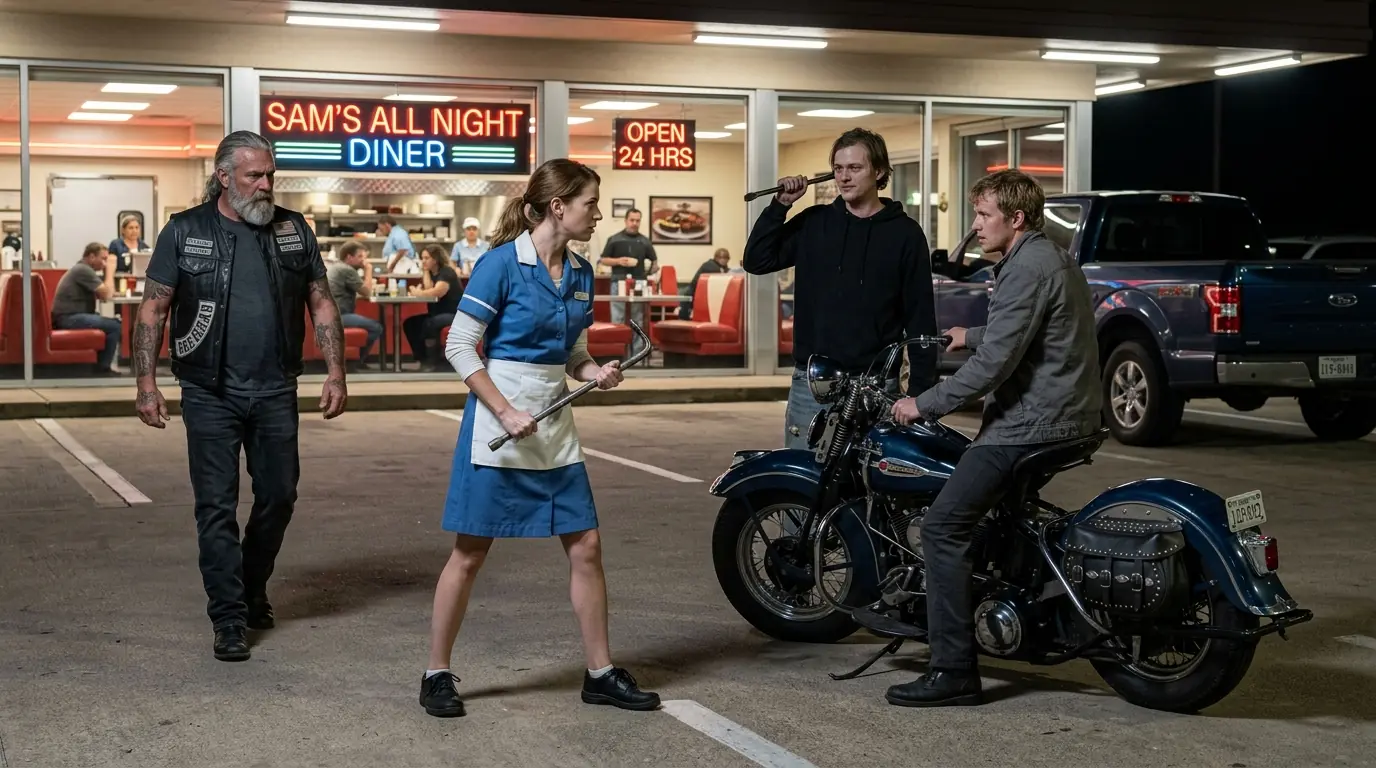
Then Clay stepped toward Rooster with the tire iron raised.
Rebecca swung.
Not at his head.
Not even at his body.
She struck the metal bar against the pavement directly in front of his boot.
The crash echoed across the lot.
Clay jumped backward.
For one second, everyone froze.
Then the other thief charged.
Rooster moved.
He stepped to the side, caught the man’s wrist, and redirected his momentum into the motorcycle seat. The thief folded over the bike with a grunt.
Rooster released him immediately.
Clay swung the tire iron.
Rooster leaned away, but the metal caught his shoulder.
The sound was sickening.
Rebecca screamed.
Rooster staggered one step.
Clay lifted the weapon again.
Rebecca drove her shoulder into him.
She weighed barely half what he did, but he was not expecting her. They crashed against the side of the pickup.
The tire iron fell.
Clay grabbed Rebecca by the apron and threw her toward the pavement.
She struck hard on one knee and one hand.
Pain flashed through her arm.
The first thief recovered and lunged at Rooster again.
This time Rooster did not merely redirect him.
One short punch landed beneath the man’s ribs.
The thief collapsed against the motorcycle, unable to breathe.
Rooster turned toward Clay.
Clay had retrieved the tire iron.
Rebecca tried to stand.
Her knee failed.
Clay raised the weapon.
Then a truck horn exploded behind them.
Dale had driven his eighteen-wheeler halfway across the diner entrance, blocking the blue pickup’s path to the road.
Its high beams flooded the parking lot.
The two women from booth three stood inside the doorway shouting that the police were coming.
The young man near the window had his phone raised and was yelling descriptions of the thieves into it.
Clay looked around.
The situation had changed.
He was no longer intimidating a tired waitress and an older biker in an empty parking lot.
There were witnesses.
Cameras.
A blocked escape.
He dropped the tire iron and ran toward the pickup.
His partner followed, still bent over and gasping.
Rooster could have stopped them.
He did not.
He went to Rebecca.
“Stay down.”
“I’m fine.”
“You’re bleeding.”
She looked at her hand.
The skin along her palm had torn open against the asphalt.
Her knee throbbed beneath her uniform.
Rooster crouched beside her.
“You hit your head?”
“No.”
“Dizzy?”
“No.”
“Can you move your fingers?”
She did.
“Leo,” she said suddenly.
She turned toward the diner.
The noise had awakened him.
He stood inside the glass door in his socks, one hand pressed against the window.
His eyes were wide.
His mouth was open.
Even from the parking lot, Rebecca heard the beginning of the wheeze.
“No.”
She pushed herself upright.
Rooster caught her before she fell.
“My son.”
He followed her gaze.
Leo’s chest moved too fast.
Rebecca forgot the thieves.
Forgot the motorcycle.
Forgot her bleeding hand.
She stumbled toward the diner.
Rooster supported most of her weight without making it obvious.
By the time she reached the door, Leo had begun coughing.
Rebecca lowered herself beside him.
“Look at me, baby.”
He tried.
His breath came in short, tight pulls.
She reached for the inhaler on the back table.
It was not there.
Her mind went blank.
She had placed it beside him.
She always placed it beside him.
The blanket had fallen to the floor. The inhaler had rolled beneath the booth.
The young man near the window saw it first.
He crawled under the table and retrieved it.
Rebecca shook the canister, fitted it to the small spacer she carried in her apron, and held the mask over Leo’s mouth.
“Slow breath.”
He could not.
“Look at Mommy.”
His eyes filled with panic.
Rebecca’s own fear rose so quickly she almost choked on it.
Rooster knelt on Leo’s other side.
He did not touch the child.
He lowered his voice.
“Hey, little man.”
Leo’s eyes moved toward him.
“You see me?”
A tiny nod.
“I need you to help me with something.”
Leo struggled for breath.
Rooster held up one large hand.
“Pretend you’re cooling down a motorcycle engine. Slow air in. Then blow it out.”
He made the breathing motion.
Leo followed badly.
Then again.
Rebecca activated the inhaler.
One dose.
Wait.
Another.
The wheeze remained, but the tightness began easing.
Sirens approached.
Rebecca kept one hand behind Leo’s neck.
The paramedics arrived before the police.
They assessed Leo on the diner floor while another medic cleaned Rebecca’s palm and examined her knee.
Rooster refused treatment until the child’s breathing had stabilized.
Only then did he allow someone to look at his shoulder.
The tire iron had left a dark swelling beneath his shirt, but nothing appeared broken.
“You need imaging,” the paramedic said.
“I’ve had worse.”
“That doesn’t make this minor.”
Rooster looked toward Rebecca.
She sat on the floor beside Leo, holding him so tightly that his small body almost disappeared inside her arms.
“I’ll go if she goes.”
Rebecca looked up.
“I can’t afford an emergency room.”
The paramedic paused.
The sentence was not unusual.
That made it worse.
“Your hand may need stitches,” he said.
“I can clean it here.”
“Your knee could be fractured.”
“I’m walking.”
“Barely.”
Rebecca looked toward the clock.
1:02 a.m.
Her shift had nearly seven hours remaining.
If she left, she would lose the night’s pay.
Possibly the job.
Phil, the manager, had Tuesdays off.
The owner had never met her.
“I need to finish my shift.”
The diner became quiet.
Ruby, one of the women from booth three, stared at her.
Dale lowered his phone.
The paramedic looked as though he wanted to argue.
Rooster stood.
“No.”
Rebecca’s exhaustion hardened into irritation.
“No what?”
“You’re not working on that knee.”
“I don’t have a choice.”
“There’s always a choice.”
“That sounds like something people say when they have money.”
The words came out harsher than she intended.
Rooster did not flinch.
Rebecca continued.
“I miss this shift, I lose about ninety dollars. If Sam decides I abandoned the diner, I lose the job. My rent is eight hundred dollars behind. I have thirty days. My son’s inhaler refill costs more than what I have in my wallet.”
Leo looked toward her.
Rebecca stopped.
She had not meant for him to hear.
Rooster looked at the boy.
Then at her.
“All right,” he said.
Rebecca waited for advice.
For pity.
For some sentence about government programs she had already called.
Instead, Rooster turned toward the customers.
“Who knows how to make coffee?”
Dale raised one hand slowly.
“I can pour it.”
“One of you worked a register?”
The older woman named Ruby nodded.
“Twenty years in retail.”
The young man by the window said, “I worked grill at Denny’s last summer.”
Rooster looked toward the paramedic.
“How long will she be at the hospital?”
“If the scans are clear, a few hours.”
Rooster faced Rebecca again.
“Your shift is covered.”
“You can’t just take over the diner.”
“Watch us.”
The woman from booth three removed her coat.
“I can wait tables.”
Her friend stood.
“I’ll call Phil.”
Dale walked behind the counter and examined the coffee machine.
“I’ve operated heavier equipment.”
Rebecca stared at them.
These people had been customers fifteen minutes earlier.
Now they were tying on spare aprons and collecting menus from tables.
“You don’t understand,” she said. “Sam will fire me.”
The second woman already had the diner phone in her hand.
“Then Sam can speak to all of us.”
Rooster held out his hand.
“Go take care of your son.”
Rebecca looked at it.
His palm was scarred.
His fingernails were clean.
She placed her uninjured hand inside his.
He pulled her carefully to her feet.
At Mercy Hospital, X-rays showed no fracture.
Rebecca received six stitches in her palm and a brace for a badly bruised knee. Leo’s breathing remained stable after a nebulizer treatment.
Rooster sat in the waiting room throughout the entire visit.
He did not ask personal questions.
He did not tell Rebecca everything would be all right.
People who had been through enough knew better than to promise that.
At four in the morning, Leo fell asleep against Rooster’s side.
The biker remained completely still so he would not wake him.
Rebecca watched from the chair opposite.
“You’re good with children.”
Rooster looked down at Leo.
“I had a daughter.”
The past tense carried its own answer.
Rebecca hesitated.
“What was her name?”
“Sophie.”
“How old?”
“When she died?”
Rebecca nodded.
“Seven.”
He looked toward the emergency-room doors.
“She had asthma too.”
Rebecca’s throat tightened.
Rooster spoke without emotion at first, as though he had repeated the facts enough times to sand down their edges.
“She had an attack during a school camping trip. The nurse thought she was panicking. They waited too long to call an ambulance.”
“I’m sorry.”
“So am I.”
The words were not angry.
They were exhausted.
“How long ago?”
“Twenty-three years.”
Rebecca looked at him.
“You noticed Leo’s breathing before I said anything.”
“I’ve been noticing children breathe for twenty-three years.”
Leo shifted.
Rooster placed one hand lightly near the boy’s shoulder without touching him.
“I was on the road when Sophie died,” he continued. “Riding with men who thought grief was something you drank through or fought through.”
“What did you do?”
“Both.”
Rebecca waited.
“Neither worked.”
“Did your wife—”
“Left two years later. She said looking at me felt like looking at the night I wasn’t there.”
Rebecca looked down at her bandaged hand.
“Leo’s father left too.”
“Because of the asthma?”
“Because life became difficult.”
Rooster nodded as though he understood exactly what kind of person that described.
“You stayed.”
“He’s my son.”
“That isn’t why everyone stays.”
Rebecca looked at Leo.
“No.”
By dawn, the hospital released them.
Rooster paid the emergency-room copay before Rebecca discovered what he was doing.
When she protested, he handed her the receipt.
“Loan.”
“I can’t repay you soon.”
“I didn’t say soon.”
“You don’t know me.”
“I know enough.”
“That’s not a reason.”
He looked toward Leo.
“Maybe not for you.”
The diner was still open when they returned.
Dale had mastered the coffee machine.
The young man from the window had burned two orders of hash browns but improved by the third.
The women from booth three were dividing tips with military precision.
Phil had arrived at three thirty after receiving a call describing the incident.
He stood near the counter waiting for Rebecca.
The moment she entered, his face changed.
“Are you okay?”
“I’m bruised.”
“Leo?”
“Better.”
Phil shook his head.
“I watched the video.”
Rebecca looked around.
“Where is Sam?”
Phil’s expression tightened.
“I called him.”
“And?”
“He said he doesn’t involve himself in employee problems.”
The words should not have surprised her.
They still hurt.
“He also said if you can’t complete your schedule, I need to replace you.”
The volunteers behind the counter went silent.
Rooster looked toward Phil.
“What did you say?”
“That he should come here and tell her himself.”
Rooster’s gaze sharpened.
“Did he?”
“No.”
Phil looked at Rebecca.
“I’m not firing you.”
“You don’t have that authority.”
“I know.”
“If Sam finds out—”
“He already knows. He fired me over the phone ten minutes ago.”
Rebecca stared.
“Phil.”
He shrugged.
“I’ve been running this place six nights a week for nine years. He didn’t know my last name.”
Rooster turned toward the front window.
His motorcycle remained where he had left it.
The police had recovered the thieves’ pickup less than two miles away after it broke down near an industrial road. Both men had been arrested. One carried tools linked to several vehicle thefts.
The danger had passed.
But the night had exposed something larger.
Rebecca had protected a stranger’s property because she believed it was right.
Her employer had decided her injuries were an inconvenience.
Phil had defended her and lost his job.
Rooster stood quietly for several seconds.
Then he asked, “Who owns the building?”
Phil looked confused.
“Sam does.”
“No. Who owns the land?”
“I don’t know.”
“Find out.”
Rebecca frowned.
“Why?”
Rooster picked up his leather jacket.
“Because men like Sam usually own less than they pretend.”
He left before she could ask what he meant.
Rebecca slept until noon in the motel room she and Leo rented by the week.
The landlord’s eviction notice applied to their previous apartment, but the motel was already demanding payment for the next seven days. She had moved there after falling behind, hoping to save enough to recover.
Instead, every emergency pushed them further away.
When she woke, her phone contained thirty-seven missed calls and more messages than she had ever received in a single day.
The young man from the diner had posted the parking-lot video.
It showed Rebecca stepping outside with the tire iron.
It showed Rooster confronting the thieves.
It showed Rebecca knocking the first weapon aside and rushing Clay when he prepared to strike again.
The video ended with Rebecca crawling toward the diner after realizing Leo could not breathe.
The caption read:
WAITRESS RISKED HER LIFE TO SAVE A STRANGER’S MOTORCYCLE—THEN WORRIED MORE ABOUT MISSING HER SHIFT THAN HER OWN INJURIES.
People had shared it thousands of times.
Most comments praised her.
Some criticized her for bringing Leo to work.
Others asked why a child with severe asthma was sleeping inside a diner at midnight.
Rebecca stopped reading.
The facts of a life always looked simpler from outside it.
At three that afternoon, someone knocked on the motel door.
Rebecca looked through the peephole.
Rooster stood outside.
Behind him stretched a line of motorcycles.
Not two or three.
Thirty.
They filled the parking spaces along the motel and extended into the street. Riders in leather vests stood beside them, men and women of different ages, all carrying bags, boxes, or envelopes.
Leo rushed toward the window.
“Mom!”
“I see them.”
Rebecca opened the door only partway.
“What is this?”
Rooster looked over his shoulder.
“Friends.”
“I thought you were riding alone.”
“I was.”
A woman with braided gray hair stepped forward holding grocery bags.
“Rooster called.”
Another rider carried a new children’s nebulizer.
A man in a denim vest held an envelope containing prepaid motel vouchers.
Someone else had brought winter clothes in Leo’s size.
Rebecca looked at Rooster.
“I don’t understand.”
He gestured toward the motorcycle riders.
“The Iron Roads Veterans Association.”
“You’re veterans?”
“Most of us.”
Rooster had served as an Army mechanic for twelve years before opening a motorcycle repair shop near Fresno. The club was not an outlaw gang, though their appearance often encouraged people to assume otherwise.
They escorted fallen veterans.
Repaired vehicles for military families.
Raised money for children needing medical equipment.
And when one of their own called at eight in the morning saying a waitress had stepped into danger for a bike she did not own, they came.
Rebecca moved outside.
The riders applauded.
She immediately wanted to go back into the room.
“I didn’t do anything.”
The woman with the groceries laughed.
“You walked outside with a tire iron.”
“That was not smart.”
“Smart and brave don’t always arrive together.”
“I wasn’t brave.”
Rooster looked at her.
“What were you?”
“Terrified.”
“Most courage is.”
Rebecca shook her head.
“I can’t accept all of this.”
“You can.”
“No.”
“Then accept it for Leo.”
That was unfair.
Rooster knew it.
Rebecca knew it.
Leo stood in the doorway staring at the motorcycles.
One rider knelt and handed him a child-sized leather vest with no club markings, only a small embroidered lion.
Leo touched it carefully.
“Is this mine?”
“If your mother says yes.”
He looked toward Rebecca.
Her resistance weakened.
“Yes.”
The riders covered the motel for two months.
They filled Rebecca’s refrigerator.
Paid for Leo’s medication and arranged an appointment with a pediatric asthma specialist through a veterans’ family health foundation.
But Rooster did not simply hand her an envelope and disappear.
He had learned long ago that emergency charity could rescue someone for one week while leaving the structure that created the crisis untouched.
He wanted to know why Sam’s All Night Diner employed one manager without authority, one exhausted mother without childcare, and no owner willing to appear after a violent incident.
The answer arrived through county property records.
Sam did not own the land.
A widow named Margaret Ellis did.
Her late husband had leased the property to Sam twenty-six years earlier under an agreement that allowed termination if the diner repeatedly violated employment laws or safety codes.
Phil had records.
Unpaid overtime.
Broken locks.
Fire exits blocked by unused equipment.
Staff members required to work alone despite police reports documenting prior assaults.
The tire iron beneath the counter had not been installed as part of a safety plan.
It had been Sam’s entire response to the previous robbery.
Rooster introduced Phil and Rebecca to an attorney who volunteered with the veterans’ association.
Within two weeks, six former employees submitted wage claims.
Margaret Ellis terminated Sam’s lease.
The diner closed temporarily.
Rebecca lost her job after all.
This time, she did not face it alone.
Margaret wanted the restaurant reopened under new management.
Phil understood the operation.
Rebecca understood the customers.
The veterans’ association offered a small-business loan at no interest for the first year.
Rooster offered something else.
A condition.
“If this becomes another place where an owner sits at home while tired people destroy themselves keeping the lights on, I walk away.”
Phil nodded.
“So do I.”
Rebecca looked at the lease papers.
She had never owned anything more expensive than a used car.
“You want me to become a partner?”
“You know the diner better than anyone,” Margaret said.
“I know how to carry plates.”
“You know who needs extra coffee without asking. You know which truckers are safe enough to give stranded customers a ride. You know who pays late and always returns. That is a business.”
Rebecca stared at the signature line.
“What if I fail?”
Phil answered.
“Then we fail after making a fair attempt.”
She signed.
The diner reopened six weeks later under a new name.
Leo’s All Night Kitchen.
Rebecca resisted the name until her son drew a lion beside it.
The new schedule never placed one employee alone overnight.
A small room near the office became an emergency childcare space with a cot, books, air filtration, and clear rules. It was not a replacement for regular childcare, but no parent had to hide a child in a booth to keep a job.
Employees received paid sick leave.
Tips remained with the people who earned them.
Phil became general manager.
Rebecca became operating partner.
Rooster rebuilt the damaged front steps himself and installed a security system connected directly to local police dispatch.
He also repaired the 1947 Knucklehead.
The thieves had damaged the ignition and bent one of the control levers.
Rebecca watched him work in the parking lot after closing.
“You could have replaced the parts,” she said.
“I did replace the parts.”
“I mean the motorcycle.”
Rooster looked offended.
“You don’t replace something because it was attacked.”
She smiled.
“You repair it?”
“If it wants to be repaired.”
“Motorcycles want things?”
“This one does.”
Leo sat nearby wearing the small lion vest.
He had decided Rooster was the greatest human being alive.
“Can I ride it when I’m older?”
“No,” Rebecca and Rooster said together.
Leo frowned.
“You don’t even know how old I mean.”
“Forty,” Rebecca said.
Rooster nodded.
“Forty-five.”
The diner became profitable during its first year.
Not wildly.
Not enough to make anyone rich.
But enough.
Rebecca moved into a two-bedroom apartment.
Leo received consistent treatment and had fewer emergency attacks.
The riders visited often, usually arriving in groups large enough to fill the parking lot. Other customers learned they were nurses, mechanics, teachers, construction workers, retirees, and veterans.
The frightening appearance that once made Dale bury himself in a paperback became part of the diner’s comfort.
Nobody caused trouble at Leo’s when fifteen motorcycles stood outside.
Rooster never became an employee.
He appeared when something broke.
A refrigerator motor.
A booth leg.
Rebecca’s car.
Sometimes he came when nothing needed repair.
Those visits became more frequent.
One evening, Leo fell asleep in the office while Rebecca finished accounts.
Rooster sat across from her at a back table.
“You’re staring at the numbers like they insulted your mother.”
“They don’t balance.”
He looked at the page.
“You entered the bread delivery twice.”
Rebecca checked.
He was right.
“You can do bookkeeping?”
“I ran a shop for thirty years.”
“What happened to it?”
“Sold it.”
“Why?”
“Nothing left there I wanted.”
Rebecca closed the ledger.
“And now?”
Rooster looked around the diner.
Phil laughed with a customer at the counter. A tired nurse ate soup beside the window. Leo slept safely behind the office door.
“Now I’m reconsidering.”
Rebecca felt something shift inside her.
Not romance.
Not yet.
Something quieter.
The possibility that a person could remain without being trapped.
The following October, exactly one year after the attempted theft, the Iron Roads riders returned before dawn.
Rebecca expected coffee orders.
Instead, Rooster led everyone into the parking lot.
A tarp covered something near the front entrance.
“What did you do?” she asked.
“Nothing illegal.”
“That is not reassuring.”
Leo pulled the tarp.
Beneath it stood a small wooden bench built from dark polished oak.
A brass plate had been fixed to the back.
Rebecca read the words.
FOR SOPHIE HENDERSON
AND FOR EVERY PARENT WHO KEPT WATCH WHEN THE WORLD WAS ASLEEP
Rebecca looked toward Rooster.
His surname was Henderson.
He had never told her.
The riders stood silently.
Rooster kept his eyes on the bench.
“I used to think remembering her meant remembering only the worst night,” he said. “Then I met you and Leo.”
Rebecca took his hand.
He looked down at their fingers.
“You don’t owe me anything,” he said.
“I know.”
“I’m too old for you.”
“Probably.”
“You should think carefully.”
“I have.”
Leo looked between them.
“Are you going to kiss?”
Rebecca released Rooster’s hand.
“No.”
Rooster nodded.
“Definitely not now.”
Leo groaned.
The riders laughed.
Six months later, Rooster moved into the apartment across the hall from Rebecca and Leo.
He claimed it was temporary.
Nobody believed him.
Their relationship did not begin with rescue.
Rooster had helped Rebecca, but she had also given him something he believed he had lost permanently.
A child’s laughter that did not feel like betrayal.
A reason to notice the future.
A place where his daughter’s name could exist without being followed immediately by the story of her death.
Rebecca did not need a replacement father for Leo.
Rooster did not try to become one.
He became the man who showed up.
He attended school meetings.
Learned the asthma plan.
Kept spare inhalers in his motorcycle bag, truck, apartment, and diner.
He taught Leo to use tools and required him to return every one to the correct drawer.
When Leo asked whether Rooster was family, the biker took a long time to answer.
“Family isn’t a title you claim,” he said. “It’s a job you keep doing.”
Leo considered that.
“You keep doing it.”
Rooster looked away so the boy would not see his eyes.
Years later, customers still told the story about the night Rebecca Lawson ran into a dark parking lot carrying a tire iron.
The details changed with every retelling.
Some claimed she knocked both thieves unconscious.
She did not.
Others said Rooster fought six men alone.
There were only two, and he spent more time preventing harm than causing it.
One version insisted a hundred bikers arrived the following morning.
There were thirty-one.
Rebecca remembered different details.
The forty-two dollars in her apron.
The sound of Leo struggling for breath.
Rooster sitting completely still in a hospital chair so a sleeping child would not wake.
Customers tying on spare aprons because a stranger needed stitches but could not afford to miss work.
She remembered the fear most clearly.
Not because it disappeared.
Because it had not.
She walked outside while afraid.
Dale moved his truck while afraid.
Luis recorded the license plate while afraid.
Phil challenged Sam while afraid.
Margaret ended a decades-old lease while afraid of the financial risk.
Rooster admitted his daughter’s name while afraid of opening a wound that had never fully closed.
None of them waited to feel brave.
That was why the story mattered.
Courage did not arrive as a feeling.
It arrived as a decision made before fear could provide a better excuse.
Rebecca once believed survival meant carrying everything alone.
That night taught her something different.
Sometimes survival began when one person stepped forward.
Then another.
Then another.
Until the thing that had looked like one exhausted woman standing in a dark parking lot became a diner full of witnesses, a truck blocking an escape, thirty-one motorcycles at sunrise, and a community strong enough to keep one mother and her son from falling through the cracks.
The old Knucklehead remained parked outside Leo’s All Night Kitchen on most Friday evenings.
Its engine still sounded like thunder beneath the road.
Whenever it arrived, Leo—older now and breathing more easily—would look up from his homework and grin.
Rooster would take the same stool at the counter.
Rebecca would pour his coffee.
“Anything to eat?” she would ask.
“Whatever comes out best.”
And every time, one side of his mouth would rise in the same almost-smile he had given her on the first night.
The night he stopped because the light was on.
The night she walked outside because she had no choice.
The night three exhausted strangers discovered that sometimes home is not the place where your story begins.
It is the place where people refuse to let it end.