Two men are about to kidnap a young woman right now. Corner booth. Table 4. Carol sees it. Frank's hand around Maya's wrist like he's done it a 100 times before.
The eyes that ran out of tears somewhere around day three. The hoodie pulled over her shoulders by someone who needed her to look like she came here willingly. She's just a waitress. 36 single mom 40 minutes from the nearest deputy on a Friday night in Flagstaff, Arizona. One shot, that's all she has.
So she picks up the coffee pot, hands completely steady, walks past that booth and lays a folded napkin on the window table without breaking striangle. Fold tuck. 14 minutes later, Dale Stoneback Harker, president of the Hell's Angels, walks through that door. What he did when he sat down across from Frank Delinger, nobody inside Hollow Creek Diner has ever forgotten. This is Heart Tales.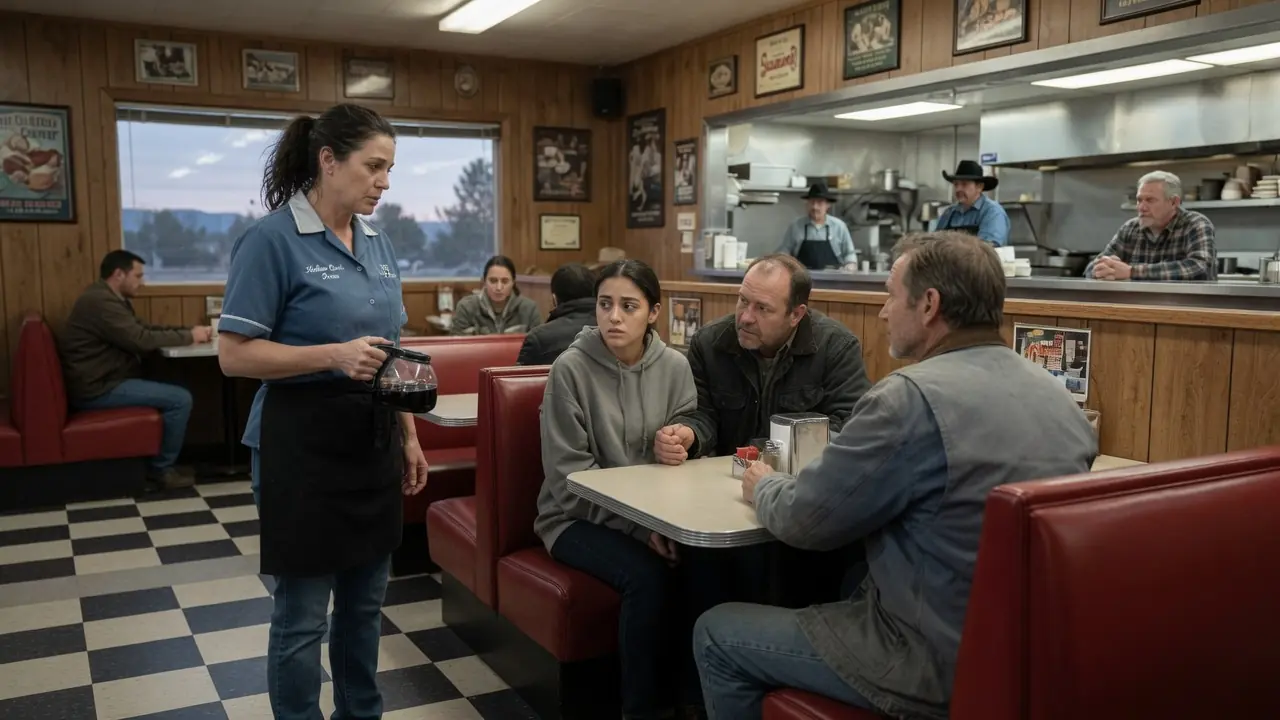
Stay with me. One question. What was on that napkin? It was 7:41 on a Friday night when Frank Dinger decided they had stayed long enough. He leaned across the table.
His voice dropped to something Maya could feel more than hear. A low pressure against the side of her face. The kind of voice that doesn't need to be loud because loud has never been the point. We leave in 10 minutes. He said, "You understand what I'm telling you? " Maya Torres kept her eyes on the table.
The laminate surface had a hairline crack running from the salt shaker to the edge nearest her. She had been staring at that crack for 47 minutes. She had memorized its shape the way you memorize things when you have nothing else to hold on to. When the world has been reduced to the six square feet of a diner booth and the only thing standing between you and what comes next is the ability to stay very very still. She was 20 years old.
She had been missing for 11 days. Roy Sutter shifted in the seat beside her. He was the quieter one, the one who watched the room the way a man watches a room when he has already calculated every exit and decided none of them are problems. He had positioned himself on the outside of the booth from the moment they sat down between Maya and the aisle, between Maya and the door. That was the calculation.
That was always the calculation with these two. Every position, every choice, every word made with the same cold architectural logic. Close every exit before she knows she's looking for one. 11 days had taught Maya how they thought. It had also taught her something else.
Carol Whitfield came out of the kitchen and began walking her way down the counter, refilling mugs without being asked the way you do after nine years on the same shift when you know what every regular needs before they know they need it. She had a small tear near the toe of her left sneaker. Dark circles that concealer couldn't fully address. a daughter at home with the neighbor across the hall, the one who kept a key for exactly these Friday nights. Carol was not a police officer. She had no weapon, no radio, no backup 30 seconds away.
What she had was nine years of watching people come through that door. She refilled Pete Garland's mug at the end of the counter. Retired school teacher. black coffee every Friday since before Carol could remember and let her eyes run the room. The same quiet inventory she ran every few minutes without thinking about it. Booth one.
Booth two. Three. The couple by the window who always split a slice of pie. The man in the corner reading the same newspaper he'd been reading for an hour. Table four.
She moved on, refilled the mug at the counter, came back around, looked again. The girl's hands were flat on the table, completely flat, fingers pressed together. The way you hold your hands when someone has told you to hold them that way. and you have been holding them that way long enough that you no longer think about it. It has become the shape of your body in this situation. The shape of someone who has learned to take up as little space as possible.
Carol set the coffee pot down. She had seen hands like that before, not from a textbook. from a bathroom floor in Tucson 15 years ago when she was 21. And the man she thought loved her had made very clear that the dead bolt on the apartment door was not there to keep other people out. 4 months she got out. She rebuilt piece by piece over years in a town where nobody knew her history and she could choose what to carry and what to leave behind.
She never forgot what those hands looked like. Stay with me because what happens in the next 6 minutes is the part that matters and you need to understand what Carol was carrying before you can understand what she did with it. Frank Dinger was looking at his phone. His thumb moved across the screen with the unhurried confidence of a man who believed nothing in this room could touch him. Roy had his eyes on the parking lot window.
The girl sat between them like something that had already been decided. Carol had a window of maybe 4 seconds. She picked up the coffee pot, walked to the window table near the front, the one closest to the parking lot visible from Route 89, visible from the road. She set down a small folded napkin at the edge of the table, refilled the salt shaker that didn't need refilling, and walked back to the counter without breaking her stride. Triangle fold tuck.
Frank never looked up. Across the room at the table nearest the door, a man in a worn leather vest looked at the napkin. He had been there for 2two minutes. Black coffee, pot roast gone cold, same table, same order every Friday. Carol had stopped putting a menu in front of him 3 years ago.
His name was Dale Harker. 54 years old, two tours in the Gulf, 19 years running the Flagstaff chapter of a club that meant different things to different people, and the same thing always without exception to the men inside it. He looked at the napkin, triangle, fold, tuck. Something went very quiet inside him. The specific quiet of a man who has been waiting for something he hoped would never come.
And now it has come. And all the preparation in the world does not make the moment feel any smaller. He reached for his phone, said four words. Hollow Creek right now. He put the phone down, picked up his coffee, looked at the wall behind the counter, and breathed once slowly.
The way a man breathes when a decision is already in motion, and what remains is only execution. Outside on Route 89, the first headlight appeared in the dark. Then another, then more than Carol could count from behind the counter. Keep watching because what you just saw, the fold, the phone call, those headlights, you're going to see it again before this story is over. And the second time, you'll understand every layer of it that you're missing right now.
11 days earlier, a 20-year-old woman walked out of her apartment in Phoenix for a coffee run and stepped into a ride share that wasn't a ride share. That is where the napkin begins. Maya Torres had grown up in Ahwatukee, the kind of neighborhood where the houses have small yards and the yards have big dogs, and the families have been there long enough to stop being strangers. She was the second of three daughters. Her father ran an electrical contracting business out of the bed of a white pickup truck.
Her mother worked dispatch for a medical courier service and possessed the organizational instincts of someone who genuinely believed every problem could be solved if you just kept making calls. Maya had inherited the phone manner. She was studying communications at Northern Arizona University. Her father called it a degree in talking. She said that was exactly right.
He laughed every time, even though he'd heard it six times by now. She was home for a long weekend when Frank Dillinger took her. He had spent 43 days building the architecture of that morning, the ride share credentials that looked real, the route that avoided every camera he had cataloged on a Thursday afternoon walk 3 weeks before the storage unit outside Winslow, where they stopped for the first 2 days while the noise died down. The sequence after that, north to Williams, west on 40 into Flagstaff on nights, staying off the main arteries, eating in places where people minded their business. Frank Delinger had done this before.
That was the thing most people spent their whole lives not understanding about men like Frank. They were not impulsive. They did not act out of rage or desperation or the momentary failure of ordinary self-control. They were patient and methodical, and they planned the way architects plan, accounting for loadbearing details, contingency routes, structural tolerances. They had a logic so cold and complete that it looked from the outside like calm.
The only thing Frank had not accounted for was a waitress with 9 years on a Friday night shift and a fold she had learned on a Tuesday afternoon and hoped she would never need. Maya spent the first two days in that storage unit trying to stay calm. She focused on details, memorized license plates, counted turns, kept a mental record of every stop, every route change, every conversation she was not supposed to hear. She told herself, "You are gathering information. Information is power.
Power is what you need right now. " By day four, she had stopped thinking about power and started thinking about survival. By day seven, she had stopped thinking about survival and started thinking about her mother's face. Her mother's face the way it looked when Maya called home on Sunday nights. the specific expression of a woman who had worried about her children every day of their lives and had learned to wear it quietly, like a layer beneath everything else, so it didn't crush the ordinary joy of ordinary moments. That expression would be on her face right now, except the ordinary joy was gone. Only the worry remained undiluted, running without a bottom.
Maya Torres was not going to let her mother spend the rest of her life with only that. She started watching Frank and Roy the way they watched her. Not obviously, slowly learning the rhythms the same way they had learned hers. when Roy got distracted, when Frank's attention shifted, which exits they clocked automatically, and which ones they had already decided weren't viable. And on the 11th day, in a diner on Route 89, with a hairline crack in the laminate, running from the salt shaker to the edge of the table, she watched the waitress pick up the coffee pot and walk past the booth. She watched the napkin land on the window table.
She watched the woman's hands not shake. Something moved inside her chest. A word she hadn't let herself think for 11 days because thinking it made the distance between where she was and where she needed to be feel of an unbearable hope. She looked up just once directly at the woman behind the counter. The woman did not nod, did not smile, did not do anything that Frank or Roy could read, but she held the look for one second longer than a waitress looks at a table.
Maya lowered her eyes back to the hairline crack in the laminate. She moved her left hand slowly, almost imperceptibly, flat to the edge of the table closest to the window. The way you place a hand when you are trying something without saying it. Carol saw it. Maya sat still, kept her hands flat, breathed, and waited.
Now, before we go forward, hold one thing in your mind. Carol's hands when she set that napkin down completely steady. Not because she wasn't afraid, but because she had made a decision before she picked up the coffee pot, and the decision was already made, and fear was something that could be carried alongside it, rather than instead of it. A girl in a booth 11 days into the worst experience of her life saw those hands and understood something that no one had said out loud. That understanding is the whole story.
Dale Harker had not set out to become the kind of man people called in emergencies. He had set out to become an electrician. Two years of a trade program. Then a recruiter came to his community college and the version of himself that existed at 22 made a decision that the version at 54 was still working out how to account for two tours. He came back to Flagstaff in 2001, started the chapter 2 years later.
Men who had come back from things and needed somewhere to put it. men who had grown up in places that stopped believing in them and found in a group of people who actually showed up something worth more than abstract goodwill from institutions that had never been tested. Dale believed in showing up. He believed in paying attention because he had learned in places he didn't name and situations he didn't describe at dinner tables that the difference between people who made it out and people who didn't was almost never burst strength or speed. It was attention. Sustained, unglamorous, disciplined attention to the details that other people had already decided didn't matter.
Rachel Briggs had mattered. 23 years old, daughter of a man in the chapter, working at a shipping warehouse on the north side of town, gone 8 days before anyone understood what kind of gone she was. By the time Dale understood, by the time the right people were in the right rooms, four more days had passed. He did not talk about those four days. What he did Three weeks later was sit down at Carol Whitfield's counter on a Tuesday afternoon with a cup of coffee he didn't touch and explain what he knew.
He told her what to look for. He told her how fast it moved once it started. And he taught her the fold: a napkin, a specific shape visible from the door. And he said, "If you see it and you can't call anyone, and you can't do it alone, you fold the napkin first before anything else. I will be there. " He had meant it the way you mean things forged in grief rather than optimism.
With the specific weight of someone who has already paid the cost of being too late, Carol had nodded. She had tucked the memory of the fold into the place where she kept the things she hoped never to need. Three years passed and then it was a Friday night in November and the napkin was on the window table and Dale looked at it for exactly 2 seconds. He reached for his phone and said four words. 2two minutes later, this is the part that nobody who was inside Hollow Creek Diner that night has ever been able to fully describe.
2two minutes later, the first motorcycle turned off Route 89 into the parking lot. Then another, then another. They came in single file, engines dropping from highway pitch to a low idle as they turned, one after the other, filling the lot in a slow arc that covered every exit, every angle, every path between the front door and the road. The sound of them had been building for 30 seconds before the first headlight appeared. Felt in the floor and the walls before it was heard.
A vibration that moved up through the foundation of the building like the ground itself had changed its mind about something. 22 motorcycles, 22 engines, then silence all at once. The silence after was larger than the sound had been, heavier, filling the cold November air the way water fills a vessel and then keeps filling it past the point of capacity. Inside the diner, three people heard it and understood exactly what it meant. Carol behind the counter felt something in her chest loosen for the first time in 47 minutes.
The specific release of a person who has been holding a door closed with their body and has just felt someone else's hands reach for the other side. Maya in the corner booth heard the engines die and felt a physical sensation she would later describe to her mother as like someone opened a window in a room I didn't know was sealed. Roy Sutter looked toward the parking lot window. The calculation behind his eyes shifted. Something he had believed was solid, revealing very quietly that it was not.
Frank was on his phone. He had not looked up. Dale came through the door. He did not look around. He walked to his usual table near the entrance, the one with the clear sight line to the counter and sat down and looked at Carol.
She was there in three seconds. "Coffee," he said. She poured it. Her hands were steady. He wrapped both hands around the mug and looked at the backsplash and let the room settle around him.
He did not scan the exits. He did not look at the corner booth. He did nothing that could be read as a man looking for something. But he had already seen everything he needed. Corner booth, Carol said quietly, wiping the counter in front of him.
Two men, the girl between them. She hasn't touched her food. The big one asked for the check 10 minutes ago. I've been stalling. How long have they been here?
53 minutes. How is she? Carol was quiet for a moment. She looked at me, she said about 20 minutes ago. Really looked.
Dale, set the mug down. Anyone else in here know? No. He turned the mug slowly. Go take an order.
Give me two minutes. Carol picked up her pad and walked away. Dale sat at the counter for two minutes and 14 seconds. He drank his coffee. He did not move.
From the outside, he was a large, quiet man at the end of a long Friday, having a coffee before the drive home. From the inside, he was running the same sequence he had run in other rooms in other years. Entries, sightlines, the distance from the booth to the kitchen door, the distance from the kitchen door to the alley, the civilians and their positions. 14 civilians, three staff, two men in the corner booth, one young woman who needed to be on the other side of that kitchen door in the next 15 minutes. He finished his coffee.
Then he stood up, picked up his mug, and walked toward the corner booth. Frank Dillinger saw him coming. You could see the exact moment, a slight recalibration in the shoulders, a tightening around eyes, something about Dale, the absolute stillness, the complete absence of any social performance, registered immediately as something that did not belong, the category of ordinary Friday night diner patron. Dale reached the booth and stopped. He looked at Frank, then Roy, then briefly at Maya.
One second the length of a confirmation, then back at Frank. Mind if I sit? He was already sitting. The booth went very quiet. Names Dale.
Come in here most Fridays. Easy, unhurried. The voice of a man who has all night. Don't think I've seen you two before. Just passing through, Frank said.
Sure. Dale looked toward the window, toward the parking lot, toward 22 motorcycles in the dark, not moving, not making a sound, then back at Frank. Cold night for it. Roy said nothing. Dale picked up the menu from the edge of the table, the one nobody had opened, and set it back down.
"You know what I like about this place," he said quietly. Carol's been here nine years. Knows every face that comes through that door. A pause. Every single one.
The coffee mug sat between them. Neither of them looked at it. And somehow that mug, white ceramic, half full, completely ordinary, became the most significant object in the room. Frank put his phone face down on the table. That was the tell.
The phone going down was never casual. It was a man closing one door and opening another. Accepting that this moment was the only thing that existed. Something we can help you with. Frank's voice was controlled.
The voice of a man who had talked his way out of difficult rooms before. Dale leaned forward slightly, voice dropping to just above a whisper. Your name is Frank Dillinger, he said. Your truck is outside. Arizona plates 7 Romeo kilo449 registered to an address in Scottsdale you stopped using 6 months ago.
He paused. Let it land. The man next to you has a warrant out of Maricopa County that nobody's connected to his current ID yet. The temperature in the booth dropped. Frank did not move, but something happened behind his eyes.
The specific moment when a man realizes the walls he believed were invisible have been visible to someone else the entire time. Roy had gone completely still. I wouldn't, Dale said quietly to Roy without looking at him. Roy didn't move. Dale looked at Frank.
I'm going to ask you to do one thing. one and then we're going to sit here until the sheriff's department arrives. A brief glance at Maya without performance, the length of a fact. And back to Frank. Let her go to the bathroom. Silence.
That's all I'm asking. Let her stand up, walk to the back of the diner, and use the bathroom. Frank looked at him, calculating, trying to find the angle. There wasn't one. That was the point.
Dale had given him something small enough to agree to a request that looked on its surface like a reasonable ask from a man who had perhaps misread a situation. Agreeing cost Frank nothing he could publicly claim to value. But it got Maya out of the booth. And once she was out of the booth, she wasn't going back. Frank looked at Roy.
Something passed between them. Then he looked at Maya. "Go ahead," he said, like it was his idea. Maya didn't move for a moment. Carol had appeared at the edge of the booth, materializing the way she had materialized all evening at exactly the right moment with exactly the right expression.
Calm, unhurried. A waitress checking on a table. Maya, can I show you where the restrooms are? Maya looked at Carol. Then she looked at Dale.
Dale did not look back at her. He was looking at Frank completely exclusively at Frank, giving her the gift of not being watched. She moved to the edge of the seat. She stood up. Her legs were unsteady for the first step, just slightly, just enough for Carol to notice, and no one else to see.
And then they weren't. Carol fell into step beside her. Close but not touching, moving at the same pace toward the back of the diner. Dale kept his eyes on Frank Dillinger. Frank kept his eyes on Dale.
Roy looked at the window at the parking lot at 22 men who had not moved. He looked for a long time. Then he looked at the table. Carol walked her past the restrooms, past the staff lockers to the kitchen door. She pushed it open.
The kitchen was warm and loud. The line cook, Marcus, 6 years on this shift, long enough to have learned that when Carol came through that door with that particular expression, the correct response was to ask absolutely nothing, looked up and asked nothing. Carol looked at Maya. There's a door at the back of the kitchen. It opens to the alley.
Two men are outside that door right now. They're with the man who just sat down with your friends. They're going to stay with you until the police arrive. She paused. You understand?
Maya's eyes were dark and exhausted. And underneath the exhaustion, something else was moving. something that was only just beginning to allow itself to understand that the last 11 days might actually impossibly be over. "Who are you? " she said. Carol held the kitchen door. "Someone who knows what those 11 days felt like," she said from the inside.
Maya stared at her. Then something gave way in her face. not a collapse, something quieter than that. The specific expression of a person who has been carrying an enormous weight alone and has just for the first time felt another pair of hands reach for it. Carol nodded toward the back door. Marcus was already there holding it open.
Maya walked toward it. She slowed at the threshold and then without anyone asking her to, without anyone guiding her, she stopped, turned back, looked at Carol one more time. Carol met her eyes. You're out. Keep walking.
Maya turned back to the door and stepped through it herself. Not because someone told her to, not because someone was holding her hand, because she decided to. The cold November air came in for three seconds before Marcus let the door close. Carol pressed one hand flat against the kitchen wall, breathed. Back in the corner booth, Dale was still talking.
Same voice, same tone, the voice of a man who has nothing to prove and all night to prove it. He had watched Carol and Maya disappear toward the back. He had noted the exact moment. Frank noted it. A small shift in posture, the recalibration behind flat eyes.
Frank looked at Dale. You made a mistake, he said quietly. Dale considered this with the seriousness it deserved. Could be, he said. I've made a few.
He turned the coffee mug slowly. This isn't one of them. We haven't done anything. then you'll be fine. Dale's voice did not change, did not harden or warm. It stayed exactly where it had been, level, unhurried, immovable as the mountain outside town.
He leaned forward one final time, voice dropping to a register Frank would not forget. I want to be very clear, Dale said. The people who sent you here already know this operation is over. They knew before you sat down in this booth. The question you should be thinking about right now is not how to get out of this diner.
He paused. It's how to make the next conversation you have with a federal agent go as well as it possibly can. The silence in the booth was total. Roy Sutter had stopped looking at the window. Frank Dillinger had stopped looking at anything.
Dale picked up the menu. Set it down. Sheriff's department is about 8 minutes out. You want more coffee while you wait? Nobody answered.
Outside on Route 89, the first red and blue lights appeared in the distance. Dale saw them through the window. Said nothing. He picked up his mug and finished his coffee. Deputy Kelsey Briggs was first through the door, four years on the job.
She came in with her hand on her belt and her eyes moving fast, trying to read a situation that had been called in as a possible abduction at a diner on Route 89, which was not a scenario the academy had covered in depth. She saw 22 motorcycles in the parking lot. She saw a large man in a leather vest sitting calmly across from two men who were not moving. She saw Carol Whitfield behind the counter, arms crossed, watching the door. She made eye contact with Carol.
Carol tilted her head toward the corner booth. That was enough. Two more deputies arrived within 6 minutes. A federal agent named Carver, who had driven from Phoenix and arrived looking like a woman who had not slept enough, but had been waiting for exactly this call, came through the door at 9:17. She looked at Dale first.
Dale nodded toward the corner booth. Carver looked at Frank Dillinger for a long moment, then said something quietly to Briggs. Whatever it was, Briggs's expression changed. Pete Garland, the retired school teacher at the end of the counter, black coffee, every Friday since before Carol could remember, watched the whole thing from his stool without saying a word. Later, when a reporter asked him what he remembered most about that night, he said, "The quiet.
The way those men outside just stood there. I've never seen that many people say that much without saying anything. " Marcus through the kitchen window watched Frank and Roy get walked out and said nothing for a long moment. Then he looked at Carol and said, "You doing okay? " She said yes. It was true and it wasn't true and she knew the difference. At 9:31, Frank Dillinger and Roy Sutter were walked out of Hollow Creek Diner, hands behind their backs, heads down.
The bell above the door rang twice. Frank stopped at the threshold. Just for a moment, he turned his head and looked back at Dale. still at the counter, mug in both hands, looking at nothing in particular. Something moved across Frank's face. Recognition.
The recognition of a man who has spent years believing that the careful, systematic removal of other people's choices was a form of intelligence, and has just encountered for the first time a wall he did not see being built around him. He looked at Dale for two seconds. Then Deputy Briggs walked him through the door and into the cold. Later, much later, in a federal holding facility outside Phoenix, Frank Dillinger would tell the agent assigned to his case that he had never felt fear the way he felt it in that booth. Not when Dale sat down.
Not when Dale named him and named Roy and named the warrant, but when Maya stood up and walked away, when he realized in the space of one breath that he had given permission, that he had been maneuvered into granting the one thing he most needed to deny, and had not seen it coming, and there was nothing left to do but sit across from a man who had already finished his coffee, and wait for the lights. That Frank said was when he understood. The agent asked him what he understood. Frank was quiet for a long moment. That I was always the one being watched, he said.
Carol found Maya in the back hallway 20 minutes after the deputies arrived. Sitting on the bench outside the staff lockers, both hands wrapped around a mug of hot chocolate. Marcus had made without being asked. Agent Carver seated across from her, notebook open, voice low and careful. Maya looked up when Carol came through the kitchen door.
Carver glanced at Carol, something in her expression close to a nod and said 2 minutes and moved to the far end of the hallway. Carol sat down beside Maya. Neither of them said anything for a moment. The hallway was narrow and warm and smelled like coffee and the industrial cleaner Marcus used on the floors every night. Through the wall, the diner was running again.
Voices, cutlery, the coffee machine doing its particular thing. Normal sounds. Ordinary sounds. Carol had never been so grateful for ordinary sounds. Maya," she said.
"Just the name. " Maya looked at her mug. "How did you know? " she said. Her voice was steadier than Carol had expected. "How did you know what was happening? " "Your hands," Carol said. "The way you held them flat on the table.
The way you didn't order for yourself. " A pause. The way you looked at the door like you'd already decided it wasn't an option. Maya absorbed this. Most people wouldn't have noticed, she said. Most people haven't needed to.
Carol said a longer silence. The specific kind that exists between two people who have understood something about each other that is beyond the reach of anything more elaborate. I stopped believing anyone was going to come. Maya said, "After day four, I just I stopped. " Carol looked at her own hands, she said. Two words.
Nothing else. But Maya looked up when she heard them. Really looked the way she had looked across the diner earlier, and something passed between them that was beyond language. "Your parents know," Carol said. Agent Carver called them 40 minutes ago.
Maya's face changed. Something that had been held in place for 11 days by will alone finally felt the weight of not needing to be held anymore. She pressed her lips together, looked at the ceiling, breathed. Carol didn't put her arm around her, didn't say anything else. Just sat there on the bench, present and still. the way someone had not sat with Carol when she was 21 and needed exactly this.
After a moment, Maya looked back down at her mug. "Thank you," she said. Carol shook her head. "You walked out that door yourself," she said. "I just held it open.
Dale was in the parking lot. " Carol found him 40 minutes later after her statement, after the last deputy had gone, after the diner had slowly returned to something resembling itself. The remaining customers had finished and left with the slightly dazed expressions of people who had witnessed something they would be trying to describe for years without ever quite capturing it. Flagstaff in November, clear and cold, and the stars from one edge of the world to the other. Carol walked over and stood beside him. Neither of them spoke for a while.
The other bikes were gone, dispersed the way they had arrived, one by one back onto Route 89 until the parking lot was a parking lot again. "She's okay," Carol said. I know. Carver thinks it connects to something larger. Out of the valley, she said.
Delinger had been on their radar for 7 months. Dale nodded slowly. Carol looked at the side of his face in the darker. "You're thinking about Rachel," she said. "It wasn't a question. " Dale was quiet for a long moment.
"Rachel," he said. "Just the name. The way you say a name when it is the only thing left to give. Carol looked up at the stars. She'd have been 26 this year, Dale said.
I know. A semi rolled past on Route 89. Headlights sweeping the lot. And then it was gone and the dark came back and the stars were still there. "You did good tonight," Dale said.
Carol thought about Maya's hands flat on a table, about a gray hoodie two sizes too large, about a young woman stepping through a kitchen door on her own two feet and deciding in that specific private unwatched moment, that she was going to keep moving. "She did good," Carol said. Dale looked at her for the first time since she'd come outside. Then he looked back at the sky. Yeah, he said quietly.
She did. 3 weeks later, Carol received a letter. Phoenix postmark. No return address. Inside a single index card, four words in careful even handwriting.
I remember your hands. Carol read it twice, stood at her kitchen counter for a long moment. Then she opened the drawer beside the stove, the one with the rubber bands and the spare batteries and the things that didn't have another place to go. And she put the card inside. Then she went to make coffee because that's what you do.
You keep going. You show up for the next shift. You watch the door. You carry what you've been through instead burying it because the thing you've been through is exactly what makes you able to see what someone else is going through right now. People ask what courage looks like.
They imagine it as loud, something that announces itself with certainty already intact. Soundtrack included. But the courage in this story was a woman picking up a coffee pot with steady hands while her heart was hammering against her ribs. A fold that took 3 seconds. A man who finished his coffee before he stood up.
A young woman who moved her hand to the edge of a table slowly almost imperceptibly to say the one thing she couldn't say out loud. That is what steady hands teach. That fear and decision can exist in the same body at the same time. That you do not have to stop being afraid in order to act. You only have to pick up the coffee pot.
That is what dignity looks like under pressure. Quiet, deliberate, irreversible. One person paid attention. One person showed up. and the thing that was about to become permanent didn't. If you or someone you know is in danger, the National Human Trafficking Hotline is available 24 hours a day, 7 days a week.
The number is 1-888-373-7888. It is free. It is confidential. You do not have to be certain. You only have to make the call.
If something in this story stayed with you, a moment, a detail, a feeling you can't quite name, tell me about it in the comments. I read every single one. And I want to know which part hit you hardest. If you're new here, welcome. Heart tales is where stories like this live. stories about ordinary people doing extraordinary things in the quietest, most human ways possible.
Hit subscribe so you don't miss the next one. And before you go, there are two more stories waiting for you right now on your screen. I think you'll want to stay.
Thank you for watching. Thank you for caring enough to make it to the end. That matters more than you