For 4 years, he never said a word. Just black coffee, pie, and a silent thank you left under a plate. Then one stormy night, he vanished. Three bikers rolled in days later. What they brought would unravel a secret life, a heroic death, and a gift that would change a young mother's world forever.
But who was Steve really? And why did he choose her? The bell above the door chimed at exactly 10:07 a.m. It always did. Natalie looked up from wiping down the coffee counter already reaching for the glass pot.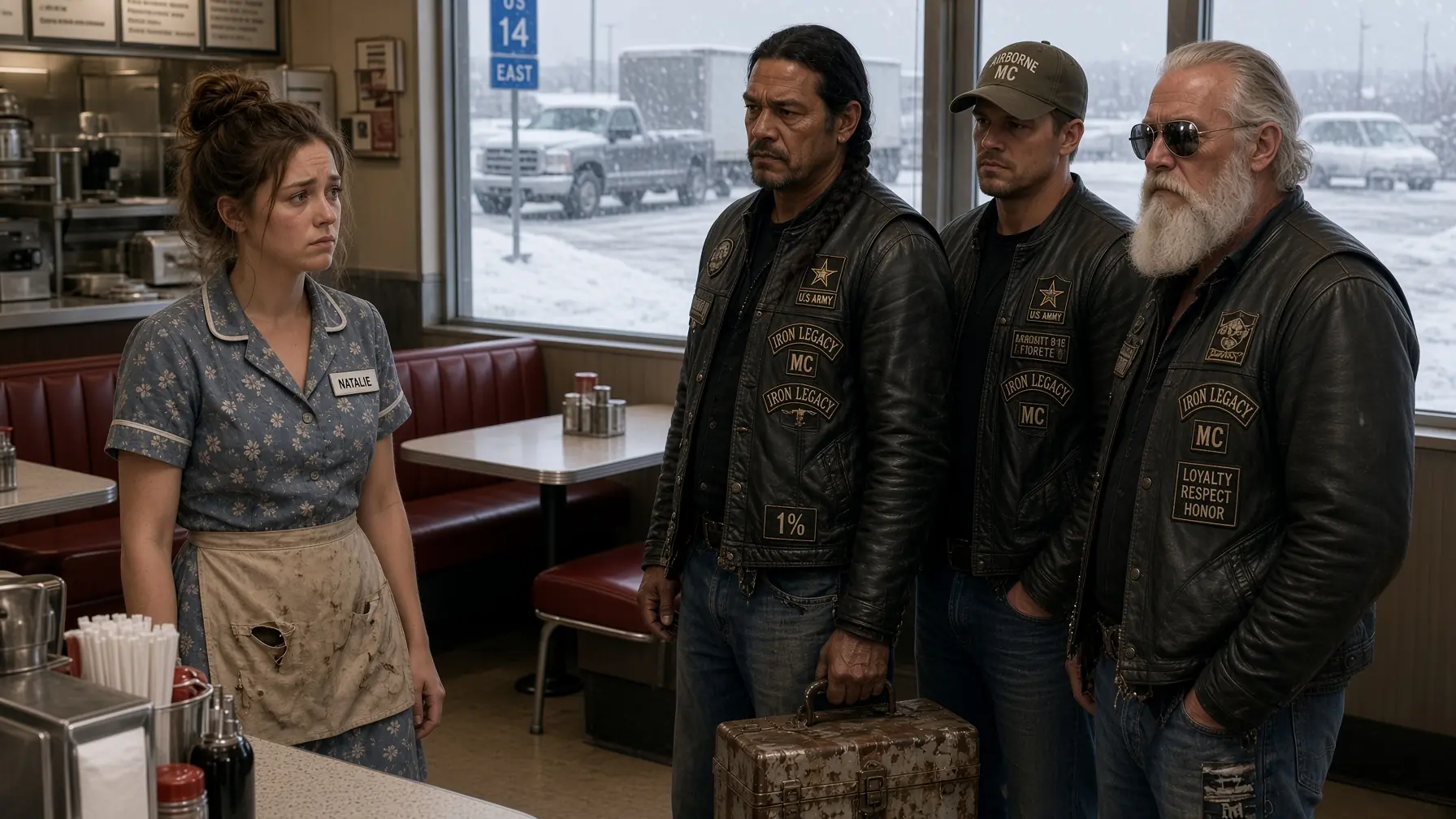
The man stepped inside like a shadow. Same frayed army jacket, same heavy boots, same slow limp that seemed to carry a lifetime with each step. He was not a man of much talk, just a few words and a smile. He just nodded once in her direction and made his way to the far-left booth, his booth. By the time he settled into the red vinyl seat, she was already there, setting down a mug of steaming black coffee and a thick slice of cherry pie.
No whipped cream, no forks. He always used the same spoon he brought in his coat pocket. "Night, Steve," she said softly, though he had never confirmed that was his name. It was just what the regulars had started calling him years ago, and he never corrected anyone. He gave her a small nod again, more of a blink. really and stared out the window into the dark parking lot where a row of trucks idled under a flickering halogen bulb.
Natalie returned to the counter, glancing at the baby monitor wedged between the napkin holders. On the tiny screen, her 4-year-old son, Eli, slept on a cot in the store room, curled up with a stuffed dinosaur. The same cot she'd set up six months ago when her ex stopped paying child support in daycare became impossible. She leaned against the counter, stretching her back. 12 hours on her feet in cheap sneakers.
Her hair was tied up in a messy bun, and her apron had a rip near the pocket she kept trying to ignore. There was always something else to fix. Rent, the car's radiator, her son's growing feet. Any pie left for me, sweetheart? Came a voice from the far end of the diner.
Big Joe, the overnight trucker, winked and slid into a booth. Natalie smiled. genuinely. Joe was a good tipper and liked to flirt just enough to feel charming but not creepy. Only if you want it reheated for the hundredth time," she said, grabbing a plate anyway. But her eyes drifted back to Steve.
He sat with perfect stillness. Hands wrapped around the coffee like it was the only warm thing left in the world. His knuckles were scarred, the kind of scars you didn't get from accidents, but from survival. He stared out like he was watching ghosts walk the pavement. Natalie had seen a lot of truckers come and go over the years.
Same routine. Same $10 bill folded neatly and placed under the plate before he slipped out the door as silently as he came in. For 4 years, this had been their silent exchange. He never asked her name. She never asked his story, but Natalie noticed the limp worsening this winter.
The way he winced when sitting down, how he held his coffee mug like it weighed more than it should. She had once offered him extra napkins when he sneezed. He had looked her in the eye just once, and shook his head. Around 2:00 a.m., Steve stood, left the usual tip under the plate, and disappeared into the night. She never saw what truck he drove.
Some said he didn't sleep. just drifted from town to town, hauling freight no one asked about. She never believed the stories. She believed in routine, in little gestures, and in the quiet. By 3:30 a.m., the diner was empty again. The hum of the fridge in the kitchen was the only sound.
Natalie poured herself a cup of coffee and sat at Steve's booth, resting her feet for just a minute. On the table, the formica was scratched with old initials. She ran her finger along one J plus M. Probably carved by teenagers a decade ago. Back when this place still had a jukebox and families stopped in for pancakes after Sunday service.
She stared out the same window Steve always looked through. All she could see was black highway stretching into nowhere and the orange glow of a distant truck stop sign. Sometimes she thought about asking him why he kept coming back. Why here? Why her?
But maybe it wasn't about her. Maybe it was just that some people needed a place to exist without being expected to explain. And for Steve, this diner wasn't a pit stop. It was home. At 7:00 a.m., Eli woke up crying.
Natalie slipped off her apron and hurried to the back room. "I had the dinosaur dream again," he said, eyes still puffy. She smiled and scooped him up. "Was it the good dinosaur or the mean one? " "The good one. " He was looking for his family. Maybe he found them this time.
Eli rested his head on her shoulder. His small hands clutched her tired arms. Natalie looked toward the dining room. The booth was empty. The pie plate gone.
The bill still neatly folded under the edge of the plate. Another night, another ritual. By the end of her shift, the breakfast crowd was already rolling in. People laughed. Orders shouted.
The quiet was gone. But Natalie always remembered the silence between 1 and 2:00 a.m. when the world paused and a quiet man with haunted eyes came in for black coffee, cherry pie, and no questions. He never skipped a week until one week he did. The bell did not ring for a few days. Natalie checked the wall clock again.
108. She tapped it, thinking maybe the battery had slowed, but it ticked forward just fine. She looked toward the door. No boots, no jacket, no Steve. She poured the coffee anyway.
The booth sat empty. A slice of cherry pie untouched on the counter. Natalie stared at it, then set it on the warmer. Maybe he was late. Maybe the storm outside had slowed him down.
The snow had been coming in sideways since 11:00. By 1:30 a.m., she knew he wasn't coming. She told herself not to worry. Truckers got rerouted all the time. Maybe his route had changed.
Maybe he was sleeping in for once. One more night, the booth still empty. She started checking local news. No truck accidents, no fatalities, no mention of a man named Steve or Brad or whoever he really was. After a week, she was visibly shaken.
She dropped a tray midshift, snapped at Big Joe, burned a grilled cheese. At 10:07 a.m., she stood at the door, apron dusted with flour and pieces, the bell didn't ring. But at 1:26, the parking lot rumbled with something different. Three motorcycles cut through the snow like ghosts. Chrome glinted beneath layers of frost.
The bikes pulled up slow, no urgency, but with purpose. The men who climbed off were heavy set, leather wrapped, weathered. Each wore a thick vest patched with old army insignias, faded units, and a curved rocker that read, "Third battalion, iron dogs. " Natalie froze. They didn't come in right away. One of them, tall, mixed race with a braid trailing down his back, opened a side saddle bag, and lifted out a battered metal toolbox, rusted on the edges, paint chipped, lock broken.
They stepped inside. The bell finally rang. No one spoke. The youngest of them, clean shaven, square jawed, wearing a hat that read airborne, removed his gloves and looked around. His eyes landed on Natalie.
You Natalie? Her throat tightened. Yeah. The tallest nodded. He said, "We'd know you right away.
You're exactly how he described. " "Who? " They didn't answer. Instead, the one with the braid placed the toolbox on the counter with a quiet thud. Snow dripped from the corners. The third man, stalkier with a white beard and mirrored sunglasses still on. Tapped the top of the box.
He called you the only light on his darkest road. That ring a bell. Natalie's knees gave slightly. She grabbed the counter. Steve.
They all looked at each other. Then the man with the braid said it. Brad. Sergeant Brad Stevenson. Vietnam.
Purple Heart. Never stopped serving. Just changed how he did it. Natalie's breath caught. What happened?
The youngest man took off his hat. His voice cracked. He died pulling two kids and their mom from a burning van. Ice took out their minivan on a mountain curve. He didn't even hesitate.
Climbed in while it was already smoking. No one spoke for a moment. Snow melted on the tiles. The air felt heavy with things unsaid. He'd been riding with us a while, said the tall one.
Never talked much, but we all knew him, trusted him. When he didn't show up at our usual meet point, we went looking. Natalie's hands trembled as she opened the toolbox. Inside a folded American flag, a laminated set of dog tags that read Stevenson Bradley J. SGT US Army Catholic, Vietnam, 1971.
Beneath that was a sealed envelope and a tattered manila folder. She opened the letter with trembling fingers. The handwriting was rough but deliberate. Natalie, if you're reading this, it means the road finally caught up with me. But I didn't go out sad.
I went out doing what I should have done more of, helping someone. You never asked for my name, never asked me to explain myself. You just brought me pie like I wasn't broken. Like I still belong to this country. That's why I'm leaving you my truck.
She's old but strong. Like me. Like you. Maybe you'll know what to do with her better than I ever did. Tell your boy to grow up kind.
Keep the coffee hot. Brad Natalie covered her mouth. The folder contained the truck's title and a picture of the rig. Vintage truck, green with silver accents, still proudly bearing its original military convoy plates from decades ago. The bikers exchanged glances but gave her space.
Why me? " she whispered. The bearded man answered, "Because for four years, you showed up. You smiled. You didn't treat him like he was some ghost or broken vet. You saw him. " The braided-haired biker leaned forward.
You gave him peace. That diner, that booth, that pie was all the family he had. Natalie sat down slowly, her hands gripping the edge of the counter. And he wanted you to have a part of him. The best part, his truck, his road.
The snowstorm outside held louder. Natalie looked over at the booth where Brad had sat. For a moment, it almost felt like he was still there, watching quietly, maybe smiling. She stood, wiped her eyes, and walked toward the coffee pot. "You boys want some pie? " The bikers grinned.
"Damn right we do," said the youngest. That night, after the pie was served and stories were shared, some funny, some painful, Natalie stood alone outside the diner, toolbox in her arms. She looked up at the stars, icy breath rising into the dark sky, and whispered, "Thank you, Brad. " The wind howled past her, rattling the windows and carrying a faint scent of diesel and pine. And somewhere in the distance, she could almost hear a diesel engine roaring up a mountain pass. One last run, one last save.
Natalie sat alone in the booth that used to be his. The night outside was silent, save for the occasional rumble of a distant rig or a gust of wind brushing snow across the windows. In her hands, the letter had grown soft from being unfolded and refolded too many times. The edges curled. Coffee had splashed on the corner.
She read it again. Maybe you'll make something better out of it than I ever could. It wasn't just a note. It was a map, a handoff. Natalie traced her finger over the words, her mind drifting.
She hadn't realized how much his silence had said, how much space it had left for presents. 3 days later, the bell above the door rang again. But it wasn't 1:00 a.m. Lewis stood in the doorway, brushing snow off his leather jacket, toolbox in one hand, a dented thermos in the other. He looked older in daylight, more human.
A patch on his vest read, "Iron Dogs MC Corpsman. " He nodded toward her. "Coffee still good? " Natalie smiled. "Better be. I've had nothing but caffeine and heartache this week. " Lewis gave a soft chuckle and sat at the counter. They didn't speak for a minute.
The silence wasn't awkward. It was familiar. Then Natalie said, "What was he like before the diner? " Lewis sighed, unscrewing his thermos. Brad was complicated. He was the guy who patched you up and walked 5 miles back into hell because someone was still out there bleeding.
But he wouldn't accept a handshake after. Said medals were politics in metal. He took a sip. He lost his brother in a firefight in Nam right in front of him. After that, he didn't write home much.
Didn't come back the same. Tried marriage once. Had a daughter. Walked out when she was two. Said she was better off with a clean start.
Natalie's throat tightened. He ever tell you any of that? Lewis asked gently. No, she whispered. He barely spoke at all.
Then he told you the most. Lewis pulled something from his coat pocket. A photo worn and faded. It showed Brad much younger. Arms around a toddler girl smiling like he didn't know how rare that moment would be.
He kept this in his glove box. Lewis said, "Right next to a picture of you and your son. Found it tucked in behind your Christmas card from last year. " Natalie's eyes widened. He kept that. Lewis nodded.
Brad didn't believe in chance. If he kept it, it meant something. Later that afternoon, Natalie walked around the back of the diner where Brad's truck sat, parked like a sleeping beast. Rust traced the edges, the paint dulled by time and wind, but it was proud. The front grill still gleamed under the snow.
She climbed into the cab for the first time. The seat groaned. The cab smelled of tobacco, old leather, and peppermint oil. The dashboard was cluttered with yellowed maps, a military compass, and a little metal cross hanging from a frayed cord. The passenger seat was empty, except for a folded American flag tucked neatly where someone might keep a glove box manual.
Natalie ran her hand over the wheel. She imagined him driving night after night. No destination, just moving, staying ahead of the silence. That night, after she closed the diner and tucked Eli into bed, she called Louis. "Can you meet me tomorrow? " she asked.
"Bring your crew. Everything all right? I think I know what to do with the truck. " The next morning, six bikes and two pickup trucks pulled into the lot. Natalie stood waiting, clipboard in hand, blueprints sketched out on napkins and receipt paper. She wore her apron like armor.
I don't want to sell it, she began. I want to use it, repurpose it. There's too many drivers sleeping in their cabs with empty stomachs. Too many vets passing through town with nothing but a pocket full of meds and pride too big to ask for help. Lewis crossed his arms, intrigued.
You got a plan? Natalie pointed to the truck. We gut the sleeper cab and build shelves, storage for food, blankets, thermoses. Set up a small generator, a water tank, and keep it stocked. No names, no IDs, no sermons, just a sign.
If you carry the weight of the road, fuel, food, no questions asked. The bikers glanced at each other. Then Lewis smiled. Brad would have loved that. The work began that weekend.
Lewis brought his tools. Big Joe brought paint. A retired mechanic named Darla welded the hinges on new cabinets in the sleeper cab. One biker, Ray, who once worked in refrigeration, installed a mini fridge that ran off a solar panel. Natalie baked pies and brewed coffee for everyone.
Even little Eli pitched in handing out screws. A local sign painter made a wooden board in deep green with silver lettering. Brad's rest. They bolted it to the truck side just above the service window. Inside the toolbox, Natalie placed a framed copy of Brad's letter.
The original stayed on the diner wall. By the end of the week, the truck looked reborn. What once was a steel tomb for a drifting soul had become a sanctuary, a beacon with a warm engine. The first driver to stop by was a young woman out of gas and out of luck. She opened the service hatch, expecting to get turned away.
Instead, she found warm soup, a full tank voucher, and a sticky note taped to the cash box. "You're not alone out here. Rest easy," she cried behind her glasses. Left 20 bucks anyway. Natalie stood beside Lewis, watching the snow fall gently around the truck.
The snow finally stopped. In the silence that followed, something changed. Not just in the air, but in the way people moved around the diner. Natalie noticed at first in the way truckers paused before climbing back into their cabs, glancing at the green Kenworth parked by the fence like it meant something, like it was watching over them. The words painted on its side now shone through the fresh polish and snow melt for those who carry the weight of the road.
No ads, no sponsors, no QR codes, just one sign in black marker taped next to the side hatch. Take what you need, leave what you can. The first time someone left a letter, it was folded around a $5 bill and a patch from a Marine Corps jacket for a man I never met, but who made me feel less alone. The second was a photo of a father and son in front of a Peterbilt captioned. He didn't come back from Fallujah, but he'd have liked this place.
By the end of the week, the small shelf under the counter was full coins, dog tags, keychains, Polaroids. A tapestry of invisible grief made visible. Natalie cleared space on the diner wall and began pinning them up. The toolbox never left the counter. Its edges were now buffed smooth by elbows, fingerprints, and stories.
The laminated dog tags remained inside next to the folded flag and photo of Brad and his unit. Seven men in the jungle, all squinting into sunlight, some still boys, none of them smiling. Big Joe built a case around it out of oak and plexiglass. Added a tiny brass plaque. Property of Sergeant Brad Stevenson, Iron Dogs, MC, Vietnam, 1971.
People stopped and read it, some for seconds, some for minutes. One man knelt, closed his eyes, and whispered something no one else heard. Natalie never asked. The booth by the window, his booth, wasn't officially retired, but everyone seemed to know it was his. Even regulars who hadn't known him seemed to sense it, like something sacred clung to the cushions, like you could hear stories whispered in the red vinyl if you sat quiet enough.
Veterans came through, some loud and funny, others silent as tombs. One man in his 80s walked in wearing a medal he'd never worn before, touched the booth once and left without a word. Others sat and told stories that had never passed their lips before. One of them, Marcus, a Gulf War medic, broke down halfway through a story about a roadside explosion in Kuwait. Natalie sat with him, hands wrapped around a warm mug she'd placed in front of him.
No words, just presence. He came back the next night with a framed picture of his squad and hung it beside Brad's. Kept happening. People came not for food, but for memory, for forgiveness, for warmth. Some brought their own coffee, but drank Natalie's anyway.
Eli, now almost six, started referring to the truck as Uncle Brad's. One night, he slipped a crayon drawing into the toolbox. It showed a big green truck, a stick figure with gray hair, and a smiling boy with curly lines for arms. Natalie found it 2 days later, laminated and thumbtacked to the wall. She didn't ask who did it.
And then there was the bell. Every night around 1:00 a.m. the bell rang above the door. Sometimes it was a stranger. Sometimes it was a man in uniform, eyes tired, looking for something he couldn't name. One night it was a woman in her 30s in a US Navy hoodie who walked straight to the booth, sat and cried quietly for an hour without ordering a thing.
And sometimes, rarely, Natalie would look up and find the door empty, the bell still swinging, no footsteps, no wind, just a creak, a whisper. She stopped questioning it. It was during one of those silent nights that Natalie made a decision. She called Lewis. "You still in touch with that foundation? " she asked.
"The one for mobile aid units? " he replied. "Yeah, why? I want to expand Brad's truck, add a second rig, a mobile kitchen, maybe a mobile clinic down the line. I've got space behind the diner. We've got people and we've got need.
Lewis paused, then said, "I know a few people who'd back you. " They did. Within a month, she had more help than she expected. union reps, old mechanics, widows of drivers, a woman named Beth, who'd run dispatch in the 80s and could rebuild a carburetor one-handed. Brad's legacy was becoming something much bigger. On the one-year anniversary of his passing, they held no ceremony, no cameras, no podium, just pie, black coffee, and open doors. At 1:00 a.m., every light in the diner dimmed except one over the booth.
Natalie sat there for a few minutes alone. She placed a new photo on the table. Eli's latest school picture and whispered, "He's doing good, Brad.
Just thought you'd want to see. " Now, if you drive down the highway through the northern stretch of Wyoming, you might see it. A green truck parked under a string of warm yellow lights beside a modest roadside diner. If you stop, you'll find no questions, no forms, no expectations, just warmth, coffee, a photo of a man who never asked for thanks. And maybe if you come at the right time, the bell will ring for you, too.