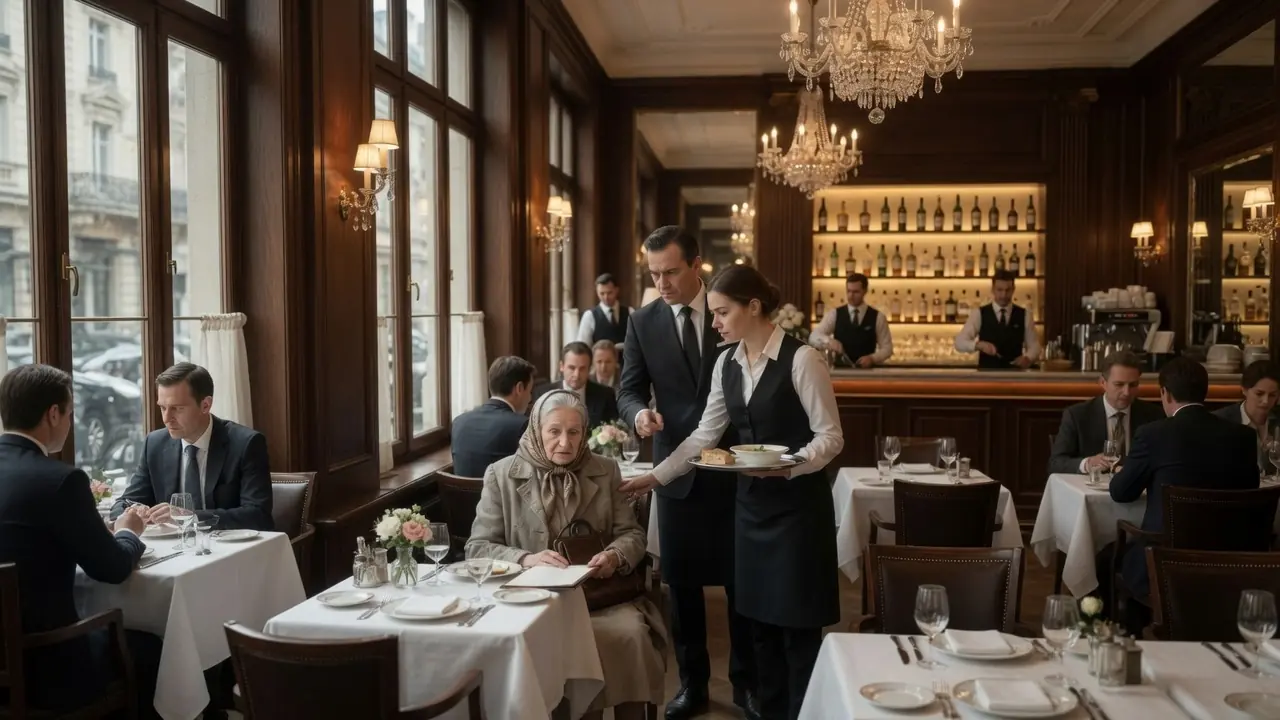
The elderly woman entered Harrington’s Grill shortly after the lunch crowd disappeared.
The dining room had grown quiet. Half-empty coffee cups remained on several tables, and the smell of roasted chicken, fresh bread, and strong coffee still hung in the air.
She paused just inside the doorway.
One hand gripped a worn brown handbag. The other pressed against the wall as she waited for her balance to return.
Her gray coat was clean but thin, with faded patches across the shoulders. The leather of her black shoes had cracked around the toes, though someone had polished them carefully that morning. Beneath her silver hair, she wore a small silk scarf tied neatly around her neck.
Most people barely noticed her.
A businessman near the counter continued reading his newspaper.
Two women in a corner booth kept talking.
The manager glanced up once, saw the old coat, and immediately looked away.
Only Emily Carter crossed the dining room.
“Good afternoon, ma’am.”
The elderly woman looked up.
Emily smiled.
“Would you like a table?”
“Somewhere quiet, if you have one.”
“Of course.”
Emily led her to a booth beside the front window, away from the remaining customers. The woman lowered herself carefully onto the red vinyl seat and set her handbag beside her.
“My name is Emily,” the waitress said as she handed over a menu. “I’ll bring you some water. Take as much time as you need.”
“Thank you, dear.”
The woman’s voice was soft and tired, yet controlled. She spoke with the calm precision of someone who had once been accustomed to people listening when she entered a room.
Now, no one seemed interested.
Harrington’s Grill had stood in the center of Brookfield, Ohio, for more than forty years.
There had been a time when the restaurant represented the heart of the town.
Farmers arrived before sunrise for eggs and coffee. Factory workers crowded the booths after evening shifts. Families celebrated birthdays beneath the framed photographs covering the walls.
The red booths had held generations of conversations.
Marriage proposals.
Job offers.
Bad medical news.
Old friends meeting after years apart.
The building still looked mostly the same.
The photographs remained.
So did the long wooden counter and the brass bell beside the kitchen window.
But the warmth had faded.
Richard Sloan had become general manager eighteen months earlier.
He was forty-six, neatly dressed, carefully groomed, and permanently impatient. Richard wanted customers who ordered quickly, spent heavily, and left without creating difficulty.
He raised prices.
Reduced portions.
Eliminated the senior discount.
Removed the free coffee refills that regular customers had enjoyed for decades.
Several longtime employees were replaced with younger workers willing to accept fewer hours and lower pay.
Whenever anyone objected, Richard repeated the same sentence.
“Harrington’s is a business, not a charity.”
Emily had heard it more times than she could count.
At twenty-eight, she had worked at the restaurant for nearly six years.
She was raising her seven-year-old son, Noah, alone after her husband died in a construction accident. The job barely covered rent, groceries, utilities, and Noah’s school expenses.
Still, Emily took pride in doing it well.
She remembered which customers preferred their eggs soft.
She knew who needed extra time to read the menu.
She noticed when elderly couples ordered one meal and asked for two plates because they could no longer afford separate dinners.
Emily treated everyone who entered as though being seen mattered.
When she returned to the old woman’s booth with water, the menu had not been opened.
Instead, the woman had arranged a small collection of coins on the table.
Three quarters.
Four dimes.
Several nickels.
A few pennies.
Less than two dollars.
Emily saw them.
She pretended not to.
“Have you decided what you’d like?”
The woman glanced at the menu.
“What is the least expensive thing you serve?”
“A cup of chicken soup is six dollars.”
“Does it include bread?”
“Yes.”
The woman looked at the coins.
Her fingers gathered them slowly.
“I see.”
Emily waited.
The woman placed the coins back inside her purse.
“I think I’ll only have water.”
The words were polite.
The embarrassment behind them was not difficult to recognize.
Emily had worn that same expression before.
After her husband died, she had once stood at a grocery register removing items one by one while a line of strangers watched.
Milk.
Cereal.
Fruit.
A package of chicken.
Every item returned to the shelf had felt like a public confession that she could not provide enough for her child.
A woman behind her had quietly paid the difference.
Emily never learned the woman’s name.
She had remembered the kindness ever since.
“The chicken soup is especially good today,” Emily said.
The elderly woman gave a faint smile.
“I’m sure it is.”
“I’ll bring you a bowl.”
“No, dear.”
“It’s all right.”
“I cannot pay for it.”
Emily leaned closer.
“You don’t have to.”
The woman studied her.
“Who is paying?”
“I am.”
“No.”
“It’s only soup.”
“It is not only soup when you have little money yourself.”
Emily paused.
Her tips that afternoon totaled twenty-eight dollars.
She needed milk, cereal, and Noah’s allergy medicine on the way home.
Six dollars mattered.
Still, she shook her head.
“Someone helped me once when I couldn’t repay them.”
The woman looked toward the window.
Emily continued.
“Let me do the same.”
For several seconds, the elderly woman said nothing.
Then she nodded.
“Thank you, Emily.”
Emily entered the order under her employee meal number and placed six dollars from her tip envelope into the register.
She asked the cook to add extra chicken and two pieces of warm bread.
When she carried the tray to the booth, the woman’s eyes filled with tears.
She turned quickly toward the street, pretending to watch passing cars.
Emily set the bowl before her.
“Careful. It’s hot.”
The woman wrapped both hands around the warm ceramic.
“I haven’t eaten since yesterday morning.”
Emily’s chest tightened.
“Then eat slowly.”
The first spoonful seemed difficult for the woman to swallow.
After the second, her shoulders lowered.
Color began returning to her face.
She spread butter over the bread with small, formal movements, as though good manners were one of the few possessions no one had been able to take from her.
Emily continued working.
She refilled coffee.
Cleared plates.
Prepared checks.
But she kept watching the booth.
That was how Richard Sloan noticed.
He had been inside his office reviewing inventory figures when he stepped into the dining room.
His eyes went immediately to the woman’s coat.
Then to the bowl.
Then to Emily.
“Did she order?” he asked.
Emily hesitated.
“She has soup.”
“Did she pay?”
Richard moved behind the counter and opened the register log before Emily could answer.
He saw the employee meal number.
His expression hardened.
“What is this?”
“I paid for it.”
“You used your employee discount for a customer.”
“I put the full price in the register.”
“That is not the point.”
Emily glanced toward the booth.
The elderly woman had stopped eating.
Richard raised his voice.
“This restaurant is not a shelter.”
Every remaining customer heard him.
Emily stepped closer.
“Keep your voice down.”
“Why? Are you embarrassed?”
“She’s hungry.”
“Then she should have gone somewhere equipped to deal with that.”
The elderly woman set down her spoon.
“The young lady was only trying to help me.”
Richard turned toward her.
“I wasn’t speaking to you.”
The room became still.
Emily stared at him.
“Richard.”
He pointed toward his office.
“Come with me.”
“No.”
The answer surprised both of them.
Emily’s hands trembled, but she remained beside the booth.
“You don’t get to speak to her like that.”
Richard’s face reddened.
“I am the manager.”
“That doesn’t make her less human.”
A dishwasher stood frozen in the kitchen doorway.
The cook lowered the spatula in his hand.
Two customers turned fully in their seats.
Richard realized everyone was watching.
Instead of calming him, the attention made him more determined to demonstrate authority.
“Take off your apron.”
Emily stared.
“What?”
“You heard me.”
“You’re firing me over a bowl of soup?”
“I’m firing you for insubordination and misuse of restaurant property.”
“I paid for the meal.”
“You embarrassed this business.”
Emily looked around the room.
“No. You did.”
Richard stepped closer.
“Apron. Now.”
For one moment, Emily could not move.
She thought of Noah waiting at the after-school program.
Rent was due in seven days.
The electric company had sent a final notice.
There was less than four hundred dollars in her checking account.
Then she looked at the elderly woman.
The woman sat hunched over the unfinished soup, trying to become invisible.
Emily slowly untied her apron.
She folded it once and placed it on the counter.
Richard pointed toward the front door.
“Leave.”
The old woman pushed herself out of the booth.
“If she goes, I go.”
Richard gave a cold laugh.
“You were already leaving.”
He took the bowl from the table.
The woman looked at him.
“I wasn’t finished.”
“You didn’t pay for it.”
Emily moved forward.
“I did.”
Richard turned on her.
“You no longer work here.”
The old woman lifted her handbag.
Before leaving, she placed every coin she had brought onto the table.
Then she looked directly at Richard.
“You should be careful how you treat people when you believe they have nothing.”
Richard shook his head.
“Is that supposed to frighten me?”
“No.”
Her voice remained calm.
“It is advice.”
She followed Emily outside.
The afternoon had grown colder.
Emily stood on the sidewalk holding her jacket, fighting back tears. She had survived grief, debt, loneliness, and years of raising a child without help.
But losing her job over six dollars made the future feel frighteningly small.
The elderly woman stepped beside her.
“I am so sorry.”
Emily wiped her eyes.
“You did nothing wrong.”
“You lost your job because of me.”
“I lost it because I worked for a cruel man.”
The woman looked through the restaurant window.
Richard was already instructing a busboy to clear the table.
“What will you do?”
“I’ll find something.”
“Do you have family?”
“A son.”
“How old?”
“Seven.”
The woman closed her eyes briefly.
“What is your full name?”
“Emily Carter.”
She opened her handbag and removed a plain white card.
It contained only a name and a telephone number.
Margaret Harrington.
Emily looked at it.
“Harrington?”
The woman nodded.
“Call this number tomorrow morning.”
“Why?”
“I may know someone who needs an honest employee.”
Emily glanced toward the restaurant sign above them.
HARRINGTON’S GRILL.
Before she could ask another question, a city bus stopped at the corner.
Margaret stepped toward it.
Emily touched her sleeve.
“Do you have somewhere safe to go?”
Margaret smiled gently.
“Yes, dear.”
“Are you certain?”
“For the first time in a long while.”
The bus doors opened.
Margaret climbed aboard and raised one hand in farewell.
Then the bus carried her away.
Emily returned home shortly after six.
Noah ran toward her the moment she opened the apartment door.
“Mom!”
She caught him in both arms.
He immediately noticed the missing uniform.
“Why aren’t you wearing your apron?”
Emily held him tighter.
“The restaurant made some changes today.”
“Good changes?”
She forced a smile.
“I don’t know yet.”
That evening, she made grilled cheese sandwiches and tomato soup.
She did not tell Noah she had been fired.
After he fell asleep, Emily sat alone at the kitchen table.
Unpaid bills were spread before her.
Margaret’s card lay between them.
Emily entered the name into her phone.
The first search result made her sit straighter.
Margaret Harrington had not merely shared the restaurant’s name.
She had founded it.
An old newspaper photograph showed Margaret standing beside her husband, Samuel Harrington, at the restaurant’s grand opening in 1978.
They were younger.
Samuel wore a white apron.
Margaret held an oversized pair of scissors beneath a banner.
Together, they had grown Harrington’s Grill into three locations.
Samuel became known throughout Brookfield for feeding anyone who entered, whether they could pay or not.
During the factory shutdown of 1982, he created a meal program for unemployed workers.
During winter storms, the restaurant stayed open overnight for stranded motorists.
After Samuel died, the two additional locations were sold.
The original building remained under the Harrington family trust.
Several years earlier, an investment group had obtained operating control.
Richard Sloan became manager eighteen months ago.
The reviews changed immediately.
Former employees described unpaid overtime, missing tips, verbal abuse, and constant staff turnover.
Customers complained that the restaurant no longer felt welcoming.
Emily stared at Margaret’s photograph.
Why would the owner of Harrington’s Grill enter her own restaurant dressed in a worn coat and carrying less than two dollars?
The question kept Emily awake.
At 8:05 the next morning, she dialed the number.
A man answered.
“Harrington Legal Group.”
Emily nearly ended the call.
“My name is Emily Carter. Margaret Harrington gave me this number.”
The man’s tone changed.
“One moment, Ms. Carter.”
Margaret came onto the line less than a minute later.
“Good morning, Emily.”
“Mrs. Harrington?”
“Margaret, please.”
“I looked up your name.”
“I thought you might.”
“Why did you come into the restaurant like that?”
Margaret became quiet.
“Because I needed Richard to believe I had nothing.”
“You were testing him.”
“I was investigating him.”
Margaret explained that she still owned the building, the Harrington name, and a large portion of the original company through the family trust.
The investment group controlled operations.
But the agreement contained a clause allowing the trust to reclaim the business if management violated employment, financial, or community-service standards.
For months, complaints had been arriving.
Employees said tips disappeared.
Work hours were altered.
Customers were insulted.
The community meal program Samuel created had been eliminated.
Margaret’s attorneys had documents.
What they lacked was direct evidence of the culture Richard had created.
“So you pretended to be poor,” Emily said.
“I did not need to pretend as much as you think.”
Emily waited.
Margaret explained that a family dispute had frozen several personal accounts while the repurchase negotiations continued. She still had resources, but she had spent months living quietly and avoiding attention.
“The clothes were mine,” Margaret said. “The hunger was real.”
Emily looked toward her kitchen.
“What happens now?”
“Come to Harrington’s Grill at nine.”
“Why?”
“You deserve to see.”
At 8:58, a black SUV stopped outside the restaurant.
Emily stood across the street wearing her cleanest blouse and dark trousers. She had left Noah with a neighbor.
The rear door opened.
Margaret stepped out.
The thin gray coat was gone.
She wore a tailored navy suit, low black shoes, and a pearl brooch. Her silver hair had been arranged neatly, and her posture appeared stronger.
Three attorneys emerged behind her.
Another vehicle arrived carrying an accountant and two representatives from the investment group.
Emily crossed the road.
Margaret smiled.
“You came.”
“You asked me to.”
“That is one of the things I like about you.”
They entered together.
The morning staff looked up.
Richard stood behind the register, giving instructions.
When he saw Emily, his face hardened.
“You are not allowed in here.”
Then he noticed Margaret.
At first, he did not recognize her.
She placed the worn brown handbag on the counter.
His face changed.
“You.”
“Yes.”
He looked at the attorneys.
“What is this?”
One lawyer stepped forward.
“My name is David Mercer. I represent Margaret Harrington and the Harrington family trust.”
Richard stared at her.
“Harrington?”
“My husband founded this restaurant.”
The employees began emerging from the kitchen.
The cook who had witnessed Emily’s firing stood beside the doorway.
Two servers exchanged shocked looks.
Richard recovered quickly.
“I didn’t know who you were.”
Margaret nodded.
“That is why yesterday mattered.”
“I was enforcing policy.”
“You humiliated an elderly customer.”
“She could not pay.”
“The meal had been paid for.”
“Through an employee discount.”
Emily stepped forward.
“I put the full six dollars in the register.”
The accountant opened a folder.
“We verified the transaction.”
Richard looked toward the investment representatives.
“This is being exaggerated.”
The attorney continued.
“We have also verified altered time records, withheld employee tips, unauthorized supplier payments, unpaid overtime, and repeated violations of the Harrington community-service clause.”
Richard’s face lost color.
“That isn’t true.”
“We have nine months of records.”
“You cannot remove me without board approval.”
One of the investment representatives spoke.
“The board met at seven this morning.”
Richard swallowed.
“And?”
“Your employment has been terminated.”
The room became silent.
The lawyer placed documents on the counter.
Margaret looked around the restaurant.
“My husband did not build this place simply to sell meals.”
She touched the wooden counter.
“During the recession, Samuel fed factory workers who could not pay.”
She pointed toward an old photograph on the wall.
“That man washed dishes for breakfast until he found another job. He later became a city councilman.”
She pointed to another.
“That family lost its house in a fire. Samuel fed them every morning for three months.”
Margaret turned toward Richard.
“You removed every program that made this restaurant worthy of our name.”
Richard looked desperate.
“The place was losing money.”
“So you took employee tips?”
“I didn’t—”
“You reduced hours on payroll after the work had already been completed.”
“Those were corrections.”
“You charged suppliers through a company owned by your brother.”
Richard stopped speaking.
Margaret continued.
“The Harrington trust exercised its repurchase option this morning.”
He stared at her.
“You bought the restaurant back?”
“I reclaimed what should never have become this.”
“This place will fail without me.”
From the kitchen doorway, the cook laughed once.
Margaret turned toward Emily.
“Yesterday, you spent money intended for your own child to feed a woman you believed could never repay you.”
Emily looked down.
“It was only soup.”
“No.”
Margaret’s voice softened.
“It was proof.”
“Proof of what?”
“That Samuel’s restaurant is still alive somewhere inside this building.”
She removed a document from the attorney’s folder.
“I would like to offer you your job back.”
Emily hesitated.
Richard gave a bitter laugh.
“She is a waitress.”
Margaret looked at him.
“She was the only manager in this restaurant yesterday.”
His expression tightened.
Margaret turned back to Emily.
“Not as a server.”
Emily stared.
“What do you mean?”
“As general manager.”
Whispers moved through the staff.
Emily shook her head.
“I don’t know how to manage a restaurant.”
“You know how people should be treated.”
“That isn’t enough.”
“It is the beginning of everything that matters.”
“I’ve never handled payroll.”
“We have accountants.”
“I’ve never negotiated supplier contracts.”
“We have attorneys.”
“I have a seven-year-old son.”
“Your schedule will allow you to be home with him most evenings.”
Emily’s eyes filled.
“Why me?”
Margaret held her gaze.
“Because you did the right thing when you believed doing it could only cost you.”
Richard removed his keys and dropped them on the counter.
“This is a mistake.”
Margaret looked toward him.
“No.”
She placed one hand on the old wooden register.
“The mistake was believing kindness had no business value because it could not be entered neatly on a spreadsheet.”
Richard walked out.
No one followed.
Margaret reopened the community meal program that afternoon.
A wooden board was mounted beside the register. Customers could purchase an extra meal and pin the receipt to the board for anyone who needed food.
Emily bought the first one.
Chicken soup with bread.
Margaret purchased fifty more.
Within a week, the board was filled.
The missing tips were repaid.
Employee hours were corrected.
Former workers returned to apply for jobs.
The senior discount came back.
Coffee refills became free again.
Emily learned slowly.
She made mistakes.
She asked questions.
She spent evenings reading invoices and studying schedules.
Margaret often appeared beside her office at five thirty.
“Go home.”
“I still have work.”
“The restaurant will be here tomorrow.”
“How do you know?”
Margaret smiled.
“It survived Richard.”
Noah began coming to the restaurant after school on Fridays.
He completed homework in a booth near Emily’s office while Margaret brought him hot chocolate and claimed it was necessary management training.
Three months later, Harrington’s Grill held a reopening celebration.
The original sign had been restored.
Photographs of Samuel and Margaret returned to the main wall.
Former employees, longtime customers, and families filled the booths.
Emily stood beside Margaret near the counter.
“You changed this place,” she said.
Margaret looked around.
“No.”
“What do you mean?”
“I gave it back to the people who remembered why it existed.”
The front door opened.
An elderly man entered wearing a worn coat. He paused near the entrance and looked uncertainly at the menu.
Emily recognized the expression.
She walked toward him.
“Good afternoon, sir. Would you like a table?”
He looked embarrassed.
“I don’t have much money.”
“That’s all right.”
She led him to the same booth where Margaret had sat.
A few minutes later, Emily placed chicken soup and warm bread before him.
He looked up.
“I can’t pay for this.”
Emily pointed toward the community board.
“Someone already did.”
Across the dining room, Margaret watched.
Her eyes filled with tears.
She did not wipe them away.
One year later, Harrington’s Grill was profitable again.
Not because prices increased.
Because people returned.
Families celebrated birthdays there.
Older customers remained over coffee.
Workers stopped leaving after a few months.
Employees took pride in the place because the place treated them with dignity.
Emily became known throughout Brookfield as the manager who would not allow anyone to leave hungry.
On the anniversary of their first meeting, Margaret gave her a small framed display.
Inside were the coins from the table.
Three quarters.
Four dimes.
Several nickels.
A few pennies.
Beneath them was a brass plaque.
THE PRICE OF A BOWL OF SOUP: SIX DOLLARS.
THE VALUE OF BEING SEEN: EVERYTHING.
Emily hung it behind the register.
Years later, every new employee heard the story.
They learned about the elderly woman who entered with only coins.
The waitress who paid from her own tips.
The manager who saw poverty and mistook it for worthlessness.
And the black SUV that arrived the next morning.
People often described the story by saying Margaret rewarded Emily for feeding her.
Margaret always corrected them.
“I did not buy back the restaurant because Emily gave me soup.”
She would look around the dining room.
“I bought it because she reminded me why the restaurant deserved to survive.”
That distinction mattered.
Emily had shown kindness without expecting recognition.
She believed Margaret had no influence.
No money.
No important name.
Nothing to offer in return.
That was what made the act valuable.
Real generosity is not measured only by what is given.
It is measured by what giving costs when no one powerful appears to be watching.
Richard Sloan believed the elderly woman did not matter because she could not afford lunch.
Emily Carter believed hunger was enough reason to help.
The next morning, everyone learned which of them had truly understood the meaning of Harrington’s name.