By the time attorney Charles Whitman reached the final page of the will, almost everyone in the room had received something.
The farmhouse went to Trevor.
The western fields and modern equipment went to Amanda.
The investment accounts were divided between three adult children.
The restored automobiles went to Uncle Raymond, who had already begun calculating what they might bring at auction.
Only Daniel Mercer remained empty-handed.
He sat in the back row of the attorney’s office, wearing the same dark suit he had worn at his grandfather’s funeral two days earlier. Around him, relatives whispered about acreage, appraisals, and transfer dates.
Nobody looked directly at him.
They all knew Daniel had been closer to his grandfather than any of the other grandchildren.
From the age of eight, he spent every summer at the Mercer farm in rural Nebraska. His grandfather taught him to drive an old tractor before his feet could comfortably reach the pedals. He taught him to rebuild carburetors, read storm clouds, sharpen blades, and judge soil by rubbing it between his fingers.
When Daniel joined the Army at nineteen, his grandfather was the only person who did not try to persuade him to stay.
“You need to discover what kind of man you are away from this land,” Arthur Mercer told him. “Then you’ll know whether you truly belong to it.”
Daniel served for eleven years as a mechanical systems specialist. He repaired equipment in desert heat, mountain cold, and temporary workshops built from shipping containers.
Through every deployment, Arthur wrote to him.
Sometimes the letters contained no more than weather reports and planting updates.
Other times, Arthur wrote about responsibility.
Machines fail when neglected.
Soil remembers how it has been treated.
A man’s real character appears in the things he maintains when nobody is watching.
Daniel kept every letter.
He assumed that closeness would mean something when Arthur’s property was divided.
It did not.
Charles Whitman closed the will.
“That concludes Mr. Mercer’s final testament.”
Daniel remained seated.
“Was there another page?”
The attorney looked toward him.
“No.”
“My name wasn’t mentioned.”
Charles hesitated.
“No, it was not.”
Trevor shifted uncomfortably near the mahogany desk.
“I’m sure Grandpa had his reasons.”
Daniel turned toward his cousin.
Trevor had inherited the farmhouse and one hundred sixty acres. Amanda received the remaining farmland and the commercial equipment. Neither had spent more than two weeks at the farm in any single year.
“What reasons?” Daniel asked.
Trevor looked away.
Nobody answered.
Arthur had left Daniel no land.
No money.
Not even one of the old tools they had used together.
Three days later, Daniel drove back to the farm alone.
Trevor had not yet moved into the farmhouse, but the locks were already being changed. A real estate consultant’s vehicle stood near the machine shed.
Daniel parked beside the road rather than entering the yard.
For several minutes, he stared at the property that had shaped most of his childhood.
Three hundred acres spread beneath the autumn sky.
The main farmhouse stood on a rise surrounded by cottonwoods. Two grain bins reflected the late-afternoon sun. Beyond them were the barn, machine shed, and workshop where Arthur had spent thousands of hours repairing equipment other farmers had thrown away.
Daniel walked around the edge of the property.
Technically, the farm no longer belonged to him any more than it ever had.
Still, every gate remembered his hands.
He entered the workshop through a side door Arthur had never locked.
The familiar smell of oil, dust, and old wood struck him immediately.
Tools hung in precise rows above the workbench.
Sockets were arranged by size.
Coffee cans held bolts separated according to thread.
Arthur had labeled everything in block letters, though he could identify nearly every part by touch.
Daniel ran one hand along the bench.
The last time he stood there, he and Arthur had been rebuilding the hydraulic pump on a 1954 Farmall tractor.
Arthur had paused in the middle of the work.
“You understand the valuable things aren’t always listed on paper, don’t you?”
Daniel had assumed the old man meant memories.
“Sure.”
Arthur studied him.
“No, you don’t.”
Daniel laughed then.
Arthur did not.
“Some things belong to whoever is willing to understand them,” he said. “Not whoever happens to sign for them.”
At the time, Daniel thought it was another one of his grandfather’s lessons.
Now, standing inside the empty workshop, he wondered whether it had been an instruction.
Two weeks later, Trevor called.
“I need help sorting Grandpa’s equipment.”
Daniel almost refused.
“What for?”
“There’s too much of it. Some dealer from Omaha says half is junk, but another guy told me one of the plows might be worth twenty thousand dollars.”
“You’re selling everything?”
“Most of it.”
Daniel tightened his grip on the phone.
Trevor continued.
“The farm loses money. Horizon Ridge Development offered twenty-two million for the entire property.”
Daniel said nothing.
“They want to build a resort,” Trevor explained. “Golf course, event center, private homes. It could change the county.”
“It would destroy the farm.”
“The farm is already dying.”
“That isn’t the same thing.”
Trevor sighed.
“Look, you know the equipment better than anyone. Help me identify what’s valuable before the auction. I’ll pay you.”
“I don’t want your money.”
“Then do it for Grandpa.”
The words were manipulative.
They also worked.
Daniel arrived Saturday morning.
The machine shed looked exactly as Arthur had left it. Old cultivators, seed drills, plows, and tractor parts filled every corner.
Trevor stood in the middle of it wearing expensive boots that had never seen fieldwork.
“I don’t even know where to start.”
“Arthur did.”
Trevor looked around.
“Then he should’ve left instructions.”
Daniel glanced toward him.
“Maybe he did.”
They spent the morning cataloging equipment.
Daniel identified a 1930s corn sheller that collectors would want, a rare International Harvester seed drill, and several pieces Trevor had planned to sell for scrap.
In the far corner stood Arthur’s most treasured machine.
A 1952 John Deere Model G tractor rested beneath a gray canvas cover.
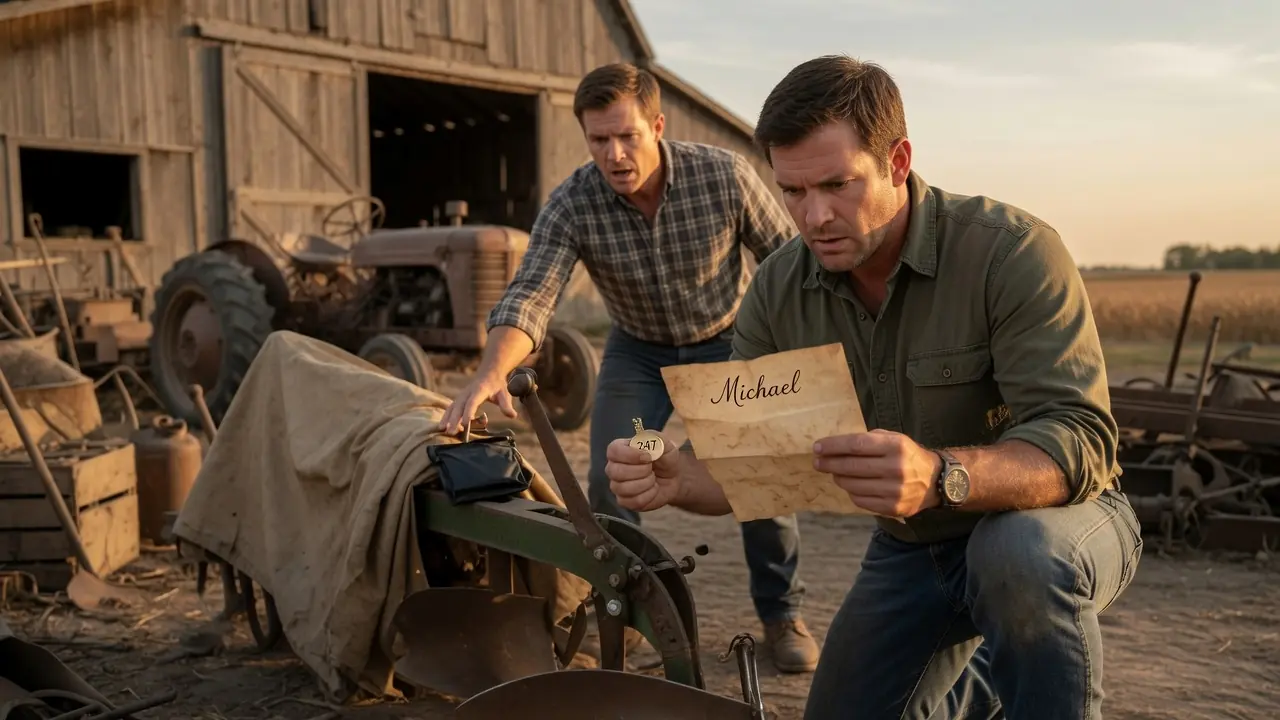
Arthur’s grandfather had purchased it used after the Second World War. Three generations of the family had driven it. Arthur restored it personally over nine winters, refusing to replace any part that could still be repaired.
Daniel removed the cover.
The green paint gleamed beneath the dust.
Trevor whistled.
“This thing might bring serious money.”
“It isn’t for sale.”
Trevor looked at him.
“It belongs to the estate.”
“It belongs to the family.”
“And I’m family.”
Daniel did not argue.
He opened the side panel to examine the engine.
Everything was as he remembered until he noticed four polished bolts beneath the battery compartment.
They were too new.
Arthur rarely used modern hardware on historical restorations unless absolutely necessary.
Daniel crouched.
Behind the bolts was a narrow steel plate painted the exact shade of John Deere green.
It appeared to be part of the frame.
But the welds were recent.
Trevor’s phone rang.
He stepped outside to take the call.
Daniel removed a screwdriver from the workbench.
The plate opened on a concealed hinge.
Inside was a small waterproof pouch wrapped in oilcloth.
Daniel’s heart began pounding.
He looked toward the shed entrance.
Trevor remained outside, arguing with someone about environmental surveys.
Daniel removed the pouch and opened it.
Inside were three objects.
A brass key stamped with the number 247.
A faded photograph.
And an envelope bearing Daniel’s name in Arthur’s handwriting.
The photograph showed Arthur as a young soldier standing beside a dark-haired woman. She held an infant wrapped in a white blanket.
On the back was written:
Arthur, Margaret, and baby Eleanor. San Diego, 1956.
Daniel had never heard of Margaret or Eleanor.
His grandfather married Daniel’s grandmother, Helen, in 1959.
Daniel opened the letter.
Danny,
If you found this, then you remembered that machines speak to people who pay attention.
The key opens box 247 at Cedar State Bank. Harold Pierce has the matching key. Go alone. Tell no one until you understand what I have left you.
I could not name you in the will without bringing attention to something I have spent most of my life protecting. I know that hurt you. Forgive me.
You were never forgotten. You were chosen.
Grandpa
Daniel read the final sentence twice.
Trevor’s footsteps approached.
Daniel returned the pouch to his jacket and closed the panel.
Trevor entered.
“Everything okay?”
“Yes.”
“You find something?”
“Loose battery bracket.”
Trevor studied him.
Then looked at the tractor.
“Horizon wants the equipment cleared within sixty days.”
Daniel stood.
“You haven’t signed yet.”
“Almost.”
“What exactly do they want with three hundred acres?”
“The resort.”
“That doesn’t require every inch.”
“They said it does.”
Daniel remembered hearing Trevor mention environmental surveys.
He looked toward the fields beyond the shed.
Arthur had protected something.
Possibly something Horizon wanted.
Cedar State Bank occupied a century-old brick building in the center of town.
Harold Pierce was eighty-three and technically retired, though he still worked two mornings a week because, according to the receptionist, he did not know what else to do with himself.
When Daniel gave his name, Harold stood immediately.
“You found the tractor.”
Daniel stopped.
“You knew?”
“I knew Arthur had hidden the key in a machine. He never told me which one.”
Harold led him through the vault.
“Your grandfather opened box 247 in 1989. He updated it almost every year.”
“Why me?”
Harold inserted one key while Daniel used the other.
“Perhaps the answer is inside.”
The box contained documents arranged in labeled folders.
A letter marked READ FIRST rested on top.
Daniel opened it.
Arthur wrote about a life nobody in Nebraska knew existed.
After serving in Korea, he had been stationed in California. There he met Margaret Ellis, a schoolteacher working near the naval base.
They married in 1955.
Their daughter, Eleanor, was born the following year.
Margaret died in a car accident when Eleanor was eleven months old.
Arthur still had a year of military service remaining. Margaret’s parents agreed to care for the baby temporarily.
But when Arthur returned to Nebraska, his own father was ill and the family farm was near foreclosure.
He had no stable home for a young child.
The Ellises loved Eleanor and wanted to adopt her.
Arthur agreed.
He returned to Nebraska carrying grief, shame, and the belief that surrendering his daughter had been the only responsible choice available.
Three years later, he married Helen.
They built the family Daniel knew.
Arthur never forgot Eleanor.
He sent money through a private trust.
Margaret’s parents sent photographs, school reports, and letters.
Decades passed.
The longer Arthur kept the secret, the more difficult revealing it became.
Then Daniel reached the final pages.
Arthur had placed forty acres of the original Mercer homestead into a separate trust for Eleanor.
The parcel included the first farmhouse, the family cemetery, and a natural spring feeding most of the property’s irrigation channels.
Legally, those forty acres had never been part of the estate Trevor inherited.
A financial statement showed a second trust containing more than six hundred thousand dollars for Eleanor.
Arthur’s letter continued.
You may wonder why I left this to you instead of telling the entire family myself. The honest answer is cowardice mixed with love. Those two things often resemble each other when a man has carried them long enough.
Eleanor knows who I am. We found each other after Helen died. We met quietly for nearly fifteen years. She asked for nothing.
The forty acres belong to her, though she does not know I completed the transfer. That parcel is the heart of the farm. Beneath it lies the strongest section of the Ogden Aquifer in this county. I separated it because one day someone would see the water before they saw the land.
That day has arrived.
Horizon Ridge is not building a resort merely to sell vacations. It wants control of the spring and future commercial rights to the aquifer. If the family sells, neighboring farms may someday buy their own water back from a corporation.
I could not stop the sale through the will without exposing Eleanor before she was ready. I could only protect the forty acres and trust someone to tell the truth when necessary.
That person is you.
I left you no farm because I am leaving you the responsibility of deciding whether the farm has a future.
Daniel lowered the letter.
He had spent weeks believing Arthur had rejected him.
Instead, the old man had placed the most dangerous part of his legacy in Daniel’s hands.
Another folder contained Eleanor’s address in California.
A third held photographs.
Eleanor as a child.
At graduation.
At her wedding.
With her children.
Then grandchildren.
One photograph showed a young woman standing beside an experimental greenhouse at the University of Nebraska.
On the back Arthur had written:
Emily Ross, Eleanor’s granddaughter. Sustainable agriculture. She came home without knowing it.
The private-room door opened.
A man in an expensive gray suit entered without knocking.
“Mr. Mercer.”
Daniel closed the folder.
The man introduced himself as Gregory Sloan, the bank’s new president.
“I understand you are reviewing one of Arthur Mercer’s older boxes.”
“That is private.”
“Certainly.”
Gregory glanced at the documents.
“Old deeds and trusts can create significant complications, particularly when property is under contract.”
Daniel’s expression remained neutral.
“How do you know the farm is under contract?”
“Horizon Ridge conducts business through this bank.”
“You are involved with Horizon?”
“I serve on the county development council.”
Harold appeared behind him.
“Gregory, this room is reserved for the customer.”
“I was offering assistance.”
“It was not requested.”
Gregory smiled thinly.
“Mr. Mercer should know that unrecorded property claims may not be enforceable.”
Daniel placed the papers back in the box.
“These are recorded.”
The smile disappeared for a fraction of a second.
That was enough.
Daniel understood.
Gregory already knew there was a title problem.
He simply did not know who possessed the proof.
Daniel left the originals in the vault.
Harold handed him certified copies through a private side exit.
“Arthur expected this,” the old banker said.
“Horizon?”
“Not by name. But he knew the water would eventually attract someone.”
“Who can I trust?”
Harold looked toward the front offices.
“Fewer people than you want.”
Daniel returned to his motel after dark.
The door was open.
His clothes lay across the floor. His laptop had been removed from its case. The mattress had been lifted.
Nothing appeared stolen.
Whoever entered had been searching for documents.
Daniel did not call local police.
Before he could decide what to do, someone knocked.
Sheriff Calvin Moore stood outside.
Daniel kept the chain fastened.
“What do you want?”
“Gregory Sloan reported you removed confidential bank property.”
“That is false.”
“I know.”
Daniel opened the door slightly wider.
Calvin had known Arthur since childhood.
“Your grandfather told me this day might come,” the sheriff said. “He also told me not to speak until you found the key.”
“You know about Eleanor?”
“I knew there had been a wife and child in California.”
“Who searched this room?”
“I cannot prove it, but Horizon has hired a private security firm. Several men have been asking questions around town.”
“Why does everyone care so much about forty acres?”
“Because the spring is becoming more valuable every year.”
Calvin lowered his voice.
“Regional drought projections are worse than the public reports suggest. If Horizon controls that water, it controls development across half the county.”
Daniel looked back at the destroyed motel room.
“What do I do?”
“First, leave town tonight.”
“Where?”
“Attorney Frank Dalton’s home in Millfield. Arthur trusted him. So do I.”
Frank Dalton had once represented the Mercer family.
He had also been Arthur’s closest friend.
At Frank’s kitchen table, Daniel learned the rest of the history.
Eleanor had hired an investigator in the early 1990s to identify her biological father. Arthur discovered she was searching for him.
At first, he panicked.
Then he contacted her.
Arthur and Eleanor exchanged letters for years before meeting in person after Helen’s death.
Helen had known about Eleanor since 1981.
“She found the old letters,” Frank explained.
“Was she angry?”
“At Arthur, yes. At Eleanor, never.”
Helen wrote to Eleanor privately. The two women met once.
They agreed not to reveal the truth to the wider family while Arthur and Helen’s children were raising families of their own.
The decision was imperfect.
It was also theirs.
Frank opened a file containing more recent correspondence.
In one letter, Eleanor wrote about her granddaughter Emily studying sustainable farming in Lincoln.
Arthur’s replies revealed enormous pride.
“He followed her career?” Daniel asked.
“Every award. Every article. Every research project.”
“She doesn’t know?”
“No.”
Daniel looked at Emily’s photograph.
“She looks like him.”
Frank nodded.
“More than she knows.”
The next morning, Daniel called Eleanor.
She answered after the fourth ring.
“My name is Daniel Mercer,” he said. “Arthur was my grandfather.”
Silence.
Then a woman’s voice answered softly.
“I’ve been waiting for someone in Nebraska to call.”
Eleanor was seventy.
She sounded composed, but Daniel heard the emotion beneath each word.
Arthur had shown her photographs of the Nebraska family. She knew Daniel’s name. Knew he had served in the military. Knew he spent summers on the farm.
“He always said you listened to the land,” she told him.
Daniel explained the trust.
The forty acres.
The spring.
The proposed resort.
Eleanor remained quiet.
“I never knew he left me property.”
“He believed the parcel belonged to you.”
“I don’t need his money.”
“This isn’t only money.”
“No.”
Her voice strengthened.
“It never was.”
Daniel told her about Emily.
“She is finishing graduate work at Nebraska,” Eleanor said. “Sustainable agricultural development.”
“I’d like to meet her.”
“Does she know about Arthur?”
“No.”
“That truth should come from you.”
“I agree.”
Eleanor arranged a meeting without revealing their relationship.
Daniel met Emily at a university café.
She was twenty-four, practical, confident, and unable to speak about soil for less than twenty uninterrupted minutes.
She described family farms as living systems rather than businesses composed only of fields and machines.
Daniel showed her maps of the Mercer property without naming Eleanor or explaining the trust.
Emily immediately identified the forty-acre parcel as the critical resource.
“The spring changes everything,” she said. “A resort would consume enormous amounts of water, especially with a golf course.”
“Horizon claims it will create jobs.”
“For how long? And at what cost?”
Daniel explained Trevor’s financial problems.
Emily did not dismiss them.
“Preservation without income is just slow abandonment.”
“What would you do?”
She outlined an agricultural heritage center.
The original farmhouse could host educational programs and small farm stays. Historic equipment could become part of a restoration workshop. The working fields could transition gradually toward higher-value heritage crops and sustainable methods.
The spring could be protected through a conservation easement, generating immediate capital without surrendering ownership.
“This could work,” she said.
“Could it work quickly?”
“Quickly enough to stop a development vote?”
Emily looked at him.
“When?”
“Five days.”
She closed her notebook.
“Then we should see the land.”
The old homestead stood hidden behind cottonwoods on the northern edge of the property.
Daniel had never visited it as a child.
Arthur kept the access road locked and said the buildings were unsafe.
They were not.
The original farmhouse remained furnished. The stone barn was structurally sound. The spring emerged from a limestone shelf and flowed into Cedar Creek.
Emily knelt beside the water.
“This is extraordinary.”
Daniel watched her touch the stream.
“You feel connected to it?”
She laughed.
“That sounds unscientific.”
“It wasn’t a scientific question.”
Emily looked toward the farmhouse.
“I do.”
Inside Arthur’s study, Daniel found decades of journals.
The final entry read:
The water is still clear despite the dry summer. I have done what I can. The next caretaker will need courage, not ownership. Ownership ends. Stewardship is passed forward.
Emily read the entry over his shoulder.
“Your grandfather understood conservation better than half the people writing modern policy.”
“He understood this land.”
“Bring Trevor here.”
Trevor arrived that afternoon.
Daniel showed him the legal deed first.
His cousin read it twice.
“This is impossible.”
“It’s recorded.”
“Horizon closes next week.”
“They cannot purchase land you do not own.”
Trevor threw the document onto the table.
“You did this because Grandpa left you nothing.”
Daniel felt the old wound open.
Then he remembered Arthur’s letter.
“I believed that too.”
He explained Eleanor.
The first marriage.
The adoption.
The trust.
Trevor sank into a chair.
“No.”
“I saw the birth certificate.”
“He would have told us.”
“He was ashamed he waited too long.”
Trevor pressed both hands against his face.
When he looked up, anger had been replaced by fear.
“If the sale fails, the bank takes my land.”
Daniel sat opposite him.
“How much debt?”
Trevor hesitated.
“More than two million.”
Daniel finally understood.
Trevor was not simply greedy.
He was drowning.
“Horizon promised to clear the loans?”
“And give me a management job.”
“They need you desperate.”
“I am desperate.”
Daniel told him about Emily’s plan.
Trevor laughed at first.
Then Emily arrived with preliminary numbers.
The conservation easement could provide enough capital to restructure the farm’s debt. Grants for historic preservation could restore the homestead. Agricultural tourism and education could generate income within eighteen months.
It was not twenty-two million dollars.
It was not easy.
It was a future.
“Who are you?” Trevor asked Emily.
“A graduate student.”
“Why do you care this much?”
Emily looked toward Daniel.
He remained silent.
The truth was not his to reveal.
Eleanor flew to Nebraska the following day.
When she stepped from Frank’s truck at the homestead, Daniel recognized Arthur in her face immediately.
The same gray eyes.
The same thoughtful pause before speaking.
Eleanor looked at the farmhouse she had known only through photographs.
“He described the light on that barn,” she whispered.
Inside, Emily greeted her grandmother with confusion.
“What are you doing here?”
Eleanor took both her hands.
“There’s something I should have told you years ago.”
The conversation lasted almost an hour.
When Emily emerged, her eyes were red.
She walked toward Daniel.
“You knew.”
“For three days.”
“Why didn’t you tell me?”
“It belonged to her.”
Emily looked toward the fields.
“So Arthur Mercer was my great-grandfather.”
“Yes.”
“And Eleanor owns this land.”
“Yes.”
Emily let out a breath that was almost a laugh.
“I thought I was helping strangers save a farm.”
Daniel smiled.
“You were helping family.”
The county council meeting took place the next morning.
Horizon Ridge arrived with consultants, economic projections, and glossy renderings of luxury cabins surrounding a golf course.
Its representative promised jobs, tourism, and tax revenue.
Gregory Sloan spoke about progress.
Then Eleanor stood.
She introduced herself as Arthur Mercer’s first daughter.
The room erupted in whispers.
She presented the trust documents and the deed showing that Horizon’s development plan included forty acres Trevor did not own.
Gregory challenged the papers.
Frank produced certified county records.
The argument shifted.
Emily presented her alternative.
Not nostalgia.
Numbers.
Thirty-five permanent jobs.
Local training partnerships.
Conservation funding.
Sustainable farm production.
Historic tourism.
Long-term community ownership of the spring.
Trevor spoke next.
He admitted his debt publicly.
“I wanted the Horizon deal because I was afraid,” he said. “I thought selling everything was better than losing everything.”
He looked toward the farmers seated behind him.
“But if this corporation controls our water, we may all lose more than one farm.”
Daniel spoke last.
He did not mention Arthur’s secret or his own hurt.
He spoke about the aquifer.
Horizon’s resort would require millions of gallons annually. During drought years, corporate water use could compete directly with nearby agriculture.
“Once water rights leave this community,” Daniel said, “promises will not bring them back.”
A farmer near the rear stood.
His land bordered the Mercer creek.
“If they control the spring, what protects the rest of us?”
Horizon’s representative offered vague assurances.
The questions multiplied.
How many jobs would go to local residents?
Who would receive priority during drought?
Could Horizon later sell the water rights?
Would golf-course irrigation be restricted?
The polished presentation began falling apart beneath specific questions.
The council rejected the zoning change by one vote.
It was not the end.
Horizon could return.
It could sue.
It could revise its proposal.
But the immediate sale was stopped.
Trevor sat on the courthouse steps afterward.
“What happens now?”
Emily opened her folder.
“Now we do the difficult version.”
The conservation easement took three months.
It generated enough money to prevent foreclosure and refinance Trevor’s debt.
Eleanor placed the forty acres into a family stewardship trust rather than keeping them for herself.
The trust prohibited the sale of the spring or transfer of water rights to private developers.
The main farm remained in production.
Trevor continued managing it, though he began transitioning several fields toward the practices Emily recommended.
Daniel moved back to Nebraska.
He had spent months searching for a civilian job that felt meaningful.
Arthur had left one waiting for him.
Daniel restored the old equipment.
The Model G tractor became the first exhibit inside the Mercer Agricultural Heritage Center.
He did not remove the hidden compartment.
Inside it, he placed a copy of Arthur’s letter.
Not the page containing the family secret.
Only the lines:
You were never forgotten. You were chosen.
Eleanor divided her time between California and Nebraska.
Emily completed her graduate thesis using the Mercer farm as her primary case study.
The heritage center opened two years after the will reading.
Visitors stayed inside the restored farmhouse.
Students learned about soil health, water conservation, and traditional mechanical repair.
Local farmers attended workshops.
The spring continued feeding Cedar Creek.
At the opening ceremony, Trevor approached Daniel near the old tractor.
“I owe you an apology.”
“For what?”
“I thought you were trying to take the farm.”
“I thought Arthur had rejected me.”
Trevor looked at the machine.
“He left you more than all of us.”
Daniel considered that.
“No.”
He watched Eleanor and Emily walk together near the farmhouse.
“He left all of us something. I was only the one who found the key.”
Later that evening, Daniel went to Arthur’s grave.
The family cemetery stood on the protected forty acres beneath two old cottonwood trees.
Eleanor had placed flowers beside the stone.
Daniel placed the brass key on top of the marker.
For months, he carried it on a chain around his neck.
He no longer needed it.
“We found her,” he said.
The wind moved through the grass.
Daniel thought about the will reading.
The silence after every other name had been called.
The humiliation of believing the person he loved most had decided he was worth nothing.
Arthur could have avoided that pain by speaking sooner.
Daniel did not excuse him.
Love did not make every choice wise.
But he finally understood the choice.
Arthur knew money would draw attention.
Land would create conflict.
So he left Daniel nothing anyone could see.
No acreage.
No account.
No machine listed in an inventory.
He left him a loose panel beneath an old tractor battery.
A brass key.
A hidden daughter.
And a decision that would determine whether a century of family history ended beneath a golf course.
Years later, children visiting the heritage center often asked why the antique tractor was displayed with one side panel open.
Daniel would show them the small hidden compartment.
“What did your grandfather put inside?” they asked.
“A question.”
“What question?”
Daniel would look across the farm toward the original homestead and the cottonwoods lining the creek.
“What is something worth if selling it destroys the reason it mattered?”
Most children did not understand immediately.
That was all right.
Arthur had asked Daniel the same question in different forms for most of his life.
Through broken engines.
Through exhausted soil.
Through tools repaired rather than discarded.
The answer was never that money did not matter.
Trevor’s debt was real.
The farm needed income.
Buildings needed repairs.
People could not survive on memory alone.
The answer was that value had more than one measurement.
Acres could be priced.
Water could be sold.
Machines could be auctioned.
But stewardship could not be deposited into an account.
It existed only through choices.
Arthur Mercer’s will gave everyone else property.
His true inheritance went to the grandson whose name never appeared on a single page.
And in the end, the man who inherited nothing became the one responsible for ensuring something remained.