The dog recognized her before anyone else understood what was happening.
Ethan Cole stood near the living-room doorway, watching a twenty-six-year-old woman sit nervously in the old armchair beside the window.
Her name was Sofia Alvarez.
She had her father’s dark eyes, the same quiet way of holding her hands, and a small silver identification tag hanging from a chain beneath her blouse.
Across the room, Ranger lifted his head.
The Belgian Malinois had been sleeping beside the fireplace. At eight years old, he still carried the powerful shoulders and alert ears of the military working dog he had once been, but the tension that used to live permanently inside his body had softened.
He stared at Sofia.
She stared back.
Neither moved.
“I don’t know if he’ll remember anything,” Ethan said gently. “It has been a long time.”
Sofia nodded, though her eyes remained fixed on the dog.
“My father talked about him every time he called home.”
Her voice trembled.
“He called Ranger his shadow.”
The dog stood.
Ethan resisted the instinct to give a command.
Ranger did not need one.
He crossed the room slowly, placing each paw carefully against the wooden floor. His head remained low, but his eyes never left Sofia.
She stopped breathing.
Ranger reached the chair.
For several seconds, he simply stood in front of her.
Then he leaned forward and placed his head in her lap.
Sofia’s face collapsed.
She wrapped both arms around the dog’s neck and began to cry.
Not loudly.
Not theatrically.
The grief came from somewhere that had remained sealed for seven years.
Ranger did not pull away.
He closed his eyes and pressed more of his weight against her knees.
Ethan looked toward the window.
Outside, the late-May sun rested over the dry hills beyond San Diego. Wind moved gently through the eucalyptus trees, carrying the distant sound of traffic from the highway.
Inside the house, the daughter of a fallen soldier held the last living partner who had been beside her father when he died.
Ethan gave them the silence.
He understood that some reunions were not meant to be watched too closely.
Six months earlier, Ranger had wanted nothing to do with any human being.
Neither had Ethan.
At forty-three, Ethan Cole had spent fourteen years in Naval Special Warfare.
Seven deployments.
Two Purple Hearts.
One battlefield promotion that other men described more clearly than he could.
People told the story as though it proved courage.
A compound outside Fallujah had caught fire during an attack. Ammunition began cooking off inside one of the rooms. Two men were trapped beyond the flames.
Everyone with sense moved away.
Ethan went in.
He remembered heat.
A collapsed doorway.
Someone screaming his name.
Afterward, he remembered waking inside a field hospital with burns along one arm and a commander telling him he had saved two lives.
The official report used words like extraordinary valor and disregard for personal safety.
Ethan never agreed with the description.
He had not disregarded his safety.
He had forgotten it existed.
Four years after leaving the service, he lived alone in a small one-story house near the eastern edge of San Diego County.
The property had a fenced yard, a dry garden, and enough distance from neighboring houses that sudden noises were rare.
That mattered.
Ethan slept badly.
On good nights, he managed four hours.
On bad ones, he sat at the kitchen table until sunrise with a glass of whiskey and every light in the house turned on.
The memories did not arrive as complete stories.
They came in pieces.
Sand cutting across his face.
A helicopter rotor somewhere above darkness.
The metallic smell inside an armored vehicle.
A voice asking for a medic.
The expression on a young sailor’s face moments before the road beneath him exploded.
Ethan’s body had returned home.
The rest of him seemed to remain scattered across countries he no longer wanted to name.
His marriage lasted three years after his final deployment.
His wife, Caroline, tried.
So did he, in the limited ways he still understood.
He attended two counseling appointments and left before the third. He drank less when she asked, then began hiding the bottles. He promised to sleep in the bed but often woke beneath the dining-room table or against the bedroom wall.
One evening, Caroline stood in the kitchen holding a suitcase.
“You came back,” she said.
Ethan stared at her.
“Your body did.”
Tears filled her eyes.
“But the man I married is still waiting somewhere overseas.”
He did not ask her to stay.
That failure followed him longer than the divorce papers.
Ethan worked part-time at a veterans’ training center, teaching defensive tactics, fitness, and emergency response.
The work gave his mornings structure.
It also allowed him to help other veterans without discussing himself.
He could demonstrate how to break a grip.
How to secure a room.
How to control breathing after an adrenaline surge.
He could not explain why he still checked every exit inside a grocery store.
He could not explain why fireworks made his hands shake.
He could not explain why silence sometimes felt more dangerous than gunfire.
On a cold Tuesday morning in November, his former teammate Lucas Mercer called.
“Cole.”
Lucas’s voice carried the controlled urgency Ethan remembered from operations.
“What happened?”
“I need you to come outside the city.”
“For what?”
“There’s a dog.”
Ethan almost ended the call.
“I don’t work with dogs.”
“This one worked with people like us.”
“That doesn’t make me a trainer.”
“I didn’t say you could train him.”
Lucas paused.
“I said you need to see him.”
Ethan leaned against the kitchen counter.
“What’s wrong with him?”
“Everything.”
“That’s not an answer.”
“They’re euthanizing him tomorrow morning.”
Ethan became quiet.
He had not owned a dog since childhood.
The military dogs in his memory belonged to missions. They moved through darkness beside handlers, detected explosives, chased armed men, and entered rooms before everyone else.
They were not pets.
They were team members who happened to have four legs.
“What did he do?” Ethan asked.
“Come read the file.”
“I’m working.”
“You’re not scheduled until Thursday.”
Ethan frowned.
Lucas knew his schedule because he occasionally called the training center when Ethan stopped answering his phone.
“Twenty minutes,” Lucas said. “Then you can leave.”
Ethan looked toward the unopened bottle on the counter.
“I’ll meet you there.”
The Coastal Working Dog Rescue sat at the end of a dirt road beyond the city.
The facility contained two long kennel buildings, a veterinary room, an exercise yard, and a small office that smelled of coffee, disinfectant, wet fur, and paper records.
Dogs began barking the moment Ethan stepped through the gate.
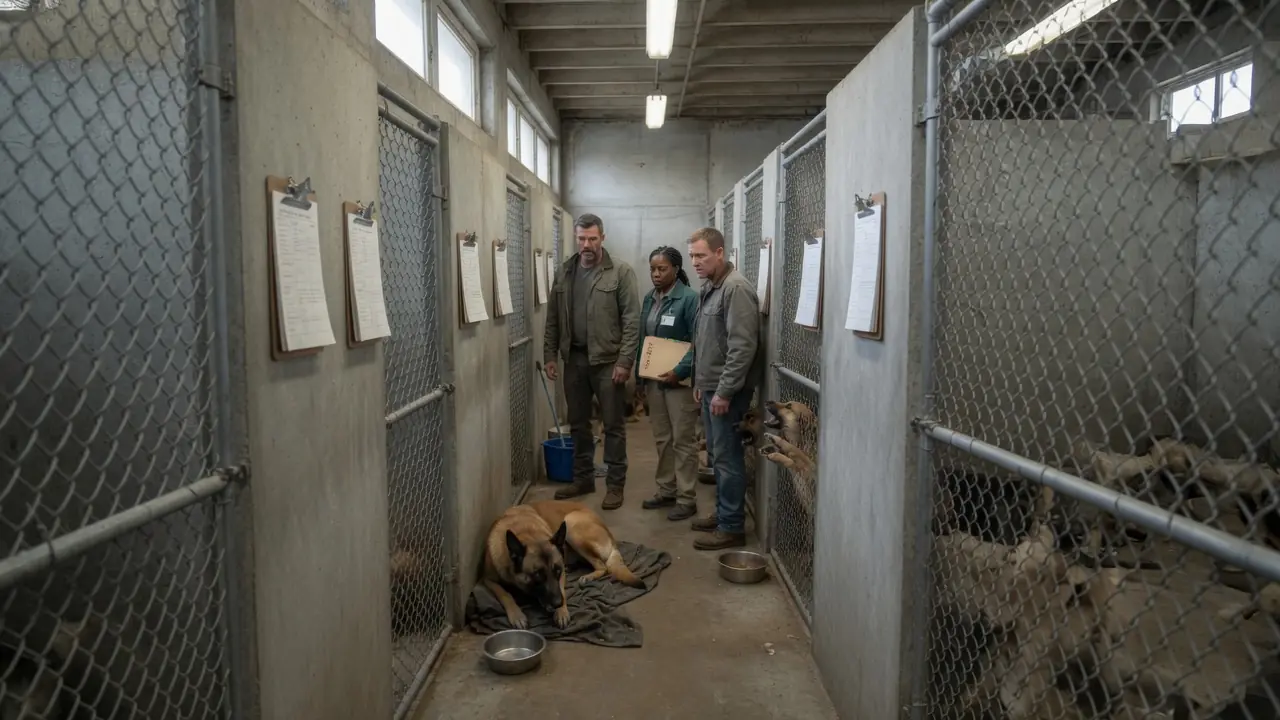
Some jumped against the fencing.
Others turned in excited circles.
Each animal seemed desperate to be noticed.
Lucas met him near the office.
He was forty-five, broad through the chest, and carried a permanent stiffness in his left leg from a wound sustained in Afghanistan.
“Thanks for coming.”
“Where is he?”
Lucas led him past the kennels.
The dogs followed their movement with barking and whining.
At the far end of the second row, one kennel remained silent.
A large Belgian Malinois lay in the back corner with his spine toward the door.
His coat was tan with a black mask. One ear carried a small scar near the tip. The muscles along his shoulders remained visible despite weeks of poor eating.
The dog did not look at them.
Ethan stopped.
“What’s his name?”
“Ranger.”
“He respond to it?”
“Not anymore.”
The shelter manager approached from behind.
Denise Harper was in her early fifties and wore faded jeans beneath a blue rescue jacket.
“You must be Ethan.”
He nodded.
“Lucas says you served with working dogs.”
“I served near them.”
Denise unlocked the office.
“His file is inside.”
The folder was thin.
That disturbed Ethan more than a thick one would have.
A military career should not have been reduced to five typed pages, three photographs, and a handwritten warning.
Ranger entered military training at eighteen months old.
He had been selected for intelligence, endurance, scent ability, and the kind of focused aggression required for special operations.
His handler was Sergeant First Class Mateo Alvarez.
Mateo and Ranger deployed together three times.
Ranger detected more than forty explosive devices.
He participated in dozens of night missions.
He located hidden weapons, followed fleeing suspects, and once led medics to two injured soldiers after smoke and darkness separated them from their unit.
The final report concerned a mission in Kandahar Province.
A special operations team entered a village shortly before midnight to capture a senior insurgent coordinator.
The target compound appeared quiet.
It was not.
Gunfire came from two rooftops and a narrow alley beside the western wall.
Mateo took a round through the chest.
Ranger immediately moved over him.
The dog refused to leave even while bullets struck the ground nearby. He barked repeatedly until the rest of the team reached them.
Mateo was evacuated.
He died before the helicopter returned to base.
Ranger waited beside the kennel entrance for two days.
He ignored food.
He refused water unless someone left the bowl and moved far away.
Each vehicle sound made him stand.
Each approaching footstep made him search beyond the person entering.
Mateo never returned.
Over the following months, Ranger developed severe trauma-related behaviors.
He reacted violently to sudden noises.
He guarded doorways.
He refused commands from unfamiliar handlers.
He snapped when touched from behind.
During one incident, a new handler reached toward his injured ear and received a deep bite to the forearm.
The military retired Ranger.
Three civilian placements followed.
The first family had experience with working breeds but underestimated him. During a birthday party, a child grabbed Ranger from behind. The dog spun and bit the child’s sleeve, bruising the arm without breaking the skin.
The family returned him.
The second placement ended after a thunderstorm. Ranger tore through an interior door, destroyed furniture, and injured himself trying to find a protected corner.
The third adopter could not approach closely enough to attach a leash.
Now Ranger lay at the end of the kennel row, facing the wall.
The final note read:
Severe handling risk. Minimal response to rehabilitation. Euthanasia scheduled Wednesday, 8:00 a.m.
Ethan closed the file.
“How long has he been here?”
“Seven weeks,” Denise said.
“Who has worked with him?”
“Two behavioral specialists. A former police K-9 trainer. Our veterinarian.”
“And?”
“He tolerates food being placed inside. He allows the kennel to be cleaned only if we move him to the secondary enclosure remotely.”
“Anyone touch him?”
“No.”
Lucas watched Ethan.
The former SEAL opened the file again.
He looked at the photograph of Ranger beside Mateo.
The dog appeared younger. Alert. Proud. Completely focused on the man beside him.
Mateo had one hand resting behind Ranger’s shoulders.
Both looked toward something outside the frame.
“Why did you call me?” Ethan asked.
Lucas took a moment before answering.
“Because you look at doors the same way he does.”
Ethan’s jaw tightened.
“That’s a stupid answer.”
“It’s the honest one.”
Denise folded her arms.
“Mr. Cole, I need to be clear. Ranger is not simply sad. He can be dangerous.”
“I know.”
“If he bites, the injury may be severe.”
“I understand.”
“We cannot guarantee he’ll ever behave like a normal companion animal.”
Ethan looked through the office window toward the silent kennel.
“I’m not looking for normal.”
Denise studied him.
“What are you saying?”
“I’ll take him.”
She shook her head immediately.
“You haven’t even entered the kennel.”
“I don’t need to.”
“You cannot adopt him based on a file.”
“I’m not.”
Ethan looked at Ranger.
“I’m adopting him based on the corner.”
Denise did not understand.
Lucas did.
Ethan had spent years selecting corners inside restaurants, waiting rooms, classrooms, and homes.
A corner protected the back.
It reduced the number of directions danger could come from.
It allowed a person—or an animal—to watch every entrance while pretending not to watch anything.
Ethan walked toward the kennel.
Denise followed.
“We still need to determine whether he’ll allow you near him.”
“He doesn’t need to.”
“Then how will you transport him?”
“We’ll let him decide.”
Ethan sat on the concrete outside the kennel door.
He did not face Ranger.
He did not call his name.
He did not push his fingers through the fence.
He sat with his back against the opposite wall and looked toward the exercise yard.
Ten minutes passed.
Ranger did not move.
Denise and Lucas remained behind the secondary gate.
Fifteen minutes.
The dog’s breathing changed slightly.
Twenty-three minutes.
One ear turned toward Ethan.
The rest of the body remained still.
Ethan knew the first mistake most people made with frightened living things.
They approached to prove they were harmless.
But approaching was itself a kind of pressure.
So Ethan waited.
At twenty-nine minutes, Ranger lifted his head.
He looked at Ethan’s boots.
Then his hands.
Then his face.
Ethan kept his eyes turned away.
“You don’t know me,” he said quietly.
Ranger’s ears moved.
“I don’t know you either.”
The dog remained in the corner.
“Nobody is asking for trust today.”
Ethan rested his forearms on his knees.
“We’re only deciding whether you want to leave this place.”
The words carried no command.
No false cheerfulness.
No desperate attempt to sound kind.
Only the steady tone of someone who understood that trust could not be demanded from a creature whose trust had repeatedly ended in loss.
Ranger stood after thirty-seven minutes.
His legs were stiff.
He moved one step.
Stopped.
Then another.
He reached the kennel threshold but did not cross it.
Ethan placed a leash on the concrete between them.
He did not pick it up.
At forty-eight minutes, Ranger lowered his nose toward the leash.
He smelled the leather.
Then Ethan’s shoe.
The dog stepped outside.
Denise covered her mouth with one hand.
Lucas remained completely still.
Ethan rose slowly.
Ranger’s muscles tightened.
Ethan turned his back and walked toward the gate.
He heard no movement behind him.
Three seconds passed.
Then came the quiet click of claws on concrete.
Ranger followed.
The drive home took forty minutes.
Ranger sat in the rear seat of Ethan’s truck without lying down.
He watched traffic, overpasses, pedestrians, and every vehicle that approached from behind.
Ethan kept the radio off.
At home, he opened both rear doors and walked inside.
Ranger remained in the truck.
Ethan placed a bowl of water near the front doorway and sat in the living room with an old book.
Ten minutes later, Ranger appeared on the porch.
He stood at the open door.
Ethan turned one page.
The dog entered.
He inspected every room.
Nose near the walls.
Eyes checking windows.
He paused beside the bedroom, kitchen, back door, and narrow hallway.
Ethan allowed him to clear the house.
Two hours later, Ranger lay in the center of the living-room rug.
He did not face the wall.
That was enough for the first day.
The first week became a series of silent agreements.
Ethan placed food near the kitchen doorway and moved away.
Ranger ate only after Ethan sat across the room.
On the third morning, Ethan sat several feet closer.
Ranger stared at him.
Ethan looked toward the window.
The dog continued eating.
On the fifth day, Ranger approached while Ethan sat on the porch.
He smelled Ethan’s hand for two seconds.
Then walked away.
Ethan did not attempt to pet him.
Progress disappeared when people tried too hard to capture it.
The first nightmare came on the seventh night.
Ethan woke at 2:17 in the morning with both hands gripping the mattress.
His shirt was soaked.
The bedroom remained dark, but for several seconds he was not inside it.
He was beneath a broken wall in Iraq.
Someone was shouting from the other side.
The air smelled of dust and burning wiring.
Ethan forced himself to breathe.
Four counts in.
Hold.
Four counts out.
Hold.
Then he noticed Ranger.
The dog stood beside the bed.
He had entered without making a sound.
Ranger’s body was rigid, but he did not bark.
He watched Ethan.
“You know this part?” Ethan whispered.
The dog’s tail moved once.
Not a wag.
A small sweep against the floor.
Ethan held out one hand, palm upward.
Ranger stared at it.
Then lowered his head into Ethan’s palm.
The contact lasted only a few seconds.
It was still the first voluntary touch Ranger had allowed in months.
Ethan closed his eyes.
Something warm and painful moved behind them.
“You stay,” he whispered.
Ranger remained beside the bed until morning.
Healing did not become easy after that.
On the twelfth day, a neighbor knocked without warning.
The sharp sound sent Ranger charging through the hallway with his teeth exposed.
Ethan stepped between him and the door.
He did not grab the dog.
He did not shout.
“Easy.”
The neighbor knocked again.
Ranger growled.
Ethan opened the door only far enough to speak.
“Not a good time.”
The neighbor saw the dog behind him and immediately stepped back.
“Sorry. I brought oranges.”
“Leave them on the porch.”
Ethan closed the door.
Ranger remained focused on it.
His breathing came fast.
“It’s over,” Ethan said.
The dog did not look at him.
“No threat.”
Ranger’s ears shifted.
Ethan sat on the hallway floor.
He placed both hands on his knees.
After nearly a minute, Ranger’s body loosened.
He walked toward Ethan and lay beside him.
No command.
No reward.
Only presence after fear.
Ethan began walking Ranger each morning in an open field beyond the house.
At first, he used a long training line but kept it loose.
He did not drag the dog or demand perfect positioning.
He walked.
Ranger followed.
When the dog stopped to inspect something, Ethan waited.
When Ranger became overwhelmed by a distant truck or slamming gate, Ethan stood nearby until the moment passed.
Lucas visited during the third week.
He watched from the fence while Ranger moved through the yard.
“You’re not giving many commands,” he said.
“He knows commands.”
“Then what are you teaching him?”
“That he has choices.”
Lucas looked at Ethan.
“Military dogs usually follow structure.”
“So do military men.”
Ethan watched Ranger inspect the garden.
“Structure kept both of us alive. It also taught us to react before deciding whether reaction was necessary.”
“You talking about the dog?”
“Both.”
Ethan placed an old training bite sleeve in the center of the yard one afternoon.
Ranger recognized it immediately.
His head lowered.
He circled the object without approaching.
The sleeve belonged to a world of commands, targets, impact, and praise for aggression used correctly.
Ethan sat several feet away.
He gave no instruction.
Ranger moved closer.
Stopped.
Placed one paw against the sleeve.
Nothing happened.
No handler shouted.
No arm rose.
No command released him into action.
Ranger lowered himself on top of the padded sleeve and rested his head between his paws.
Ethan felt something loosen inside his own chest.
A living thing did not have to remain trapped inside the purpose for which it had been trained.
That lesson belonged to both of them.
At the end of the fourth week, Ethan dropped a shovel while working near the garden.
The metal struck a stone with a sharp crack.
Ethan flinched.
Ranger launched to his feet.
His fur rose.
He spun toward the sound.
Then he looked at Ethan.
The change was small enough that another person might have missed it.
Ranger did not react immediately.
He checked.
“Just the shovel,” Ethan said.
The dog looked at the tool.
Then back at him.
“No threat.”
Ranger lay down.
Ethan stood motionless for several seconds.
Trust was not obedience.
It was the decision to consult another living being before believing fear.
Two months after the adoption, Lucas entered the living room and stopped.
Ranger sat on the opposite end of the couch beside Ethan.
There were still several inches between them.
The distance was voluntary rather than defensive.
“What did you do?” Lucas asked.
“Nothing.”
“That dog wouldn’t come within six feet of anyone.”
“I stayed.”
Lucas sat carefully in the chair.
Ranger watched him but did not growl.
“You look different too,” Lucas said.
Ethan opened two bottles of nonalcoholic beer.
“Different how?”
“Less dead.”
Ethan handed him one.
“That’s a terrible compliment.”
“It’s the best I have.”
They drank in silence.
After several minutes, Lucas asked, “You sleeping?”
“More.”
“Drinking?”
“Less.”
“Therapy?”
Ethan looked toward Ranger.
“I called the veterans clinic.”
Lucas turned.
“You did?”
“Appointment next Wednesday.”
“What changed?”
Ethan considered the question.
Ranger climbed down from the couch and lay beside his feet.
“He keeps showing up when I’m at my worst.”
Ethan rested one hand lightly against the dog’s back.
“I started wondering whether I could do the same for myself.”
Therapy remained difficult.
The first counselor had served as an Army medic.
She did not pretend to understand everything Ethan had experienced.
She asked precise questions and allowed silence without rushing to fill it.
Ethan returned for the second appointment.
Then the third.
He began writing after nightmares.
Not poetry.
Not a diary.
Names.
Places.
Fragments.
The things he remembered and the things he feared forgetting.
Putting them on paper did not remove their weight.
It gave the weight a location outside his body.
Dr. Lena Patel examined Ranger once each month.
During the first visit, the dog remained muzzled and stood behind Ethan.
By the third, he allowed Lena to check his ears and teeth.
She moved slowly and explained each action before touching him.
After the examination, she looked at Ethan.
“He’s recovering.”
“How much?”
“That isn’t measurable in a clean line.”
She closed her medical bag.
“He may always react strongly to certain sounds. He may never tolerate crowded homes or careless strangers.”
“I’m not expecting him to become somebody else.”
“Good.”
Lena looked toward Ranger.
“I’ve seen traumatized dogs improve when they find the right person.”
“What makes someone the right person?”
“Not perfection.”
She met Ethan’s eyes.
“The right person is often healing too.”
Ethan did not answer.
After Lena left, he sat on the kitchen floor.
Ranger immediately pressed his side against Ethan’s leg.
Heavy.
Warm.
Real.
Six months after Ranger left the shelter, Denise posted a photograph on the rescue organization’s page.
Ethan sat on the front steps of his house.
His hair had grown silver at the temples. One hand rested lightly behind Ranger’s shoulders.
The dog looked toward the yard rather than the camera.
His expression was alert but settled.
The caption read:
Sometimes two survivors recognize each other before either knows how to ask for help.
The photograph spread through military families and working-dog communities.
Three days later, Denise received a message from Sofia Alvarez.
She was Mateo’s daughter.
Ethan spoke with her by telephone first.
She asked detailed questions.
Did Ranger still dislike thunderstorms?
Did he tilt his head when someone said Mateo’s name?
Did he still sleep near doors?
Ethan answered honestly.
Then Sofia asked whether she could visit.
That was how she came to be sitting in Ethan’s living room on a May afternoon while Ranger placed his head in her lap.
After she finished crying, Sofia removed the silver tag from beneath her blouse.
Ranger smelled it.
The metal had belonged to Mateo.
The dog’s ears lowered.
He pressed his nose against the tag and remained there.
“My dad sent me a video once,” Sofia said. “Ranger kept interrupting because he wanted the ball Mateo was holding.”
Ethan smiled faintly.
“He still likes tennis balls.”
Sofia looked toward him.
“Do you think he remembers my father?”
“Yes.”
“How?”
Ethan looked at Ranger.
“The same way we remember people.”
Sofia waited.
“Not only in the mind.”
He touched his chest.
“In the body.”
They spent the afternoon sharing stories.
Sofia described Mateo dancing badly at family weddings, cooking breakfast at midnight, and calling Ranger his most dependable teammate.
Ethan told her about the first night beside the bed.
The shovel.
The training sleeve.
The dog who had begun choosing life in movements so small that most people would not have noticed them.
Before leaving, Sofia knelt beside Ranger.
“My dad loved you,” she whispered.
Ranger rested one paw against her knee.
Ethan looked away again.
Some moments needed privacy even when everyone remained in the same room.
That summer, Ethan began volunteering with a program matching retired working dogs with veterans experiencing trauma, isolation, and difficulty returning to civilian life.
He did not present himself as a psychologist.
He taught no miracle method.
He spoke about patience.
Boundaries.
Predictable routines.
The difference between controlling fear and understanding it.
One young veteran named Tyler barely spoke during the first three weeks.
He sat at the edge of the training yard while others worked with dogs.
Ranger approached him one afternoon and lay near his chair.
Tyler slowly placed one hand against the dog’s back.
Neither moved for several minutes.
Ethan watched from across the yard.
Lucas stood beside him.
“Did you ever imagine this?”
“No.”
“You thought you were saving a dog.”
Ethan looked toward Tyler and Ranger.
“That’s what I told myself.”
“And?”
Ethan considered the years before Ranger.
The bottles.
The empty house.
The unopened appointment reminders.
The nights when waking the following morning felt less like expectation and more like obligation.
“I gave him somewhere to stay,” Ethan said.
“He gave me a reason to stay too.”
Some wounds remained.
Ethan still woke from nightmares.
Thunderstorms sometimes sent Ranger beneath the kitchen table.
Fireworks were difficult for both of them.
On those nights, Ethan closed the curtains, turned on a fan, and sat on the floor.
Ranger leaned against him.
Neither pretended the sounds were harmless.
They waited until the danger inside their bodies understood that the danger outside had passed.
Ethan eventually spoke to Caroline again.
Not to repair the marriage.
Too much time and pain stood between them.
He called to apologize without asking her to absolve him.
“You were right,” he said.
“About what?”
“I came home physically.”
Caroline remained silent.
“The rest of me stayed gone because I was afraid of what would return with it.”
“Are you better?”
“Some days.”
“That sounds honest.”
“I’m learning.”
She cried quietly.
So did he.
They ended the call without promises.
It was still a kind of peace.
Years later, Ranger’s muzzle turned gray.
His steps slowed.
He no longer patrolled every room before sleeping.
He chose the rug beside Ethan’s bed rather than the doorway.
Sofia visited often.
She brought photographs of Mateo and spoke to Ranger as though continuing a conversation interrupted overseas.
The program Ethan helped build expanded.
Veterans came with retired dogs.
Some came alone.
No one was forced to speak.
Sometimes the first step was simply sitting on cold concrete beside a kennel and waiting.
Ethan taught volunteers never to confuse silence with emptiness.
A dog facing the wall might still be listening.
A veteran who refused eye contact might still be deciding whether the room was safe.
Progress could be a meal eaten while someone sat nearby.
A hand smelled for two seconds.
A shovel striking stone without destroying the afternoon.
A nightmare survived with another heartbeat in the room.
Ranger had not become a different dog.
Ethan had not become the man he had been before war.
Recovery did not return them to untouched versions of themselves.
It helped them build lives that included what had happened without allowing it to control every decision that followed.
One autumn evening, Ethan sat on the porch while Ranger slept beside his chair.
The sun disappeared behind the hills.
A delivery truck passed on the road.
Somewhere in the distance, a dog barked.
Ranger opened one eye, checked Ethan’s face, and went back to sleep.
Ethan rested a hand on the old dog’s shoulder.
For years, he believed healing would arrive as a dramatic moment.
A memory losing its power.
A night without dreams.
A morning when he suddenly felt like himself again.
It never happened that way.
Healing came quietly.
It arrived when Ranger ate while Ethan sat nearby.
When Ethan attended the fourth therapy appointment.
When Sofia entered the house and the dog recognized a family before recognizing a face.
When a silent veteran placed one hand on Ranger’s back.
When Ethan poured whiskey down the sink and did not buy another bottle.
When two damaged living beings stopped demanding that the other become unbroken.
Nobody at the shelter wanted to approach Ranger because they believed his anger made him unreachable.
Ethan saw something else.
He saw exhaustion.
Grief.
The terrible certainty that everyone eventually leaves.
He recognized it because he carried the same certainty.
Ethan did not save Ranger by proving he was stronger.
He sat outside the kennel and removed the pressure to trust.
Ranger did not save Ethan by performing some heroic act.
He stood beside a bed during a nightmare.
He stayed.
Sometimes that was all a wounded soul needed at first.
Not a cure.
Not a command.
Not someone promising everything would become easy.
Only another living being willing to remain close enough to say, without words:
You do not have to survive the dark alone anymore.