The first time Clara Whitaker heard men laugh at the idea of her owning the Bar W Ranch, she was standing outside the feed store with a sack of oats on one shoulder and a Winchester rifle in her other hand.
It was August of 1884, in a hard little Wyoming town called Mercy Ridge, where the wind never stopped moving and people mistook stubbornness for faith. The main street was no more than two ruts in the dust, lined with a blacksmith shop, a church, a general store, a land office, and a saloon whose painted sign had been shot through twice. Beyond town, the prairie rolled into red hills and broken mesas, and farther west, the Wind River country rose blue and sharp against the sky.
Clara was twenty-four years old, lean from ranch work, sun-browned from long days in the saddle, and strong in a way that made certain men uncomfortable. Her hair was a dark chestnut braid usually tucked under her father’s old hat. Her hands were rough from rope, branding irons, and fence wire. She wore split riding skirts when her mother visited, trousers when her mother was not alive to scold her, and boots that had crossed more open country than most of the men who called her unnatural.
“Whole thing’s a shame,” Ezra Pike said from the feed store porch, loud enough for her to hear. “A ranch like the Bar W left to a girl with no husband. Land like that needs a steady hand.”
Clara shifted the oats higher on her shoulder and kept walking.
“A male hand,” another man added.
The laughter came behind her like thrown pebbles.
She had heard worse since her father died in the spring. Some said a woman could not negotiate cattle prices. Some said she could not hold the water rights. Some said she would sell within a month, then marry the first man kind enough to take her. Some said her father had spoiled her by teaching her to rope, ride, shoot, track, mend a wagon axle, dress a deer, and read a ledger before he ever taught her how to pour tea without spilling.
Clara did not care what they said in theory. She cared when their talk turned into law.
At the land office, a notice had been nailed beside the door that very morning. The town council was considering a guardianship petition. Any unmarried woman holding property above a certain value could be required to name a male trustee “for the protection of family assets and community stability.”
Everyone in Mercy Ridge knew whose ranch had inspired that language.
Clara stopped in the middle of the street and looked at the paper long enough for the wind to snap its corners against the nail. Ezra Pike came up behind her, his polished boots somehow clean despite the dust. He was thirty-eight, broad through the belly, narrow through the heart, and richer than any decent man needed to be. He owned the bank, half the store, three cattle herds, and the newspaper editor’s debt.
“Don’t take it personal, Miss Whitaker,” he said. “This is the way the world works.”
Clara turned slowly. “The world, or you?”
Pike smiled as if she had amused him. “Your father’s notes are due in ninety days. Your north pasture fence is failing. Your hands are leaving because they don’t trust a woman to pay them through winter. This ordinance would help you make sensible choices before sentiment buries you.”
“You mean before I refuse to sell you my land.”
His smile thinned.
The Bar W sat over the only reliable spring within twenty miles. Cattlemen had coveted it for years. Pike had tried to buy it from her father twice. Her father had told him, with increasing creativity, where he could put his offer.
“You’re alone out there, Clara,” Pike said. “A woman alone is easy to frighten. Easy to cheat. Easy to ruin.”
She looked him up and down. “Then you should pray I never feel alone.”
She walked away before he could answer, but she felt the town watching her. Women paused with baskets on their arms. Men leaned in doorways. Children stared openly. Mercy Ridge had always tolerated her because her father stood behind her. Now that Thomas Whitaker was six months in the ground, everyone wanted to know whether the wild daughter would bend.
She would not.
That evening, Clara rode home beneath a sky the color of old copper. The Bar W house stood low against the land, built from weathered pine and river stone, with a porch that sagged on one side and a barn that needed new shingles. It was not grand, but every board held a memory. Her father’s boots had crossed that threshold. Her mother’s roses still fought the dry soil near the kitchen window. Clara had been born in the back bedroom during a late snowstorm while coyotes sang in the creek bed.
She would not hand it to Ezra Pike because men in town feared a woman with a deed.
Inside the kitchen, a lamp burned low. Her mother’s sister, Aunt Lorna, sat at the table shelling beans. She had come from Laramie after the funeral and stayed because grief had made the house too quiet.
“You saw the notice?” Lorna asked.
“I saw it.”
“And?”
“And tomorrow I ride north for elk.”
Lorna’s hands stopped. “Clara.”
“We need meat before the first frost. We need hides for trade. And I need distance from that town before I forget my manners.”
“You should take Jonah.”
“Jonah quit last week.”
“Then take Samuel.”
“Samuel says his wife won’t let him work for a woman once the ordinance passes.”
Lorna sighed. She had once been pretty in a soft, church-window way, but years had made her practical. “You cannot fight the whole territory by yourself.”
“I don’t intend to. I intend to outlast it.”
“That is not the same thing.”
Clara poured coffee from the stove and drank it black. “It’s close enough.”
Lorna watched her over the candle flame. “Your mother wanted you safe.”
“My mother wanted me honest.”
“She wanted you married.”
“She wanted me loved. Those are not always the same.”
Lorna lowered her eyes, and Clara regretted the sharpness in her voice. But regret did not change truth. Every person in town had a plan for Clara’s life. Marry Pike. Marry his clerk. Let a trustee sign the papers. Wear softer colors. Speak quieter. Stop hunting. Stop riding alone. Stop proving men wrong in public.
But the more they pushed, the more the land inside her pushed back.
The next morning, before dawn touched the ridge, Clara saddled her mare, Juniper, packed dried biscuits, coffee, ammunition, a bedroll, and her father’s compass, then rode north toward the broken country where elk moved down from the timber. She did not leave a note. Lorna would know.
The prairie opened around her like a promise. Sage brushed against Juniper’s legs. Antelope lifted their heads and vanished into the morning shimmer. Hawks circled high, black against a pale sky. With every mile between herself and Mercy Ridge, Clara felt her breath deepen.
Out here, no one asked why a woman carried a rifle. No one told the wind it needed a guardian.
By noon, she reached Dead Woman Draw, a red-rock wash that curved into a stand of cottonwoods. She hated the name and suspected men had named it after a woman who had simply gone somewhere they could not follow. Elk sign marked the muddy edges near the water. Fresh. Heavy. A small herd had passed through at first light.
Clara dismounted and led Juniper into the shade. She tied the mare loosely, checked the wind, and followed the tracks deeper into the draw.
She was so focused on the trail that she missed the first sound.
The second sound stopped her cold.
A dry, sharp rattle.
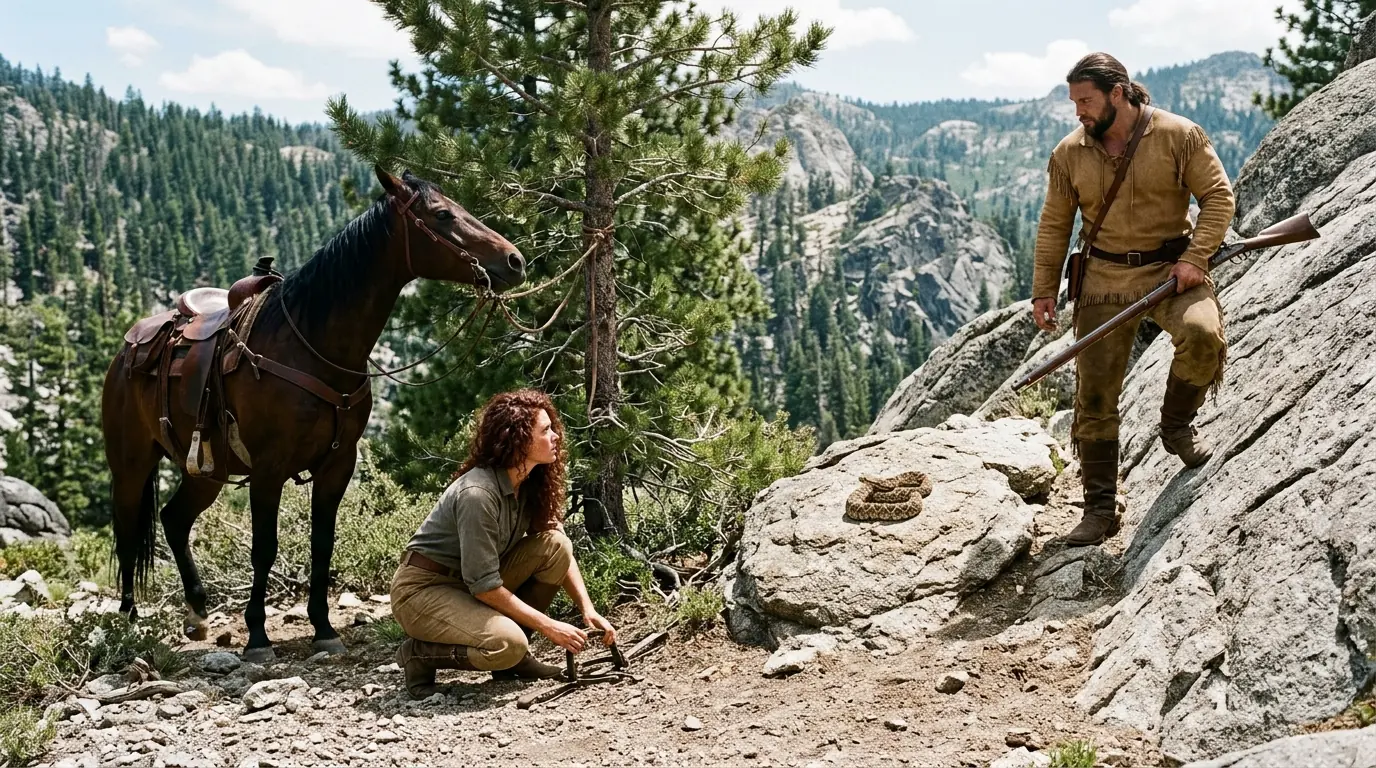
Clara froze with one boot halfway down. The snake lay coiled in the shadow of a sandstone shelf less than three feet from her ankle, thick as her wrist, its diamond-patterned body nearly invisible against the rock. Its head lifted. Its rattle shook again, furious and close.
Her rifle was in her hands, but the barrel was angled wrong. If she moved too quickly, the snake would strike. Her heart thudded once, hard enough to make the world narrow.
A voice came from above her, low and calm.
“Don’t breathe hard.”
Clara’s eyes flicked upward without moving her head. A man stood on the ledge above the wash, half hidden by sun glare and juniper branches. He wore a faded duster, a dark hat pulled low, and a gray beard trimmed close to a scarred jaw. His rifle was already raised.
“I don’t need help,” Clara said through her teeth.
“Yes, ma’am,” he replied. “Snake don’t seem convinced.”
The rifle cracked.
The snake’s head snapped backward into dust and stone. The body twisted violently, then fell still.
Clara stumbled back one step, anger and relief hitting her at the same time. The stranger came down the slope with the careful balance of a man who knew bad ground well. He was tall, perhaps fifty, perhaps older; weather made age difficult to read. His shoulders were broad under the duster, and his movements had the quiet economy of someone who had survived too many close calls to waste motion.
“You all right?” he asked.
“I was handling it.”
He glanced at the dead rattler. “Poorly.”
She narrowed her eyes. “Do you make a habit of insulting women you rescue?”
“Only the ones still breathing.”