Forty-seven minutes.
That was how long Claire Bennett had been sitting alone at a table set for two inside Maison Elise, one of the most expensive restaurants in Chicago.
For forty-seven minutes, she pretended to study a wine list she could barely understand.
She checked her phone often enough that the screen had begun dimming before she touched it.
She adjusted the sleeve of her sapphire-blue dress.
She smiled politely whenever the waiter passed.
And she tried not to notice the sympathetic glances coming from nearby tables.
The dress had cost more than she normally spent on clothes in six months. Claire taught English literature at Roosevelt High School, where her salary covered rent, groceries, student-loan payments, and very little else.
She had justified the purchase because she believed that night would change her life.
Daniel had chosen the restaurant.
He told her to wear something special.
After three years together, Claire had allowed herself to imagine the small velvet box that might appear after dessert.
Their relationship had never been passionate, but it had seemed stable.
Daniel was dependable in the way a clock was dependable. He arrived when expected, made sensible choices, and spoke about the future as though it were an appointment they would eventually schedule.
Claire had mistaken predictability for security.
At 8:17 p.m., her phone vibrated.
Her heart leaped.
The message contained only four sentences.
I’m sorry, Claire.
I can’t keep pretending this is enough.
You deserve someone who wants the same life you do.
Please don’t wait for me.
She read it twice.
Then a third time.
Three years had ended in twenty-one words.
No explanation.
No conversation.
Not even the courage to walk into the restaurant and look at her.
The waiter approached again.
His name was Samuel. Claire knew because she had spent nearly an hour reading the small silver badge on his jacket whenever she needed somewhere safe to rest her eyes.
“Ma’am?”
His voice was gentle.
That somehow made the humiliation worse.
“Will your guest still be joining you?”
Claire looked around.
Crystal glasses caught the soft light. Couples leaned toward each other over candles. A woman at the nearest table lowered her gaze too quickly when Claire noticed her watching.
“No,” Claire whispered.
Samuel’s expression softened.
“Would you like to order for yourself?”
She wanted to.
Part of her wanted to sit there, eat every course, and prove that being abandoned had not diminished her.
But her chest had tightened until breathing felt difficult.
“I think I’ll leave.”
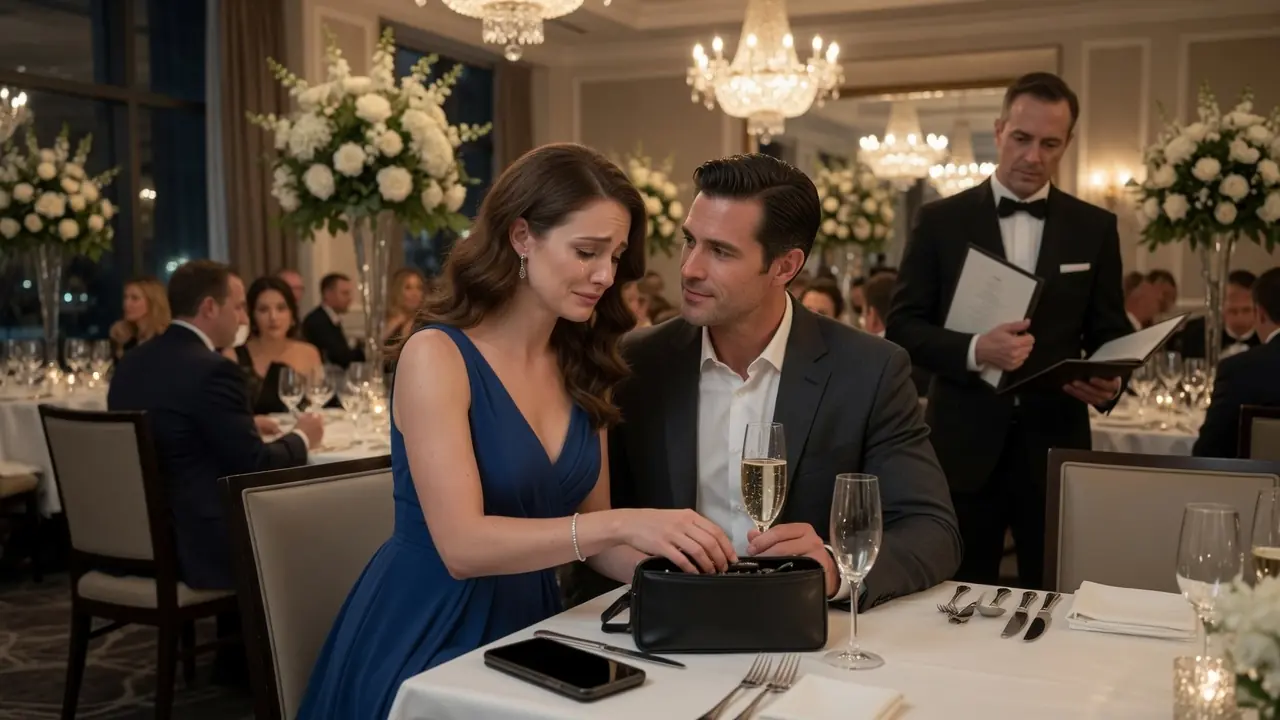
She stood and reached for her handbag.
A man stepped beside the empty chair.
He was tall, perhaps forty, with dark hair, sharp features, and a charcoal suit that fitted him too perfectly to have come from an ordinary store. He carried two glasses of champagne.
“Sorry I’m late,” he said.
Claire stared at him.
The stranger placed one glass on the table and lowered his voice.
“Play along for thirty seconds.”
“What?”
“I watched you receive that message.”
Her embarrassment sharpened.
“You were watching me?”
“I noticed you.”
“That isn’t better.”
“No.”
Something almost like regret crossed his face.
Then he glanced toward the nearby diners.
“But you are about to leave believing everyone in this room sees you as someone who was rejected.”
“I was rejected.”
“That does not make you less worthy of sitting here.”
Claire’s fingers tightened around her handbag.
“I don’t need rescuing.”
“I believe you.”
His answer came without hesitation.
“I’m offering you a choice. Leave because you want to leave, not because a coward made you feel unwelcome.”
The certainty in his voice unsettled her.
He did not sound like a man performing kindness to impress anyone.
He sounded angry on her behalf.
Samuel returned.
The stranger pulled out the empty chair.
“We’ll have the tasting menu for two.”
Claire opened her mouth.
He looked at her.
“You may tell me to leave.”
She should have.
Every sensible part of her understood that sitting down with an unknown man was ridiculous.
But the message still glowed on her phone.
Daniel had taken her choice away by ending their relationship from a distance.
Claire was tired of allowing other people to determine the shape of her evening.
She sat.
The stranger did the same.
He raised his champagne.
“To unexpected changes.”
Claire reluctantly touched her glass to his.
“This does not make you my date.”
“Understood.”
“And I am paying for my own dinner.”
“We’ll argue about that later.”
“We will not.”
A faint smile appeared.
“Then perhaps you should tell me your name before our first argument.”
“Claire Bennett.”
“Ethan Mercer.”
The name meant nothing to her then.
For the first several minutes, conversation was uncomfortable.
Claire answered with short sentences. Ethan did not push.
He asked what she taught.
“Literature.”
“What age?”
“Teenagers who believe every book written before they were born is a personal attack.”
He smiled.
“What are you teaching now?”
“Jane Eyre.”
“Is that the one with the house fire?”
“There is more to it than the fire.”
“I suspected you might say that.”
Claire studied him.
“What do you do?”
“I build things.”
“Houses?”
“Sometimes.”
“Bridges?”
“Occasionally.”
“That is impressively vague.”
“I’ve been told.”
The first course arrived.
As the evening continued, Ethan asked questions that surprised her.
Not what school she worked for or whether she enjoyed vacations.
He wanted to know why she became a teacher.
Claire told him about Mrs. Alvarez, the ninth-grade teacher who placed a copy of The Secret Garden in her hands after Claire’s father disappeared.
“She said books could become doors when real life felt like a locked room.”
“And did they?”
“Yes.”
“What door are you still trying to open?”
The question caught her off guard.
Claire looked down at the table.
“I want to write children’s books.”
“Want to?”
“I write sometimes.”
“Then you are already doing it.”
“Unpublished manuscripts do not make someone an author.”
“Buildings exist before people move into them.”
She looked toward him.
“That sounds like something a man who builds things would say.”
“Probably.”
Claire told him about a story she had been working on for years, about a small girl who collected forgotten words and returned them to people who had stopped speaking honestly.
Daniel used to call the project her “little hobby.”
Ethan listened as though she were describing an important invention.
He asked what the girl was called.
What the forgotten words looked like.
Why people had lost them.
For the first time in years, Claire spoke about her work without apologizing for it.
By dessert, she had almost forgotten why she entered the restaurant.
Almost.
When the bill arrived, she reached for it.
Ethan moved faster.
“Don’t.”
“I told you I would pay.”
“You also told me I was not your date.”
“You aren’t.”
“Then consider it payment for allowing a stranger to interrupt your evening.”
“I’m a public-school teacher. I cannot afford whatever that meal cost.”
“That is precisely why we are not dividing it.”
Claire frowned.
“I don’t like owing people.”
“Then don’t owe me.”
He signed the receipt without looking at the total.
Outside, a black sedan waited at the curb.
A driver stepped forward.
“Good evening, Mr. Mercer.”
Claire stopped.
There was something in the driver’s tone—not merely respect, but practiced formality.
Ethan noticed her expression.
“What?”
She took out her phone.
“Claire.”
She searched his name.
The first result showed Ethan standing in front of a glass corporate tower.
ETHAN MERCER CLOSES $1.8 BILLION INFRASTRUCTURE ACQUISITION
Another headline called him the founder and chief executive of Mercer Global, a company responsible for transportation systems, industrial facilities, and commercial projects across three continents.
His net worth was estimated in the billions.
Claire lowered the phone.
“You said you built things.”
“I do.”
“You left out most of the sentence.”
“I wanted one conversation before my résumé entered the room.”
“You could have told me.”
“And then every word between us would have changed.”
“It has changed now.”
Disappointment crossed his face.
“So what happens?”
“I go home.”
He nodded slowly.
Then extended his hand.
“One more hour.”
“Where?”
“My apartment.”
Claire’s expression hardened.
“Absolutely not.”
Ethan withdrew his hand immediately.
“That was too direct.”
“It was.”
“There is a terrace with a view of the lake. I thought we could continue talking somewhere quieter.”
“You regularly invite strangers there?”
“No.”
“That answer is either reassuring or worse.”
For the first time, he looked uncertain.
“I am not asking you for anything physical. My driver can take you home whenever you choose. You may call someone and give them the address before we leave.”
Claire studied him.
Most powerful men carried confidence as armor.
Ethan’s had slipped.
Underneath it was not arrogance.
It was loneliness.
She texted the address to her friend Laura and entered the car.
The penthouse occupied the top floor of a tower overlooking the lake.
It was beautiful in the way museums were beautiful.
Glass walls.
Perfect furniture.
Art selected with professional care.
Nothing appeared touched often enough to belong to a human being.
Claire walked onto the terrace.
Chicago glittered beneath them.
“It must be incredible waking up to this,” she said.
“It is quiet.”
“That sounds like a complaint.”
“It is an observation.”
Ethan remained several feet away.
“My father died when I was twenty.”
Claire turned.
“He worked in a manufacturing plant outside Gary. A fire started after management delayed replacing damaged electrical systems.”
“I’m sorry.”
“My mother survived him. For a while.”
Claire waited.
“She disappeared after the funeral,” Ethan continued. “Not physically at first. Then completely.”
“What happened?”
“She left.”
He looked toward the city.
“I built my first safety-engineering company because I believed no family should lose someone over a repair that executives considered too expensive.”
Claire understood then.
The money was not the center of his life.
The work was.
“Did it help?” she asked.
“Building the company?”
“With your grief.”
“No.”
His honesty silenced her.
“It gave the grief somewhere useful to go.”
Claire thought about her own father leaving when she was twelve.
About Daniel’s message.
About all the ways abandonment taught a person to remain half-prepared for departure.
“My father vanished too,” she said. “He called once a year for a while. Then not at all.”
Ethan looked at her.
“Daniel knew?”
“Yes.”
“And he still ended things through a text.”
Claire laughed bitterly.
“Apparently people repeat the lesson until you learn it.”
“What lesson?”
“That nobody stays.”
The words were out before she could stop them.
Ethan took one step closer.
“Perhaps that is not the lesson.”
“What is?”
“That you have repeatedly trusted people who were not capable of staying.”
The distance between them narrowed.
His hand rose slowly.
He touched one loose strand of hair near her face, giving her time to move away.
She did not.
Then his phone rang.
The moment broke.
Ethan closed his eyes briefly.
“I’m sorry.”
He answered.
His voice transformed into the clipped, controlled tone of an executive dealing with a crisis.
Claire listened for less than a minute.
Then she collected her bag.
When he ended the call, she stood near the elevator.
“Don’t go.”
“I need to.”
“Because of the call?”
“Because yesterday I thought I was going to marry Daniel. Tonight I am standing in a billionaire’s penthouse.”
“That is a reasonable summary.”
“I need to stand on ordinary ground again.”
He walked her to the elevator.
“May I see you again?”
Claire hesitated.
“Maybe.”
The doors closed.
Only inside the subway station did she realize he had never asked for her number.
The following morning, she woke to forty-seven messages from Daniel.
I made a mistake.
Please talk to me.
I wasn’t thinking clearly.
Then:
Who was the man you left with?
Someone had photographed Claire and Ethan outside the restaurant.
The image had already reached social media.
Claire felt surprisingly little sadness as she read Daniel’s messages.
Mostly anger.
He had abandoned her until another man made her appear valuable.
At school, her friend Laura cornered her in the faculty lounge.
“That was Ethan Mercer.”
“I discovered that.”
“You had dinner with him?”
“Technically.”
“What does technically mean?”
“He sat down after Daniel failed to appear.”
Laura stared.
“That does not happen to normal people.”
“It happened to me.”
During her planning period, Claire returned to her classroom and found a black envelope on her desk.
Inside were two tickets to a private modern-art exhibition.
A note accompanied them.
For the woman who reminded me that buildings are not the only things worth finishing.
Ethan
Claire attended.
She told herself she wanted to see the exhibition.
The lie lasted until she entered the gallery and began searching the crowd.
She found Ethan beside a striking woman wearing an ivory gown. The woman’s hand rested lightly on his arm.
Claire’s stomach tightened.
She turned toward the exit.
“Claire.”
Ethan crossed the room immediately.
The joy on his face was too genuine to mistake.
“You came.”
“I didn’t realize you were with someone.”
He glanced toward the woman.
“Vanessa Grant. Chief operating officer. We are hosting the event for a foundation.”
Vanessa approached.
She was elegant, intelligent, and controlled.
“So this is Claire.”
The wording suggested Ethan had spoken about her.
Before Claire could respond, someone grabbed her arm.
Daniel.
“We need to talk.”
Claire pulled against his grip.
“Let go.”
“You ignored every message.”
“That should have answered you.”
Ethan stepped forward.
“Remove your hand.”
Daniel looked him over.
“Who do you think you are?”
“The man asking once.”
The quiet menace in Ethan’s voice drew attention from the surrounding guests.
Daniel released Claire.
“You’ve known her for one night.”
“And yet I know not to abandon her in a restaurant and demand ownership the next morning.”
Daniel’s face reddened.
Claire felt people watching.
The familiar humiliation began rising.
Then something changed.
She was not sitting alone anymore.
More importantly, she was no longer willing to disappear.
“You knew me for three years,” she told Daniel.
He turned.
“Claire—”
“Three years of canceled plans. Three years of calling my writing childish. Three years of making me grateful for the smallest amount of attention.”
“That isn’t fair.”
“You ended our relationship through a text because you believed I would wait quietly until you changed your mind.”
Daniel’s anger faltered.
“You didn’t leave me at that restaurant,” Claire said. “You released me from a life where I was always asking to matter.”
She walked away.
Ethan followed without touching her.
Outside, Claire began trembling.
“Are you all right?” he asked.
“Yes.”
She laughed once, breathlessly.
“I think that was the first completely honest conversation Daniel and I ever had.”
Ethan explained Vanessa before Claire asked.
“She has wanted our relationship to become personal. I have never encouraged it.”
“Why tell me?”
“Because I don’t want uncertainty to become dishonesty.”
Claire looked at him.
“We barely know each other.”
“I would like to change that.”
This time, Claire set the conditions.
No luxury restaurant.
No driver.
No private gallery.
“A normal date.”
Ethan arrived at her apartment Saturday wearing jeans and a dark sweater.
He drove himself.
Their first stop was a street festival.
Ethan ate a hot dog from a food truck and got mustard on his chin.
Claire laughed so hard she had to sit down.
They visited a used bookstore, where he followed her through narrow aisles without rushing.
When she caught him buying every book she had picked up and reluctantly returned to the shelf, she protested.
“This is not normal.”
“People buy books on dates.”
“Not fourteen.”
“I am an enthusiastic beginner.”
At dinner in a small neighborhood Italian restaurant, the elderly owner recognized Ethan.
“I haven’t seen you since your father used to bring you here.”
Ethan’s body became rigid.
The owner apologized and moved away.
Claire did not press.
Eventually Ethan explained the factory fire fully.
His father had died.
His mother, Eleanor, had suffered a breakdown and left him in the care of an uncle.
“She sends letters sometimes,” he said. “I never answer.”
“You told me you lost both parents.”
“I did.”
Claire understood the distinction.
Weeks passed.
Their relationship grew through ordinary moments.
Coffee before school.
Phone calls after board meetings.
Claire reading him unfinished chapters.
Ethan attending a student production of Romeo and Juliet and remaining respectful despite the performance lasting nearly three hours.
But Ethan’s public life followed him everywhere.
Photographs appeared online.
Old stories resurfaced describing him as a ruthless playboy.
Many women in the photographs were colleagues, charity partners, or executives. Two had been serious relationships that ended years earlier.
Claire believed him.
Belief did not erase insecurity.
Vanessa made certain of that.
She called Claire under the guise of concern.
“Ethan is a good man,” she said. “But the company will always come first.”
“Why are you telling me?”
“Because I have watched other women believe they would change him.”
Claire ended the call.
Then anonymous photographs arrived.
Ethan and Vanessa at a hotel bar.
Entering an elevator.
Standing close during a conference.
Ethan explained each image immediately and invited Claire to verify everything with members of his executive team.
He confronted Vanessa.
She denied sending the photographs until company security traced the anonymous account to an assistant acting under her instructions.
Vanessa resigned rather than face termination.
“You are giving up everything we built for a teacher you barely know,” she told him.
“No,” Ethan replied. “I am protecting something real from someone who decided possession was the same thing as love.”
The next threat came from Claire’s past.
Richard Bennett appeared at her school after twenty-two years.
Her father looked older and smaller than memory, but his eyes remained alert for opportunity.
He apologized.
Blamed addiction.
Blamed fear.
Blamed youth.
Claire almost allowed herself to believe him.
Then he mentioned Ethan’s wealth.
“A man like that could help family,” Richard said.
Claire stood.
“You did not come because you missed me.”
“I am your father.”
“You are a man who returned after seeing my photograph beside a billionaire.”
Richard’s expression hardened.
“You think you’re better than me now?”
“No.”
Claire opened the office door.
“I think I finally understand you.”
When he refused to leave quietly, the principal called security.
Richard went to the tabloids.
He claimed Ethan had manipulated Claire and isolated her from a sick father seeking reconciliation.
The story spread rapidly.
Strangers called Claire a gold digger.
Reporters appeared outside her school.
The company’s stock declined as rival firms used the scandal to question Ethan’s judgment.
Claire offered one interview.
She spoke calmly about being abandoned as a child and about Richard returning only after learning Ethan’s identity.
Some people believed her.
Others never would.
Threats followed.
A dead sunflower arrived at the school.
Ethan asked Claire to stay at his penthouse until security identified the sender.
She resisted.
Moving into his protected world felt too much like surrendering her own.
Then someone posted her home address online.
She packed a bag.
Living together under fear exposed every weakness in their relationship.
Claire could not work in person.
Ethan was consumed by meetings, security reviews, and investor calls.
One evening, he canceled dinner for the third time.
Claire’s frustration erupted.
“Vanessa was right.”
Ethan went still.
“She said you would promise to be present but always choose the company.”
“I have ten thousand employees watching their savings disappear because someone turned our private lives into a weapon.”
“I know.”
“Do you?”
“I am trapped in this apartment, Ethan. I cannot teach. I cannot walk outside. I cannot see anyone without security following me.”
“You think I want that?”
“I think you know how to manage crises, but you do not know how to live with the person inside one.”
His face tightened.
“That is unfair.”
“So is all of this.”
They shouted.
Not because they stopped loving each other.
Because both were terrified.
Ethan left to walk alone.
Hours later, Claire received a call from Eleanor Mercer.
Ethan’s mother.
She had followed news about him from a distance for years.
“I failed my son,” Eleanor said. “After his father died, grief made me selfish. Ethan learned that work was the only thing that did not leave.”
Claire closed her eyes.
“He is repeating it now.”
“Yes.”
“Then how do I compete with something that kept him alive?”
“You should not compete.”
Eleanor’s voice trembled.
“He has to learn that survival and living are not the same.”
When Ethan returned, Claire told him about the call.
His composure collapsed.
For the first time, he allowed her to see the boy beneath the empire.
The twenty-year-old who buried his father.
The son who waited for a mother who never returned.
“I’m afraid if I stop working, everything disappears,” he admitted.
Claire sat beside him.
“And I’m afraid if I need someone, they disappear.”
They held each other.
Not healed.
But honest.
Then Ethan’s phone sounded with an emergency alert.
A structural collapse had occurred at one of Mercer Global’s processing facilities.
Several employees were trapped.
Ethan moved toward the door.
Claire took her coat.
“You should stay here.”
“I’m coming.”
“It could be dangerous.”
“This is what people who love each other do.”
She took his hand.
“They show up.”
At the site, Claire saw the purpose behind Ethan’s work.
He knew supervisors by name.
He spoke directly with families.
He arranged medical treatment before discussing financial exposure.
He remained until every worker was accounted for.
The collapse injured twelve people.
Nobody died.
Investigators discovered that support bolts had been deliberately loosened during maintenance.
Security footage identified a subcontractor receiving money from a corporate intermediary.
That intermediary had met repeatedly with Richard Bennett.
Richard had sold personal information about Claire and Ethan to a rival development company. He provided schedules, contact information, and access details obtained by pretending he wanted reconciliation.
He claimed he never knew anyone would be harmed.
The evidence showed he accepted payment after the sabotage plan had been discussed.
Richard was arrested along with three corporate conspirators.
Claire blamed herself.
Ethan refused to let her.
“You are not responsible for the character of the man who abandoned you.”
“He reached you through me.”
“He reached for us through your wound.”
Ethan held her face between his hands.
“But you did not create him.”
Claire visited Richard once in jail.
He offered excuses.
Debt.
Desperation.
Manipulation.
An unfair world.
Claire listened until he had nothing left.
“I forgive you,” she said.
Hope entered his face.
“Not because you deserve access to me.”
His hope faded.
“I forgive you because I do not want to carry you anymore.”
“Claire—”
“This is the last time we speak.”
She left before he could turn forgiveness into another opportunity.
Outside, Ethan waited inside a car.
He had offered to enter with her.
She asked him not to.
When Claire opened the door, he did not ask what happened.
He simply held out his hand.
She took it.
A month later, Ethan cleared his calendar for the first time in eight years.
“Come away with me.”
“Where?”
“Somewhere nobody knows us.”
They spent two weeks in Tuscany.
No interviews.
No board meetings except one emergency call.
No security team close enough to see.
They walked through villages, became lost on country roads, and ate meals at restaurants where nobody cared about Ethan’s net worth.
Claire finished the first draft of her children’s book on a terrace overlooking a sunflower field.
Ethan read it in one sitting.
“The girl needs to keep the word ‘stay,’” he said.
Claire looked at him.
“She gives it back at the end.”
“She should keep one word for herself.”
Claire revised the final page.
On their last evening, Ethan led her to a hill overlooking the valley.
He was nervous in a way Claire had never seen.
“I prepared a speech.”
“That sounds dangerous.”
“I forgot most of it.”
“Probably for the best.”
He laughed.
Then took both her hands.
“The night we met, I thought I was rescuing you from embarrassment.”
Claire smiled.
“You were very pleased with yourself.”
“I was.”
His expression became serious.
“But you were never the person who needed rescuing.”
He lowered himself onto one knee.
Claire stopped breathing.
“You taught me that being loved is not the same as being useful,” Ethan said. “You taught me to remain when there is nothing to fix.”
He opened a small box.
The ring was delicate and vintage in design, remarkably similar to one Claire had once drawn in the margin of a notebook.
“You remembered.”
“I remember everything you think nobody notices.”
Tears filled her eyes.
“Claire Bennett, will you build a life with me?”
“Yes.”
“You should consider it carefully.”
“I have.”
She pulled him to his feet before he could say anything else.
They married the following spring in a garden outside the city.
The ceremony was small.
Claire’s mother attended.
So did Eleanor, who sat quietly in the second row after beginning the slow work of rebuilding a relationship with her son.
Claire kept teaching.
Ethan continued running his company but established boundaries he had once considered impossible.
He attended Claire’s book launch six months later.
The Girl Who Collected Forgotten Words became more successful than either expected.
On the dedication page, Claire wrote:
For those who were left behind—and for those who learned to stay.
At the reception, Ethan found her standing alone near a window.
“What are you thinking about, Mrs. Bennett-Mercer?”
“That is an unnecessarily long name.”
“You chose it.”
“I was emotional.”
He wrapped his arms around her.
Claire looked across the room at students, teachers, friends, and readers holding the book she once believed would never exist.
“I was thinking about Maison Elise.”
“The worst entrance I have ever made.”
“The most arrogant.”
“I brought champagne.”
“You interrupted a private disaster.”
“You looked like you needed an accomplice.”
Claire turned in his arms.
“That night, I thought my life was ending.”
Ethan touched her cheek.
“It was.”
She raised an eyebrow.
“The version where you settled for being half-seen.”
Claire smiled.
Daniel had left her at a table for two.
For a long time, she believed the important part of the story was that another man appeared and filled the empty chair.
It was not.
The important part was that Ethan did not ask her to become smaller once he sat down.
And when his own life became frightening, Claire did not ask him to become less complicated in order to be loved.
They did not rescue each other.
They witnessed each other.
Then, through scandal, fear, grief, work, and every painful truth they had spent years avoiding, they made the more difficult choice.
They stayed.