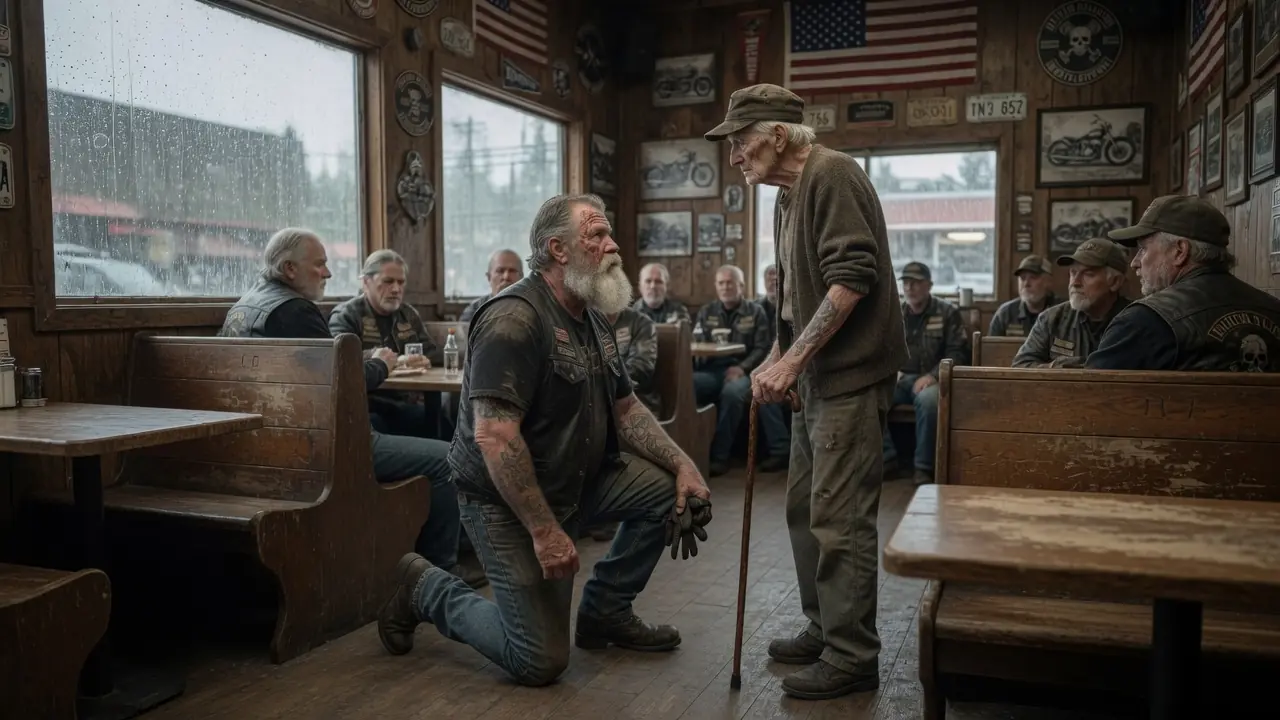
Inside the diner the air was warm and thick with the smell of bacon grease and wet wool. Forks paused halfway to mouths when the nine men in soaked black cuts walked through the door. People always did that when bikers entered small places. Mason didn’t blame them. He had spent most of his life giving strangers reasons to be nervous.
He was sixty-two now, broad through the shoulders and thick in the hands from decades of turning wrenches and throwing punches. His beard had gone mostly gray, and the skin around his eyes looked like old road maps. The patch across his back read Iron Saints, but there had been years when the only saint he believed in was the bottom of a bottle.
He was scanning the booths out of habit when he saw the old man in Booth 7.
The man sat alone by the fogged window, wearing a faded Army cap and a brown cardigan that had seen better decades. A small plastic hospital bracelet still circled his thin wrist. His eggs had gone cold on the plate. His coffee sat untouched. He stared out at the rain with the gentle, distant expression of someone whose mind had already left the room and was walking through some other year.
Mason stopped walking.
Behind him, the rest of the Saints stopped too. Someone near the counter whispered, “Please don’t let this turn into something.” Mason barely heard it. All the noise in the diner seemed to pull back, like water draining from a sink.
He knew that face.
Even with the years and the illness carving it thinner, he knew it.
Fifteen years. Fifteen years of searching, of dead ends, of almost giving up, of getting clean just far enough to start looking again. Fifteen years of carrying a single photograph sealed in plastic inside his cut, folded so many times the edges had gone soft.
Mason took off his gloves slowly, folded them, and tucked them into his pocket. Then he walked toward Booth 7 like a man approaching something holy.
The waitress started to move, maybe to stop him, but something in the way he held himself made her stay where she was. Mason reached the table and lowered himself to one knee on the worn linoleum. His bad leg from Kandahar protested, but he stayed down.
People began whispering immediately. Someone lifted a phone. Mason didn’t look at any of them.
He bowed his head.
“Sergeant Whitaker,” he said, voice low and rough. “I finally found you.”
The old man turned his cloudy blue eyes toward him. There was no fear in them, only a polite confusion.
“I’m sorry, son,” he said gently. “Do I know you?”
Mason’s face broke in a way that made the entire diner go still. He reached inside his cut with a hand that trembled for the first time in years and pulled out the photograph. He laid it on the table between them.
In the picture, a much younger Mason lay on a dusty Afghan road beside a burning truck, blood soaking the sand under him. A soldier in desert camo knelt over him, both hands pressed hard against Mason’s chest, face tight with concentration.
“That was Kandahar,” Mason said. “November 2009. You pulled me out before the second IED went off. You stayed with me until the medevac came. I should have died out there.”
The old man stared at the photograph for a long time. His finger, knotted with arthritis, touched the edge of the plastic. Recognition flickered somewhere far back in his eyes, then faded like a lightbulb about to burn out.
“I don’t…” he began, then stopped. He looked at Mason with genuine sorrow. “I’m sorry. I don’t remember.”
A woman in her late forties hurried over from the register, her face already streaked with tears she hadn’t finished wiping away. She was the old man’s daughter. Mason could see it in the shape of her eyes and the way she moved to stand between them at first, protective.
“Dad has Alzheimer’s,” she said quietly, voice shaking. “Some days he remembers the war. Most days he doesn’t even remember what he had for breakfast. Please… he doesn’t mean to forget.”
Mason nodded. He stayed on one knee.
“I came to thank him,” he said. “Took me fifteen years to get clean enough to deserve standing in front of him.”
The daughter’s hand flew to her mouth. She looked at the photograph, then at Mason’s face, and something in her expression shifted from fear to something closer to pain.
Mason kept his eyes on the old man.
“I was twenty-three when that picture was taken,” he said. “Came home broken in more ways than the shrapnel could explain. Spent the next decade trying to drink and drug myself into forgetting what it felt like to almost die out there. I lost everything. My wife left. My kids stopped answering the phone. I ended up in a county jail more times than I can count. Every time I got out, I told myself I was going to find you and say thank you before I died. But I was never clean long enough to actually do it.”
He swallowed hard.
“Four years ago I got sober for real. Started riding with these men behind me. They kept me alive when I wanted to quit. I’ve been looking for you ever since. Your old unit gave me a last known address in Ohio. That led to a nursing home in Kentucky. That led to your daughter’s name on a care facility form here in Tennessee. I’ve been riding toward this moment for fifteen years.”
The old man had been listening with his head tilted slightly, the way people do when they’re trying very hard to follow a story that keeps slipping away from them. When Mason finished, Sergeant Whitaker reached out with one trembling hand and placed it on Mason’s leather-covered shoulder.
“Did you make it home, son?” he asked.
Mason closed his eyes. For a second the rain outside and the diner around them disappeared.
“Yes, Sergeant,” he said. “Because of you.”
The old man nodded slowly, as if that single fact made sense even if everything else around it had gone hazy.
“That’s good,” he said. “That’s real good.”
He looked down at his cold eggs, then back at Mason.
“You want to sit with me a while?”
Mason’s throat closed. He nodded and carefully rose from his knee, wincing as his leg straightened. He slid into the booth across from the old man. His brothers stayed back near the door, giving him space. The daughter stood beside the table, torn between leaving them alone and staying close in case her father became confused or frightened.
The waitress brought a fresh cup of coffee for Mason without being asked. She set it down gently, her eyes red.
For several minutes no one spoke. The rain kept tapping the windows. The old man occasionally looked at the photograph again, touching it like he was trying to pull something out of it that wouldn’t come.
Then he said, almost to himself, “I remember the sound the truck made when it burned. I remember thinking I wasn’t going to be able to hold pressure on your chest long enough.”
Mason’s head came up.
“You remember that?”
The old man’s eyes cleared for a moment, sharp and present.
“I remember thinking you were too young to die that far from home,” he said. “I remember promising God that if I got you out of there, I’d try to be a better man when I got back.”
Mason’s hands tightened around the coffee cup.
“You kept that promise, Sergeant.”
The old man smiled faintly. Then the clarity slipped again. He looked around the diner like he was surprised to find himself there.
“Where’s your mother?” he asked his daughter.
“She’s at home, Dad,” she said softly. “Remember? We came here for breakfast.”
The old man nodded, accepting the answer even though it clearly didn’t fit anywhere in his mind.
Mason stayed in the booth. He didn’t try to fill the silence with more stories. He just sat there while the old man finished his coffee, one slow sip at a time. When the cup was empty, Sergeant Whitaker pushed it gently toward the center of the table and looked at Mason with something close to recognition again.
“You take care of yourself, son,” he said. “You made it home. That matters.”
Mason nodded. He couldn’t speak.
The daughter touched his arm lightly.
“Would you… would you like to come by the house sometime?” she asked. “He has good days and bad days. On the good days he might remember more. I can’t promise anything, but…”
Mason looked at her for a long moment.
“I don’t need him to remember,” he said. “I just needed to say it out loud while he was still here.”
She nodded, tears slipping down her face now without shame.
Outside, the rain had eased to a steady drizzle. Mason’s brothers were still waiting by their bikes, engines cold, no one complaining about the wait. When Mason finally stood and walked out of the diner, none of them asked what had happened. They simply nodded, started their engines, and followed him back onto the wet highway.
He never told them the full story that day. Some things were too private even for brothers.
But that night, alone in a cheap motel room outside Atlanta, Mason took the photograph out of his cut again. He looked at the young man bleeding in the sand and the soldier kneeling over him. For the first time in fifteen years, he allowed himself to cry.
Not because the old man had forgotten.
But because, for one clear minute in a foggy diner in Chattanooga, Sergeant Whitaker had remembered enough to ask if Mason had made it home.
And Mason had been able to answer yes.
That was more than he had ever let himself hope for.
Two weeks later a letter arrived at the garage where Mason worked on bikes. It was from the daughter. She wrote that her father had asked about “the man with the picture” on three different days since the diner. He didn’t remember the name or the war story, but he remembered the feeling of someone kneeling in front of him with respect.
She included a new photograph. This one showed Sergeant Whitaker sitting in his recliner at home, wearing the same brown cardigan, holding the old Kandahar picture in both hands. He wasn’t smiling at the camera. He was looking at the photograph with an expression of deep, quiet concentration, as if he were trying very hard to keep something important from slipping away.
Mason taped that picture to the inside of his toolbox.
Every morning when he opened the lid to pull out his tools, he saw it.
He never went back to the house. He had said what he came to say. Pushing for more would have been selfish. But sometimes, late at night when the garage was quiet and the rain tapped on the metal roof the same way it had on the diner windows, Mason would sit on an old milk crate and look at the photograph.
He would remember the weight of the old man’s hand on his shoulder.
He would remember the simple question: *Did you make it home, son?*
And he would answer it again, out loud, to the empty garage.
“Yes, Sergeant. Because of you.”
Then he would close the toolbox, turn off the lights, and go home to the small apartment above the shop where he now lived alone. Clean. Sober. Grateful in a way that didn’t need to be witnessed to be real.
The men who had ridden with him that day never asked for the full story. They didn’t need to. They had seen the way Mason knelt. They had seen the way he stayed until the coffee was gone.
That was enough.
Because sometimes the bravest thing a man can do is kneel in a room full of strangers and thank someone who may never remember saving his life.
And sometimes the kindest thing the saved man can do is accept that gratitude without needing to earn it all over again every single day.
Mason Price carried both of those truths with him for the rest of his life.
He never spoke about that morning in Rosie’s Diner again.
But every time he saw an old man in an Army cap, he slowed down.
Just in case.