The morning had promised sunshine, and for once the promise had held. Light spilled across the wide lawns of Ashenford Hall in long golden strips, warming the tops of the yew hedges, and the polished stones of the terrace. A soft wind carried the smell of cut grass and roses, and beneath that the sharper, sweeter smell of lemon cakes set out on the long linen table. Miss Vivienne Ashcombe stood a little apart from the crowd, her gloved hands folded before her and watched the party from the edge of the rose walk. She was not hiding.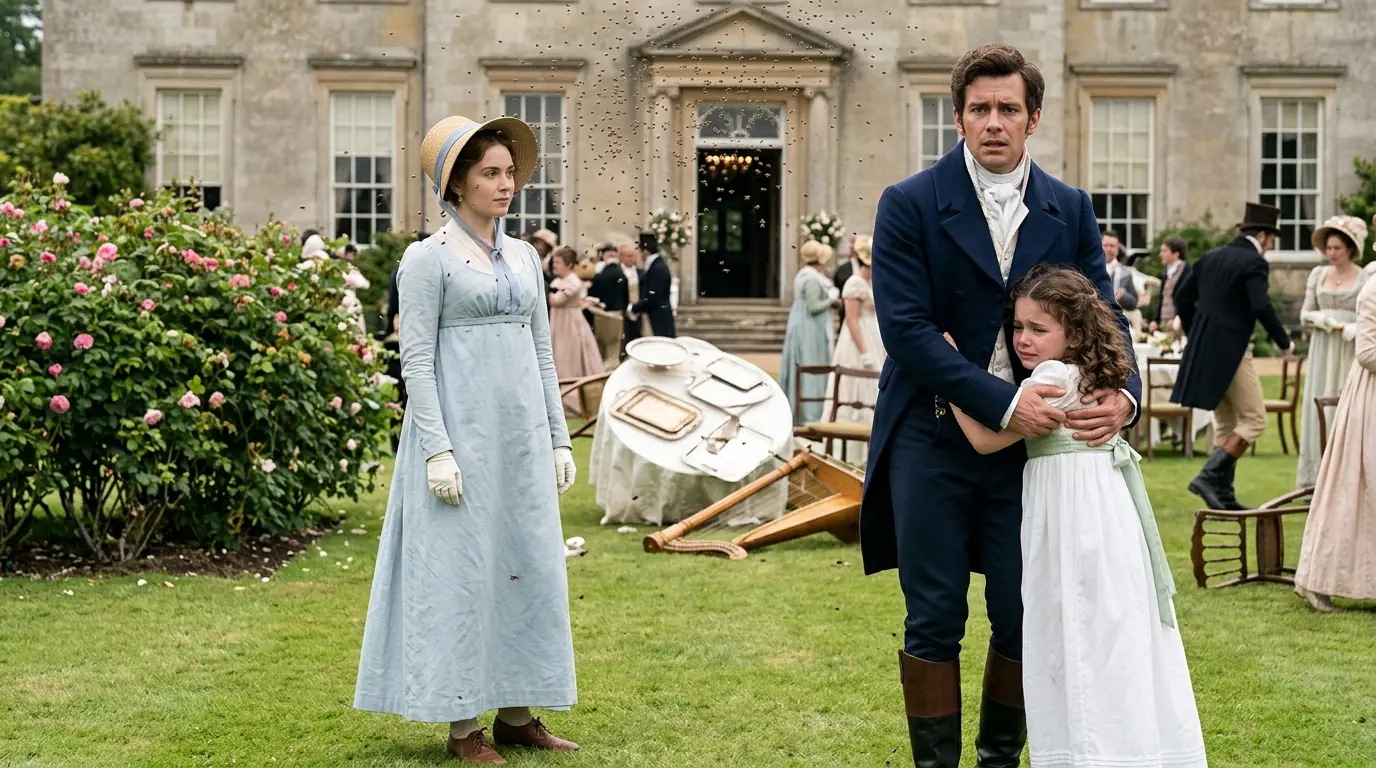
She was simply standing where she could see without being seen too much. It was a trick she had learned early, and it had served her well. The garden party at Ashenford was the event of the summer. Everyone said so. The Duke of Ashenford had not opened his gates to society for nearly 3 years, and now, without warning, invitations had gone out across half of England.
Mothers had polished their daughters and pressed their best silks. Fathers had reminded sons to bow properly. Carriages had lined the drive since 10:00 in the morning. Vivienne had come with her aunt, who had already vanished into the crowd. That suited Vivienne.
She had no wish to be paraded. She was seven-and-twenty, unmarried, and as her aunt reminded her often, not the sort of girl a duke would notice. Vivienne did not mind. She had come for the gardens. She had heard the Ashenford roses were the finest in the county, and she had wanted to see them for herself.
She lifted her face to the sun and closed her eyes for a moment. The warmth was gentle on her cheeks. From somewhere behind the hedge came the small sound of a child laughing quick and bright, then cut off. Vivienne opened her eyes. She wondered whose child it was.
There were not many children at these things. She had barely finished the thought when she saw him. The Duke of Ashenford stood at the top of the terrace steps, one hand resting lightly on the stone balustrade. He was not what she had expected. He was tall, yes, and dressed in dark blue with a plain white cravat, but there was nothing showy about him.
He looked like a man who had been asked to attend his own party and had agreed only because there was no polite way to refuse. His eyes moved over the crowd with a quiet, careful attention, as though he were counting something. Vivienne looked away. She did not want to be caught staring. She turned toward the rose walk instead and began to move slowly along it, brushing her fingers just above the petals without touching them.
The scent was thick and warm here, layered like heavy cloth. Somewhere a bee droned past her ear, and she smiled. She loved bees. Her father had kept them before he died. She had helped him tend the hives as a girl, wrapped in a long veil that smelled of smoke and honey.
She remembered the low, steady hum of the hive, and the way her father would speak to the bees in a soft voice, telling them the news of the family. "Tell the bees," he used to say. "If you do not tell the bees, they will leave." She had not told the bees when he died. There had been no bees left to tell. A movement caught her eye.
A small girl, perhaps six years old, was crouched at the far end of the rose walk. She was dressed in white muslin with a pale green sash, and her dark curls had come partly loose from their ribbon. She was staring at something in the grass with fierce concentration. Vivienne walked toward her slowly so as not to startle her. "What have you found?" she asked, keeping her voice low.
The child looked up. She had large, serious eyes and a scratch on one cheek that had already begun to heal. She did not smile. She simply studied Vivienne for a long moment, as though deciding whether to answer. "A bee," the child said at last.
"It cannot fly." Vivienne knelt down carefully, spreading her skirts around her. On a flat stone at the edge of the path lay a single honeybee, its wings damp, its small body still. It was not dead. Vivienne could see the faint tremble of one leg. "It got wet, I think," the child said.
"In the fountain. I took it out."
"That was kind of you," Vivienne said.
"Nurse says bees sting." "They can, but this one is too tired. She will not sting you today." The child considered this. "The worker bees are all girls." "Oh." The child looked at the bee with new interest. "Then she needs help."
"She needs sun," Vivienne said. "And a drop of something sweet. Do you have anything sweet?" The child shook her head. Then, after a moment, she reached into the small pocket sewn into her sash and pulled out a crumpled piece of paper. Inside was half a sugared almond.
"I saved it," she whispered as though this were a great secret. "From breakfast."
"That will do very well." Vivienne took the sugared almond and crushed a small piece between her fingers. She let a few grains of sugar fall onto the stone beside the bee. Then she cupped her hand carefully over the little creature to keep the wind from her and she waited.
The child watched without moving. She hardly seemed to breathe. Above them, the party carried on. Voices rose and fell. Someone was playing a harp under the great cedar tree.
A footman passed carrying a tray of small glasses. None of it seemed to matter here at the end of the rose walk where a girl and a woman knelt over a wet bee. After a long minute, the bee's leg moved, then another. It shifted slow and clumsy and touched the grain of sugar with its long tongue. The child made a small delighted sound and pressed her hand quickly to her mouth. "She is drinking," she whispered.
"She is." They watched. The bee drank. Its wings began to move. First a shiver, then a slow beat. Vivienne felt the small warm current of air against her palm. "You saved her," Vivienne said.
"You did," the child said. "We did," said Vivienne. The child looked up at her, and this time she smiled. It was a small, careful smile, as though she had not used it much lately, and it made her whole face different. "I am Petra," she said.
"I am Vivienne." "Are you a lady?" "I am a miss. Is that less than a lady?"
"A little less, but not much." Petra thought about this. "My uncle is a duke. That is more than a lady."
"He does not like parties." "Then he must be very tired today."
Petra nodded solemnly. "He is." Vivienne smiled. She lifted her hands slowly away from the stone. The bee sat for another moment, drinking, and then, with a small, clean movement, it lifted itself into the air. It hovered for a heartbeat above Petra's head as though thanking her, and then it was gone into the roses. Petra watched it go with her mouth a little open. "Now you must tell the other bees," Vivienne said without thinking. "Tell them that you were kind to their sister."
"Do bees remember?" Petra's eyes grew even larger. "Truly. My father told me so." Petra nodded once as if she were making a serious promise. Then she looked past Vivienne and her small face changed. It did not close exactly.
It simply became more careful. Vivienne turned. The Duke of Ashenford was standing at the top of the rose walk, watching them. She had not heard him come. He must have moved very quietly, or she must have been very absorbed.
She rose to her feet at once, brushing her skirts, and made her curtsy. It was neither grand nor small. It was correct. "Your grace," she said. He inclined his head. His eyes moved from her to Petra, and something in his face eased just a little. "Petra," he said. "Uncle." Petra's voice was very small. "I was helping a bee."
"I see." "Miss Vivienne helped me. She knows about bees."
"Does she?" He looked at Vivienne again. His eyes were dark gray, quieter than she had expected. He did not smile. He did not frown. He simply looked at her as though he were reading a page he had not seen before.
"Forgive me, your grace," Vivienne said. "I did not mean to keep her from you. You have not kept her from me." There was a small silence. Vivienne became aware of the sound of the harp again, drifting from beyond the hedge, and of the way the sun struck the top of the Duke's dark hair. He smelled faintly of clean linen and something like cedar.
He did not seem in any hurry to move. "You are Miss Ashcombe," he said. She blinked. "Yes, your grace." "You came with Lady Maravel." "My aunt?" "Yes." He nodded once as though this confirmed a small fact he had wanted confirmed. He said nothing else.
Petra slipped her small hand into Vivienne's quite naturally, as though she had been doing it all her life. Vivienne felt the warm little fingers curl around her own. The Duke saw it. Vivienne watched him see it. She waited for him to call the child back to his side.
He did not. He only bent slowly and offered Petra his other hand. "Come," he said. "Your grandmother is asking for you." Petra did not move. She looked up at Vivienne.
"May Miss Vivienne come?" The Duke straightened. He looked at Vivienne again. She thought for a heartbeat that he was going to refuse. Instead, he said in the same quiet voice, "If Miss Ashcombe pleases." Vivienne was pleased. She did not say so.
She simply nodded and Petra pulled her forward and the three of them walked back up the rose walk together out of the shade and into the bright busy noise of the party. The moment they stepped onto the lawn, heads turned. Vivienne felt the shift like a change in the wind. Fans paused. Conversations dipped.
She saw her aunt across the grass, one hand pressed to her chest. She saw a tall young woman in yellow silk, whose face went first pale, then tight. She saw a footman, who had been about to speak to the Duke, change his mind and stepped back. Petra did not notice any of it. She was telling Vivienne about a rabbit she had seen in the kitchen garden that morning.
The Duke walked on Petra's other side, matching his pace to the child's short one. He did not speak. He did not need to. His presence beside Vivienne was speaking loudly enough on its own. They reached the great cedar.
Under it, a small circle of chairs had been set up, and in the largest chair sat an old woman in black. Her hair was white, and her eyes were sharp. She held a walking stick across her knees. "There you are, child," she said. Her voice was dry, but not unkind.
"And who is this?" "Miss Ashcombe, grandmother," the Duke said. "Miss Ashcombe, my mother, the Dowager Duchess." Vivienne curtsied again. The old woman studied her without blinking. Ashcombe she said of Maravel house. My aunt is Lady Maravel.
Your grace your father was Colonel Ashcombe. Yes. He kept bees. Vivienne. Vivienne's breath caught.
He did more. Remember the Dowager Duchess tapped her stick lightly on the grass. He sent my late husband a jar of honey once. It was the best honey I ever ate. I said so at the time.
Your father wrote me back a very civil letter. He said the credit belonged to his bees. Vivienne smiled. It was a small sudden smile that she could not stop. That sounds like him.
She said. Sit down child. The Dowager Duchess said, "Not you, Petra. You are wanted at the pony. Ashenford, take her." The Duke did not argue with his mother.
He held out his hand to Petra, and Petra took it, but not before she squeezed Vivienne's fingers hard once and whispered, "Do not go. I will be here." Vivienne whispered back. The Duke lifted Petra onto his hip as easily as though she weighed nothing and walked away with her toward the far side of the lawn where a small brown pony had been led out for the children of the guests. Vivienne watched them go. She could not help it.
Sit, the daer said again. Vivienne sat. For a moment, the old woman did not speak. She simply watched her grandson cross the grass with the child on his hip. Her sharp eyes softened, then hardened again.
"She has not let anyone hold her like that in a year," she said quietly. "Not since her mother died." Vivienne did not know what to say. "She said nothing. You knelt in the dirt with her. There was a bee." So I gathered.
So I gathered. The Dowager Duchess looked at her at last. Most young women would have called a footman. Most young women were not raised by a man who kept bees. The Dowager Duchess duchess made a small sound that might have been a laugh.
No, I suppose not. They sat in silence for a moment. The harp had stopped. A servant was passing among the guests with tall glasses of something pale. The tall young woman in yellow silk had positioned herself near the cedar, clearly waiting for the duke to return.
Her mother stood behind her, arranging her curls with quick, sharp fingers. The Dowager Duchess followed Vivienne's gaze. "That is Miss Cressida Halverton," she said. "Her mother has decided that my son will marry her by autumn."
"Has he decided?" "No." "Then perhaps he will not."
Then perhaps he will not. Perhaps the Dowager Duchess tapped her stick again. You are very calm, Miss Ashcombe. I have no reason not to be. Your grace, have you not?
Vivienne did not answer. Across the lawn, the Duke had set Petra on the pony's back and was holding the leading rein. Petra was laughing. It was a full open laugh, the kind a child makes when she has forgotten to be careful. Vivienne saw the Duke's face at that laugh.
He did not smile with his mouth. He smiled with his shoulders, which lowered by a small visible degree, and with his eyes, which lost some of their carefulness. Vivienne looked away before she was caught. It was then that she heard it. A low, deep hum at first almost too soft to notice, then rising, rising fast.
She turned her head. Across the lawn, above the yew hedge that ran along the east side of the garden, a dark cloud was lifting into the sky. It was not a cloud. It was moving too fast, and it had a shape that shifted and gathered. It rose, hung in the air for a heartbeat, and then began to move altogether toward the party.
Vivienne stood. "Oh," she said very softly. The Dowager Duchess turned to look, her hand tightened on her stick. "What in heaven?" "Please," Vivienne said. The hum grew louder.
It became a roar, low and dark, like the sound of a river in flood. On the lawn, people began to notice. A woman screamed. A man shouted. Someone dropped a glass and it shattered on the flagstones with a small, clear sound that was swallowed at once by the rising drone.
The swarm came down over the lawn like a black scarf thrown across the sun. For one long terrible moment, no one moved. Then everyone moved at once. Ladies snatched up their skirts and ran. Gentlemen shielded their heads with their hats.
A footman upended a tray. The harp toppled with a great discordant crash. The tall young woman in yellow silk shrieked at a pitch that hurt the ear and bolted toward the house, dragging her mother behind her. Within seconds, the great lawn of Ashenford Hall was a scene of complete disorder. Silk skirts and coats and hats fleeing in every direction.
The guests pouring toward the terrace like water down a drain. Vivienne did not run. She looked across the lawn. The Duke was at the pony. He had already lifted Petra off its back.
The pony, mad with the sound, had reared once and torn its rein from the groom's hand, and was now bolting for the far gate. The Duke had Petra in his arms. He was walking, not running, toward the house, one hand on the back of the child's head, pressing her face into his shoulder. But he was too far. The swarm was ahead of him.
It was between him and the house, and Petra was crying high and thin. A sound Vivienne could hear even through the roar. Vivienne moved. She did not think about it. She simply moved.
She lifted her skirts and she walked fast but not running straight into the lawn where the swarm was thickest. Behind her, she heard the Dowager Duchess say her name once sharply. She did not stop. The bees were everywhere. She could feel them against her face. small warm bodies bumping into her cheeks, her forehead, her hair.
She did not swap them. She kept her hands low. She kept her breath slow. She spoke out loud in the same soft voice her father had used when she was a child. "Peace, sisters," she said.
"Peace. You are only tired. You are only looking for a home." The Duke saw her coming. She saw his face across the noise. He was not calm.
He was holding Petra so tightly that his knuckles were white against the child's white dress. Bees were on his shoulders. One was crawling on the side of his throat. He had not brushed it away. He had not moved.
Vivienne reached him. "Do not move quickly," she said in a low voice. "They are not angry. They are lost. Do you hear me, Your Grace?"
He nodded once, his jaw tight.
"Petra, my love, look at me." The child turned her wet face from her uncle's shoulder. Her eyes were huge.
"Do you remember what I told you about the bees?" Vivienne asked.
Petra gave a small, trembling nod.
"They know you were kind to their sister. They will not hurt you, but you must be still. Very, very still. Can you do that for me?"
Petra nodded again. Her small hand crept out and gripped Vivienne's sleeve, and Vivienne let it remain.
Vivienne turned to the Duke. "Walk slowly toward the roses, not toward the house. Do you understand?"
"The house is closer," he said, his voice low.
"The hedge has flowers. They will follow the flowers and let you go."
He searched her face, then made his decision. "Very well."
They began to walk, Vivienne on his left and Petra held between them in his arms. The swarm moved around them like a living cloud, but as they advanced, it began to shift. Some bees drifted with them. Most turned toward the roses.
And yet, as they moved, it began to shift. Some of the bees drifted with them. Most turned toward the roses. Vivienne kept speaking, low and steady, words she barely heard herself. She spoke of the hive.
She spoke of honey. She spoke of her father. She did not know what she said. She only knew that her voice was steady and that the Duke was matching his pace to hers and that Petra had stopped crying. They reached the rose walk.
The bees fell behind them, thick around the blossoms, drinking. The roar softened into a hum. The hum softened into a whisper. They were through. Vivienne stopped.
She was suddenly aware of her own body. Her legs were shaking. Her hands were shaking. A single bee had crawled into her sleeve and was making its slow way along her wrist. She lifted her arm carefully and let it climb onto her finger.
She held it up to the light. "Go home," she whispered. The bee flew. She turned. The Duke was staring at her.
He had not put Petra down. Petra was looking at her too over her uncle's shoulder with those enormous eyes. For a long moment, no one spoke. Then Petra reached out her small arms. Vivienne stepped forward.
The child came into her arms as though she had always belonged there. Vivienne felt the warm, damp cheek against her own. She felt the small heart beating hard against her chest. "You told them," Petra whispered into her ear. "I told them," Vivienne whispered back.
Behind them, on the far side of the lawn, the last guests were being herded into the house. Somewhere, a woman was still crying. The garden party at Ashenford Hall was over. The Duke stood three feet away and watched Petra in Vivienne's arms.
His face seemed closed and open at once. Vivienne could not read it and did not try. At last he said, "You stayed."
She looked up at him over Petra's dark curls. "So did you."
He shook his head very slightly. "Not before you."
She had no answer. He drew a breath and said, "Miss Ashcombe, I owe you a debt that I will not name in front of my niece, but I will not forget it."
"There is no debt, Your Grace."
"There is." He did not press the point. Instead, he stepped closer and laid one hand briefly on the top of Petra's head.
He came a step closer instead, and he laid his hand very briefly on the top of Petra's head. His hand was steady now. His knuckles had returned to their proper color. "Come inside," he said. "You will take tea with my mother, and you will not leave until I have thanked you properly." Vivienne opened her mouth to refuse.
She closed it again. Petra's arms were tight around her neck. The Duke was watching her. The sun was slanting long across the lawn. She nodded once.
They walked back toward the house together, the three of them, along the edge of the rose walk. The bees hummed in the flowers behind them, quiet again at home. The house of Ashenford, when the doors closed behind them, was very still. The guests had all been swept into the drawing room on the west side, where they were being calmed with brandy and iced water and the assurances of two doctors. Vivienne could hear the distant murmur of it through the walls, and now and then the sharp voice of a lady demanding her carriage, but here in the great front hall, the noise was faint.
The stone floor was cool under her thin slippers. The tall clock in the corner ticked as though nothing had happened. The Duke set Petra down at last gently, and Petra at once caught Vivienne's hand. "The East Parlor," the Duke said to a footman. Send for my mother when she returns from the lawn.
Yes, your grace. Your grace. He turned to Vivienne. He looked at her a moment and she saw again the careful, quiet attention he had turned on the crowd from the terrace steps that morning. He was reading her.
She let him. You have been stung, he said. a little. Show me your hand. She held it out. There was a small red mark on the back of her wrist, no bigger than a pea, and another just below her thumb.
He looked at them. He did not touch her. They must be drawn out. I know. My mother has a woman for this sort of thing.
So did my father. He looked up sharply as though she had said something unexpected. Then he nodded once. He did not say anything else. The east parlor was smaller than she had expected.
It was a pale yellow room with tall windows looking onto a stone terrace. There was a low fire in the great, though it was July, and the smell of applewood was faint and pleasant in the air. Petra climbed at once into a large armchair and tucked her feet beneath her. She had not let go of Vivienne's hand. "Sit here," the Duke said, indicating the sofa.
"Please." Vivienne sat. Petra climbed off the chair and onto the sofa beside her and pressed against her side. Vivienne, without thinking, put an arm around her. The Duke stood by the window. He did not sit.
He did not pace. He simply stood. After a moment, he asked, "Why did you not run? I mean no offense by the question, but every other guest ran. Some knocked others down in their haste. My own footman ran. My mother would have run had she been able. You did not."
"No." "Why?"
She considered how to answer, aware of Petra's quick breathing against her side. "I saw where the child was," she said at last.
He was silent for a long moment. "That is not an answer that pleases me."
"Why not?" "Because it means you would have done the same for any child." "I would have."
He almost smiled. It was a very small movement at the corner of his mouth, gone before she was certain she had seen it. He turned back toward the window.
"Petra," he said without looking around, "your grandmother is coming. Show her your hand. You have been stung on the ear, I think." "Twice," Petra said with quiet pride. "But I did not cry." "You did not. You were very brave."
"Miss Vivienne told the bees not to hurt me. Do you think they listened, Uncle?"
He turned his head and looked at Vivienne. His gray eyes rested on her a moment too long. "I think they listened to her."
The Dowager Duchess entered a moment later, leaning heavily on her stick, with a small dark-haired woman in a white apron behind her. There followed a bustle of practical things: the drawing out of stings, the application of a paste that smelled of honey and something bitter, and the fetching of a cool cloth for Petra's ear.
Vivienne allowed herself to be tended. At last, Petra was persuaded by the promise of a story from her grandmother to release Vivienne's hand and go to the nursery, but only after making her promise three times that she would still be in the house when Petra woke.
"I promise," Vivienne said for the third time.
When they were gone, the Duke crossed the room and sat in the chair opposite her. He sat straight, with his hands loose on his knees. He looked tired. Vivienne noticed faint shadows under his eyes and a small scar at the edge of his jaw that she had missed on the lawn.
"Miss Ashcombe, I have something to say, and I would rather say it now while I have the courage." "You do not lack courage, Your Grace."
"I lack it more than you think." A log shifted in the grate. "My niece has not spoken more than four words at a time to anyone in this house since her mother died. Not to me, not to my mother, not to the woman who has been her nurse since birth. She eats, sleeps, and curtsies when told. She does not laugh. She does not choose."
Vivienne swallowed. "Your Grace—"
"Today she chose you. From the moment I found her in the rose walk with her hand in yours, she had chosen you already. The bees only made me see it."
Vivienne did not know what to say.
"I do not know what you did," he continued. "I do not know how, and I do not need to know." "I did nothing, Your Grace. There was a bee. I helped it. She helped it. We spoke of my father. That is all."
"That is a great deal." He looked into the fire, then back at her. "I am not a man who says pretty things, and I do not intend to begin today, but I would ask you a favor."
"Ask it."
"Stay a few days as my mother's guest, not mine. She will send for your aunt, and it will all be proper. Stay until my niece has had a chance to know you better. She has taken to no one in a year. I will not squander that."
Vivienne thought of Petra's small hand on her wrist and of the Duke's face when the child had laughed on the pony. "I will stay," she said. "For the child."
"For the child," he agreed. He rose, bowed gravely, and left the room.
He rose and bowed to her gravely and left the room. She sat where she was for a long time after he had gone. The fire crackled softly. Outside, someone was sweeping broken glass off the terrace. The sun had begun its long, slow slide toward the west.
The days that followed were quiet in a way Vivienne had not known for years. Her aunt arrived the next morning with three trunks and a great deal of advice. Most of it whispered. Vivienne heard none of it. She rose early.
She took breakfast in the small parlor with the Dowager Duchess, who spoke little and watched much. She spent the mornings in the nursery with Petra, and the afternoons in the garden with Petra, and the evenings, when Petra had been put to bed, in the library with a book she had not yet begun to read. She saw the Duke often, and yet never alone. He came in to say good night to Petra. He sat at the head of the table at dinner.
He passed her once in the long gallery and once in the stable yard when she had gone with Petra to see the pony and once in the walled garden at the far end of the estate. Each time he stopped. Each time he spoke a few words no more. Each time she felt his careful, quiet attention on her face. He was not caught her.
She knew that. She would not have accepted it if he had been. She did not know quite what he was doing. She only knew that when he entered a room, she became aware of it without turning her head and that when he left, the room felt smaller. On the third day, Petra spoke a whole sentence at breakfast.
She said, "May I have more toast, please, grandmother?" with butter. The Dowager Duchess did not look up. She simply passed the toast, but her hand shook once and Vivienne saw it. On the fourth day, Petra laughed out loud at something a footman said. The footman went pink to the ears and pretended he had not heard.
On the fifth day, Petra, without warning, climbed into the Duke's lap at tea. He froze for a heartbeat as though he did not know what to do with his arms. Then slowly he put them around her. He did not look at Vivienne. Vivienne did not look at him.
But when she raised her cup, her hand was not quite steady. That evening, walking alone in the long gallery after dinner, Vivienne came upon a small painting she had not noticed before. It hung between two windows in a place where it caught no good light. It was a portrait of a young woman in blue silk with dark hair and grave eyes and a small crescent-shaped scar at the corner of her jaw. There was no name plate.
"That is my sister," said the Duke from behind her. Vivienne did not startle; she had heard his step. She turned slowly. "Petra's mother," he added.
"She is lovely."
"She was." He came to stand beside her, though not too close. "She died a year ago last April. My brother-in-law followed within the month. A fever took them both. Petra was in the country with her nurse, or she would have gone too."
"I am sorry."
"So am I." They stood in silence before the painting.
"I brought Petra here because there was no one else. She has no other family. Her father's people are all dead, or worse than dead. I am the only uncle she has. I did not know what to do with her. I still do not."
"You do not need to know," Vivienne said. "You need only to be there." "I have been there. It has not been enough."
"It will be." He looked at her, and she looked back. The lamp between them flickered. In the portrait, the young woman in blue silk seemed almost to smile.
"Miss Ashcombe," he said quietly. "Vivienne." She waited, but he did not continue. He only bowed slowly and walked away.
He only bowed to her slowly and walked away. She stood before the painting a long while after he had gone. Later, much later, when the house was asleep, she could not settle. She rose from her bed, put on her wrap, and went down the back stairs and out into the walled garden. The moon was high.
The gravel path was cool through the thin soles of her slippers, and the air was heavy with the smell of nightstock. She walked slowly, arms crossed against the chill, and let her thoughts run where they liked. She had begun, she realized, to imagine a life here. It was a foolish thing. She stopped walking as soon as she saw it, as though the thought were a step she had missed.
She stood in the middle of the path in the moonlight and made herself say it plainly. She was Vivienne Ashcombe, 7 and 20, a soldier's daughter with a small dowry and no title. He was the Duke of Ashenford, first in his line, master of a great estate and half a county besides. He had a duty. He had, by all accounts, a near arrangement with the Halverton family, and if not them, then a dozen other families.
She had helped his niece. She had walked through a swarm of bees. He was grateful. That was all. She stood a long moment with that.
It hurt more than she had expected. She had not known she had let herself hope. She had turned to go back inside when a voice spoke from the shadow of the wall. You should not be out here alone. She did not startle.
She was becoming used to the way he moved. She waited until he stepped into the moonlight before she answered. Neither should you, your grace. I do not sleep well. I do not sleep well.
Neither do I tonight. He came a little closer. He wore no coat, only a shirt and waist coat, and his hair was loose about his temples, as though he had run a hand through it many times. He looked younger. He looked less like a duke.
I heard the gate, he said. I came down to warn me off to sit with you if you will let me. She turned her face away so that he would not see it. She said, "I do not know that I should. I do not know that you should either." And yet he offered her his arm.
She took it. They walked in silence along the wall of the garden and back again. And then a third time. The night was very still. Somewhere in the house a clock struck too.
"You have been kind to Petra," he said at last.
"She has been kind to me." "You have been kind to my mother." "She has been kind to me."
"You have been kind to me." She did not answer. She could not. He stopped walking, and she stopped with him.
He turned to face her under the moon. "Miss Ashcombe—Vivienne—I must tell you something. I would rather tell you here, where no one can hear us, than in a room where I must be a duke."
"Then tell me."
"I have been promised, in a manner of speaking, to Miss Halverton. Not formally, not by contract, but by the sort of expectation that is nearly as binding as a contract. My father made the arrangement before he died. Her father was his oldest friend, and her mother has reminded me of it since the day I inherited."
Vivienne's throat closed. She looked toward the garden wall, where the ivy moved in a small breath of wind.
"I do not love her," he said. "I never have. I do not think she loves me. She loves the idea of the title, and her mother loves the security of it. If I marry her, no one will be surprised and no one will be hurt—not truly. If I do not, there will be a scandal that will touch my mother and, in time, my niece."
"Then you must marry her," Vivienne said. She was surprised by the steadiness of her voice.
"That was what I thought until last week."
She did not look at him. "Do not, please, Your Grace."
"I have not yet said anything." "You are going to." "Yes."
A long silence passed. She could hear him breathing and could hear her own heart. "Then say it," she said. "Let it be done."
He was quiet for a moment. "I do not know what to do with what I feel. I have not felt it before. I am not a young man, and I do not have the excuse of youth. I saw you kneeling in the rose walk with my niece and a wet bee, and something in me that I did not know was locked opened. I have been reaching for it ever since."
"I did not intend to. I am not proud of it. I have a duty, and I know my duty. Yet I stand here in the middle of the night in my own garden and tell you plainly that I have never in my life wanted anything as I want to sit across a breakfast table from you for the next forty years."
She closed her eyes. "You cannot."
"I know." "You must not say such things to me." "I know."
"You are promised." "I am."
"I have nothing," she said, and her voice broke a little. "I have my aunt's charity, a small income, and my father's watch. I am not a woman who could carry a scandal. I am not brave enough."
"You are the bravest woman I have ever met." "For the bees?" "For everything."
She opened her eyes and looked at him. He was very close and very still, and he did not touch her. She was glad. She would not have been able to bear it if he had touched her.
"What do you want me to say?" she whispered.
"Nothing. Say nothing. I would not put the weight of this on you. I only wanted you to know that I see what has happened, though I do not know what to do with it. I did not want you to leave this house thinking I had merely been kind to you out of gratitude."
"I would not have thought that." "You might. You are a proud woman." "So are you a proud man."
He almost smiled. "Yes."
They stood for a long moment in the moonlight. Then she stepped back gently and drew her hand from his arm. "I will leave the day after tomorrow. Petra is better. She will be well. I will come, if you permit it, to visit her sometimes. I have grown to love her."
"I would like that. But you will not stay?" "I cannot."
He bowed his head. "Then I will not press you. You do not deserve to be pressed."
She turned and walked back toward the house. At the small side door, she paused with one hand on the wood and said without turning, "I hope you will be happy, Your Grace. Truly, in whatever way you can be."
"I do not think I can be happy in the way I want." "Then I hope for you a lesser happiness that is real."
She went inside and closed the door. She did not sleep that night. She lay in the dark with her hands folded on her chest and let the tears fall sideways into her hair. She did not sob or shake. She simply let it happen the way one lets rain happen.
She did not shake. She simply let it happen the way one lets rain happen. In the morning, she washed her face and went down to breakfast and smiled at Petra and made her plans to leave. Her aunt was furious. Her aunt saw at once from Vivienne's face that something had happened and knew at once from the fact that Vivienne would not speak of it that the something had been the wrong thing.
Her aunt scolded her all through breakfast in a low sharp voice. Her aunt said the Duke had all but proposed and Vivienne must have thrown it away. Her aunt said Vivienne was a fool. Her aunt said, "You will die a spinster. Mark me and it will be your own doing." Vivienne bore it.
She did not answer. She spread butter on her toast and did not eat it. The Dowager Duchess watched all of this over her cup of chocolate. She said nothing. But when breakfast was done and Lady Maravel had swept off to write letters, the Dowager Duchess touched Vivienne's arm and said, "Come walk with me in the small garden." The small garden was on the south side of the house.
The small garden was on the south side of the house. It had a stone bench, a fountain, and a great bed of lavender that hummed with bees. The Dowager Duchess sat on the bench and said, "Tell me what he said to you last night."
"How did you know?" "I saw him this morning. I have not seen his face like that in a decade. I know my son. Tell me."
Vivienne told her. Not all of it, but enough. The Dowager Duchess listened with her hands folded over the head of her stick. When Vivienne had finished, she was silent for a long time.
"My son is a fool," she said at last. "But he is an honest fool. That is more than most." "He is not a fool, Your Grace." "He is where you are concerned." The old woman looked at her. "You will leave tomorrow?"
"Yes." "Though you love him?" "Yes."
"Because of Cressida Halverton?" "Because of duty. Because of scandal. Because I cannot make him unhappy."
The Dowager Duchess tapped her stick. "Sit down, child. I have something to tell you, and you cannot receive it standing." Vivienne sat.
"That arrangement was made by my late husband and Lord Halverton in the year my son turned six. It has never been a contract. It has never been announced. It was, at best, a comfortable understanding between two old men who are now both dead."
"Lord Halverton left his affairs in disarray. His widow has been trying to force this match for two years because, if it does not happen, the Halverton estate will not be saved. There is no debt to my son or to my house. There is only pressure. That is all."
Vivienne stared at her.
"Cressida Halverton does not love my son," the Dowager Duchess continued. "She does not even like him. I have spoken to her three times since Christmas. She is a shallow, unhappy girl who is being sold by her mother, and she knows it. If my son married her, he would ruin two lives, his own and hers."
"If he does not marry her, there will be talk for a season, perhaps two. It will pass. The Halverton estate will fall. That is Lady Halverton's problem, not ours."
"But—"
"But nothing." The old woman's voice was very quiet. "My son is thirty-one. He has run this estate for six years. He has raised his sister's child. He has never asked anything for himself. Not once. Do you understand me? Not once."
"Then he came into my sitting room this morning and stood by the window like a boy of nineteen. I saw his face and thought, at last, he has asked. And you, Miss Ashcombe, intend to refuse him for the sake of a scandal that would last two months."
Vivienne could not speak.
"You told my granddaughter to be still, and the bees would not harm her. Do you remember?" "Yes." "Then be still, child, and do not let a swarm you have not seen frighten you away."
Vivienne began to cry silently without moving. The Dowager Duchess reached out and held her hand. "You are afraid," the old woman said. "Of course you are. You are afraid of drawing rooms, whispers, and mothers with sharp fans. You are afraid of being unequal to it."
"But you are not unequal to it. You knelt in the dirt for a bee. You walked through a swarm for a child. You are exactly equal to it. The whispers are afraid of you. They simply do not know it yet."
Vivienne pressed her free hand to her mouth. She said nothing for a long time. "I will think," she said at last.
"Think quickly," said the Dowager Duchess, releasing her hand. "He does not know that I have told you any of this. I would not have him think I interfered. But I am eighty-two, child, and I have spent enough years being quiet."
That afternoon, while Petra slept and the Duke rode over the estate, Vivienne asked a groom to saddle her a horse and rode toward the west boundary. A soft English rain had begun, and by the time she reached the woods her hair clung to her face and her riding habit was dark across the shoulders. She did not care.
He came round the corner of the path a moment later. He drew up when he saw her. He did not smile. He dismounted at once. "You are wet through," he said.
"So are you. You should not be out alone."
"I needed to think." He came a step closer. He did not touch her. She saw that his hair was dark with water and that a small drop hung at the tip of one eyelash and fell as she watched. "Your Grace," she said.
"Alaric," he said.
She swallowed. "Alaric."
"You are leaving tomorrow."
"I was." She drew a breath. She had rehearsed what she wanted to say all the way here in perfect order. She had lost all of it. She looked up at him instead into his gray eyes and she said the only true thing she could find. "I am afraid," she said. "That is why I said no."
"I know." "I did not think I had the right." "Vivienne, my love, you have every right that I have. Every right anyone has." "There will be talk."
"There will."
"Cressida Halverton and I have not exchanged more than twenty sentences in the last year. Her mother wants the title for the estate. She does not want me. She will find another. She will be relieved."
"Your mother would very much like a grandchild who calls her grandmother and does not flinch."
"She has told me so repeatedly." She almost laughed then. It came out as a small wet sound, half laughter and half something else.
"Alaric," she said, "if I say yes and it is hard, and if it costs you, and if in a year or five years you look at me across a room and think she was not worth it, I will not survive it."
He came the last step then and took her face in both his hands. They were warm despite the rain. His thumbs brushed the water from her cheeks, and it was not water only.
"Vivienne," he said, "listen to me. I am not a man who says pretty things. You know this. Then hear me plainly. I have run this house for six years, and I have not been happy in it once. In the last week, you have made me laugh three times. You have made my niece speak. You have made my mother sit up straight at breakfast. You have made the dogs follow you into rooms where they are not allowed. I do not require pretty things. I require you. If in five years I look at you across a room and think anything at all, it will be gratitude that you did not run."
She closed her eyes and let his hands hold her face. The rain was cool on her forehead where his fingers were not and warm where they were. She could hear, over the rain, the small quick sound of her own breath. "You did not run when the bees came," he said. "Do not run from me." She opened her eyes. "I will not run," she said. "I do not know how to do this, but I will not run." "That is all I ask." He did not kiss her then.
She was glad. She was not ready. He only bent his forehead to hers gently and stood a long moment in the rain with his eyes closed. She felt his breath on her mouth. She felt the whole of the last week press down on her chest and lift again easier now, as though something had been set down. "Come home," he said. "You are shivering."
"I am." He put her up on her horse himself. He led both animals through the wood, one rein in each hand in the rain. She watched the back of his head and the set of his shoulders, and she thought without any drama, without any wonder, only with a quiet certainty. Yes. This was a man she could walk beside.
They came out of the wood into the low sun that had broken through the last of the cloud. The house lay ahead of them across the wet lawn. Its windows lit warm and yellow against the gray, and above the chimneys a thin line of smoke rose straight up into the still air. That evening at dinner, he did not sit at the head of the table. He sat beside her.
He did not touch her. He did not need to. Petra, who had been placed opposite Vivienne against all custom, at the Dowager Duchess's insistence, watched them both across the candles with wise, quiet eyes. Once, halfway through the soup, Petra reached her small hand under the table and touched Vivienne's knee, just once, as if to be sure she was still there. Vivienne touched the small finger's back.
She said nothing. Neither did the child. Lady Maravel at the far end of the table was suspicious that something had shifted and could not quite tell what. She spoke very loudly of the weather. The Dowager Duchess ate her soup with the calm of a general who has already won her battle.
The engagement was not announced that week. It was not announced for a full month, in fact, at the Dowager Duchess's advice, so that no one might say later that it had been rushed. It was announced at last at a small dinner at Ashenford in the same room where the swarm had once turned the world upside down. The Halverton family did not attend. The Dowager Duchess informed the Duke the morning of the announcement that Cressida Halverton had accepted the addresses of a viscount from Devonshire and appeared, according to reliable sources, to be sincerely relieved.
The Duke received this news without comment, though a slight expression crossed his face that Vivienne, watching from the sofa with Petra on her lap, would later insist was almost a laugh. There were, of course, whispers. The Dowager Duchess had promised there would be, and she was right. Some ladies said Miss Ashcombe had no fortune. Some ladies said she had used a child to trap a duke.
One elderly countess at a card table in London said with real venom, "One hears she smells of hives." She was met by such a sudden, complete silence around the table that she did not repeat the observation. The Duke, when he heard of the countess's remark from his mother, went very still for a long moment and then said only, "She will not be received here again." And she was not. The wedding was small in the family chapel at Ashenford on a bright September morning. Vivienne wore pale ivory with a small posy of white roses from the very rose walk where a wet bee had once been rescued. And Petra, who had been permitted to carry the posy up the aisle before her, did not once let go of Vivienne's hand at the altar, which the officiating clergyman, after a moment of hesitation, chose graciously not to notice.
The Dowager Duchess wept only twice and the second time was into her son's shoulder in the vestry when she thought no one was looking. A year later, on a bright July morning, Ashenford Hall held another garden party. It was smaller this time and quieter. The invitations had been fewer, and the guests, though gracious, were not the same. There were tables under the great cedar and a harp beneath it that no one had knocked over and a small brown pony on a leading rein near the yew hedge being led about by a groom for a serious little girl of seven in white muslin and a green sash.
Vivienne stood at the top of the terrace steps in a soft green gown, one hand resting lightly on the stone balustrade. Beside her stood her husband. Neither of them spoke. They did not need to. She watched the crowd.
He watched her. At the edge of the rose walk, a bee droned past. She turned her head to follow it. It made its unhurried way to the flowers and lost itself among the roses. Behind her, her husband said quietly so that only she could hear. "Do you remember?"
"I remember."
"So do I." Petra came running toward them across the grass, laughing. Both hands full of long grass she had pulled up for the pony, and Vivienne bent to catch her, and above the three of them the summer sky was a clean, clear blue, and somewhere in the roses the hive that had been coaxed onto the estate that spring hummed its low, contented hum, and Vivienne Ashcombe, once of nowhere in particular, and now of Ashenford, thought, with a quiet that had lasted a full year, and did not seem likely to leave her, that she had, after all, told the bees. And that in the end was how a swarm of frightened creatures gave a lonely house back its heart.
And how the one woman who did not run became, at last, the one who was chosen.