The snow began falling before sunset.
By eight that evening, the highway through northern Colorado had almost disappeared beneath it.
Wind pushed white sheets across the road, erasing lane markers and turning every set of headlights into a pair of pale, floating eyes. Cars crawled toward the mountain town of Blackridge, where every motel sign flashed the same two words:
NO VACANCY.
Caleb Ward saw the woman before she saw him.
She stood beside a dark luxury SUV on the shoulder of Route 17, one hand shielding her face from the storm. Her long wool coat was soaked along the hem. Beside her, a boy of about eight clutched a backpack and tried not to cry.
The SUV’s hood was raised.
Steam drifted through the snow.
Caleb slowed his aging tow truck.
His twelve-year-old daughter, Sophie, looked up from the paperback she was reading beneath the dashboard light.
“Dad?”
“I see them.”
“You always see them.”
Caleb glanced at her.
“That sounded like criticism.”
“It was an observation.”
He smiled despite himself and pulled onto the shoulder.
The tow truck’s tires struggled for traction before settling into the snow. Caleb switched on the amber lights and reached for his heavy jacket.
“Stay inside.”
Sophie closed her book.
“You say that every time.”
“And every time, you ignore me.”
“I prefer ‘assist.’”
“Stay inside and assist by calling emergency services if anything goes wrong.”
Sophie saluted.
“Yes, Sergeant.”
Caleb’s smile faded for half a second.
She had never known him in uniform, but she had seen the photographs stored in the bottom drawer of his dresser. She knew the title people once used.
Staff Sergeant Caleb Ward.
Army combat engineer.
Bronze Star.
Two deployments to Afghanistan.
A man who could cross a mined road under fire but sometimes woke at three in the morning because a car backfired two blocks away.
He stepped into the storm.
The woman turned sharply when he approached.
Fear crossed her face before she saw the reflective strip on his work jacket.
“Tow service,” Caleb called over the wind. “Are you hurt?”
“No.”
Her voice was controlled, but her eyes moved constantly—toward the highway, the tree line, and the black road behind them.
“My engine overheated. Then everything shut down.”
Caleb looked inside the vehicle.
The boy stood close to the passenger door. His lips had begun turning pale.
“How long have you been here?”
“Thirty minutes.”
“Heat stopped working?”
“Almost immediately.”
Caleb bent beneath the hood.
The engine trouble was real. A ruptured coolant line had sprayed fluid across the compartment. But something else bothered him.
The line had not split naturally.
It had been cut.
A clean slice.
Then bent backward to make the damage look accidental.
Caleb straightened slowly.
“Can you repair it?” the woman asked.
“Not here.”
He looked at the boy.
“We need to get him warm.”
The woman placed a protective hand against the child’s shoulder.
“We’ve called several hotels.”
“They’re full. Winter festival starts tomorrow.”
“I can pay whatever it costs.”
“That won’t create an empty room.”
Caleb glanced toward his tow truck.
“My daughter and I have a room at the Pine Creek Motor Lodge. It’s small, but it has two beds.”
The woman’s expression changed.
“We can’t take your room.”
“You can tonight.”
“What about you?”
“I own the truck. It has heat.”
Sophie opened the passenger door before Caleb could stop her.
“We also have blankets and terrible hot chocolate.”
Caleb gave her a look.
“What happened to staying inside?”
“I got cold waiting.”
The boy stared at Sophie.
“You have hot chocolate?”
Sophie nodded.
“It tastes like melted cardboard, but it’s warm.”
For the first time, the boy almost smiled.
The woman looked from Sophie to Caleb.
“I’m Claire.”
“Caleb.”
“This is my son, Noah.”
Sophie climbed down from the truck and wrapped one of the emergency blankets around Noah’s shoulders.
“I’m Sophie.”
Caleb lowered the tow rig and secured the SUV.
While he worked, Claire watched the highway.
Not with the impatience of someone worried about a vehicle.
With the alertness of someone expecting another car.
When Caleb finished, he opened the rear cab door.
“You and Noah can ride inside. Sophie will sit with you.”
Claire hesitated.
“You don’t know us.”
Caleb looked at the cut coolant line again.
“No. But I know that boy shouldn’t remain beside a dead vehicle in this weather.”
Something softened in her face.
She helped Noah into the cab.
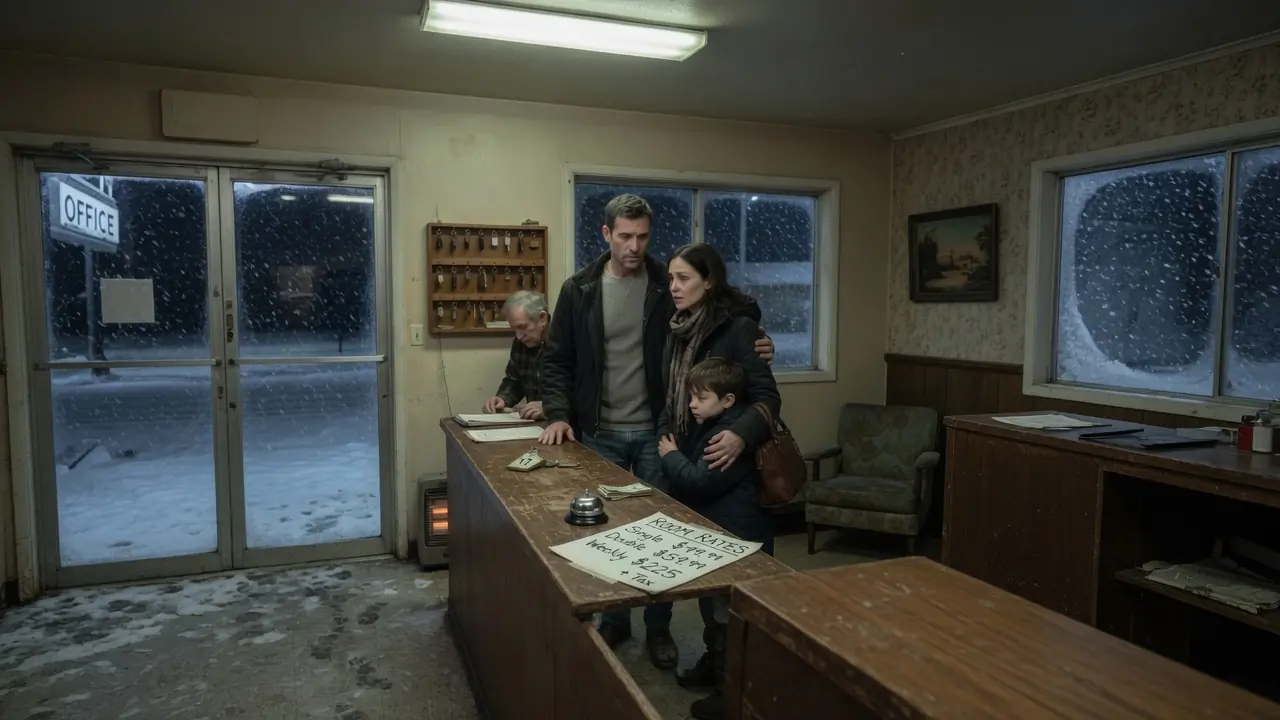
The Pine Creek Motor Lodge sat near the edge of Blackridge, squeezed between a closed diner and a gas station with one working pump. Its neon sign flickered through the storm.
The owner, Raymond Cobb, stood behind the front desk arguing with a young couple.
“No room,” he repeated. “Not for double, not for triple.”
Caleb entered carrying Noah, who had fallen asleep during the drive. Claire and Sophie followed.
Raymond looked at the woman’s expensive coat, then at Caleb’s stained work clothes.
His expression sharpened.
“Ward, you’d better not be bringing extra people into that room.”
“The room is paid through tomorrow.”
“For you and your daughter.”
“They’re taking it.”
Raymond shook his head.
“Not happening.”
Caleb set Noah gently in a chair near the heater.
“He’s freezing.”
“That’s not my problem.”
Sophie’s face darkened.
Caleb held up one hand.
Raymond leaned over the counter.
“The festival has people offering five hundred dollars for rooms. You paid seventy-two because you’ve been here all week repairing county vehicles. If you leave, I can resell it.”
“You’re not reselling it. They’re using it.”
“You don’t decide what happens on my property.”
Claire stepped forward.
“I’ll pay five hundred.”
Raymond looked at her carefully.
“Cash?”
“Yes.”
Caleb shook his head.
“No.”
Claire turned toward him.
“You’ve already helped enough.”
Raymond smiled.
“Lady has sense.”
Caleb placed his room key on the counter.
“She doesn’t owe you five hundred dollars for a room that is already paid for.”
Raymond’s smile disappeared.
“You always did think the uniform made you important.”
The lobby went quiet.
Caleb’s jaw tightened.
He had been back in Blackridge for four years. Long enough for people to know he had served. Long enough for some of them to decide his service was either a heroic story they could borrow or a weakness they could use.
Raymond preferred the second.
“You aren’t wearing it now,” the motel owner continued. “You’re driving a tow truck and sleeping in a discount room because you can’t afford a real apartment.”
Sophie looked down.
Caleb noticed.
That was the part he could not forgive.
Not the insult.
The fact that Raymond had delivered it where his daughter could hear.
Caleb took one slow breath.
“The room remains in my name. Claire and Noah are my guests.”
Raymond reached for the key.
“I’m canceling your reservation.”
Caleb placed his hand over it first.
His movement was calm.
But something in his eyes made Raymond stop.
“You can dislike me,” Caleb said quietly. “You can raise the price tomorrow. You can tell every person in this town that I’m broke.”
He leaned slightly closer.
“But that boy is going upstairs before he becomes hypothermic.”
Raymond looked toward the lobby cameras.
Several guests had begun watching.
He withdrew his hand.
“One night.”
“That’s all I asked.”
Caleb carried Noah upstairs and placed him beneath the blankets.
Sophie found the hot chocolate packets and filled the motel’s small coffee machine with water. Claire removed her wet coat and stood near the window.
Without the coat, she looked younger than Caleb had expected. Perhaps thirty-five. Her dark hair fell loosely around her shoulders, and there was a small bruise near her wrist.
Caleb noticed it.
Claire noticed him noticing.
“It’s nothing.”
“I didn’t ask.”
“You were going to.”
“No.”
She looked surprised.
Caleb checked the heater.
It rattled but worked.
“My number is written beside the phone. The front desk has it too.”
“You’re really sleeping in the truck?”
“I’ve slept in worse places.”
Sophie handed Noah a cup of hot chocolate.
“Dad once slept inside a construction vehicle during a flood.”
Caleb looked at her.
“Operational security.”
“You tell that story every Thanksgiving.”
Claire smiled faintly.
Sophie took her own backpack.
“I’m staying with them.”
“No, you’re not.”
“There are two beds.”
“One is for Claire. One is for Noah.”
“I can sleep on the floor.”
“You can sleep in the truck.”
Sophie folded her arms.
“That makes no sense.”
“It makes perfect sense. I’m your father.”
“That explains the decision. It doesn’t improve it.”
Claire covered a laugh with her hand.
Caleb sighed.
“Fine. You can stay. Lock the door behind me.”
Sophie hugged him before he reached the hallway.
It was quick, almost casual.
But Caleb knew his daughter.
She hugged him when she sensed something was wrong.
“Dad?”
“What?”
“You saw something in the engine.”
Claire’s eyes lifted.
Caleb looked at both of them.
“The coolant line was cut.”
The room became still.
Claire’s face changed completely.
The tired mother disappeared.
In her place stood someone who had been waiting for this sentence.
Caleb closed the door.
“Who are you running from?”
Claire sat on the edge of the bed.
Noah held his cup with both hands, watching her.
“Nobody.”
Caleb waited.
Sophie spoke gently.
“He knows when people lie.”
Claire looked at her son.
Noah whispered, “We should tell him.”
She closed her eyes.
Then she reached inside her purse and removed a small flash drive on a silver chain.
“My full name is Claire Bennett.”
Caleb recognized it.
Most people in Colorado would have.
Bennett Health Systems owned hospitals, rehabilitation centers, and private clinics throughout the western states. Its founder, Senator Jonathan Bennett, had died six months earlier.
Claire was his only daughter.
News reports said she had inherited the company.
They had not mentioned that she had a child.
“You’re the CEO,” Caleb said.
“Interim CEO.”
“What’s on the drive?”
“Evidence.”
“Of what?”
Claire looked toward Noah again.
“Bennett Health has been billing the Department of Veterans Affairs for treatments that never happened.”
Caleb’s expression hardened.
“Ghost patients?”
“Some. Others are real veterans whose records were altered to show expensive procedures, extended therapy, or medication they never received.”
“How much?”
“At least sixty million dollars.”
Sophie stopped moving.
Caleb asked, “Who knows you found it?”
“My chief financial officer. Two board members. And someone inside the federal contracting office.”
“Names?”
“I don’t know which one betrayed me.”
“Why are you driving through a snowstorm with your son instead of speaking to federal investigators?”
“I tried.”
Her voice cracked for the first time.
“The investigator assigned to meet me was killed yesterday. They called it a highway accident. Then someone entered my home.”
Noah stared at the floor.
Claire continued.
“We escaped through the garage. I stopped trusting phones, drivers, security teams—everyone.”
Caleb looked at the bruise on her wrist.
“They grabbed you.”
“One of them did.”
“Did they see Noah?”
“Yes.”
Caleb turned toward the window.
The motel parking lot was barely visible through the snow.
His tow truck stood beneath the flickering sign.
The damaged SUV was attached behind it.
Too obvious.
Anyone tracking Claire’s vehicle would find them.
“You can’t remain here.”
Claire stood.
“Noah can’t go back outside.”
“I’m not suggesting that.”
Caleb pulled out his phone and called a number.
The man who answered sounded half asleep.
“Ward?”
“Eli, I need the keys to the old fire station.”
There was a pause.
“The one outside town?”
“Yes.”
“Why?”
“Because it has a generator, a basement, and no active address in the county database.”
Another pause.
“What happened?”
“I’ll explain later.”
Eli’s voice became alert.
“Keys are above the garage door in the magnetic box.”
“Thank you.”
Caleb ended the call.
Claire shook her head.
“We can’t involve more people.”
“Eli doesn’t need details.”
“You’re treating this like a military evacuation.”
“It is an evacuation.”
“I won’t place your daughter in danger.”
Caleb looked at Sophie.
“Neither will I.”
Sophie picked up her backpack.
“Which is why we should move before the people who cut the hose arrive.”
Claire stared at her.
“She’s twelve,” Caleb said. “Unfortunately, she is often correct.”
They left through the rear stairwell.
Caleb moved the group into the tow truck while the motel owner argued with a guest in the lobby. He detached Claire’s SUV and left it parked beneath the motel camera.
Then he covered it with snow from the lot, enough to make it appear that it had been there longer.
They drove without headlights for the first half mile.
The old fire station stood six miles outside town, near an abandoned mining road. It had closed after the county consolidated emergency services.
Caleb had helped repair its roof the previous summer.
Inside, it smelled of dust, oil, and cold concrete.
The generator started on the third attempt.
Sophie arranged blankets in the former crew room. Noah fell asleep almost immediately.
Claire stood beside Caleb near the bay doors.
“Why are you doing this?”
“You needed help.”
“You don’t know whether I’m telling the truth.”
“I know the hose was cut.”
“That doesn’t prove the rest.”
“No.”
He looked at her.
“But fear has patterns. Yours is real.”
Claire studied him.
“You’ve seen it before.”
“Yes.”
“In combat?”
“Sometimes.”
“What happened to your wife?”
Caleb’s face closed.
Claire immediately regretted asking.
“I’m sorry.”
“She died five years ago.”
“How?”
“A hospital error.”
Claire stopped breathing for a moment.
Caleb continued before she could respond.
“Rachel had a routine gallbladder surgery. The surgeon nicked an artery. The night staff missed the internal bleeding for six hours.”
Claire’s hand tightened around the flash drive.
“Which hospital?”
“Bennett Memorial in Denver.”
Silence filled the old station.
Claire stepped backward.
Caleb saw the answer in her face.
“You knew.”
“No.”
“You recognized the hospital.”
“My father settled several malpractice claims from that facility.”
“Rachel’s case was never settled.”
“Did you file?”
“I tried. The hospital’s lawyers said her complications were unforeseeable. The chart was incomplete. Medication records disappeared.”
Claire looked ill.
Caleb’s voice became quieter.
“Was Bennett Memorial part of the fraud?”
“Yes.”
The word seemed to strike the walls.
“The altered records began there,” she said. “My father discovered irregular billing years ago. He covered it up to protect the company.”
Caleb stared at her.
“You’re telling me the same people who profited from veterans may have changed my wife’s medical records?”
“I don’t know.”
“But it’s possible.”
“Yes.”
Sophie appeared in the doorway.
“Dad?”
Caleb turned away.
He could feel anger building inside him, old and familiar.
The kind that simplified the world into targets and actions.
He had spent years teaching Sophie that anger was not a plan.
Now he had to remember it himself.
“Go back with Noah.”
She did not move.
“Are you okay?”
“No.”
The honesty surprised all three of them.
Caleb looked at Claire.
“If your evidence connects Bennett Memorial to Rachel’s records, I want the truth.”
“You’ll have it.”
“If your family helped bury what happened—”
“I’ll expose that too.”
“Even if it destroys your company?”
Claire looked toward the room where her son slept.
“The company is not my child.”
Before Caleb could answer, headlights appeared through the cracks around the bay door.
One vehicle.
Then another.
Then three more.
They approached without sirens.
Caleb shut off the station lights.
Sophie whispered, “Are those police?”
“No.”
The vehicles stopped outside.
Doors opened.
Men spread into the snow.
Professional spacing.
Long coats hiding weapons.
Caleb counted six.
Possibly more behind the vehicles.
Claire reached for Noah.
Caleb caught her arm.
“Basement.”
“We can’t leave you.”
“You aren’t leaving me. You’re giving me room to work.”
Sophie looked at him.
“You promised Mom.”
The words stopped him.
Rachel had made Caleb promise that if danger ever came home with him, he would choose his daughter over his pride.
“I remember.”
He led them toward the basement stairwell.
At the bottom was an old communications room with reinforced concrete walls and a second exit leading to the drainage ditch behind the station.
Caleb handed Sophie a radio.
“Channel three.”
“What are you going to do?”
“Call help.”
“You already called someone?”
“Not yet.”
He looked at Claire.
“Who can you trust absolutely?”
She thought.
“My father’s former attorney. Miriam Sloan.”
“Call her. Tell her to contact the inspector general directly, not local law enforcement. Send the files now.”
Claire lifted the flash drive.
“There’s no internet here.”
Caleb pointed toward an old terminal mounted on the wall.
“Emergency radio network. Eli restored it last summer.”
Sophie looked impressed.
“You said the station was abandoned.”
“It is abandoned. That doesn’t mean I left it useless.”
A fist struck the bay door.
Then a voice.
“Claire Bennett! We know you’re inside.”
Noah woke and began crying.
Caleb knelt before Sophie.
“Take them through the drainage exit if anyone reaches the stairs.”
“What about you?”
“I’ll meet you at the tree line.”
“That’s not a promise.”
Caleb recognized his own words in hers.
“No. It’s a plan.”
He returned upstairs.
The men outside began forcing the side door.
Caleb moved through the dark station, using the layout he remembered from repairs.
He did not have a firearm.
He had a fire axe, a pry bar, an emergency flare, and forty feet of heavy hose.
Enough.
The side door burst inward.
Two men entered.
Caleb waited behind the old rescue truck bay.
The first man passed.
Caleb wrapped the fire hose around his ankles and pulled. The man hit the floor. Before the second could react, Caleb swung the empty metal nozzle into his wrist.
A pistol dropped.
Caleb kicked it beneath a cabinet.
The first attacker rolled and reached inside his coat.
Caleb stepped on the arm and struck him once beneath the jaw.
Both men stopped moving.
Outside, someone shouted.
“They’re inside!”
Gunfire shattered the front windows.
Caleb dropped behind the concrete engine block.
He had survived worse.
But he had never survived worse with Sophie one floor beneath him.
That changed everything.
He crawled toward the control panel and pulled the emergency release.
The old bay door rose six inches.
Wind drove snow inside.
The attackers outside moved toward the opening.
Caleb connected the fire hose to the station’s pressurized reserve tank and opened the valve.
Water exploded beneath the door with enough force to knock two men from their feet. On the frozen concrete, they slid directly beneath the rising metal panel.
Caleb triggered the door.
It dropped again, trapping one attacker’s coat and separating him from his weapon.
The second fired blindly.
A bullet struck Caleb’s shoulder.
The impact spun him into the wall.
For a moment, the room disappeared beneath white pain.
Then he heard Sophie’s voice through the radio.
“Dad?”
Caleb pressed one hand against the wound.
“I’m here.”
“They’re trying the basement exit.”
He looked toward the rear corridor.
The attackers had split.
Caleb forced himself upright.
“Go to the drainage ditch. Now.”
“We sent the files.”
“Good. Move.”
He reached the basement stairs as another man entered from below.
Caleb struck first.
The pry bar caught the weapon and knocked it aside. The attacker drove a shoulder into Caleb’s injured arm.
Pain nearly dropped him.
The man raised a knife.
Caleb caught the wrist with both hands.
They struggled in the narrow stairwell.
The attacker was younger.
Stronger.
Caleb was losing blood.
Then the man whispered, “Your wife should’ve died quietly.”
Caleb became completely still.
Not weak.
Focused.
“You know about Rachel.”
The attacker smiled.
“She found the billing changes while she was admitted. She threatened to report them.”
The world narrowed.
Rachel had not died only because of incompetence.
She had seen something.
Her chart had been altered because she had become a witness.
The attacker drove the knife downward.
Caleb shifted, trapped the man’s elbow against the railing, and used the narrow staircase to take away his balance.
The knife fell.
Caleb forced him against the wall.
“Who gave the order?”
The man laughed.
“You think Bennett’s father built that company by asking questions?”
A gunshot echoed from the bay.
Caleb struck the man unconscious and moved downstairs.
The communications room was empty.
The rear exit stood open.
Sophie had followed the plan.
Caleb reached the drainage ditch and saw three figures moving through the snow toward the tree line.
Claire.
Noah.
Sophie.
Then headlights appeared on the mining road.
A black SUV accelerated toward them.
Claire pushed both children behind a concrete culvert.
The vehicle stopped.
A tall man stepped out wearing a long coat and no hat.
Claire froze.
“Uncle David.”
Caleb reached the edge of the ditch.
David Bennett had served as Bennett Health’s chief financial officer for fifteen years. News reports described him as Claire’s closest adviser and her late father’s younger brother.
He smiled.
“You’ve caused an extraordinary amount of trouble.”
Claire stood in front of the children.
“You killed the investigator.”
“He refused to understand the value of discretion.”
“You sabotaged my car.”
“I hoped the storm would solve the problem.”
David looked at Caleb.
“And you must be the widower.”
Caleb descended into the ditch.
David raised a pistol.
“Stop.”
Caleb stopped.
Claire’s face changed.
“You knew who he was.”
“Of course. Rachel Ward was the first nurse who noticed the false veteran accounts. She copied records and hid them inside her own chart.”
Caleb felt the truth settle inside him.
Rachel had not told him.
Perhaps she had planned to.
Perhaps she believed she had more time.
David continued.
“My brother tried to make the issue disappear. When Rachel survived the surgical error, someone ensured the night staff delayed treatment.”
Sophie made a small sound.
Caleb did not turn toward her.
His daughter had just heard that her mother’s death might have been intentional.
David smiled.
“That anger you feel is useful, Sergeant. It makes men predictable.”
Caleb looked at the pistol.
Then at David’s feet.
Then at the SUV idling behind him.
“You followed Claire personally,” Caleb said.
“I needed the drive.”
“You don’t trust the men you hired.”
“I trust results.”
“No. You trust control.”
David’s smile weakened.
Caleb continued.
“That’s why you came close enough to speak.”
“Is this where you distract me?”
“No.”
Caleb looked past him.
“It’s where you realize the files are already gone.”
David turned instinctively toward Claire.
It was less than a second.
Caleb moved.
He struck David’s wrist with the metal emergency flare still hidden inside his sleeve. The gun fired into the snow.
Claire pulled the children lower.
David hit Caleb’s wound.
Caleb stumbled.
David reached for the pistol.
Before he could take it, Sophie kicked it into the drainage channel.
David looked at her in disbelief.
Sophie stood shaking.
“My dad said to watch the hands.”
David lunged toward her.
Claire struck him with a broken branch.
He fell to one knee.
Caleb grabbed the back of his coat and drove him face-first into the snow.
Sirens sounded beyond the trees.
Not local police.
Federal vehicles.
Miriam Sloan had reached the inspector general.
David stopped resisting.
For the first time, he looked afraid.
The agents arrived minutes later.
They secured the fire station, arrested the surviving attackers, and recovered the weapons.
Caleb remained standing until Sophie was safe inside an ambulance.
Then his legs gave way.
He woke in a hospital room.
Sophie slept in a chair beside him, her head resting against the mattress.
Claire stood near the window.
Her face was bruised. Her coat was gone. She wore a hospital sweatshirt several sizes too large.
“You were shot,” she said.
“I noticed.”
“The bullet passed through.”
“Good.”
“Your daughter refused to leave.”
“That sounds like her.”
Claire sat down.
“Noah is safe.”
“Good.”
“The inspector general has the files. David is cooperating because he believes it will reduce his sentence.”
“Will it?”
“Not enough.”
Caleb looked at Sophie.
“Did she hear everything?”
“Yes.”
He closed his eyes.
“How do I tell her that her mother may have been murdered?”
“You tell her the truth slowly. And you stay when it hurts.”
Caleb looked at Claire.
“You sound experienced.”
“My father spent my whole life telling me lies slowly.”
She removed the flash drive chain from her neck.
“The investigators found Rachel’s hidden files.”
Caleb sat up despite the pain.
“She copied billing records into a private nursing archive. There was also a statement.”
Claire placed a tablet beside him.
The video showed Rachel sitting in a hospital office.
She looked tired but alive.
Caleb had not seen her face moving in five years.
Rachel spoke directly into the camera.
“If anything happens to me, the alterations came from Bennett Health’s executive office. Veterans are being used as billing identities. Patients are being denied care while the company charges the government for treatments they never receive.”
She paused.
Then her expression softened.
“Caleb, if you ever see this, I’m sorry I didn’t tell you. You spent years carrying dangerous truths home from war. I wanted to carry one for you.”
The video ended.
Caleb covered his face.
Sophie woke.
“Dad?”
He reached for her.
She climbed carefully onto the bed and held him.
Neither spoke for a long time.
The scandal destroyed Bennett Health’s executive leadership.
David Bennett and six senior administrators were charged with fraud, conspiracy, obstruction, and involvement in multiple deaths connected to altered medical records.
Claire testified publicly.
She refused to protect her father’s legacy.
The company entered federal oversight. Its private aircraft, executive estates, and luxury retreats were sold to fund restitution for veterans and affected families.
Claire remained CEO only long enough to complete the restructuring.
Then she resigned.
Six months later, she returned to Blackridge with Noah.
Caleb had repaired the tow truck, moved out of the motel, and rented a small farmhouse outside town.
The shoulder still hurt in cold weather.
Sophie said it improved his personality because pain made him too tired to argue.
Claire arrived one Saturday carrying two boxes.
“What’s inside?” Caleb asked.
“Paperwork.”
“That’s not an appealing beginning.”
She placed the first box on the kitchen table.
“Medical records related to Rachel’s case. The government has approved compensation.”
“I don’t want company money.”
“It isn’t company money. It comes from assets seized from the people responsible.”
Caleb looked at Sophie.
The compensation could pay for college.
It could repair the farmhouse.
It could give his daughter stability he had failed to provide since Rachel’s death.
He signed.
Claire opened the second box.
Inside was a framed document.
THE RACHEL WARD VETERANS’ MEDICAL ADVOCACY FUND.
Caleb looked up.
“We created an independent organization,” Claire said. “It will help veterans challenge denied claims, missing records, and fraudulent billing.”
“We?”
“Noah helped choose the logo.”
Noah held up a drawing of a shield with a small lantern in the center.
“The lantern means people can find help in the dark.”
Sophie nodded approvingly.
“Better than most corporate logos.”
Claire smiled.
“We need someone to oversee field investigations.”
Caleb shook his head.
“No.”
“You haven’t heard the salary.”
“No.”
“Health insurance.”
“No.”
“A vehicle newer than your tow truck.”
Caleb hesitated.
Sophie pointed at him.
“He’s considering it.”
“I am not.”
Claire stepped closer.
“You spent years believing Rachel died because no one noticed the truth. She noticed. She fought. Now you can help finish what she began.”
Caleb looked at the foundation document again.
“What would the job require?”
“Travel. Interviews. Helping people who are being ignored.”
Sophie smiled.
“That’s already what you do.”
Caleb accepted the position.
He and Claire began working together.
At first, their relationship remained professional.
Then came late dinners after long investigations.
Phone calls that continued after the work discussion ended.
Weekends when Noah and Sophie insisted everyone attend the same movie.
Claire learned that Caleb repaired broken appliances when anxious.
Caleb learned that Claire organized kitchen cabinets when frightened.
One evening, nearly a year after the storm, they returned to the abandoned fire station.
It had been renovated into the foundation’s first emergency shelter for veterans and families stranded during medical travel.
The old bay doors had been painted red.
The communications room had become a legal assistance office.
A bronze plaque near the entrance carried Rachel’s name.
Sophie and Noah ran ahead to inspect the kitchen.
Claire stood beside Caleb beneath the exterior light.
“You gave us your motel room before you knew who I was.”
“You had a freezing child.”
“Raymond Cobb called you a failure in front of everyone.”
“He has poor judgment.”
“He tried to charge me five hundred dollars.”
“He has excellent business instincts and poor humanity.”
Claire laughed.
Then her expression softened.
“I thought powerful people were the only ones who could protect us.”
Caleb looked through the windows at Sophie and Noah arguing over hot chocolate.
“Powerful people were the reason you needed protection.”
“You know what I mean.”
“I do.”
Claire touched the scar near his shoulder.
“You saved us.”
Caleb shook his head.
“Rachel saved you. She collected the evidence.”
“You stopped David.”
“Sophie kicked away the gun.”
“Then perhaps the women in your family saved everyone.”
“That is usually how Sophie tells the story.”
Claire moved closer.
“And what does Sophie say about us?”
Caleb looked toward the window.
His daughter immediately turned away, pretending she had not been watching.
“She says I’m emotionally slow.”
“Is she wrong?”
“Rarely.”
Claire kissed him.
It was not dramatic.
No snowstorm.
No gunfire.
No desperate escape.
Only two tired people standing beneath a light outside an old fire station, allowing themselves to believe survival could lead somewhere other than loneliness.
When they stepped apart, Sophie opened the door.
“Finally.”
Caleb frowned.
“You were spying.”
“I was monitoring.”
Noah appeared behind her.
“Can we have pizza?”
“It’s almost ten,” Claire said.
Sophie shrugged.
“Pizza doesn’t know what time it is.”
Caleb looked at Claire.
“She uses that argument for everything.”
“It remains logically consistent.”
They entered together.
Outside, snow began falling softly over the mountain road.
A year earlier, the same weather had hidden armed men, a sabotaged vehicle, and secrets powerful people had killed to protect.
Tonight, it covered the ground in silence.
Caleb stood inside the renovated station as Sophie and Noah laughed near the kitchen. Claire hung her coat beside his.
For years, he had believed his story ended when Rachel died.
Everything afterward had seemed like duty.
Raise Sophie.
Pay the bills.
Keep moving.
Help people when he could.
Expect nothing for himself.
But Rachel had left behind more than evidence.
She had left a path.
It led through a broken SUV, a frightened mother, a little boy in the snow, and a woman brave enough to destroy the empire she inherited rather than protect the lies beneath it.
Caleb had once crossed battlefields to clear safe roads for other soldiers.
Now he did the same thing in a different way.
He found people trapped by systems larger than themselves.
He listened when others dismissed them.
He stood beside them when powerful institutions expected them to surrender.
And each evening, he returned to a farmhouse where two children argued over movies and Claire left books on his side of the bed.
The people who murdered Rachel had believed her truth would die with her.
They were wrong.
It lived in every veteran whose medical care was restored.
Every family that received answers.
Every frightened person who discovered someone had finally come to help.
And it lived in the single father who had given away his last warm room during a snowstorm, never realizing that the woman he rescued was carrying the final piece of the mystery that had haunted him for five years.
Caleb Ward had stopped believing in coincidence long ago.
But he still believed in choices.
The choice to stop beside a broken car.
The choice to give shelter without demanding a name.
The choice to protect children before protecting comfort.
The choice to tell the truth even when it destroyed everything familiar.
Those choices had cost him blood.
They had also given him a future.
Sometimes the road that brings a person home does not begin with a map.
Sometimes it begins with a stranger standing in the snow—and a good man deciding not to drive past.