The blizzard reached Detroit on Christmas Eve with almost no warning.
By sunset, snow had swallowed the roads, power lines were bending beneath ice, and the wind was driving white sheets across the city so violently that even the streetlights disappeared.
At the far end of Maple Avenue stood a small roadside diner called Rose’s Kitchen.
The sign above the door had lost three letters.
Two windows were covered with clear plastic where the seals had failed.
The heater had stopped working earlier that week, and the electricity had gone out shortly after dark.
Inside, thirty-two-year-old Danielle Carter sat beneath three blankets with her two-year-old son pressed against her chest.
Eli was shivering.
She could hear his teeth clicking together whenever the wind struck the building.
Danielle had lit every candle she owned and moved them into the kitchen, the smallest room in the diner. The gas stove still worked, so she kept a stockpot of water simmering and warmed towels near the burners.
It was not safe to heat the room with the oven, and she knew it.
But knowing the danger did not make the cold less real.
The thermometer beside the pantry door showed forty-one degrees.
Outside, the storm continued strengthening.
Danielle tucked another blanket around Eli.
“Mama’s here,” she whispered. “We’re going to be all right.”
She had been telling him that for months.
Some days she almost believed it.
Rose’s Kitchen had once belonged to Danielle’s mother, Gloria Carter.
For twenty-two years, Gloria served fried chicken, greens, cornbread, catfish, peach cobbler, and coffee strong enough to wake a person halfway through a night shift.
Factory workers came before dawn.
Police officers stopped during late patrols.
Families filled the booths after church.
Then Gloria became ill.
Medical expenses consumed her savings. Construction redirected traffic away from Maple Avenue, and newer restaurants opened closer to downtown.
By the time Gloria died, the diner was barely surviving.
Danielle inherited the building, its unpaid taxes, its failing equipment, and a wooden recipe box filled with cards written in her mother’s careful handwriting.
She also inherited Gloria’s final piece of advice.
“Food cannot solve every problem,” her mother told her. “But a warm plate tells people they are not facing the problem alone.”
At the time, Danielle had a husband, a small apartment, and steady work managing a hotel laundry department.
She did not expect to depend on those recipes.
Eight months later, her husband, Marcus Reed, announced that fatherhood was not the life he wanted.
He left Detroit with a woman he met online and stopped answering calls about child support.
Danielle lost her apartment shortly afterward.
She moved with Eli into the two small rooms above the diner and tried to reopen Rose’s Kitchen with seven dollars and thirty-two cents remaining in her bank account.
Her mother’s fried chicken was still extraordinary.
The first four customers said so.
Unfortunately, four customers could not pay property taxes, replace a furnace, or purchase groceries for a growing child.
Several neighbors avoided the diner entirely.
Some assumed it was dirty because the building looked tired.
Others looked at Danielle, saw a struggling single mother, and created the rest of her story without speaking to her.
Helen Bradford, who lived in a well-maintained house three doors away, was the most direct.
She stopped outside the diner one morning and examined Danielle’s handwritten menu.
Danielle opened the door.
“Good morning, Mrs. Bradford. I made a fresh batch of chicken. Would you like to try some?”
Helen’s expression changed.
“I don’t eat food prepared in unlicensed homes.”
“This is a licensed diner. My mother operated it for more than twenty years.”
“I heard you live upstairs.”
“Yes.”
“With that child.”
“My son.”
Helen looked past her into the empty dining room.
“This neighborhood is trying to improve. Businesses like this make that difficult.”
Danielle held the door open despite the cold.
“The kitchen passed inspection last month.”
“That isn’t what I meant.”
Danielle understood exactly what she meant.
She closed the door gently.
That night, she sat at the counter with Eli sleeping in a booth and counted the day’s earnings.
Fourteen dollars.
The gas bill alone was more than two hundred.
Three weeks later, the blizzard arrived.
By Christmas night, Danielle and Eli had spent nearly two days inside the freezing diner.
The city emergency line was overwhelmed.
Heating technicians were not reaching the outer neighborhoods.
Snow had piled against the front door nearly halfway to the handle.
Eli had developed a cough.
Danielle’s telephone battery was down to eighteen percent.
She considered walking to the emergency shelter at the church four blocks away, but the weather report warned that windchill had fallen below zero.
Carrying a toddler into that storm would be more dangerous than staying.
At 11:38 p.m., Danielle heard something beneath the wind.
A low vibration.
At first she assumed a snowplow had finally entered Maple Avenue.
Then the sound multiplied.
One engine became several.
Several became a rolling mechanical thunder that seemed impossible in weather like this.
Danielle stood and moved toward the front window.
Through a narrow gap in the snow, she saw headlights.
Motorcycles.
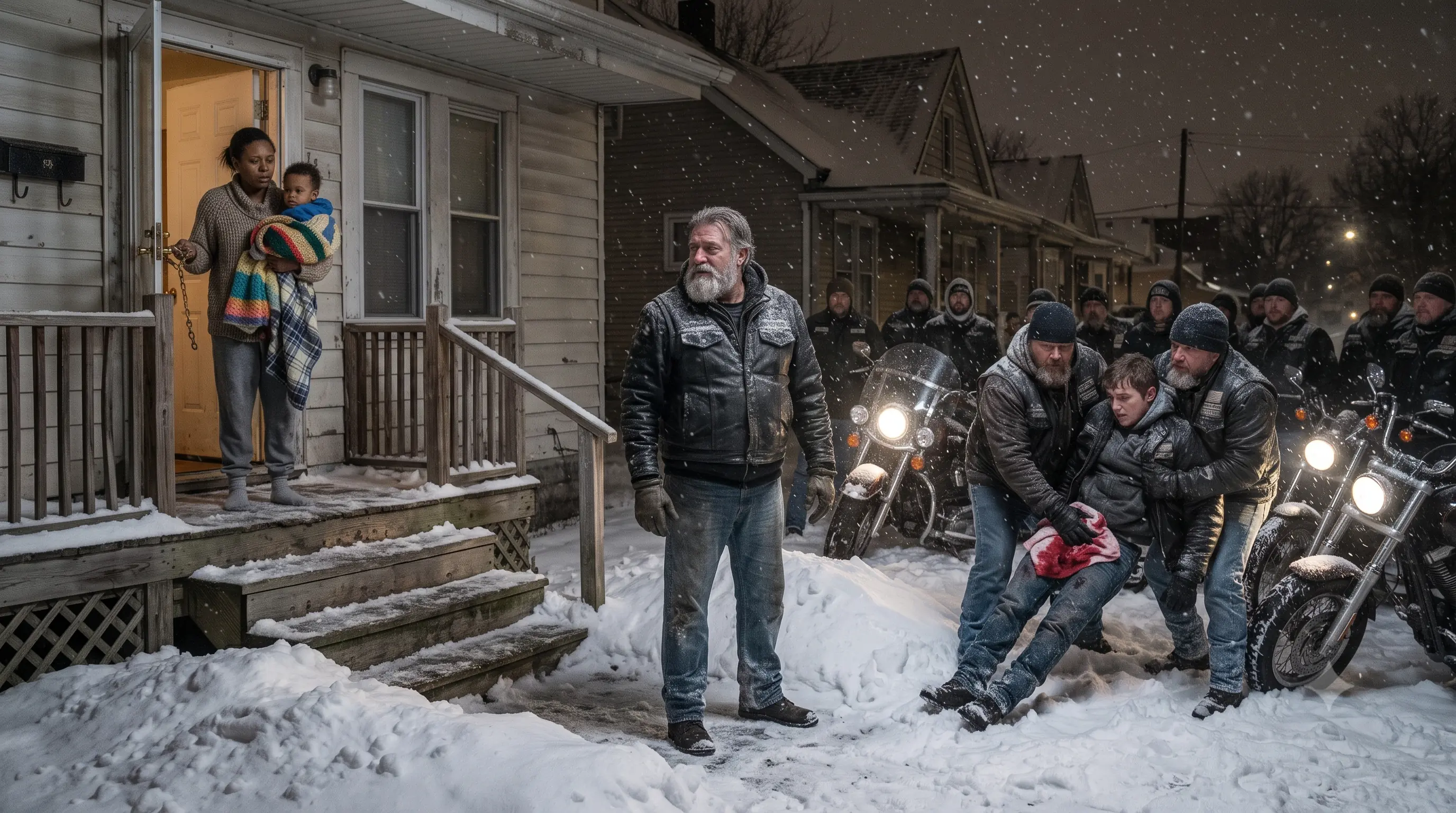
Dark shapes emerged from the white, moving slowly behind two utility trucks. Riders used their boots for balance as the tires slipped across the road.
One motorcycle fell near the intersection.
The others stopped immediately.
Men climbed down and lifted both the machine and its rider.
The convoy reached the diner and gathered beneath the failing light above the entrance.
Then came three knocks.
Danielle froze.
Eli stirred against her shoulder.
Another knock followed.
“Ma’am!” a man called through the door. “We need shelter!”
Danielle did not answer.
She counted shadows through the glass.
There were far too many.
The man spoke again.
“We have twenty-five people and one injured rider. We saw the diner sign. We’ll stay in the dining room and leave as soon as the road opens.”
Danielle’s heart beat painfully.
She had spent her entire adult life learning the dangers faced by women alone.
Opening the door to twenty-five strangers at midnight during a citywide blackout violated every instinct she possessed.
She moved closer without unlocking it.
“What happened to the injured man?”
“He went down on the ice about ten miles east. His leg is cut badly, and he’s getting confused.”
“Do you have weapons?”
There was a brief silence.
“Yes, ma’am,” the man answered honestly. “Some of us do. We will secure them in our trucks before entering if that makes you feel safer.”
“Who are you?”
“Name’s Gabriel Mercer. We ride with the Iron Harbor Veterans Association. Most of us served. We were heading to a Christmas charity event when the storm changed direction.”
A second voice called from behind him.
“Gabe, Nolan’s going down again.”
Danielle peered through the window.
One rider was being held upright by two others.
His left pant leg was dark with blood. His movements were slow and uncoordinated.
The men around him looked frightened.
Not aggressive.
Frightened.
Eli coughed against Danielle’s chest.
She thought about her mother.
Gloria had once invited a homeless family into Rose’s Kitchen during an August thunderstorm. Danielle’s father complained afterward that she trusted people too easily.
Gloria answered with a sentence Danielle still remembered.
“You do not wait for someone to look respectable before deciding whether they deserve to survive.”
Danielle closed her eyes.
Then she unlocked the door.
Gabriel Mercer stood on the other side.
He was enormous, with a gray-streaked beard and ice covering the shoulders of his leather jacket. His face looked weathered, but his eyes were careful.
He immediately removed both hands from his pockets.
“Thank you.”
“Leave the weapons outside.”
“Yes, ma’am.”
“And no one goes upstairs.”
“Understood.”
“Your injured man comes in first.”
Gabriel turned.
“You heard her. Nolan first.”
The riders moved with surprising discipline.
Two carried Nolan inside and placed him on a padded booth near the kitchen. The others secured their firearms inside locked motorcycle cases and utility vehicles before entering.
Each person removed wet outer clothing near the door and wiped snow from heavy boots.
Within minutes, the diner was crowded with twenty-five frozen riders.
Men and women.
Some in their twenties.
Others old enough to be Danielle’s father.
Their patches identified them as veterans from Michigan, Indiana, Ohio, and Illinois.
Gabriel knelt beside Nolan.
The injured rider appeared to be in his mid-thirties. His face was gray, and his lips had begun turning blue.
Danielle touched his forehead.
Too warm.
That concerned her more than the cold skin of his hands.
“Help me get the wet clothes off him.”
Several riders moved immediately.
Danielle opened the diner’s emergency kit.
Her mother had trained as a nurse before opening the restaurant and kept extensive medical supplies. Danielle had maintained the habit.
When she cut the fabric away from Nolan’s lower leg, she found a deep wound beneath the knee. The injury had been wrapped, but the bandage had soaked through.
His motorcycle had fallen against a damaged metal guardrail.
The cut contained dirt, fabric fibers, and road debris.
“This needs a hospital,” Danielle said.
“We know,” Gabriel replied. “Emergency dispatch says no ambulance can reach us until snowplows clear Maple.”
“How long?”
“No estimate.”
Danielle looked at Nolan.
“Was he conscious after the fall?”
“Yes.”
“Did he hit his head?”
“Helmet stayed intact. He was talking normally for the first hour.”
“Now he has a fever.”
Gabriel’s expression changed.
“Is that bad?”
“It can be. The cold may be hiding how sick he is.”
Danielle cleaned the wound as thoroughly as she could, applied sterile dressings, and instructed two riders to maintain pressure without restricting circulation.
She did not pretend she could treat a serious infection with kitchen supplies.
Instead, she called emergency dispatch and gave exact information: mechanism of injury, bleeding, fever, mental confusion, breathing rate, and location.
The dispatcher elevated the call.
A National Guard vehicle supporting local emergency crews would attempt to reach them when Maple Avenue became passable.
Until then, Danielle’s task was keeping Nolan stable.
The riders began warming the diner.
An electrician named Ray inspected the failed power panel and confirmed the outage came from the neighborhood line, not the building.
Two riders closed gaps around the windows using plastic sheeting and duct tape from their service truck.
Others moved tables aside, hung blankets across the dining-room entrance, and created a smaller space to conserve body heat.
Gabriel found an old generator beneath a tarp in the storage room.
“It hasn’t worked in three years,” Danielle told him.
“Then it’s rested long enough.”
A mechanic named Tomas cleaned the fuel line, replaced a cracked hose using material from one of the motorcycles, and carried the generator outside beneath a metal awning.
Twenty minutes later, several lights flickered on.
The refrigerator began humming.
A portable heater warmed the dining room.
Eli looked up at the sudden light and smiled.
The sight brought Danielle close to tears.
“You had food prepared?” Gabriel asked.
“Enough ingredients for a Christmas crowd that never came.”
He removed his gloves.
“Tell us what needs doing.”
Danielle stared at him.
“You cook?”
“Poorly. But I follow orders.”
Several riders laughed.
The tension eased.
Danielle began assigning tasks.
Chicken from the refrigerator.
Flour and spices from the pantry.
Greens.
Potatoes.
Rice.
Beans.
The diner came alive.
One rider had worked as a Navy cook.
Another owned a small bakery in Toledo.
Tomas chopped vegetables with the concentration of a surgeon.
Gabriel burned the first pan of cornbread and accepted the criticism without defense.
Eli sat on the counter wrapped in a blanket, watching strangers transform the cold diner into a warm kitchen.
An older rider named Thomas Callahan crouched beside him.
“I have three grandchildren about your size.”
Eli studied Thomas’s beard.
Then he reached out and touched it.
Thomas remained perfectly still.
“Inspection passed?” he asked.
Eli smiled.
By two in the morning, the dining room smelled of fried chicken, onions, coffee, and hot bread.
The riders ate from mismatched plates.
Nolan managed several sips of broth but remained weak.
Danielle monitored him constantly.
The storm continued outside, but inside Rose’s Kitchen, candles and temporary lights reflected against the windows.
Conversation grew.
The Iron Harbor riders were not a criminal gang.
They were part of a national veterans’ motorcycle organization that raised money for injured service members, homeless veterans, and children of military families.
Gabriel had served in the Marines.
Thomas was retired Army.
Tomas had worked aviation maintenance in the Navy.
Nolan had joined the organization after leaving the foster system and serving six years as a combat engineer.
“We know what people see,” Gabriel said. “The leather, the tattoos, a large group of motorcycles. Most people decide what we are before we remove our helmets.”
Danielle turned a piece of chicken in the oil.
“I know something about people deciding who you are.”
The room became quieter.
She told them about the diner.
Her mother.
The failing business.
Her husband leaving.
The jobs lost because no one would allow her to bring Eli and she could not afford reliable childcare.
She described the neighbors who walked past the menu without entering and the humiliation of begging employers for hours that fit around motherhood.
Gabriel listened without interrupting.
When Danielle finished, he looked toward Eli, who had fallen asleep against Thomas’s chest.
“I had a daughter,” Gabriel said.
No one moved.
“Her name was Grace. She was six when she was diagnosed with leukemia.”
He rubbed both palms together.
“She fought eighteen months. My wife and I spent every dollar we had. After Grace died, the marriage did too.”
Danielle lowered the burner flame.
“I’m sorry.”
“My wife looked at me and saw the hospital. I looked at her and saw the empty bedroom. Neither of us knew how to remain married to the grief.”
Gabriel glanced around at the riders.
“These people did not fix me. They simply stayed close while I learned how to exist again.”
Danielle looked toward the dining room.
Twenty-five strangers had entered less than three hours earlier.
Now one repaired her generator.
Two cared for Nolan.
Several washed dishes without being asked.
Thomas slept sitting upright because Eli refused to release his jacket.
The biker organization had not removed Danielle’s problems either.
But for one night, she was not carrying all of them alone.
Shortly after three, Nolan’s condition worsened.
His fever climbed.
He became disoriented and tried to stand.
Danielle stopped him.
“Nolan, look at me.”
His eyes moved toward her but did not focus.
“Where are we?”
“My mother’s house,” he whispered.
“No. You’re inside Rose’s Kitchen in Detroit.”
He tried to remember.
Danielle checked the wound again.
A red line had begun extending above it.
She showed Gabriel.
“He may be developing a serious infection. We need that rescue team now.”
Gabriel called dispatch again.
The National Guard vehicle had entered Maple Avenue but was blocked by a fallen tree.
Without hesitation, six riders put on winter gear, took axes and saws from the utility truck, and went into the storm to help clear the road.
Danielle stayed with Nolan.
She kept him warm without overheating him, gave small amounts of fluid when he could swallow safely, and documented every change for the emergency team.
Nolan reached toward her during a confused moment.
“Mom?”
Danielle took his hand.
“I’m here.”
She understood that he was not seeing her.
That did not matter.
Forty minutes later, heavy diesel engines approached.
A National Guard transport and city ambulance reached the diner.
Paramedics treated Nolan and transported him to the hospital.
Before leaving, one of them spoke privately with Danielle.
“You did everything correctly. The wound is badly contaminated, and he may be septic. Keeping him stable and giving us accurate information saved time he did not have.”
Gabriel heard.
His eyes filled, though no tears fell.
After the ambulance left, the remaining riders helped Danielle clean the kitchen.
By dawn, the blizzard weakened.
Plows opened the main road.
The Iron Harbor group prepared to leave.
Each rider thanked Danielle.
Some hugged her.
Others shook her hand with both of theirs.
Thomas tried to return Eli, but the toddler clung to his beard.
“I’ll come back,” Thomas promised. “You and I still need to discuss motorcycle maintenance.”
Gabriel was last.
He placed an envelope on the counter.
Danielle pushed it back.
“No.”
“It is payment for food, shelter, medical care, and generator repair.”
“Your people repaired the generator.”
“Then consider it payment for keeping one of them alive.”
“I did what I could.”
“Most people would not have opened the door.”
Danielle looked toward the snow outside.
“I almost didn’t.”
“But you did.”
Gabriel placed the envelope beneath the wooden recipe box.
“Do not give up on the diner.”
Then he left.
The motorcycles departed slowly behind the snowplows.
Danielle stood at the entrance with Eli on her hip until the final taillight disappeared.
The diner felt enormous after they were gone.
She opened the envelope.
Eight hundred dollars lay inside with a handwritten note.
For Danielle and Eli, who reminded us that family sometimes begins with an unlocked door.
Nolan underwent surgery that morning.
The doctors removed debris from the wound and treated the infection before it spread farther.
Gabriel telephoned Danielle that evening.
“He’s stable,” he said. “The surgeon said you bought him the time he needed.”
Danielle sat down behind the counter.
“Tell him he still owes me for the bandages.”
Gabriel laughed.
“I will.”
The money repaired the diner’s heater and restored electricity after the neighborhood line returned.
Danielle purchased groceries and reopened Rose’s Kitchen two days after Christmas.
No customers came.
The next day, none came again.
On the third morning, Eli woke coughing.
His temperature rose by afternoon.
Danielle had enough money for medicine or the overdue property-tax payment, but not both.
The decision was simple.
She bundled him into his coat and began walking toward the pharmacy.
The sidewalks remained buried.
Halfway there, Eli became weak and asked to be carried.
Danielle turned toward Helen Bradford’s house.
She hated the thought of asking Helen for anything.
But the pharmacy was another mile away, and Eli needed fever medicine.
Helen opened the door but left the chain attached.
“What is it?”
“My son is sick. Do you have children’s fever medicine? I’ll replace it tomorrow.”
Helen looked at Eli.
“I do not share medicine.”
“He has a temperature. We lost power during the storm, and—”
“That is not my responsibility.”
“Could you drive us to the pharmacy?”
“No.”
Danielle swallowed her pride.
“I am asking for help for a child.”
Helen began closing the door.
Danielle placed one hand against it instinctively.
Helen shoved it outward.
Danielle lost her balance on the icy step and fell backward, protecting Eli with both arms.
Pain shot through her elbow.
Eli began crying.
“Stay away from my property,” Helen said. “I am tired of your problems becoming everyone else’s responsibility.”
The door slammed.
Danielle sat on the frozen walkway holding her son.
A voice came from across the street.
“Are you hurt?”
An elderly woman stood on the porch of a small brick house Danielle had passed hundreds of times.
She had silver hair gathered into a bun and wore a long wool coat.
“I saw what happened,” the woman said. “Bring that baby inside.”
“I don’t want to cause trouble.”
“Child, kindness is not trouble.”
Her name was Esther Lewis.
She had worked as a pediatric nurse for thirty-six years before retiring.
Inside her home, she checked Eli’s breathing, temperature, and throat.
“He has a cold and a mild fever. Nothing frightening yet, but he needs rest and fluids.”
Esther gave Danielle the correct dose of children’s medicine, warmed milk, and packed bread, soup, and fruit inside a grocery bag.
Around her neck hung an old silver pendant with detailed engraving.
Danielle noticed it only because Esther touched it while watching Eli drink.
“My son had one like this,” Esther said.
“Had?”
“I lost him during an apartment fire thirty years ago.”
Danielle did not know what to say.
Esther looked toward the fireplace.
“I was unconscious for weeks. The building records were destroyed. My boy entered temporary care under a misspelled name, and by the time I recovered, he had been moved. Later he was adopted.”
“You never found him?”
“I searched until the agencies stopped returning calls.”
Esther placed an envelope inside the grocery bag.
Danielle tried to return it.
“No.”
“You don’t know me.”
“I know you carried a sick child through the snow because you were out of options.”
“That does not mean you should give me money.”
Esther smiled.
“It means I recognize you.”
Three days later, Danielle was frying chicken when the floor began vibrating.
At first, she assumed a truck was passing.
The vibration continued.
Dishes rattled.
The front windows trembled.
Eli climbed onto a chair.
“What that, Mama?”
Danielle opened the curtain.
Motorcycles appeared at the far end of Maple Avenue.
Not twenty-five.
Hundreds.
The line continued beyond the intersection, moving in organized groups behind police escorts and charity vehicles.
Riders filled both sides of the road.
More arrived in waves.
By noon, nearly fifteen hundred members of the national Iron Harbor network had gathered throughout the surrounding blocks and a nearby municipal parking lot.
Maple Avenue had become the final stop of a veterans’ charity ride originally scheduled for Chicago.
Gabriel stood at the front beside Thomas and several riders Danielle recognized from the storm.
Nolan was there too.
He used crutches but was smiling.
When the final engines shut down, the sudden silence felt even larger than the noise.
Gabriel approached the diner.
“We told you we do not forget.”
Danielle stared at the motorcycles.
“What have you done?”
“Made a few telephone calls.”
Thomas carried a thick folder.
Gabriel explained that Iron Harbor chapters throughout the Midwest had heard what happened during the blizzard.
Riders contributed money.
Local unions volunteered labor.
Licensed electricians, plumbers, roofers, and restaurant contractors offered services.
A charity foundation agreed to match the donations.
They were not going to rebuild the diner illegally in one afternoon.
They had brought permits, plans, contractors, and enough funding to restore Rose’s Kitchen properly over the following weeks.
The property taxes would be paid.
The heating system replaced.
The kitchen brought fully up to modern code.
A licensed childcare cooperative nearby had offered Eli a place.
Danielle covered her mouth.
“Why?”
Nolan moved forward on his crutches.
“Because I almost died in that booth, and you treated me like I belonged to someone.”
“You do belong to someone.”
“I didn’t know that for most of my life.”
His hand moved toward the silver pendant around his neck.
A gasp came from the edge of the crowd.
Esther Lewis stood near the sidewalk.
Her eyes were fixed on the pendant.
“Nolan?”
He turned.
Esther stepped closer, trembling.
“Where did you get that necklace?”
“I’ve always had it.”
“Turn it over.”
Confused, Nolan lifted the pendant.
On the back were four words.
LOVE DOES NOT LOSE YOU.
Esther began crying.
“I had those words engraved for my son’s seventh birthday.”
Nolan stared at her.
She continued through shaking breaths.
“You have a crescent-shaped birthmark behind your left ear.”
His hand moved automatically to the spot.
“How do you know that?”
“My son’s name was Daniel Lewis. After the fire, the hospital records listed him as Nolan Louis.”
She took another step.
“I am your mother.”
The street became silent.
Nolan looked toward Gabriel as if asking whether the world had somehow shifted beneath him.
Then he looked back at Esther.
She reached up but stopped before touching his face.
“I have been looking for you for thirty years.”
Nolan’s crutches fell to the pavement.
He crossed the remaining distance and wrapped both arms around her.
Esther made a sound that seemed to contain every year of waiting.
Around them, riders removed helmets.
Neighbors wiped their eyes.
Even the reporters lowered their cameras for several seconds.
Danielle stood beside Eli, unable to speak.
Esther looked toward her while still holding Nolan.
“You cared for my child.”
Danielle shook her head.
“And you cared for mine.”
They both began laughing through tears.
The renovation of Rose’s Kitchen took six weeks.
The riders returned in smaller groups each weekend.
Licensed crews repaired the roof, replaced the furnace, rewired the kitchen, and restored the original dining room.
Danielle refused to rename the diner after herself.
Her mother’s name remained above the door.
The new sign read:
ROSE’S KITCHEN
A WARM PLATE MEANS YOU ARE NOT ALONE
The grand reopening occurred in February.
Customers formed a line around the block.
Some came because they had heard about the blizzard.
Others came to see the motorcycles.
Most returned because Danielle’s fried chicken was genuinely unforgettable.
Nolan became the diner’s assistant manager while completing physical therapy.
Esther helped with recipes and spent every morning learning the adult life of the son she had lost.
Their reunion was not magically simple.
Thirty years could not be repaired by one embrace.
Nolan had questions.
Esther carried guilt that did not belong to her.
They moved carefully.
One breakfast at a time.
One photograph.
One story.
One silence that no longer had to be endured alone.
Helen Bradford entered the diner during the second week.
Conversation quieted when people recognized her.
She stood near the door holding a small envelope.
Danielle approached.
“I owe you an apology,” Helen said.
“Yes.”
The direct answer surprised her.
Helen looked down.
“What I did was cruel. I cannot excuse it.”
“No.”
“I was wrong about you.”
“You were wrong about many people.”
Helen nodded.
“I know.”
She offered the envelope.
Inside was enough money to cover Eli’s medical visit and Danielle’s injured elbow.
Danielle closed it.
“I don’t need payment for forgiveness.”
“Are you forgiving me?”
“Not today.”
Helen accepted that.
Danielle pointed toward an empty booth.
“But you may sit down and order breakfast.”
Helen became a regular customer.
Forgiveness came later, slowly and without ceremony.
Six months after the blizzard, Rose’s Kitchen had become the busiest small restaurant in the district.
Police officers ate beside motorcycle riders.
Retired factory workers shared booths with young families.
Children from a nearby school visited once each month for free meals funded by Iron Harbor.
Eli moved through the dining room wearing a miniature leather vest Thomas made for him.
The back read:
LITTLE HARBOR.
Gabriel visited twice each month.
He always sat at the same booth where Nolan had been treated.
One evening, after the dinner rush, he found Danielle standing near the window.
“You saved more than Nolan that night,” he said.
“I opened a door.”
“That is sometimes the same thing.”
Danielle looked around the dining room.
Esther and Nolan were comparing photographs.
Thomas was showing Eli how to stack sugar packets.
Neighbors who once avoided one another were sharing dessert at the counter.
“I thought those twenty-five men needed shelter,” Danielle said.
“We did.”
“I didn’t realize I needed it too.”
Gabriel nodded.
“That is the strange thing about shelter. Sometimes the building is only part of it.”
The snow returned the following Christmas.
Not a blizzard.
Only a quiet evening storm that softened the city beneath several inches of white.
Rose’s Kitchen remained open.
Danielle placed a handwritten sign on the door.
TRAVELERS STRANDED BY WEATHER EAT FREE TONIGHT.
Shortly after nine, a family entered after their car broke down.
Then two delivery drivers.
An elderly man whose apartment heater had failed.
Danielle served them chicken, soup, coffee, and warm bread.
Eli fell asleep in a booth with his head against Esther’s shoulder.
Outside, several Iron Harbor motorcycles stood beneath the awning, their engines cooling in the snow.
The story of Rose’s Kitchen did not begin with fifteen hundred riders.
It began with one frightened woman standing behind a locked door.
She had almost nothing.
A cold diner.
A sick child.
Unpaid bills.
Food prepared for customers who never came.
On the other side stood twenty-five people whose appearance gave her every reason to fear them.
Danielle opened the door anyway.
That decision did not guarantee safety.
It did not erase poverty or repair the furnace.
It simply allowed strangers to see one another clearly.
Everything that followed grew from that moment.
A wounded man survived.
A mother found the son she had lost.
A neglected diner became a community gathering place.
A divided street learned that proximity was not the same as being neighbors.
And a child who once slept beneath blankets in a freezing kitchen grew up believing that family could arrive in many forms.
Sometimes in a nurse’s wool coat.
Sometimes in an old recipe box.
Sometimes in twenty-five snow-covered leather jackets.
And sometimes, three days after the storm, in the distant thunder of motorcycles coming down Maple Avenue to repay an act of kindness no one had expected and no one would ever forget.