A Struggling Waitress Stood Between Two Thieves and an Outlaw Biker’s Harley — Five Days Later, Thirty Motorcycles Surrounded Her Apartment
You never know which decision will change the direction of your life.
Sometimes it is a decision made after weeks of careful thought.
Sometimes it is a signature at the bottom of a contract or a turn taken at the wrong intersection.
And sometimes it is a terrified single mother stepping into a freezing parking lot with an iron bar in her hand because she is tired of watching people take things that do not belong to them.
Rebecca Lawson never expected to survive what happened outside Sam’s All-Night Diner.
She certainly never expected the man whose motorcycle she protected to return five days later with thirty riders behind him.
But before that morning ended, Rebecca would learn that the most frightening-looking man she had ever met understood her fear better than anyone else in the world.
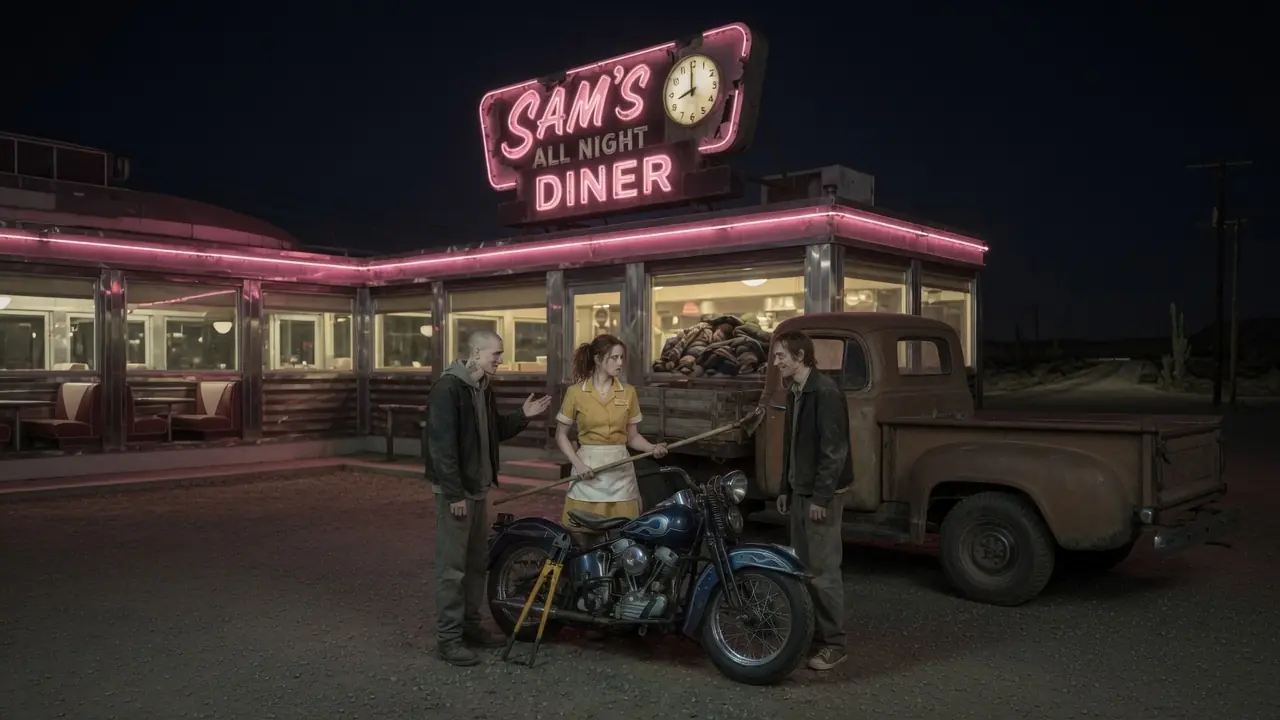
The neon sign above Sam’s All-Night Diner had been broken for nearly a year.
The letter N flickered on and off, turning SAM’S into SA ’S and casting an ugly pink glow across the empty parking lot outside Bakersfield, California.
It was 2:15 on a Tuesday morning.
The hour when highways seemed endless, truck stops fell quiet, and the world felt temporarily abandoned.
Inside the diner, the air carried the familiar mixture of burned coffee, old grease and industrial cleaning solution.
Twenty-eight-year-old Rebecca Lawson stood behind the counter, wiping the same spot for the third time.
Her shoulders ached beneath her faded mustard-yellow uniform.
She had been working for nearly fourteen hours.
But physical exhaustion was easier to tolerate than the numbers moving through her head.
Forty-two dollars in her checking account.
Eight hundred dollars in overdue rent.
Five days before the landlord changed the locks.
Almost three hundred dollars for her son’s asthma medication.
Every number felt like a wall closing around her.
In the booth farthest from the entrance, six-year-old Leo slept beneath a pile of winter coats.
Rebecca had arranged them into something resembling a bed after her babysitter canceled. The diner’s owner did not like children on the overnight shift, but Rebecca had nowhere else to take him.
Leo’s chest rose and fell unevenly.
Every few breaths, a faint wheeze escaped him.
Rebecca listened for that sound even when she was across the room.
She could hear it through the clatter of plates, through the coffee machine, through conversations between tired truck drivers.
She heard it in her sleep.
Leo had suffered from severe asthma since he was three.
His prescription inhalers cost more than Rebecca earned during several full shifts. His father had emptied their savings account two years earlier and disappeared before the divorce was finalized.
He sent no money.
He made no calls.
Rebecca had stopped expecting either.
She refilled a trucker’s coffee and glanced at the eviction notice folded inside her apron pocket.
She did not need to read it again.
She already knew every word.
Then a deep mechanical rumble rolled across the parking lot.
The sound reached the diner before the motorcycle did, vibrating through the windows and the metal napkin holders on the tables.
Both truckers at the counter turned toward the glass.
A custom 1947 Harley-Davidson Knucklehead glided beneath the flickering neon sign.
The motorcycle was painted midnight blue, almost black, with subtle silver flames worked into the fuel tank. The chrome reflected the diner lights like liquid glass.
It did not look restored.
It looked preserved.
The kind of machine that belonged in a museum but had spent its life moving through rain, dust and darkness.
The rider cut the engine.
The sudden silence seemed heavier than the noise.
He dismounted slowly.
He stood at least six feet four inches tall, with broad shoulders beneath a thick leather vest. Faded jeans covered heavy boots scarred from years of riding.
Across the back of his vest was the winged skull of the Iron Saints Motorcycle Club.
The Iron Saints were known throughout California.
People told stories about them in lowered voices.
Some stories were probably exaggerated.
Others were not.
The rider turned toward the diner.
His beard was thick and streaked with gray. A jagged scar curved beneath his left eye. His face carried the deep lines of a man who had spent decades riding into the wind and trusting very few people.
The name stitched above his chest pocket read ROOSTER.
The bell above the diner door gave a cheerful jingle as he stepped inside.
One trucker looked down at his eggs.
The other suddenly became fascinated by the weather application on his phone.
Rebecca wiped her hands on her apron and walked around the counter.
The first rule of surviving the overnight shift was simple.
Treat everyone the same.
Police officers.
Drifters.
Businessmen.
Bikers.
Everyone received the same coffee and the same tired politeness.
“Booth or counter, sir?”
The biker looked at her.
His dark eyes moved briefly across the diner, pausing on Leo’s sleeping form before returning to Rebecca.
“Corner booth.”
His voice sounded like gravel dragged across concrete.
He walked to the booth opposite Leo’s and sat with his back against the wall.
Rebecca brought him a menu.
He did not open it.
“Black coffee. Steak and eggs. Burn the meat.”
“How burned?”
“Enough that the cow can’t complain.”
Rebecca almost smiled.
“I’ll tell the cook.”
When she returned with his coffee, she noticed a small photograph beside his helmet.
It was old and bent at the corners.
A much younger Rooster sat in what looked like a repair shop, holding a baby wrapped in a pink blanket.
His large thumb rubbed slowly across the edge of the picture.
For a moment, the intimidating man looked impossibly vulnerable.
Rebecca placed the coffee on the table without commenting.
When she brought his food, he covered the photograph with one hand and began eating.
Twenty minutes later, she placed the check beside his plate.
“Fourteen fifty.”
Rooster removed a worn wallet attached to his belt by a chain.
He dropped a fifty-dollar bill on the table.
“Keep it.”
Rebecca stared at the money.
“Sir, that’s more than thirty dollars.”
“I can subtract.”
“I can’t take that much.”
He nodded toward Leo.
“Buy the kid a real blanket.”
Rebecca’s throat tightened.
She wanted to refuse.
Pride told her she should.
Then Leo coughed in his sleep.
Her hand closed around the bill.
“Thank you.”
Rooster looked back at his plate.
“Don’t make it a speech.”
Rebecca slipped the money into her apron.
Thirty-five dollars would not stop the eviction.
It would not repair her life.
But it might help buy Leo’s medicine the following morning.
For the first time that week, relief found a small opening inside her.
Then she heard tires scrape across the parking lot.
Rebecca was loading the dishwasher when an old Ford flatbed truck stopped near the diner entrance.
Its headlights shut off immediately.
Two men climbed from the cab.
Both were thin and restless, their movements quick and disorganized.
One had a shaved head and a dark tattoo climbing his neck. The other wore a dirty jacket several sizes too large.
The tattooed man pulled a wooden loading ramp from the flatbed.
His companion removed a pair of yellow bolt cutters.
Rebecca looked toward Rooster’s motorcycle.
Her stomach dropped.
“They’re stealing the bike.”
She hurried into the dining room.
Rooster’s booth was empty.
The restroom door stood closed at the end of the hall.
Outside, one thief positioned the ramp while the other approached the motorcycle’s front wheel.
Rebecca looked toward Leo.
He remained asleep beneath the coats.
She could wake Rooster.
She could call the police.
She could stay inside and let the thieves disappear before anyone became violent.
All three choices were reasonable.
Then the man with the bolt cutters lowered them around the chain.
Something inside Rebecca broke loose.
For two years, she had watched people take.
Her husband took their savings.
The landlord threatened to take their home.
Medical costs took every extra dollar she earned.
Fear took her sleep.
Exhaustion took her patience.
She was tired of standing still while the world removed one piece of her life after another.
Beside the back door stood an old iron bar the staff used to break ice around the dumpster during winter.
Rebecca grabbed it.
She pushed through the front doors and ran into the cold.
“Hey!”
Her voice cracked across the parking lot.
Both men spun around.
The bolt cutters fell to the asphalt.
“Get away from that motorcycle!”
The thieves stared at her.
They had expected the biker.
Instead, they saw a five-foot-four waitress in a yellow uniform gripping a rusty iron bar.
The tattooed man laughed.
“Go back inside, sweetheart.”
Rebecca positioned herself between them and the Harley.
“You don’t know whose bike this is.”
“I know exactly whose it is.”
“Then you know touching it is the worst decision you’ve made tonight.”
The second thief smiled.
“It’ll belong to us in thirty seconds.”
He moved toward the handlebars.
Rebecca lifted the iron bar.
“Stop.”
He reached for her shoulder.
She swung.
The iron connected with his forearm.
The man screamed and stumbled backward.
Rebecca stared at him in shock.
She had not intended to hit him that hard.
“You broke my arm!”
The tattooed man’s amusement vanished.
He reached inside his jacket.
The switchblade opened with a metallic snap.
Rebecca’s breathing stopped.
The knife reflected the pink neon light.
“You should have stayed inside,” he said.
Reality returned all at once.
Leo was sleeping less than forty feet away.
If Rebecca died in the parking lot, no one would know which inhaler he needed or how he liked the hallway light left on at night.
She raised the iron bar with both hands.
The man stepped closer.
“Move.”
“No.”
Her voice trembled.
But she remained where she was.
He lunged.
Rebecca swung, but he ducked beneath the iron and slashed upward.
Pain tore across her left forearm.
The knife sliced through her sleeve and opened the skin beneath it.
Blood immediately darkened the yellow fabric.
Rebecca staggered against the motorcycle.
Drops of blood struck the polished chrome exhaust.
The thief raised the knife again.
“Drop it.”
Rebecca tried to lift the bar.
Her fingers were becoming weak.
She closed her eyes.
The diner door slammed open behind her.
“What do you think you’re doing?”
The voice shook the parking lot.
The tattooed man froze.
Rebecca opened her eyes.
Rooster stood in the doorway.
He had removed his hoodie, revealing thick arms covered in faded tattoos. The calm, unreadable expression he had worn inside the diner was gone.
His eyes moved from the flatbed truck to the bolt cutters.
Then to Rebecca’s bleeding arm.
Finally, he looked at the knife.
Rooster stepped from the curb.
Broken glass crunched beneath his boots where the door had struck the wall.
He did not run.
He walked with the slow certainty of a man who did not believe anyone in front of him could escape.
The thief pointed the blade toward him.
“Stay back.”
Rooster continued moving.
“I’ll cut you.”
The knife came forward.
Rooster caught the man’s wrist with one hand.
He twisted sharply.
The switchblade fell.
The thief cried out and dropped to one knee.
Rooster struck him once in the ribs, sending him onto the pavement.
The second man, still clutching his injured arm, ran for the truck.
He climbed into the cab and sped away, abandoning his partner.
Rooster placed one boot beside the fallen man’s shoulder.
“If I see you near this diner again,” he said, “the sheriff will be the least of your problems.”
The thief nodded rapidly.
Rooster stepped away.
He did not chase the truck.
He did not continue hitting the man.
His attention shifted immediately to Rebecca.
She leaned against the motorcycle, pale and shaking.
Blood ran from her fingertips.
Rooster looked at the dark drops on his chrome pipes.
“You’re bleeding on my bike.”
Rebecca stared at him.
“I’m sorry.”
Her knees gave way.
Rooster caught her before she hit the asphalt.
The same hands that had restrained the thief now supported her with surprising care.
He lowered her beside the motorcycle and tore a strip from the sleeve of his hoodie.
Then he wrapped the cloth firmly around her arm.
Rebecca winced.
“Why did you do that?” he asked.
She looked at him through blurred vision.
“They would have stolen it.”
“It’s a machine.”
“It would have become a crime scene.”
“What?”
“The diner.”
Her teeth began chattering.
“If there was a fight or a shooting, Sam would close. I’d lose my job.”
She looked toward the diner.
“My son is inside.”
Rooster’s head turned sharply.
“The sick kid?”
“Leo.”
He pulled out his phone.
“Stay awake.”
He called one of his club members and ordered him to bring a truck and watch the motorcycle.
Then he lifted Rebecca into his arms.
Inside the diner, one of the truckers had already called emergency services.
Rooster carried Rebecca to a booth.
Then he crossed the room toward Leo.
The boy had awakened.
He sat beneath the coats, frightened and wheezing.
“Mommy?”
Rebecca tried to stand.
Rooster held up one hand.
“I’ve got him.”
The enormous biker sat beside the child.
“Your mother hurt her arm.”
Leo’s eyes filled.
“Is she going to die?”
“No.”
Rooster’s answer was immediate.
“She’s too stubborn.”
Leo looked toward Rebecca.
Rooster took the faded pink baby blanket from the top of his helmet bag and wrapped it around the boy.
The blanket was old, but clean.
When the paramedics arrived, they found Rebecca bleeding in one booth while a notorious biker sat in another, holding a frightened asthmatic child against his chest.
The emergency medical technician recommended transporting both mother and son.
Rebecca panicked.
“No ambulance.”
“Ma’am, that cut needs stitches.”
“I can’t afford it.”
“You may have tendon damage.”
“I said no.”
Rooster stood.
“She’s going.”
Rebecca looked at him.
“You don’t understand.”
“I understand bills.”
“They’ll destroy us.”
He lifted Leo gently.
“I’m riding with the kid.”
Then he met Rebecca’s eyes.
“You worry about keeping that arm attached. I’ll worry about the rest.”
Five days later, Rebecca sat on a cardboard box in the middle of her apartment.
Her arm was wrapped in thick white gauze.
The blade had missed the major tendons, but she needed twelve stitches and antibiotics.
Sam had fired her over the phone.
He claimed the diner could not afford the broken entrance or the increased insurance risk.
He thanked her for her years of work before removing her from the schedule.
The hospital bill had not yet arrived.
Rebecca was too frightened to calculate it.
At eight that morning, her eviction deadline expired.
The landlord had given her until one o’clock to remove her remaining belongings.
Leo sat on a deflated air mattress playing with a plastic fire truck missing two wheels.
Their furniture had already been sold.
Two suitcases stood beside the door.
Rebecca had thirty-eight dollars.
The family shelter had a three-week waiting list.
She buried her face in her uninjured hand.
The tears came silently.
She had tried to do the right thing.
She had bled for it.
And now her son was about to become homeless.
Then the windows began vibrating.
The sound started in the distance.
A low rumble moving closer.
Within seconds, it became the unified thunder of dozens of motorcycle engines.
Leo dropped his toy.
“What is that?”
Rebecca walked toward the window.
The cracked parking lot below had filled with motorcycles.
Thirty custom Harleys stood in a perfect diagonal line.
Riders in black leather dismounted together.
The winged skull of the Iron Saints covered their backs.
Curtains closed throughout the apartment complex.
Doors locked.
Residents stepped away from their windows.
Rooster led the group toward the building.
Beside him walked an older man with silver hair and a SERGEANT AT ARMS patch on his vest.
A heavy knock sounded on Rebecca’s door.
She opened it carefully.
Rooster removed his sunglasses.
“Heard you were moving.”
Rebecca looked down the hallway at the riders waiting near the stairs.
“I lost my job.”
“So I heard.”
“The landlord is changing the locks.”
Rooster reached into his vest and removed a thick envelope.
“No, he isn’t.”
Rebecca accepted it with her good hand.
Inside was a receipt showing that her hospital bill had been paid in full.
Behind it was a two-year lease on a modest townhouse in a safer neighborhood.
The rent, utilities and security deposit had already been covered.
Rebecca stared at the pages.
Then she found a third document.
It was an appointment confirmation for Leo at a leading pediatric pulmonary clinic in Los Angeles.
At the top were the words:
PRIVATE SPONSORSHIP — ALL COSTS COVERED.
Rebecca’s legs weakened.
“I can’t accept this.”
“Yes, you can.”
“This is thousands of dollars.”
“More than that.”
“Why?”
Rooster stepped into the apartment.
For a moment, he looked around at the boxes and empty walls.
Then he removed the old photograph from his wallet.
He handed it to Rebecca.
The young man in the picture barely resembled him.
He had no beard, no scar and none of the hard lines that now marked his face.
He held a baby wrapped in the same faded pink blanket Rooster had placed around Leo.
“Her name was Sophie,” he said.
His voice changed.
The gravel remained, but something beneath it had cracked.
“I was twenty-one.”
Rebecca looked at the photograph.
Rooster’s eyes moved toward Leo.
“I worked at a body shop. Swept floors, changed tires, did whatever they paid me to do.”
He swallowed.
“Sophie had asthma. Worse than your boy.”
Rebecca held the photograph carefully.
“We had no insurance. The inhalers cost more than I made in a week.”
He looked toward the window.
“One night, she had an attack.”
His hands closed slowly.
“I knew she needed the hospital. But I was scared of the bill. I thought if we waited, the inhaler might work.”
Rebecca stopped breathing.
“It didn’t.”
Rooster’s voice became almost inaudible.
“She died in my arms before a doctor reached us.”
The room went completely still.
“I spent years blaming the hospital, the insurance company, the government, anyone I could find.”
He looked at Rebecca.
“But the person I blamed most was myself.”
A faint shine appeared in his dark eyes.
“I got angry. Stayed angry. The club found me before that anger killed me.”
Rebecca glanced toward the riders outside.
“They became your family.”
“They gave me somewhere to put what I had left.”
He pointed toward Leo.
“When I saw your boy sleeping in that booth, I remembered Sophie.”
His gaze moved to Rebecca’s bandaged arm.
“Then I watched you run into a parking lot and stand between two armed men and my motorcycle because you were afraid of losing a minimum-wage job.”
Rebecca lowered her eyes.
“That wasn’t brave. It was stupid.”
“Most brave things look stupid when you’re standing too close to them.”
Rooster stepped nearer.
“You did not know me. You did not owe me anything.”
“It was wrong to let them take it.”
“You bled protecting something that mattered to me.”
His voice deepened.
“In our club, that means something.”
Rebecca shook her head.
“I didn’t do it for the club.”
“I know.”
He looked at Leo again.
“That’s why the club is doing this for you.”
Rebecca’s face crumpled.
Rooster continued.
“You and your son will not sleep in a shelter.”
He nodded toward the medical appointment.
“You will never delay taking him to a doctor because you’re scared of the cost.”
His jaw tightened.
“What happened to Sophie will not happen to Leo.”
Rebecca began crying.
Not the controlled tears she shed after bills arrived or after Leo fell asleep.
This was the helpless, exhausted crying of someone who had remained strong for too long and had finally been told she could stop.
She stepped forward and wrapped her good arm around Rooster.
The giant biker stood rigidly for a moment.
Then he placed one hand gently on her back.
Leo walked over and hugged one of Rooster’s legs.
Rooster looked down at him.
“You like motorcycles?”
Leo nodded.
“Are they loud?”
“Very.”
“My mom says loud things make people nervous.”
“Your mom is smart.”
Leo studied his beard.
“Are you scary?”
Rooster glanced at Rebecca.
“Sometimes.”
“Are you scary to us?”
“No.”
Leo accepted the answer immediately.
The riders carried Rebecca’s boxes downstairs.
No one asked for money.
No one complained about the stairs.
Several men who looked as though they could dismantle a truck with their hands carefully transported Leo’s broken fire engine and the small bag containing his inhalers.
The silver-haired sergeant at arms introduced himself as Mack.
He handed Rebecca a business card.
On the front was the name of a legitimate motorcycle repair shop.
“We need someone in the office,” he said. “Scheduling, invoices, customer calls. Day shift. Health insurance after ninety days.”
Rebecca stared at him.
“You’re offering me a job?”
“You stood up to two thieves with an iron bar.”
Mack shrugged.
“We figure you can handle our customers.”
Rooster loaded the last suitcase into a pickup truck.
“The position is yours if you want it.”
Rebecca looked down at Leo.
He was sitting on the curb wearing a borrowed motorcycle helmet far too large for his head.
For the first time in months, he was laughing.
“Yes,” she said.
“I want it.”
The townhouse was not luxurious.
It had two bedrooms, a small fenced yard and a kitchen window overlooking a row of trees.
To Rebecca, it looked like a palace.
Leo received his own room.
The Iron Saints filled it with a bed, blankets and shelves for his toys.
Rooster placed the faded pink blanket inside the closet.
Rebecca tried to return it.
He shook his head.
“It belongs somewhere a child can use it.”
Leo’s appointment in Los Angeles changed everything.
The specialist adjusted his medication and created an emergency treatment plan Rebecca could actually follow.
The club covered the prescriptions through a charitable foundation created years earlier by members whose families had struggled with medical bills.
Leo’s breathing improved within weeks.
Rebecca began working at the Iron Saints’ repair shop.
The business was rough around the edges but legitimate.
She handled appointments, parts orders and bookkeeping.
She also discovered that the bikers who frightened half of Bakersfield regularly repaired vehicles for elderly veterans at no charge and delivered groceries to club widows who lived alone.
Rooster visited almost every day.
Sometimes he brought Leo small model motorcycles.
Sometimes he sat quietly at Rebecca’s desk drinking terrible coffee.
He never discussed the night in the parking lot unless she mentioned it first.
Months passed.
Rebecca saved enough money to begin rebuilding her life.
She paid off old debts.
She bought Leo a proper bedspread.
She replaced the broken fire engine with a new one, although Leo continued playing with both.
Sam’s Diner reopened after repairs, but Rebecca never returned.
She heard that the owner struggled to keep overnight staff.
She felt no satisfaction about it.
Only distance.
On the anniversary of Sophie’s death, Rooster did not come to the shop.
Rebecca found him sitting alone at a cemetery outside town.
His Harley stood beside the road.
She carried flowers.
Leo carried the pink blanket.
Rooster looked up as they approached.
“You didn’t have to come.”
Rebecca sat beside him.
“You didn’t have to come to my apartment.”
“That was different.”
“No.”
She looked at the small stone bearing Sophie Henderson’s name.
“It wasn’t.”
Leo placed the blanket beside the grave.
Rooster’s face tightened.
The boy sat beside him.
“Did she like motorcycles?”
Rooster looked at Sophie’s name.
“She never got old enough to decide.”
Leo thought for a moment.
“I think she would have.”
Rooster laughed once, although tears had reached his eyes.
“Probably.”
Rebecca placed her hand over his.
The hardened biker who had frightened an entire diner allowed himself to cry beside the grave of the child he had carried for thirty years inside a folded photograph.
Leo leaned against him.
And for the first time since Sophie died, Rooster did not grieve alone.
A year after the attempted theft, Rebecca stood outside the repair shop watching Leo ride slowly across the parking lot on a small electric motorcycle.
He wore a helmet, knee pads and an expression of fierce concentration.
Rooster jogged beside him with one hand ready near the handlebars.
“Don’t let go!” Leo shouted.
“I’m not touching it!”
“You’re supposed to!”
“You’re riding by yourself!”
Rebecca laughed.
Rooster looked toward her.
For a moment, the fearsome outlaw disappeared.
He was simply an older man teaching a child to ride.
Leo completed a full circle and stopped beside Rebecca.
“Did you see?”
“I saw.”
“I didn’t fall.”
Rooster removed the helmet from the boy’s head.
“Falling isn’t the problem.”
“What is?”
“Staying down.”
Leo nodded as though he had been given a piece of important mechanical advice.
The Iron Saints later created the Sophie Henderson Children’s Breathing Fund.
It helped low-income families pay for asthma medication, emergency visits and specialist appointments.
Rebecca became the program’s administrator.
She knew how to speak to terrified mothers.
She knew what it felt like to choose between rent and medicine.
She made sure no parent heard the words she had once heard from pharmacies, landlords and hospital billing departments.
Not enough.
Past due.
Come back when you can pay.
A photograph hung inside the repair shop office.
It showed Rebecca in her mustard-yellow diner uniform, her arm bandaged, standing beside Rooster and Leo.
Behind them were thirty motorcycles.
Beneath the photograph was a simple line:
NO FAMILY RIDES ALONE.
People often assumed Rooster had rescued Rebecca.
In one sense, he had.
He paid the bills.
Found her a home.
Opened a door when every other door had closed.
But Rooster always corrected anyone who told the story that way.
“She saved me first,” he would say.
They usually assumed he meant the motorcycle.
He did not.
Rebecca had reminded him that Sophie’s death did not have to remain only a source of anger.
The worst night of his life could become the reason another child survived.
His grief could become shelter.
His regret could become medicine.
His club could become something more than a place to hide his rage.
Rebecca had stood between two desperate men and an old machine.
But what she truly protected that night was a piece of Rooster Henderson he believed had died with his daughter.
The part that could still care.
The part that could still choose mercy.
The part that was waiting for a reason to come home.
And it all began at 2:15 on a Tuesday morning beneath a broken neon sign, when a frightened waitress made a reckless decision and refused to step aside.
She believed she was protecting a stranger’s motorcycle.
Instead, she protected her son’s future.
She found a new family.
And she gave an old man one final chance to save the child he could never stop mourning.