Silas Callaway arrived at the Everhart Farm with a hammer in his tool bag, seven dollars in his pocket, and a son who still believed every new place might be the one where they finally stayed. The gravel driveway curved toward a red farmhouse with a neat wraparound porch, a faded red barn standing to one side, and golden fields stretching farther than Silas expected any one person to own. Autumn light rested over the land in a clean, quiet way, making everything look honest and tired at the same time. He parked his old pickup in front of the farmhouse and told himself this was only a repair job.
Finn jumped down from the passenger side before Silas could remind him to wait. The boy was seven years old, thin as a fence rail, bright-eyed, and impossible to keep still when the world looked interesting. His messy blond hair stuck up in every direction, and his denim jacket hung open over a faded shirt. He looked around the farm with wonder, as if the red barn, the porch steps, the trimmed grass, and the far fields had all been placed there for him to discover.
“Dad,” Finn whispered, though no one was close enough to hear them yet. “This place feels like it has secrets.”
Silas looked toward the barn, where part of the roof sagged and a line of missing boards showed the weather had been winning for years. “Every old farm has secrets.”
“But good ones?”
Silas almost smiled. “We are here to fix a shed, not dig for treasure.”
Finn made a face. “Barn, Dad. That is definitely a barn.”
Silas did smile then, but only for a second. He had not had much reason to smile in the last few years, and when it happened, it still felt like something he had borrowed. Since his wife Laura died in a car accident four years earlier, he had moved from town to town, taking carpentry jobs, fence jobs, roof jobs, whatever work would keep food on the table and gas in the truck. He always told Finn they were chasing better opportunities, but the truth was simpler. Silas had been running from the kind of grief that followed anyway.
A woman appeared on the porch of the red farmhouse. She was about thirty-two, with long chestnut-brown hair tied back in a loose ponytail, sharp green eyes, and a guarded face that suggested she had learned long ago not to trust easy promises. She wore a plaid work shirt, fitted jeans, and sturdy boots dusted with soil near the soles. Her arms were crossed, but not in a rude way, more like she was holding herself steady.
“Silas Callaway?” she asked.
“That is me.” He stepped forward and extended a hand. “You must be Marigold Everhart.”
She shook his hand firmly. “I appreciate you coming out this soon.”
“I appreciate the work.”
Her eyes moved briefly to Finn, and her expression softened. “And this must be your son.”
“Finn,” the boy said, stepping forward with all the importance of a man introducing himself at a bank. “I am mostly here to supervise.”
Marigold’s mouth twitched. “That sounds serious.”
“It is,” Finn said. “Dad sometimes forgets lunch.”
“That is useful supervision.”
Silas cleared his throat, partly to stop Finn and partly because kindness toward his son always caught him unprepared. “You said over the phone the barn roof was the main problem?”
Marigold glanced toward the red structure beside the farmhouse. “The roof, a few boards, maybe some support work. It has seen better days, but I would rather keep it standing than tear it down.”
Silas understood that immediately. He had spent most of his life around old wood and old houses, and he knew the difference between something ruined and something neglected. Ruined things collapsed under your hand. Neglected things waited for someone patient enough to strengthen them. The barn looked like the second kind.
Marigold led him across the clean gravel and toward the barn. Finn followed at Silas’s side, dragging one hand along the fence rail until Silas gave him a look. The farm seemed quiet, but not empty. Chickens scratched near a side yard, wind moved through the dry grass, and somewhere beyond the barn, a dog barked once and then fell silent.
Inside the barn, sunlight cut through gaps in the roof and fell in bright slanted beams across the floor. The air smelled of old hay, dust, and dry wood. Silas ran one hand along a support beam, tapped it twice with the handle of his hammer, then crouched near the wall to inspect the lower boards. The foundation was better than he expected.
“Good bones,” he said.
Marigold’s shoulders eased almost invisibly. “That is what I hoped.”
“The roof needs reinforcement. These side boards should be replaced before winter. I would add braces here and here.” He pointed with the hammer. “It will take time, but it can be done.”
“I can help.”
Silas looked at her. “You do not have to.”
“I know.”
“Most landowners I work for prefer to stand back and tell me what I am doing wrong.”
“I am not most landowners.”
He believed that already.
They walked back into the yard to discuss cost, materials, and timing. Silas kept his estimate fair, maybe lower than he should have, but he needed the work badly and did not want to scare her off. Marigold listened carefully, asked practical questions, and did not haggle for sport. That, too, he respected.
“You fix things without asking too many questions, don’t you, Mr. Callaway?” she asked.
Silas tightened his grip on the tool bag. There was something behind the question, something watchful. “I do not ask many questions when I need the money.”
“Maybe you should.”
He looked at her then, really looked. The farm owner in front of him had dirt on her boots and loneliness behind her eyes. She did not look like a rich woman, not in the way people expected rich women to look. She looked like someone holding a whole world together with both hands.
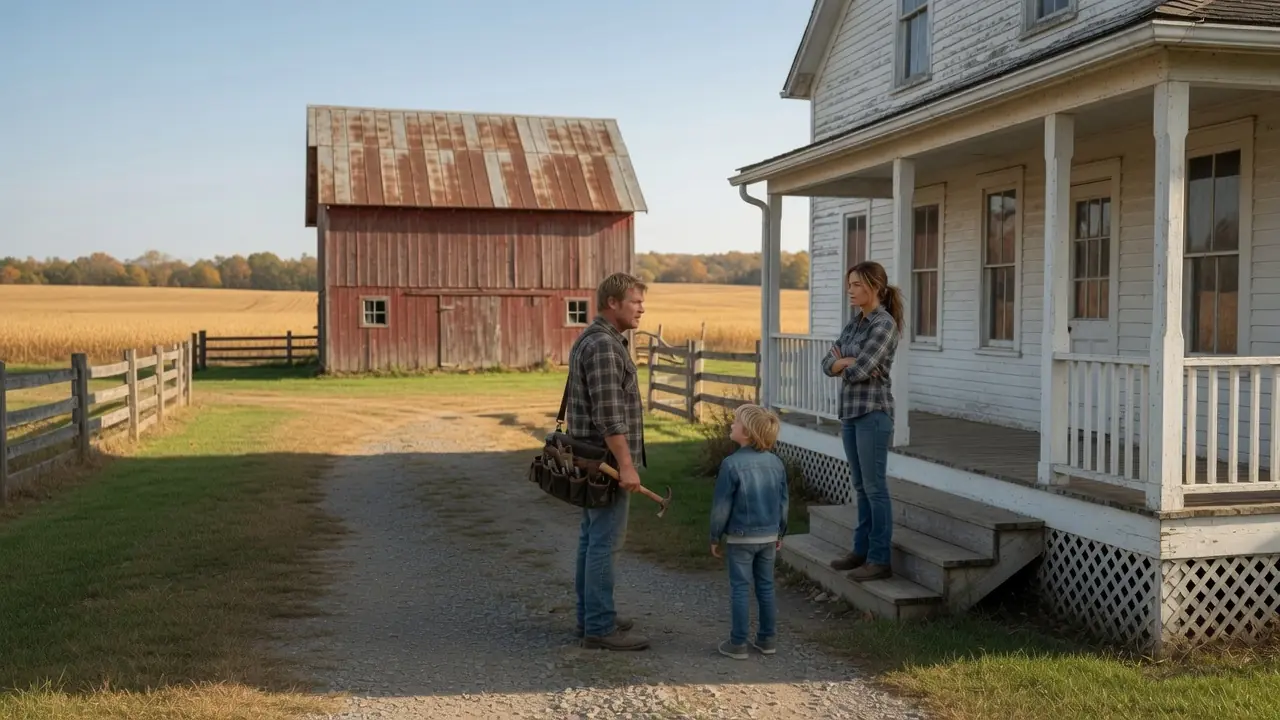
Before Silas could answer, Finn called from near the porch. “Dad, look!”
Silas turned quickly, expecting trouble, but Finn was crouched near the steps beside a scruffy brown dog with one floppy ear and a tail wagging so hard it shook his whole body. The dog sniffed Finn’s hand, then leaned against him like they had been friends for years. Finn’s face shone.
“Can we keep him?” he asked.
Silas closed his eyes for one brief second. “Finn.”
Marigold walked closer. “His name is Rusty. Or at least that is what I call him. He showed up one day and decided the porch belonged to him.”
“Smart dog,” Finn said, rubbing Rusty behind the ears.
“He has been looking for someone to follow around,” Marigold said. “Maybe he found him.”
Silas wanted to say no. They were barely settled in Hopewell. They did not have money for surprises, and a dog was a responsibility. But Finn had smiled more in the last five minutes than he had in the previous week, and Rusty had his head in the boy’s lap as if the matter had already been decided.
“We will talk about it,” Silas said.
Finn knew that was as close to yes as he could get for now. He hugged Rusty around the neck, and Silas felt something in his chest loosen against his will.
Work began the next morning. Silas arrived early, the sun barely lifting over the fields, and found Marigold already outside near the barn with a thermos of coffee and a stack of replacement boards arranged neatly beside the wall. She had not been joking about helping. Her sleeves were rolled, her hair was tied back, and her eyes were alert with purpose.
“You always start this early?” she asked.
“When I need the money.”
She handed him a cup. “Then you will need coffee.”
He took a sip and raised his eyebrows. “Strong.”
“I do not make weak coffee.”
“That is good to know.”
They worked side by side through the cool morning. Silas handled the high beams and heavy repairs, while Marigold measured, passed tools, steadied boards, and listened when he explained what needed to be done. She was not skilled, but she was careful, and careful mattered more than confidence. By midmorning, Finn arrived with Rusty trotting at his heels, both of them muddy despite the fact that the yard was mostly dry.
“I brought your supervisor,” Finn announced.
Rusty stole a glove from Silas’s tool pile and ran proudly in a circle.
“That supervisor is fired,” Silas said.
Finn laughed so hard he fell onto the grass.
For a few hours, the farm felt almost easy. Silas found himself working with the steady rhythm he loved most: measure, cut, lift, secure, test. There was comfort in making something stronger one board at a time. Marigold stood nearby, watching the barn change under his hands with an expression that seemed almost protective.
“This place means a lot to you,” Silas said.
Marigold looked toward the farmhouse. “It has been in my family for generations. My grandfather started with a small patch of land and a mule. My father expanded it into something bigger than anyone thought possible.”
“And now?”
“Now it is mine.”
She said it without pride, but with weight.
Silas waited, but she did not explain further. He knew better than to push. Some histories came out slowly, when trust had been given enough time to settle. He returned to the work, but the question stayed with him.
Over the next week, Silas began to hear things in town. Hopewell was small enough that people shared information whether you asked for it or not. The Everharts had once owned more land than anyone in the county. Marigold’s father, Elijah, had been a powerful farmer and businessman, admired by some, envied by others, and pressured by men who wanted the land after his death. Marigold had inherited thousands of acres, though she lived as if she owned only what she could personally repair.
That confused Silas. If she owned that much land, why was she patching an old barn with her own hands? Why did she wear worn boots and drive an old truck? Why did she look at every fence post like losing one more piece might break something inside her?
The answer arrived in a sleek black car.
It was late afternoon, and Silas was working near the front of the farm while Finn and Rusty chased each other by the porch. Marigold had been helping in the garden, planting wildflower seeds with Finn in a small empty patch beside the farmhouse. The day had been peaceful until the black sedan rolled up the gravel driveway, too polished for the land, too quiet for a man who wanted to be welcomed.
The driver stepped out wearing an expensive suit and polished shoes that looked offended by the dust. He was in his forties, smooth-faced and confident, with the kind of smile that did not reach his eyes. Marigold stiffened the moment she saw him.
“Marigold,” he called. “You have been ignoring my calls.”
“There was nothing left to say, Damon.”
Silas glanced at Finn and motioned him to stay back. The boy obeyed, holding Rusty close.
Damon Caldwell walked toward Marigold as if the farm were already his. “You know this place is sitting on a gold mine. Development firms would pay more than fairly. It is time to let it go.”
“My answer has not changed.”
Damon sighed, as if she were a difficult child. “You are being stubborn. This is not what your father would have wanted.”
Marigold’s face hardened. “You do not get to speak for my father.”
Silas set down his hammer and walked closer. He did not step in front of her, because Marigold did not seem like a woman who needed shielding, but he came near enough that Damon noticed. The man’s eyes moved over Silas’s flannel shirt, calloused hands, and dusty boots, and his mouth curved slightly.
“And you are?”
Silas held his gaze. “Someone who does not like watching people get pushed around.”
Damon’s smile thinned. “How noble.”
“How temporary,” Silas replied. “If you leave now.”
For a moment, the air went very still. Damon looked from Silas to Marigold, calculating. Then he adjusted his cuff and stepped back.
“Think carefully,” he told her. “Before the choice is no longer yours.”
He returned to his car and drove away.
Marigold stood in the driveway after he left, hands curled at her sides. The dust settled around her boots, and the farm seemed to hold its breath. Silas waited before speaking.
“That happen often?”
“More than I want to admit.”
“And you keep saying no.”
Her eyes met his. “Every time.”
“Good.”
She gave a small humorless laugh. “You say that like saying no is enough.”
“It is not. But it is a start.”
Marigold looked past him toward the fields. “He was my father’s investment partner once. He helped finance some expansions before my father got sick. After the funeral, Damon started circling. He wants the land, and he thinks pressure will make me weak enough to sell.”
“Will it?”
“No.”
Silas nodded. “Then we figure out how to make him weaker.”
She stared at him, startled. “We?”
“I am here, am I not?”
“You are here to repair a barn.”
“That is how it started.”
The words surprised him as much as they seemed to surprise her.
That evening, Marigold invited Silas and Finn to dinner. The farmhouse was warmer inside than Silas expected, full of old photographs, books, sturdy furniture, and the smell of beef stew and fresh biscuits. Finn ate like a child who had never trusted tomorrow’s meal and then declared Marigold’s cooking better than pancakes. Marigold laughed, and Silas realized he liked the sound.
After dinner, Finn played on the porch with Rusty while Silas and Marigold stood near the railing. The fields stretched before them in the fading light, thousands of acres he had not understood she owned until that week. She held a mug of coffee between both hands, her face turned toward the land.
“You do not live like someone rich,” Silas said.
She looked at him sideways. “Do you think owning land makes a person rich?”
“Usually.”
“Land can feed you, bury you, or ruin you. Sometimes all three.”
He accepted that. “Why not sell part of it? Enough to make things easier.”
“Because once I start cutting pieces away, men like Damon will not stop until all of it is gone.”
Silas leaned against the post. “You are defending more than property.”
“Yes.”
“Your family?”
“History. Promise. Maybe guilt.”
He heard the last word. “Guilt for what?”
Marigold was quiet long enough that he thought she would not answer. “For not wanting the life my father wanted for me until he was gone. Then suddenly everyone expected me to protect it.”
Silas understood more than she knew. “My wife died before I learned how to stop running from responsibility. By the time I figured it out, I had already dragged Finn through half the state.”
Marigold’s eyes softened. “You are here now.”
“For the moment.”
“Is that all Hopewell is to you?”
He looked out at Finn laughing with Rusty, at the red barn taking shape again, at the woman beside him who had somehow made him feel seen and challenged at the same time. “I do not know yet.”
But he was starting to.
The storm came three days later. Dark clouds moved in faster than expected, swallowing the afternoon light. Wind tore across the farm, sending leaves skittering over the gravel and rattling loose boards against the barn wall. Marigold moved immediately to secure the animals, and Silas followed, sending Finn into the house with Rusty before the rain began.
The north fence gave way first. One post snapped under the pressure, then another, and the loose wire lashed wildly in the wind. Marigold ran toward it before Silas could stop her. He cursed and sprinted after her through the rain.
“Marigold, leave it!” he shouted.
“If the cattle get loose, we lose half the herd!”
“You are not worth less than a fence!”
Lightning cracked over the far field, bright and violent. Marigold grabbed the broken section, but another gust nearly pulled her off her feet. Silas caught her around the waist and dragged her back just as debris flew past where she had been standing. She turned on him, ready to fight, soaked and furious.
“You cannot save everything by yourself,” Silas said, gripping her shoulders. “Not at the risk of yourself.”
Her anger faltered. Rain ran down her face, and for once, the guarded wall behind her eyes slipped. She looked exhausted, not physically, but in the soul. The storm raged around them, but in that moment, she finally nodded.
“I know.”
By dawn, the storm had passed, but the damage remained. Silas found Marigold standing by the broken north fence with two mugs of coffee, dark circles under her eyes. She handed him one without speaking. The air smelled of wet earth, split wood, and the kind of beginning that came after destruction.
“You did not sleep,” he said.
“No.”
“Tell me what Damon has over you.”
This time, she did not deflect. She told him about the debt, the old investment agreement, the suppliers Damon had turned against her, the bank loans quietly blocked, the pressure applied through smiling men in offices. Legally, Damon had no claim, but influence could become a weapon when wielded by someone patient and cruel.
Silas listened. Then he looked across the field.
“You still have friends in this town?”
“A few.”
“Then use them.”
“I do not ask people to fight my battles.”
“Then do not ask them to fight for you. Ask them to fight for the farm. Show them what this place means before Damon convinces them it is just empty land.”
Marigold frowned. “How?”
“Make it useful to Hopewell again. A market. Local vendors, farmers, bakers. Turn the farm into a gathering place.”
She stared at him. “You have thought about this.”
“Yes.”
“Why?”
Silas took a breath. “Because I know what it is like to lose something that matters and feel like no one is standing in your corner.”
Her expression changed, just slightly.
“Then stand in mine,” she said.
“I already am.”
The market idea moved faster than either of them expected. Word spread through Hopewell that Everhart Farm would host a Saturday gathering for farmers, bakers, craft sellers, and families. Mrs. Thompson brought pies and cinnamon bread. Henry Logan brought produce and three workers to help set up stalls. The Coopers brought honey, the Millers brought quilts, and children came running through the fields as if the farm had been waiting years to hear laughter again.
By midday, the land was alive.
Marigold stood near the barn, stunned by the sight of people moving between stalls, talking, buying, remembering. She had spent so long seeing the farm as a burden that she had forgotten it could be a place of belonging. Silas stood beside her, Finn nearby with Rusty, both covered in dust and happiness.
“This is because of you,” she said.
Silas shook his head. “No. People needed a reason to fight for this place. You gave them one.”
Then Damon Caldwell arrived.
His black car cut through the gravel driveway like a stain. He stepped out with the same polished confidence, but the market clearly annoyed him. Silas moved closer to Marigold without thinking. This time, she did not step away.
“You really think this changes anything?” Damon asked, gesturing toward the stalls. “A few jars of jam and children running in a field?”
Marigold lifted her chin. “I think you should leave.”
Damon smiled. “You still do not understand. I do not need you to sell anymore. The county is listening. Underused agricultural land can be redirected for development if the public interest is strong enough.”
“Eminent domain,” Silas said.
Damon’s eyes flicked toward him. “The handyman knows legal terms. Impressive.”
Silas stepped forward. “The town is standing on the land you are trying to call underused. You picked the wrong day to lie about its value.”
People nearby began turning. Henry Logan crossed from his stall. Mrs. Thompson stopped wrapping bread. A dozen townspeople watched Damon Caldwell with expressions that made his smile fade.
Marigold took one step forward. Her voice did not shake. “This farm feeds this town, hosts this market, supports local families, and preserves land my family protected for generations. If you want to claim it serves no public good, you can say it in front of the public.”
Damon looked around and saw what he had missed. Silas had not merely repaired a barn. Marigold had not merely hosted a market. Together, they had created witnesses.
“This is not over,” Damon said.
“No,” Marigold replied. “But now it is not quiet.”
Within weeks, the county backed away from Damon’s proposal. The public opposition was too strong, the legal support from local landowners too organized, and the evidence of the farm’s community value too visible to ignore. Damon’s influence did not vanish, but it weakened enough for Marigold to breathe. Everhart Farm survived.
On the morning the decision became final, Marigold stood at the edge of the golden fields, watching the sun rise over land that was still hers. Silas approached quietly, hands in his pockets, his boots dark with dew. Finn and Rusty were somewhere near the porch, making noise over breakfast and probably trouble.
“It is safe,” Silas said.
“For now.”
“For now is not nothing.”
She smiled. “No, it is not.”
He stood beside her, both of them looking across the acres that had nearly been lost. Silas thought about the day he arrived believing he was only taking another repair job. He thought about how easily he could have finished the barn, collected his pay, and kept driving. Instead, Hopewell had set roots around him before he noticed they had reached his heart.
“Guess I should finish the last beam on the barn,” he said.
Marigold looked at him. “Is that what is keeping you here?”
“No.”
Her breath caught.
Silas turned toward her. “I came here because I needed money. I stayed because Finn was happy. Then I stayed because this farm needed help.” He paused. “Now I think I am staying because I do not want to leave you.”
Marigold looked away toward the fields, but he saw the emotion cross her face. She had spent years guarding land, memory, grief, and pride. Trust did not come quickly to her. But when she reached for his hand, her fingers were steady.
“Good,” she said softly. “Because I do not want you to leave either.”
The market became permanent after that. Every Saturday, Everhart Farm filled with vendors, children, neighbors, and strangers who came for produce, bread, crafts, music, and the kind of community people did not know they missed until they stood inside it. Finn declared himself official assistant farmhand and took his responsibilities too seriously for everyone’s comfort. Rusty greeted every visitor as if each one had arrived specifically to admire him.
Silas continued repairing the barn, then the fences, then the porch railing, then anything else that needed hands willing to make broken things strong. Marigold ran the farm with renewed purpose, not because she no longer felt fear, but because she no longer faced it alone. The red farmhouse looked brighter by spring, the barn stood solid, and the wildflowers Finn had planted began to rise in green shoots near the porch.
One evening, Marigold found Silas kneeling beside Finn at the flower patch. The boy pointed excitedly at the tiny sprouts breaking through the soil. Rusty sat beside them, tongue out, tail thumping against the dirt.
“They made it,” Finn said proudly. “Miss Marigold said you have to believe in what you cannot see yet.”
Silas looked up at Marigold. “She was right.”
Marigold stood still, the sunset touching her face, and felt the truth of it settle deep. They had planted more than flowers. They had planted trust, courage, and a life none of them had planned but all of them had needed.
Silas rose and brushed the dirt from his hands. “Some things take time.”
Marigold smiled. “And patience.”
“And the right place to grow.”
Finn looked between them and grinned. “Are you two talking about flowers or each other?”
Silas laughed. Marigold covered her face, but she was laughing too.
The farm was no longer quiet the way it had been before. It was quiet now in the way living places are quiet after work is done and people are safe. The barn held. The porch light glowed at night. The fields stretched wide and golden, no longer a burden carried by one woman but a legacy shared by those brave enough to fight for it.
Silas Callaway had come to Everhart Farm for a paycheck.
He found work, yes.
But he also found land worth defending, a woman worth standing beside, and a place where his son could finally stop asking whether they were staying.
Because they were.