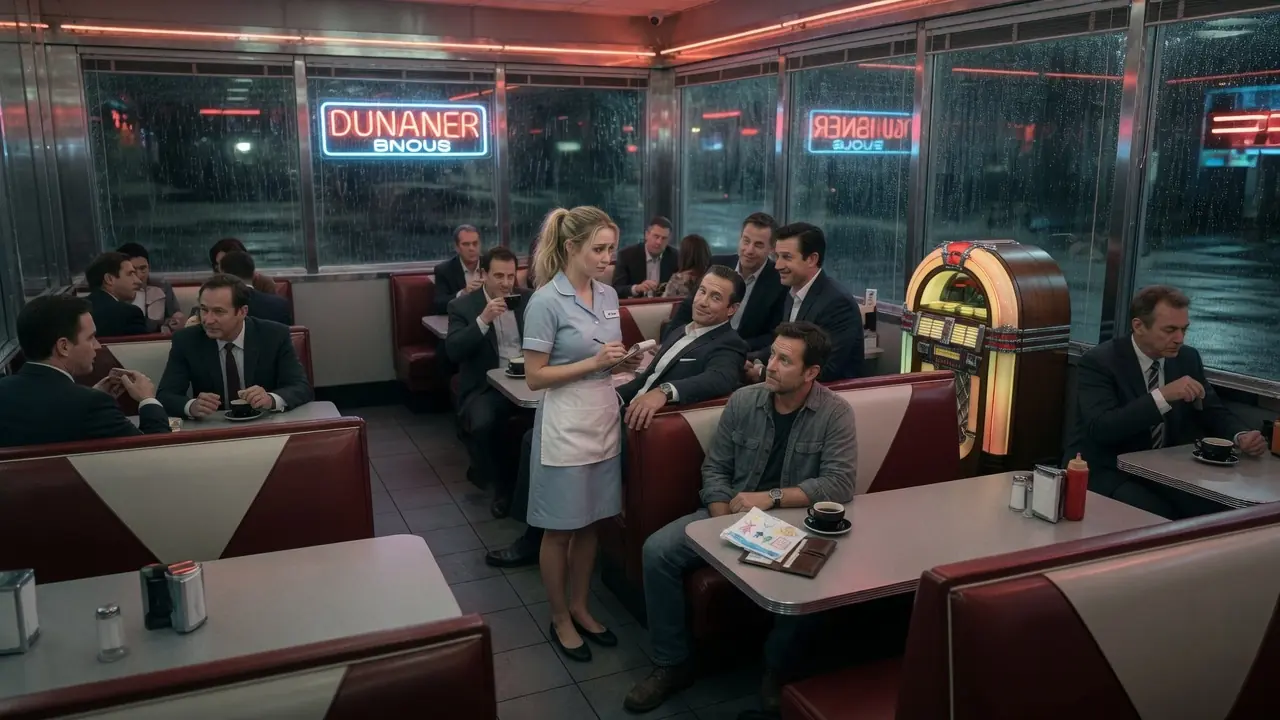
Rain hammered the windows of the Blue Lantern Diner at twelve forty-five in the morning.
Outside, the streets of Portland were nearly empty. Water streamed beneath the tires of passing trucks, the traffic lights changing for intersections where no one was waiting. Inside, the diner glowed beneath faded fluorescent lights that made every chrome table look pale and tired.
At the end of the counter, thirty-six-year-old Jack Mercer sat over a cup of black coffee.
He had been awake since five that morning.
His first job had been delivering medical supplies to clinics across the city. After that, he had repaired a leaking roof for an elderly couple who could not afford a professional contractor. In less than an hour, he was expected at a warehouse where he worked the overnight security shift.
Jack wanted nothing more than fifteen quiet minutes.
His right shoulder ached whenever the weather turned cold and wet. The injury had followed him home from Afghanistan nearly nine years earlier, along with memories he rarely discussed and a folded flag that belonged to a friend who had not returned.
Three jobs were barely enough to support the small apartment he shared with his seven-year-old daughter, Emma.
Rent had risen again.
Emma needed new shoes for school.
Her dance instructor had gently reminded Jack that the monthly payment was overdue.
The numbers never stopped moving inside his head.
He took another drink of the bitter coffee and looked toward the young waitress behind the counter.
She wore a faded blue uniform and a silver name tag that read Anna.
Her blond hair was tied into a practical ponytail. She moved quietly between the tables, refilling mugs and carrying plates with the careful balance of someone who had learned how to remain polite while exhausted.
Jack had seen her several times during his late-night visits.
She never rushed him.
Even when he ordered nothing except the cheapest coffee on the menu, she refilled his cup without making him feel as though he was occupying space he had not paid for.
There was something unusual about her.
She spoke too precisely for someone who had spent her whole life working in diners. Her posture remained straight even at the end of a long shift. When angry customers snapped at her, she did not become frightened or defensive. Instead, she studied them with the calm concentration of someone accustomed to difficult negotiations.
Jack had noticed.
But he had learned long ago that people carried stories they did not always want explained.
So he never asked.
The bell above the diner door rang at twelve forty-three.
Three men entered from the rain.
The first wore a dark suit that probably cost more than Jack’s truck. His hair was perfectly arranged, and the expensive cologne surrounding him briefly overwhelmed the smell of coffee and fried onions.
The two men behind him looked less confident.
They wore business clothes, but they moved like employees following a boss they feared disappointing.
Anna froze when she saw the first man.
Only for half a second.
Then the professional expression returned to her face.
The man noticed the reaction and smiled.
“Well,” he said loudly, removing his wet coat. “There she is.”
Several customers glanced up.
Anna picked up her order pad.
“Good evening, Mr. Langford.”
The man slid into a booth.
Graham Langford was forty-one, wealthy, charming when necessary, and accustomed to entering rooms where people already knew his name. His investment firm controlled millions of dollars in technology ventures, and he treated nearly every human interaction as a negotiation he expected to win.
He snapped his fingers.
“Coffee. Black. And try not to ruin it this time.”
Anna walked toward the booth.
“Would any of you like menus?”
“What I’d like,” Graham said, “is for you to stop embarrassing yourself.”
Jack looked up from his coffee.
Anna’s hand tightened around her order pad.
“This is my place of employment,” she said evenly. “Please behave like any other customer.”
Graham laughed.
“Your place of employment?”
His associates joined him, although neither seemed to find the situation amusing.
“Does your father know you’re still doing this?” Graham asked. “Serving truck drivers and drunks in the middle of the night?”
Anna glanced around the diner.
“Lower your voice.”
“Why? Are you afraid one of your new friends will discover who you really are?”
She turned to leave.
Graham reached out and seized her wrist.
The movement was quick and deliberate.
Anna’s face changed.
The confidence vanished for a moment, replaced by shock.
“Let go of me,” she said.
Graham tightened his grip.
A truck driver in the corner lowered his eyes to his newspaper.
An elderly couple near the window began gathering their coats.
The cook looked through the kitchen opening and then disappeared behind the grill.
No one moved.
Jack watched Graham’s fingers pressing into Anna’s skin.
He saw the fear she was trying to hide.
He had seen that expression before.
Not in a diner.
In villages thousands of miles away, where powerful men had learned they could do anything they wanted because everyone around them was too frightened to interfere.
Jack placed his coffee cup on the saucer.
The quiet sound carried through the diner.
Then he stood.
He did not move quickly.
He walked toward the booth with the controlled calm of a man who knew rushing often made dangerous situations worse.
“I think she asked you to let go,” Jack said.
Graham turned.
His eyes moved across Jack’s old flannel shirt, worn jeans, work boots and rough hands.
“This doesn’t concern you.”
“It became my concern when you put your hands on her.”
One of Graham’s associates leaned forward.
“You should sit down.”
Jack kept his eyes on Graham’s hand.
“I’m asking once. Let her go.”
Graham gave a disbelieving smile.
“Do you know who I am?”
“No.”
That answer seemed to offend him more than an insult would have.
“I could buy this diner before breakfast. I could buy the building you live in and throw you onto the street.”
Jack nodded slightly.
“Maybe you could.”
Graham waited for fear.
None came.
“But right now,” Jack continued, “you’re a man holding a woman who told you to stop. Your money doesn’t change that.”
Anna looked at him.
There was surprise in her expression, but also something deeper.
People in her world measured consequences before they acted. They considered alliances, reputations and possible returns.
This tired stranger had simply seen something wrong and stood up.
Graham released a short laugh.
Then he nodded toward the younger man beside him.
The associate rose and reached for Jack’s shoulder.
Jack moved before the man’s hand landed.
He stepped aside, caught the reaching wrist and turned it gently but decisively. A second later, the young man was bent over the table with his arm controlled behind him.
Nothing broke.
There was no wild punch or reckless violence.
Only speed, leverage and absolute control.
The second associate half stood.
Jack looked at him.
“Stay seated.”
The man sat down.
Jack returned his attention to Graham.
“Let her go.”
Graham released Anna’s wrist.
She stepped back, rubbing the red marks on her skin.
Jack freed the associate and gave him enough space to retreat.
“No one needs to be hurt,” Jack said. “That part is still your choice.”
Graham pulled out his phone.
“You’re finished.”
Jack returned to his stool.
“I’ve heard that before.”
“I’m calling the police.”
“You should.”
Graham stared at him.
Jack lifted his coffee.
“Everyone here saw what happened.”
The police arrived eleven minutes later.
Officer Daniel Ruiz had been with the Portland Police Bureau for more than twenty years. He listened to Graham’s accusations, examined Anna’s wrist and questioned each witness separately.
The security camera above the register had recorded the confrontation, but the reflection from the diner’s neon sign obscured the beginning.
Graham demanded Jack’s arrest.
“He attacked my employee without provocation.”
“I’m not his employee,” the younger man muttered.
Graham glared at him.
Anna gave her statement clearly.
“He grabbed me after I told him not to. Mr. Mercer intervened only after Graham refused to release me.”
The truck driver in the corner reluctantly confirmed the same thing.
Officer Ruiz closed his notebook.
“Mr. Mercer’s actions appear consistent with defending another person.”
Graham’s attorney arrived before the questioning was complete.
Within minutes, the lawyer began speaking about lawsuits, medical damages and public safety.
Officer Ruiz looked tired.
“Mr. Mercer, Mr. Langford insists on filing a formal complaint. I need you to come to the station to complete your statement.”
Jack nodded.
“I need to call my daughter.”
He stepped into the narrow hallway beside the restrooms.
Emma answered after three rings.
“Daddy?”
Her voice was heavy with sleep.
“Hey, sweetheart. Everything’s okay. I might be home a little late.”
“Are you at work?”
“Not yet.”
Mrs. Chen, the elderly woman across the hall, was staying with Emma until he returned.
“Did something happen?”
Jack closed his eyes.
“I helped somebody who was in trouble.”
There was a pause.
“Like when you were a Marine?”
“Something like that.”
“Was she scared?”
“Yes.”
“And you didn’t leave?”
“No.”
Emma sounded more awake now.
“Then you did the right thing.”
Jack leaned against the wall.
“I hope so.”
“You always tell me the right thing can still be hard.”
For a moment, Jack could not answer.
“Go back to sleep, Em.”
“Okay. Love you.”
“I love you too.”
At the police station, Graham already had two attorneys waiting.
Jack had no one.
Then, at two thirty in the morning, a woman in a dark coat entered the station carrying a leather briefcase.
“My name is Rachel Brooks,” she announced. “I represent Mr. Mercer.”
Jack had never met her.
She explained that a customer from the diner had called a veterans’ legal assistance organization. Rachel handled pro bono cases for former service members who could not afford representation.
She sat beside Jack and opened her notebook.
“Do not speak to Mr. Langford or his attorneys again tonight.”
“I can’t pay you.”
“You’re not paying me.”
“I don’t want charity.”
“It isn’t charity. It’s my job.”
Something about her tone ended the argument.
By four in the morning, Jack was permitted to leave.
He missed his security shift.
By noon, he no longer had the job.
Someone had posted a video from the diner online.
The clip began after Graham released Anna. It showed only Jack forcing the associate onto the table.
The caption read:
UNSTABLE VETERAN ATTACKS BUSINESSMEN IN MIDNIGHT DINER.
The video spread quickly.
Graham’s public-relations team fed local websites a carefully prepared story. Jack’s military history was mentioned. His therapy for post-traumatic stress was described as evidence that he might be dangerous.
The warehouse security company called before lunch.
“We’re concerned about liability,” the supervisor said. “Until this clears up, we have to remove you from the schedule.”
His delivery supervisor called next.
“Take a few days off.”
The handyman jobs stopped coming.
By evening, Jack had lost most of his income.
Anna learned about it inside a glass conference room on the thirty-second floor of Halston Technologies.
Her real name was Evelyn Halston.
At twenty-seven, she held a master’s degree in product design and was the only daughter of Victor Halston, founder of one of the largest technology companies on the West Coast.
For years, Evelyn had been expected to take a leadership role in the company.
Instead, she had walked away.
She wanted to understand the lives of the people Halston Technologies claimed to serve. She wanted to know what exhaustion felt like when missing one shift meant missing rent. She wanted to learn why hourly workers distrusted executives who spoke about efficiency without ever doing the jobs they were trying to improve.
So she had taken a position at the Blue Lantern under the name Anna.
Her father considered it rebellion.
Her therapist called it a search for identity.
Evelyn considered it the first honest thing she had done in years.
Across the conference table sat Maya Chen, Halston Technologies’ director of communications.
“This is getting worse,” Maya said, placing a tablet in front of her. “Graham’s people are portraying Jack Mercer as violent and unstable.”
Evelyn watched the edited video.
“That isn’t what happened.”
“I know.”
“He protected me.”
“I know.”
“Then tell the truth.”
Maya hesitated.
“Your father is concerned that acknowledging your identity will turn this into a corporate scandal.”
“It already is a scandal. An innocent man is losing his livelihood because he helped me.”
The conference-room door opened.
Victor Halston entered.
At sixty-three, Victor still possessed the energy of the young engineer who had built his first computers inside a rented garage. But decades of wealth had hardened that energy into authority.
Behind him stood Owen Price, his head of private security and a former Army Ranger.
Victor looked at his daughter.
“This ends now.”
“What ends?”
“The diner. The false name. All of it.”
“No.”
“You were assaulted.”
“And the only person who protected me is being destroyed while you’re worried about the company.”
Victor’s expression tightened.
“Mercer may have recognized you.”
“He didn’t.”
“You don’t know that.”
“He didn’t even know Graham.”
“Everyone has motives.”
Evelyn stood.
“That is what you believe because everyone around you wants something.”
The words landed harder than she intended.
Victor’s face went still.
“Jack Mercer didn’t ask who I was. He didn’t ask whether I was important. He saw a man hurting a woman, and he stood up.”
Victor turned toward Owen.
“Investigate him.”
Evelyn stared at her father.
“You’re looking for a reason not to believe in him.”
“I’m making sure you are safe.”
“No. You’re making sure the world still works the way you think it does.”
Over the following week, Jack’s life continued to collapse.
Parents whispered when he collected Emma from school.
A photograph from a bar fight six years earlier appeared online. The article did not mention that Jack had entered treatment shortly afterward or that he had not been involved in another incident since.
Graham’s attorneys filed a civil lawsuit demanding more money than Jack could earn in a decade.
Rachel spread the documents across her desk.
“They don’t expect to win at trial.”
“Then why file it?”
“They expect you to panic.”
“They’re succeeding.”
“They want you to accept a settlement, sign an agreement and disappear.”
Jack looked toward the window.
Rain blurred the city outside.
“I didn’t do anything wrong.”
“That is exactly why they need to bury you. You humiliated Graham in front of people he considers beneath him.”
That evening, Jack sat at the kitchen table helping Emma complete an art assignment.
She was drawing a man with a shield.
“Is that supposed to be me?” he asked.
“Yes.”
“I’ve never owned a cape.”
“You should.”
He smiled.
Then Emma looked up.
“Mrs. Chen said people are saying bad things about you.”
Jack put down the pencil.
“Some people only saw part of what happened.”
“Did you hurt someone?”
“I stopped a man who was trying to hurt me.”
“Did you have to?”
“Yes.”
Emma studied him with serious brown eyes.
“Then the people saying bad things don’t know you.”
A knock came at the door.
Evelyn stood in the hallway wearing jeans, a gray sweater and no makeup. She carried a covered casserole dish.
Jack stared at her.
“You found my apartment.”
“Your attorney gave me the address after I convinced her I wasn’t here to cause trouble.”
“That sounds like Rachel.”
“I brought dinner.”
“You didn’t need to.”
“I know.”
Jack stepped aside.
Evelyn entered the small apartment.
Everything was neat. A military photograph stood beside the folded flag. Children’s drawings covered the refrigerator. A photograph of Jack’s late wife rested on a shelf near the living room.
In the picture, she was smiling with one hand on Jack’s shoulder and the other around a much younger Emma.
Evelyn looked away respectfully.
Emma appeared in the hallway.
“You’re the lady from the diner.”
Evelyn crouched slightly.
“Yes.”
“My dad helped you.”
“He did.”
“Were you really scared?”
Evelyn glanced at Jack.
“Yes,” she answered honestly. “I was.”
Emma nodded.
“He helps people when they’re scared.”
Then she returned to her bedroom.
Evelyn placed the casserole on the counter.
“My name isn’t Anna.”
“I know.”
She looked at him.
“Evelyn Halston. Victor Halston is my father.”
“I figured it out after the news reports.”
“I should have told you.”
“It wouldn’t have changed anything.”
“My father believes you recognized me.”
“I didn’t.”
“I know.”
Jack looked at the casserole.
“What are you doing here, Evelyn?”
“This is happening because of me.”
“It’s happening because Graham made a choice.”
“And because he knew who I was. He is trying to pressure my father over a business deal. You became part of a fight you never knew existed.”
“I stood up because he grabbed you. The rest came later.”
“I want to pay for your legal defense.”
“No.”
“You haven’t even heard what I’m offering.”
“I don’t need to.”
“Jack, you have lost your jobs.”
“I know.”
“You could lose your apartment.”
“I know.”
“Then stop being proud.”
His expression hardened.
“This is not pride.”
“What is it?”
“If I allow your family’s money to erase what happened, then Graham’s money still decides the outcome. I’m not giving him that.”
“I’m trying to help.”
“Then help tell the truth.”
They stood in the narrow kitchen facing each other.
Evelyn had spent her entire life solving problems with resources, connections and influence. Jack had none of those things.
Yet he possessed something the people around her often lacked.
He knew where his line was.
And he would not cross it simply because doing so was easier.
“All right,” she said. “We tell the truth.”
Rachel began building the case.
A former hotel bartender named Lauren Price came forward with messages Graham had sent after she rejected him.
Two other women provided confidential statements describing similar behavior.
But none of them had witnessed the diner incident.
The security footage remained unclear.
Then Rachel received a call from Miguel Alvarez, the truck driver who had been sitting in the corner booth.
Miguel entered her office wearing a delivery uniform and carrying his cap in both hands.
“I should have spoken sooner.”
“Why didn’t you?” Rachel asked.
“I have a wife and three kids. Graham looked like a man who could destroy somebody’s life.”
“He is.”
Miguel lowered his eyes.
“My twelve-year-old daughter saw the news. She asked me why the man who helped the waitress was being called violent. I didn’t know how to explain that I had watched everything and stayed quiet.”
He agreed to record a statement.
“I saw Graham grab her. She told him to release her more than once. Jack gave him every opportunity to stop. When that other man stood, Jack controlled him without striking him.”
“How do you know the difference?”
“I served as military police for six years.”
Miguel looked directly into the camera.
“What Jack did was defensive restraint. Nothing more.”
Graham’s response came the next morning.
An intermediary delivered a settlement offer.
Fifty thousand dollars.
In exchange, Jack would admit partial responsibility, sign a nondisclosure agreement and agree never to speak publicly about Graham or the diner.
The money could have covered two years of rent.
It could have paid every overdue bill.
It could have created the beginning of Emma’s college fund.
Jack read the offer once.
Then he tore it in half.
That evening, photographs appeared online.
Jack walking Emma to school.
Emma leaving dance class.
Mrs. Chen opening the apartment door.
The message was unmistakable.
We know where your daughter is.
Officer Ruiz opened a criminal investigation into harassment and witness intimidation.
Rachel urged Jack to move temporarily.
He refused to leave the neighborhood, but he allowed Emma to stay with her aunt outside the city.
When he told her, she cried.
“You said everything was okay.”
“I said I would keep you safe.”
“Who’s keeping you safe?”
Jack had no answer.
Meanwhile, Owen Price completed the investigation Victor Halston had requested.
He entered Victor’s home office carrying a thick folder.
Victor did not look away from the financial reports on his screens.
“What did you find?”
“Jack Mercer served two tours in Afghanistan. He received a Bronze Star after pulling two wounded Marines from an ambush. He was medically discharged following a shoulder injury.”
“Anything concerning?”
“He developed post-traumatic stress symptoms after coming home. His wife died of cancer four years later. He drank heavily for several months after her death and was involved in one bar fight.”
Victor finally looked up.
“There it is.”
“He entered treatment the following week.”
Owen placed the folder on the desk.
“He has attended therapy consistently for six years. No arrests since then. No domestic complaints. No violent incidents.”
“What about his finances?”
“He is in debt.”
“Then he has a price.”
“Graham offered him fifty thousand dollars.”
Victor leaned back.
“He refused?”
“He tore up the offer.”
Owen paused.
“Graham’s people photographed his daughter. Mercer still refused.”
Victor looked toward the windows overlooking the city.
“You were supposed to find out whether he was using Evelyn.”
“I did.”
“And?”
“He isn’t.”
Owen spoke with quiet certainty.
“Your daughter was right. He is one of the rare ones.”
Victor said nothing for a long time.
His empire had been built through negotiations.
Every employee wanted advancement.
Every investor wanted returns.
Every politician wanted support.
Even friendship often arrived with a proposal hidden inside it.
The idea of a man who could not be bought felt almost irrational.
“What do you recommend?” Victor asked.
“Stop looking for leverage.”
Owen placed a flash drive on the desk.
“And show people what really happened.”
Halston Technologies’ annual product presentation attracted more than eight hundred journalists, investors and executives.
Graham Langford sat near the front.
His firm had invested heavily in the company’s newest data platform, and he expected to be photographed shaking Victor Halston’s hand.
Instead, Victor walked onto the stage and stood silently beneath the giant screens.
“Before we discuss technology,” he began, “I want to discuss character.”
The prepared graphics disappeared.
Video from the Blue Lantern Diner filled the screens.
This recording was different.
Halston’s technical team had recovered the original footage directly from the diner’s storage drive. They synchronized it with a second camera mounted near the kitchen entrance.
Together, the angles showed everything.
Graham seizing Evelyn’s wrist.
Her attempts to pull away.
Jack approaching calmly.
The associate reaching first.
Jack restraining him without striking anyone.
The audience became completely silent.
“The woman being assaulted is my daughter,” Victor said.
Graham’s face lost its color.
“The man who defended her is Jack Mercer, a former Marine and single father who did not know her identity. He expected no reward. Since that night, he has been harassed, defamed and threatened for refusing to lie.”
Graham rose from his seat.
Officer Ruiz and two detectives appeared beside the exit.
“Graham Langford,” Ruiz said, “you are under arrest for assault, witness intimidation, stalking and criminal harassment.”
Cameras turned toward him.
The man who had controlled public narratives for years was handcuffed beneath the lights of the largest event in his industry.
Evelyn walked onto the stage.
She was not wearing a waitress uniform.
But she was not dressed like an executive either.
She stood simply as herself.
“Jack Mercer did not protect me because I was Victor Halston’s daughter,” she said. “He protected me because I was a human being in danger.”
She looked toward the audience.
“Every other person in that diner had a reason to remain seated. They were tired. Afraid. Uncertain. Jack had those same reasons.”
She paused.
“He stood anyway.”
Evelyn announced the creation of the Halston Safe Workplace Initiative, a program designed to train employees, managers and security staff to recognize harassment and intervene safely.
The program would be offered free to small businesses that could not afford private training.
Within days, six more women came forward with allegations against Graham.
His firm lost clients.
Federal investigators began examining several of his business practices.
His civil lawsuit against Jack was withdrawn.
The edited video disappeared beneath headlines reporting the full truth.
Jack watched the news from his apartment.
Emma had returned home that morning and sat curled beside him on the couch.
“So everyone knows you didn’t do anything bad now?” she asked.
“Most people.”
“That took too long.”
Jack smiled.
“Yes, it did.”
Rachel called that evening.
“Three companies have offered you security positions.”
“I’m not interested in being used for publicity.”
“One of them might be different.”
Three days later, Victor Halston arrived at Jack’s apartment with Owen.
Victor looked out of place in the narrow hallway, but he made no complaint.
“Mr. Mercer, I owe you an apology.”
Jack let them inside.
“I assumed you recognized my daughter and were attempting to gain something from the situation.”
“You weren’t the only one.”
“I was still wrong.”
Victor placed an envelope on the kitchen table.
Jack did not touch it.
“I don’t want your money.”
“It isn’t money.”
Inside was a formal job offer.
Director of Safety Training for the new workplace initiative.
The position paid more than Jack had ever earned.
It included health insurance, stable hours and enough flexibility to be present for Emma.
Jack read the first page.
“Why me?”
“Because people can be taught procedures by anyone,” Victor said. “But courage is different. Employees will listen to someone who has paid a price for doing the right thing.”
Jack looked toward Emma’s bedroom.
“What would I actually do?”
“Develop intervention programs. Train security teams. Visit small businesses. Work with Evelyn and Rachel.”
“You mean work for your daughter.”
“I mean work with her.”
Victor stood.
“For what it is worth, I would trust very few people with her safety.”
He glanced at the offer.
“I trust you.”
After they left, Emma climbed into Jack’s lap.
“Are you taking it?”
“I don’t know.”
“Would you help people?”
“Yes.”
“Would you still come to my dance recitals?”
“Yes.”
“Would you only need one job?”
Jack looked at the stack of bills on the counter.
“Yes.”
Emma smiled.
“Then I think you know.”
Two weeks later, Jack entered Halston Technologies for his first day.
He wore clean work pants, boots and a blue button-down shirt Emma had chosen.
Evelyn waited in the lobby.
“No flannel?” she asked.
“Emma said I needed to look respectable.”
“I liked the flannel.”
“I still own it.”
They walked toward the elevators.
“Are you ready to change corporate America?” Evelyn asked.
“No.”
She looked at him.
“I’m ready to help one person at a time.”
The elevator doors closed.
Their first training session took place at the Blue Lantern Diner.
The owner had replaced the damaged booth and installed better security cameras.
A sign beside the register read:
WE DO NOT IGNORE HARASSMENT.
WE STAND UP FOR ONE ANOTHER.
Jack stood before a group of restaurant managers, warehouse supervisors and hourly employees.
“The hardest part is not always the physical intervention,” he said. “The hardest part is defeating the voice that tells you it isn’t your responsibility.”
Miguel sat in the front row.
Lauren Price and two other women who had reported Graham’s behavior sat beside Rachel.
Evelyn stood near the counter where Graham had grabbed her months earlier.
“When someone is in danger,” Jack continued, “you do not have to become a hero. You do not have to fight. You can call for help, create a distraction, record what is happening or stand beside the person being targeted.”
He looked around the diner.
“But doing nothing is still a choice.”
The program grew.
Rachel joined as legal director.
Miguel became one of Jack’s first trainers.
Maya Chen built a public campaign focused not on Jack’s confrontation, but on the responsibility of witnesses.
Graham eventually pleaded guilty to several charges after more evidence emerged. He received a prison sentence and was ordered to compensate multiple victims.
But Jack rarely discussed him.
The story had never truly been about Graham.
It was about the people who had once remained silent and later decided not to remain silent again.
Six months after the night at the diner, Jack and Evelyn sat together on a park bench.
Emma rode her bicycle along the path in front of them.
She had removed the training wheels that morning and was determined not to fall where anyone could see her.
Evelyn held a small box of cookies she had baked badly but confidently.
“She asked me something yesterday,” Evelyn said.
“What?”
“She asked whether standing up for people runs in families.”
Jack watched Emma wobble around a curve.
“What did you tell her?”
“I said it does now.”
Evelyn reached for his hand.
Their relationship had developed slowly.
There had been no sudden confession and no dramatic promise.
She sometimes joined Jack and Emma for Sunday dinner.
Jack helped repair a loose railing at Evelyn’s apartment.
Evelyn attended Emma’s dance recital and cried harder than Jack did, although she denied it afterward.
They came from different worlds.
Jack’s life had been shaped by necessity.
Evelyn’s had been shaped by expectation.
But both understood what it felt like to be seen as something other than who they truly were.
He had been treated as poor, damaged and disposable.
She had been treated as wealthy, useful and available.
With each other, neither had to perform.
Emma completed a full lap around the path.
She raised both hands in victory, immediately lost her balance and barely recovered before hitting the grass.
Jack and Evelyn stood at the same time.
“I’m fine!” Emma shouted.
Jack laughed.
Evelyn squeezed his hand.
The rain still fell over the Blue Lantern Diner on many nights.
The coffee remained terrible.
The neon sign continued flickering above the door.
But the people inside no longer looked away as easily.
Jack Mercer never considered himself a hero.
He had simply been tired, underpaid and worried about rent when he saw a frightened woman being hurt.
He could have remained seated.
He had every reason to.
Instead, he stood.
And sometimes the distance between an ordinary man and a hero is no greater than that.
The moment when everyone else looks away…
and one person quietly rises from his chair.