The sun had not yet risen over the dry plains of northern New Mexico when Dr. Ethan Cole woke to a strange sound at the front door of his cabin.
Tap.
Tap.
Tap.
His eyes opened at once.
For several seconds, he remained still beneath the thin blanket, listening to the quiet room and trying to decide whether the sound had been real or only part of a dream. The small digital clock on the table beside his bed glowed 5:12 a.m.
Then it came again.
Tap.
Tap.
Tap.
The sound was too soft to be a fist and too deliberate to be a branch moving in the wind. It carried a steady rhythm, almost polite, as though whoever stood outside understood that the hour was early and did not wish to frighten him.
Ethan slowly sat up.
At forty-nine, he had lived in the desert long enough to recognize most of its voices. He knew the dry hiss of wind moving across sandstone, the distant cries of coyotes, the scratching of lizards beneath the porch, and the faint hum of insects rising before dawn.
This was none of those things.
Someone—or something—was at his door.
He pulled on his work pants, stepped into a pair of worn boots, and crossed the cabin without switching on the overhead light. The air inside was cool, carrying the faint smell of coffee grounds from the night before and the medicinal scent of supplies stacked near the kitchen wall.
Ethan paused beside the door.
“Hello?”
There was no answer.
Only one final tap.
He unlocked the door and opened it carefully.
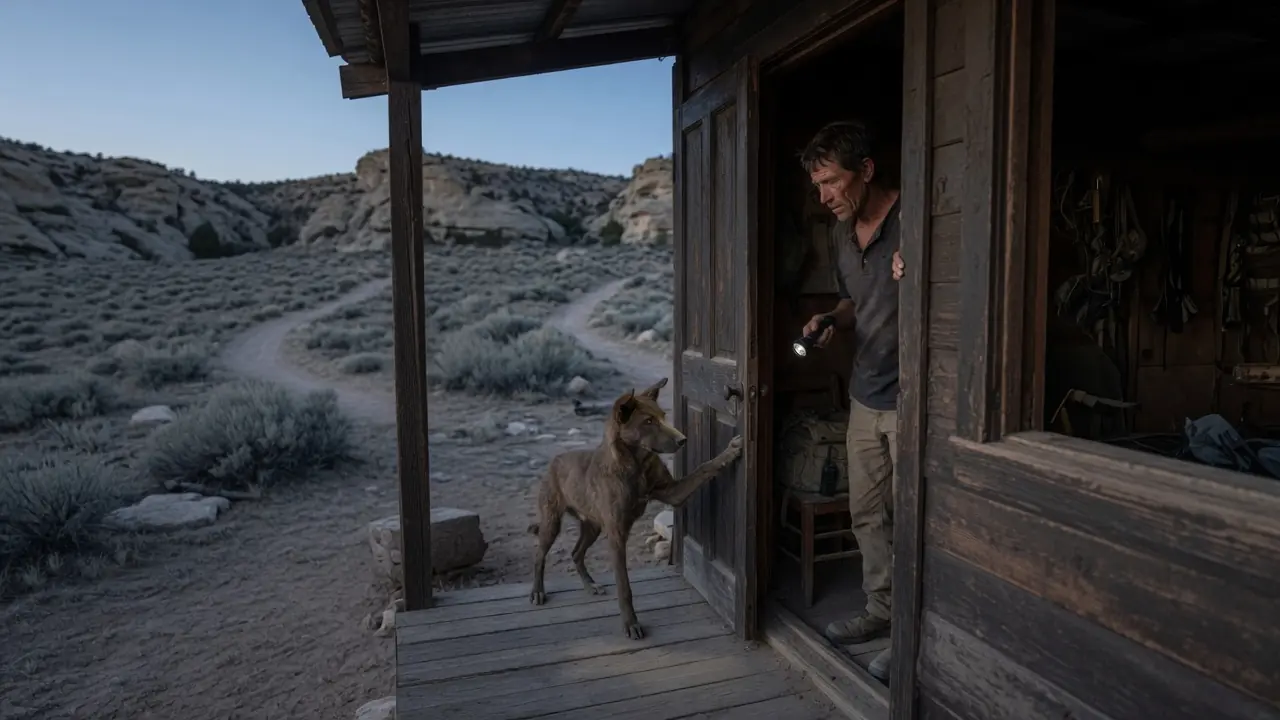
A young dog stood on the porch.
For a moment, Ethan simply stared.
The animal was no more than a year old, a lean mixed breed with dusty brown fur, a narrow chest, and intelligent amber eyes. Its paws were coated in pale desert soil, and several small burrs clung to the fur around its legs.
There was no collar.
No tag.
No rope trailing behind it.
Nothing that suggested where it had come from or who might be searching for it.
Yet the dog did not behave like a lost animal.
It did not cower.
It did not bark.
It did not rush toward him looking for food.
It stood alert and steady, watching Ethan with a level of concentration that immediately unsettled him.
The dog slowly lifted one front paw.
Tap.
Its nails touched the bottom of the door.
Then it turned, walked several steps away from the porch, stopped, and looked back over its shoulder.
Ethan remained in the doorway.
The dog waited.
“You want me to follow you?”
Its ears lifted.
Then it took several more steps and looked back again.
Ethan let out a slow breath.
“All right,” he murmured. “I see you.”
He returned inside, grabbed his field pack, a flashlight, a small medical kit, two bottles of water, and the portable radio he used for emergencies around the reserve. By the time he stepped outside, the eastern horizon had begun to soften from black to deep blue.
The dog was still waiting.
The moment Ethan closed the door, it turned and started forward.
It did not run.
It moved at a quick, controlled trot, pausing every few minutes to make certain he was still behind it. Whenever Ethan slowed across uneven ground, the dog waited until he caught up.
That was when he understood that this was not random.
This dog knew exactly where it was going.
Ethan followed it away from the cabin and into the wide, rocky landscape surrounding the Cañon del Silencio Wildlife Reserve. Scrub grass and low desert shrubs covered the uneven plain. Farther west, sandstone ridges rose against the slowly brightening sky.
The early air was cold enough to sting his lungs.
By noon, the same ground would shimmer with heat.
Ethan adjusted the pack on his shoulder and kept moving.
Three years earlier, he would have been waking in a comfortable house in Phoenix, preparing for another full day at the successful veterinary clinic he had built over nearly two decades.
Back then, people had known his name.
Pet owners waited weeks for appointments with him. Younger veterinarians asked for his advice. He had a large office, modern equipment, and a schedule so crowded that lunch often meant eating crackers between surgeries.
He had also had a wife.
Her name was Laura.
She had been a school counselor with a quick laugh and the strange ability to make every room feel less serious the moment she entered it. She loved stray animals, overwatered every plant they owned, and believed that Ethan worked too much.
She had been right.
After she died from a sudden brain aneurysm, the clinic no longer felt like something he had built. It felt like a place where the hours kept moving while his life remained frozen.
He sold his share to his partners.
He packed only what he needed.
Then he accepted a position with a remote wildlife rehabilitation program near the reserve.
He told everyone he wanted different work.
More space.
More meaning.
The truth was simpler.
He wanted quiet.
The desert had given him that.
Sometimes too much of it.
The dog led him through a narrow wash between two rocky slopes. Ethan glanced at his watch.
They had been walking for nearly thirty minutes.
“Where are you taking me?” he asked.
The dog looked back but did not stop.
Its mouth was open now, breath coming quickly, yet it showed no sign of losing direction. It turned sharply around a cluster of juniper, crossed an old cattle trail, and headed toward a shallow ravine.
Then Ethan heard it.
A faint sound carried through the morning air.
A whimper.
Weak.
Pained.
The young dog heard it too.
Its pace quickened instantly.
Ethan followed, sliding slightly on loose gravel as they approached the edge of the ravine. The dog stopped there for only a second before scrambling down the slope.
Ethan looked below.
His chest tightened.
A larger female dog lay trapped among fallen rocks, dry brush, and a collapsed section of old ranch fencing. Rusted wire had twisted around one hind leg, pinning her beneath a broken wooden post.
The leg rested at a terrible angle.
Her breathing was shallow.
Her eyes were half closed.
The young dog rushed to her side and began licking her face, whining softly. The injured female responded with the smallest movement of her head.
Her tail tapped the dirt once.
Then stopped.
Ethan descended carefully.
“Easy,” he said. “Easy, girl.”
The young dog watched every movement but did not growl or attempt to block him. It moved aside just enough to let Ethan kneel beside the injured animal.
Up close, the situation looked worse.
The wire had cut deeply into the female dog’s leg. Blood had dried around the fur, though fresh bleeding had slowed. Her gums were pale, and dehydration had begun to set in.
She had probably been trapped through the night.
Maybe longer.
Ethan placed his hand near her ribs.
Her heartbeat was rapid and weak.
He looked around.
The old fencing had likely been abandoned decades earlier. Time, wind, and erosion had pulled part of it down into the ravine, where it had become a rusted trap hidden beneath brush.
The young dog had tried to free her.
The evidence surrounded them.
Soil had been dug away near the post.
Scratch marks covered the wood.
Several pieces of wire had been chewed until they were bent and polished by teeth.
There was dried blood around the young dog’s gums.
Ethan looked at it.
“You tried everything, didn’t you?”
The dog stared back.
When it had failed, it had left the injured female alone, crossed miles of open desert, found the cabin, and asked for help.
Not by barking wildly.
Not by running in circles.
By knocking.
Ethan reached for his radio.
“Base, this is Cole.”
Static answered.
He adjusted the antenna.
“Base, this is Dr. Cole. I have an injured canine in a ravine northeast of my cabin, approximately two miles from marker fourteen. Severe hind-leg trauma, possible shock. I need transport equipment and wire cutters.”
A voice responded through the static.
“Copy that. Is this wildlife or domestic?”
“Domestic, probably feral or abandoned. One additional dog on scene.”
“How did you locate them?”
Ethan looked toward the young dog.
“It located me.”
He spent the next forty minutes stabilizing the injured female as best he could. He gave her water in small amounts, cleaned the visible wounds, and placed padding around the trapped leg so the wire would not cut deeper while they waited.
The young dog never left.
It remained close enough to touch the injured female’s face but far enough not to interfere. Every time she made a sound, it moved nearer. Every time Ethan changed position, it watched his hands carefully.
There was complete trust in its eyes.
Not blind trust.
Earned trust.
The kind that had begun when Ethan opened the cabin door and chose to follow.
The rescue team arrived a little after seven.
Two wildlife technicians, a ranger, and a volunteer veterinarian descended into the ravine carrying a folding stretcher, cutting tools, blankets, and fluid supplies.
Together, they lifted the wooden post and cut the wire piece by piece. The female dog cried out once, and the younger animal pressed its body against her head until the sound stopped.
Ethan examined the leg as soon as it was free.
“Fracture,” he said. “Possibly two places.”
“Can she keep it?” the volunteer asked.
“I think so.”
He did not add that it would depend on infection, circulation, and how much tissue had been damaged. There was no reason to speak the worst possibilities aloud while the animal was still fighting.
They placed her carefully on the stretcher.
The young dog attempted to climb on beside her.
One technician gently blocked it.
“It’s all right,” Ethan said. “Let him stay close.”
The dog walked beside the stretcher all the way back through the ravine.
At the rehabilitation clinic, the female was sedated, cleaned, and placed on intravenous fluids. X-rays confirmed a complicated fracture but no damage severe enough to require amputation.
Surgery took nearly three hours.
Ethan had performed thousands of procedures in Phoenix, but this one felt different.
He found himself looking through the small window in the operating-room door, where the young dog sat waiting in the hallway.
It had refused food.
Refused water.
Refused to lie down.
It only watched.
After the surgery, Ethan stepped outside and crouched beside it.
“She made it.”
The dog stared at him.
“Her leg is repaired. She’s still weak, but she’s going to live.”
The dog moved closer and pressed its forehead briefly against Ethan’s chest.
The contact lasted only a second.
Then it pulled away and looked toward the recovery room.
Ethan swallowed unexpectedly.
“All right,” he said quietly. “You can see her.”
The female dog slept beneath a warming blanket. Her leg had been stabilized, and a fluid line ran into one front leg.
The younger dog approached slowly.
It sniffed her face.
Then it curled against the outside of the recovery kennel, positioning itself as close to her as the metal bars allowed.
For the first time since dawn, it closed its eyes.
The staff began calling the young dog Scout.
No one knew its real name, if it had ever had one. No microchip was found. No missing report matched either animal. Local ranchers recognized neither dog.
The female recovered slowly.
They named her Grace.
For the first several days, she would only eat if Scout remained nearby. Whenever a technician approached, Scout watched with careful attention, but he never showed aggression.
He seemed to understand that everyone in the clinic was helping.
Ethan found reasons to spend more time in the recovery room.
He told himself he was monitoring the surgery.
Checking circulation.
Watching for infection.
But the truth was that Scout had stirred something in him that he had spent three years trying not to feel.
Connection.
Responsibility.
Hope.
Each evening, Ethan sat beside the kennels after the others left. Scout would rest near his boots while Grace slept. Sometimes Ethan spoke aloud, though he was not sure whether he was talking to the dogs, to himself, or to Laura.
“You would have loved this one,” he said one night.
Scout lifted his head.
“Too smart for his own good. Stubborn. Doesn’t know when to quit.”
The dog placed one paw on Ethan’s boot.
Laura had once said the same thing about him.
After two weeks, Grace was able to stand with support.
After four, she took several careful steps.
Scout stayed beside her through every attempt.
If she lost balance, he pressed his shoulder against her. If she became tired, he lay down.
He never rushed her.
He seemed to know that healing could not be forced.
Ethan watched them and began to understand something he had resisted for years.
He had believed grief meant remaining loyal to what he had lost.
He had mistaken isolation for remembrance.
Laura had loved animals because they never treated affection as a betrayal of the past. They could remember pain and still move toward kindness. They could lose one home and trust another.
Scout had crossed the desert because he refused to accept that Grace would die alone.
Ethan had crossed into the desert because he had almost accepted exactly that fate for himself.
One evening, nearly six weeks after the rescue, the sun lowered across the red cliffs while Ethan stood outside the clinic watching Grace walk without assistance.
Her repaired leg remained stiff, but she used it.
Scout trotted beside her, glancing over every few steps.
Ethan smiled.
The program director, Hannah Price, stood nearby with a clipboard.
“They’re ready for placement,” she said.
Ethan looked at her.
“Together?”
“Of course.”
He nodded.
Several approved families had already expressed interest. The story of the dog that knocked on a cabin door had traveled throughout the county.
There would be no difficulty finding them a home.
That thought should have made him happy.
Instead, something inside him sank.
Hannah watched his face.
“You know,” she said, “we do allow staff adoptions.”
Ethan looked toward Scout.
The young dog had stopped walking and was now staring directly at him.
Grace stood beside him.
Both waited.
Ethan felt suddenly foolish.
They had already chosen.
Perhaps they had chosen before he understood there was a choice.
He signed the forms the next morning.
Scout returned to the desert cabin where he had first knocked at dawn. Grace came with him, moving slowly but steadily across the porch.
The cabin changed after that.
There were bowls near the kitchen wall.
Blankets beside the fireplace.
Paw prints across the floor.
Ethan began leaving the door open during cool mornings so the dogs could move between the porch and the house.
Scout still woke before sunrise.
Sometimes he stood beside the bed and tapped the wooden frame with one paw.
Tap.
Tap.
Tap.
At first, Ethan assumed he wanted to go outside.
But Scout would walk to the front door, wait for Ethan to follow, then lead him to the porch.
They would sit together as the first light spread across the desert.
Grace usually joined them, lowering herself carefully beside Ethan’s chair.
On those mornings, Ethan sometimes thought of Laura.
The memories still hurt.
But they no longer felt like walls.
They felt like windows opening onto a life he had been fortunate to share.
Months later, Ethan found an old photograph while unpacking a box he had avoided since leaving Phoenix. It showed Laura kneeling beside a stray dog outside their first apartment.
On the back, in her handwriting, she had written:
Sometimes they don’t come because they need saving. Sometimes they come because we do.
Ethan carried the photograph to the porch.
Scout lay near the door.
Grace slept in the morning sun.
He read the words again, then looked across the open plain toward the ravine beyond the hills.
He finally understood why the young dog had arrived at his cabin before dawn.
Scout had come to save Grace.
That was the purpose Ethan recognized first.
But it was not the only one.
The dog had crossed the distance between fear and hope, between instinct and understanding, and trusted a grieving stranger to follow.
In doing so, he had led Ethan back toward the part of himself he believed had disappeared with Laura.
The part still capable of caring.
Still capable of being needed.
Still capable of returning home.
Scout lifted his head and looked at him.
Then he stood, crossed the porch, and placed one paw gently against Ethan’s knee.
One quiet tap.
Ethan rested his hand on the dog’s head.
“I see you,” he whispered.
This time, he understood exactly what it meant.