Jane Eyre's story begins in sorrow. She is a young orphan, a child with no parents. After her parents die, she is forced to live with her cruel aunt and cousins. They never show her any love. Instead, they constantly bully and punish her.
Jane is locked in a dark room and treated like a servant in her own home. Finally, her aunt sends her away to Lowood, a strict boarding school for poor girls. Life at Lowood is incredibly hard. The rooms are freezing, the food is terrible, and many girls get sick. However, despite the miserable conditions, Jane learns something valuable.
She learns how to survive. She makes her first real friend and she discovers the power of education. Time passes. Jane spends eight long years at Lowood. First, she is a hard-working student, and later, she becomes a teacher.
But Jane wants more from life. She's a brave and independent young woman, and she wants to see the real world. She decides to put an advertisement in a newspaper looking for a job. Soon, she receives an offer to become a governess, a private teacher, at a grand country house called Thornfield Hall. Jane packs her small bag and leaves Lowood behind.
He is older, serious, and has a very dark and mysterious personality. At first, he is moody and strict with Jane. But soon, they start having long, fascinating conversations by the fireplace. Mr. Rochester admires Jane's honesty, and Jane slowly falls in love with his brilliant mind. However, Thornfield Hall holds dark secrets.
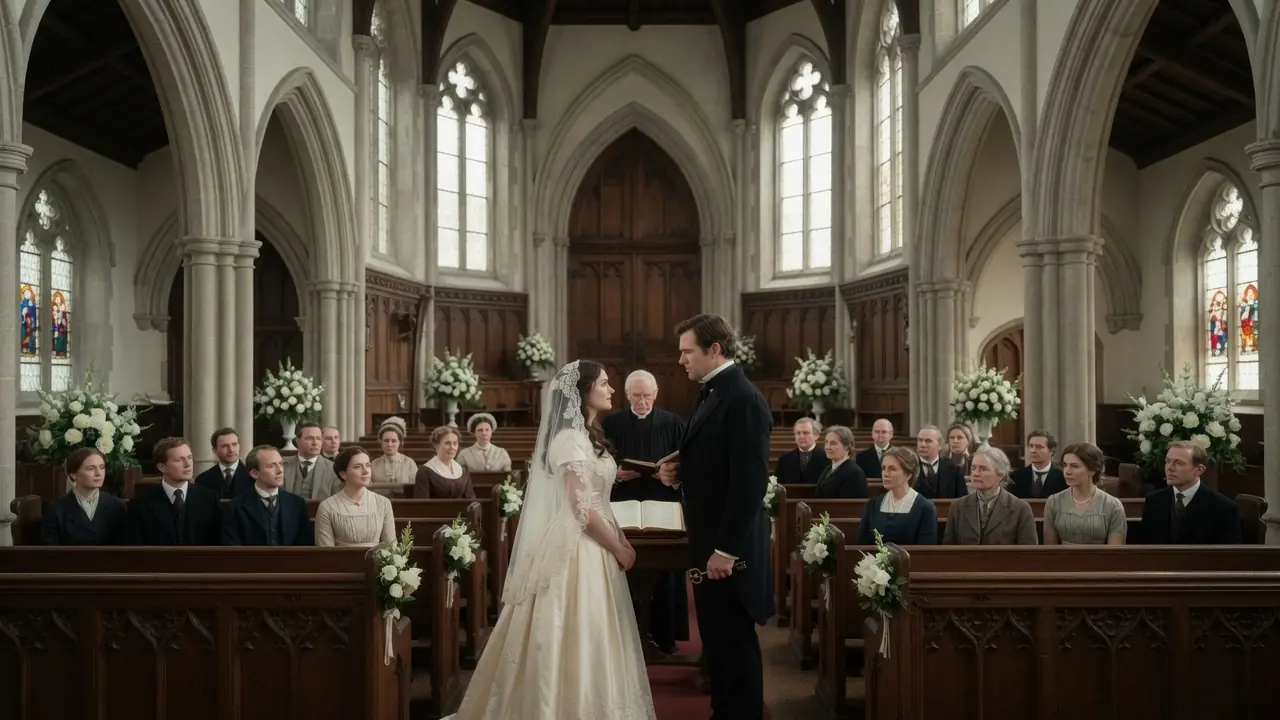
At night, Jane hears creepy laughs echoing through the empty halls. One night, she wakes up to find Mr. Rochester's bed on fire, and she has to save his life. Rochester blames a servant, but Jane knows something strange is going on. Despite the danger, their affection for each other grows, and Mr. Rochester asks Jane to marry him. Overjoyed, she says, "Yes." It is the day of the wedding.
Jane is wearing her white dress, standing in the church. But just as they are about to say, "I do," a man rushes into the church and stops the ceremony. This marriage cannot happen. Mr. Rochester is already married. Jane is heartbroken and shocked.
Mr. Rochester finally confesses the terrible truth. He takes Jane back to Thornfield and unlocks a hidden door in the attic. Inside is his wife, Bertha. She has been violently mentally ill for years, and Rochester has kept her hidden away to protect her and himself. Rochester begs Jane to stay with him, saying she is his only true love.
But Jane has strong morals. She knows that staying with a married man is wrong. Breaking her own heart, she packs her bags in the middle of the night and runs away. Jane wanders alone with no money, no food, and no friends. She nearly starves to death in the rain before she is rescued by a kind clergyman named St. John Rivers and his two sisters.
They take her in and help her recover. Then a miracle happens. She receives a letter discovering that her uncle has died and left her a massive fortune. She is now a wealthy, independent woman. She also discovers that the Rivers family are actually her cousins.
For the first time, Jane has a real family and financial freedom. Yet, her heart still belongs to Mr. Rochester. One night, she thinks she hears his voice calling her name on the wind. Jane. immediately travels back to Thornfield Hall. But when she arrives, she sees a tragedy.
The grand mansion is completely destroyed. It is just black burned stone. She discovers that Bertha, Rochester's sick wife, started the fire and tragically did not survive. Mr. Rochester bravely tried to save everyone, but he was badly injured. He survived, but he lost his home and his eyesight.
He is now completely blind. Jane finds him living in a small house in the woods. When he hears her voice, he cannot believe it. He thinks he is dreaming. Jane holds his hand and tells him she will never leave him again.
They marry and after a few years, Mr. Rochester even gains enough sight back in one eye to see their firstborn child. Jane never gives up, no matter how difficult life becomes. She leaves Thornfield with a broken heart, but strong morals. Mr. Rochester hides a secret that changes everything. Jane chooses love, but she never abandons her principles.
The fire destroys Thornfield Hall and changes their lives forever. Every time I hear that ending, I get goosebumps. What a powerful story. It really is an amazing story, Harry. I always feel so happy for Jane at the end.
But, Olivia, tell our listeners, why is this book so famous? I mean, it was written in 1847 by Charlotte Brontë. That is almost 180 years ago. Why do we still read it today? That is a great question.
Well, in the 19th century, women in stories were usually very weak. They waited for a strong man to come and save them. But Charlotte Brontë created Jane Eyre. Jane is poor and she is not traditionally beautiful. But she is so strong.
She says, "I have a mind and I have feelings and I am equal to you." Exactly. She is completely independent. Even when she loves Mr. Rochester, she leaves him because he is married. She follows her own rules. She only goes back to him when she is ready and completely free.
Yes, and people loved that. Also, the book has everything. Romance, a big fire, a crazy secret in the house. It is like a thriller. Charlotte Brontë actually had to use a man's name, Currer Bell, to publish it first because people didn't take female writers seriously back then.
It's incredible how much things have changed. Now, Jane Eyre is one of the most important books in English literature. Bully. This can be a noun or a verb. A bully is a person who is cruel to people who are smaller or weaker.
In the story, Jane's cousins bully her when she is a child. It is terrible. You can also use it in everyday life. For example, "Don't let him talk to you like that. He is just a bully." Or, "It is important to teach children not to bully their classmates." Our second word is miserable.
Miserable. If you are miserable, you are very, very unhappy or uncomfortable. Life for young Jane at the boarding school was miserable. It was cold and the food was bad. We use this word a lot when we talk about British weather.
For example, "I forgot my umbrella and waiting for the bus in the rain was completely miserable." Okay, word number three is despite. Despite. This is a very useful word for B1 students. We use despite to show that something happens even if there is a problem. In our story, despite the miserable conditions at the school, Jane learns to survive.
Here is a daily example. "Despite having a headache, Sarah finished all her homework." Or, "I love playing football despite being very bad at it." Let's move on to the fourth word. Enormous. This is a great adjective. It simply means very, very big. Huge.
Jane moves to Thornfield Hall, which is an enormous mansion. You shouldn't say very enormous because enormous already means very big. You can say I was so hungry, I ate an enormous pizza. Our next word is optimistic. Optimistic.
Someone who is optimistic always looks at the good side of things. They think the future will be good. When Jane gets her new job, she feels optimistic about her life. I am a very optimistic person. I am optimistic that I will finally win the lottery this weekend.
The next word is a bit spooky. It's attic. Attic. The attic is the room at the very top of a house, right under the roof. At Thornfield Hall, Mr. Rochester hides his secret wife in the attic.
It is such a scary part of the book. In modern homes, the attic is usually just where we put old things. For example, my grandfather keeps his old books in the attic. Our seventh word is violently. Violently.
This is an adverb. It means doing something with a lot of sudden and dangerous physical force. In the story, Bertha is violently mentally ill. She loses control and starts fires. You can also use it for nature.
For example, the boat shook violently during the storm. It shows a lot of power and movement. Wealthy. It is just another word for rich. It means having a lot of money and land.
At the end of the story, Jane's uncle dies and leaves her a fortune. So, she becomes a wealthy woman. Which is wonderful because she finally has independence. Many wealthy people live in that part of London.