Judson Crane noticed the smell before he noticed the woman. He had pushed open the front door of his ranch house after three days riding fence, expecting dust, stale boards, cold ash, and the familiar emptiness that had lived there since mercy left him. Instead, something rich and steady drifted from the kitchen, filling the hallway with beef, onions, carrots, herbs, and bread warming near the stove. For one long second, Judson stood frozen with his hand on the doorframe, because that smell did not belong in a house that had forgotten how to feel alive.
The Crane ranch sat beyond Copper Creek, where the wind ran hard across dry grass and carried grit into every corner of a man’s life. Five years earlier, Judson’s wife, Mary, had vanished into fever and grief, leaving behind a kitchen he could not bear to enter except when hunger forced him there. He had kept the cattle alive, kept the fences upright, and kept his name respected in town, but inside the house, everything had slowly gone quiet. The curtains had faded, the table had gathered knife marks, and the stove had become a cold black memory against the wall.
Now steam curled from a pot on that same stove. A wooden spoon moved slowly through the stew, guided by a woman in a blue dress and cream apron who stood with her back to him like she belonged there. Her dark hair was pinned loosely, and one strand had fallen against her cheek, damp from the heat of cooking. Judson’s chest tightened, not only from anger, but from the shock of seeing care in a room where he had tried so hard to bury wanting it.
“Who made this stew?” he asked. His voice came out low and rough, almost accusing, because if he sounded softer, he feared the room would hear the ache under it. The woman froze for one heartbeat, then turned with the spoon still in her hand and flour dusting one wrist. Her eyes met his, frightened but steady, and Judson saw at once that she was not a thief, not a fool, and not the sort of woman who ran simply because a man raised his voice.
“I did,” she said. The answer was simple, but it did not solve anything. Judson looked from her to the pot, then to the peeled potatoes, chopped carrots, clean plates, and a loaf of bread resting under a towel. The kitchen looked warmer in one hour of her presence than it had looked in five years of his ownership.
“You were never meant to be in my kitchen at all,” Judson said, stepping inside with dust on his coat and anger hardening his jaw. The woman’s fingers tightened around the wooden spoon, but she did not step back. “No, sir,” she answered. “I know that.” The honesty of it struck him harder than an excuse would have, because she did not even try to pretend she had permission.
Her name was Nell Archer, though Judson had only learned it three weeks earlier on the dusty platform outside Copper Creek’s supply depot. She had stood there with a worn carpetbag in one hand and a letter crushed in the other, while the stage driver told her the family who had promised work had moved west before she arrived. Other men had looked at her, decided she was trouble, and walked on. Judson had noticed only that she did not cry, even though the world had left her standing alone with nowhere to go.
Judson had no wife, no children, and no intention of bringing a woman into his house. But the bunkhouse cook had quit two months before, and his ranch hands had been living on beans, burned biscuits, and whatever could be swallowed without much complaint. He told Nell she could stay in the old washroom near the back porch for one night and help with supper for wages before moving on. She accepted so quietly that he almost felt ashamed of how little he had offered.
One night became three, then a week, then nearly a month. Nell cooked for the hands, scrubbed pans, mended sacks, organized the pantry, and never once entered the front rooms of the ranch house without being asked. She kept her eyes lowered around Judson and spoke to him only about flour, salt, coffee, cuts of meat, and what needed buying in town. That should have pleased him, because distance was safer, but instead her silence began to fill the house differently than the old emptiness had.
Then he left for three days to check the east fence line after a hard windstorm. He returned tired, hungry, and more lonely than he was willing to admit. He had expected to find the bunkhouse supper waiting outside and the main house dark. Instead, he found Nell Archer inside his private kitchen, stirring stew in Mary’s old pot as if she had reached straight into the locked part of his life.
“I was told to use the bunkhouse stove,” Nell said, her voice careful as she set the spoon down. “But the chimney smoked too badly, and the men had already missed a hot meal yesterday.” Judson’s eyes narrowed, but she continued before fear could steal her words. “I meant to finish the stew, clean everything, and leave the room as I found it.” Her hand trembled once against her apron, and she pressed it flat to hide the motion.
“You took it on yourself to decide that?” he asked. Nell lifted her chin a little, and the movement showed more pride than defiance. “No one else was here to decide,” she said. “And hunger does not wait kindly for permission.” The words hit the room with quiet force, and Judson felt his anger shift, not vanish, but lose its clean edge.
Outside, one of the ranch hands laughed near the corral, unaware of the storm gathering inside the kitchen. Judson looked at the stew again, and the sight of it pulled memories loose despite his resistance. Mary had once stood at that stove with her sleeves rolled up, scolding him for tracking mud across the floor and laughing when he kissed the flour from her cheek. After she died, he had scrubbed that same flour mark from the table until the wood went pale, then hated himself for wanting every trace gone and every trace back.
Nell saw his face change. She did not know the full story, but she knew grief when it moved through a man’s body like a wound reopening. Her anger softened, and guilt crossed her eyes. “I should not have touched this room,” she said. “I am sorry.”
Judson wanted to say yes, she should be sorry, because this kitchen was not just boards and iron and shelves. It was the last room where Mary had sung, the last place she had set a plate for him, the last place he had believed that coming home meant being met by love. But the stew kept simmering, and the smell kept rising. It was hard to hate a woman for bringing life back into the very room he had let die.
Nell reached for the towel and covered the bread. “I’ll go, Mr. Crane,” she said, her voice barely above the stove’s hiss. “I never meant to touch what still hurts.” She stepped around the table, careful not to brush against him, and the simple courtesy of that movement made his throat tighten. She was leaving with dignity, not because she was weak, but because she refused to beg for a place in a room that had rejected her.
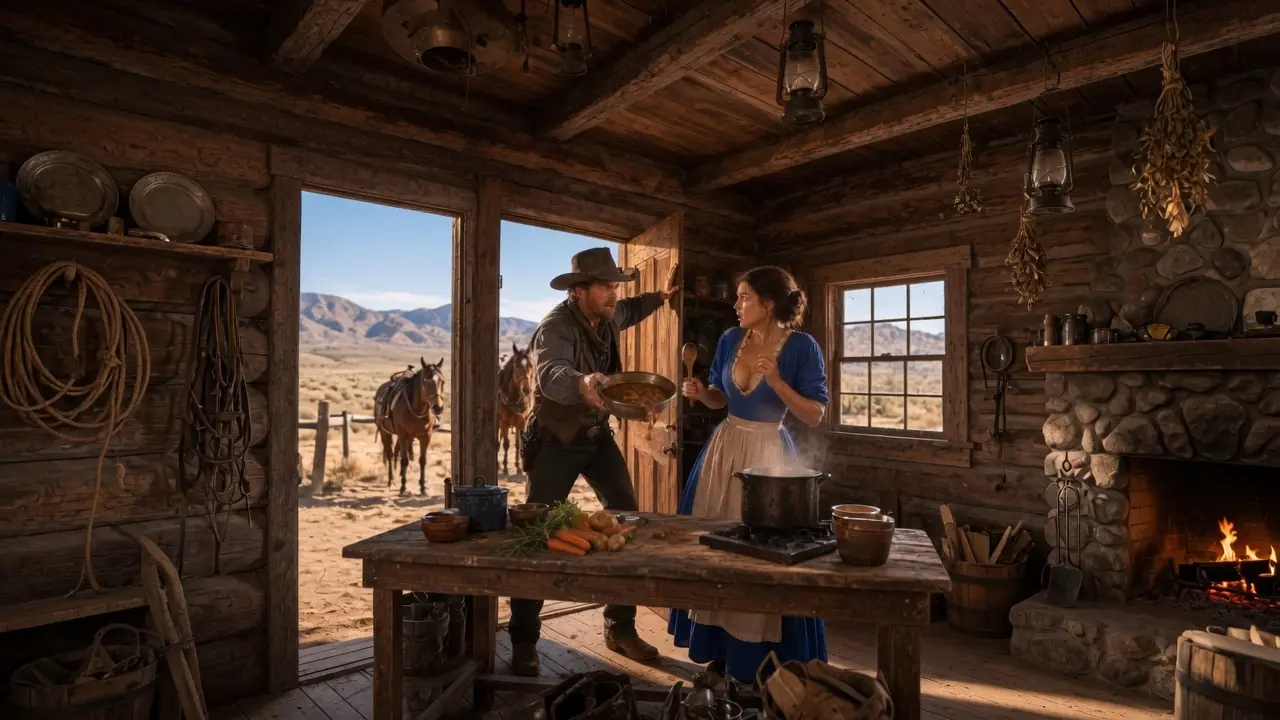
Judson did not stop her at first. His hand stayed on the doorframe, and he let her pass close enough that he could smell flour, woodsmoke, and the faint soap she used from the washroom basin. Nell reached the open doorway, where the dry range stretched beyond the porch and his horse stood flicking its tail in the late light. One more step, and she would be gone from the kitchen, then from the ranch, then from whatever strange feeling had begun to wake in him.
“This house hasn’t smelled alive in five years,” he said. Nell stopped with one hand near the door, her shoulders stiff under the blue cloth of her dress. She did not turn right away, and Judson was grateful because his face had betrayed too much. The words had come without permission, torn from a place he thought had sealed itself shut. He looked down at his dusty hands and hated how badly they shook.
Nell turned slowly. Her eyes were wet now, though she held herself straight. “Then don’t hate me for hearing how hungry it was,” she said softly. The sentence undid him more than any apology could have, because it named something he had refused to name. His house had been hungry, and so had he.
Judson looked at the clean table, the stew, the fresh bread, and the woman standing between leaving and staying. He saw no scheme in her face, no attempt to take Mary’s place, no careless trespass dressed as kindness. He saw a woman who understood emptiness because she had carried her own. He saw a survivor who had stepped into his forbidden kitchen not to steal from the dead, but to feed the living.
“Don’t leave, Nell,” he said. His voice broke on her name, and he gripped the doorframe harder to steady himself. “Not after you made this place remember home.” Nell’s lips parted, and her hand rose to her chest as if the words had struck somewhere deep.
For a moment, neither of them moved. Dust floated in the strip of light by the open door, and the stew bubbled gently behind them. Judson realized that if she walked out now, the kitchen would not return to silence the same way it had before. It would be worse, because now he had been reminded what warmth felt like.
“I am not Mary,” Nell whispered. Judson closed his eyes for a second, because the name still hurt, but not as sharply as it once had. “I know,” he said. “That is not what I am asking.” Nell searched his face, her fingers twisting into the fabric of her apron. “Then what are you asking?”
Judson took off his hat slowly and placed it on the table. It was not a grand gesture, only a tired man trying to stand honestly in his own kitchen. “I am asking you to sit down and eat what you made,” he said. “I am asking you not to run from a kindness just because I was too proud to welcome it.” His jaw tightened as he forced out the hardest truth. “And I am asking forgiveness for making you feel like life in this house was a crime.”
Nell looked away, and one tear slipped down her cheek before she could stop it. She wiped it quickly with the back of her hand, embarrassed by her own feeling. “I have been turned out of kinder places than this,” she said. “I learned not to expect doors to stay open.” Judson stepped aside, leaving the doorway clear, because he understood that trapping a frightened heart was not the same as keeping it.
“This door stays open,” he said. “But you choose whether to walk through it.” Nell looked at the open range beyond him, then back at the kitchen. The choice stood between them, heavy and fragile, and for the first time since arriving in Copper Creek, she looked like a woman being offered more than temporary shelter. She looked like someone trying to believe she was allowed to stay.
She returned to the stove. Judson watched her pick up the spoon with fingers that still trembled, then stir the stew once before ladling it into two bowls. The sound was ordinary, metal against enamel, liquid against ceramic, but to Judson it felt like the first bell after a long burial. Nell set one bowl in front of him and one across the table for herself. Then she sat, not at the edge of the room, not near the doorway, but at the table.
They ate in silence at first. The stew was better than anything he had tasted in years, rich with roots, beef, pepper, and patience. Judson wanted to compliment it, but the words felt too small after what had passed between them. Nell ate carefully, as if still unsure whether the meal belonged to her too.
After a few minutes, Judson said, “Mary used to put too much salt in stew.” Nell looked up, surprised by the sudden opening. He stared into his bowl and continued because if he stopped, cowardice would claim the room again. “She said hard work needed salt, and I told her she was trying to preserve me like winter meat.” Nell’s mouth twitched despite the sadness in her eyes.
“She sounds like a woman who knew how to answer a man,” Nell said. Judson’s chest tightened, but the memory did not crush him the way it once had. “She did,” he replied. “Especially when I deserved it.” The faint almost-smile on Nell’s face became real for one brief second, and Judson felt the house shift around that smile.
From that evening, the kitchen changed. Judson did not pretend the past had vanished, and Nell never tried to claim what had belonged to Mary. She asked before moving old jars, before washing curtains, before touching the cracked blue cup that still sat on the highest shelf. Each time, Judson either answered yes or said not yet, and Nell respected both with equal care.
The ranch hands noticed the change before Judson admitted it. Meals became steady, the pantry ran cleaner, and men who had once stumbled into supper loud and careless now removed their hats before sitting. Nell had a way of quieting foolishness without raising her voice. One look from her over a pan of biscuits could make a grown cattle hand remember his manners like a boy before Sunday school.
Judson found himself coming in earlier from the range. At first, he told himself it was because the accounts needed checking or because winter repairs could not be delayed. Then one evening, he caught himself washing his hands twice before supper because Nell had mentioned clean hands made food taste better. He stood by the basin, looking at himself in the small mirror, and felt foolish enough to smile.
Nell changed too, though slowly. Her shoulders lost their constant tightness, and she began humming while she worked, soft tunes that wandered through the kitchen and out the open windows. She planted thyme and onions in a narrow strip behind the house, saying food tasted better when it knew where it came from. She also took charge of the pantry with such authority that Judson’s foreman, Abel Pike, declared her the most frightening woman he had ever respected.
Still, the town was not kind. Copper Creek had eyes in every window and tongues in every doorway, and word spread that Judson Crane had taken a woman into his house. Some said she was a hired cook, some said worse, and some made guesses simply because guessing made them feel important. Nell heard enough at the mercantile to come home silent, her face still and her hands folded tightly in her lap on the wagon ride.
Judson noticed but did not press until they reached the ranch. “Who said it?” he asked, helping her down. Nell kept her eyes on the ground. “No one worth repeating.” Judson’s hands curled at his sides, but he knew anger alone would not protect her from a world that had already decided poor women were easy targets.
That Sunday, he drove her into town in the good wagon. He wore his best coat, and Nell wore a simple dark dress with her hair pinned neat. When people looked, Judson did not look away. At the church steps, Mrs. Tavish glanced at Nell, then at Judson, then smiled with too many teeth.
“Mr. Crane,” she said, “how nice to see you bringing your help to service.” Nell’s face paled, but Judson answered before she could lower her eyes. “Miss Archer is not my help today,” he said evenly. “She is my guest.” The words carried just far enough for the women behind Mrs. Tavish to hear, and by noon, half the town knew Judson Crane had drawn a line.
Nell said nothing about it until that evening. She stood at the stove, stirring beans, her face turned from him. “You should not make trouble on my account,” she said. Judson leaned against the doorway, the same doorway where he had first found her with the stew. “Trouble was already there,” he said. “I only gave it a name.”
She turned then, and the look in her eyes struck him harder than gratitude. It was fear mixed with longing, a look that said she wanted to believe him and did not trust the world enough to do it fully. “Men with land can answer gossip,” she said. “Women without family have to survive it.” Judson nodded, because he had learned enough from her to know when truth required silence before a reply.
Days shortened, and winter crept toward the ranch in pale mornings and hard evenings. Nell began waking before dawn to bake bread, and Judson began waking early too, pretending he needed coffee before riding out. They shared those quiet hours without naming them, her hands working dough while he sharpened tools or wrote figures in the ledger. Sometimes their eyes met across the kitchen, and both looked away too quickly.
One morning, Judson found Nell standing before the high shelf, staring at Mary’s cracked blue cup. Her hand was lifted but not touching it. “I was only going to wash the dust off,” she said quickly when she realized he had entered. Judson looked at the cup, and the old pain rose, but it no longer rose alone.
“Take it down,” he said. Nell froze. “Are you sure?” He nodded, though his throat tightened. “A cup should not spend five years pretending it is a tombstone.” Nell’s eyes filled, and she reached up carefully, bringing the cup down as if carrying something sacred.
She washed it, dried it, and placed it near the stove. That evening, Judson drank coffee from it for the first time since Mary died. It hurt, but it also freed something. Nell did not speak while he drank, but when he set the cup down, she laid one hand briefly over his on the table. The touch lasted only a moment, yet it warmed him more than the coffee.
The real storm came two weeks later, when Nell’s past rode into the yard in the form of a man named Silas Greer. He was the brother of the family who had promised her work and vanished before she arrived, and he came with a sour smile and a claim that Nell owed him train fare, lodging fees, and “damages” for not waiting where she had been told. Judson stood on the porch as Silas spoke, feeling anger settle low and cold in his chest. Nell stepped out behind him, her face going white at the sight of the man.
“She belongs to no one who speaks of her like that,” Judson said. Silas laughed and spat into the dust. “You ranchers always play noble until a woman costs you money.” Nell’s hands clenched in her skirt, and for the first time Judson saw not only fear, but shame. Silas had brought old chains with him, invisible but heavy.
Nell stepped forward before Judson could answer. “I owe you nothing,” she said. Her voice shook, but she kept speaking. “Your sister promised work, took my last money for travel, and left me stranded.” Silas’s smile thinned. “Who will believe that?” he asked.
“I will,” Judson said. Abel Pike stepped from the barn, and two ranch hands followed, not threatening, only present. Judson looked at Silas with a quietness more dangerous than shouting. “Leave my land.” Silas looked from Judson to the men, then to Nell, and realized he had misjudged what kind of house she now stood in.
When Silas rode away, Nell nearly collapsed from the effort of staying upright. Judson reached for her, then stopped, letting her choose whether to accept the help. She turned toward him and stepped into his arms without another word. He held her gently on the porch while the wind moved over the yard, and for the first time, she let herself tremble where someone could see.
That night, Nell tried to apologize for bringing trouble. Judson sat across from her in the kitchen, the stew pot between them, and shook his head. “You did not bring trouble,” he said. “Trouble followed a woman it thought was alone.” Nell looked up slowly. “And am I?” she asked.
Judson’s answer came from somewhere deeper than caution. “No.” The word was small, but it changed the room. Nell lowered her eyes, and a tear fell onto her clasped hands. “Then I do not know how to live yet,” she whispered. “I have only known how to endure.”
Judson came around the table and knelt beside her chair, not caring how foolish it might look. “Then learn here,” he said. “Learn slowly, learn loudly, learn badly if you must, but learn where no one will shame you for needing time.” Nell covered her mouth with one hand, and her shoulders shook. Judson did not rush her grief; he stayed there until it passed through her like weather.
By Christmas, no one in Copper Creek doubted that Nell Archer belonged at the Crane ranch. Judson brought her to the holiday supper at the meeting hall and introduced her simply, plainly, and without hesitation. “This is Miss Nell Archer,” he said. “She keeps my ranch from falling into foolishness.” Nell gave him a sharp look for that, but her cheeks warmed with pleasure.
In January, he asked her to marry him. He did it in the kitchen, because that was where both of them had first told the truth. The stove was hot, bread cooled under a towel, and snow pressed against the windows in quiet white sheets. Judson stood where he had once accused her of trespassing and took off his hat.
“Nell,” he said, his voice rough with feeling, “you came into this house without permission and gave it back its heartbeat.” She set down the knife she had been using to cut bread, her eyes widening. “Judson Crane, that is a strange beginning to a proposal.” He smiled then, nervous and bare. “I am a strange man asking a brave woman to stay.”
Nell did not answer at once. She looked around the kitchen, at Mary’s blue cup on the shelf, the herbs by the window, the clean table, and the pot simmering on the stove. “I will not marry you to fill a dead woman’s place,” she said. Judson took a breath, steadying himself around the truth. “No,” he said. “You will marry me only if I have made a place that is yours.”
Her face broke then, not into sadness, but into the kind of joy that scares a person who has lived too long without it. “Then yes,” she whispered. Judson crossed the room, and she met him halfway, laughing through tears as he took her hands. Outside, the winter wind moved across the ranch, but inside, the kitchen held.
They married when the snow melted and the first green returned to the range. It was not a grand wedding, but the whole ranch came, and half of Copper Creek came too, including some people who had once whispered and now stood quiet with lowered eyes. Nell wore a blue dress, not because it was fine, but because it was hers. Judson stood beside her with a look that told every person present he considered himself the honored one.
Years later, whenever stew simmered in the Crane kitchen, Judson would pause at the doorway and ask the same question. “Who made this stew?” Nell would roll her eyes, though she always smiled before turning back to the pot. “A woman who was never meant to be in your kitchen,” she would say. Judson would step behind her, kiss her flour-dusted cheek, and answer, “No. The woman who made it home.”
And every time, Nell remembered the first day he had nearly sent her away. She remembered the door open behind him, the pot in his hand, the anger on his face, and the grief hiding underneath it. She remembered choosing not to run before the truth had finished speaking. Most of all, she remembered that sometimes a person is not welcomed into a life because they were invited, but because they bring back something the house itself has been begging to remember.