The motorcycle died beneath a gray Oregon sky with one final metallic cough.
Its engine sputtered twice, released a thin breath of smoke, and went silent in the middle of a narrow industrial street on Portland’s east side.
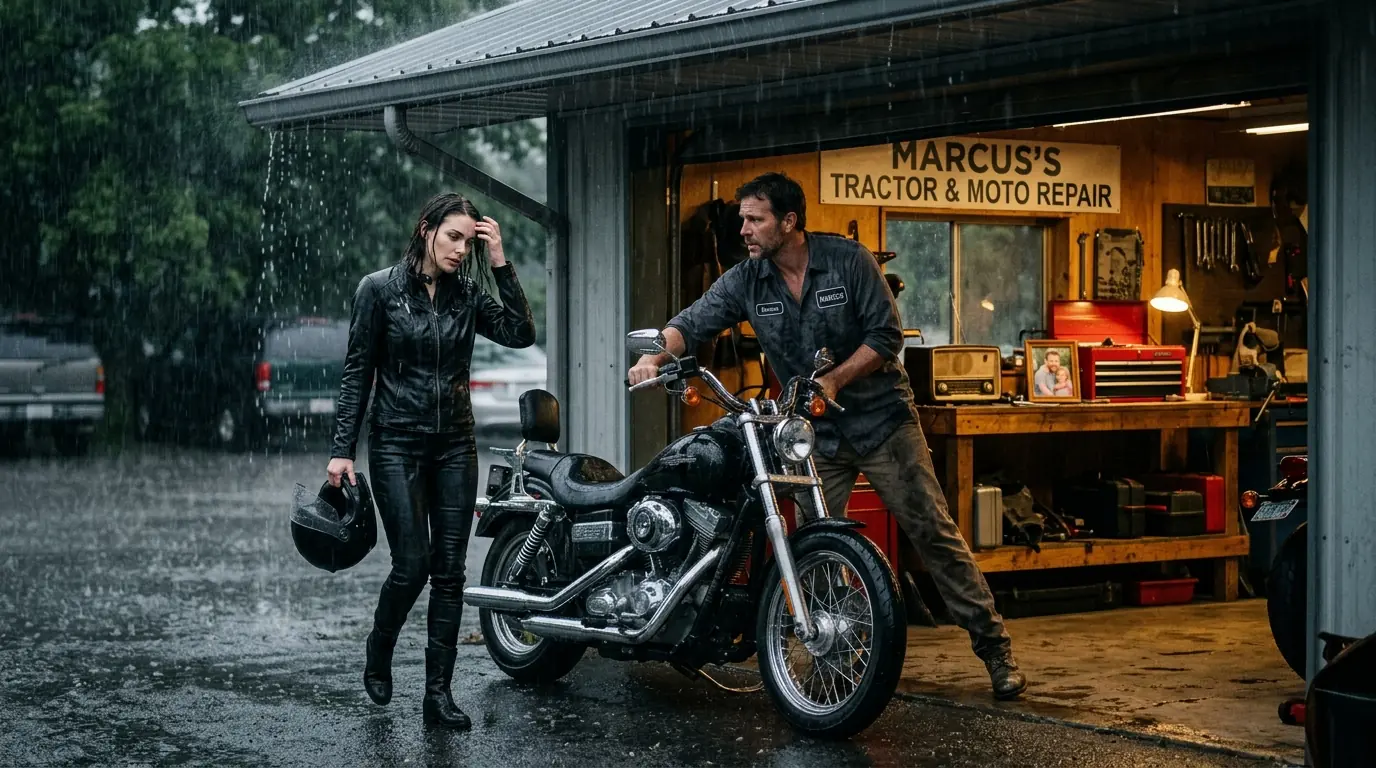
The woman riding it managed to guide the heavy machine beneath the awning of Walker Cycle Works before the rain became harder.
By the time she lowered the kickstand, dark hair had escaped from beneath her helmet. Water ran down the shoulders of her leather jacket and gathered at the toes of boots that had clearly cost more than most people’s monthly rent.
Inside the garage, Ethan Walker looked up from the carburetor spread across his workbench.
Rain drummed against the old metal roof. An ancient radio played beside a cabinet of labeled parts, though static swallowed half the song.
Ethan wiped his hands on a rag and walked toward the open bay.
“You hurt?”
The woman removed her helmet.
She appeared to be in her mid-thirties. Her green eyes were alert despite the exhaustion in her face, and she carried herself with the controlled stillness of someone accustomed to concealing whatever she felt.
“I’m fine.”
Ethan glanced at the motorcycle.
It was a black 1973 Harley-Davidson FLH with faded silver trim and enough original hardware to suggest someone had loved it carefully for decades.
“Your motorcycle disagrees.”
“It started losing power a few miles back.”
“Knocking?”
“No.”
“Backfire?”
“Once.”
“Smell fuel?”
She hesitated.
“I thought it was coming from traffic.”
Ethan crouched beside the engine.
A dark stain had begun forming beneath the frame.
He reached toward the fuel line, then stopped.
“May I?”
The woman looked surprised.
“It’s a motorcycle.”
“It’s your motorcycle.”
After a moment, she nodded.
Ethan examined the line and found a narrow split beside the carburetor. Fuel had begun leaking onto the engine casing, dangerously close to the exhaust.
“You got lucky.”
“How lucky?”
“Lucky enough that we’re discussing a repair instead of watching firefighters discuss what remains.”
Her expression changed briefly.
Ethan noticed but did not comment.
“You can wait inside,” he said. “There’s heat.”
“I’d rather stay with the bike.”
“That’s fine.”
He stood and extended his hand.
“Ethan Walker.”
She looked at the grease around his fingernails before shaking it.
“Claire.”
“Last name?”
A pause.
“Reed.”
It was small enough that most people would have missed it.
Ethan had spent years listening to customers describe mechanical problems they had caused and did not want to admit. He knew hesitation when he heard it.
He chose not to challenge her.
People sometimes entered a repair shop carrying more than broken machines. Forcing explanations rarely made either kind of problem easier to fix.
“I’ll roll it inside, Claire Reed.”
“I can help.”
“You’ve been riding through cold rain.”
“I’m capable of moving my own motorcycle.”
Ethan stepped aside.
“Then impress me.”
Claire gripped the handlebars and pushed.
The Harley moved several feet before its weight shifted. Her wet boot slipped across the concrete.
Ethan caught the handlebar before the machine fell.
Claire regained her balance.
Neither spoke for a second.
Then Ethan said, “Extremely impressive.”
She stared at him.
He expected irritation.
Instead, the corner of her mouth lifted.
“Don’t become unbearable.”
“My daughter says that happened years ago.”
“You have a daughter?”
“Nine. Her name is Sophie.”
As though summoned, a small face appeared behind the office window.
Sophie Walker pushed open the door.
She wore yellow rain boots, jeans covered in marker stains, and an oversized sweatshirt reading PORTLAND JUNIOR SCIENCE CLUB.
“Dad, the printer made the grinding sound again.”
“It makes that sound when you put too much paper in it.”
“I used four sheets.”
“You told me six last time.”
“I’m improving.”
Sophie noticed Claire.
Her eyes moved from the wet leather jacket to the vintage Harley.
“Is that yours?”
“Yes.”
“It’s beautiful.”
Claire’s face softened.
“Thank you.”
“Dad says motorcycles are beautiful when people respect gravity.”
Ethan sighed.
“Not every private conversation needs to become public information.”
Sophie walked closer.
“Is it broken?”
“Fuel line,” Ethan said. “Maybe ignition.”
“Can you fix it?”
“I haven’t checked everything.”
Sophie gave him a long, patient look.
“What?”
“You always say broken isn’t the same as finished.”
Claire looked toward Ethan.
He reached for a wrench.
“I also say children should finish their homework before interrogating customers.”
“The printer is broken.”
“Office.”
Sophie turned toward Claire.
“We have hot chocolate.”
“Sophie.”
“She’s freezing.”
Claire glanced toward the rain.
“I might accept that.”
Sophie smiled as though she had successfully completed a difficult negotiation.
Walker Cycle Works had occupied the same brick building since 1991.
The garage was small but carefully organized. Tools hung in exact rows. Shelves contained labeled containers of seals, bolts, wires, and salvaged parts no longer manufactured.
Photographs covered one wall.
Ethan as a teenager beside a broad-shouldered man with a gray beard.
Ethan holding a newborn Sophie.
Several riders standing beside motorcycles along the Oregon coast.
A woman with auburn hair sitting on the workbench and laughing toward someone outside the frame.
Claire studied the final photograph longer than the others.
Ethan noticed.
He removed the side panel from the Harley.
“When was the last complete service?”
“About six months ago.”
“Where?”
“Seattle.”
“Dealership?”
“Private mechanic.”
“Did he replace the fuel line?”
“He said it didn’t need replacing.”
Ethan held up the cracked rubber.
“This line remembers the Carter administration.”
Claire almost smiled.
He continued inspecting the bike.
The fuel leak was simple.
The electrical problem was not.
A damaged wire near the ignition coil had been wrapped beneath newer insulation, hiding a poor repair.
“This patch wasn’t done six months ago.”
“What does that mean?”
“Someone covered an old failure instead of fixing it.”
“Can you fix it?”
“Yes.”
“How long?”
“If the coil survives testing, a few hours. If not, I’ll need a replacement.”
“I have to reach Seattle tonight.”
Ethan looked through the open bay.
Rain fell in sheets beyond the awning.
“You shouldn’t ride north tonight even after I finish.”
“I have a meeting tomorrow morning.”
“Rent a car.”
“I don’t leave this motorcycle.”
“Motorcycles rarely feel the same loyalty.”
Her shoulders became rigid.
“I asked whether you could repair it.”
“And I’m telling you the repair won’t fix the storm, freezing temperatures, or the drivers on Interstate 5.”
“I didn’t ask for a lecture.”
“No. You arrived with a leaking Harley and an impossible deadline. Lectures come free with both.”
Claire stared at him.
Ethan waited.
Sophie emerged carrying a chipped mug of hot chocolate.
“Are you two fighting?”
“No,” Ethan said.
“Yes,” Claire answered.
Sophie handed her the mug.
“Dad argues when he’s worried.”
“I am not worried.”
“You get that line between your eyebrows.”
She pointed.
Ethan closed his eyes.
“Homework.”
Sophie disappeared again.
Claire held the warm mug between both hands.
“She’s very direct.”
“She inherited that from her mother.”
Something in his voice changed.
Claire glanced again at the photograph.
“Where is she?”
Ethan turned toward the motorcycle.
“She died five years ago.”
“I’m sorry.”
“So am I.”
The answer was neither cold nor inviting.
It was simply complete.
Claire lowered her eyes.
Ethan removed the fuel tank.
“Leukemia,” he said after a moment. “Fourteen months from diagnosis to funeral.”
“That must have been difficult for Sophie.”
“She was four. Some days she remembers everything. Some days she remembers almost nothing and feels guilty.”
“And you?”
Ethan loosened another bolt.
“I remember enough for both of us.”
Rain hammered the roof.
For the next hour, Claire sat in the office while Ethan worked. Sophie completed half a page of homework and asked questions unrelated to every subject taught at school.
Where did Claire live?
Why did she ride alone?
Did wealthy people ride old motorcycles?
Was Claire wealthy?
Ethan nearly dropped a screwdriver at the final question.
“Sophie.”
“What? Her boots are expensive.”
Claire looked down.
“What makes you think that?”
“They’re soaking wet and still look perfect.”
Ethan pointed toward the office.
“You’re finished.”
Claire examined the black boots as if seeing them for the first time.
“They were a gift.”
“From who?” Sophie asked.
“My father.”
“Is he dead too?”
Ethan set the screwdriver down.
Claire’s fingers tightened around the mug.
“Yes.”
Sophie’s expression changed.
“I’m sorry.”
“Thank you.”
“My mom gave Dad the red toolbox before she died.”
Claire looked beneath the window.
A weathered red toolbox sat beside the workbench.
“Does he still use it?”
“Every day.”
Claire nodded slowly.
“My father gave me the motorcycle.”
Ethan understood then why she had refused to leave it.
“It belonged to him?”
“Since 1975.”
“He bought it used?”
“How did you know?”
“It’s a 1973 model. You said he gave it to you, not that he bought it for you.”
Claire looked toward the black fuel tank.
“He purchased it after leaving the military. He said it was the first thing he ever owned that made him feel his life belonged entirely to him.”
“You rode together?”
“When I was younger.”
“But not recently.”
“No.”
“What changed?”
She stared toward the rain-darkened window.
“He died two years ago. The motorcycle stayed in storage until last month.”
“Why take it out?”
Claire was quiet for several seconds.
“I inherited his houses, shares, artwork, and responsibilities.”
Ethan glanced toward her.
“That sounds like a large inheritance.”
“I realized none of those things explained who he was when he was happy.”
Her eyes moved to the Harley.
“This did.”
Ethan understood.
He had inherited the garage from his father. The business had never made him rich, but it kept Walter Walker’s tools in use and his name above the door.
Some inheritances were valuable precisely because no accountant could price them properly.
By seven thirty, Ethan had replaced the fuel line, repaired the damaged wiring, and tested the ignition coil.
It was weak but serviceable.
He reassembled the motorcycle and pressed the starter.
The Harley came alive with a heavy, uneven rhythm that gradually settled into a steady idle.
Claire left the office immediately.
She stopped beside the lift.
For one brief moment, she no longer looked like a guarded woman wearing expensive clothes.
She looked like a daughter hearing her father’s voice inside an old machine.
Ethan allowed the engine to warm.
Then he shut it off.
“What’s the verdict?” she asked.
“It runs.”
“But?”
“The coil should be replaced soon. Your rear tire is older than it appears, and the front brake line needs attention before another long trip.”
“How much do I owe you?”
Ethan wrote the amount on a paper invoice.
Claire looked at it.
“This is too low.”
“It’s the price.”
“You worked more than three hours.”
“I also drank coffee and argued with you. I deducted for entertainment.”
She opened her purse.
The wallet inside was custom-made leather. Several dark metal credit cards sat in one section.
Claire removed five hundred-dollar bills.
“I don’t carry much cash.”
Ethan looked at the money.
“No.”
“It covers the repair.”
“It covers several repairs.”
“Keep the rest.”
“No.”
“I can afford it.”
“That isn’t relevant.”
Her expression sharpened.
“Why are you making this difficult?”
“I’m charging what the work costs.”
“You stayed late.”
“I own the place.”
“Your daughter is still waiting.”
“She lives upstairs.”
Claire glanced toward the ceiling.
“You could use the money.”
The mistake reached her face before the words finished leaving her mouth.
She looked around the garage.
The patched roof.
The aging heater.
The second lift that had not operated in months.
“I didn’t mean it like that.”
“I know exactly how you meant it.”
“I was trying to thank you.”
“Then say thank you.”
Claire became silent.
People probably did not refuse her money often.
Ethan took one bill, counted the change from the cash drawer, and pushed the remaining four bills back.
“Eighty-nine dollars.”
She accepted the change.
“Thank you.”
“You’re welcome.”
Rain continued pounding the roof.
Ethan checked the weather forecast. A wind warning stretched across the route north. Temperatures would fall near freezing after midnight.
“You still shouldn’t ride to Seattle.”
“I have to leave.”
“You can borrow my truck.”
Claire stared at him.
“You refused a tip, but you’ll lend your truck to someone you met three hours ago?”
“You leave the Harley as collateral.”
“What if I steal the truck?”
“I sell your bike to someone who changes fuel lines on time.”
She laughed.
A real laugh.
The sound reached somewhere Ethan had kept closed for years.
It had been a long time since a woman’s laughter inside the garage had felt like anything other than an echo of what he had lost.
Sophie opened the office door.
“She can sleep upstairs.”
“We don’t have a guest room,” Ethan said.
“The couch becomes a bed.”
“That does not make it a guest room.”
Claire shook her head.
“I’ll find a hotel.”
Every nearby hotel was full because of a medical convention and a college football game.
After several calls, the nearest available room was more than forty miles away.
Ethan pointed toward the staircase behind the parts shelves.
“The couch is uncomfortable.”
“I’ve slept in airports.”
“Then you’re qualified.”
Claire hesitated.
Trusting strangers carried risks.
Ethan saw her calculating them.
“You can still take the truck and go somewhere else.”
“What about you?”
“Sophie and I live above the shop.”
Only then did Claire understand the garage was also their home.
Sophie smiled.
“We’re making grilled cheese.”
That decided it.
The apartment above Walker Cycle Works was small, warm, and filled with evidence that a father and daughter were building a life without enough time to make it look organized.
School papers covered half the dining table.
Motorcycle magazines shared shelves with children’s books.
A basket of unfolded laundry sat beside the couch.
Claire stood uncertainly near the doorway.
Sophie handed her a towel and an old sweatshirt.
The shirt belonged to Ethan.
OREGON VETERANS’ RIDE, 2020.
Claire changed and returned wearing clothes several sizes too large.
Ethan looked once, then quickly turned toward the stove.
She noticed.
The restraint pleased her in a way she did not entirely understand.
They ate grilled cheese and tomato soup.
Sophie explained that her father could rebuild an engine but could not braid hair correctly.
Ethan objected.
Sophie retrieved a photograph proving her argument.
Claire laughed until she had to cover her mouth.
After dinner, Ethan put Sophie to bed.
When he returned, Claire was washing dishes.
“You don’t have to do that.”
“I ate from them.”
“My father used to say the same thing.”
“So did mine.”
Ethan made tea.
They sat at the kitchen table while rain moved across the windows.
Claire asked about the garage.
Ethan told her his father opened it more than thirty years earlier. The neighborhood had once been filled with mechanics, warehouse workers, printers, and small manufacturers.
Now investment firms were purchasing entire blocks.
Repair shops were becoming luxury apartments.
Property taxes rose faster than businesses could adapt.
“What about this building?” Claire asked.
“Sold four months ago.”
“To whom?”
“Cascade Future Mobility Partners.”
Her hand tightened around the cup.
Ethan did not notice.
“They’re planning an electric transportation campus,” he continued. “Research space, retail, apartments, offices. The kind of development described as good for everyone except the people already here.”
“Has your lease been terminated?”
“Not yet.”
“But you expect it.”
“The new owner gave themselves six months to review all tenants.”
“What happens if they remove you?”
“I find another building.”
“Can you afford one nearby?”
Ethan smiled without humor.
“You ask direct questions.”
“I was trained to.”
“No. I can’t afford Portland commercial prices.”
“What about Sophie’s school?”
“She loves it.”
“That doesn’t answer the question.”
“It’s the only answer I have.”
Claire looked toward the hallway leading to Sophie’s bedroom.
For the first time, a development plan became more than aerial photographs and projections.
Cascade Future Mobility Partners was a subsidiary of Bennett Meridian Group.
Claire’s company.
Her actual name was not Claire Reed.
It was Caroline Bennett.
At thirty-six, Caroline was chief executive and controlling shareholder of Bennett Meridian, a multinational transportation, technology, and real-estate company valued at nearly twenty billion dollars.
Cascade Future Mobility had been created to build a sustainable transportation campus in Portland.
The board described the project as transformative.
Press releases promised innovation, affordable housing, and thousands of jobs.
No report had mentioned Walker Cycle Works.
No presentation had shown Sophie’s science papers, Ethan’s red toolbox, or the apartment over the garage.
Her chief operating officer, Adrian Cross, had called the block underutilized industrial property.
Caroline had approved the preliminary acquisition.
She felt suddenly sick.
“You all right?” Ethan asked.
“Yes.”
“You went pale.”
“Long day.”
He studied her.
She had lied successfully in negotiations involving governments, unions, and investors.
Lying at Ethan’s kitchen table felt different.
“I should tell you something.”
Her phone rang.
ADRIAN CROSS appeared on the screen.
Ethan looked away politely.
Caroline answered.
“What?”
“Where are you?” Adrian demanded. “Security has been trying to locate you for hours.”
“I’m safe.”
“You missed the investor dinner.”
“My motorcycle failed.”
“Send me your location.”
“No.”
“Caroline.”
Ethan looked toward her.
Adrian continued.
“The Portland property closes Monday. I need your approval on the accelerated tenant-clearance plan.”
Caroline’s eyes moved toward Ethan.
He could not hear everything.
He heard enough.
“Caroline?” he repeated.
She ended the call.
The kitchen became silent.
Ethan stood.
“Your name is Caroline.”
“Yes.”
“Who was talking about removing tenants?”
She placed the phone on the table.
“I can explain.”
“Start with your full name.”
“Caroline Bennett.”
Recognition arrived slowly.
Then completely.
He had seen her photograph in business articles.
Bennett Meridian.
The company purchasing his building.
“You own Cascade Future Mobility.”
“Bennett Meridian owns it.”
“You control Bennett Meridian.”
“Yes.”
Ethan moved away from the table.
Sophie’s drawing of three motorcycles hung on the refrigerator behind him.
“You knew about the garage.”
“Not when I arrived.”
“When did you know?”
“When you named the subsidiary.”
“And then you kept asking what I would do when your company forced us out.”
“I was trying to understand.”
“You could have begun by telling the truth.”
“I tried.”
“After my daughter trusted you? After you sat in my home wearing my clothes?”
Caroline’s face tightened.
“I did not plan this.”
“People with your kind of power rarely plan the moment the people beneath their decisions become real.”
The words struck harder than shouting.
Caroline stood.
“I’m going to stop the tenant-removal process.”
“Don’t do that for me.”
“I’m doing it because it’s wrong.”
“You signed the project.”
“I approved it based on reports.”
“You still signed it.”
“Yes.”
Ethan looked toward the veterans’ sweatshirt she wore.
The intimacy of the evening suddenly felt like another deception.
“You should go.”
“The storm—”
“Call the security team searching for you.”
“Ethan.”
“My daughter is asleep.”
His voice lowered.
“I don’t want her waking up and discovering the woman she trusted never existed.”
“Claire Reed was my mother’s name.”
“That does not make it yours.”
Caroline had defended billion-dollar decisions without losing control.
Now her eyes filled.
Ethan did not soften.
Trust was too fragile in his home to be repaired with sympathy alone.
She changed into her clothes, gathered her belongings, and called a car.
Before leaving, she folded the sweatshirt and placed it on the couch.
“I did not lie about my father.”
Ethan stared through the window.
“I believe you.”
“I didn’t pretend to care about Sophie.”
“I believe that too.”
The truth made it worse.
Caroline opened the door.
“I will stop the eviction notices.”
Ethan finally turned.
“You should have known the people were worth protecting before your motorcycle broke.”
She left without answering.
On Monday morning, a notice appeared on the garage door.
TENANCY TERMINATION
PROPERTY REDEVELOPMENT
VACATE WITHIN 120 DAYS
Ethan stared at the Bennett Meridian subsidiary logo.
Caroline had promised to stop the process.
Either she had lied again, or the people beneath her no longer obeyed her.
By noon, news crews appeared.
Someone had leaked security photographs of Caroline entering the garage and leaving the following morning.
Headlines described a secret relationship between a billionaire executive and a tenant whose business stood in the path of her company’s development.
One article suggested Ethan had manipulated Caroline for a favorable lease.
Another called him an opportunist.
Customers began cancelling appointments.
At school, a classmate told Sophie that her father was trying to marry a billionaire so he would not lose the garage.
She came home crying.
Ethan called Caroline for the first time.
She answered before the second ring.
“What happened?”
“My daughter is being mocked because of your company.”
“I’m sorry.”
“I don’t need an apology. I need reporters kept away from her school.”
“I’ll handle it.”
“No. You will explain what you plan to do, and I’ll decide whether it helps.”
The correction landed.
Caroline took a breath.
“I will issue a public statement confirming that you repaired my motorcycle during an emergency, refused excess payment, and did not know my identity.”
“What about the notice on my door?”
“I suspended all terminations.”
“It still arrived.”
“Adrian released the notices after I ordered the review.”
“Then your authority is more decorative than I thought.”
“I’m removing him.”
Ethan paused.
“What?”
“I discovered he accelerated the process before the final board vote. Several relocation assessments were altered. Community consultation meetings listed in our reports never occurred.”
“You approved those reports.”
“Yes.”
“You keep admitting that like it removes the damage.”
“It doesn’t.”
For the first time, her voice sounded like the woman who had stood in his kitchen rather than the executive from magazine covers.
“I failed,” she said. “I accepted a system because distance made it easy to believe.”
Ethan sat on the workbench.
“What happens now?”
“There is a city hearing Thursday.”
“You want me there?”
“I hope you will speak.”
“Beside you?”
“Only if you choose.”
The word mattered.
She had remembered.
The hearing chamber was full.
Mechanics, warehouse workers, restaurant owners, artists, renters, and residents occupied every seat.
Ethan sat near the back with Sophie beside him.
Caroline entered wearing a dark suit.
Cameras followed her.
Adrian Cross sat across the aisle with attorneys.
He looked composed and mildly offended, as though accountability were a clerical error.
The board chair called Caroline first.
She described the altered reports, missing consultations, and pressure her company had placed on existing businesses.
Then she said something her lawyers had advised against.
“The responsibility remains mine.”
The room became quiet.
“I signed the acquisition authorization. I accepted summaries instead of meeting the people described inside them. Mr. Cross concealed information, but the concealment succeeded because I chose convenience over examination.”
Adrian leaned toward his attorney.
Caroline continued.
“Bennett Meridian is withdrawing the current redevelopment application.”
Murmurs spread through the chamber.
“We will offer existing commercial tenants long-term leases tied to historical assessments rather than speculative redevelopment values.”
A board member asked whether the entire project was cancelled.
“The research campus will be relocated to an abandoned industrial property near the airport.”
“What happens to this block?”
“A community land trust will receive the first opportunity to purchase the residential portions with independent financing and municipal oversight. Existing businesses will participate in any future plan.”
Adrian’s attorney stood.
“This reversal follows an undisclosed personal relationship between Ms. Bennett and a tenant who stands to receive significant benefit.”
Caroline’s face remained still.
The attorney pointed toward Ethan.
“Mr. Walker provided private lodging, developed direct access to the chief executive, and now receives a protected lease.”
Ethan stood.
He had not intended to speak yet.
Sophie touched his hand.
“Dad?”
“I’ll be right back.”
He approached the microphone in clean work clothes.
“My name is Ethan Walker. I own Walker Cycle Works.”
The attorney asked whether Caroline had spent the night in his apartment.
“She slept on a couch during a dangerous storm.”
“Did you know who she was?”
“No.”
“Did you discuss your business?”
“I told a stranger that I might lose my garage.”
“Did Ms. Bennett offer you money?”
“She offered five hundred dollars for an eighty-nine-dollar repair.”
“And you accepted?”
“I accepted eighty-nine dollars.”
Laughter moved through the room.
The attorney continued.
“Have you received any other benefit from her?”
“The termination notice is still taped to my garage door.”
The laughter stopped.
Ethan looked toward the board.
“I did not ask Caroline Bennett to save my business.”
He paused.
“I asked her company to stop calling occupied homes and functioning workshops empty land.”
Applause began softly.
“I’m not supporting the new plan because she and I are friends.”
Caroline’s expression changed slightly at the word.
“I support it because no company should describe a neighborhood as underused simply because the people already using it have less money than the people buying it.”
The applause grew.
The hearing lasted four hours.
The city delayed demolition permits and opened a review of the altered consultation reports.
Adrian was removed from Bennett Meridian the following morning.
Authorities later examined whether the false filings violated state law.
Walker Cycle Works remained open.
That did not repair everything between Ethan and Caroline.
For two months, they spoke only about legal documents, the lease, and the motorcycle.
The Harley remained in Ethan’s garage because the replacement coil arrived after the scandal began.
He could have delivered it.
He did not.
Caroline could have sent someone to collect it.
She did not.
On a quiet Saturday morning in January, Caroline entered the garage wearing jeans, a dark coat, and no security detail.
Ethan was adjusting the Harley’s ignition timing.
Sophie sat at the workbench painting a model motorcycle.
She looked up.
“Claire.”
Then she corrected herself.
“Caroline.”
“Hello, Sophie.”
“Are you still a liar?”
Ethan nearly dropped the timing light.
Caroline remained still.
“Sometimes. I’m trying to become one less often.”
Sophie considered the answer.
“Dad says people who claim they never lie are probably lying.”
“That sounds like him.”
Ethan set down the tool.
“Why are you here?”
“My motorcycle.”
“It’s finished.”
“I know.”
“You could have sent someone.”
“I know.”
He studied her.
The armor around her eyes had weakened.
She looked tired, but she was allowing the tiredness to remain visible.
“Coffee?” he asked.
“Yes.”
Sophie returned to her model as though the difficult negotiations had concluded.
Ethan poured two cups.
Caroline stood beside the Harley.
“I found something,” he said.
He removed the seat and pointed beneath the rear bracket.
A small metal plate had been fixed to the frame. Years of dust had hidden the engraving.
Caroline used a flashlight to read it.
FOR CHARLES BENNETT
KEEP HER RUNNING
WALTER WALKER, 1989
She looked at Ethan.
“Walter Walker?”
“My father.”
Caroline touched the plate.
“My father knew your father.”
Ethan brought out an old service ledger.
Beneath a date from October 1989, Walter had written:
Charles Bennett. Black FLH. Electrical failure outside Salem. Refused to leave the bike. Stubborn man. Paid too much. Decent company.
Caroline laughed through sudden tears.
“That sounds exactly like him.”
“There’s another note.”
Ethan turned the page.
Charles returned with replacement parts and dinner for the shop. Told me a man should be allowed to thank someone properly. I told him to return if the machine ever needed us.
Caroline stared toward the Harley.
“The motorcycle brought me back to the same family.”
“Old machines keep strange records.”
“Do you believe that?”
“No.”
A pause.
“Possibly.”
She closed the ledger.
“I owe you an apology without attorneys, cameras, or corporate statements.”
Ethan waited.
“I should have told you who I was as soon as I understood the connection.”
“Yes.”
“I was afraid.”
“Of losing control?”
“Of losing the way you looked at me before you knew my name.”
The honesty disarmed him.
“Most people meet Bennett Meridian before they meet me,” she said. “You met me stranded, cold, dishonest, and wearing wet expensive boots.”
“Sophie identified the boots immediately.”
“She was right.”
“You wanted to remain Claire.”
“For one more hour.”
Ethan looked down at his coffee.
“I understand.”
“It still does not excuse it.”
“No.”
“I hurt you.”
“Yes.”
“And Sophie.”
“Yes.”
Caroline accepted every answer without defense.
“What are you looking for now?” he asked.
She glanced toward the Harley.
“I thought I was searching for the part of my father’s life I had lost.”
“And?”
“I found it.”
Her fingers rested lightly on the fuel tank.
“Then I found a home where people expected me to wash dishes and pay the exact amount on an invoice.”
“Very strict standards.”
“I found a child who asks questions no board member would dare ask.”
“Terrifying.”
“And I found a man who refused my money, challenged everything I said, ordered me out of his home, and still repaired my motorcycle correctly.”
“That last part is professional pride.”
She smiled.
“I don’t know what happens next.”
Ethan appreciated the uncertainty.
Caroline Bennett spent her life presenting five-year strategies as though the future obeyed her calendar.
Now she stood in his garage admitting she did not know.
“Start the motorcycle,” he said.
“That’s all?”
“That’s why you came.”
Caroline mounted the Harley.
Ethan explained the new coil, brake line, and rear tire.
Then he stepped back.
She turned the ignition.
The engine came alive immediately.
Its deep rhythm filled the garage.
Caroline closed her eyes.
For several seconds, she was somewhere else.
Ethan did not interrupt.
When she opened them, Sophie stood beside the motorcycle holding two helmets.
“Dad says it needs a road test.”
“I said I need to road-test it.”
“You need someone to ride it.”
Caroline looked toward Ethan.
“Do I?”
He picked up the second helmet.
“Your decision.”
They rode through Portland beneath a pale winter sky.
Caroline led on her father’s Harley.
Ethan followed on an old Triumph.
They crossed the river, climbed through the hills, and stopped at an overlook above the city.
For a while, neither spoke.
“You fixed more than the motorcycle,” Caroline said.
“That sounds dangerously symbolic.”
“I’m serious.”
“I did not fix you.”
“I know.”
She looked toward the city.
“You gave me somewhere honest to stand while I repaired some things myself.”
“That’s better.”
She turned toward him.
“I’m not looking for someone impressed by my life.”
“What are you looking for?”
“Someone willing to share an ordinary one.”
Ethan thought about Sophie.
The garage.
Unfolded laundry.
Bills beside the toaster.
The empty side of his bed that had remained untouched since his wife died.
“I cannot promise anything large.”
“Good.”
“Good?”
“Large promises are how people in my world avoid small actions.”
She stepped closer.
“We could begin with dinner.”
“Sophie will interrogate you.”
“I’ve survived hostile shareholders.”
“She’s worse.”
“I know.”
They began there.
Dinner.
Another road trip.
A school science fair where Caroline sat on a folding chair beside Ethan and cheered when Sophie’s bridge held twice the required weight.
A board meeting Caroline left on time because she had promised to attend Sophie’s birthday.
A Sunday when Ethan finally allowed her to purchase motorcycle parts at the normal customer price.
Trust returned slowly.
Caroline did not offer to buy the garage.
She understood now that generosity without consent could become another form of control.
Walker Cycle Works received a fifteen-year lease under the new neighborhood plan.
Ethan paid rent.
The rate was fair, documented, and identical in structure to those offered to neighboring businesses.
Bennett Meridian built its transportation campus on a vacant industrial property near the airport.
Every executive involved had to attend community meetings personally.
No summaries replaced conversations.
No presentation used the phrase underutilized land without photographs showing exactly who was using it.
One year after the motorcycle failed, Ethan stood beneath the garage awning while rain crossed the street.
The black Harley approached and stopped exactly where it had died.
Caroline removed her helmet.
“Engine trouble?” he asked.
“No.”
“Fuel leak?”
“No.”
“Then why are you blocking my bay?”
“Sophie invited me for grilled cheese.”
“Did she?”
“She said it was important.”
Sophie appeared in the office doorway holding a folded sheet of paper.
“Come upstairs.”
At the kitchen table, she placed the drawing between them.
It showed three figures beside two motorcycles.
Ethan.
Sophie.
Caroline.
Above them, Sophie had written:
OUR FAMILY, MAYBE
Caroline read the words twice.
Then she looked at Ethan.
He had not seen the drawing before.
“Why maybe?” Caroline asked.
“Adults get nervous about family.”
“That is true.”
“Dad says we shouldn’t pressure people.”
Ethan looked suspiciously at his daughter.
“I said that about customers approving expensive repairs.”
“Same principle.”
Caroline folded her hands.
“I don’t want to become your mother instead of your mother.”
Sophie’s face became serious.
“I know.”
“I can never replace her.”
“I know that too.”
“But I love you.”
Sophie looked toward Ethan.
His throat tightened.
“And I love your father.”
Sophie nodded.
“Okay.”
“Okay?”
“You can cross out maybe when you’re ready.”
Caroline looked at Ethan.
He moved his chair closer.
“No one needs to decide anything tonight.”
She smiled through tears.
“That is why I think I already have.”
Caroline took a pencil.
She did not erase the word maybe.
Beneath it, she wrote one new word.
CHOSEN
The framed drawing eventually hung inside the office of Walker Cycle Works.
Not in Caroline’s corporate headquarters.
Not in the house they later chose together.
The garage was where the story began.
Years later, customers still asked about the black 1973 Harley parked beside the first bay.
Ethan told them it belonged to a woman whose motorcycle failed during a storm.
Sophie told them her father charged the woman only eighty-nine dollars even though she was a billionaire.
Caroline corrected both of them.
“The motorcycle did not fail,” she said. “It selected the correct garage.”
Ethan always rolled his eyes.
But he never removed the small metal plate beneath the seat.
FOR CHARLES BENNETT
KEEP HER RUNNING
WALTER WALKER, 1989
Two fathers met on an Oregon road decades earlier.
One repaired a stranger’s motorcycle.
The other remembered the kindness without knowing how far it would travel.
Years later, their children found one another because the same machine stopped beneath the same rain.
Ethan did not rescue Caroline with a wrench.
Caroline did not rescue Ethan with money.
He showed her that help could be offered without ownership.
She showed him that loving someone new did not erase the person he had lost.
And Sophie showed both of them that family did not always begin with blood, marriage, or a perfect plan.
Sometimes it began with a broken fuel line.
A cup of hot chocolate.
A couch above a small garage.
And two people who had spent years carrying life alone, slowly learning that accepting another hand did not make either of them weak.