The clerk never looked at Calvin Vance when she told him he did not exist.
Her fingers continued tapping against the plastic edge of her keyboard while the digital clock in the corner of the screen crept toward noon.
“The system doesn’t recognize civilian authorizations issued that far back, sir,” she said. “Your signature block should have been updated before the last fiscal rollover.”
Calvin stood on the other side of the glass partition with a worn brown folder tucked beneath one arm.
He was seventy-eight years old, tall but slightly stooped, with closely cut white hair and the lean frame of a man who had never allowed age to make his movements careless. His faded green field jacket had been repaired twice at the elbows. The outline of an old airborne patch remained visible on one sleeve where the fabric had faded around it.
“The authorization is valid,” Calvin said.
His voice was low and rough, without anger or pleading.
“It was issued through Fort Bragg before the records were transferred to the digital archive. Check the secondary ledger.”
The clerk released a slow breath through her nose.
Behind Calvin, three active-duty soldiers shifted impatiently in line.
The clerk clicked her mouse twice.
“There’s nothing here.”
Calvin watched the reflection in the tinted glass.
Her screen had changed before she answered. A directory had opened. Several archived files had appeared. Then she closed the window without reading them.
She had found something.
She simply did not want to deal with it.
“You’ll need to request a physical records search,” she continued. “Those requests go through St. Louis. Six to eight weeks.”
“I was instructed to report today.”
“Then whoever instructed you should have issued current credentials.”
Calvin remained still.
Arguing with a clerk would accomplish nothing. Bureaucracies were rarely defeated from the front. They were navigated through alternate doors, forgotten procedures, and people who understood where the real records were buried.
He pulled the folder back toward his chest.
“Thank you.”
The clerk had already looked beyond him.
“Next.”
The young specialist waiting behind Calvin stepped forward before the old man had cleared the window. His shoulder struck Calvin’s arm with enough force to be intentional.
“Move it, Grandpa.”
Calvin absorbed the impact without shifting his feet.
He turned his head just enough to see the soldier’s unit patch, name tape, and rank.
Specialist Miller.
Infantry insignia.
Uniform perfectly pressed.
Pupils slightly enlarged.
A rapid twitch along the jaw.
Miller looked no older than twenty-four.
Calvin said nothing.
The specialist smirked as though silence meant surrender.
Calvin walked through the double doors and entered the central quadrangle of Fort Lawson.
The base had changed since his last visit.
The old brick administration buildings remained, but steel-and-glass offices had risen behind them. Electronic access gates had replaced the guards who once checked paper orders by hand. Soldiers carried tablets instead of clipboards. Vehicles were tracked through digital scanners.
Yet beneath the new systems, Calvin recognized the same ancient weaknesses.
People became lazy when machines promised to remember everything for them.
Records disappeared because someone selected the wrong menu.
Orders were ignored because a screen displayed the wrong color.
And dishonest men learned that a database was only as truthful as the person entering the information.
Calvin crossed the quadrangle toward the mess hall.
He needed a place to sit and review the documents inside his folder.
He had also learned something at the gate that bothered him.
The brass access tag issued with his authorization carried a shallow file mark across its third tooth. The mark had not been there when the chairman’s courier delivered it three days earlier.
Someone had handled the tag.
Someone had copied it or attempted to alter it.
Calvin slipped one hand into his jacket pocket and touched the cold metal.
The cafeteria doors opened before him.
Heat, noise, and the smell of burned grease rolled into the corridor.
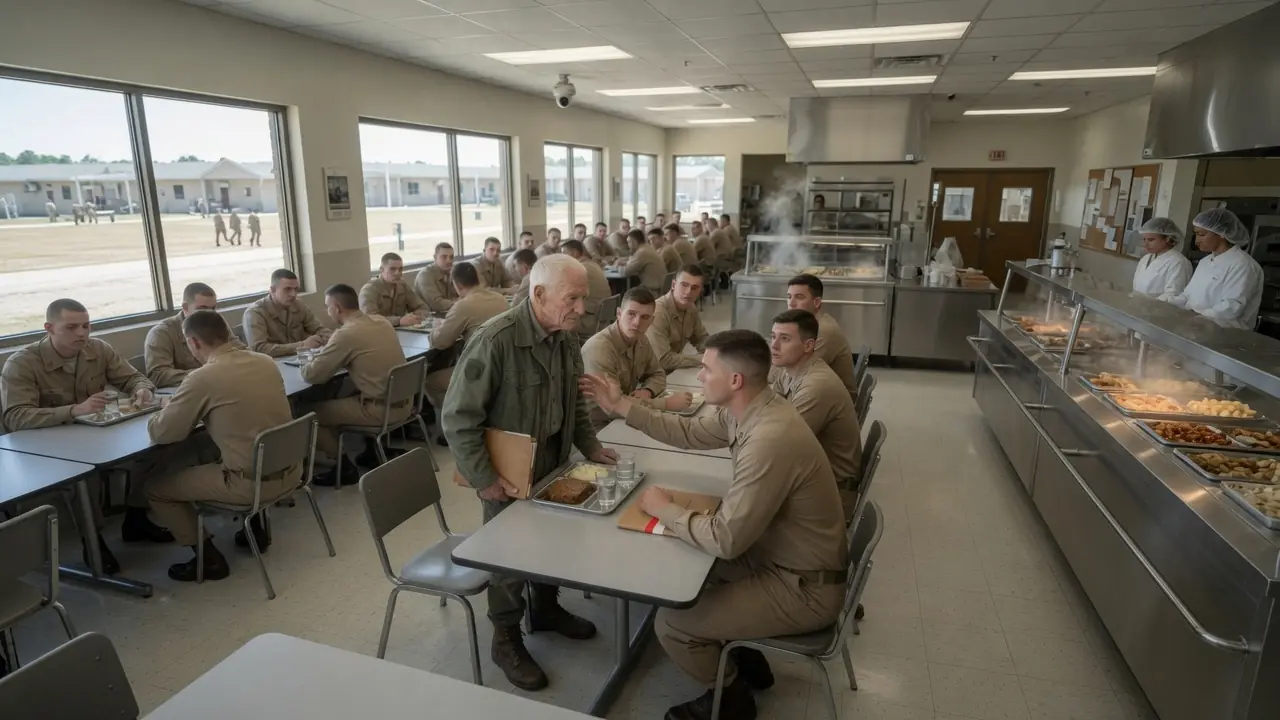
The mess hall was crowded with hundreds of soldiers moving between stainless-steel serving stations and long rows of tables. Trays clattered. Boots scraped against the floor. Conversations collided beneath the fluorescent lights.
To most people, it was lunchtime.
To Calvin, it was a map.
Two exits.
One kitchen access corridor.
Three cameras covering the central aisle.
A blind area behind the beverage station.
Military police near the western doors.
A senior noncommissioned officer seated alone beneath the wall clock.
He noted everything automatically.
Some habits were too deeply carved to disappear.
Calvin collected a tray, chose meatloaf, potatoes, and water, then moved toward an empty seat near the eastern wall.
The same specialist from the administrative office sat at the table with three other soldiers.
Miller had leaned his chair backward and stretched his boots across the aisle.
Calvin approached without changing direction.
Miller watched him come.
He could have moved his feet.
He did not.
Calvin stopped.
The specialist allowed the front legs of his chair to strike the floor with a loud crack.
Water trembled inside Calvin’s glass.
“You’re tracking dirt onto a clean floor, old-timer.”
The three soldiers beside Miller became quiet.
Calvin looked down.
His boots were clean.
“The floor appears unaffected.”
Miller leaned back and smiled.
“This section is for active personnel.”
“The dining facility is open to authorized visitors.”
“You aren’t authorized.”
Calvin placed his tray on the far end of the table.
“The clerk at the front office seems to share your opinion.”
One of the soldiers lowered his eyes, hiding amusement.
Miller did not.
He leaned forward.
“You deaf?”
“No.”
“Then take the tray and find another table.”
Calvin examined him more carefully.
The enlarged pupils.
The tension in his hands.
The sour chemical odor beneath his uniform.
This was not ordinary arrogance.
Miller was frightened.
Beside his elbow rested a thin folder sealed with a red security stripe. His forearm covered most of the label, but Calvin could see part of the routing number.
It was not a personnel file.
It belonged to a division-level Inspector General inquiry.
Miller noticed Calvin looking at it.
He slid the folder closer to his body.
“Eyes up here.”
Calvin lifted his glass but did not drink.
“The table has enough room.”
“Not for you.”
Miller planted both hands against the surface.
The three soldiers beside him did not encourage him. They glanced toward the exits and the security cameras.
They were not friends enjoying a joke.
They were men trapped inside someone else’s mistake.
Calvin remained standing.
“Sit down, Miller,” one of them whispered.
The specialist ignored him.
“You think that old jacket makes you somebody?”
“No.”
“You served once?”
Calvin looked at the empty place where the airborne patch had been removed.
“Once.”
Miller laughed.
“Then you should understand how things work. You’re a civilian now. That means you stay out of the way.”
Calvin’s gaze returned to the folder.
The exposed serial prefix matched a notation he had seen that morning in an old vehicle manifest.
Transport division.
Heavy equipment.
Restricted movement.
The pieces began to align.
He had not come to Fort Lawson because of a missing benefit record.
That was merely the cover story.
Three months earlier, the chairman of the Joint Chiefs had received evidence that armored recovery vehicles and heavy transport tractors were disappearing from bases across the region.
Official records listed them as scrapped.
Satellite images showed some of them being loaded onto civilian freight ships.
The theft required cooperation from procurement officers, gate personnel, maintenance supervisors, and senior command.
Calvin had been asked to enter the base quietly because his authorization existed outside the modern administrative system.
No electronic notice.
No scheduled inspection.
No warning.
Someone had discovered his arrival anyway.
The altered brass key proved it.
And now a frightened specialist was carrying a restricted investigative file through a public cafeteria.
Miller was either very foolish or very desperate.
“The routing prefix on that folder belongs to procurement oversight,” Calvin said.
The specialist’s smile disappeared.
The soldiers around him became motionless.
“You don’t know what you’re looking at.”
“The final digits identify a vehicle-diversion inquiry.”
Miller slowly stood.
His chair scraped backward.
Calvin continued.
“You’re not protecting your lunch table. You’re protecting that file.”
Miller’s face darkened.
“Shut your mouth.”
One of the soldiers rose.
“Miller, leave it.”
The specialist stepped around the table.
He was six feet three, heavily built, and more than fifty years younger than Calvin.
Calvin did not move.
Miller stopped within inches of him.
“You don’t exist on this post,” he whispered. “You’re an old ghost carrying bad paperwork.”
Calvin met his eyes.
“Ghosts still notice when frightened men hide evidence.”
Miller’s right hand closed around the front of Calvin’s jacket.
The cafeteria changed instantly.
Nearby conversations stopped.
Chairs turned.
Several soldiers rose halfway from their seats.
Calvin looked down at the fist gripping his lapel.
“Release the jacket.”
Miller pulled him closer.
“What are you going to do?”
The old man’s expression remained calm.
“Give you one opportunity to make a better decision.”
Miller shoved him.
Or tried to.
Calvin’s left hand moved along the inside of the specialist’s arm. His palm struck no harder than necessary, deflecting the grip while his right foot shifted several inches outside Miller’s stance.
The specialist’s momentum carried him forward.
Calvin caught the wrist, rotated beneath the shoulder, and used the table edge as a barrier against Miller’s recovering step.
For one brief moment, the young soldier’s boots left the floor.
Then he landed flat on his back.
The impact shook the trays on the table.
Calvin’s glass tipped over and shattered against the tile.
Water spread around Miller’s shoulder.
Silence rolled across the cafeteria.
Calvin remained standing.
His breathing had not changed.
Miller stared up at him in disbelief.
Calvin released his wrist immediately.
“Experience still matters, son.”
The specialist scrambled upright.
Humiliation had replaced fear.
That made him more dangerous.
“You attacked me.”
“You grabbed my clothing.”
“I’ll have you arrested.”
Calvin looked at the ceiling camera.
“The recording should clarify the sequence.”
Miller followed his gaze.
Panic flickered across his face.
Then Calvin saw the red-striped folder lying near the overturned chair.
Its full routing label was exposed.
The visible code did not merely identify a procurement investigation.
It linked directly to the Office of the Inspector General.
More importantly, a handwritten note appeared beneath the printed label.
TRANSFER TO BAY THREE BEFORE 1300.
DO NOT ENTER DIGITAL CHAIN.
The file was being moved outside official systems.
Miller noticed Calvin reading it.
He lunged toward the folder.
A sharp command stopped him.
“Stand down, Specialist.”
The voice was controlled, quiet, and accustomed to immediate obedience.
A colonel had entered the dining hall.
He was tall and thin, with silver eagles on his collar and a black leather briefcase in one hand. His name was Colonel Arthur Strickland, deputy commander for regional logistics.
Calvin recognized him from the confidential briefing.
Strickland was one of the officers under suspicion.
Miller snapped to attention.
“Sir, this civilian interfered with classified documents.”
Strickland did not return the salute.
His eyes moved from Miller to the folder, then to Calvin.
“Take your men and report to Bay Three.”
Miller hesitated.
“Sir, the file—”
“Leave it.”
The specialist’s face drained of color.
“Yes, sir.”
He marched toward the exit with the three other soldiers following him.
The cafeteria slowly began breathing again.
Strickland approached Calvin.
“You were supposed to remain inside the administrative corridor.”
“I was refused access.”
“You should have contacted your liaison.”
“My liaison failed to answer.”
The colonel looked at the broken glass.
“You assaulted a soldier.”
“He attempted to remove me physically.”
“You could have walked away.”
“I could have.”
Calvin bent and collected his leather folder.
Strickland lowered his voice.
“You are far outside the limits of your assignment.”
Calvin looked toward the red-striped file.
“That depends on the assignment.”
“You were brought here to review inactive transport records.”
“I was brought here because active vehicles are being moved under inactive serial numbers.”
The colonel’s expression remained controlled.
“You have no evidence of that.”
Calvin removed a folded sheet of blue carbon paper from his folder.
It was a copy of a manual departure log from the north gate.
Modern scanners recorded electronic identification numbers, but the night supervisor still maintained an old paper ledger in case the system failed.
Three heavy transport vehicles had left the base at two seventeen that morning.
Their digital entries identified them as garbage removal trucks.
Their handwritten hull numbers belonged to armored tractor units valued at more than two million dollars each.
At the bottom of the form was an override code.
The same code appeared on Strickland’s executive authorization file.
Calvin laid the carbon copy on the table.
“The machines left through the north gate before sunrise.”
Strickland glanced down.
“The numbers were entered incorrectly.”
“Three times?”
“A clerical error.”
“The same error occurred at Fort Hayes, Camp Roland, and the Red River depot.”
“You don’t have access to those records.”
“I have access to more than your database shows.”
Strickland’s hand tightened around the briefcase.
“You are an elderly civilian with expired credentials.”
Calvin’s eyes settled on him.
“That was the mistake your clerk was instructed to make.”
The colonel did not answer.
Calvin continued.
“She found the authorization. Then she closed it. Specialist Miller carried an Inspector General file toward a transfer bay that does not appear on the inquiry schedule. My access key was altered before I reached the gate.”
“You are imagining a conspiracy because a clerk inconvenienced you.”
“Your organization has stolen at least fourteen heavy recovery vehicles and routed them through civilian scrap contractors.”
Strickland stepped closer.
“You should be very careful.”
“I have been careful for forty years.”
“You have no rank here.”
“The rank is irrelevant.”
Calvin removed the brass access tag from his pocket.
He placed it on the table beside the carbon copy.
A small seal was stamped into the back.
The chairman’s personal audit cipher.
Strickland recognized it.
For the first time, his composure shifted.
“The chairman would not authorize an off-book field inspection.”
“He would if he believed the inspection office itself had been compromised.”
Outside, engines began rumbling in the courtyard.
The sound was deeper than ordinary staff vehicles.
Heavy diesel engines.
Strickland turned toward the windows.
Two black armored utility vehicles stopped outside the mess hall. Federal marshals in dark blue tactical uniforms stepped out carrying secure communication cases.
Soldiers throughout the cafeteria moved toward the windows.
The doors opened.
Four marshals entered in formation.
Their leader crossed directly toward Calvin and saluted.
“Mr. Vance, the command terminal is connected. The Pentagon audit team is standing by.”
The room became silent again.
Strickland stared at Calvin.
“You planned this.”
“No.”
Calvin looked toward the red-striped folder.
“I suspected someone would reveal himself when an obsolete civilian authorization appeared inside the system.”
“You used yourself as bait.”
“I presented an opportunity.”
The marshal lifted the red-striped folder with gloved hands and sealed it inside an evidence case.
Strickland recovered some of his confidence.
“This proves nothing. A junior specialist improperly handled a file. The vehicle records remain incomplete.”
Calvin nodded.
“That would be true if this were the only evidence.”
He opened his brown folder.
Inside were photographs of transport vehicles crossing private loading yards, copies of payments from defense contractors to shell companies, gate logs, fuel records, and recorded communications between procurement officials.
At the top was an account bearing Strickland’s signature.
The colonel’s face became rigid.
“Those documents are classified.”
“They are evidence.”
“You obtained them illegally.”
“They were delivered by your own personnel.”
Strickland looked toward the marshals.
“Who?”
Calvin did not answer.
The colonel’s gaze moved toward the western doors where Specialist Miller had disappeared.
“You turned Miller.”
“No.”
Calvin’s voice softened slightly.
“Miller came forward two months ago after he discovered vehicles were being transferred under false repair orders.”
Strickland looked genuinely surprised.
“You said he was distributing stimulants.”
“You created that allegation.”
Miller’s dilated pupils had not come from illegal drugs.
They came from prescribed medication and three sleepless nights under surveillance.
The Article 32 file was designed to discredit him before he could testify.
The other soldiers at the table had been ordered to escort him to Bay Three, where the evidence would be removed and Miller would be detained for questioning.
His aggression toward Calvin had not been random.
He had been told the old civilian was part of the group investigating him.
Strickland had turned a frightened whistleblower against the one person sent to protect him.
Calvin looked at the marshal.
“Find Specialist Miller before he reaches Bay Three.”
Two agents moved immediately.
Strickland stepped backward.
“You cannot detain a senior officer inside an active command without the base commander’s authorization.”
A new voice answered from the entrance.
“He has it.”
Major General Rebecca Sloan entered the cafeteria with the base commander beside her.
Sloan oversaw readiness procurement for the Joint Chiefs. She carried no visible weapon and wore no expression beyond professional disappointment.
Strickland straightened.
“General.”
“Colonel, place the briefcase on the table.”
“This is a misunderstanding.”
“Place it down.”
Strickland obeyed.
A marshal opened the case.
Inside were transfer documents, encrypted drives, and more than eighty thousand dollars in cash.
The cafeteria erupted in whispers.
Strickland looked at Calvin.
“You planted that.”
Calvin shook his head.
“I never touched your briefcase.”
The colonel turned to Sloan.
“General, this man assaulted an active-duty soldier, accessed classified material, and entered the post under false pretenses.”
Sloan’s gaze moved toward Calvin.
“Mr. Vance entered Fort Lawson under an authorization issued by my office and countersigned by the chairman.”
The young soldiers nearest the table stared at the old man in the faded jacket.
“He also holds independent investigatory authority under a readiness-security directive established before most of you were born.”
Strickland’s voice became desperate.
“That directive was dissolved.”
“No,” Sloan replied. “It was removed from the standard database.”
The clerk had been partly correct.
Calvin Vance was a ghost inside the modern system.
But he had been made invisible intentionally.
His name belonged to a small group of retired operational auditors authorized to investigate defense facilities without triggering conventional reporting chains.
During the Cold War, Calvin had inspected nuclear storage locations, covert supply routes, and special operations bases.
He had no visible rank.
No current service card.
No office.
That was what made him useful.
Corrupt officers watched generals.
They prepared for formal inspectors.
They did not prepare for an old man carrying a leather folder.
The marshals stepped beside Strickland.
“Colonel Arthur Strickland, you are being detained pending investigation into theft of government assets, conspiracy, falsification of military records, obstruction of an Inspector General inquiry, and retaliation against protected personnel.”
Strickland looked around the room.
Only an hour earlier, he had crossed the cafeteria believing everyone inside it would respond automatically to the silver eagles on his collar.
Now no one moved to help him.
“You have no idea what you’re doing,” he said.
Calvin met his eyes.
“I know exactly what you were doing.”
The marshals removed Strickland’s briefcase and escorted him toward the door.
As he passed the tables, soldiers stood silently.
No one saluted.
Specialist Miller was found in Bay Three with two military police officers waiting to place him in custody under falsified orders.
The marshals intervened before he was taken.
Later that afternoon, Miller sat alone in a secure interview room.
His uniform was wrinkled. A bruise had formed along one shoulder where he struck the cafeteria floor.
Calvin entered carrying two cups of coffee.
Miller looked away.
“You here to finish humiliating me?”
“No.”
Calvin placed one cup on the table.
“You knew about Strickland.”
“I knew vehicles were disappearing.”
“You copied the manifests.”
Miller remained silent.
“You contacted the Inspector General.”
“They sent my report back through division command.”
“To Strickland.”
Miller nodded.
“Two days later, they searched my barracks and found pills in my locker.”
“Were they yours?”
“Prescription medication. I have a sleep disorder.”
“They altered the label.”
“Yes.”
Calvin sat opposite him.
“Why did you confront me?”
Miller stared at the coffee.
“Colonel Strickland said you were a civilian contractor hired to identify the whistleblower. He said if I let you see that file, I’d disappear into military prison.”
“And you believed him.”
“He was a colonel.”
Calvin leaned back.
“That is not an explanation.”
Miller raised his eyes.
“It felt like one.”
Calvin understood.
Rank often borrowed trust it had not earned.
“I’m sorry,” Miller said. “For grabbing you.”
“You should be.”
The young soldier looked surprised.
Calvin continued.
“Fear explains behavior. It does not excuse it.”
Miller nodded.
“You could have broken my arm.”
“Yes.”
“Why didn’t you?”
“Because stopping a threat and punishing a man are different things.”
Miller absorbed the answer.
“Are they going to discharge me?”
“You will answer for your conduct in the cafeteria.”
His face fell.
“But your report exposed the theft. Your evidence may save careers and lives.”
“What happens to me?”
“That depends on whether you continue reacting from fear or begin acting from principle.”
Calvin stood.
Miller looked at the old jacket.
“Who are you?”
“Today?”
Calvin picked up his coffee.
“A man who wanted lunch.”
The investigation lasted four months.
Nine officers and fourteen civilian contractors were charged. Twelve stolen vehicles were recovered from private shipping yards. Two had already been sent overseas and were later seized through an international operation.
The clerk from the personnel office admitted she had been instructed to reject any outdated authorization connected to Calvin’s name.
She kept her job after cooperating.
Specialist Miller received formal discipline for assaulting Calvin but remained in the Army because of his role in exposing the theft network. He entered treatment for anxiety and sleep problems that his command had ignored.
Colonel Strickland was convicted of conspiracy, theft, obstruction, and retaliation.
Calvin was asked to testify before a congressional readiness committee.
He refused television interviews.
He refused a commendation ceremony.
And when the chairman offered him a permanent advisory office in Washington, Calvin declined that too.
Six months after the cafeteria confrontation, Calvin returned to Fort Lawson.
This time the clerk looked directly at him.
“Mr. Vance.”
“Good morning.”
She entered his authorization number.
The record appeared immediately.
“Your access is approved.”
“I’m relieved to discover I exist.”
Her face reddened.
“I’m sorry about what happened.”
Calvin collected his badge.
“You corrected the procedure.”
“Yes, sir.”
“That matters more than being embarrassed by the mistake.”
At the mess hall, Specialist Miller was waiting near the entrance.
He had been promoted to sergeant.
His posture was different.
Still alert, but no longer vibrating with hidden panic.
“I saved you a seat,” Miller said.
Calvin looked toward the same long table near the eastern wall.
“No boots in the aisle?”
“No, sir.”
They collected their trays and sat together.
Several young soldiers glanced toward Calvin’s jacket, clearly curious about the old civilian sharing lunch with a sergeant.
One private finally gathered the courage to ask.
“Sir, is it true you used to inspect classified bases?”
Calvin cut into the meatloaf.
“It is true the meatloaf has not improved.”
Miller laughed.
The private waited.
Calvin looked at him.
“What do they tell you about authority in basic training?”
“That we follow the chain of command.”
“And?”
The private hesitated.
“That orders must be lawful.”
Calvin nodded.
“Rank deserves professional respect. Character earns trust. Do not confuse the two.”
The private glanced toward Miller.
The new sergeant did not appear offended.
He had learned the difference the hard way.
After lunch, Calvin walked alone across the quadrangle.
A formation of recruits passed beneath the afternoon sun. Their boots struck the pavement in perfect rhythm.
The base looked unchanged.
The same buildings.
The same flags.
The same uniforms.
But systems rarely changed because corrupt men were removed.
They changed when ordinary people stopped assuming someone else would speak.
A clerk had closed an archive because opening it required effort.
Soldiers had watched Miller bully an old man because opposing him carried risk.
Officers had accepted suspicious records because the signatures came from above.
Strickland had built an entire criminal network inside the distance between what people noticed and what they were willing to question.
Calvin touched the brass key in his pocket.
The small filed mark remained across its third tooth.
It was no longer evidence.
The marshals had already photographed and documented it.
Calvin kept it as a reminder.
Modern institutions loved clean digital systems, perfect uniforms, and official credentials.
Yet the truth often entered through something small and inconvenient.
A scratched key.
A carbon copy.
A frightened soldier carrying the wrong folder.
An old man whom no one believed mattered.
At the gate, a young guard scanned Calvin’s authorization.
The machine flashed green.
“Have a good afternoon, sir.”
Calvin stepped through.
The guard glanced at the faded jacket.
“Were you stationed here once?”
“Long ago.”
“What did you do?”
Calvin looked back toward the base.
Vehicles moved through the depot.
Soldiers crossed the quadrangle.
A flag snapped above the headquarters building.
“I checked whether things were where people claimed they were.”
The guard smiled.
“Inventory?”
“Something like that.”
Calvin walked toward the parking lot.
He had arrived as a ghost in the database.
A forgotten civilian with an obsolete signature and an old field jacket.
The clerk dismissed him.
The soldiers crowded him.
A corrupt colonel threatened him.
Each of them made the same mistake.
They believed authority lived in computer records, polished brass, and rank insignia.
Calvin knew better.
Authority without accountability was only intimidation wearing a uniform.
And experience did not disappear simply because a database stopped remembering the name of the man who carried it.
Sometimes the most dangerous person in the room was not the officer with silver eagles on his collar.
It was the quiet old man everyone had already decided did not belong there.