Nobody paid much attention when the old pickup rolled through the gates of Raven Ridge Training Center just after sunrise.
The truck had faded blue paint, a cracked rear light, and enough mud around the wheel wells to suggest it had spent the previous night on roads no military planner would have approved.
A woman stepped out.
Twenty-nine years old.
Plain gray T-shirt.
Worn green backpack.
Brown hair tied low at the back of her neck.
Scuffed boots.
No expensive watch.
No polished luggage.
No entourage.
She looked less like a participant in an advanced NATO leadership course and more like someone assigned to unload supplies.
Several recruits noticed.
That was enough.
“Logistics building’s the other way,” somebody called.
A few men laughed.
The woman closed the truck door.
She did not look toward the voice.
She checked the number painted on the nearest barracks, adjusted the strap of her backpack, and walked toward formation.
Her name was Mara Ellison.
Very few people at Raven Ridge knew anything else.
That was intentional.
The course had brought together military personnel from several allied nations for twelve weeks of leadership assessment, field training, small-unit decision making, logistics planning, tactical medicine, navigation, and crisis-command exercises.
Most participants had been nominated by units proud to advertise their best people.
Mara’s paperwork was different.
Sparse.
Prior government service.
Security clearance verified.
Several years listed simply as:
Joint operational assignment.
Then a three-year gap from active military work.
More recently:
Civilian emergency management consultant.
No decorations listed.
No impressive biography.
No explanation.
To most of the people standing in formation that morning, it made her look ordinary.
Captain Ross Devlin, the senior field instructor, walked down the line.
He was forty-three, broad through the shoulders, with a voice that seemed specifically designed to travel through bad weather.
He stopped in front of Mara.
“Ellison.”
“Yes, sir.”
His eyes moved over her old boots.
Then her backpack.
“This isn’t a volunteer camp.”
“No, sir.”
“You sure you’re in the correct course?”
“Yes, sir.”
Someone behind her snickered.
Devlin looked toward the sound.
Silence returned.
Then he looked back at Mara.
“What branch?”
“Former Army, sir.”
“Former?”
“Yes.”
“What are you doing here?”
“Transition assessment.”
“For?”
“Operational planning.”
A blond recruit two places down smiled.
His name was Grant Mercer.
Thirty-one.
Infantry captain.
Decorated.
Athletic.
Popular before the first morning had even finished.
“Planning,” he whispered.
“Of course.”
Mara heard him.
She gave no reaction.
Devlin moved on.
That disappointed Grant.
He had expected embarrassment.
Most people reacted when you challenged their place in a room.
Mara seemed not to notice whether the room wanted her there at all.
That made people curious.
Curiosity became irritation quickly.
At breakfast, Mara sat alone.
She chose a small table near the wall, placed her backpack beneath the chair, and ate oatmeal while reviewing the training schedule.
Grant approached with two other participants.
One was Lucas Trent, a communications officer with a habit of laughing before jokes were finished.
The other was Paige Sutton, an intelligence specialist who had already formed opinions about nearly everyone.
Grant dropped his tray on Mara’s table.
“You always eat alone?”
Mara continued reading.
“Apparently not.”
Lucas laughed.
Grant sat.
“So what’s the story?”
“What story?”
“You show up in a farm truck with equipment older than half this base.”
He looked at her boots.
“Former Army.”
“Civilian consultant.”
“Then somehow you get a slot people wait years for.”
Mara looked at him.
“You want my application?”
Paige smiled.
“We’re just curious.”
“No.”
Grant leaned back.
“No what?”
“You’re not.”
His smile tightened.
Mara returned to the schedule.
“You want to know whether I belong here.”
Grant stared at her.
“And?”
“That’s what the course is for.”
She took another spoonful of oatmeal.
The answer irritated him more than defensiveness would have.
He stood.
“Hope you can keep up.”
Mara nodded.
“I hope you can too.”
Lucas stopped laughing.
The first week rewarded noise.
That was what Mara noticed.
People announced confidence before exercises began.
They compared scores.
Backgrounds.
Units.
Deployments.
Fitness numbers.
Grant Mercer seemed built for that environment.
He finished runs near the front.
Spoke first in classroom discussions.
Volunteered for demonstrations.
He had an answer to every scenario.
Mara rarely spoke unless asked.
During a ten-mile terrain run, she remained in the middle third of the formation.
Not fastest.
Not slowest.
Her breathing barely changed.
Grant passed her during the final mile.
“Thought special planning people were supposed to plan ahead.”
Mara looked at his left boot.
“Your lace is coming loose.”
He glanced down.
It was.
By the time he tied it, she had passed him.
Later, he told everyone she had deliberately distracted him.
Mara did not bother correcting the story.
The navigation exercise came three days later.
Participants received map coordinates, compass bearings, and a five-hour time limit to cross wooded hills surrounding Raven Ridge.
Mara worked alone.
Twenty minutes into the route, she stopped near a fallen pine and checked a contour line.
Lucas Trent approached with two others.
“You lost?”
“No.”
He looked at her map.
“You’re heading west.”
“Yes.”
“Point three is north.”
“Not my point three.”
Lucas frowned.
Participants had different waypoint sequences.
He realized that only after reaching for her map.
Mara moved it away.
“Something you need?”
Lucas smiled.
“Relax.”
He walked off.
Thirty seconds later Mara called after him.
“You’re twelve degrees off.”
Lucas stopped.
“What?”
“Your bearing.”
He laughed.
“Thanks.”
He continued.
Two hours later, Mara passed him walking back from the wrong ridge.
She said nothing.
That somehow humiliated him more.
People began noticing her during weapons handling.
The course was not designed to produce elite shooters.
Most participants were already trained.
The purpose was evaluation under pressure.
Mara approached the rifle station without ceremony.
Sergeant Adrian Holt handed her a training carbine.
“You familiar?”
“Yes.”
“You want a demonstration?”
“No, thank you.”
The disassembly test began.
Most participants completed the process between ninety seconds and two minutes.
Grant finished in seventy-eight.
He stepped back proudly.
Mara took fifty-six.
More important to Holt, she did not move quickly.
She moved efficiently.
Each part landed in the same place.
No searching.
No dropped pins.
No wasted hand motion.
Holt looked at the timer.
“Again.”
Mara looked up.
“Problem?”
“I want to see whether that was memorized rhythm or luck.”
She reassembled.
Then disassembled again.
Fifty-eight seconds.
Holt stared at her hands.
“Where’d you learn?”
“Army.”
“That answer covers a lot.”
“Yes, Sergeant.”
Grant muttered from behind her:
“She can clean a rifle. Congratulations.”
Holt turned.
“Mercer.”
“Yes, Sergeant?”
“You know what separates professionals from amateurs?”
Grant waited.
Holt pointed toward Mara’s laid-out components.
“Professionals care about boring things.”
The group went quiet.
Mara reassembled the weapon.
She did not smile.
But Holt did.
On the rifle range, Mara became harder to dismiss.
Five rounds.
Four hundred meters.
Variable wind.
Grant scored four center hits and one just outside.
Excellent.
Paige managed three.
Lucas two.
Mara lay behind the rifle.
Checked the wind flag once.
Adjusted nothing.
Five shots.
Five center hits.
The range officer lowered his binoculars.
“Ellison.”
“Yes?”
“Again.”
She fired another group.
The result was nearly identical.
An older officer observing from behind the firing line turned toward Sergeant Holt.
Colonel Nathaniel Cross had commanded troops for thirty-two years.
Gray hair.
Thin face.
No theatrical manner.
He watched Mara stand.
“Who trained her?”
Holt looked at the paperwork.
“Former Army.”
Cross frowned.
“That isn’t what I asked.”
Mara walked away from the line.
Colonel Cross continued watching.
Something about her posture bothered him.
Not negatively.
Familiarity.
He had seen people move that way before.
People who did not scan a room obviously because scanning had become ordinary.
People who kept their weight balanced even while waiting.
People who looked relaxed without ever becoming unaware.
He asked an aide for her record.
The aide returned twenty minutes later.
“Most of it’s restricted.”
Cross looked up.
“Restricted at what level?”
The aide hesitated.
“Higher than mine.”
That ended the conversation.
But not the colonel’s curiosity.
Raven Ridge became less friendly as Mara’s scores improved.
Some recruits adjusted.
Others doubled down.
Paige stopped mocking her after Mara quietly helped her correct a compass error without telling the instructor.
A medic named Elena Ruiz began sitting with her at lunch.
Grant did the opposite.
Every strong performance from Mara seemed to become a personal insult.
During a field obstacle exercise, he bumped her shoulder while passing.
During a tactical briefing, he interrupted her twice.
When she corrected a vulnerability in his defensive plan, he said:
“Easy to draw perfect arrows after somebody else does the work.”
Mara replied:
“You want the flaw fixed or your feelings protected?”
The room went silent.
Major Helen Ward, who taught tactical planning, looked toward Grant.
“Well?”
He did not answer.
Ward pointed toward Mara’s revised map.
“She’s correct.”
Afterward, Grant caught Mara outside.
“You think you’re better than everybody here?”
“No.”
“That quiet act?”
“What act?”
“You walk around like nothing gets to you.”
Mara looked at him.
“Most things don’t deserve the effort.”
He stepped closer.
“Everybody’s got something to prove.”
“That may be your problem.”
Grant’s jaw tightened.
Mara walked away.
The incident that changed the course happened during week four.
Close-combat training.
Controlled environment.
Protective equipment.
Supervised one-on-one drills.
Participants were instructed to practice restraint escapes, position control, and safe takedowns.
No strikes to the head.
No choking.
No joint manipulation beyond designated limits.
The point was control.
Grant Mercer was paired with Mara.
Captain Devlin noticed the tension immediately.
“Professional exercise,” he warned.
Grant nodded.
Mara did too.
The whistle sounded.
Grant moved first.
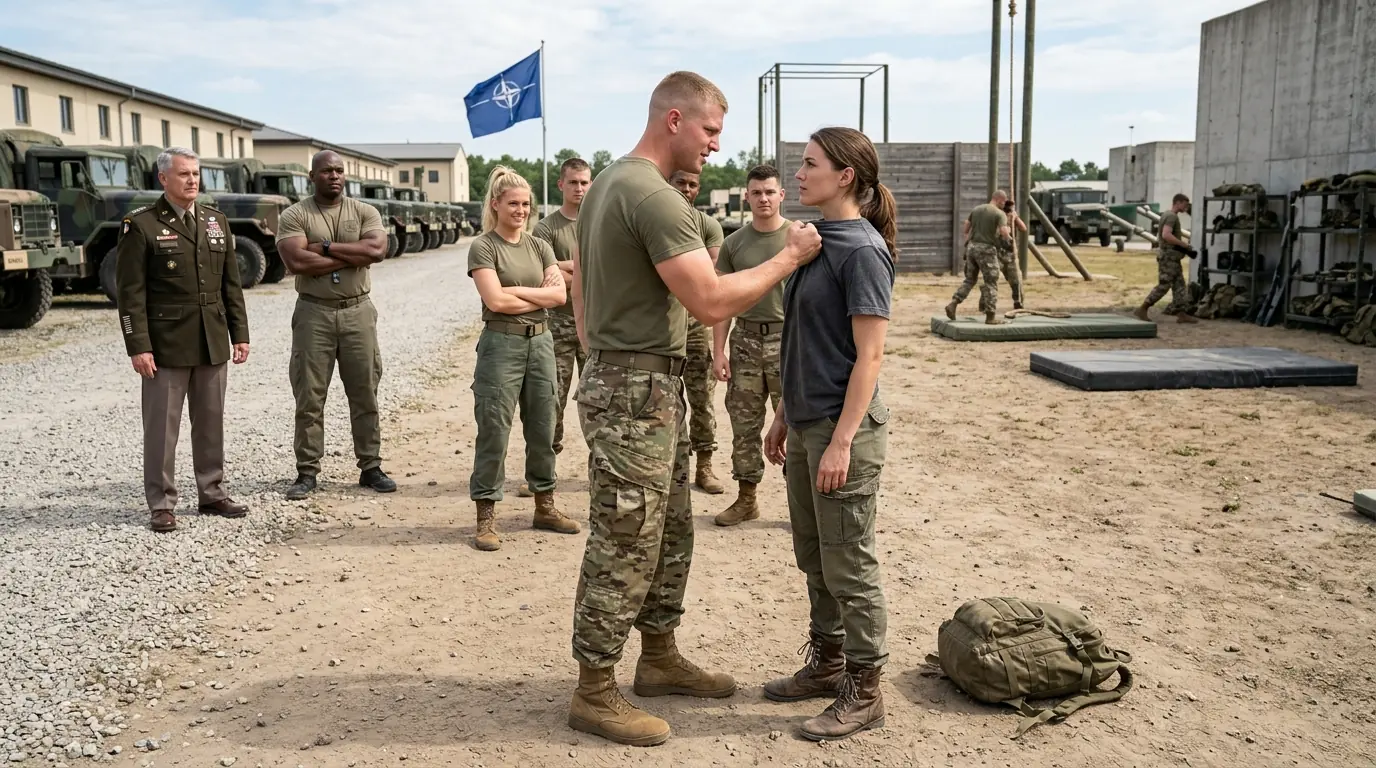
He grabbed Mara near the shoulders.
She redirected his weight.
He recovered quickly.
Stronger than she was.
He tried forcing her toward the padded wall.
Mara changed angle and escaped.
Several recruits cheered.
Grant heard them.
That was the problem.
He stopped treating the drill like training.
He caught Mara’s shirt collar from behind.
Pulled hard.
The fabric tore from the neckline down across her back.
Mara immediately stepped away.
“Stop.”
The whistle had not blown.
Grant grabbed again.
“This is combat, Ellison.”
Captain Devlin shouted:
“Mercer, release!”
Grant did.
Too late.
Mara’s shirt hung open across one shoulder.
Across her upper back was a black tattoo.
Not large.
Not decorative.
A coiled viper surrounding a broken compass rose.
Beneath it were six small vertical bars.
Most participants saw only ink.
Colonel Nathaniel Cross saw something else.
He had been walking past the yard.
He stopped so abruptly his aide nearly collided with him.
His face changed.
For the first time in four weeks, the recruits saw a senior officer look genuinely shaken.
Cross walked toward the mat.
“Mara.”
Nobody had heard him use her first name.
Mara turned.
The colonel stared at the tattoo.
Then at her face.
“When?”
Mara pulled the torn fabric across her shoulder.
“Six years ago.”
Cross’s voice lowered.
“Who gave you that mark?”
The entire yard waited.
Mara looked uncomfortable for the first time since arriving.
“Chief Warrant Officer Daniel Voss.”
Colonel Cross closed his eyes briefly.
A few older instructors exchanged looks.
Captain Devlin frowned.
He recognized the name.
Barely.
Voss.
Ghost Viper.
Not a person.
A call sign that had become associated with a joint special mission advisory element that officially existed only in vague administrative language.
The unit had worked in recovery, reconnaissance support, extraction planning, and high-risk advisory missions.
Most records remained classified.
Several operators had died during its final deployment.
The group was disbanded afterward.
The tattoo was not an official military insignia.
No regulation recognized it.
It did not grant rank.
It did not make Mara more important than anyone else.
It was something more personal.
A memorial.
Members of the final team had marked themselves after losing three people during an evacuation mission.
Colonel Cross knew because he had been the conventional-force commander waiting for that team to bring sixteen trapped civilians through hostile territory.
He remembered the after-action report.
He remembered the extraction arriving at dawn.
He remembered one young woman walking behind the final stretcher with blood soaking one sleeve while refusing medical treatment until every civilian was accounted for.
He had not seen her face clearly then.
He had seen the mark later in a classified photograph.
Now she stood in his training yard.
Cross straightened.
Then saluted.
Not the tattoo.
Not some secret society.
Her.
Mara froze.
“Colonel.”
His hand remained at his brow.
“Sergeant Ellison.”
Several recruits looked at one another.
Sergeant?
Her course paperwork had not listed rank.
Mara slowly returned the salute.
Cross lowered his hand.
“I thought you left service.”
“I did.”
“What brought you back?”
“Different work.”
His eyes moved toward the training building.
“Planning track?”
“Yes, sir.”
Cross nodded.
Then looked toward Grant Mercer.
The temperature of the yard seemed to drop.
“Captain Devlin.”
“Yes, sir.”
“Was that tear part of the drill?”
“No, sir.”
“Was the second grab after she called stop authorized?”
“No, sir.”
Cross looked at Grant.
“Then this is not a story about a tattoo.”
Nobody moved.
“This is a story about a soldier failing to follow control instructions because his pride was injured.”
Grant’s face reddened.
“Sir, I—”
“Save it for the review.”
Cross turned toward Mara.
“You all right?”
“Yes, sir.”
“Medical evaluation anyway.”
“Not necessary.”
“That was not optional.”
For the first time, Mara almost smiled.
“Yes, sir.”
The story spread before dinner.
By midnight it had become ridiculous.
Mara had been an assassin.
Mara had trained intelligence officers.
Mara had commanded secret missions in eight countries.
Mara had supposedly killed twenty people with a knife.
Most of it was nonsense.
She hated every version.
Elena found her sitting outside the medical station.
“You all right?”
“Yes.”
“You hate this.”
“Yes.”
“The attention?”
Mara looked toward the barracks.
“The simplification.”
Elena sat beside her.
“What do you mean?”
“Yesterday I was the poor girl who didn’t belong.”
Mara looked at her.
“Today I’m a secret legend because an older man recognized ink on my back.”
She shook her head.
“Both versions are lazy.”
Elena thought.
“So what version is true?”
Mara looked toward the dark training yard.
“I was good at a job.”
Pause.
“Then I got tired.”
Another.
“Then people died.”
Elena said nothing.
Mara continued.
“I left.”
“Why come back?”
“Because leaving the Army didn’t make the skills disappear.”
“And?”
Mara looked at her hands.
“I didn’t want the skills deciding what I had to become.”
Elena waited.
“So you’re here to learn another way to use them.”
“Yes.”
That answer never made it into the rumors.
It was too ordinary.
Grant Mercer was removed from contact training pending review.
He was not exiled.
Not destroyed.
Not sent to some mysterious punishment base.
He received formal disciplinary action for ignoring an instructor’s command and violating training safety requirements.
The incident also triggered review of several earlier complaints.
A shoulder shove.
Sabotaging equipment layouts.
Harassment disguised as jokes.
Grant had built a pattern from things everyone had considered too small individually.
Captain Devlin had to answer uncomfortable questions too.
Why had he ignored the culture forming in the course?
Why had ridicule been treated as motivation?
Why had Mara’s complaints never existed?
Because she had not made any.
That answer did not completely absolve him.
Colonel Cross said:
“Leadership is not simply responding when somebody finally reports mistreatment.”
Devlin listened.
“Sometimes leadership is noticing what your own training environment is rewarding.”
That sentence stayed with him.
Mara returned two days later wearing a plain black training shirt.
The yard became strangely respectful.
Too respectful.
People stepped aside.
Nobody joked.
Nobody challenged her.
She disliked that almost as much as the mockery.
During a planning exercise, Paige agreed with everything she said.
Mara stopped.
“You disagree.”
Paige blinked.
“No.”
“Yes, you do.”
Silence.
“You’ve been staring at that route for five minutes.”
Paige hesitated.
“I think your evacuation corridor is too narrow.”
Mara nodded.
“Good.”
Paige stared.
“You’re not mad?”
“Why would I be?”
“I thought—”
“What?”
Paige looked embarrassed.
“Nothing.”
Mara handed her the marker.
“Show me.”
Paige changed the route.
Mara studied it.
“Better.”
That moment began repairing the course more than any punishment did.
People slowly learned Mara did not want reverence.
She wanted competence.
Colonel Cross requested a private conversation.
They met in an empty classroom.
“You never told them.”
“No.”
“Why?”
Mara sat across from him.
“Because it wasn’t relevant.”
“Your experience is relevant.”
“My record is relevant.”
“The difference?”
“My record tells them what I’ve done.”
She looked at him.
“The stories make them decide who I am.”
Cross nodded.
“Fair.”
He leaned back.
“How much are you allowed to say?”
“Very little.”
“I remember the Oradin evacuation.”
Mara looked away.
Cross continued carefully.
“You brought sixteen civilians out.”
“Our team did.”
“Three of your people were killed.”
“Yes.”
“Voss?”
Mara’s expression changed.
“Six months later.”
Cross understood.
“I’m sorry.”
Mara nodded.
“Why the mark?”
She touched the back of her shoulder unconsciously.
“Voss used a viper symbol on planning boards.”
“Why?”
“He said vipers survive by knowing when not to strike.”
Cross smiled faintly.
“That sounds like him.”
“The bars are for the team.”
“Six?”
“Six who made it out.”
Cross became quiet.
“You were the youngest.”
“Yes.”
“How old?”
“Twenty-two.”
He stared.
“That’s too young.”
Mara looked at him.
“Most people are too young when something changes them forever.”
Cross had no answer.
By the sixth week, Mara became one of the strongest participants in the course.
Not best at everything.
That would have been unrealistic.
She struggled with administrative software used by NATO logistics teams.
Her French was embarrassing.
A Belgian captain destroyed her in one multinational negotiation exercise because she underestimated cultural protocol.
She finished one endurance course sixth.
Elena was faster.
Paige was better at intelligence synthesis.
Lucas, once he stopped performing for an audience, was genuinely gifted at communications planning.
Mara learned from all of them.
That mattered.
Because the point was not revealing that everyone else was incompetent.
The point was revealing how much talent contempt had made them unwilling to see.
The final exercise placed participants in a simulated humanitarian crisis.
A fictional earthquake had destroyed roads, disrupted communications, and displaced thousands.
No enemy.
No shooting.
No hand-to-hand combat.
Food.
Water.
Shelter.
Medical evacuation.
Conflicting priorities.
Limited helicopters.
Damaged bridges.
Political pressure.
Exactly the sort of scenario Mara had come to learn.
Captain Devlin assigned her command of one planning cell.
Her team included Paige.
Lucas.
Elena.
And, after his disciplinary review, Grant Mercer.
That surprised everyone.
Grant had been allowed to remain in the course under strict conditions.
He stood at the table without looking at Mara.
Devlin said:
“Problem?”
Mara answered:
“No, sir.”
Grant said nothing.
The exercise began.
Two hours later, everything went wrong.
The primary road collapsed.
A medical convoy became trapped.
Weather grounded aircraft.
Paige identified a secondary route but could not verify bridge capacity.
Lucas lost communication with one district.
Grant proposed concentrating resources on the largest population center.
Mara disagreed.
“Why?” he asked.
“Because the smaller district loses access completely if the river rises.”
“Largest number first.”
“Not automatically.”
“That’s standard triage.”
“No.”
Mara pointed toward the map.
“Triage is about urgency and survivability, not just volume.”
Grant stared.
Weeks earlier, that disagreement would have become personal.
Now he looked at the map.
Then at the weather forecast.
He slowly nodded.
“You’re right.”
Paige looked up.
Mara said:
“Maybe.”
Grant almost smiled.
“What?”
“We need data.”
They got it.
The smaller district had a hospital with only four hours of generator fuel.
Priority changed.
Grant immediately began reallocating transport.
No pride.
No argument.
Just work.
Later, he caught Mara alone near the operations board.
“I owe you an apology.”
She continued writing.
“Yes.”
He seemed surprised by the direct answer.
“I expected you to say I didn’t.”
“You do.”
Grant nodded.
“I treated you badly before I knew anything about you.”
Mara turned.
“That’s the part you need to fix.”
“I know.”
“No.”
She set down the marker.
“You’re still thinking the mistake was not knowing who I was.”
Grant looked confused.
Mara continued.
“If I had been exactly what you thought—some mediocre civilian candidate with bad boots—you still didn’t have the right to humiliate me.”
He said nothing.
“You don’t correct prejudice by finding out the target was secretly impressive.”
Her voice remained calm.
“You correct it by understanding nobody needs a secret résumé before you treat them with basic respect.”
Grant absorbed that.
Finally:
“You’re right.”
Mara nodded toward the planning table.
“Good.”
She handed him a worksheet.
“Now calculate fuel.”
He laughed once.
Then took it.
The team finished first in the final exercise.
Not because Mara dominated.
Because by the end, they actually operated like a team.
Paige challenged assumptions.
Lucas rebuilt communications through civilian radio networks.
Elena redesigned medical distribution.
Grant handled transport.
Mara coordinated.
When the exercise ended, Colonel Cross addressed the class.
He did not mention Ghost Viper.
He did not mention the tattoo.
He displayed a photograph from the first week.
The class standing in formation.
Mara near the back.
Plain shirt.
Old boots.
Unremarkable.
“Look at this photograph.”
The recruits waited.
“Some of you saw weakness.”
No one moved.
“Some saw poverty.”
“Some saw a quota.”
“Some saw somebody who had accidentally entered your space.”
Cross walked slowly.
“You were all working with incomplete information.”
He stopped.
“That will happen every day of your careers.”
He pointed toward the image.
“The failure was not being wrong.”
“It was becoming certain before you had evidence.”
Mara looked toward the screen.
Cross continued.
“Later, when you learned Sergeant Ellison had unusual experience, many of you made the opposite mistake.”
Several people shifted.
“You turned her into a legend.”
He looked toward Mara.
“She is not.”
Mara almost smiled.
“She is an officer candidate with strengths, weaknesses, history, judgment, and things left to learn.”
He faced the class.
“Exactly like the rest of you.”
Then:
“The standard does not change because somebody turns out to be special.”
His voice hardened.
“Respect was owed before the reveal.”
The yard remained silent.
Mara thought that was the first version of her story she actually liked.
After graduation, she packed the same backpack.
The strap was still damaged.
Elena pointed at it.
“You know they pay us now.”
“I know.”
“You can buy a backpack.”
“This one works.”
“One strap is held together with tape.”
“Good tape.”
Elena shook her head.
“You’re impossible.”
Mara smiled.
“Probably.”
Outside, Colonel Cross waited near the old pickup.
“You heading back east?”
“Eventually.”
“What now?”
“Emergency-management command course.”
“You staying government?”
“Maybe.”
“Still allergic to clear answers.”
“Yes, sir.”
He looked toward the truck.
“You drove here in that?”
“Yes.”
“Why?”
“It starts.”
Cross laughed.
Then became serious.
“Voss would have been proud.”
Mara looked away.
For several seconds, she was twenty-two again.
Young.
Exhausted.
Standing beside people who would never come home.
Then she looked back.
“I hope so.”
Cross saluted.
This time, nobody was watching.
Mara returned it.
Then opened the truck door.
Before climbing inside, she stopped.
“Colonel.”
“Yes?”
“Thank you for what you said at graduation.”
Cross nodded.
“You shouldn’t have needed a colonel to say it.”
“No.”
“But people did.”
He looked toward the training yard.
“Sometimes institutions learn slower than individuals.”
Mara smiled faintly.
“Still learning?”
“Always.”
“Good.”
She climbed into the truck.
Years later, Raven Ridge still told the story.
But the version changed.
At first it had been about the tattoo.
The mysterious woman.
The colonel’s salute.
The secret unit.
Those details were exciting.
Exciting stories travel fast.
Useful stories travel slower.
Captain Devlin eventually became commandant of the school.
During the first morning of every new course, he showed participants a photograph.
A woman with a worn backpack standing at the edge of formation.
He did not tell them who she was.
He asked:
“What do you see?”
Answers came.
Civilian.
Reservist.
Junior staff.
Someone nervous.
Someone unprepared.
Then Devlin asked:
“What do you actually know?”
The room always became quieter.
That was the lesson.
Not the symbol on Mara Ellison’s back.
Not her shooting score.
Not the classified years nobody was allowed to discuss.
The lesson was the dangerous distance between observation and conclusion.
Mara eventually moved into national disaster-response planning.
She never returned to covert operations.
That surprised people who knew fragments of her past.
One interviewer once asked:
“Don’t you miss doing work where your skills mattered more?”
Mara looked toward him.
“They matter now.”
“I meant life-and-death operations.”
She smiled slightly.
“You think moving food, water, medicine, and evacuation routes during a flood isn’t life and death?”
He had no answer.
She continued:
“I spent years learning how to get people out of dangerous places.”
She closed the folder before her.
“I still do.”
No tattoo needed explaining that.
No salute made it true.
Years after Raven Ridge, the mark on her back faded slightly.
The six bars remained.
So did the memories attached to them.
But Mara stopped thinking of the tattoo as evidence of who she used to be.
It became something quieter.
A reminder of people she carried forward.
And whenever someone eventually learned about her past and asked why she had never led with it, Mara gave almost the same answer every time.
“Because you shouldn’t need to know the most impressive thing about a person before deciding they deserve respect.”
That was the part Raven Ridge had taken longest to learn.
The recruits laughed when Mara arrived because her clothes looked cheap.
They mocked her because she did not advertise confidence.
They assumed silence meant weakness.
Then, when a torn shirt exposed a symbol they recognized as rare, they made the opposite mistake.
They assumed history made her untouchable.
Both judgments came from the same habit.
Looking at one visible detail and imagining it explained the whole person.
It never did.
Mara Ellison had been worthy of a place in that training yard before Colonel Nathaniel Cross recognized the mark on her back.
Before five perfect shots.
Before the planning exercises.
Before anyone discovered there were sealed pages in her record.
And if she had possessed none of those things—if she really had been an inexperienced woman with battered boots and a patched backpack—the laughter still would have been wrong.
That became the story worth remembering.
Not that everyone had mocked the wrong woman.
That there had never been a right woman to mock in the first place.