Brandon Coleman’s alarm rang at 6:15 a.m., just like it had every morning for the past five years.
He reached across the nightstand, turned it off, and lay still for a moment, listening to the quiet apartment around him. Outside the window, Philadelphia was just beginning to wake, the early light touching the brick buildings across the street. In the kitchen, he could already hear his daughter Maya moving around, opening cabinets with the careful confidence of a nine-year-old who believed burnt toast counted as breakfast if made with love. Brandon smiled before he even sat up.
This was the morning everything was supposed to feel different.
Three days earlier, Coleman Software Incorporated had officially been acquired by Premier Logistics, a national transportation company that had spent six months negotiating for the routing platform Brandon built from nothing. Five years of late nights, rejected pitches, unpaid invoices, and quiet humiliation had finally turned into one clean number on paper. Ten million dollars. A check made out to Brandon Coleman, founder and sole owner.
He could have deposited it digitally.
He could have arranged a wire transfer through the corporate attorneys. He could have let the money move quietly from one account to another while he sat at home drinking coffee. But something about that felt too invisible after everything he had survived. Brandon wanted to walk into a bank, place that check on the counter, and be treated like any man who had earned what he carried.
His father would have understood.
Gerald Coleman had worked thirty-eight years as a machinist, leaving the house before dawn and coming home with metal dust under his nails. He never made millions, but he carried himself like a man whose dignity did not depend on anyone’s permission. When Brandon was twenty-six, his father died and left him an old leather briefcase with cracked corners, a repaired handle, and one sentence Brandon had never forgotten. Don’t let anyone make you small.
That briefcase sat on the kitchen chair now.
Inside it were everything Brandon should not have needed but had brought anyway. Business incorporation papers. Tax returns. Bank statements. Acquisition documents. Government ID. Revenue records from five years of software contracts. He had heard too many stories to walk in with only trust.
Maya stood at the counter when he entered the kitchen, holding a piece of toast that was slightly too brown at one edge.
“Morning, baby,” Brandon said.
“Morning, Daddy,” she replied. “Big day?”
He poured coffee into a chipped mug and kissed the top of her head.
“Big day.”
“Bank day?”
“Bank day.”
She wrinkled her nose.
“That sounds boring.”
Brandon laughed softly. “Most important things sound boring before they change your life.”
Maya looked at the briefcase on the chair.
“Is the big check in there?”
“It is.”
“Can we buy a house with stairs that don’t squeak?”
“One day.”
“And a backyard?”
“Yes.”
“And a dog?”
Brandon paused.
Maya narrowed her eyes.
“That pause means you’re thinking about saying no.”
“That pause means I’m thinking about whether a dog is ready for you.”
She grinned, satisfied enough with that answer.
Brandon drove to First Heritage Bank in downtown Philadelphia just after noon, because the attorneys had scheduled one final confirmation call earlier that morning. The bank was located in the financial district, inside a bright marble building with glass doors, polished floors, and the kind of clean design that seemed built to make customers feel safe before they even reached the counter. He parked across the street, checked the briefcase twice, and stood beside his car for a moment. Then he looked up at the building and took a slow breath.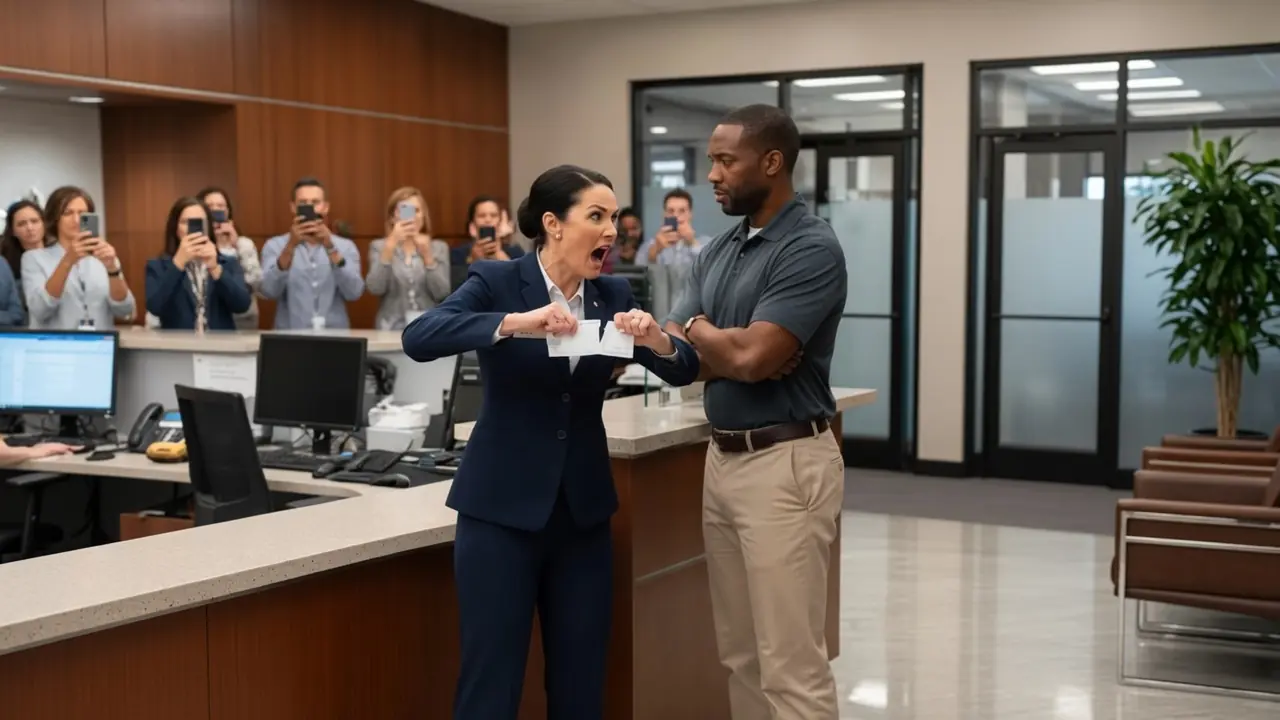
His father’s briefcase felt heavy in his hand.
Not because of the check.
Because of what the moment meant.
Brandon had grown up in West Philadelphia, where people had called his ambition cute before they called it dangerous. Teachers praised him when he was quiet, but acted surprised when he spoke with authority. Investors smiled through meetings while asking questions they never asked white founders with worse numbers. Clients loved his software, then asked whether someone else was “the real technical lead.”
He had learned to prepare.
He had learned to stay calm in rooms where anger would only become evidence against him.
First Heritage Bank was crowded when he walked inside. It was lunch rush, and the lobby hummed with footsteps, printer noise, low conversation, and the soft beeping of teller machines. Three teller windows were open, two customer desks were occupied, and a security guard stood near the entrance with one hand resting casually on his belt. A line of customers waited behind a rope barrier, moving forward one polite step at a time.
Brandon joined the line.
He was dressed neatly but not expensively: a dark polo shirt, tan slacks, brown shoes, and a watch Maya had given him for Father’s Day with her initials scratched on the back. He did not look like a man carrying ten million dollars. He looked like a man on a lunch break. That was not a crime, though by the time he reached the counter, Sarah Winters would treat it like one.
Her name badge said Branch Manager.
Sarah Winters looked to be in her early forties, with black hair pulled into a tight bun and a navy suit sharp enough to announce authority before she opened her mouth. She was not sitting behind a regular teller window. She stood near a service counter, helping a customer with account paperwork while glancing around the lobby like she owned every movement inside it.
When Brandon approached, she looked up.
“Good afternoon,” Brandon said. “I’d like to deposit this check.”
He removed the envelope from his briefcase and placed it on the counter.
Sarah opened it.
Her expression changed before she said a word.
It was small, but Brandon saw it clearly. Her eyes moved from the check to his face, then down to his clothes, then back to the check. The professional smile tightened at the corners. Her fingers stopped moving.
The check was real.
Ten million dollars.
Issued by Premier Logistics.
Made payable to Brandon Coleman.
Dated March 11.
Signed by the company’s chief financial officer.
Sarah lifted it slightly, as if holding it closer might reveal the lie she had already decided must exist.
“Where did you get this?” she asked.
Brandon kept his voice even.
“It’s payment from the acquisition of my company.”
Sarah blinked slowly.
“Your company?”
“Yes.”
“What kind of company?”
“Software.”
Her lips pressed together.
“I see.”
But she did not see.
That was the problem.
She had already looked at him and chosen a story before he offered the truth. Brandon recognized that look because it had followed him all his life. It was not confusion. It was accusation waiting for language.
“I have documentation,” Brandon said calmly, opening the briefcase.
Sarah raised one hand.
“Don’t start pulling things out.”
He paused.
“I’m trying to make verification easier.”
“This amount requires review.”
“I understand.”
“And we take fraud very seriously.”
Brandon looked at her.
“As you should.”
The customer behind him shifted impatiently. Someone else in line leaned sideways to see what was happening. Sarah’s voice had risen just enough to invite attention while pretending not to. Brandon felt the lobby begin to notice.
Sarah turned the check over, then back again.
“This branch cannot simply accept a check of this size without confirming legitimacy.”
“Then confirm it.”
Her eyes sharpened.
“Excuse me?”
“Confirm it,” Brandon repeated. “Call Premier Logistics. Call the issuing bank. Review the documents. That is why I came in person.”
For a moment, silence stretched between them.
Then Sarah gave a short laugh.
Not loud.
Not kind.
“A ten-million-dollar check,” she said, “from a software sale.”
“Yes.”
“And you expect me to believe you walked in here alone, dressed like that, carrying it in an old briefcase?”
The words were quiet enough to seem controlled, but loud enough for nearby people to hear.
Brandon’s jaw tightened.
“What I’m wearing doesn’t affect whether the check is valid.”
Sarah’s face hardened.
“Do not lecture me on banking procedure.”
“I’m asking you to follow it.”
That was when her control cracked.
Maybe it was his calm. Maybe it was the fact that he did not lower his eyes. Maybe it was because customers had begun watching and she needed to prove authority before the room could question hers. She picked up the check with both hands, holding it in front of him.
“This is unacceptable,” she snapped.
Then she tore it down the middle.
The sound was small.
Too small for what it did.
The lobby froze.
Sarah tore the check again, splitting the pieces in front of Brandon’s face as if destroying the paper could destroy the possibility that he belonged to it. Then she threw the torn pieces toward his chest. Some hit his shirt. Some fell to the floor. One piece landed beside his father’s briefcase.
“This is unacceptable,” she said again, louder now. “You cannot walk into my branch with a fake check and expect us to play along.”
Brandon did not move.
He looked down at the torn paper against his shoes.
Then he looked back at her.
“You destroyed a real check before verifying my name.”
Sarah’s cheeks flushed.
“Security.”
The young guard near the entrance stiffened.
Brandon turned his head slightly and saw the guard approaching. He was young, maybe twenty-three, with nervous eyes and a uniform that looked too new. His name badge said Tyler. He did not look eager. He looked trapped between a manager’s order and his own discomfort.
“Sir,” Tyler said carefully, “please step away from the counter.”
Brandon did not step back.
“I have done nothing wrong.”
Sarah pointed at him.
“He attempted to deposit a fraudulent check.”
“I attempted to deposit my own check.”
“You people always think yelling makes lies sound better.”
The lobby went very still.
A woman near the waiting area raised her phone higher.
A man in a gray suit looked down, pretending he had not heard.
Two tellers behind the glass exchanged frightened glances.
Brandon felt heat rise in his chest, but he held it down with both hands inside himself.
“My documents are in the briefcase,” he said. “Open them.”
Sarah’s mouth twisted.
“I don’t need to open anything.”
“Yes,” Brandon said quietly. “That has been obvious from the beginning.”
Tyler placed one uncertain hand near Brandon’s arm, not grabbing yet.
“Ma’am,” the guard said, glancing at Sarah, “maybe we should check his documents first.”
Sarah rounded on him.
“Are you questioning me?”
Tyler’s hand dropped.
“No, ma’am.”
“Then do your job.”
Brandon looked toward the security camera in the corner.
Then toward the phones now recording from three different angles.
Good, he thought.
Witnesses matter.
Sarah leaned over the counter, her voice sharp enough to cut through the lobby.
“You need to leave before I call the police.”
Brandon slowly bent down.
Tyler moved as if to stop him, but Brandon only picked up the torn pieces of the check from the floor. He gathered each one carefully, including the piece beside the briefcase. Then he placed them flat on the counter in front of Sarah.
“You will not touch me,” Brandon said.
The calm in his voice carried farther than shouting would have.
Sarah’s eyes flickered.
“I will have you removed.”
“You will try.”
Customers shifted again.
Someone whispered, “Oh my God.”
Sarah looked around and realized the room had changed. It was no longer fully with her. People were not laughing. They were watching. Recording. Waiting.
That seemed to make her angrier.
She snatched one of the torn pieces from the counter and waved it toward him.
“This is exactly why banks have fraud protections.”
Brandon looked at the paper in her hand.
“No,” he said. “This is exactly why people like me bring proof for things other people are allowed to simply own.”
The words landed hard.
Sarah opened her mouth to answer.
Then the front doors opened.
A tall man in a charcoal suit entered with a leather portfolio under one arm, speaking into a phone. He looked polished, hurried, and important in the effortless way senior executives often do. A teller near the far window saw him first and straightened immediately. Sarah turned, still furious, then froze.
“Mr. Whitaker,” she said.
The man lowered his phone.
His name was Daniel Whitaker, regional director for First Heritage Bank.
He had come for a scheduled branch review, which Sarah had forgotten in the rush of her own performance. He looked from her face to the crowd, then to Tyler, then to Brandon standing at the counter with torn check pieces spread before him. At first, he seemed confused.
Then he saw Brandon’s face.
All color drained from his.
“Mr. Coleman,” Daniel said.
The lobby froze harder than before.
Daniel stepped forward quickly, his phone still in his hand.
“Sir,” he said, voice tight with alarm, “what happened to your check?”
One word changed the room.
Sir.
Not suspect.
Not fraud.
Not problem.
Sir.
Sarah’s expression shifted from anger to confusion, then to something that looked like fear trying to disguise itself as professionalism. Brandon did not look away from her. He let the silence do the work.
Daniel reached the counter and stared at the torn pieces.
“What happened?” he asked again, this time lower.
Brandon folded his hands in front of him.
“Your branch manager tore up my ten-million-dollar check before making a single verification call.”
Daniel closed his eyes briefly.
Sarah spoke too fast.
“Mr. Whitaker, this customer presented an extremely suspicious instrument, and I followed—”
“You tore it?”
She stopped.
Daniel looked at her.
“Did you tear the check?”
Sarah swallowed.
“The amount was highly irregular.”
“That is not what I asked.”
Her voice dropped.
“Yes.”
Daniel turned toward Tyler.
“Was he aggressive?”
Tyler looked at Sarah, then at Brandon, then at the customers recording them.
“No, sir.”
“Did he refuse to provide identification?”
“No, sir. He said he had documents.”
Daniel’s jaw tightened.
Sarah’s face changed again.
Brandon reached down, opened the briefcase, and removed a folder. He placed it on the counter with deliberate care. The folder contained the acquisition agreement, company records, identification, tax documents, bank statements, and a printed confirmation letter from Premier Logistics. Daniel took the first page, read three lines, and looked like a man watching a disaster finish happening in slow motion.
“Mr. Coleman,” he said quietly, “I am deeply sorry.”
Brandon’s expression did not change.
“I did not come here for an apology. I came here to deposit a check.”
Daniel nodded immediately.
“Of course.”
Sarah whispered, “I had no way of knowing—”
Brandon turned to her.
“You had every way of knowing. You refused all of them.”
Nobody spoke.
Then an older woman seated near the waiting area said, “That’s true.”
Sarah looked at her in shock.
The woman lowered her phone only slightly.
“He told her to verify it. We all heard him.”
Another customer spoke from the line.
“She tore it before checking anything.”
A third said, “She called him a fraud.”
Daniel looked toward the customers, then back at Sarah.
His face had gone cold.
“Sarah,” he said, “step away from the counter.”
Her mouth opened.
“Mr. Whitaker—”
“Now.”
The branch manager who had spoken like the room belonged to her suddenly looked smaller than the counter she stood behind. She stepped back, hands trembling, eyes moving from Daniel to Brandon to the customers still recording. The torn check remained on the counter like evidence she could not sweep away. Daniel turned to Tyler.
“Please escort Ms. Winters to the conference room.”
Sarah flinched.
“Escort me?”
Daniel’s voice stayed controlled.
“Yes.”
Tyler hesitated only a second.
Then he stepped aside and gestured toward the hallway.
Sarah walked past Brandon without looking at him.
But Brandon looked at her.
Not with triumph.
Not with rage.
With the steady disappointment of a man who had expected better and prepared for worse.
After she disappeared behind the glass doors, the lobby exhaled.
Daniel turned back to Brandon.
“Sir, we will need to reissue the check through the issuing bank or process through alternative verification. We will handle every step.”
Brandon picked up the torn pieces.
“No.”
Daniel blinked.
“No?”
“I want everything documented first.”
“Of course.”
“I want the security footage preserved.”
“Yes.”
“I want the names of every employee involved.”
Daniel nodded.
“You will have them.”
“And I want my daughter to know,” Brandon said, his voice tightening for the first time, “that when her father walked into a bank with what he earned, he did not have to beg to be believed.”
Daniel looked down.
“I understand.”
“No,” Brandon said. “You don’t. But you can start by fixing what your branch allowed to happen.”
Daniel accepted that without defense.
That mattered.
The next fifty-two minutes moved like a public unraveling.
Daniel personally called the issuing bank. He called Premier Logistics. He verified the check number, signature authority, acquisition payment, and Brandon’s identity. He reviewed the documents in Brandon’s folder while two assistant managers stood nearby, pale and silent. Every confirmation came back clean.
Legitimate.
Verified.
Real.
Ten million dollars.
At one point, Daniel put the issuing bank representative on speaker in his office, and the words carried clearly enough for those near the door to hear.
“Yes, Mr. Coleman is the authorized payee.”
A teller covered her mouth.
Tyler stared at the floor.
Brandon sat across from Daniel with his father’s briefcase beside his chair.
His phone buzzed twice.
Maya had texted.
Did bank day happen yet?
Brandon stared at the message for a long moment.
Then he typed back.
Still happening, baby.
She replied with three thumbs-up emojis and a dog emoji.
He almost smiled.
Almost.
At 1:08 p.m., Daniel asked Brandon if he wanted to continue the deposit process with First Heritage Bank.
Brandon looked at him.
“Why would I?”
Daniel had no quick answer.
That was wise.
“I understand if you choose not to,” Daniel said.
“I built my company after years of people assuming I didn’t belong in rooms I entered,” Brandon said. “Today, your branch manager decided the same thing before she even read the name on the check.”
Daniel folded his hands.
“She will not continue in her position.”
“That is between you and your company.”
“It is also part of our accountability.”
“No,” Brandon said. “It is the beginning of accountability.”
Daniel nodded slowly.
“You’re right.”
Brandon leaned back in the chair.
“I want a written statement acknowledging what happened. I want confirmation that the footage is preserved. I want your corporate office notified before this video hits the internet, because it will. And I want First Heritage to explain why a verified business client was treated as a criminal for bringing in a check he earned.”
Daniel wrote every word down.
He did not interrupt.
Outside the office, the lobby remained unsettled. Customers whispered in clusters. A few left without finishing their transactions. Others stayed because they understood they had witnessed something that would not disappear when the doors closed. Sarah Winters sat in the conference room with the blinds half drawn, no longer shouting, no longer pointing, no longer in command of anything.
By mid-afternoon, the first video appeared online.
It showed Sarah tearing the check.
It showed the pieces hitting Brandon’s chest.
It captured her voice saying, “This is unacceptable.”
Then it captured Daniel Whitaker entering, stopping, and saying, “Mr. Coleman. Sir.”
That was the moment the internet seized.
Not because people loved irony, though they did.
Because the respect came too late.
The next morning, Brandon woke to seventeen missed calls.
Three were from First Heritage corporate headquarters.
Two were from Premier Logistics.
One was from a civil rights attorney a friend had referred before Brandon even asked.
The rest were reporters.
Maya sat at the kitchen counter eating cereal, watching him over the rim of her bowl.
“Daddy?”
“Yes?”
“Are you famous?”
“No.”
She considered that.
“Are you in trouble?”
“No.”
“Is the bank lady in trouble?”
Brandon sat across from her.
“Yes.”
“Because she tore your check?”
“Because she judged me before she knew me.”
Maya looked down at her cereal.
“Like when people think I’m not good at math before I answer?”
Brandon’s chest tightened.
“Yes,” he said softly. “Like that.”
Maya nodded with the seriousness of a child placing a new truth somewhere important.
“Did you let her make you small?”
Brandon thought of his father’s briefcase.
Then he smiled.
“No, baby.”
“Good.”
She went back to her cereal.
The formal statement from First Heritage came that afternoon.
It apologized to Brandon Coleman by name, confirmed that the incident violated bank policy and customer dignity standards, and announced Sarah Winters was no longer employed by the company. It also promised a review of branch training, escalation procedures, bias reporting, and executive oversight. The statement was polished, careful, and legal.
Brandon read it twice.
Then he placed it beside his father’s briefcase.
It was not justice.
Not fully.
But it was a record.
A week later, Brandon returned to banking business through a different institution, one that sent a senior officer to his office and treated him with the professionalism he should have received the first time. The ten-million-dollar payment was processed properly. Coleman Software’s acquisition closed completely. His employees received bonuses. His daughter got the house with the backyard three months later.
And yes.
Eventually, she got the dog.
But the story did not end with money.
It ended, in a way, at a community entrepreneurship event in West Philadelphia six months later. Brandon stood in front of a room full of young founders, students, and small business owners, many of them carrying the same look he once carried. Ambition mixed with caution. Hope guarded by experience.
He placed his father’s briefcase on the table beside the podium.
Then he told them what happened.
Not for sympathy.
For instruction.
“I brought every document because I knew what assumptions could do,” Brandon said. “But preparation did not stop disrespect from entering the room. What preparation did was keep me steady when disrespect tried to write the story for me.”
The room was silent.
He looked at the young faces watching him.
“Do not let anyone make you small,” he said. “Not with a look. Not with a title. Not with a torn piece of paper. If you built it, own it.”
Afterward, a teenage boy waited until most people had left.
He approached slowly, holding a notebook against his chest.
“Mr. Coleman?”
Brandon turned.
“Yes?”
The boy swallowed.
“I’m building an app.”
Brandon smiled.
“What does it do?”
The boy’s eyes lit up.
And Brandon listened.
Years later, people would still mention the video whenever Brandon’s name appeared in business articles. Some remembered the torn check. Some remembered Sarah Winters losing her career in real time. Some remembered the regional director saying “sir” and changing the temperature of an entire bank lobby with one word.
But Brandon remembered smaller things.
He remembered Maya’s burnt toast.
He remembered the weight of his father’s briefcase.
He remembered picking up the torn pieces from the floor without letting his hands shake.
And he remembered that dignity sometimes looks quiet to people who expect it to beg.
The bank manager had torn the check.
She had not torn what earned it.
She had not torn the company built at three in the morning, the contracts signed after years of rejection, the code written while Maya slept, or the promise Gerald Coleman had left behind in worn leather and simple words.
Don’t let anyone make you small.
Brandon didn’t.
And that was why, long after the paper was replaced and the money cleared, the real deposit he made that day was not ten million dollars.
It was proof.
Proof that a man could stand inside a room designed to doubt him and still refuse to shrink.
Proof that witnesses matter.
Proof that respect given too late can still expose the truth.
And proof that sometimes one word, spoken by the right person at the wrong moment, can reveal everything a room tried to hide.
Sir.