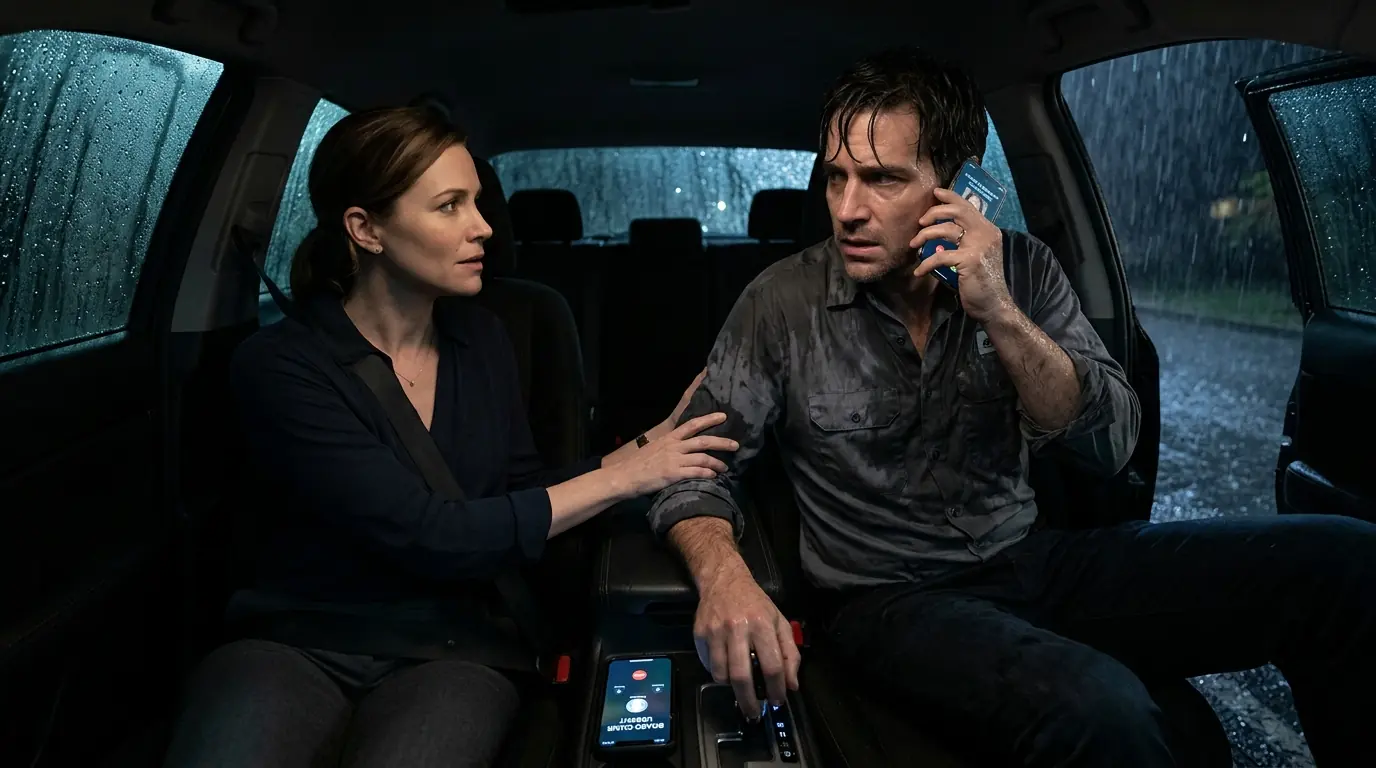
“Sir… this isn’t your Uber.”
The woman said it quietly.
By the time the words reached him, the soaked man had already pulled the passenger door shut.
Rain hammered downtown Chicago so hard that the windows looked covered in moving glass.
Jonah Pierce wiped water from his face with the sleeve of his work shirt and tried to catch his breath.
His blue uniform was stained from ten hours of electrical work.
His boots carried mud from a construction site.
His hair was dripping.
He looked exhausted.
But what Audrey Sinclair noticed first was his fear.
Not fear of the stranger sitting behind the steering wheel.
Fear of time.
“Lincoln Elementary,” Jonah said quickly. “Please. My daughter is at the nurse’s office.”
Audrey stared at him.
“I think you misunderstood—”
“She had trouble breathing.”
The words came out faster now.
“They called me twenty minutes ago. My truck died at the job site. I requested a car, and when I saw yours pull up…”
He looked at the dashboard for the first time.
No rideshare phone mount.
No driver identification.
No navigation screen showing a passenger route.
His face changed.
“Oh God.”
He reached for the door.
“I’m sorry. I’m so sorry. Wrong car.”
Audrey looked through the windshield.
Rain.
Gridlocked traffic.
The man beside her was already halfway out.
Then his phone rang.
The screen showed:
LINCOLN ELEMENTARY
Jonah froze.
He answered immediately.
“Hello?”
A woman spoke on the other end.
Jonah’s entire posture changed.
“How is she?”
He listened.
Then closed his eyes.
“Can I talk to her?”
A few seconds later his voice softened.
“Mia?”
Audrey looked away.
“I’m coming, sweetheart.”
Jonah spoke slowly now.
Carefully.
“Remember what we practiced. Breathe in through your nose. Slow.”
Pause.
“I know.”
Another pause.
“No, I didn’t forget.”
His voice almost broke.
“I told you I’d come.”
He swallowed.
“I always come.”
Audrey’s hand rested on the gear selector.
Her own phone lit up.
BOARD CHAIR
Then:
LEGAL
Then:
TESSA — OFFICE
She silenced all three.
Jonah ended the call.
He looked ashamed.
“I’m sorry.”
Audrey said nothing.
“I’ll get out.”
“Fasten your seat belt.”
Jonah stared at her.
“What?”
“Lincoln Elementary?”
“Yes.”
“Seat belt.”
He obeyed.
The black sedan pulled away from the curb.
Jonah blinked.
“You don’t have to do this.”
“No.”
Audrey merged into traffic.
“I don’t.”
For the first time since climbing into the car, Jonah looked directly at her.
“Thank you.”
Audrey nodded.
Then he added:
“I’ll still give you five stars.”
A laugh escaped her before she could stop it.
Jonah smiled weakly.
“That bad?”
“You climbed into a stranger’s car.”
“Technically you were parked where my ride was supposed to stop.”
“So this is my fault?”
“I’m under a lot of stress.”
“Clearly.”
For several blocks, neither spoke.
Jonah watched the traffic lights as though staring hard enough could turn them green.
At one intersection, he apologized for the mud on the floor mat.
Audrey glanced down.
“You have a sick daughter waiting for you and you’re worried about my floor?”
“I don’t like making my problems other people’s problems.”
Something about that sentence stayed with her.
“Is she okay?”
“Asthma.”
Jonah rubbed both hands over his face.
“Usually controlled. But cold weather, allergies, running too hard—sometimes it hits fast.”
“How old?”
“Eight.”
“And it’s just you?”
He looked at her.
“Me and Mia.”
Audrey heard the part he did not say.
No mother.
No one else heading toward the school.
“She counts on you.”
“Yeah.”
He smiled faintly.
“That’s the best part.”
“And the hardest?”
Jonah looked through the windshield.
“Same answer.”
Audrey Sinclair had spent the previous three hours in a boardroom thirty floors above the Chicago River.
Her company, Sinclair Transit Technologies, had completed the largest acquisition in its history that afternoon.
News outlets were waiting for a statement.
Investors wanted calls.
Senior executives wanted to celebrate.
Audrey had wanted ten quiet minutes.
She had left through a private garage alone rather than wait for her driver.
At thirty-eight, she was the founder and chief executive of a transportation-technology company worth more than a billion dollars.
She had spent fifteen years building systems that moved other people.
Public transit software.
Electric vehicle charging networks.
Fleet management.
Accessible transportation platforms.
Her days were full of motion.
She rarely felt as though she was going anywhere.
Most people around Audrey knew what she could do for them before they knew anything else about her.
Investors wanted returns.
Politicians wanted partnerships.
Executives wanted approval.
Reporters wanted quotes.
Men she dated eventually wanted access to the life surrounding her.
Nobody climbed into her car because they simply thought she was a driver.
Until Jonah Pierce.
He did not recognize her.
Did not know her company.
Did not care what her last name could open.
He wanted only one thing.
To reach his daughter.
Audrey found that strangely refreshing.
Lincoln Elementary appeared through the rain twelve minutes later.
Jonah leaned forward.
“There.”
Audrey pulled toward the curb.
Before the car had fully stopped, Jonah caught himself reaching for the handle.
“Sorry.”
Audrey smiled.
“Go.”
He opened the door.
Then stopped.
“I mean it.”
“What?”
“Thank you.”
He looked directly at her.
“I know you had somewhere to be.”
Audrey glanced at the dozens of missed notifications on her phone.
“Yes.”
Jonah misread the expression.
“I’m sorry.”
“No.”
She shook her head.
“I think I was exactly where I needed to be.”
He stared at her.
Then nodded.
“Thank you.”
Jonah ran into the rain.
Audrey remained parked.
A nurse opened the school doors.
An eight-year-old girl in a pink jacket rushed outside.
Jonah dropped to one knee.
Mia wrapped both arms around his neck.
Even through the rain, Audrey could see the relief in the child’s body.
“I knew you’d come,” Mia said.
Jonah hugged her.
“I told you.”
“I got scared.”
“I know.”
“You were late.”
“I know.”
“But you came.”
Jonah pulled back.
“I’ll always try.”
Mia nodded as if that answer meant more than a guarantee.
They walked toward Audrey’s car.
Jonah tapped lightly on the passenger window.
Audrey lowered it.
Mia leaned closer.
“Are you the lady who brought my dad?”
Audrey nodded.
“I am.”
“Thank you.”
“You’re welcome.”
Mia studied her for a second.
Then dug into her backpack.
She pulled out a small folded paper star decorated with blue marker lines.
Jonah looked confused.
“Mia?”
“My teacher says you should give people something nice when they help you.”
She extended the star through the window.
Audrey accepted it.
The paper was uneven.
One point was slightly bent.
“I made it at school.”
“It’s beautiful.”
“It’s supposed to remind you of something good.”
Audrey held it carefully.
“I’ll keep it.”
Jonah reached for his wallet.
“Please.”
He held out several bills.
Audrey shook her head.
“No.”
“You drove across downtown in a storm.”
“Buy her dinner.”
Jonah hesitated.
“I need to pay you something.”
Mia looked between them.
Audrey considered.
“One dollar.”
Jonah blinked.
“What?”
“One dollar.”
Mia immediately approved.
“That’s fair, Dad.”
Jonah laughed.
He found a one-dollar bill.
Audrey accepted it solemnly.
“There. We’re even.”
Mia smiled.
Jonah shook his head.
“You two would be dangerous together.”
He took Mia’s hand.
Audrey watched them walk toward an aging pickup truck parked beneath a tree.
Jonah tried the engine.
Nothing.
Again.
Nothing.
Audrey almost got out.
Then she saw Jonah laugh.
Not angrily.
Just tired.
Mia climbed beside him.
Through the open window Audrey heard her say:
“Bus?”
“Bus.”
“Grilled cheese?”
“Absolutely.”
They shared one umbrella and disappeared toward the corner.
Audrey remained in the car.
Her phone began ringing again.
She ignored it.
The paper star rested in her palm.
She slipped it inside the leather notebook where she normally kept acquisition notes.
That evening, the cheapest thing Audrey Sinclair carried home was the thing she handled most carefully.
The next morning, Audrey found writing inside one folded point.
Small blue letters.
THANK YOU FOR HELPING MY DAD KEEP HIS PROMISE.
She read it twice.
Then smiled.
Her executive assistant, Tessa Monroe, walked into the office.
She stopped.
“What?”
Audrey closed the notebook.
“Nothing.”
“You’re smiling.”
“I smile.”
“At earnings reports.”
“That still counts.”
“No. This one looks human.”
Audrey gave her a look.
Tessa placed a folder on the desk.
“What’s in the notebook?”
Audrey hesitated.
Then showed her the paper star.
Tessa stared.
“This is new.”
“A little girl gave it to me.”
“Why?”
Audrey told her.
The wrong car.
The rain.
The father.
The school.
The dollar.
Tessa listened.
When Audrey finished, she smiled.
“So a stranger mistook you for a rideshare driver, got into your car with muddy boots, made you ignore the board chairman, paid you one dollar and somehow improved your week?”
“Yes.”
Tessa nodded.
“Interesting management strategy.”
Jonah spent that morning repairing wiring in an apartment building on the north side.
During lunch, he sat on the back step of the service van and called Mia.
“How’s breathing?”
“Fine.”
“Inhaler with the nurse?”
“Yes.”
“Water?”
“Yes.”
“Lunch?”
“Dad.”
“What?”
“You ask too many questions.”
“Occupational hazard.”
“You fix wires.”
“I’m also a dad.”
Mia lowered her voice.
“I got one hundred on my spelling test.”
Jonah smiled.
“Knew you would.”
“And science fair is next Saturday.”
“I remember.”
“You promised we’d finish the volcano.”
“I remember every promise I make to you.”
Mia went quiet.
Then:
“Okay.”
That one word told Jonah everything.
She believed him.
For Jonah, that trust was sacred.
Mia’s mother, Lauren, had died when Mia was four.
A sudden brain aneurysm.
No warning.
No long goodbye.
One morning, Lauren was singing badly while making toast.
By evening, Jonah was sitting beside a hospital bed learning that his daughter would grow up without her.
Four years later, he still occasionally reached for his phone when something happened to tell Lauren.
Then remembered.
He never dated seriously after that.
Not because he had stopped wanting companionship.
Because every choice had a second consequence now.
Someone entering Jonah’s life also entered Mia’s.
And Mia had already lost one woman she loved.
He could not risk making another temporary person feel permanent.
That afternoon, Audrey discovered an old work glove beneath the passenger seat.
She stared at it longer than necessary.
Then looked up Jonah’s name.
She stopped herself before searching too far.
That felt invasive.
Instead, she checked the one thing he had mentioned.
He worked for Lakeshore Electrical Services.
Public business directory.
Nothing more.
She called the company.
“This is Audrey. One of your electricians left something in my car yesterday.”
The receptionist asked:
“Name?”
“Jonah Pierce.”
“Oh, Jonah. He’s out until six.”
“Could I drop it at the office?”
“You can, but he lives closer to your side of town if you’re downtown.”
Audrey wrote down the neighborhood.
Then immediately wondered what she was doing.
Returning a glove.
That was all.
She arrived near Jonah’s small brick house just after sunset.
She had no plan to knock.
She would leave the glove.
Drive away.
Instead, she saw him across the street kneeling beside an elderly neighbor’s porch.
Mia held a flashlight nearly half her size.
“Higher,” Jonah said.
“Like this?”
“Perfect.”
An older woman stood beside them.
“Jonah, please let me pay.”
“It’s a porch light, Mrs. Harris.”
“You worked all day.”
“And now I’m changing one light.”
“It isn’t one light. You replaced the fixture.”
“Save your money.”
The woman frowned.
“For what?”
“Groceries.”
Mia nodded seriously.
“Dad says food is more important than light.”
Jonah looked at her.
“I did not say that.”
“You kind of did.”
Mrs. Harris laughed.
Audrey remained inside the car.
She suddenly understood something.
The man from the rain had not behaved kindly because he was desperate.
This was simply how he moved through the world.
Jonah finished.
The porch light came on.
Mrs. Harris hugged him.
He looked embarrassed.
Mia looked proud.
Audrey reached for the door handle.
Then every light on the block went out.
Darkness swallowed the street.
Someone shouted.
A child began crying.
Jonah immediately turned.
“Mia.”
“I have the flashlight.”
“Good girl.”
Audrey stepped out.
“You always do this?”
Jonah looked toward her.
Surprise crossed his face.
“The Uber driver.”
Audrey laughed.
“I found your glove.”
She held it up.
Jonah smiled.
“You drove across the city for a glove?”
“It’s a very good glove.”
“It has a hole in it.”
“I was trying to be polite.”
Mia ran over.
“Star lady!”
Audrey knelt.
“Hello again.”
“You kept it?”
“It’s in my notebook.”
Mia seemed satisfied.
Across the street, a worried mother called out.
“Jonah! My son’s medication is in the refrigerator.”
Jonah immediately became serious.
“What kind?”
“Insulin.”
“Keep the refrigerator closed.”
He looked toward Audrey.
“Can you hold this?”
She accepted the flashlight.
For the next forty minutes, Audrey followed Jonah up and down the block.
He did not attempt to repair the utility company’s equipment himself.
He checked household panels.
Verified there was no immediate electrical hazard.
Helped an elderly couple start their backup generator outdoors safely.
Made sure the family with refrigerated medication had a backup cooler ready if power remained off.
Then he called the utility company and gave a detailed report about where he believed the failure occurred.
Audrey held tools.
The flashlight.
Once, Mia’s snack.
Nobody recognized Audrey.
Nobody asked what company she ran.
Nobody cared.
She was simply another person standing in the dark.
When the lights finally returned, children cheered.
Mia looked at Audrey.
“See?”
“What?”
“My dad fixes everything.”
Jonah shook his head.
“No, I don’t.”
Mia whispered:
“He says that too.”
Audrey smiled.
Over the next week, their lives overlapped more often.
Some of it happened naturally.
Some of it did not.
Audrey stopped pretending every visit was accidental by the third one.
Mia invited her to see the science-fair volcano.
Jonah showed Audrey how to tighten a loose battery terminal after hearing a clicking sound from her car.
Audrey learned Jonah made terrible coffee.
Jonah learned Audrey did not know how to use a basic socket wrench despite running a transportation company—though he still did not know that part.
“What do you do?” he asked one evening.
They sat at a picnic table while Mia painted cardboard.
Audrey hesitated.
“I work in transportation.”
Jonah nodded.
“That explains the nice car.”
“Does it?”
“Maybe.”
He did not ask further.
That made telling him harder.
Audrey told herself she would explain eventually.
Next visit.
After the science fair.
After the week calmed down.
There was always a later.
The problem with later was that trust continued growing while truth waited.
Mia’s science fair was Saturday.
Audrey arrived wearing jeans and a sweater.
No assistant.
No driver.
No one from the company.
Mia spotted her across the gym.
“You came!”
Audrey smiled.
“You invited me.”
“That doesn’t mean people always come.”
Jonah heard that.
Something flickered through his face.
Audrey understood immediately.
Mia had learned early that promises and arrival were not always the same thing.
She knelt.
“Well, I’m here.”
Mia’s volcano erupted perfectly.
Red foam poured down cardboard mountains.
She received applause.
Then immediately looked at Jonah.
He applauded harder than anybody.
Audrey watched him.
That expression on his face contained more pride than any corporate award she had ever received.
Afterward, they carried the project outside.
Jonah noticed the display boards.
“You know…”
Audrey looked at him.
“These appeared on our porch mysteriously.”
Mia smiled.
“Star lady.”
Audrey tried to look innocent.
Jonah laughed.
“You didn’t have to.”
“I know.”
“That sentence seems familiar.”
“I learned it from someone.”
He looked at her for a moment.
Longer than usual.
Then his work phone rang.
He answered.
“Yes.”
Pause.
“Monday?”
Another pause.
“I can do that.”
He hung up.
“Emergency commercial job.”
“Where?”
“Some transportation company downtown.”
He checked the message.
“Sinclair Transit Technologies.”
Audrey stopped breathing for one second.
Jonah did not notice.
“Big place?”
She looked at him.
“Yes.”
“Know it?”
“A little.”
Jonah smiled.
“Maybe I’ll finally see where people in transportation actually work.”
Audrey knew then.
Later had run out.
She should have told him.
She almost did.
But Mia called from the truck.
The moment slipped away.
And Audrey let it.
That choice would cost her.
Monday morning, Jonah parked his old service van beneath a sixty-story glass tower.
The lobby looked like a different world.
Stone floors.
Digital displays.
Security gates.
A giant suspended screen announcing:
SINCLAIR TRANSIT TECHNOLOGIES
NEXT GENERATION MOBILITY SUMMIT
Jonah checked in as a contractor.
An engineering supervisor brought him to a service corridor behind the main event hall.
“We’re getting voltage fluctuations during full-load testing.”
Jonah opened the electrical cabinet.
Twenty minutes later, he found the problem.
A connection in the secondary distribution system had been running hotter than normal.
Not failed.
Not yet.
But too close to the margin for the planned demonstration load.
Jonah documented everything.
“This needs reinforcement before they power every demonstration station.”
The engineering supervisor looked worried.
“The event starts in ninety minutes.”
“Then you have eighty-nine minutes.”
“You think it’s dangerous?”
“I think electricity doesn’t care what time the investors arrived.”
The man almost smiled.
Jonah continued.
“It might hold.”
“Might?”
“I don’t sign my name under might.”
The supervisor nodded.
“I’ll take it upstairs.”
Jonah packed some tools.
Then stepped into the central atrium looking for the service elevators.
That was when he saw her.
Forty feet tall.
Audrey.
On the screen.
Same eyes.
Same smile.
Different world.
Text appeared beside her photograph.
AUDREY SINCLAIR
FOUNDER & CHIEF EXECUTIVE OFFICER
Jonah stopped.
He read it again.
Audrey Sinclair.
Not Audrey who worked in transportation.
Audrey Sinclair.
The name on the building.
His mind replayed everything.
The black sedan.
The leather notebook.
The ignored calls.
The way she avoided questions about work.
The science fair supplies.
The expensive but understated clothes.
He felt foolish.
Then betrayed.
Not because she was rich.
Because she had watched him be honest while giving him only part of herself.
Applause came from the upper level.
Executives descended a sweeping staircase.
Audrey stood among them in a navy suit.
Jonah had never seen her like this.
Controlled.
Formal.
Untouchable.
Then she saw him.
Her expression changed instantly.
For one second she was simply Audrey again.
She stepped away from the group.
“Jonah.”
He did not answer.
A senior executive named Victor Langley followed her gaze.
Victor looked at Jonah’s uniform and tool bag.
“Can I help you?”
Jonah replied:
“I finished an electrical inspection. I was looking for the service elevator.”
Victor glanced toward Audrey.
Then back.
“Contractors normally remain in restricted service areas during executive events.”
Audrey’s jaw tightened.
“Victor.”
“What?”
“Stop.”
Jonah looked at her.
Victor understood something was happening.
Audrey walked closer.
“I was going to tell you.”
Jonah nodded slowly.
“I believe you.”
That somehow made it worse.
“When?”
She had no answer.
“Mia trusted you.”
“I know.”
“I trusted you.”
“I know.”
His voice remained quiet.
“I never asked what you earned.”
“I know.”
“I didn’t care where you worked.”
“I know.”
“So why did you think the truth would change how I treated you?”
Audrey looked down.
“Because it usually does.”
Jonah absorbed that.
Then said:
“I’m sorry people taught you that.”
Her eyes lifted.
“But I didn’t.”
Silence.
He picked up his bag.
“I have to go.”
“Jonah.”
He stopped.
“I’m not angry that you’re Audrey Sinclair.”
His voice softened.
“I’m disappointed that the woman I knew didn’t trust me enough to be Audrey Sinclair.”
Then he left.
No shouting.
No scene.
That made it hurt more.
An hour later, the executive demonstration was supposed to begin.
It did not.
The electrical systems began showing instability during final testing.
The engineering supervisor brought Jonah’s report to Victor.
Victor barely read it.
“We cannot delay.”
“He recommended reinforcement.”
“He’s a contract electrician.”
“He’s the electrician we called because our own maintenance team couldn’t isolate the fluctuation.”
Victor lowered his voice.
“We have international partners in that room.”
The supervisor hesitated.
“What happens if the connection fails under full load?”
“Does it definitely fail?”
“No.”
“Then proceed.”
Audrey entered.
“What are we proceeding with?”
Victor turned.
“Nothing.”
She saw the paper.
“What is that?”
“Maintenance note.”
Audrey took it.
Jonah’s handwriting.
Clear.
Precise.
Recommend full shutdown of secondary distribution branch until terminal connection is reinforced and thermal readings stabilize under projected demonstration load.
Audrey read it twice.
“Was this done?”
The supervisor shook his head.
“No.”
“Why?”
Victor answered.
“Because delaying the summit would be disproportionate to the risk.”
Audrey looked at him.
“Did the electrician say the risk was insignificant?”
“No.”
“Did engineering?”
“No.”
“Then whose technical judgment are you using?”
Victor became irritated.
“Audrey, we have hundreds of people waiting.”
She looked toward the event hall.
Then at Jonah’s report.
She remembered him in the blackout.
Do not guess around electricity.
Do not make people feel safe by lying.
Fix what is actually wrong.
Audrey closed the folder.
“Delay the event.”
Victor stared.
“What?”
“Shut the section down.”
“You realize what this will cost.”
“Yes.”
“Investors flew from Europe.”
“Yes.”
“We may lose half the day.”
“Then we lose half the day.”
“Audrey—”
She looked directly at him.
“We are not putting schedule above a documented safety concern because the person who wrote the warning carried a tool bag instead of a title.”
Victor went silent.
“Shut it down.”
The repairs required nearly two hours.
Jonah was already several miles away when Lakeshore Electrical called.
He almost refused to return.
Then his supervisor explained.
“They repaired it according to your recommendations. Sinclair wants you to inspect the final work because your name is on the original report.”
Jonah stared at the road.
“Sinclair personally?”
“Apparently.”
He sighed.
“This day is getting weird.”
He returned.
Audrey waited near the service corridor.
Alone.
No executives.
No performance.
Jonah approached.
“You didn’t need to wait.”
“Yes.”
He looked toward the panel.
“Let me inspect it.”
That was all.
He worked.
Audrey stayed nearby but did not interfere.
Jonah checked each termination.
Thermal readings.
Load.
Backup transfer.
One connection needed additional reinforcement.
He explained why.
The maintenance team corrected it.
Final testing passed.
Jonah packed his tools.
Audrey said:
“You were right.”
“About the wiring?”
“Yes.”
“That’s what you hired me for.”
“And about me.”
He stopped.
Audrey continued.
“I thought hiding part of my life would let me know whether you liked me without everything attached to my name.”
Jonah listened.
“But that meant I decided you weren’t trustworthy before you had a chance to prove otherwise.”
“Yes.”
“I’m sorry.”
He looked at her.
“I believe you.”
Audrey waited.
“But believing you’re sorry doesn’t make the problem disappear.”
“I know.”
Jonah nodded.
That answer helped.
She did not ask forgiveness.
Did not offer him money.
Did not offer him a job.
Did not promise some grand gesture.
She simply said:
“I’ll give you space.”
“Thank you.”
He left.
This time Audrey did not follow.
Weeks passed.
Mia asked about Audrey twice.
Jonah did not lie.
“She has a lot going on.”
“Did you fight?”
“No.”
“Are you sure?”
“Yes.”
Mia frowned.
“You look like when you say a car repair is simple but then you watch a twenty-minute video.”
Jonah laughed despite himself.
“You’re eight.”
“I know.”
He missed Audrey.
That was the problem.
He missed the person he knew before the screen.
The woman holding a flashlight in the blackout.
The woman laughing at the volcano.
The woman who accepted one dollar.
But now those memories came with questions.
Had any of it been real?
He knew the answer.
Yes.
That made it harder.
Audrey did not return to Jonah’s neighborhood.
She wanted to.
Every day.
Instead, she made smaller changes in places Jonah would never see.
At work, she began asking executives questions she had avoided before.
Why had Victor dismissed the electrician’s warning?
Why were contractors spoken about as though expertise disappeared with a uniform?
Why had employees been afraid to challenge the schedule?
Victor had not broken a law.
He had made a judgment.
A bad one.
But during the internal review, other employees described a pattern.
Deadlines over safety.
Status over expertise.
Confidence rewarded more than caution.
Victor eventually stepped out of operations after the board restructured the division.
Audrey did not consider that justice for Jonah.
It had nothing to do with Jonah personally.
It was a business problem Jonah happened to expose.
More importantly, Audrey changed herself.
She stopped using secrecy as a test.
Stopped treating anonymity as proof of authenticity.
You could not ask people to love the real you while hiding the real you from them.
That was not fairness.
It was control.
Tessa told her that.
Less gently.
“You built an experiment.”
Audrey frowned.
“I did not.”
“You wanted to see whether he liked ordinary Audrey.”
“There is no ordinary Audrey.”
“Exactly.”
Tessa leaned across the desk.
“You don’t get to divide yourself into acceptable pieces and then get upset when people don’t know the whole person.”
Audrey looked at the paper star.
“I know.”
“Good.”
One Saturday afternoon, Jonah and Mia volunteered at a neighborhood community garden.
Mia painted signs.
Jonah repaired a broken outlet near the pavilion.
Children ran through the grass.
Older neighbors planted flowers.
Nobody rushed.
It was an ordinary day.
A black sedan pulled into the lot.
Jonah noticed immediately.
Mia noticed faster.
“Audrey!”
Jonah looked at his daughter.
Mia was already running.
Audrey stepped out.
Jeans.
Gray sweater.
Sneakers.
No notebook this time.
Just a paper bag.
And the blue paper star.
Mia stopped in front of her.
“You kept it.”
Audrey knelt.
“Every day.”
Mia hugged her before Jonah could prepare himself.
Audrey closed her eyes.
When Mia let go, Audrey stood.
Jonah approached.
“Hi.”
“Hi.”
Neither knew what came next.
Audrey held up the bag.
“I brought lunch.”
Jonah looked inside.
Three grilled-cheese sandwiches from the diner near Mia’s school.
Mia gasped.
“My favorite.”
“I remembered.”
Mia took the bag.
“I’m going to show Mrs. Harris.”
Jonah opened his mouth.
Too late.
Mia ran away.
Audrey and Jonah were left standing beside the garden.
“I didn’t come to ask you for anything,” she said.
“All right.”
“I came because the last time I was here, I was hiding.”
Jonah waited.
Audrey unfolded the paper star.
“Your daughter wrote this before she knew who I was.”
Jonah read the familiar message.
Thank you for helping my dad keep his promise.
Audrey continued.
“She trusted me because of what I did.”
“Yes.”
“And then I gave both of you less honesty than you gave me.”
Jonah looked toward Mia.
Audrey’s voice softened.
“I was afraid if you knew about the company, you would see the company every time you looked at me.”
“Maybe I would have.”
She nodded.
“That was your choice to make.”
Jonah looked back at her.
“Exactly.”
“I know that now.”
Silence.
Then Jonah asked:
“Why did you really drive me that night?”
Audrey thought.
“Because you looked terrified.”
He smiled faintly.
“I was.”
“You weren’t scared for yourself.”
“No.”
“You kept apologizing for the floor mats while your daughter was having trouble breathing.”
“That sounds stupid.”
“It was a little stupid.”
He laughed.
Audrey continued.
“I spend my life around people trying to be impressive.”
She looked toward Mia.
“You were trying to keep a promise.”
“That felt more important.”
Jonah studied her.
“Was any of it fake?”
“No.”
“The blackout?”
“No.”
“Science fair?”
“No.”
“The display boards?”
Audrey winced.
“That was me.”
“I knew it.”
“Mia knew it.”
“She usually does.”
For the first time in weeks, the tension between them softened.
Audrey took a breath.
“I don’t expect you to trust me because I apologized.”
“Good.”
“I’m asking whether I can earn it again.”
Jonah looked at her.
Not as a CEO.
Not as the woman from the forty-foot screen.
The woman who had driven a stranger across Chicago in a storm.
The woman who remembered grilled cheese.
The woman who had made a mistake and returned without money, lawyers, or excuses.
Jonah finally said:
“Trust is usually boring.”
Audrey raised an eyebrow.
“Boring?”
“It’s showing up.”
He looked toward Mia.
“When you said you would.”
Audrey nodded.
“I can do boring.”
“You run a billion-dollar company.”
“I’m excellent at boring.”
Jonah smiled.
Then pointed toward the picnic tables.
“Come eat.”
Audrey’s eyes filled slightly.
“That’s it?”
“That’s lunch.”
“Jonah.”
He stopped.
“This is not forgiveness.”
“I know.”
“It is a sandwich.”
She smiled.
“I’ll take the sandwich.”
Audrey came back the next Saturday.
Then another.
No excuses.
She showed up.
Sometimes Jonah invited her.
Sometimes Mia did.
Sometimes nobody planned anything.
They cooked.
Walked through the park.
Finished homework.
Audrey learned Mia hated peas and loved astronomy.
Jonah learned Audrey woke at five even on Sundays.
Mia learned wealthy CEOs could be terrible at braiding hair.
Audrey learned Jonah still spoke to Lauren sometimes when he was alone.
He told her that one night.
They sat on the porch after Mia went to bed.
“You think that’s strange?” he asked.
“No.”
“I know she’s gone.”
“I know.”
“Sometimes I tell her things anyway.”
“What do you tell her?”
Jonah looked toward the window.
“Mostly about Mia.”
Audrey waited.
“And lately?”
He looked at her.
“Other things.”
Her breath caught.
Jonah smiled slightly.
“I was scared of this.”
“Me?”
“Wanting somebody here.”
Audrey became quiet.
“Because wanting someone means Mia might want them too.”
“Yes.”
“And people leave.”
“Yes.”
Audrey did not say she would never leave.
That promise would have been too easy.
Instead she said:
“I can’t promise life won’t change.”
Jonah listened.
“I can promise I won’t disappear because things stop being interesting.”
That was the right answer.
He took her hand.
A year later, Mia found the one-dollar bill.
Audrey had framed it.
It sat in her home office beside the paper star.
Mia stared at the frame.
“You kept the dollar too?”
“It was my first rideshare payment.”
“You are not a rideshare driver.”
“I was for twelve minutes.”
Jonah stood in the doorway.
“You were severely underpaid.”
Audrey looked at him.
“Your customer service rating was excellent.”
Mia laughed.
Life did not transform into perfection.
Audrey still traveled.
Jonah still worked long days.
Mia still had asthma attacks sometimes.
Schedules conflicted.
Audrey missed one school event and cried harder about it than Mia did.
Jonah occasionally felt uncomfortable in Audrey’s corporate world.
Audrey occasionally found Jonah’s refusal to accept help maddening.
They argued.
Apologized.
Adjusted.
Stayed.
That was the important part.
Two years after the storm, Mia came home carrying another folded star.
Audrey looked suspicious.
“What is that?”
“Different one.”
“For what?”
Mia placed it in Jonah’s hand.
Then another in Audrey’s.
“What do these say?”
“Open them.”
Jonah unfolded his.
THANK YOU FOR ALWAYS COMING.
Audrey opened hers.
THANK YOU FOR STAYING.
Neither spoke.
Mia looked between them.
“Why are adults always crying when I give them paper?”
Jonah laughed and pulled her into a hug.
Audrey joined them.
Years earlier, she had believed the most valuable things in her life were difficult to acquire.
Companies.
Deals.
Influence.
Scale.
She had been wrong.
The thing that changed her life had cost one dollar.
A soaked electrician had climbed into the wrong car.
He had asked for nothing except a ride to his daughter.
She had driven him because, for once, there was no strategy behind the decision.
No acquisition.
No return.
No publicity.
Just a man trying to keep a promise.
And perhaps that was why it became the beginning of something real.
Not because a wealthy woman met a working father.
Not because two different worlds collided.
But because on one rainy Chicago evening, two strangers briefly stopped asking what the other person could offer them.
Jonah needed a ride.
Audrey gave one.
Mia gave her a paper star.
And from those small things came the kind of life Audrey had spent years being too busy to notice.
A life built not from grand gestures, but from ordinary proof.
Coming when you said you would.
Telling the truth even when it might change how someone sees you.
Fixing what you can.
Apologizing for what you cannot undo.
And staying long enough for another person to believe you mean it.
Years later, whenever someone asked Audrey Sinclair how she met Jonah Pierce, she never mentioned the company headquarters.
Or the product launch.
Or the electrical failure.
Or the giant screen that revealed who she was.
She smiled and gave the simpler answer.
“He thought I was his Uber.”
Usually people laughed.
Then Jonah would add:
“She charged me a dollar.”
And Mia, no matter how old she became, always corrected both of them.
“No.”
She would smile.
“It started because Dad promised he would come.”
And in the end, that was the truest version.
Because the wrong car had only brought them together.
The promise was what carried them home.