People started laughing before Eli Carter even opened his toolbox.
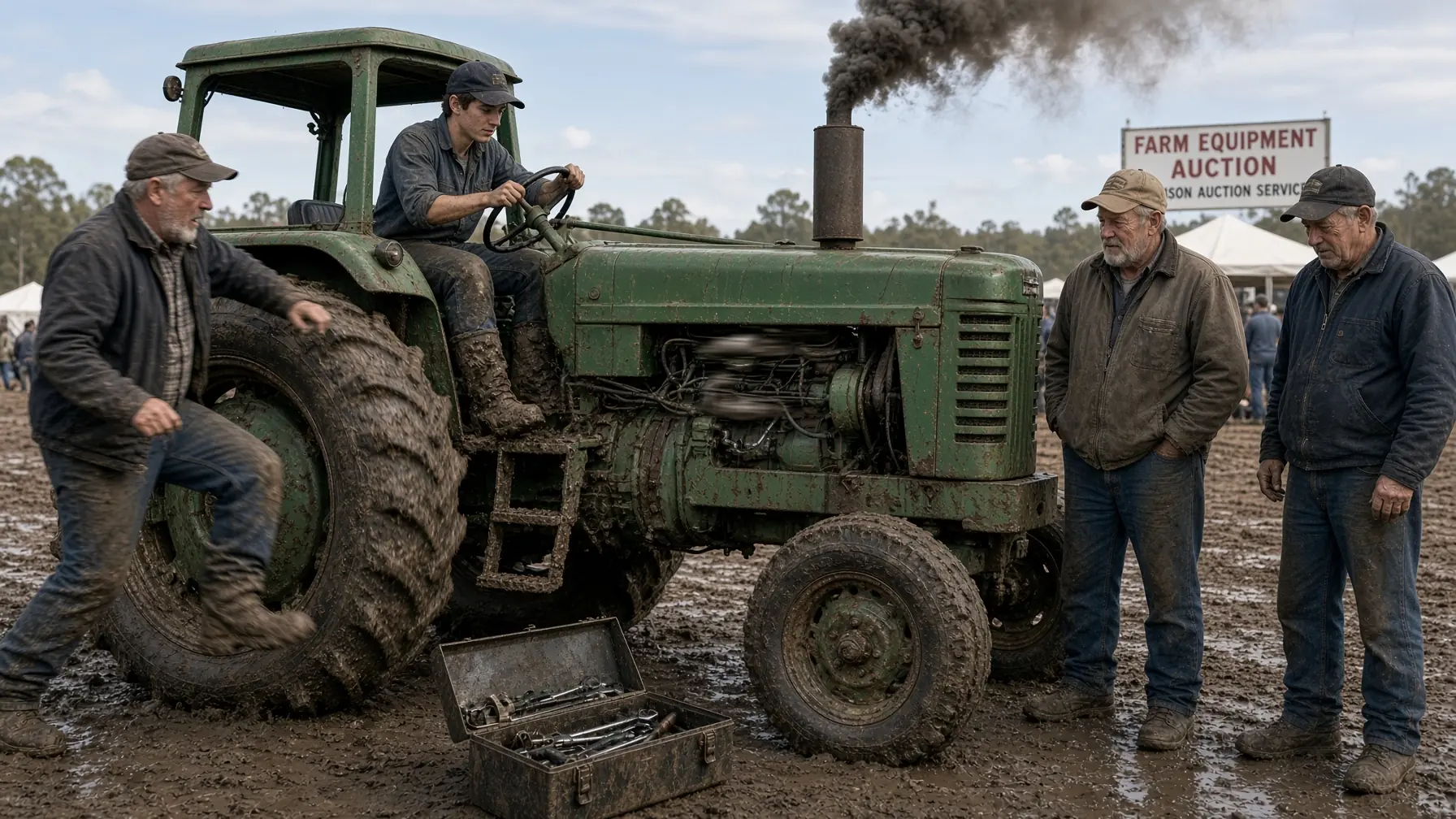
The old tractor sat in the middle of Harrison Equipment’s auction yard beneath a pale October sky, surrounded by rows of combines, hay rakes, planters, and battered pickups waiting for new owners.
It was hard to blame anyone for laughing.
The tractor looked finished.
Its green paint had faded almost gray along the hood. Rust spread around the wheel wells. One headlight hung crooked. Oil and dirt had hardened into a black crust around the engine block. The rear tires were cracked deeply enough that weeds had once grown between the treads.
And according to Robert Harrison, the man who had owned the dealership for nearly forty years, the tractor’s problems went much deeper than appearance.
Harrison stood beside it with his arms folded.
“Engine’s locked,” he announced to a cluster of farmers.
He tapped the transmission housing with the toe of his boot.
“Transmission may be gone too. Fuel system’s a mess. Electrical is worse.”
Someone asked whether he had tried repairing it.
Harrison gave a dry laugh.
“Three mechanics have looked at it.”
He held up three fingers.
“Three.”
A farmer near the back whistled.
“What’d they say?”
“First one said rebuild. Second said replace the engine. Third told me to sell it for parts.”
Another man laughed.
“So that’s what we’re bidding on?”
“Mostly iron.”
The crowd chuckled.
Then a voice came from the edge.
“Can I look at it?”
Heads turned.
That was when they saw Eli.
Sixteen years old.
Thin enough that the oversized work jacket hung loosely from his shoulders.
Faded jeans.
Mud-stained boots.
And a navy-blue baseball cap so worn that the original logo on the front had almost disappeared.
He carried a small metal toolbox in one hand.
Someone laughed.
Not maliciously at first.
Just surprised.
A farmer called out:
“Kid, the professionals already buried that thing.”
Another added:
“You fixing tractors for science class now?”
More laughter.
Eli did not react.
He looked only at Harrison.
“Can I?”
Robert Harrison studied him.
There was something oddly familiar about the boy, though he couldn’t place it.
Maybe the eyes.
Maybe the way he stood.
But Harrison had seen thousands of young farm kids in his life.
He pushed the feeling away.
“You can look,” he said. “Just don’t hurt yourself.”
Eli nodded.
Set down the toolbox.
Then knelt beside the tractor.
And did something nobody expected.
He didn’t immediately grab a wrench.
He listened.
Ash Creek had been built around farming long before anyone bothered giving the town a name.
The grain elevator stood beside the railroad.
The school calendar still quietly accommodated harvest.
Every diner conversation eventually became weather, machinery, cattle prices, or somebody’s broken auger.
For most families there, farming was not a career choice.
It was something inherited along with old land surveys, medical bills, family arguments, and machinery that nobody could quite afford to replace.
The Carter farm was one of the smaller operations.
Eighty-seven acres.
Corn and soybeans.
A few cattle.
A garden Eli’s mother insisted was “for groceries” even though she gave half the vegetables away every summer.
It had once been larger.
Before the debt.
Before Daniel Carter disappeared.
Eli had been eight years old when his father left.
That was how everyone said it.
Left.
Not died.
Not abandoned them.
Not exactly.
Just disappeared from Ash Creek.
Daniel had been known throughout the county as a gifted diesel mechanic. Farmers called him when engines made noises no one else understood.
He rarely began by taking anything apart.
First he listened.
That was what Eli remembered best.
His father standing beside a tractor with one hand resting against the hood, head tilted slightly.
Sometimes he closed his eyes.
Eli used to think it looked ridiculous.
One evening when he was six, he asked:
“Why don’t you just open it?”
Daniel smiled.
“Because machines tell you things before you open them.”
“They don’t talk.”
“Not with words.”
Daniel tapped the side of the engine.
“Everything moving makes a pattern. Everything failing changes the pattern.”
Eli stared seriously at the tractor.
“What if I can’t hear it?”
“You will.”
“When?”
“When you stop trying so hard to hear what you expect.”
Eli did not understand.
Not then.
Two years later, Daniel was gone.
There had been arguments before it happened.
Adult arguments.
Quiet ones in the kitchen after Eli was supposed to be asleep.
His father worked at Harrison Equipment then.
Robert Harrison had not owned the dealership yet. His older brother, Frank, controlled most of the business decisions.
Daniel believed the shop was charging struggling farmers for repairs they did not always need.
Sometimes complete replacements when a component could have been rebuilt.
Sometimes labor Daniel thought excessive.
Eli understood none of it as a child.
All he knew was that his father came home angrier every month.
Then one morning Daniel packed a duffel bag.
He knelt beside Eli’s bed.
Placed the faded navy cap on the boy’s head.
“It’s too big,” Eli said.
Daniel smiled.
“You’ll grow.”
“Where are you going?”
“To find work.”
“When are you coming back?”
Daniel hesitated.
That hesitation stayed with Eli longer than the answer.
“When I can.”
He hugged his son.
Then left.
At first letters came.
Kansas.
Then Nebraska.
Then somewhere in Wyoming.
Daniel sent money when he could.
He wrote about repair jobs.
Old combines.
Truck engines.
Cold mornings.
Then the letters stopped.
No explanation.
Eli’s mother, Sarah, tried every phone number they had.
Nothing.
Eventually, people began making assumptions.
Some believed Daniel had started another life.
Some thought he had died somewhere no one knew to look.