“Are you going to leave too?”
The question stopped everyone at the kitchen table.
Seven-year-old Sophie Carter still held a forkful of blueberry pancake in front of her mouth. Syrup slid slowly down one side and fell onto the plate, but she did not notice.
Across from her, Claire Whitmore went completely still.
Ethan Carter stood beside the stove holding a coffee pot.
Morning sunlight entered through the narrow apartment windows, touching the mismatched chairs, the stack of unopened mail beside the toaster, and the row of colorful drawings taped above the radiator.
It was not a wealthy room.
Nothing matched.
The cabinet beneath the sink refused to close unless kicked near the bottom hinge. One kitchen light had burned out two weeks earlier, and Ethan had not yet found time to replace it.
Yet Claire had begun thinking of the apartment as the safest place she knew.
Until Sophie asked the question.
“Why would you think I’m leaving?” Claire said carefully.
Sophie lowered her fork.
“Because grown-ups leave when things get hard.”
Ethan set the coffee pot down.
“Sophie.”
“It’s true.”
The girl’s voice was not angry.
That made it worse.
Her mother had left when Sophie was three. She remembered very little clearly, but children did not need complete memories to carry abandonment. They carried the empty chair, the missing voice, and the way other adults changed the subject whenever they asked why.
Claire looked toward Ethan.
He did not rescue her from the question.
That was one of the reasons she loved him.
He would protect her from danger, cruelty, humiliation, and anyone attempting to take away her choices.
He would not protect her from honesty.
Claire returned her attention to Sophie.
“I don’t plan to leave.”
“Mom didn’t plan to either.”
Ethan closed his eyes briefly.
“Sophie, that’s enough.”
“No,” Claire said softly. “It’s all right.”
She folded her hands on the table.
“I can’t promise that nothing difficult will ever happen.”
Sophie watched her.
“I can promise that I won’t disappear because I’m scared.”
“Adults lie about promises.”
“Sometimes.”
“Dad doesn’t.”
Claire looked toward Ethan.
He had spent four years believing he was failing his daughter in a hundred invisible ways. Yet in Sophie’s mind, his word remained the safest object in the world.
Claire felt something tighten inside her chest.
“Then I’ll make the promise in front of him,” she said. “And you can both hold me to it.”
Sophie considered that.
“Even when I’m annoying?”
“You are frequently annoying.”
Ethan coughed to hide a laugh.
Sophie narrowed her eyes.
“Dad says I’m curious.”
“Your father is diplomatic.”
“What does that mean?”
“It means he finds kind words for difficult truths.”
Sophie looked satisfied.
“Okay.”
Then she ate the pancake.
The crisis had apparently ended.
Claire remained still.
Ethan brought the coffee pot to the table and filled her cup.
“You all right?” he asked quietly.
“No.”
“Good answer.”
She looked up.
He smiled faintly.
“You’re learning.”
Claire had once controlled meetings involving billions of dollars without allowing anyone to see uncertainty in her face.
Now a seven-year-old with syrup on her chin could expose every fear she possessed with one question.
A year earlier, Claire would have considered that weakness.
Now she understood it differently.
Being loved did not make her less powerful.
It simply gave her something worth losing.
Sophie slid a badly folded piece of paper across the table.
“I made this.”
Claire opened it.
Three stick figures stood beneath a blue square meant to represent an apartment building. One had long dark hair. One wore a gray jacket. The smallest figure held both their hands.
Above them, Sophie had written:
OUR FAMILY, MAYBE.
Claire stared at the word maybe.
“Why maybe?”
“Because you haven’t decided yet.”
Claire looked toward Ethan.
He did not speak.
The decision had to belong to her.
It always did.
Claire folded the drawing carefully.
“I decided a while ago.”
Sophie brightened.
“Really?”
“Yes.”
“Then can I cross out maybe?”
Claire reached for a blue crayon.
“No.”
Sophie frowned.
“Why?”
“Because I want to keep the exact moment you were brave enough to ask.”
She placed the drawing beside her coffee.
One year earlier, Claire Whitmore had stood outside the Arcadia Hotel believing no one had noticed she was in trouble.
She was wrong.
One man had noticed.
He almost kept walking.
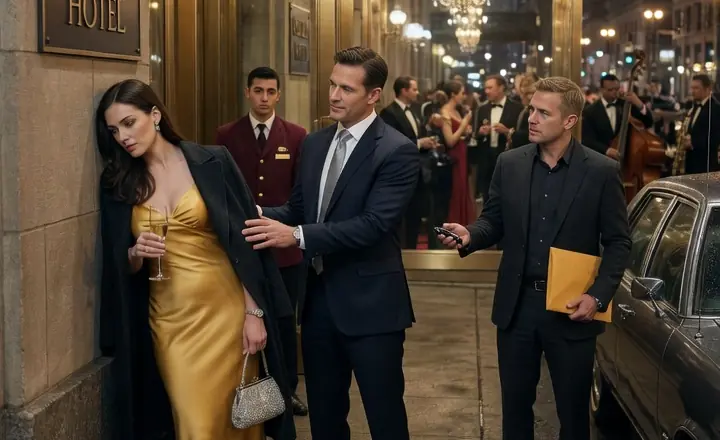
The champagne glass slipped from Claire’s hand at exactly 11:47 p.m.
It struck the pavement near her silver heels and broke into three clean pieces.
The sound was strangely small.
There was no dramatic crash.
No sudden silence from the charity gala inside the hotel.
No musician missing a note beneath the chandeliers.
The glass simply broke while Claire pressed one palm against the cold stone wall and tried to remain standing.
She was thirty-one years old and controlled one of the largest private development firms in Chicago.
Whitmore Urban Partners held interests in hotels, office towers, residential projects, hospitals, public transportation hubs, and entire blocks of property along the river.
Business magazines called Claire relentless.
Investors called her disciplined.
Employees rarely used any description when she was close enough to hear them.
She never stumbled in public.
She never raised her voice during negotiations.
She had trained herself not to cry before other people after her mother died when she was eight.
But that night, outside the Arcadia Hotel, the stone beneath Claire’s hand seemed to shift.
She had eaten almost nothing.
She had slept perhaps twelve hours across four nights.
Her father called that morning to remind her that she was divorced, thirty-one, and rapidly becoming the sort of woman who would reach forty with impressive buildings and no actual life.
Then she attended a children’s hospital gala where hundreds of people wanted photographs, promises, introductions, donations, and access.
Claire drank two glasses of champagne.
Then a third.
That was enough to make exhaustion visible.
It was also enough for Adrian Vale to follow her outside.
Adrian was forty-six, wealthy, polished, and connected to nearly every circle Claire had spent her adult life navigating.
He controlled Vale Capital Network, an investment group tied to banks, developers, political donors, judges, and media executives.
Two years earlier, he attempted to pressure Claire into approving a joint waterfront deal designed to place most of the risk on her company while giving him control over the financing.
She refused.
Adrian had not forgiven her.
He began describing her privately as unstable, volatile, and impossible to work with.
The words were chosen carefully.
An aggressive man was decisive.
An aggressive woman was unbalanced.
Adrian understood the difference and used it.
Now he stepped closer as Claire fought to remain upright.
“You need air,” he said.
“I have air.”
“You need somewhere quiet.”
“I’m going home.”
His hand closed lightly around her arm.
“My car is around the corner.”
“No.”
“Claire.”
She tried to pull away.
The motion nearly cost her balance.
Adrian tightened his grip.
“Don’t create a scene. I’m helping you.”
Across the valet lane, Ethan Carter saw everything.
He stood beside an old gray sedan with a sealed legal envelope beneath one arm and his keys in the other hand.
He was thirty-six, exhausted, and already calculating how much the babysitter would cost if he reached home after midnight.
Ethan owned Carter Rapid Logistics, a small courier company handling legal filings, medical records, contracts, and emergency deliveries around Chicago.
The company occupied two rooms above a dry cleaner.
Its largest vehicle had 190,000 miles.
Its office printer jammed whenever the weather became humid.
But clients trusted Ethan because documents arrived where he promised, when he promised, in the condition he promised.
Reliability had kept Sophie fed after his wife left.
It had also left him with almost no time, money, or emotional space to spare.
That night, he had collected a signed contract from the Arcadia concierge for a law firm client.
He wanted only to drive home.
Then Claire’s glass fell.
Ethan noticed the man before he understood anything about the woman.
Adrian stood too close.
His hand held her arm with the false gentleness of someone hoping witnesses would misread control as concern.
Claire’s body leaned away even while she tried not to draw attention.
Ethan had seen that posture before.
In parking lots.
Outside restaurants.
At company events where men believed expensive clothes made coercion look respectable.
He looked toward his car.
Sophie was asleep at home.
The babysitter charged extra after midnight.
Ethan had two medical deliveries scheduled before nine the next morning.
Claire was a stranger.
There were hotel employees nearby.
Surely someone else would intervene.
No one did.
A valet looked over, then returned his attention to a luxury sedan.
A doorman shifted uncertainly but remained beneath the awning.
Guests passed through the revolving doors without slowing.
Ethan thought about Sophie.
One day, she would be old enough to go places without him.
She might stand outside a building frightened and trying not to show it.
He wanted the world to contain at least one person who stopped.
So he stopped.
Ethan crossed the valet lane at a controlled pace.
Running would create alarm.
Claire already looked as though every eye on her felt dangerous.
“Excuse me,” he said.
Adrian turned.
His irritation appeared immediately.
“Yes?”
Ethan ignored him.
“Ms. Whitmore, your driver asked me to see whether you still wanted the car brought around.”
Claire’s eyes took a moment to focus.
Confusion appeared first.
Then understanding.
“Yes,” she said. “The car.”
Adrian frowned.
“What driver?”
Ethan remained focused on Claire.
“The curb is uneven. I can walk you over.”
Adrian’s hand tightened slightly.
“I’ll take care of her.”
Claire pulled her arm away.
“I said I need my car.”
“I’m trying to help.”
“No,” she said, regaining enough balance to face him. “You’re trying to make my condition useful to you.”
Adrian’s expression hardened.
The valet finally stepped closer.
A camera above the hotel entrance turned slowly toward the curb.
Adrian noticed both.
He smiled.
“Get home safely, Claire.”
The words sounded like a warning.
Then he returned inside.
Claire released a trembling breath.
“I don’t have a driver waiting.”
“I know.”
She stared at Ethan.
“Then why did you say that?”
“You looked like you needed a way to leave without arguing.”
The answer seemed to unsettle her more than Adrian’s threat.
Most people around Claire complicated help.
They attached access, influence, gratitude, or expectation.
Ethan had offered an exit.
Nothing more.
Claire swayed.
He held out one arm but did not touch her.
“Careful.”
“I’m fine.”
“You’re leaning into a hotel.”
“I do not faint.”
“Then we’ll call it aggressively approaching the sidewalk.”
A short laugh escaped her.
It disappeared almost immediately, but Ethan saw it.
“My phone is dead,” she said. “I need to go home.”
“Can someone pick you up?”
“No one I want coming here.”
“Taxi?”
“I don’t want to wait outside.”
Ethan glanced toward the hotel doors.
Adrian was no longer visible.
That did not mean he was gone.
“My car is over there,” Ethan said. “I can drive you.”
Claire’s face closed.
“I don’t get into cars with men I don’t know.”
“That is an excellent rule.”
“Then why suggest it?”
“Because the alternatives are limited.”
He handed her his phone.
“You can call someone. You can photograph my license plate. My identification is in my wallet. There’s a charging cable in the car. You can sit in the back, keep the window open, and leave the door unlocked.”
Claire watched him carefully.
Ethan did not step closer.
“Your decision,” he said.
The word decision mattered.
So did the distance he kept.
“What is your name?”
“Ethan Carter.”
“Do you know who I am?”
“Yes.”
“And you are offering to drive me home?”
“Yes.”
“Why?”
“Because the man who had his hand on you did not look like someone you wanted driving.”
She looked toward the hotel entrance.
Then at Ethan’s gray sedan.
Finally, she nodded.
“All right.”
Ethan opened the rear door.
A booster seat occupied half the back row. A pink backpack rested on the floor beside a stuffed elephant.
Claire looked inside.
“You have a child.”
“My daughter.”
That reassured her more than anything else.
She sat in the back.
Ethan gave her the charging cable and entered the driver’s seat.
“Address?”
Claire named a Gold Coast tower.
Of course, Ethan thought.
The building probably had a lobby larger than his apartment.
He started driving.
For the first several minutes, neither spoke.
Chicago moved around them in black glass, wet pavement, and reflected streetlights.
Claire sat upright despite her exhaustion.
Ethan watched only through brief glances in the mirror.
He did not stare.
“You didn’t ask for anything,” she said eventually.
“What should I ask for?”
“Most people find something.”
“I would like to get home before my daughter wakes and discovers her father is missing.”
Claire looked toward the booster seat.
“How old?”
“Six.”
“Her mother?”
“Not involved.”
The answer ended the subject without bitterness.
Claire understood boundaries when they were offered honestly.
“You raise her alone?”
“Yes.”
“That must be difficult.”
“Most worthwhile things are.”
She looked out the window.
“People say that when they want suffering to sound noble.”
Ethan considered the comment.
“You’re right. Some difficult things are simply unfair.”
Claire turned toward him.
People around her usually tried to make pain elegant.
Ethan did not.
“That is a better answer,” she said.
“What happened tonight?” he asked.
Her posture tightened.
“You don’t have to tell me.”
“Then why ask?”
“Because your hand is still shaking.”
Claire looked down.
It was.
“I drank too much.”
“That explains the dizziness.”
“My father called this morning.”
“That explains less.”
“He believes my divorce proves I prioritize work over being human.”
Ethan waited.
“I spent twelve hours being congratulated by people who would celebrate if my company collapsed tomorrow.”
“Sounds exhausting.”
“It was normal.”
“Normal things can still be damaging.”
Claire stared at his reflection.
“You talk like someone who has spent time around damage.”
“I talk like a father.”
That ended the conversation until they reached her building.
The doorman hurried outside.
Before leaving, Claire handed Ethan a heavy business card.
Her name was embossed in silver.
On the back, she wrote a private number.
“If Adrian contacts you, call me.”
“I do not think he knows who I am.”
“He will.”
Ethan accepted the card.
Claire paused beside the open door.
“You didn’t ask for my number.”
“You were frightened and impaired. That would have been a terrible time.”
Something shifted in her eyes.
“Thank you for giving me a choice.”
Then she entered the building.
Ethan sat at the curb for several seconds.
His phone buzzed.
Everything okay? the babysitter had written.
On my way.
At home, Sophie slept with one arm around her stuffed elephant.
Ethan pulled the blanket over her.
Then he placed Claire’s card on the kitchen counter.
The name looked too important for the room.
CLAIRE WHITMORE.
He considered throwing it away.
Instead, he left it beneath the sugar bowl.
Two nights later, his phone rang.
Unknown number.
“Ethan Carter?”
“Yes.”
“This is Claire Whitmore.”
He looked toward Sophie’s bedroom.
“Are you safe?”
There was a pause.
“Good evening to you too.”
“Good evening. Are you safe?”
Another pause.
“I don’t know.”
That answer changed everything.
Adrian had called Claire earlier.
He implied that witnesses could remember Friday differently.
He suggested a courier struggling to maintain a small company might be persuaded to describe the encounter as a misunderstanding.
“He did not threaten me directly,” Claire said.
“He did.”
“He is careful.”
“Careful threats are still threats.”
Claire fell silent.
Ethan leaned against the kitchen counter.
“What do you need?”
“I need a written statement.”
“You’ll have it.”
“That quickly?”
“I saw what happened.”
“You should consult an attorney.”
“I can still write the truth while lawyers decide what to call it.”
Claire breathed out.
“Why are you doing this?”
Ethan looked toward the refrigerator, where Sophie’s drawings were held beneath magnets.
“Because my daughter asked me this morning why adults lie.”
“What did you tell her?”
“That they lie when they are afraid.”
“And what did she say?”
“That lying hurts people too.”
Claire’s voice softened.
“She sounds intelligent.”
“She is terrifying.”
For the first time during the call, Claire laughed.
Ethan smiled.
He wrote the statement that night.
The following morning, Adrian’s people called Carter Rapid Logistics pretending to request a quote.
Ethan’s office manager, Nora Bennett, recognized the questions as an attempt to collect information and hung up.
Nora was sixty-two, smoked outside despite claiming she had quit, and organized the company with the severity of an air-traffic controller.
When Ethan told her about Claire, she stared at him.
“You drove a billionaire home in your sedan?”
“Yes.”
“The one with the broken rear window switch?”
“It locks.”
“Usually.”
“She sat in the back.”
“With Sophie’s crackers?”
“I cleaned most of them.”
Nora closed her eyes.
“I don’t know whether this is the best client opportunity in company history or the beginning of our destruction.”
“It is not a client relationship.”
“Worse.”
Claire asked Ethan to meet at a public café on Monday.
She arrived in gray and black, composed enough that no stranger would have guessed she spent Sunday night admitting fear to a courier.
She ordered tea.
Ethan ordered coffee.
Claire explained Adrian’s history.
The rumors.
The business pressure.
The way he cornered her after private dinners and treated every refusal as a temporary negotiation.
“Why hasn’t anyone stopped him?” Ethan asked.
“Because he is useful.”
The answer came immediately.
“To investors. Politicians. Boards. Charities. Men like Adrian survive because too many respectable people benefit from not understanding them.”
“Do other women know?”
Claire’s hands tightened around the teacup.
“Yes.”
“Have they spoken?”
“No.”
“Why not?”
“For the same reason I did not.”
She looked directly at him.
“Power does not protect women from being disbelieved. It only makes people more interested in proving we are lying.”
Ethan said nothing.
Claire seemed surprised.
“You’re not going to tell me what I should do?”
“You already know your options.”
“Most men enjoy explaining women’s options.”
“I spend enough time explaining shoes and cereal to Sophie. I’m at capacity.”
Claire smiled despite herself.
Then her expression changed.
“My father sent me to boarding school after my mother died.”
Ethan waited.
“I was eight. He said grief required discipline.”
“That was cruel.”
Claire looked up sharply.
People usually offered softer words.
Traditional.
Emotionally limited.
A difficult generation.
Ethan gave her cruel.
“It was normal in my family,” she said.
“That does not change what it was.”
Her eyes filled.
She looked away before the tears could fall.
“I’m tired of being untouchable.”
Ethan understood the sentence more deeply than she expected.
People praised his independence too.
They did not understand that independence sometimes meant no one came when he was sick, frightened, financially trapped, or one mistake from losing everything.
“Untouchable sounds like no one can hurt you,” Claire continued. “It really means no one checks.”
Ethan leaned forward.
“You are not untouchable.”
“No?”
“You’re surrounded by people afraid to reach unless they can profit from it.”
For one second, Claire lost control of her expression.
Not much.
Enough.
“I’m glad you stopped,” she said.
“So am I.”
The relationship did not begin with a kiss.
It began with documentation.
Ethan gave statements to Claire’s attorney.
A valet eventually admitted he had seen Adrian holding her arm.
A junior event coordinator confirmed that Claire tried to move away.
Hotel security footage showed enough of the encounter to make Adrian’s version difficult to maintain.
Then Claire began calling Ethan for reasons unrelated to attorneys.
At first, she asked about his company.
Then Sophie.
Then pancakes.
“You have not eaten pancakes in ten years?” Ethan asked one night.
“My nutritionist discourages them.”
“Your nutritionist has failed you.”
“She has three degrees.”
“None in joy.”
Claire laughed.
The sound became familiar.
That frightened both of them.
A week later, Ethan invited her to breakfast near Millennium Park.
“Wear ordinary clothes,” he said.
“What are ordinary clothes?”
“Jeans.”
“I own jeans.”
“Shoes you can walk in.”
“I own shoes.”
“Without heels.”
Silence.
“You are very demanding for a courier.”
“You are avoiding the question.”
Claire arrived three minutes late wearing jeans, a cream sweater, and an expression suggesting she expected photographers to emerge from the bushes.
No one did.
They ate blueberry pancakes in a crowded restaurant where customers cared more about syrup than corporate influence.
Claire took one bite and closed her eyes.
Ethan smiled.
“You remembered food can be good?”
“I remembered it can be uncomplicated.”
They spent the afternoon walking.
Claire showed him the tower her company had saved from demolition.
Ethan showed her a small bookshop she had passed hundreds of times without noticing.
He told her about Rachel, Sophie’s mother.
Rachel had not left because she stopped loving Sophie.
She left because untreated depression had become something she believed would destroy them all.
Ethan spent years being angry.
Then he accepted that compassion and damage could exist together.
“Do you hate her?” Claire asked.
“Sometimes.”
“That is not a clean answer.”
“Clean answers usually belong to people who have not lived through the question.”
Claire remembered that sentence.
Near the lake, she told Ethan the truth about the night outside the hotel.
“I was afraid.”
“I know.”
“I hate that you know.”
“Why?”
“Because fear feels like failure.”
“It isn’t.”
“You cannot know that.”
“I’m afraid every day.”
Claire looked at him.
“Of what?”
“Failing Sophie. Losing the company. Getting sick. Being too tired to notice what she needs. Becoming bitter.”
He looked toward the water.
“Fear is not evidence that you are weak. It is evidence that something matters.”
A tear moved down Claire’s cheek.
Ethan did not wipe it away.
He did not treat it like a problem.
He simply remained beside her.
That was the first time Claire understood why being near him felt different.
He never rushed to control her emotions.
He allowed them to belong to her.
“I want to see you again,” she said.
“You are seeing me now.”
“Do not ruin the moment.”
He smiled.
“I want to see you again too.”
Three weeks later, Claire met Sophie.
She arrived at Ethan’s apartment with pastries from a bakery where one box cost nearly as much as Ethan’s weekly grocery budget.
Sophie opened the door.
“You’re tall.”
Claire blinked.
“Hello.”
“Do you like dinosaurs?”
“I have not met many.”
Sophie considered the answer.
“That’s funny. You can come inside.”
Ethan hid his smile.
Claire looked at him over the child’s head.
“Did I pass?”
“Preliminary stage.”
During breakfast, Sophie explained that plain pancakes lacked imagination.
Claire listened seriously.
She did not check her phone.
She asked whether a stegosaurus could defeat three wolves.
Sophie decided she was acceptable.
Afterward, while Sophie searched for a drawing, Claire stood in the small kitchen.
“This is your life,” she said.
“Most of it.”
“The toys, the laundry, the dishes.”
“The unpaid invoices are in the bedroom.”
Claire looked around.
“It is beautiful.”
Ethan almost laughed.
“The sink leaks.”
“Beauty and plumbing can be separate discussions.”
“I often wonder whether I give her enough.”
Claire turned toward him.
“You give her a home where questions are allowed.”
He looked toward Sophie’s room.
“That is not everything.”
“No. But it is more than I had.”
The months that followed were not a fantasy.
Claire remained powerful, overworked, and accustomed to solving problems with force.
Ethan remained proud, exhausted, and deeply uncomfortable with accepting help.
They argued.
Claire once sent a contractor to replace Ethan’s car without asking.
He refused delivery.
She became furious.
“You transport medical documents in a vehicle that may fail.”
“I maintain it.”
“It has tape holding one mirror.”
“Temporary repair.”
“The tape is older than our relationship.”
“That is not the point.”
“What is the point?”
“The point is you cannot redesign my life every time something makes you uncomfortable.”
“I was helping.”
“You were taking over.”
Claire went silent.
No one spoke to her that way.
Ethan saw the instinct to fight rise inside her.
Then she stopped.
“Tell me the difference.”
He softened.
“Help asks.”
“Control decides.”
Claire looked toward the car.
“I hate this distinction.”
“I know.”
“Fine.”
She cancelled the replacement.
Two months later, Ethan asked whether she would help him compare financing options for a newer delivery vehicle.
Claire smiled.
“You’re asking.”
“Do not make me regret it.”
“I will prepare only twelve spreadsheets.”
“Three.”
“Eight.”
“Four.”
“Six.”
“Five.”
“Done.”
Adrian retaliated when Claire filed a formal complaint.
Two other women joined her.
He could no longer frame the matter as one bitter executive targeting a respected investor.
So he went after Ethan.
A gossip site published photographs of Ethan and Claire leaving breakfast.
The article implied he had used the hotel incident to gain access to her wealth.
Within hours, Carter Rapid Logistics lost two major contracts.
Ethan sat in his office staring at the cancellations.
Nora placed her phone on his desk.
“This was planted.”
“I know.”
“Let Claire crush him.”
“No.”
“She has lawyers who bill more in one hour than I make in a week.”
“No.”
Nora crossed her arms.
“You are a very difficult man to rescue.”
“That sentence sounds familiar.”
Claire called before he could call her.
“I saw the article.”
“I lost two contracts.”
“I’ll replace them.”
“No.”
“Ethan.”
“No.”
“They are punishing you because of me.”
“They are punishing me because Adrian cannot control you.”
“I can direct work to your company without anyone knowing.”
“That would prove his story.”
“It would keep your employees paid.”
“I will not become another man the public believes you purchased.”
The silence on the line was painful.
Claire spoke carefully.
“I did not mean to make you feel owned.”
“I know.”
“I want to help.”
“Help expose the lie. Do not erase the consequences with money.”
She hated the answer.
Ethan heard it.
But she said, “All right.”
The next day, Claire stood before reporters.
She confirmed the relationship.
She described Ethan as a private citizen, father, and business owner who helped her on a night when far more powerful people chose to look away.
“I will not allow his livelihood to become collateral damage because a wealthy man is embarrassed by the truth,” she said.
The statement changed the story.
Not completely.
Lies never disappeared cleanly.
But clients began calling.
One cancelled law firm returned.
The medical clinic renewed its account.
Three new businesses contacted Carter Rapid Logistics because, as one client explained, they wanted to work with someone who understood the value of doing the right thing when no one was watching.
Claire came to Ethan’s apartment carrying takeout.
“I am still angry you refused my help.”
“I know.”
“I also understand.”
“Progress.”
“I dislike progress.”
“Most people do.”
She sat across from him at the kitchen table.
“I solve discomfort by applying pressure,” she said. “Money, lawyers, authority, speed.”
“That works in business.”
“It fails with people.”
“Frequently.”
“I am not used to sitting beside a problem without taking control.”
Ethan reached across the table but stopped before touching her.
Claire noticed the gesture.
He was offering.
Not deciding.
She placed her hand in his.
“You always give me the last inch,” she said.
“What does that mean?”
“You come close enough that I know you are there. Then you let me choose whether the distance closes.”
Ethan looked at their joined hands.
“I did not know I was doing that.”
“You did it outside the hotel.”
Months passed.
Claire began therapy.
She stopped answering her father every time he called.
She delegated decisions inside Whitmore Urban Partners and discovered the company did not collapse when she slept seven hours.
Sophie began leaving a toothbrush for Claire beside the bathroom sink.
No one discussed it.
One Sunday morning, Sophie asked Claire to help wash dishes.
Claire stood at the sink while Ethan wiped the table.
“Are you rich-rich?” Sophie asked.
“Sophie,” Ethan warned.
Claire looked over her shoulder.
“Yes.”
“Then why are you washing plates?”
“Because I ate from them.”
“You could pay someone.”
“I could.”
“Then why don’t you?”
Claire thought seriously.
“Because helping clean makes me feel like I belong here.”
Sophie nodded.
“That makes sense.”
Then she returned to coloring.
Claire watched her for a moment.
Later that evening, she stood beside Ethan at the window.
“I used to think love made people weaker,” she said.
“And now?”
“I think love may be the only place where strength does not have to be performed.”
Ethan took her hand.
“I love you,” Claire said.
Her voice was controlled.
Her fingers were not.
“I love you too.”
“This is terrifying.”
“I know.”
“What if I destroy it?”
“Do not disappear.”
“That simple?”
“No.”
He looked at her.
“But begin there.”
Claire leaned into him.
“I can begin there.”
That brought them to the pancake breakfast one year after the Arcadia Hotel.
Sophie crossed out the word maybe on her drawing after all.
She used a dark blue crayon and pressed so hard the paper nearly tore.
Above it, she wrote:
OUR FAMILY.
Claire framed the drawing.
It hung first in Ethan’s apartment.
Then, after another year, inside a house they chose together.
Not Claire’s penthouse.
Not Ethan’s small apartment.
A new place.
Neutral ground.
Sophie chose the room facing the backyard.
Claire insisted Ethan keep his company independent.
Ethan accepted her investment advice but not her money.
They fought about furniture, school districts, security systems, and whether a refrigerator required internet access.
They learned that love did not remove difference.
It gave difference somewhere safe to exist.
Adrian Vale’s influence weakened slowly.
The women’s complaints led to an independent investigation.
Investors withdrew.
Organizations stopped inviting him to charity boards.
He was not destroyed in one dramatic moment.
Men protected by institutions rarely were.
But the silence around him ended.
His greatest loss was not money.
It was certainty.
He could no longer assume every room would reshape the truth for him.
Claire’s father changed more slowly.
For months, he refused to meet Ethan.
Then Sophie mailed him a birthday card without permission.
She drew four stick figures.
Claire’s father called.
The first conversation ended badly.
The second lasted six minutes.
The third lasted forty.
Claire did not forgive her childhood simply because an aging man became lonely.
But she allowed him the opportunity to behave differently.
He sometimes succeeded.
Sometimes he failed.
Real repair rarely followed a straight line.
On the second anniversary of the Arcadia night, Claire, Ethan, and Sophie walked past the hotel.
Winter wind moved between the buildings.
Sophie held both their hands and swung her feet whenever they lifted her slightly from the pavement.
“This is where you met?” she asked.
“Outside,” Ethan said.
“Was Claire wearing a princess dress?”
“It was an evening gown,” Claire replied.
“That means yes.”
Ethan laughed.
“Was Dad handsome?”
Claire looked at him.
“He was wearing an old jacket and carrying a delivery envelope.”
“That doesn’t sound romantic.”
“Your father lied to a dangerous man so I could leave safely.”
Sophie considered it.
“That is a little romantic.”
“A little?”
“Flowers are more romantic.”
Claire looked toward the stone wall where the glass had broken.
“Flowers are easy.”
Sophie waited.
“Romantic is someone noticing you are frightened when everyone else decides not to see.”
Ethan squeezed Claire’s hand.
She slowed.
The entrance looked unchanged.
Valets.
Black cars.
Warm light behind glass.
For a moment, Claire remembered the pressure of Adrian’s hand.
The dizziness.
The shame of needing help.
Then Sophie pulled her arm.
“Come on.”
Claire looked down.
Sophie stood between them.
Not because Claire had been rescued into someone else’s life.
Because she had chosen to build one.
“You okay?” Ethan asked.
Claire looked at the man who had stopped.
Then at the child who once asked whether she would leave.
“Yes.”
This time, the answer did not require armor.
She meant it.
People later told the story as though a courier rescued a billionaire.
That was not quite right.
Ethan gave Claire a way out of one dangerous moment.
He did not save her from her father, her marriage, Adrian, loneliness, or the life she had built around never needing anyone.
Claire faced those things herself.
What Ethan gave her was choice.
A hand offered without taking hold.
A car door opened without pressure.
A truthful statement when lying would have been safer.
A place at a small table where she could be frightened, difficult, powerful, loved, and still expected to wash her own plate.
What Claire gave Ethan was not wealth.
It was the experience of being seen beyond usefulness.
She saw the tired father beneath the reliable courier.
She saw how pride protected him and isolated him.
She learned to ask before helping.
She stood publicly beside him when silence would have protected her reputation.
And she stayed.
Love did not begin beneath chandeliers.
It began beside broken glass on a cold Chicago sidewalk.
A woman was trying not to fall.
A man had every reason to keep walking.
He thought about his daughter and the kind of world he wanted her to inherit.
Then he crossed the street.
One year later, that daughter handed Claire a drawing labeled OUR FAMILY, MAYBE.
Claire kept the word maybe beneath the blue crayon forever.
Not because she doubted the family.
Because it reminded her that the most important thing anyone had ever given her was not rescue.
It was the freedom to choose whether to stay.