The snow began falling over Boston shortly after sunset on Christmas Eve.
At first, it came softly, dusting the rooftops and settling along the stone ledges of old buildings. By seven o’clock, the wind had strengthened, pushing the flakes sideways through streets glowing with holiday lights.
Families hurried toward warm apartments.
Couples disappeared into restaurants.
Children pressed mittened hands against shop windows filled with toy trains, silver bells, and mechanical reindeer.
Daniel Hart walked beside his six-year-old daughter through the crowded edge of Copley Square.
Lucy wore a white knitted hat with a pom-pom and a red scarf wrapped twice around her neck. She held Daniel’s hand and talked continuously about cookies, reindeer, and the exact number of carrots Santa’s animals would require.
“At least nine,” she insisted.
“There are only eight reindeer.”
“Rudolph makes nine.”
“Rudolph may have other commitments.”
“He always comes.”
Daniel smiled.
For Lucy, Christmas remained simple.
Lights meant wonder.
Snow meant magic.
An empty place at the dinner table could still be explained by saying that someone was watching from heaven.
Daniel had not found life that simple in three years.
His wife, Rebecca, had died after a sudden illness when Lucy was three. The months that followed became a blur of hospital corridors, funeral flowers, legal documents, and mornings when Daniel woke expecting to hear his wife moving in the kitchen.
He learned how to braid hair badly.
How to attend parent conferences alone.
How to answer questions about death without frightening a child.
He also learned that grief did not disappear simply because a person remained busy.
Daniel owned the Langford House, a historic hotel near the Public Garden.
It had belonged to his mother’s family for three generations. Under his management, the hotel became known for privacy, restrained luxury, and staff members who remembered returning guests by name.
That evening, however, Daniel was not thinking about occupancy rates or Christmas packages.
He had promised Lucy they would see the lights, drink hot chocolate, and return home before eight thirty.
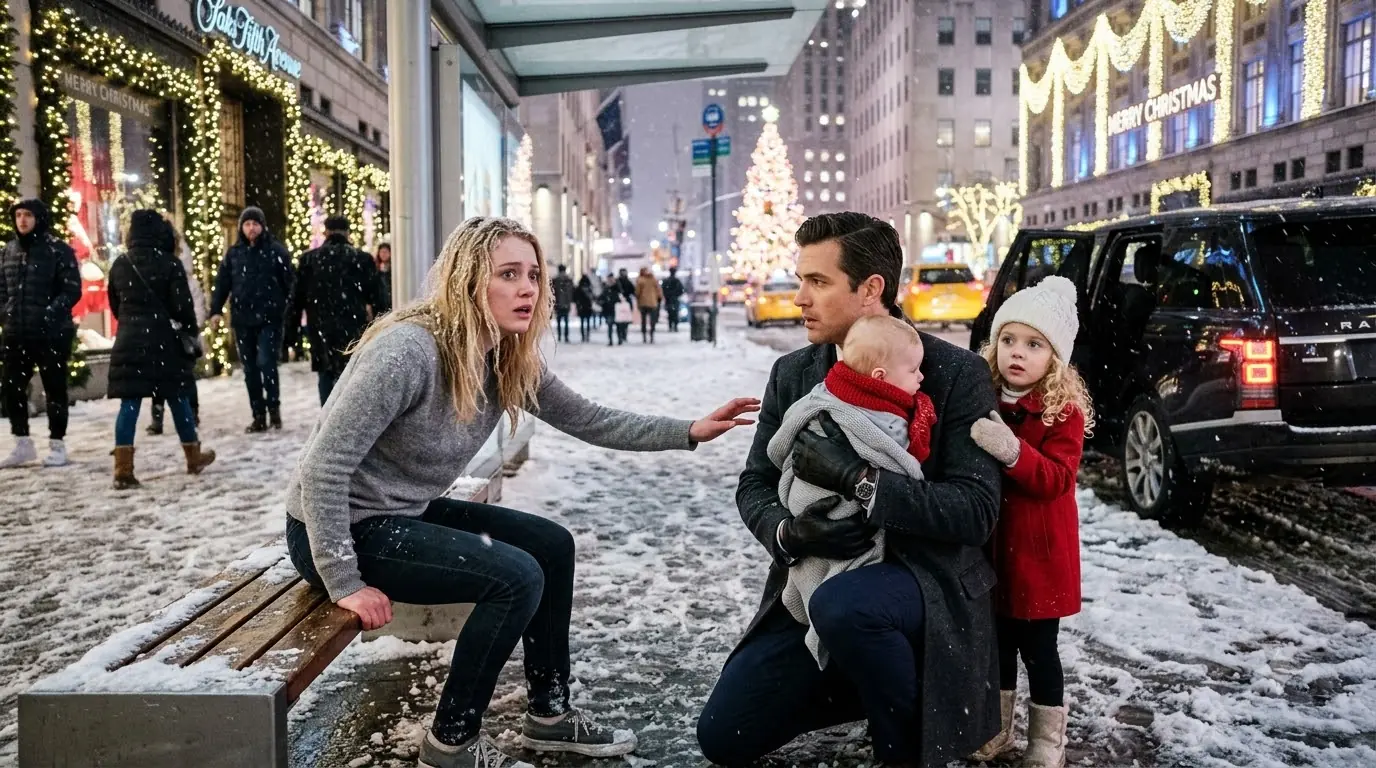
They were walking toward the waiting car when Lucy stopped suddenly.
Her small hand pulled against his.
“Daddy.”
Daniel took another step before realizing she was no longer beside him.
He turned.
Lucy was staring toward a bus shelter across the street.
A young woman sat on the bench beneath the weak fluorescent light.
She wore a thin gray sweater beneath an open secondhand coat. Her wet brown hair clung to her face. One shoulder rested against the glass wall, and her eyes were closed.
A baby lay against her chest beneath a worn blue blanket.
Snow had begun collecting along the woman’s shoes.
Daniel tightened his grip on Lucy’s hand.
The city contained countless emergencies a person could not solve alone. He knew that. He also knew approaching an unconscious stranger could create risks for Lucy.
He reached for his phone.
Then Lucy whispered, “The baby’s moving funny.”
Daniel looked again.
The infant’s face was visible above the blanket.
His skin looked pale beneath the shelter light. His lips carried a faint bluish color, and his breathing came in small, irregular movements.
Daniel crossed the street.
“Stay behind me,” he told Lucy.
He approached the bench carefully.
“Miss?”
The woman did not respond.
He spoke louder.
“Miss, can you hear me?”
Her eyes opened abruptly.
She pulled the baby tighter and attempted to stand, but her legs failed beneath her.
“Don’t touch him,” she gasped.
“I’m not taking him.”
Daniel crouched several feet away, keeping his hands visible.
“Your baby is very cold. I’m calling an ambulance.”
“No.”
The answer was immediate.
“No police. No ambulance.”
“He needs medical attention.”
“They’ll take him.”
“Who will?”
“Child services.”
Her voice cracked.
Daniel looked at the child.
The baby gave a weak cough.
“My name is Daniel,” he said. “That’s my daughter, Lucy. I’m not a police officer, and I’m not trying to separate you from your son.”
The young woman’s eyes moved toward Lucy.
Lucy unwound the red scarf from her neck.
“Can he have this?”
Daniel almost told her to keep it.
Then he saw the woman’s expression.
The fear did not leave, but something softened.
Daniel accepted the scarf and laid it over the baby without removing him from his mother’s arms.
“What is his name?” he asked.
“Theo.”
“And yours?”
“Emma.”
“How old is Theo?”
“Four months.”
“Emma, he could have hypothermia. You may have it, too.”
She shook her head.
“We just need somewhere inside.”
Daniel had already called emergency services.
“Help is coming.”
Emma tried again to stand.
“I can’t go.”
“Why?”
“I’ve been in shelters. They separate families when there’s no room.”
“An ambulance will take both of you to the hospital. I’ll follow.”
She looked at him suspiciously.
“Why?”
Daniel glanced at Lucy.
Because Rebecca would have stopped, he thought.
Because his daughter was watching.
Because a baby’s life could not depend upon whether the person who noticed him found the situation convenient.
“Because nobody should be alone in this weather.”
The paramedics arrived within six minutes.
Emma protested when they attempted to place Theo inside the ambulance.
A female paramedic named Rosa explained every step before touching the baby.
“You ride with him,” she said. “No one is separating you.”
Daniel gave Emma his card.
It contained his name, personal number, and the Langford House address.
“I’ll be at the hospital.”
“You don’t have to.”
“I know.”
Lucy stepped forward before the ambulance doors closed.
“Keep my scarf until he’s warm.”
Emma looked at her.
Then she began to cry.
The emergency department was crowded with holiday accidents, flu patients, and people seeking shelter from the storm.
Daniel called his driver and sent Lucy home with Mrs. Brennan, the longtime house manager who had helped care for her since Rebecca’s death.
“I want to stay,” Lucy said.
“You’ve helped already.”
“What if the baby needs me?”
“He needs doctors tonight.”
“And tomorrow?”
Daniel looked toward the treatment doors.
“We’ll see.”
The hospital staff treated Theo for mild hypothermia and dehydration.
Emma’s condition was also concerning. She had not eaten properly in several days and showed signs of exhaustion and exposure, though no permanent injury appeared likely.
A hospital social worker named Monica Reyes met with her.
Daniel waited in the public area.
He did not attempt to enter treatment rooms.
He did not ask the staff for private information.
Nearly two hours later, Monica approached him.
“Mr. Hart?”
Daniel stood.
“Are they all right?”
“The baby is stable. Emma will be discharged later tonight if her temperature remains normal.”
“Does she have somewhere safe to go?”
Monica studied him.
“She told me you offered help.”
“I haven’t offered anything specific yet.”
“That’s wise.”
Daniel appreciated the directness.
“I own a hotel nearby. I can provide a room for a few nights.”
“Through the hospital’s emergency-placement process?”
“If that protects her.”
“It protects everyone.”
Monica explained that Emma needed more than one warm night.
She needed identification documents, benefits assistance, pediatric follow-up, housing support, and a safe environment where help did not depend upon pleasing a stranger.
Daniel listened.
“What can I do without creating another problem?”
“Let her decide.”
The answer humbled him.
He had built a career by solving problems quickly.
Money moved obstacles.
Staff followed instructions.
Contracts made arrangements predictable.
Emma’s life could not be repaired by treating her as another project.
The hospital accepted Daniel’s offer of a temporary hotel placement through its family emergency program.
The paperwork named the hospital as the referring organization.
Emma received a private room at the Langford House for seven nights, with meals included and continued support from Monica.
Daniel covered the expense anonymously through the hotel foundation.
Emma learned the truth anyway.
When she emerged from treatment carrying Theo, she looked smaller than Daniel remembered.
A nurse had found her clean sweatpants and a warm sweater. Theo slept inside a hospital-issued blanket, Lucy’s scarf folded beneath him.
“You own the hotel,” Emma said.
“Yes.”
“You paid for the room.”
“The hospital arranged it.”
“That isn’t an answer.”
Daniel held her gaze.
“I made the room available.”
“Why?”
“It was empty.”
“On Christmas?”
Daniel almost smiled.
“We have more than one room.”
Emma looked down at Theo.
“I’m not promising anything.”
“I didn’t ask you to.”
“I won’t owe you.”
“You don’t.”
She seemed unconvinced.
Daniel understood.
People who had been repeatedly disappointed did not trust assurances. They trusted patterns, and patterns required time.
A hotel car took Emma and Theo to the Langford shortly after midnight.
Daniel did not travel with them.
He returned home.
Lucy was asleep on the sofa beneath a blanket, still wearing her boots.
Mrs. Brennan sat nearby reading.
“How are they?” she asked.
“Safe for tonight.”
“For tonight,” she repeated.
Daniel lifted Lucy carefully.
His daughter opened one eye.
“Baby?”
“He’s warm.”
“Did she keep my scarf?”
“Yes.”
“Good.”
Lucy fell asleep again against his shoulder.
On Christmas morning, Emma woke in a room overlooking a snow-covered side street.
For several seconds, she did not understand the silence.
No shelter staff announcing breakfast.
No footsteps moving around a church basement.
No voices arguing behind thin walls.
Theo slept inside a portable crib supplied by the hotel.
A basket on the table contained formula, diapers, baby wipes, bottles, toiletries, and a small card from the pediatric department reminding her of his follow-up appointment.
Emma checked the door twice.
It locked from inside.
No one had entered while she slept.
She fed Theo and stood beneath a hot shower until the bathroom filled with steam.
Then she sat on the floor and cried.
She had spent months refusing to break because she feared she might not stand again.
Safety removed the necessity of pretending.
At ten, someone knocked.
Emma opened the door with the security chain attached.
Mrs. Brennan stood in the hallway with Lucy.
The older woman was in her sixties, with silver hair and a navy wool coat. She carried herself with the firm composure of someone who had organized other people’s lives for decades.
Lucy held a gift bag.
“Merry Christmas,” she announced.
Mrs. Brennan looked at the chain.
“Keeping that attached is sensible.”
Emma opened the door slightly farther.
“Mr. Hart asked us to check whether you need anything.”
“We’re fine.”
Lucy lifted the bag.
“This is for Theo.”
Inside were two warm baby outfits, socks, a stuffed rabbit, and a board book about a bear who could not sleep.
Emma’s throat tightened.
“You picked these?”
“Mrs. Brennan helped with sizes.”
“I prevented her from buying a drum,” Mrs. Brennan said.
“Babies like music.”
“Hotel guests prefer silence.”
Emma almost laughed.
The sound surprised her.
Mrs. Brennan noticed but did not comment.
“The hotel kitchen will send breakfast whenever you are ready. You have privacy. No one expects you to entertain visitors.”
Lucy looked disappointed.
Mrs. Brennan continued, “However, Miss Lucy asked whether you might join us for Christmas lunch downstairs. You may decline.”
Emma looked toward the crib.
Every instinct warned her against becoming dependent upon kindness.
Kindness could change.
People could expect gratitude to become obedience.
But Monica would visit that afternoon. The hotel arrangement was documented. Daniel had not attempted to enter the room or demand anything.
And Lucy stood in the hallway waiting with both hands clasped.
“Lunch,” Emma said. “Just lunch.”
Lucy beamed.
Daniel had reserved a private dining room rather than bringing Emma into his home.
When she arrived carrying Theo, she found a table set for five.
Daniel.
Lucy.
Mrs. Brennan.
Emma.
And a bassinet beside Emma’s chair.
The choice mattered.
Nothing about the arrangement suggested that she had been inserted into the empty space left by Daniel’s wife.
Rebecca’s photograph remained on a side table near the window, but no one treated Emma as a replacement.
Daniel stood when she entered.
“How is Theo?”
“Better.”
“And you?”
“Still deciding.”
“That seems reasonable.”
Lunch was simple.
Roast chicken.
Potatoes.
Green beans.
Bread.
Lucy told long stories requiring very little response.
Mrs. Brennan corrected Daniel when he attempted to give the child another dessert before she finished her vegetables.
Emma ate slowly.
For the first time in months, she did not need to save half her meal for later.
When Theo began crying, Daniel moved to help, then stopped.
“May I pick him up?”
Emma studied him.
“Yes.”
Daniel lifted the baby awkwardly.
“You have a daughter,” Emma said.
“She was never this small.”
“No?”
“I was convinced I would break her.”
“You look convinced now.”
“I’m hiding it better.”
Theo settled against him.
Daniel’s expression changed.
Grief passed through it so briefly that Emma might have missed it.
“You lost another child,” she said quietly.
His eyes lifted.
“Mrs. Brennan told me only that your wife died.”
Daniel looked toward Lucy, who was occupied with arranging bread into shapes.
“Rebecca was pregnant. There were complications. Neither survived.”
“I’m sorry.”
“So am I.”
He returned Theo before the infant became restless.
No dramatic understanding passed between them.
No instant romance.
Only the recognition that both knew what it meant to have life change before there was time to prepare.
During the following week, Emma met regularly with Monica Reyes.
She obtained replacement identification documents.
Applied for nutrition assistance.
Registered Theo with a pediatric clinic.
Completed an assessment for a transitional housing program serving young mothers.
Monica asked about her family.
Emma had grown up in a rigid household in Connecticut.
Her parents valued appearances, church standing, and academic achievement.
When Emma became pregnant during her second year at art school, the child’s father disappeared.
Her parents offered to help only if she arranged an adoption.
Emma refused.
They told her not to return home.
She stayed with classmates, then in shelters.
One shelter closed.
Another required residents to leave during the day.
A series of bad decisions and lost documents carried her toward the bus bench where Daniel and Lucy found her.
“Would you contact your parents now?” Monica asked.
“No.”
“Because it’s unsafe?”
“Because they made their choice.”
Monica did not challenge her.
The seven hotel nights became fourteen after the transitional housing facility delayed her placement.
Daniel approved the extension through the foundation but did not visit Emma’s room.
He saw her occasionally in the lobby or dining room.
Their conversations remained brief.
He asked how the process was going.
She answered honestly when she wished and vaguely when she did not.
On the twelfth day, Emma approached his office inside the hotel.
“I need work.”
Daniel gestured toward a chair.
“What kind?”
“Anything.”
“What did you do before?”
“I studied illustration.”
“That isn’t anything.”
“I didn’t finish.”
“It still isn’t nothing.”
She placed several drawings on his desk.
During her hotel stay, she had sketched Theo, the snow outside the window, Lucy reading, and the Langford lobby during evening check-in.
Daniel examined them carefully.
The drawing of the lobby captured dozens of small stories.
A bellman helping an elderly guest remove her coat.
A couple arguing quietly beside the elevator.
A child asleep on a suitcase.
The hotel itself seemed alive around them.
“These are excellent.”
“I need a job, not encouragement.”
Daniel nodded.
“The hotel marketing department hires freelance designers.”
Emma’s posture tightened.
“I don’t want a position invented for me.”
“Neither do I.”
He called the department director while Emma sat there.
“Rachel, I have a portfolio I’d like you to review. The applicant is in my office. I want the normal process.”
After ending the call, Daniel looked at Emma.
“She may say no.”
“Good.”
“You want her to say no?”
“I want her to be able to.”
Rachel Chen interviewed Emma the following morning.
She rejected two of Emma’s early concepts and requested revisions.
Emma stayed awake after Theo slept and completed them.
Three days later, Rachel offered her a six-week freelance contract to illustrate materials for the Langford’s family travel program.
The pay was fair.
The schedule was flexible.
Emma signed the same agreement as every other contractor.
She cried only after leaving the office.
Not because Daniel rescued her.
Because someone had evaluated her work and found it useful.
In February, Emma and Theo moved into a furnished studio operated by the transitional housing organization.
The apartment was small.
The radiator rattled.
The kitchen contained one narrow counter and two cabinets.
Emma loved it.
The lease was in her name.
The key belonged to her.
No one could withdraw the apartment because she failed to show sufficient gratitude.
Lucy visited with Daniel once, after Emma invited them.
The child entered carrying a houseplant.
“Mrs. Brennan said every home needs something alive.”
“Theo is alive,” Emma said.
“She meant something that doesn’t cry.”
The plant survived only three months.
Emma drew it anyway.
Life began to acquire structure.
She worked during Theo’s naps and after bedtime.
Attended counseling.
Completed parenting classes required by the housing program.
Met regularly with a college adviser about returning to school.
Daniel’s foundation paid nothing directly toward her tuition.
Instead, Emma applied for grants and a scholarship for students returning after housing instability.
She received both.
The Langford contract led to another project.
Then another.
Rachel recommended her to an independent children’s publisher seeking an illustrator.
Her first book assignment involved a frightened fox searching for shelter during a snowstorm.
The symbolism was obvious.
Emma accepted it anyway.
Daniel and Emma became friends slowly.
He invited her and Theo to occasional lunches with Lucy.
She invited them to the small exhibition held by her housing program.
They spoke about parenting, art, grief, and the strange guilt of surviving circumstances that changed other people permanently.
Daniel never asked Emma to comfort him.
Emma never pretended his generosity made him flawless.
He could be controlling when frightened.
He solved problems before listening.
He worked through family dinners.
Once, he arranged a pediatric appointment after Emma mentioned Theo’s cough, then acted surprised when she became angry.
“You cannot make decisions for us,” she told him.
“I was trying to help.”
“You were trying to control uncertainty.”
Daniel went silent.
Emma continued.
“You had one terrible thing happen that you could not prevent. Now you try to prevent everything.”
The observation hurt because it was accurate.
He canceled the appointment.
Then he apologized.
Their friendship survived.
So did Emma’s boundaries.
The first public difficulty arose in spring.
A gossip website published photographs of Emma entering the Langford House with Theo and later attending a park outing with Daniel and Lucy.
The article described her as Daniel’s “mystery companion” and suggested the hotel owner had installed a homeless young woman in company accommodation.
The story implied impropriety.
It also revealed details about Emma’s period of homelessness.
Daniel’s legal team offered to respond aggressively.
Emma refused to be hidden behind attorneys.
She issued a statement through the housing organization.
Mr. Hart and the Langford Foundation provided emergency accommodation through a hospital referral after my infant son required treatment for cold exposure. I later received freelance work through the hotel’s standard hiring process. I am responsible for my own housing and education. Compassion should not be treated as scandal merely because suspicion attracts more attention than facts.
The statement spread farther than the original article.
Other mothers wrote to Emma.
Formerly homeless students contacted her.
The children’s publisher expanded her book contract.
Daniel asked if she regretted answering.
“No.”
“People will continue talking.”
“They talked when I was sleeping on a bench.”
Emma looked at him.
“Silence didn’t protect me then.”
Daniel learned from her.
When the Langford Foundation developed a new emergency housing initiative, Emma agreed to advise the project only if people with direct experience received paid positions rather than ceremonial invitations.
The program partnered with hospitals and established housing organizations.
It provided temporary rooms for families in medical or weather emergencies while caseworkers arranged longer-term support.
No wealthy stranger personally selected recipients.
No family became dependent upon pleasing a donor.
The safeguards mattered to Emma more than the publicity.
She named the project Open Door.
A year passed.
Then another.
Theo learned to walk inside Emma’s studio apartment.
Lucy began first grade.
Emma returned to college part-time and completed her illustration degree.
Her first children’s book was published in October and dedicated:
To everyone who stopped.
Daniel attended the launch with Lucy.
He stood near the back while Emma signed copies.
When the crowd thinned, he handed her a book.
“For Lucy?”
“For me.”
“You don’t need my signature.”
“I waited in line.”
Emma opened the cover.
“What should I write?”
Daniel considered.
“Write what you would tell the woman at the bus stop.”
Emma looked at him.
Then she wrote:
You are not the worst night of your life.
Daniel read the sentence twice.
“That is good.”
“It took me two years to believe it.”
Lucy ran over carrying three cookies.
“Daddy, are you ever going to ask Emma?”
Emma looked up.
Daniel closed his eyes.
“Ask me what?”
Lucy glanced between them.
“Mrs. Brennan says I’m not supposed to interfere.”
“That has never stopped you.”
“She says you both look at each other when the other person isn’t looking.”
Daniel’s ears turned red.
Emma laughed.
It was not the beginning of their love.
That had begun in dozens of quieter moments neither had named.
The argument over the pediatric appointment.
The afternoons at the park.
Daniel asking Emma’s opinion rather than offering a solution.
Emma sitting beside him on Rebecca’s birthday without attempting to make grief disappear.
Lucy trusting Emma enough to talk about missing her mother.
Theo falling asleep on Daniel’s chest after a long day.
But Lucy’s question forced the truth into the open.
After the book event, Daniel walked Emma home.
They stopped outside her building.
“I don’t know how to do this without making it complicated,” he said.
“It is already complicated.”
“I’m older than you.”
“Ten years.”
“You met me when you were vulnerable.”
“I’m not there anymore.”
“I know.”
“Do you?”
Daniel looked toward the windows above them.
“I never want you to wonder whether gratitude influenced your choice.”
Emma held his gaze.
“That is my concern to examine.”
“I also have Lucy.”
“And I have Theo.”
“I loved Rebecca.”
“I know.”
“I still love her.”
“I would be worried if you didn’t.”
Daniel’s voice softened.
“I care about you.”
Emma smiled slightly.
“That is a very cautious declaration.”
“I’m trying not to make another decision before you have space to make yours.”
“You finally learned.”
“Painfully.”
She stepped closer.
“I care about you, too.”
They did not become engaged that night.
Daniel did not offer her a penthouse, a gallery, or a corporate title.
They agreed to have dinner.
A real date.
With childcare.
Away from the hotel.
Daniel arrived ten minutes early and spent eight of them sitting in the car because he did not want to appear overeager.
Emma saw him through the window.
She let him wait.
Their relationship developed over the following year.
There were awkward moments.
Emma disliked expensive restaurants.
Daniel sometimes mistook generosity for planning permission.
Lucy became possessive of Emma’s attention, then guilty about betraying her mother.
A family therapist helped them talk about it.
“No one replaces your mother,” Emma told Lucy.
“Then what are you?”
“Someone who loves you differently.”
Lucy considered.
“Like an extra?”
“Like an extra.”
Theo began calling Daniel “Dan” before eventually choosing “Dad” on his own.
Daniel cried privately the first time.
Emma pretended not to notice until he was ready to tell her.
Three years after the night at the bus shelter, Daniel took Emma back to Copley Square.
Snow had begun falling.
The bench remained beneath the same route sign, though the shelter had been renovated.
“You hate cold weather,” Emma said.
“I have a reason.”
He did not kneel immediately.
First, he gave her a folder.
Emma frowned.
“Contracts are not romantic.”
“It isn’t a contract.”
Inside was confirmation that the Open Door program had secured permanent independent funding for ten years.
It no longer relied on Daniel’s personal foundation alone.
A board consisting largely of formerly homeless parents, social workers, and community advocates would govern it.
Emma read the pages.
“You did this?”
“We did this.”
“You brought me into freezing weather to discuss nonprofit governance?”
“There is another part.”
Daniel removed a small ring from his coat.
It had belonged to neither Rebecca nor anyone else.
He had chosen it for Emma.
No borrowed legacy.
No suggestion that she was completing a family another woman left unfinished.
“Emma Lane, you did not enter my life so I could rescue you.”
His voice trembled.
“You reminded me that grief was not the same as loyalty. That moving forward did not mean leaving Rebecca behind.”
Snow settled in his hair.
“You built a life before you chose to share it with me. You became someone I respect, someone Lucy trusts, and someone I love.”
Emma’s eyes filled.
“I cannot promise there will be no difficult nights.”
“There will be.”
“I cannot solve everything.”
“Definitely not.”
“I can listen before trying.”
“We’ll keep practicing.”
Daniel smiled.
“Will you marry me?”
Emma looked toward the bench.
Three years earlier, she had believed accepting help meant surrendering control.
She had learned that healthy love did not demand dependence.
It made room for choice.
“Yes,” she said. “But get off the cold pavement before you need the ambulance this time.”
They married the following spring in the courtyard of the Langford House.
Monica Reyes attended.
Rachel Chen attended.
Mrs. Brennan cried more loudly than anyone and denied it afterward.
Lucy carried flowers.
Theo carried nothing because he had dropped the rings during rehearsal and lost the privilege.
Rebecca’s photograph stood on a small table beside candles honoring family members who were gone.
Emma placed it there herself.
Their marriage did not transform life into a fairy tale.
Daniel continued to grieve unexpectedly.
Emma struggled with fear whenever money became uncertain.
Lucy tested boundaries.
Theo drew on a hotel wall with permanent marker.
Emma’s parents attempted contact after seeing her success and discovered forgiveness did not automatically restore access.
She met them once with a counselor present.
She listened.
Then she decided what relationship, if any, could continue.
The choice belonged to her.
Emma opened a small illustration studio several years later using income she had earned from books and design contracts.
Daniel offered investment.
She declined.
He celebrated anyway.
Her studio hired parents who needed flexible schedules and young artists rebuilding after interrupted education.
The first print displayed near the entrance showed a snowy bus shelter beneath a glowing streetlight.
A woman held a baby.
A little girl extended a red scarf.
The picture was titled:
THE MOMENT SOMEONE STOPPED.
Every Christmas Eve, the Open Door program reserved hotel rooms across Boston for families referred by hospitals, domestic violence services, and emergency shelters.
The program also funded transportation, meals, case management, and childcare.
Daniel and Emma never appeared unannounced at the rooms.
They did not turn families into holiday stories.
Help did not require an audience.
Lucy, older now, volunteered by assembling welcome kits.
One Christmas, she found the original red scarf inside a box of Emma’s keepsakes.
Theo had long outgrown it.
The wool remained faded from that first night.
“You kept this?”
Emma touched the fabric.
“It was the first thing anyone gave Theo without asking me to prove we deserved it.”
Lucy smiled.
“I was six.”
“You were very persuasive.”
“I still am.”
“That is true.”
On the tenth anniversary of their meeting, the family returned to the bench.
Daniel brought hot chocolate.
Emma brought the scarf.
Lucy was sixteen.
Theo was ten and deeply embarrassed by any story involving himself as a baby.
Snow moved lightly through the air.
“Was I really blue?” he asked.
“A little,” Emma said.
“That’s disgusting.”
“It was frightening.”
Lucy sat beside him.
“You looked like a tiny snowman.”
“I hate this family.”
“No, you don’t.”
Daniel stood behind Emma with one hand resting gently against her shoulder.
City lights reflected from the snow.
People moved around them without knowing why the family had stopped beside an ordinary bus shelter.
Emma looked at the place where she once believed her story had ended.
She no longer thought of Daniel as the man who rescued her.
The doctors protected Theo.
Monica helped her find housing.
Rachel gave her work.
The scholarship committee gave her another chance at school.
Daniel offered the first door.
Emma had walked through every one that followed.
That distinction mattered.
“You ready?” Daniel asked.
Emma nodded.
They started toward the hotel.
Halfway across the square, Lucy stopped.
A man sat near the subway entrance with a cardboard sign and a dog curled beside him beneath a blanket.
Lucy looked at her parents.
Daniel smiled.
“Go ask what he needs.”
Lucy approached carefully.
Emma watched her daughter kneel at a respectful distance and begin a conversation.
Not every problem could be fixed.
Not every story ended with wealth, marriage, or a beautiful home.
But compassion did not need to solve an entire life to matter.
Sometimes it was a scarf.
A meal.
A hospital ride.
A room for one safe night.
A question asked without judgment.
An opportunity offered without ownership.
The night Daniel Hart stopped at the bus shelter did not create a fairy tale.
It created enough warmth for a baby to survive until help arrived.
Everything larger came later—through work, patience, boundaries, mistakes, forgiveness, and choices freely made.
Emma slipped her hand into Daniel’s.
“Your daughter is going to bring that dog home.”
“Our daughter.”
Emma smiled.
“Our daughter is going to bring that dog home.”
Daniel watched Lucy remove her gloves and offer them to the stranger.
“Probably.”
The snow continued falling around them.
Ten years earlier, Daniel had almost kept walking.
He never forgot that.
Neither did Emma.
Because entire lives were sometimes changed not by grand gestures, but by the quiet moment when one person looked at another’s suffering and decided not to pass by.