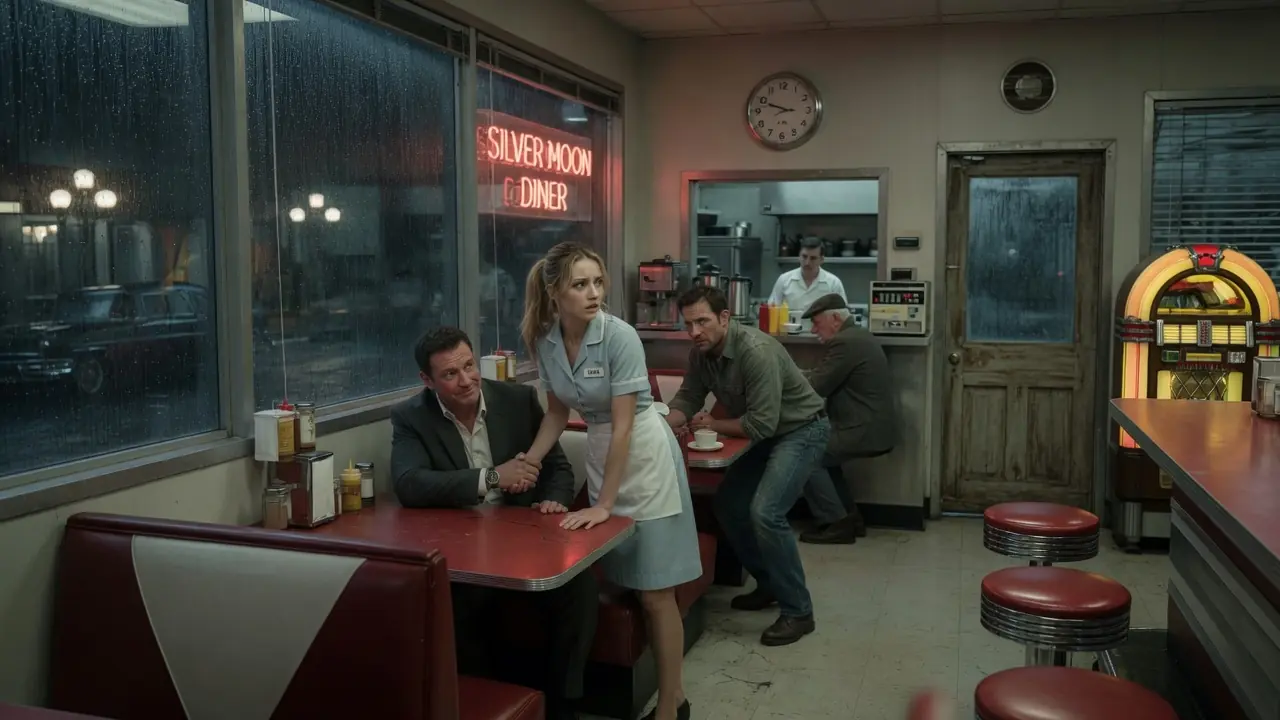
The hand closed around the waitress’s wrist so hard that the order pad slipped from her fingers.
It struck the cracked linoleum with a sharp slap.
Every customer inside the Silver Moon Diner looked up.
Then almost every one of them looked away.
The truck driver in the corner raised his newspaper.
An elderly couple suddenly became interested in putting on their coats.
The cook turned up the radio behind the service window.
No one wanted trouble.
No one except the man sitting alone in the rear booth.
Daniel Carter slowly placed his coffee cup on its saucer.
The small ceramic click sounded louder than it should have.
“Let her go.”
His voice was quiet.
The wealthy man holding the waitress laughed without releasing her.
He looked Daniel over from the worn work boots to the faded flannel shirt and the scar disappearing beneath his collar.
Then he smiled.
“You should mind your own business.”
Daniel stood.
“When a woman tells you to let go three times, it becomes everyone’s business.”
Less than forty-eight hours later, Daniel would lose all three of his jobs.
Photographs of his seven-year-old daughter would appear online.
A lawsuit demanding more money than he could earn in a decade would arrive at his apartment.
And half the city would believe he was a violent, unstable veteran who had attacked an innocent businessman.
But at twelve forty-three that rainy Thursday night, Daniel knew none of that.
He knew only that a frightened woman needed someone to stop looking away.
Forty-five minutes earlier, the Silver Moon had been almost peaceful.
At midnight, the diner belonged to the people the rest of the city had forgotten.
Long-haul drivers rested over cold fries before returning to the interstate.
Nurses sat in booths after exhausting hospital shifts.
Warehouse workers drank coffee strong enough to keep them awake until sunrise.
Daniel occupied his usual seat near the back wall.
At thirty-six, he still had the build of the Marine scout leader he had once been, though years of hard labor and old injuries had begun taking their price.
Shrapnel remained buried in his right shoulder from an attack in Kandahar. Surgeons had removed what they could, but several fragments lay too close to nerves.
Whenever rain came, the shoulder throbbed.
That night, rain pounded the diner windows as if trying to break its way inside.
Daniel rolled the joint carefully and checked his watch.
He had forty-two minutes before his overnight security shift began in the warehouse district.
Earlier that day, he had delivered medical supplies across three counties.
On Saturday, if his shoulder cooperated, he had a handyman job replacing damaged flooring in an apartment complex.
Three jobs.
Seven days a week.
That was what it took.
His small two-bedroom apartment cost twelve hundred dollars a month.
Utilities took another three hundred.
Food, school supplies, clothes, and dance lessons for his daughter Sophie consumed nearly everything else.
The dance classes were not essential.
Daniel knew that.
But they were the one thing that made Sophie forget how little they had.
When she danced, her eyes lit up exactly the way her mother’s once had.
Daniel could not bring himself to take that away.
Before returning home from war, he had earned a Bronze Star.
The medal remained inside a dresser drawer beneath old insurance papers.
It had not helped him obtain a stable career.
Employers admired military service during interviews, but many became less enthusiastic when they learned about the shoulder injury, the therapy appointments, or the gap in his employment history after his wife died.
Rachel Carter had been the center of their family.
She managed the bills, remembered birthdays, filled their home with music, and believed Daniel could survive anything.
Then cancer came.
Eighteen months of appointments followed.
Chemotherapy.
Surgeries.
Small improvements.
Terrible setbacks.
Daniel had held Rachel’s hand while the strongest person he had ever known slowly became someone he could not save.
She died four years earlier.
For several months afterward, Daniel barely functioned.
He drank too much.
He stopped sleeping.
One night, he fought a stranger outside a bar and spent several hours in a holding cell.
He still remembered returning home the next morning and finding Sophie sitting at the kitchen table in her pajamas.
She had been three.
She looked up and asked, “Daddy, who’s going to make my lunch?”
Something inside Daniel came back to life.
Not completely.
But enough.
He entered treatment for post-traumatic stress.
He attended every session.
He learned to recognize the anger before it controlled him.
He rebuilt routines.
He found work.
He kept Sophie’s lunches packed and never missed a parent-teacher conference.
He was not whole.
But he was present.
The waitress approached and refilled his coffee without asking.
Her name tag said MIA.
She was in her mid-twenties, with honey-brown hair pulled into a practical ponytail and a calm, precise manner that did not match the worn uniform.
“Long night?” she asked.
“Long week.”
She glanced toward the rain.
“Only Thursday.”
“That’s the problem.”
She smiled.
Daniel had been coming to the Silver Moon for three months and had noticed things about her.
She pronounced words with unusual care.
Her posture suggested formal training.
She never checked her phone during a shift.
She treated everyone kindly, including customers who barely noticed her.
Daniel suspected she had once lived a very different life.
He never asked.
War had taught him that almost everyone carried a story they did not owe to strangers.
The name on her uniform was false.
Her real name was Olivia Sterling.
She was twenty-six years old, held a master’s degree in product design from Stanford, and was the only daughter of William Sterling, founder of Sterling Global Technologies.
The company was worth more than forty billion dollars.
Olivia could have entered any boardroom in the country without an introduction.
She could have led a product division, traveled on private aircraft, and spent her mornings reviewing billion-dollar acquisitions from an office above the city.
Instead, she was wiping dried ketchup from booth seats at one in the morning.
Her father believed she was experiencing a crisis.
Olivia called it an education.
She had grown up in a world where every relationship carried an invisible price.
People laughed at her jokes because they wanted access to her father.
Men called their interest in her love when they meant partnership.
Executives spoke confidently about ordinary consumers while having no idea what groceries cost.
Olivia had studied human-centered design, yet most of her professional life had occurred inside conference rooms where nobody had recently worried about rent.
She wanted to understand the people those products were supposed to serve.
So she made a deal with her father.
Six months outside the company.
No trust-fund spending.
No public use of the Sterling name.
No driver waiting outside.
She would work a normal job, live in a rented studio, and experience life without the protection of wealth.
In return, she would come back and become vice president of product development.
William agreed reluctantly.
He required weekly contact with Ethan Morgan, head of family security.
Olivia negotiated those visits down to brief text messages.
Three months into the experiment, she had learned more than she expected.
She watched elderly customers struggle to read tiny receipt print.
She saw tired workers spill coffee because lids were poorly designed.
She learned how much a good pair of shoes mattered after ten hours on a hard floor.
Most of all, she learned what it felt like to be invisible.
No one at the diner knew her surname.
No one laughed because they wanted something.
For the first time in her life, every smile she received felt real.
Then the bell above the door rang.
Three men entered, carrying rain and the smell of expensive alcohol with them.
The man in front was Grant Hargrove.
At forty-one, Grant ran a venture-capital fund worth hundreds of millions.
He had built his reputation by identifying struggling companies, forcing his way into their leadership, and extracting profit before anyone else understood what was happening.
His suit cost more than Daniel earned in a month.
His watch cost more than Daniel’s car.
Grant was drunk.
Not stumbling.
Not slurring enough to attract immediate attention.
He was the more dangerous kind of drunk.
Alcohol had stripped away the thin layer of politeness separating his public image from his private entitlement.
Two associates followed him.
Mason Price was large, broad-shouldered, and accustomed to solving problems with intimidation.
Evan Ross was younger and already looked embarrassed to be there.
Grant fell into a booth.
“Coffee,” he announced when Olivia approached. “Black. Fresh.”
“Of course.”
“And make sure it hasn’t been sitting there since the last presidential administration.”
Mason laughed.
Evan studied the table.
Olivia turned.
Grant’s hand shot out and locked around her wrist.
The movement was so sudden that genuine fear crossed her face before she could hide it.
“Hold on, sweetheart.”
Her order pad fell.
“What’s the hurry?”
Olivia tried to pull back.
“Sir, please let me go.”
Grant tightened his grip.
“Sit with us. A pretty girl working in a place like this must be desperate for intelligent conversation.”
“I’m working.”
“Take a break.”
“Please let go.”
The second request.
Grant pulled her closer.
His thumb pressed deeply into the inside of her wrist.
“Don’t be unfriendly.”
“Let go of me.”
The third request came louder.
The diner fell silent.
Then, one by one, people found reasons not to see what was happening.
Daniel put down his coffee.
He rose slowly, keeping his hands visible.
He crossed the distance between his booth and Grant’s table in four unhurried steps.
“That’s enough.”
Grant looked up.
Daniel’s clothes told him everything he believed he needed to know.
Working-class.
Tired.
Poor.
Unimportant.
“Mind your own business.”
Daniel’s gaze remained fixed on Grant’s hand.
“She told you to release her.”
Grant smiled.
“Do you have any idea who I am?”
“No.”
“I could make one phone call and make sure you never work in this city again.”
Daniel’s expression did not change.
“You are going to let go of her.”
“You’re threatening me?”
“I’m giving you an opportunity to make a better decision.”
Mason began to stand.
Daniel saw the movement from the corner of his eye.
“Stay seated.”
Mason reached for his shoulder.
That was his mistake.
Daniel pivoted, trapped the man’s wrist and elbow, and used his momentum to place him face down against the table.
It took less than two seconds.
No punch.
No wild movement.
Only controlled force.
Evan started to rise.
Daniel pointed toward him.
“Sit.”
Evan sat.
Mason cursed, his arm locked behind his back.
Daniel looked at Grant.
“Let her go.”
Grant released Olivia.
She stepped away, holding her injured wrist against her chest.
Red marks were already appearing.
Daniel released Mason and backed away.
“No one needs to get hurt.”
Grant surged to his feet.
“You just made the biggest mistake of your life.”
Daniel returned to his booth and picked up his coffee.
Grant pulled out his phone.
“I’m calling the police. Assault. Battery. I’ll make sure you rot.”
“Call them.”
“You attacked my employee.”
“Your employee reached for me after you assaulted her.”
Grant’s eyes narrowed.
“You think anyone here is going to take your word over mine?”
Daniel looked around the diner.
Customers lowered their eyes.
That answer was clear enough.
The police arrived eleven minutes later.
Lieutenant Samuel Reed took statements.
He was a twenty-year veteran with tired eyes and a reputation for judging facts rather than clothing.
He knew Daniel slightly.
Most officers assigned to the warehouse district did.
Daniel never caused problems.
He brought leftover food to the night guards.
He always spoke about Sophie.
The diner’s security footage was almost useless.
An old neon sign reflected against the camera lens, obscuring the moment Grant grabbed Olivia.
The recording clearly showed Daniel restraining Mason.
It did not clearly show why.
Olivia gave a detailed statement.
Two customers admitted Grant initiated the contact, though both seemed reluctant to become involved.
Reed closed his notebook.
“It looks like a lawful defense of another person.”
Grant’s lawyer had already arrived.
He wore a charcoal suit and spoke as if volume were unnecessary because money would carry his words.
“My client intends to press charges.”
Reed looked toward Daniel.
“I need you to come to the station while we sort this out.”
Daniel nodded.
“Let me call my daughter.”
He walked to the window.
Sophie answered with a sleepy voice.
“Daddy?”
“Everything’s okay, sweetheart. I might be late. Mrs. Ortega is staying with you.”
“Did something happen?”
“I helped someone.”
There was a pause.
“Like when you were a Marine?”
Daniel closed his eyes.
“Something like that.”
At the station, help arrived from an unexpected direction.
Natalie Brooks entered at two thirty in the morning carrying a scuffed briefcase.
She was thirty-four, raised two children alone, and had completed law school through scholarships and night work.
She devoted part of her practice to veterans who could not afford representation.
“I’m Daniel Carter’s attorney.”
Daniel had never met her.
Neither had Reed.
Someone from the diner had called a veterans’ legal-aid line.
Natalie sat beside Daniel and faced Grant’s attorney.
“My client intervened after a woman was physically restrained against her will.”
“Your client has a history of violence.”
“One arrest six years ago, no conviction, following the death of his wife.”
Natalie leaned forward.
“If your client wishes to continue, we can request his blood-alcohol level and compare it with the witness statements.”
Grant’s attorney stopped smiling.
No criminal charge was filed that night.
The matter remained under review.
Daniel left the station and went directly to work.
He was three hours late.
He completed the shift anyway.
By the following morning, his life had begun collapsing.
Someone had filmed part of the incident on a phone.
The clip started at the exact moment Daniel restrained Mason.
There was no footage of Grant grabbing Olivia.
No recording of her asking three times to be released.
The caption read:
UNSTABLE VETERAN ATTACKS BUSINESSMEN IN DINER.
The video spread rapidly.
Local television stations picked it up.
Commentators discussed Daniel’s military background and mental health without speaking to him.
By noon, the security company terminated his contract.
“Liability concerns,” his supervisor said.
His medical-delivery employer suspended him.
The property manager offering handyman work stopped returning calls.
Within two days, Daniel went from three jobs to none.
Parents whispered when he arrived at Sophie’s school.
One mother called her daughter away from Sophie on the playground.
That evening, Sophie sat at the kitchen table and asked why her friend was no longer allowed to play with her.
Daniel did not know how to answer without making the world sound crueler than it already was.
After Sophie went to bed, he arranged the bills by due date.
Rent in twelve days.
Electricity already late.
A small amount of savings.
Enough for perhaps six weeks.
Then the numbers stopped working.
Daniel’s hands remained steady.
Years earlier, this would have destroyed him.
He might have shouted.
Drunk.
Struck a wall.
Instead, he sat quietly and focused on what he could control.
That discipline did not make him less frightened.
It simply meant fear would not make the decisions.
Grant Hargrove discovered Olivia’s identity eight hours after the diner incident.
An assistant placed the police report on his desk.
Grant stared at the photograph.
The waitress named Mia was Olivia Sterling.
Daughter of William Sterling.
The Sterling company controlled a cloud-infrastructure contract essential to Grant’s largest investment portfolio.
For ten seconds, panic replaced arrogance.
Then instinct took over.
Grant had survived by controlling stories.
The story would become simple.
Daniel Carter was an unstable veteran.
The diner incident was an unprovoked attack.
Olivia had misunderstood harmless flirtation.
Grant contacted media acquaintances.
Information about Daniel’s PTSD treatment appeared online.
A photograph from his old bar arrest circulated without context.
Commentators suggested a pattern of uncontrolled violence.
Grant filed a civil lawsuit demanding damages Daniel could never pay.
Then he hired a private intelligence company.
Within twenty-four hours, photographs appeared online.
Daniel walking Sophie to school.
Sophie leaving dance class.
Sophie on the playground.
The message was clear.
Grant could reach his daughter.
Olivia learned what was happening from Claire Morgan, Sterling Global’s director of communications.
“The man who defended you has lost everything,” Claire said.
They sat inside a conference room high above downtown.
“Grant is using media contacts, lawyers, and private surveillance. His daughter is being photographed.”
Olivia’s stomach tightened.
“He helped me.”
“Yes.”
“I found him a lawyer.”
Olivia had anonymously arranged for Natalie to go to the station.
“A lawyer is not enough,” Claire said. “Grant is attacking him legally, financially, publicly, and personally.”
The door opened.
William Sterling entered.
At sixty-three, Olivia’s father carried the controlled authority of a man who had built a global company from a rented garage.
Ethan Morgan, Claire’s older brother and head of security, stood behind him.
“This ends now,” William said. “You are coming home. Ethan will remain with you.”
“No.”
William stopped.
It was not a word many people used around him.
Olivia rose.
“I will not run while Grant destroys Daniel’s life.”
“He is a stranger.”
“He stood up for me when everyone else looked away.”
“You don’t know his motives.”
“He didn’t know my name.”
William stared at her.
“He did not protect a billionaire’s daughter. He protected a waitress.”
Ethan shifted near the doorway.
Olivia looked at him.
“You investigated Daniel already.”
Ethan did not deny it.
“What did you find?”
William turned toward him.
Ethan answered carefully.
“Former Marine scout leader. Honorable service. Bronze Star. Regular trauma treatment. No violent incidents since beginning therapy. Works three jobs. Sole parent. Visits his wife’s grave every Sunday.”
“Anything suggesting he wants money?” William asked.
“Grant offered him fifty thousand dollars to sign a nondisclosure agreement.”
“And?”
“He tore it in half.”
The room became quiet.
Olivia looked at her father.
“When was the last time someone in our world did the right thing without first calculating the benefit?”
William sat down.
“What do you propose?”
“We tell the truth.”
Grant’s settlement offer reached Daniel the following afternoon.
Fifty thousand dollars.
Enough to cover two years of rent.
Enough to keep Sophie in school.
The agreement required him to remain silent about Grant, the diner, Olivia, and every act of intimidation that followed.
Daniel read the first page.
Then he tore the document in half.
Natalie collected the pieces.
“You know he will escalate.”
“He is already photographing my daughter.”
“We need evidence.”
“What evidence?”
“That this is who he is.”
Natalie had begun contacting former employees from hotels, clubs, and companies where Grant conducted business.
She found Hannah Doyle, a bartender who said Grant repeatedly touched her without consent.
After she rejected him, threatening messages arrived from unlisted numbers.
Two other women agreed to give sworn statements, though both feared appearing publicly.
“It proves a pattern,” Natalie said. “But we still need proof of what happened at the diner.”
The security camera did not provide it.
Then a truck driver named Calvin Price came forward.
Calvin had been the man hiding behind the newspaper.
He had remained silent because he understood what happened to working people who challenged wealthy men.
Then his twelve-year-old daughter watched the edited video.
She asked why the man who helped the waitress was being called violent.
Calvin had no answer.
So he walked into Natalie’s office.
“I saw everything.”
He gave a recorded statement.
“Grant held the waitress hard enough to leave marks. She told him to let go three times. Daniel warned him. The other man reached first.”
Natalie asked how he could be certain Daniel’s response was controlled.
“I served eight years as military police.”
The second piece of evidence came from Olivia.
During her diner experiment, she had been testing a prototype safety device.
It was no larger than a tie clip and attached to her apron.
The device, called Witness, continuously recorded forty-eight hours of encrypted audio and deleted older material automatically.
Olivia had designed it after hearing workers describe harassment that employers dismissed because nobody could prove what happened.
The recorder captured everything.
Grant’s voice.
Olivia’s three requests.
Daniel’s calm warning.
Mason’s movement.
Grant’s threat.
The audio was time-stamped.
Unedited.
Clear.
Natalie listened once.
Then again.
“This changes the case.”
Lieutenant Reed opened a criminal harassment investigation after reviewing the photographs of Sophie.
Ethan traced the surveillance company Grant hired.
Claire began documenting which reporters received false information and when.
Grant believed he was applying pressure.
Instead, each action created another piece of evidence.
Ethan eventually reported to William.
“Daniel Carter is not looking for money.”
“Everyone has a price.”
“Not everyone.”
William looked up from his desk.
Ethan continued.
“He turned down fifty thousand dollars while unemployed. He knows Grant is targeting his daughter. He still refuses to lie.”
“What do you recommend?”
“Do not rescue him.”
William frowned.
“Then what?”
“Give him the opportunity to tell the truth.”
Three weeks after the diner incident, Sterling Global held its quarterly board meeting.
Grant sat near the head of the long table.
His attorneys occupied seats behind him.
He appeared confident.
Daniel remained unemployed.
The media narrative still portrayed him as dangerous.
Grant’s civil lawsuit continued.
The important Sterling cloud contract was scheduled for renewal that morning.
Everything seemed under control.
William called the meeting to order.
“Before we begin, we need to address a matter of board integrity.”
Grant smiled.
“Of course.”
“Three weeks ago, an investor associated with this company physically assaulted my daughter.”
The smile vanished.
William continued.
“When a bystander intervened, that investor launched a campaign of defamation, legal intimidation, and surveillance against the man and his seven-year-old child.”
Grant leaned forward.
“William, whatever Olivia told you—”
William pressed a button.
The conference-room speakers activated.
Olivia’s voice filled the room.
Please let go of me.
Grant’s response followed.
Then her second request.
Her third.
Daniel’s calm intervention.
Mason striking the table.
Grant threatening to destroy Daniel’s life.
The audio lasted four minutes and twelve seconds.
Nobody spoke after it ended.
William looked around the table.
“The recording has been authenticated by independent forensic experts.”
He turned toward Grant.
“We also possess witness testimony and evidence from multiple women describing similar behavior.”
Grant’s attorney rose.
“We should discuss this privately.”
“We are.”
William folded his hands.
“Your firm’s investment position in Sterling Global is being liquidated where legally permissible. Your access to all facilities and proprietary systems is revoked. The infrastructure agreement will not be renewed.”
Grant’s face hardened.
“You cannot do this over a misunderstanding.”
“The district attorney will decide whether it was a misunderstanding.”
The door opened.
Lieutenant Samuel Reed entered with two officers.
“Grant Hargrove, stand up.”
Grant looked toward William.
“You planned this.”
“No,” William said. “You did.”
Reed approached.
“You are under arrest for assault, criminal harassment, stalking, and witness intimidation.”
For the first time in Grant’s adult life, his money had nothing useful to say.
The story broke that afternoon.
This time, the public heard the entire audio.
News stations replayed Olivia asking Grant to let her go.
They heard Daniel warn him calmly.
They heard Grant promise to destroy him.
The outlets that had portrayed Daniel as violent issued corrections.
Some apologized.
Most used carefully worded statements about new evidence.
The corrections spread more slowly than the original lie.
But they spread.
Hannah Doyle appeared beside Olivia and Natalie at a press conference.
She described Grant’s harassment publicly.
Four additional women came forward within seventy-two hours.
Clients abandoned Grant’s investment fund.
Regulators began reviewing his financial dealings.
His lawsuit against Daniel disappeared.
Daniel watched the news from his apartment with Sophie curled beside him.
Natalie called.
“The civil case is dead. The criminal charges are against Grant, not you.”
Daniel closed his eyes.
“Thank you.”
“I also received calls from several companies interested in hiring you.”
After Sophie went to bed, Daniel sat alone.
He looked at Rachel’s photograph on the mantel.
At Sophie’s drawings taped to the walls.
At the overdue bills.
He did not feel victorious.
He felt as though a weight had finally been removed from his chest.
Someone knocked the following evening.
Olivia stood outside holding a foil-covered dish.
Her hair was tied into the same ponytail she wore at the diner.
“I made lasagna.”
Daniel looked at the dish.
“Should I be concerned?”
“It is my first attempt.”
“That did not answer the question.”
She laughed softly.
He stepped aside.
Olivia entered the apartment and saw the evidence of Daniel’s life.
The careful organization.
The folded flag.
Rachel’s photographs.
The three-job schedule still taped to the refrigerator, two positions crossed out.
She placed the food on the counter.
“I owe you an apology.”
“No.”
“I should have revealed who I was sooner.”
“Why?”
“I had resources.”
“You were frightened.”
“You lost your jobs.”
“Grant did that.”
“Because you protected me.”
Daniel looked at her.
“I would have done it if your name were really Mia.”
Olivia’s eyes filled.
“You did.”
Sophie appeared in the doorway holding a drawing.
It showed a tall figure standing between a smaller person and a dark shape.
The tall figure wore a cape.
“Is that your father?” Olivia asked.
Sophie shook her head.
“It’s anyone who helps.”
Daniel looked embarrassed.
“Daddy says everybody can be that person.”
Olivia crouched beside her.
“What do they have to do?”
“Choose.”
Two weeks later, William invited Daniel to his private office.
Olivia and Ethan were present.
William stood behind a large desk.
“Mr. Carter, I owe you an apology.”
Daniel remained silent.
“I assumed you were an opportunist. I ordered Ethan to investigate you.”
“I figured someone would.”
“I was wrong.”
William slid a folder across the desk.
“This is not charity.”
Daniel opened it.
Sterling Global was creating a workplace-safety division focused on harassment prevention, crisis intervention, and employee protection.
Olivia would direct the program.
Natalie would serve as legal counsel.
They wanted Daniel to lead intervention training.
“We need someone who understands de-escalation under pressure,” Olivia said. “Someone who can teach people how to act without creating more danger.”
Daniel read the salary.
Ninety thousand dollars a year.
Benefits.
Predictable hours.
A schedule designed for a parent.
His first instinct was suspicion.
“Why me?”
William answered.
“Because you have the experience.”
“I’m not a corporate trainer.”
“You led Marines through ambushes,” Ethan said. “You have security experience. You understand trauma. You controlled Mason without injuring him.”
Olivia leaned forward.
“And you did the right thing when there was no reward.”
Daniel closed the folder.
“I need to think about it.”
“Of course,” William said.
Daniel returned home and placed the offer on the kitchen table.
Sophie climbed into his lap.
“Are you taking it?”
“What do you think?”
She considered the question seriously.
“Helping people makes you happy.”
“Sometimes.”
“And one job means you can come to all my dance practices.”
Daniel smiled.
“That seems to be the important part.”
He accepted the offer.
The Safe Workplace Initiative launched several months later.
Olivia became its director.
Daniel led security and intervention training.
Natalie built its legal-support program.
Claire used her communications expertise to create public-awareness campaigns.
Ethan developed security protocols.
The first training session took place inside the Silver Moon Diner.
Managers, security employees, restaurant owners, nurses, and hotel workers filled the booths.
Daniel stood near the table where Grant had held Olivia’s wrist.
“The most difficult part of intervention is not physical,” he told them.
“It is overcoming the voice that says this is not your problem.”
Calvin Price sat in the audience with his daughter.
Hannah Doyle attended with several other women who had testified.
Daniel continued.
“When someone is being harmed, silence helps the person causing the harm.”
He looked toward the diner’s front window.
“You do not always need to fight. You can call for help. Record safely. Get other witnesses. Create distance. Speak clearly.”
He paused.
“But you have to choose not to look away.”
Grant’s criminal trial took place the following year.
The audio evidence was undeniable.
The surveillance of Sophie showed witness intimidation.
Testimony from multiple women established a long pattern of behavior.
Grant was convicted on several charges and sentenced to prison.
His investment company collapsed.
Some people called it justice.
Daniel understood justice was more complicated.
A sentence could not return the weeks of fear Sophie experienced.
It could not undo the loss of his jobs or erase the strangers who called him dangerous.
But it created a line Grant could no longer cross without consequence.
Six months after the diner incident, Daniel and Olivia stood in a park watching Sophie learn to ride a bicycle without training wheels.
It had become a Sunday tradition.
No board meetings.
No reporters.
No training programs.
Just three people brought together by a terrible night.
Sophie wobbled across the path.
Olivia held a thermos.
“She asked me a question yesterday.”
“What?”
“Whether standing up for people runs in families.”
Daniel watched his daughter regain balance.
“What did you say?”
Olivia slipped her hand into his.
“I said it does now.”
Sophie completed a full circle.
She threw both hands into the air.
The bicycle swerved dangerously.
Daniel ran forward.
Olivia laughed.
The Silver Moon still served coffee throughout the night.
The neon sign continued flickering.
The linoleum still creaked.
But a framed notice appeared beside the register:
WE DO NOT TOLERATE HARASSMENT.
WE STAND UP FOR ONE ANOTHER HERE.
Daniel no longer needed three jobs.
He worked one job that mattered.
He taught people that dignity did not depend on wealth.
That strength was not measured by how much fear someone could create.
That courage did not require the absence of fear.
It required a decision.
Years later, people still told the story as though Olivia’s identity were the most important twist.
A poor veteran defended a waitress and later discovered she was the daughter of a billionaire.
Daniel always corrected them.
“Her name did not matter.”
The point was not that Grant had grabbed a powerful woman without recognizing her.
The point was that he believed a powerless woman could be grabbed without consequence.
Olivia did not deserve protection because her father owned a global company.
She deserved it because she had said no.
Daniel did not become courageous when the public learned about his military service.
He was courageous when the diner became silent and he stood anyway.
Grant believed his money allowed him to decide whose voice mattered.
He believed Daniel’s poverty made him weak.
He believed Olivia’s uniform made her insignificant.
He believed every witness could be intimidated, purchased, or buried beneath a louder story.
For a while, it appeared he was right.
Then a truck driver stopped hiding behind his newspaper.
A lawyer refused to be intimidated by an expensive suit.
Several women chose to speak.
A daughter asked her father why good people remained silent.
A waitress revealed the recording no one knew existed.
And one exhausted single father refused fifty thousand dollars because accepting it would mean helping a powerful man rewrite the truth.
Daniel Carter never considered himself a hero.
He had spent years trying to become an ordinary father.
To pack lunches.
Pay rent.
Attend dance recitals.
Make it home before Sophie fell asleep.
That rainy night at the Silver Moon, he did not stand because he wanted recognition.
He stood because Olivia asked for help three times and everyone else looked away.
Sometimes the choice that changes a life does not feel important while it is happening.
It is only a coffee cup being set down.
A chair moving backward.
Four steps across a diner floor.
A quiet voice saying:
“That’s enough.”
But in a world where cruelty often depends on silence, one person refusing to remain seated can become the beginning of everything that follows.