“Daddy, can we help her?”
The question came from a four-year-old girl sitting in a cracked red booth, her legs swinging several inches above the diner floor.
It was a simple question.
Six quiet words spoken over a plate of chocolate-chip pancakes.
But before the following winter was over, those words would expose a campaign of corporate intimidation, bring down one of the most feared businessmen on the East Coast, and turn a struggling small-town mechanic into the center of a movement that would give hundreds of veterans another chance at life.
None of that had happened yet.
At that moment, Daniel Brooks was only a tired single father trying to finish dinner with his daughter.
The Maple Street Diner stood along the old highway outside Franklin Ridge, Pennsylvania, between a tire shop and an antique store that had been empty for nearly six years.
Its neon sign flickered whenever the wind blew.
Inside, a jukebox played old country songs beneath the sound of clattering forks, low conversation, and coffee being poured into thick white mugs.
Daniel sat in the booth nearest the front window.
At thirty-seven, he had broad shoulders, rough hands and the quiet posture of a man who rarely allowed himself to relax completely. His dark hair was beginning to show gray near the temples. A narrow scar crossed the edge of his chin, and his right knee stiffened whenever the weather turned cold.
He had served three tours as a Marine.
Now he repaired transmissions, replaced brake lines and changed oil inside a small two-bay garage on the edge of town.
Across the table sat his daughter, Lucy.
She wore yellow overalls marked with small streaks of engine grease. Earlier that afternoon, she had insisted on helping him work on an old pickup truck. Her contribution had consisted mostly of handing him the wrong tools and asking whether engines became lonely when people turned them off.
Daniel had told her they probably appreciated the rest.
Friday dinners at the diner had become their tradition.
Lucy received pancakes, whipped cream and hot chocolate.
Daniel received black coffee and fifteen minutes during which no one asked him to repair anything.
Their regular waitress, Nora, placed two plates on the table.
“Extra syrup,” she whispered to Lucy.
Lucy covered her mouth in delight.
Daniel smiled.
“You’re creating a monster.”
“She was already a monster,” Nora replied. “I’m merely keeping her properly fed.”
Lucy arranged sugar packets in a straight line beside her plate.
“Daddy?”
“Yes, peanut?”
“Do stars know when we look at them?”
Daniel looked through the rain-streaked window toward the cloudy night sky.
“I think they do.”
“Then Mommy’s star knows we miss her.”
His smile weakened for only a moment.
Lucy’s mother, Hannah, had died of ovarian cancer three years earlier. She had fought for seventeen months, long enough to teach Lucy the sound of her voice but not long enough for the child to keep many clear memories of her.
Daniel reached across the table and tucked a loose curl behind Lucy’s ear.
“I’m sure it does.”
The bell above the diner door rang.
Three men entered.
Daniel noticed them immediately.
He noticed nearly everyone who entered a room. Years of training had turned awareness into instinct, and although he no longer wore a uniform, that part of him had never disappeared.
The men did not look like travelers stopping for coffee.
They wore dark leather jackets despite the rain. One had a snake tattoo curling above his collar. Another kept one hand close to the inside of his coat.
They remained near the entrance, scanning the booths rather than choosing a table.
Daniel watched them for a few seconds, then returned his attention to Lucy.
He did not want her to notice anything was wrong.
A minute later, the bell rang again.
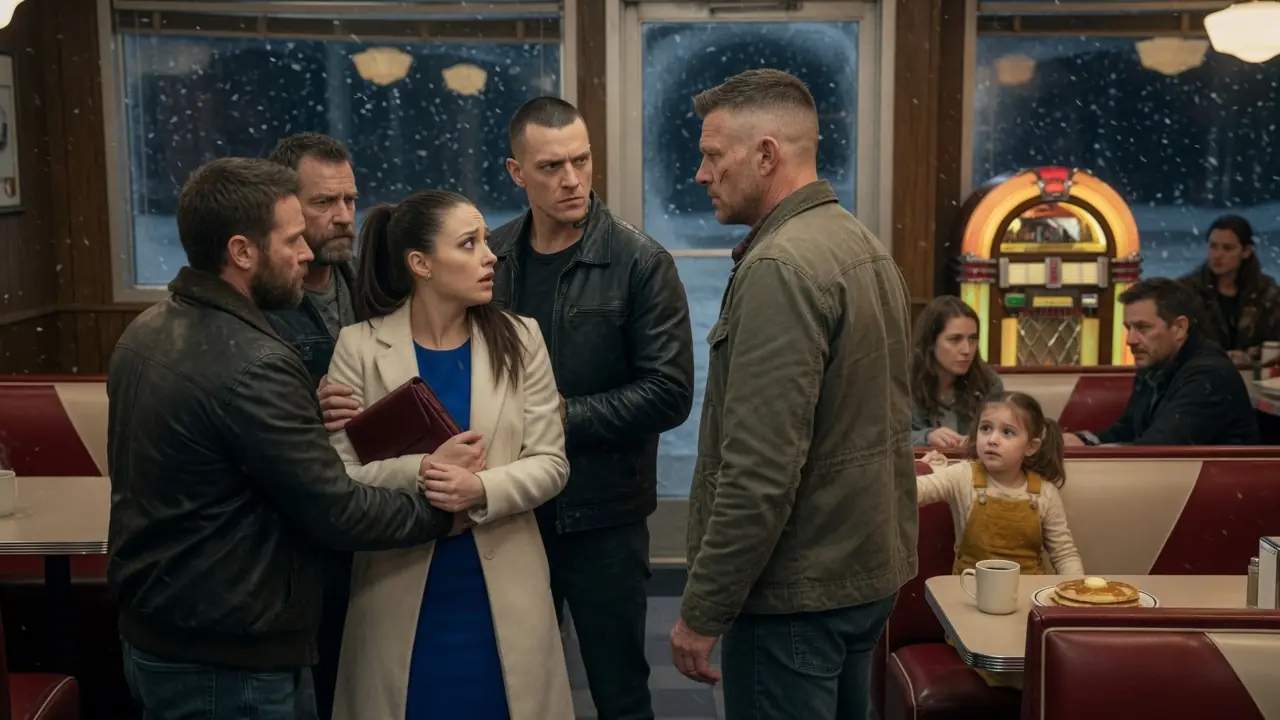
A young woman entered alone.
She appeared to be in her late twenties. Her dark hair was tied in a simple ponytail, and she wore a plain blue dress beneath a thin gray coat.
She looked cold.
But more than that, she looked frightened.
Her hand remained tightly wrapped around the strap of her purse. Her eyes moved rapidly across the room, searching for something or someone.
When she saw the three men, she stopped.
Then she turned toward the door.
The man with the tattoo stepped in front of it.
The second man moved to her left.
The third stood behind her.
They had surrounded her without touching her.
The customers nearest the entrance noticed.
No one said anything.
A truck driver lowered his eyes toward his plate.
An elderly man beside the counter began putting on his coat.
Nora stopped pouring coffee.
The tattooed man leaned close to the woman and spoke quietly.
Daniel could not hear the words.
He saw their effect.
The woman’s shoulders tightened.
She took a step back.
The man moved forward again.
Lucy had stopped eating.
She stared toward the entrance with wide brown eyes.
“Daddy?”
Daniel looked at her.
“Can we help her?”
Her voice was barely louder than the jukebox.
But the question entered him with the force of an order.
Daniel had spent three years trying to create a safe world for Lucy.
A small cabin.
A quiet garage.
Pancakes on Fridays.
No gunfire, no hospitals, no final phone calls in the middle of the night.
He had wanted to teach her that kindness mattered.
Now she was watching to see whether he believed what he had taught her.
Daniel placed his napkin beside his plate.
Then he stood.
The vinyl seat released a soft hiss.
Conversation around the diner faded.
He walked slowly toward the entrance and stopped several feet from the men.
The frightened woman looked at him.
The tattooed man smiled.
“Something you need, old man?”
Daniel was not old.
But he understood that the man wanted to diminish him before deciding whether he was dangerous.
“She wants to leave,” Daniel said.
“We’re talking.”
“She doesn’t appear interested.”
The woman swallowed.
“Please,” she whispered.
The tattooed man turned his head slightly toward her.
“You’ve caused enough trouble.”
Daniel shifted one foot half a step behind the other.
The movement was small.
But all three men noticed it.
The smile disappeared from the tattooed man’s face.
Daniel’s voice remained calm.
“You’re going to move away from the door.”
“This isn’t your business.”
“My daughter asked me to help her.”
The man glanced toward Lucy.
She sat frozen in the booth, still holding her fork.
He laughed.
“You’re risking your neck because a little girl asked you a question?”
Daniel held his gaze.
“I’ve risked it for worse reasons.”
The second man moved his hand toward the inside of his jacket.
Daniel looked directly at him.
“Don’t.”
The man stopped.
There was no shouting.
No threat.
Only certainty.
The kind of certainty people recognized when it came from experience rather than performance.
The tattooed man studied Daniel for several seconds.
Something shifted in his expression.
Recognition.
Not of Daniel’s identity, but of what he was capable of doing.
The man stepped aside.
His companions followed.
“This isn’t over,” he said to the woman.
“It is for tonight,” Daniel replied.
The three men walked out into the rain.
The bell jingled behind them.
For several seconds, no one inside the diner moved.
Then the young woman released a trembling breath.
“Thank you.”
Daniel nodded.
“Do you have someone you can call?”
“Yes.”
“Call them from inside.”
He returned to the booth.
Lucy looked up at him.
“Are you okay?”
“I’m fine.”
“Were those bad men?”
“They were making a bad choice.”
Lucy considered the distinction.
Then she smiled.
“You helped her.”
“You reminded me to.”
She leaned across the table and hugged him.
“You’re my hero.”
Daniel closed his eyes.
He wished the words did not frighten him as much as they did.
The following morning, frost covered the windows of Brooks Auto Repair.
Daniel opened the garage shortly after seven. Lucy sat on a stool near the office, drawing purple race cars while he reviewed the day’s appointments.
Two oil changes.
A damaged alternator.
A transmission inspection he had been postponing because the customer could not yet afford the parts.
It should have been an ordinary Saturday.
At eight twelve, a deep engine sound rolled down the road.
Daniel looked toward the open bay.
Three black Rolls-Royce Phantoms entered the gravel lot one after another.
Their polished bodies looked absurd against the cracked concrete, rusted tool cabinets and snow gathered beside the old fence.
Lucy jumped down from the stool.
“Daddy, are those president cars?”
“I don’t think the president is visiting.”
The rear door of the first car opened.
The woman from the diner stepped out.
But she no longer looked frightened or anonymous.
She wore a tailored cream coat over dark trousers. Her hair was pinned neatly at the back of her neck, and two security officers emerged from the other vehicles before she reached the garage entrance.
Lucy stared.
“Is she a princess?”
The woman smiled.
“No, sweetheart. I’m afraid I’m only grateful.”
Daniel wiped his hands on a rag.
“You look different.”
“I was hoping you would say better.”
“I said different.”
She laughed.
The sound was clear and unguarded.
Then she extended her hand.
“My name is Catherine Vale.”
Daniel recognized it immediately.
Vale Automotive Group owned dealerships, manufacturing plants and luxury vehicle brands throughout the eastern United States.
Catherine was the company’s chief executive and the only child of its late founder.
Daniel looked at the three cars.
“So this isn’t about an oil change.”
“No.”
She lowered her hand when he did not immediately take it.
“I wanted to thank you properly.”
“Three Rolls-Royces seems excessive.”
“They are armored.”
Daniel’s expression changed.
Catherine glanced toward Lucy, then lowered her voice.
“The men in the diner were not random criminals. They work for people attempting to force me out of my company.”
“Why were you alone?”
“I was meeting someone who claimed to possess evidence of financial sabotage inside Vale Automotive. The meeting was a trap.”
“You walked into a diner alone while people were threatening you?”
“I did not claim it was a brilliant decision.”
Daniel looked toward the road.
“Did the police find the men?”
“They disappeared.”
“Then you shouldn’t be here.”
“My security director said the same thing.”
“Sounds like a smart man.”
“He is extremely annoying.”
Lucy walked forward carrying a drawing.
It showed a purple car with stars in place of wheels.
“This is the fastest car in the world,” she told Catherine. “Only nice people can drive it.”
Catherine knelt and accepted the paper.
“What is it called?”
“The Starlight Racer.”
“It’s magnificent.”
Lucy leaned closer.
“You can have it because Daddy says you were scared.”
Daniel cleared his throat.
“I did not say that.”
“You said she needed help.”
Catherine looked up at him.
Her expression had softened.
“Your daughter is very observant.”
“She uses it irresponsibly.”
Lucy returned to her drawings.
Catherine stood.
“I did not come only to say thank you.”
Daniel crossed his arms.
“I assumed there was more.”
“Vale Automotive is planning to build a service and training network across this region. Local garages would receive equipment, technical support and long-term contracts.”
“You want to buy my shop.”
“No. I want to invest in it.”
“Why?”
“Because I need people I can trust.”
“You met me once.”
“I saw you place yourself between a frightened stranger and three armed men without asking her name.”
Daniel glanced toward Lucy.
“I did what she asked.”
“That may be the most convincing recommendation I’ve ever heard.”
Catherine explained the project.
The company wanted regional service centers operated by local owners rather than anonymous corporate managers. The first location would also pilot a training program for veterans struggling to find stable work after leaving the military.
Daniel would retain ownership of his garage.
Vale Automotive would finance renovations and provide vehicles, diagnostic systems and instructors.
Daniel would oversee the veteran program.
He listened without interrupting.
When she finished, he shook his head.
“I fix cars.”
“You also lead people.”
“You don’t know that.”
“I know you were a Marine sergeant.”
Daniel’s eyes narrowed.
“You investigated me.”
“I needed to know who saved my life.”
“I didn’t save your life.”
“You prevented the situation from becoming worse.”
She met his gaze.
“I know about your service. I know you opened this garage with the remainder of your military pension. I know your wife died three years ago and that you have raised Lucy alone since then.”
“That is private.”
“You’re right.”
For the first time, Catherine looked uncertain.
“I apologize.”
Daniel turned toward the garage.
Photographs covered one wall.
His old unit.
Hannah holding newborn Lucy.
Lucy sitting inside an engine compartment wearing safety goggles much too large for her face.
“This place gave us a quiet life,” Daniel said.
“I’m not asking you to abandon it.”
“You are asking me to bring your war into it.”
Catherine looked toward the three armored cars.
“Yes.”
The honesty surprised him.
“You should say no if protecting Lucy requires it,” she continued. “But before you decide, come see what we are trying to build.”
Daniel remained silent.
Lucy walked over and slipped her hand into his.
“Can we help more people, Daddy?”
Catherine did not smile this time.
She waited.
Daniel looked down at his daughter.
“Let me think about it.”
Catherine nodded.
“I’ll return tomorrow without the parade.”
Lucy waved the drawing.
“Drive the Starlight Racer carefully.”
Catherine placed one hand over her heart.
“I will.”
That night, Daniel sat alone at his workbench after Lucy had fallen asleep.
The garage was quiet except for the ticking wall clock and the distant hum of the heater.
He stared at the carburetor in front of him without seeing it.
He had built his life around predictability.
Work.
Home.
Lucy.
The diner on Friday.
Church when he could manage it.
He no longer chased recognition, advancement or purpose beyond keeping his daughter safe.
The arrangement was not ambitious.
But it worked.
Catherine’s offer threatened to change the structure of everything.
It also offered something Daniel had not allowed himself to consider.
The chance to help men and women who had returned from service and discovered that the world no longer knew what to do with them.
He had seen it happen.
A skilled vehicle mechanic stocking supermarket shelves.
A communications specialist sleeping in his car.
A combat medic denied hospital work because his certifications did not transfer.
Daniel had helped a few when he could.
A temporary job.
A recommendation.
A repaired truck at no charge.
But this could become something permanent.
The side door opened.
Catherine entered wearing jeans, boots and a gray coat.
No guards followed her inside.
“You said tomorrow,” Daniel remarked.
“It became tomorrow eleven minutes ago.”
“You came alone.”
“My security team is parked down the road.”
“That does not count as alone.”
“It is the closest I’m permitted to get.”
Daniel gestured toward a folding chair.
She sat beside the workbench.
“You look tired,” he said.
“I’ve spent the last six hours arguing with board members who believe fear is a business strategy.”
“I’ve had similar meetings. Mine involved officers and maps.”
Catherine looked around the garage.
“You chose this place after your wife died.”
“I needed somewhere quiet.”
“And now?”
“I still need somewhere quiet.”
“But perhaps not somewhere small.”
He looked at her.
Catherine leaned forward.
“I want this garage to become the first Vale Veterans Service Center. Training, certification and paid apprenticeships. No publicity games. No speeches about supporting veterans while hiring none of them.”
“You want me to lead it.”
“Yes.”
“I have no corporate experience.”
“That is one of your strongest qualifications.”
Daniel almost smiled.
“You make that sound convincing.”
“I’ve had practice.”
For a moment, neither spoke.
Then Catherine glanced toward the office window where one of Lucy’s drawings had been taped to the glass.
“Your daughter believes helping people makes the world better.”
“She’s four.”
“Children sometimes understand things before adults learn how to complicate them.”
Daniel studied Catherine more carefully.
Behind the composure, he saw exhaustion.
Not weakness.
The exhaustion of someone who had spent years defending every decision, every emotion and every inch of authority.
“You don’t need a hero,” he said.
“No.”
Catherine held his gaze.
“I need a partner.”
The following morning, Catherine returned with the preliminary contracts and a man named Marcus Hale, Vale Automotive’s legal counsel and risk director.
Daniel disliked him immediately.
Marcus wore an expensive navy coat and a smile that never changed enough to become genuine.
He examined the garage as though mentally calculating how quickly it could be demolished.
Lucy handed Catherine another drawing.
This one showed three people beneath a yellow sun.
A tall man.
A dark-haired woman.
A small girl holding both their hands.
“I made you a family,” Lucy explained.
Catherine stared at the paper.
Her voice became quiet.
“Everyone needs one,” Lucy added.
Daniel saw something move across Catherine’s face before she regained control.
Marcus looked away impatiently.
During the contract discussion, Daniel noticed clauses that gave Vale Automotive too much control over staffing and expansion.
He pointed to them.
“These change.”
Marcus smiled.
“They are standard protections.”
“They give your company authority to replace local workers without my approval.”
“The company is funding the facility.”
“Then the company can invest somewhere else.”
Catherine looked at Marcus.
“Remove the clauses.”
“Catherine—”
“Remove them.”
For the first time, Daniel saw the executive beneath the woman from the diner.
Calm.
Direct.
Unmistakably in command.
Marcus gathered the papers.
Then his phone rang.
He stepped outside to answer it.
Several minutes later, he returned looking alarmed.
“We need to leave.”
Catherine stood.
“What happened?”
“Someone accessed your personal files and the regional expansion plans.”
Daniel’s attention sharpened.
“Who knew she was coming here?”
Marcus ignored him.
He took Catherine by the elbow.
Daniel stepped forward.
“Take your hand off her.”
Marcus released her.
Catherine looked between them.
“I’ll call you when I know more,” she told Daniel.
After the town car departed, Daniel stood in the garage entrance watching it disappear down the road.
Something was wrong.
Not only with the corporate conflict.
With Marcus Hale.
The following afternoon, Catherine returned alone.
She explained that the men from the diner worked for Griffin Rourke, the head of an investment group attempting to acquire Vale Automotive.
Rourke had bought several struggling manufacturers, stripped their assets and eliminated thousands of jobs.
Catherine had rejected his offer.
Soon afterward, financial records were stolen, suppliers received threats and several minor accidents occurred at Vale facilities.
“Accidents?” Daniel asked.
“One warehouse fire. Brake failure in a company vehicle. A break-in at my apartment.”
“And the police?”
“Nothing could be traced to Rourke.”
“You believe someone inside your company is helping him.”
“Yes.”
“Marcus?”
Catherine’s expression changed.
“I don’t know.”
“That means you’ve considered it.”
“He worked for my father for fifteen years.”
“That wasn’t my question.”
She looked down.
“No. It wasn’t.”
Daniel walked toward the office window.
Lucy sat outside arranging bolts into separate jars.
“If I agree,” he said, “my daughter becomes visible.”
“I know.”
“If anyone comes near her, the deal ends.”
“I understand.”
“And Marcus does not come to my home or interact with Lucy.”
Catherine nodded.
“Agreed.”
Daniel turned.
“Then I’ll do it.”
Catherine released a breath.
“But we build it honestly,” he continued. “Local workers. Veterans are paid during training. No using wounded people as advertising.”
“Agreed.”
“No promises you cannot keep.”
“Agreed.”
He extended his hand.
Catherine took it.
Lucy ran into the office.
“Did we help her again?”
Daniel knelt.
“I think we’re going to help a lot of people.”
Lucy smiled.
“I knew it.”
The threats began four days later.
The garage telephone rang shortly before noon.
Daniel answered while standing beneath an old pickup.
No one spoke for several seconds.
Then a distorted male voice said, “You should have stayed in your lane, Marine.”
The line went dead.
That evening, Catherine arrived carrying a photograph.
It had been taken from the woods across from the garage.
Lucy was visible in the picture, drawing with sidewalk chalk outside the open bay.
Daniel stared at it.
His face remained still.
But the temperature inside the room seemed to change.
“They know the plans,” Catherine said. “They know you’re leading the veteran program.”
“Who had access?”
“Senior executives, the legal department and my personal staff.”
“Marcus?”
“Yes.”
Daniel placed the photograph on the desk.
“You need to investigate your own company.”
“I already started.”
“That won’t protect Lucy tonight.”
Daniel moved her to his sister’s home in another county.
Lucy cried when he packed her bag.
“Are the bad men coming?”
“No one is coming near you.”
“Are you coming with me?”
“Not tonight.”
She wrapped both arms around his neck.
“Mommy’s star can watch you.”
Daniel held her tightly.
“I’ll be all right.”
After she left, he installed additional cameras around the garage and contacted Sheriff Samuel Boyd, another former Marine.
The cameras recorded a figure near the propane tank at three thirteen the following morning.
The feed cut out seconds later.
Sheriff Boyd watched the footage twice.
“These people aren’t trying to frighten you anymore.”
“I know.”
“They’re preparing something.”
“Then we prepare better.”
Three nights later, the attack came.
Daniel had just returned from visiting Lucy when a dull blast shook the windows of his cabin.
He ran outside.
Flames climbed the western wall of the garage.
Someone had forced open a side entrance and ignited accelerant near the storage room.
Daniel grabbed an extinguisher and entered through the smoke.
He managed to slow the fire until the volunteer department arrived.
The propane tank did not ignite.
No one was injured.
But half the office, the tool-storage wall and one service bay were destroyed.
Lucy returned the following morning with Daniel’s sister.
She stood in the snow looking at the blackened building.
“Did the bad men do this?”
Daniel knelt in front of her.
“We don’t know yet.”
“Are we stopping?”
He looked at the damaged garage.
“No.”
Lucy nodded as though that was the only acceptable answer.
Catherine arrived shortly afterward.
She walked into the burned office without removing her coat.
“I’m suspending the project,” she said.
Daniel wiped soot from a metal cabinet.
“No.”
“Someone tried to burn your garage down.”
“I noticed.”
“Lucy could have been here.”
“She wasn’t.”
“She might be next time.”
Daniel turned.
“That is why stopping now is not enough.”
Catherine stared at him.
“I thought you would walk away.”
“I considered it.”
“What changed?”
He looked toward Lucy, who was helping firefighters collect scattered tools.
“They already brought the fight here. Walking away will not make us invisible again.”
“What do you want to do?”
Daniel erased the old construction timeline from the whiteboard.
“Go public.”
Catherine’s eyes widened.
“Announce the entire program. Hold the launch here. Invite reporters, veterans, local businesses and anyone else willing to stand in daylight.”
“You want to provoke Rourke.”
“I want him to understand he cannot frighten an entire town as easily as he can frighten one mechanic.”
Word spread quickly.
Former Marines Daniel had not spoken to in years arrived with tools and building materials.
The local bakery delivered breakfast each morning.
High-school students helped remove damaged drywall.
The library printed volunteer forms.
Retired electricians rewired the service bay.
Catherine spent every day at the garage.
She carried lumber, answered phones and helped Lucy create a small snack counter labeled:
LUCY’S FUEL STATION
FREE COOKIES FOR HEROES
For the first time, Daniel saw Catherine without a boardroom, security team or carefully controlled schedule around her.
She laughed easily with the volunteers.
She listened when veterans described the difficulty of finding civilian work.
She remembered their names.
One evening, after everyone had gone home, she stood in the center of the rebuilt garage.
“I never believed fear could create anything good,” she said.
“It didn’t.”
Daniel looked around at the new walls.
“People did.”
The investigation finally broke open when one of Daniel’s hidden cameras captured two men placing fuel containers near the garage.
Sheriff Boyd identified them as the same men from the diner.
One accepted a plea agreement and provided records connecting the attacks to Griffin Rourke.
He also revealed that Marcus Hale had been passing Vale Automotive’s confidential information to Rourke in exchange for a promised executive position after the takeover.
Catherine received the news inside Daniel’s office.
She sat very still.
“Marcus worked for my father.”
“That made him useful.”
“I trusted him.”
“That made him dangerous.”
State investigators arrested Marcus at Vale headquarters.
Rourke was taken into custody two days later on charges involving conspiracy, arson, corporate espionage and witness intimidation.
Reporters filled Franklin Ridge.
Daniel agreed to make one statement outside the garage.
Lucy held his hand.
Catherine stood a few feet behind them.
“This is not a story about one mechanic,” Daniel said. “It is about what happens when ordinary people decide not to move aside for fear.”
He gestured toward the garage.
“This place will provide training, employment and a way forward for veterans and local young people who have been told they are too damaged, too inexperienced or too late to begin again.”
He looked directly into the cameras.
“We are not going anywhere.”
The Vale Veterans Service Center opened six weeks later.
The old two-bay shop had become a modern six-bay facility with a classroom, welding area and technical training lab.
Behind the building was a small garden designed by Lucy.
She insisted it was for people who needed somewhere quiet when their hearts felt tired.
The first training class included eight veterans.
One had slept in his truck for nearly a year.
Another had not held a steady job since returning from Iraq.
A former Army medic named Paul had lost custody of his daughter after years of addiction. He told Daniel that he wanted only one thing.
“I want her to be proud of me again.”
Daniel hired him.
Lucy drew a sign for his locker.
BEST MECHANIC IN THE UNIVERSE.
Catherine continued visiting the center.
At first, every visit involved documents, inspections or expansion plans.
Then she began arriving with lunch.
She helped Lucy plant tomatoes.
She stayed after meetings to drink coffee with Daniel on the porch.
Neither spoke about what was growing between them.
They did not need to at first.
One Friday evening, Catherine suggested they take Lucy to the lake.
“Without contracts?” Daniel asked.
“Without contracts.”
“Without security?”
“They’ll remain far enough away to preserve the illusion.”
They drove in Daniel’s old pickup.
Lucy sat between them, talking continuously about marshmallows, frogs and whether fish slept with their eyes open.
At the lake, they built a small fire.
Lucy fell asleep with her head in Catherine’s lap.
Daniel watched the flames for a long time.
“When Hannah died,” he said, “I decided I would never love anyone again.”
Catherine did not move.
“I thought keeping life small would keep Lucy safe. And maybe protect me, too.”
“Did it?”
“For a while.”
He looked at her.
“Then you walked into a diner.”
“You make it sound intentional.”
“Most disasters aren’t.”
Catherine smiled.
Daniel continued quietly.
“I spent years believing the greatest danger was losing someone again.”
“And now?”
“Now I think the greater danger might be refusing to live because loss is possible.”
Catherine reached for his hand.
He allowed their fingers to remain together beside the fire.
Several weeks later, he kissed her in the doorway of his cabin after Lucy had gone to sleep.
It was not dramatic.
There was no audience.
Only two people who had survived different kinds of war and finally decided they no longer wanted to face everything alone.
One year after the night at the diner, three black Rolls-Royces returned to Franklin Ridge.
This time, they carried executives from Vale Automotive’s national board.
They came to approve the expansion of the veteran service program into ten additional states.
Daniel stood outside the garage wearing work jeans and a clean gray shirt.
Lucy, now five, wore a pink apron marked ASSISTANT BOSS.
Catherine stepped from the final car.
She no longer looked like the frightened woman from the diner.
Nor did she look like the guarded executive who had first arrived with security officers and contracts.
She looked like someone who had finally discovered where she belonged.
Lucy ran into her arms.
“You came!”
“Of course. I heard this place has the best cookies in Pennsylvania.”
“We added lemonade.”
“Then I could hardly stay away.”
The board members toured the classrooms, met the trainees and reviewed the results.
More than eighty percent of the program’s first graduates had found permanent employment.
Several had opened their own shops.
Paul had regained visitation with his daughter.
The center had also partnered with the local high school to teach automotive skills to teenagers who struggled in traditional classrooms.
One board member stood beside Catherine and watched the garage floor.
“This does not feel like a corporate program.”
“No,” she said.
“It feels like a family.”
Catherine looked toward Daniel and Lucy.
“That is why it works.”
After the visitors left, Daniel and Catherine sat on the tailgate of his pickup.
Lucy drew chalk hearts across the pavement.
Catherine rested her head against Daniel’s shoulder.
“One year ago, I was afraid to walk into a diner.”
“One year ago, I was trying to finish my eggs.”
“And Lucy asked you to help me.”
Daniel smiled.
“She rarely accepts responsibility for the trouble she causes.”
Catherine watched the little girl.
“She saved both of us.”
They sat in comfortable silence.
Then Catherine spoke.
“I love this town.”
Daniel looked at her.
“I love the garage. I love what we built.”
She paused.
“And I love you.”
Daniel took her hand.
“I’ve loved you longer than I’ve been willing to admit.”
Catherine smiled.
“Are you ready for what happens next?”
“Not even slightly.”
“That does sound like you.”
“But I’m no longer afraid of it.”
Later that summer, a wooden plaque was mounted beside the garage entrance.
It had been carved from cedar recovered after the fire.
The words came from Lucy:
THIS PLACE WAS BUILT ON A QUESTION.
DADDY, CAN WE HELP HER?
LET THE ANSWER ALWAYS BE YES.
The garage expanded.
The veteran program reached other states.
Franklin Ridge grew around it.
New businesses opened.
Families arrived.
Young people who had once believed they had no future learned to repair engines, weld steel and finish what they started.
Daniel never became comfortable with being called a hero.
He still wore flannel shirts.
He still arrived before everyone else.
He still repaired vehicles for elderly customers who could not afford the full bill.
But every Friday evening, he returned to the Maple Street Diner with Lucy and Catherine.
They sat in the same red booth.
Lucy ordered chocolate-chip pancakes.
Catherine ordered coffee she claimed was terrible but continued drinking anyway.
And sometimes Daniel looked toward the entrance and remembered the frightened woman surrounded by three men.
He remembered the customers lowering their eyes.
He remembered Lucy’s hand on his sleeve.
It would have been easy to remain seated.
He had a daughter to protect.
A quiet life to preserve.
A thousand reasonable excuses.
But his little girl had asked whether they could help.
And because she believed the answer should be yes, Daniel had stood.
That single choice did not change the world all at once.
It changed one moment.
Then one life.
Then another.
And the ripple kept moving.