Single Dad Fixed a Woman’s Car on the Way — Not Knowing She Was the Date He Dreaded
Sophia Lauron stood in front of the floor-to-ceiling windows of her twentieth-floor apartment, stared at the city lights below, and seriously considered faking food poisoning to escape the date.
It would have been easy.
One text.
A vague apology.
A promise to reschedule that neither person truly intended to keep.
She had already opened the message box twice.
The last thing Sophia needed was to sit across from a stranger and make polite conversation while her entire company stood three months away from collapse.
Her phone buzzed again.
Another email from the investors.
URGENT: REVISED CASH-RUNWAY PROJECTION REQUIRED BEFORE MONDAY.
Sophia closed her eyes.
Lauron Home had once been described as one of Portland’s fastest-growing sustainable furniture companies. Five years earlier, Sophia had started the business from a borrowed workshop with two carpenters and a collection of reclaimed timber nobody else wanted.
The company now employed eighty-seven people.
It had retail partnerships across the Pacific Northwest.
Its tables, shelves, and cabinets appeared in design magazines beneath words such as thoughtful, modern, and responsible.
From the outside, Lauron Home looked successful.
Inside, it was bleeding.
Shipping costs had doubled.
A major retailer had delayed payment on an order worth nearly eight hundred thousand dollars.
Their primary manufacturer had missed three production deadlines.
Two investors were pushing Sophia to sell controlling interest to a national furniture group that intended to close the Portland workshop and move production overseas.
If Sophia refused, the company might run out of cash before spring.
If she accepted, the business would survive in name while everything she built disappeared.
Her phone buzzed again.
This time, it was a text from her older sister, Elena.
Do not cancel.
Sophia typed back.
I haven’t canceled.
You’re standing by the window thinking about it.
Sophia glanced suspiciously around the apartment, as though Elena might somehow be watching through a hidden camera.
Another message arrived.
You always stand by the window when you’re planning an escape.
Sophia sighed.
Elena had arranged the date.
The man’s name was Daniel Mercer.
Thirty-eight.
Widowed.
One daughter.
Owned a small residential restoration business.
According to Elena, he was “quiet, kind, and capable of repairing almost anything.”
Sophia had responded that those qualities sounded more appropriate for a contractor than a romantic partner.
Elena said that was exactly why she needed to meet him.
Sophia knew almost nothing else.
Daniel apparently knew almost nothing about her, either.
Elena had refused to send photographs.
“You both judge too quickly,” she had said. “Meet like normal people.”
Sophia did not consider blind dates normal.
She considered them interviews conducted without useful preparation.
Her phone rang.
Elena.
Sophia answered.
“I’m going.”
“You sound thrilled.”
“I’m dressed.”
“That is not the same thing.”
Sophia looked down at herself.
She wore a black dress beneath a tailored cream coat. Her hair had been pinned into a loose knot that took twenty minutes to appear effortless.
“I have a company emergency.”
“You’ve had a company emergency every day for four years.”
“This one is different.”
“They’re all different.”
“The investors want another meeting.”
“Tonight?”
“Monday.”
“Then you have sixty hours.”
“Fifty-seven.”
Elena ignored that.
“Dinner is at eight. Rosewood Bistro. His name is Daniel. Be nice.”
“I am always nice.”
“You’re professionally polite. That’s different.”
Sophia reached for her handbag.
“What if we have nothing in common?”
“You both work too much, distrust expensive coffee, and have spent years convincing yourselves you don’t need anyone.”
“That sounds less like compatibility and more like untreated damage.”
“It’s a start.”
Sophia ended the call before Elena could add anything else.
She checked the time.
7:11.
Rosewood Bistro was thirty minutes away in light traffic.
She had plenty of time.
Then her phone buzzed with another investor email.
Sophia opened it while walking toward the elevator.
The investment group had moved the deadline forward.
They wanted her decision by Sunday evening.
Forty-eight hours.
Sophia unlocked her silver Volvo, placed the phone in the center console, and started the engine.
It made a faint whining sound.
She frowned.
The dashboard lights flickered, then stabilized.
The car was only four years old and had been serviced two months earlier.
Sophia pulled out of the garage.
Rain began as she entered the street.
Portland traffic moved slowly beneath wet lights. Wind pushed leaves across the pavement, and the weather report warned of temperatures dropping near freezing later that night.
Sophia drove with one hand on the wheel and dictated notes into her phone.
“Alternative cash scenarios. Reduce retail inventory. Delay spring launch. Negotiate partial payment from Ashton Group.”
The engine whined again.
Louder this time.
A red battery symbol appeared on the dashboard.
Sophia stopped dictating.
“No.”
The headlights dimmed.
The steering grew heavy.
She managed to turn onto a side road before the engine died completely.
The car rolled to a stop beneath an overpass.
For several seconds, Sophia sat with both hands gripping the wheel.
Then she laughed once.
It was not a happy sound.
Of course.
Her company was failing.
Her investors were cornering her.
She was already late for a date she did not want.
Now her car had died on a road where rideshare prices doubled after seven.
She tried starting the engine again.
Nothing.
Her phone showed nineteen percent battery.
Sophia searched for roadside assistance.
Estimated arrival: ninety to one hundred twenty minutes.
She stared at the screen.
The restaurant would close before anyone reached her.
For one irrational moment, she wondered whether this was the universe granting her an excuse.
Then headlights appeared behind her.
A dark green pickup slowed.
Sophia straightened.
The truck stopped several yards back and switched on its hazard lights.
A man stepped out into the rain.
He wore dark jeans, work boots, and a brown canvas jacket over a gray button-down shirt. He was tall, with short dark hair, a trimmed beard, and the tired posture of someone who had spent the day carrying heavy things.
He approached the passenger side rather than the driver’s door.
Sophia lowered the window two inches.
“You all right?” he asked.
“My car died.”
“I gathered.”
She waited.
He remained several feet away.
“Do you have roadside assistance coming?”
“In approximately the next geological era.”
A small smile crossed his face.
“What happened before it stopped?”
“The battery light came on. The steering became heavy.”
“Any smell?”
“Burning rubber. Slightly.”
He looked toward the hood.
“Could be the serpentine belt.”
“Is that bad?”
“Depends on whether it broke or slipped.”
“Those both sound bad.”
“They’re inconvenient.”
Sophia glanced toward his truck.
A little girl sat inside wearing headphones and reading a book beneath the interior light.
The man noticed her looking.
“That’s my daughter, Lily.”
The girl lifted one hand in a distracted wave without looking away from the page.
“My name is Daniel,” the man said. “I own Mercer Restoration. You can search the business before opening the door.”
Sophia’s expression changed slightly.
Daniel.
Mercer.
She almost connected the name.
Then another car passed, spraying water near the curb, and the thought disappeared.
“Do you repair cars too?”
“Mostly houses.”
“That is reassuring.”
“I grew up around engines.”
He nodded toward the hood.
“I can look, or I can wait here until roadside assistance arrives.”
Sophia checked the time.
7:36.
Her date was in twenty-four minutes.
“Look.”
Daniel stepped back while she opened the door.
Rain immediately struck her coat.
He reached into the truck, retrieved a flashlight and a small tool bag, then opened the Volvo’s hood.
Sophia stood beneath an umbrella she found in the trunk.
Daniel leaned over the engine.
Within seconds, he pointed.
“The belt is still there.”
“So the car should work?”
“No.”
“That was briefly hopeful.”
“The tensioner failed. The belt is loose, so the alternator stopped charging and the power steering stopped assisting.”
“Can you fix it?”
“Not properly on the roadside.”
Sophia looked at the dead car.
“Improperly?”
Daniel studied her.
“How far are you going?”
“Rosewood Bistro.”
His eyebrows rose.
“That’s where I’m headed.”
Sophia stared.
“For dinner?”
“Yes.”
“With someone?”
“Unfortunately.”
The word escaped him before he could stop it.
Sophia almost smiled.
“A date you’re looking forward to, then.”
“My sister arranged it.”
“So did mine.”
Daniel glanced at her, but neither seemed to consider the obvious.
The rain grew heavier.
He returned his attention to the engine.
“I may be able to reseat the belt and increase the tension enough for the alternator to charge temporarily.”
“How temporarily?”
“Long enough to reach a safer place. Maybe the restaurant.”
“Maybe?”
“If it slips again, you pull over immediately.”
Sophia looked at her watch.
“Do it.”
Daniel opened the tool bag.
“You say that like you’re approving a construction bid.”
“I spend most of my life approving things under bad conditions.”
“Sounds relaxing.”
He removed a socket wrench, loosened a mounting bolt, and adjusted the tensioner arm manually.
Sophia held the flashlight when his angle blocked the beam.
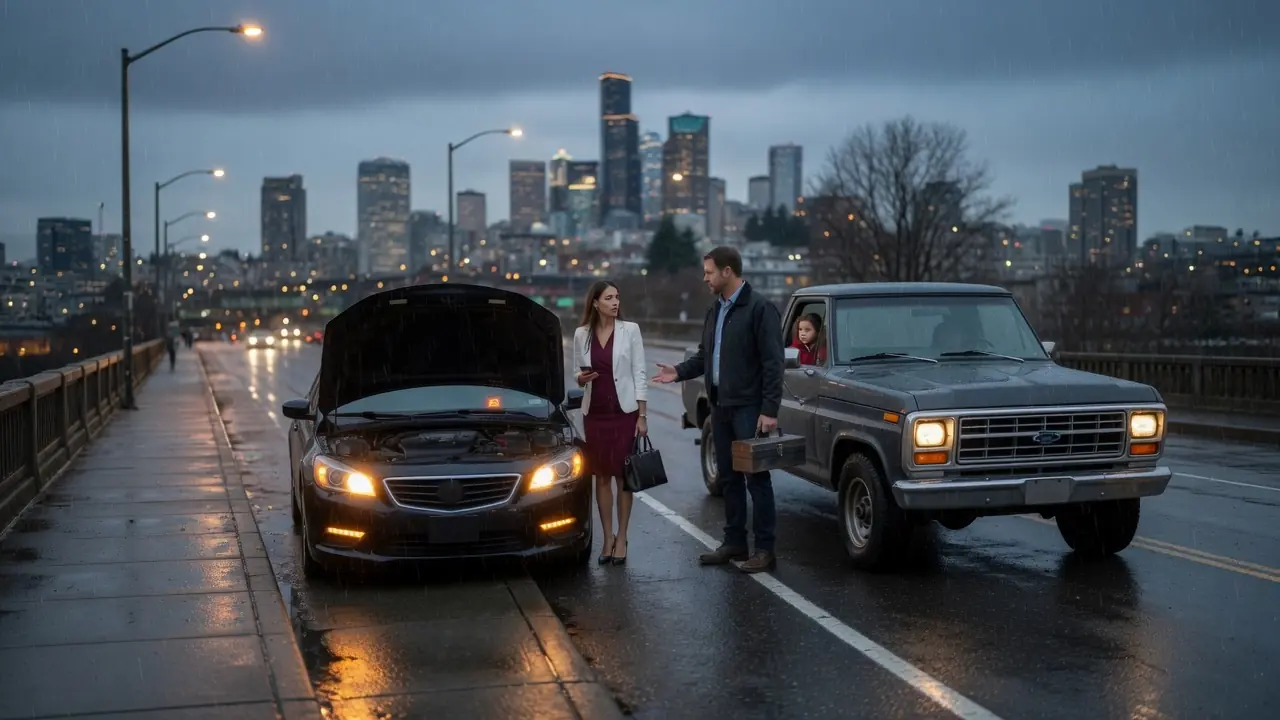
The rain tapped against the open hood.
For several minutes, neither spoke.
Daniel’s hands moved with practiced confidence. His sleeves became soaked, but he did not complain.
Sophia noticed a pale ring around his left ring finger.
Not a ring.
The absence of one.
A mark left by years of wearing it.
She looked away.
“Try the engine,” he said.
Sophia climbed inside.
The car started.
The battery light remained off.
Daniel listened closely.
“It will get you there.”
“You’re sure?”
“No.”
She looked at him through the open door.
“That is an alarming answer.”
“It’s an honest one.”
He closed the hood.
“Follow my truck. If your lights dim or the steering changes, flash your headlights.”
“Then what?”
“I stop.”
Sophia hesitated.
“You’re going to be late.”
“So are you.”
“My date probably already regrets agreeing to this.”
“Mine definitely will.”
Sophia laughed.
It surprised both of them.
Daniel looked at her for half a second longer than necessary.
Then turned toward his truck.
They drove through the rain together.
Daniel kept his speed low and checked his mirror repeatedly.
Sophia followed the green pickup, strangely comforted by the steady red taillights ahead.
For the first time that day, she stopped thinking about the company.
Not completely.
The investor deadline still waited.
The unpaid invoices still existed.
But the problems became quieter behind the simple task of keeping Daniel’s truck in sight.
They reached Rosewood Bistro at 8:08.
The belt held.
Daniel parked near the entrance and walked back to inspect the engine.
Sophia stepped out.
“Still alive?”
“For now.”
She closed the door.
“How much do I owe you?”
“Nothing.”
“You spent half an hour in freezing rain.”
“I was going this direction.”
“You repaired my car.”
“Temporarily.”
“That still has value.”
Daniel shook his head.
“Buy the next stranded person coffee.”
Sophia studied him.
“That is an inefficient business model.”
“I’m told I’m bad at business.”
“You own a company.”
“A small one.”
“Still.”
He looked toward the restaurant.
“I should go meet my date before she decides I’ve stood her up.”
Sophia glanced at her watch.
“I should do the same.”
Daniel held the door open for her.
The restaurant was softly lit and crowded with couples.
A hostess approached.
“Welcome. Reservations?”
Sophia said, “Lauron.”
At the same moment, Daniel said, “Mercer.”
The hostess smiled.
“Yes. Table for two.”
Silence.
Sophia turned slowly.
Daniel looked at her.
The hostess checked the reservation book.
“Daniel Mercer and Sophia Lauron?”
Neither answered immediately.
Then Sophia closed her eyes.
“You’re Daniel.”
“You’re Sophia.”
The hostess looked between them.
“Should I give you a moment?”
“No,” Sophia said.
“Yes,” Daniel said.
They looked at each other.
The hostess wisely stepped away.
Daniel rubbed one hand over his beard.
“My sister said you were an executive.”
“Your sister apparently considered that sufficient identification.”
“My sister said you were intimidating.”
Sophia raised an eyebrow.
“She did?”
“She used the word focused.”
“That was diplomatic.”
Sophia folded her arms.
“You told me you dreaded this date.”
“I said unfortunately.”
“That was worse.”
Daniel winced.
“In my defense, you also implied your date would regret meeting you.”
“That was self-awareness.”
“And mine wasn’t?”
She tried not to smile.
Failed.
Daniel noticed.
“So,” he said, “do we leave and pretend this never happened?”
Sophia considered it.
Twenty minutes earlier, she would have accepted instantly.
But Daniel had stopped for a stranger in the rain even though he was already late.
Explained each step.
Expected nothing.
The man she met beside the road felt more real than any profile Elena could have sent.
“I’m hungry,” Sophia said.
Daniel nodded.
“So am I.”
“And your daughter?”
“With my sister. She dropped Lily off before I found you.”
Sophia glanced back toward the parking lot.
“The little girl in your truck was Lily.”
“Yes.”
“She reads through roadside emergencies?”
“She reads through earthquakes.”
The hostess returned.
“Ready?”
Daniel looked at Sophia.
She nodded.
“Apparently.”
Their table sat near a window overlooking the rain-slicked street.
At first, the conversation felt awkward.
Not because they had nothing to say.
Because both had already revealed more beside the broken car than they intended to share over dinner.
Daniel ordered coffee.
Sophia ordered sparkling water.
When the waiter left, Daniel leaned back.
“I should apologize.”
“For what?”
“Calling the date unfortunate.”
“You didn’t know I was standing there.”
“That does not improve it.”
Sophia rested her hands on the table.
“Why did you agree to come?”
“My sister Rachel believes grief has an expiration date.”
Sophia softened.
“Your wife?”
“Died four years ago.”
“I’m sorry.”
“Thank you.”
He said it quietly, without inviting questions.
Sophia did not push.
“And you?” he asked. “Why did you agree?”
“My sister thinks I’ve replaced a personal life with quarterly projections.”
“Has she?”
Sophia considered.
“Possibly.”
“What kind of company?”
“Furniture.”
“Your company?”
“Yes.”
“Lauron Home?”
She looked surprised.
“You know it?”
“I’ve installed some of your cabinets.”
“For clients?”
“Two kitchens and a library.”
“What did you think?”
“Do you want the polite answer or the useful one?”
Sophia leaned forward.
“The useful one.”
“The joinery was excellent. The mounting system was unnecessarily complicated.”
She stared.
Daniel continued.
“The wall brackets required tolerances that older houses rarely have. In new construction, fine. In a hundred-year-old Portland home, every wall leans.”
Sophia forgot the date entirely.
“Which collection?”
“Orchard Line.”
“We revised the brackets last year.”
“I installed them eighteen months ago.”
“That explains it.”
Daniel smiled.
“You are taking notes in your head.”
“Yes.”
“This is what your sister meant.”
“Probably.”
Their food arrived.
The conversation moved naturally.
Daniel restored old homes rather than replacing their original details. He preferred repairing windows, floors, cabinets, and plaster when most contractors recommended demolition.
Sophia told him Lauron Home began with reclaimed lumber from buildings scheduled to be torn down.
Daniel understood immediately.
“Old wood has already moved,” he said. “If it’s dry and properly milled, it can be more stable than new stock.”
Sophia looked at him.
“Most people hear reclaimed and think decorative.”
“Most people don’t spend their days trying to make a crooked house square.”
They talked through dinner.
Daniel told her about Lily, now nine, who loved astronomy, graphic novels, and correcting adults.
Sophia spoke about Elena, who had arranged the date after threatening to create a dating profile on Sophia’s behalf.
For nearly an hour, Sophia did not check her phone.
Then it buzzed against the table.
The investor’s name appeared.
Daniel noticed her expression change.
“You need to answer?”
“No.”
“That looked like a yes.”
Sophia turned the phone face down.
“It can wait.”
“Work emergency?”
“Something like that.”
Daniel did not ask immediately.
Instead, he poured more water into her glass.
“What happens if you don’t answer?”
Sophia looked at him.
“The company may stop being mine.”
Daniel sat back.
She had not intended to say it.
But the words were already between them.
Sophia explained.
Not every detail.
Enough.
The delayed payment.
The cash shortage.
The acquisition offer.
The investors who wanted to protect their money by moving production away from Portland.
“How many people work for you?” Daniel asked.
“Eighty-seven.”
“And moving production would affect how many?”
“Most of them.”
Daniel’s face tightened.
“That’s why you’re fighting.”
“I’m fighting because the company was built around local production.”
“Those sound like the same reason.”
“They aren’t.”
“They are if the people are part of what you built.”
Sophia looked down.
“That is not how investors calculate value.”
“No.”
Daniel’s voice remained calm.
“But you didn’t start the company because investors told you to.”
“I may lose it because I didn’t listen to them soon enough.”
“What do they want you to do?”
“Sell control.”
“What do you want?”
“To find another way.”
“Then find one.”
Sophia gave a tired laugh.
“You make that sound simple.”
“I didn’t say simple.”
“You repair houses. You know some things cannot be saved.”
Daniel nodded.
“Yes.”
“And?”
“The first question is not whether something can be saved.”
“What is it?”
“Whether the foundation is still sound.”
Sophia became still.
Daniel continued.
“If the foundation is bad, cosmetic repairs waste money. If the foundation is good, you stop tearing things out long enough to find where the real failure started.”
She thought about Lauron Home.
Sales remained strong.
Customers still wanted the products.
Employees were skilled.
The brand had value.
The company was not failing because the market disappeared.
It was failing because cash was trapped in one unpaid account and production was tied to an unreliable supplier.
The foundation was not broken.
The systems around it were.
Daniel watched her expression.
“You’re doing it again.”
“What?”
“Taking notes in your head.”
Sophia almost smiled.
“You may have just ruined the rest of your evening.”
“Why?”
“Because now I want to ask you about manufacturing.”
“I restore staircases.”
“You understand workflow.”
“I understand wood.”
“That’s enough.”
They stayed until the restaurant began clearing empty tables.
When they stepped outside, the rain had slowed.
Daniel checked Sophia’s car.
The belt remained in place, but he frowned.
“You should not drive this home.”
“It made it here.”
“That does not mean it will make it farther.”
“I can call a tow.”
“I’ll wait.”
“You already saved me once.”
“I temporarily repaired your car.”
“Your insistence on technical accuracy is exhausting.”
“It protects me from lawsuits.”
The tow truck took forty minutes.
They stood beneath the restaurant awning drinking paper cups of coffee the staff gave them before closing.
Sophia’s phone buzzed repeatedly.
She ignored it.
Daniel asked about her first furniture design.
Sophia asked about the oldest house he had restored.
When the tow truck arrived, Daniel drove her home.
They stopped outside her building after midnight.
Neither moved immediately.
Sophia looked toward him.
“This was not the date I expected.”
“Better or worse?”
“More mechanical.”
“That is fair.”
“And better.”
Daniel’s expression softened.
“Better for me too.”
She reached for the door handle.
“Sophia.”
“Yes?”
“I’d like to see you again.”
She looked at him.
“Without a broken car?”
“Preferably.”
“No investors?”
“That may be unrealistic.”
“No blind-date ambush?”
“Definitely.”
Sophia smiled.
“All right.”
Their second date happened four days later.
By then, Sophia had rejected the acquisition offer.
Her investors were furious.
She had forty-five days to secure alternative financing or the board could force another vote.
Daniel listened while she explained it over coffee.
Then he asked to see the workshop.
Sophia hesitated.
“It isn’t part of the date.”
“I know.”
“You don’t have to help solve my company.”
“I’m curious.”
“That is how unpaid consulting begins.”
Daniel smiled.
“You bought the coffee.”
The following Saturday, Sophia took him through Lauron Home’s production facility.
The main workshop occupied a converted warehouse near the river.
Rows of worktables stood beneath high windows. Lumber racks filled one wall. Finished cabinets waited for shipment in carefully labeled sections.
Daniel walked slowly.
He touched nothing without asking.
He spoke with the floor manager, the finishing supervisor, and two carpenters.
Sophia expected him to focus on craftsmanship.
Instead, he watched movement.
How materials entered.
Where components waited.
Which steps stopped when another department fell behind.
At the end of the tour, he pointed toward twelve unfinished dining tables.
“Why are those waiting?”
“Hardware.”
“From the manufacturer causing delays?”
“Yes.”
“Custom hardware?”
“Brackets and leveling assemblies.”
“Can they be made locally?”
“The investor model says no.”
“I didn’t ask what the model says.”
Sophia crossed her arms.
“Local production would cost more.”
“How much does waiting cost?”
She did not answer.
Daniel continued.
“How much does missing delivery cost? Storage? Refunds? Staff hours spent rescheduling?”
Sophia looked toward the tables.
The offshore hardware looked cheaper per unit.
But the delays created expenses scattered across the company, where nobody had calculated them together.
“You think the savings are false.”
“I think the price is incomplete.”
That Monday, Sophia ordered a full cost analysis.
Daniel was right.
When late fees, rework, storage, freight changes, and canceled orders were included, the imported components cost eighteen percent more than locally produced alternatives.
Sophia contacted three Oregon metal shops.
One could begin within two weeks.
Another offered favorable terms in exchange for a longer contract.
The third introduced her to a regional manufacturing cooperative with unused capacity.
It did not solve everything.
But it gave Sophia a way to restart delayed production.
The more urgent problem remained the unpaid retailer invoice.
Ashton Group continued postponing payment while demanding new shipments.
Sophia’s finance director wanted to stop deliveries.
The investors feared losing the customer.
Daniel asked one question.
“Do they need you more than you think?”
Sophia reviewed the contract.
Lauron Home’s products represented the retailer’s best-performing premium collection in the Northwest.
Canceling the line would damage both companies.
Sophia suspended future shipments until Ashton paid half the outstanding balance.
The retailer threatened legal action.
Sophia waited.
Three days later, they paid sixty percent.
The company gained another two months of runway.
Daniel never claimed credit.
He continued working on houses, attending Lily’s school events, and meeting Sophia when both schedules allowed.
Their relationship grew in small pieces.
He repaired the loose cabinet door in her apartment only after she tried to pay him.
She attended Lily’s science fair and spent forty minutes helping her explain a model of Saturn’s rings.
Daniel cooked.
Sophia ordered dessert.
They disagreed about music.
Agreed about architecture.
Argued over whether a hundred-year-old floor should remain uneven.
Daniel said the slope told the house’s history.
Sophia said history should not make furniture wobble.
Lily said they were both annoying.
Three months after the roadside meeting, Lauron Home remained alive.
Sophia secured a bridge loan from a regional development fund that valued local manufacturing.
Several employees invested small amounts through a new ownership plan.
Sophia gave up some equity.
Not control.
The company did not suddenly become safe.
But it had time.
On the day the financing closed, Sophia drove to Daniel’s current restoration project.
He was repairing the porch of a 1912 craftsman house.
She stood at the bottom of the steps holding a bottle of champagne.
Daniel looked up.
“Good news?”
“We closed.”
He climbed down.
“You kept the company.”
“We kept the company.”
Daniel noticed the word.
“We?”
“My team.”
“Right.”
“And possibly one unpaid operational consultant.”
“I accepted coffee.”
Sophia handed him the bottle.
“You did more than that.”
Daniel shook his head.
“You knew your business.”
“I knew every number.”
“That is different.”
“You helped me see the structure.”
He looked toward the old house.
“Sometimes it’s easier to see someone else’s cracks.”
Sophia’s smile faded slightly.
Daniel noticed.
“What?”
“You do that.”
“Do what?”
“Help everyone else repair things while pretending you don’t need anything.”
He stepped back.
“Sophia—”
“You still wear your wedding ring on a chain.”
His hand moved instinctively toward his shirt.
She had noticed it weeks earlier when the chain appeared above his collar.
“I’m not asking you to remove it.”
“I know.”
“I’m asking whether you actually want this.”
Daniel looked toward the porch.
“My wife’s name was Anna.”
Sophia waited.
“She died in a car accident.”
His voice remained steady, but only because he had learned to hold it that way.
“Lily was four.”
“I’m sorry.”
“I spent years believing that wanting someone again meant I had failed to love Anna properly.”
Sophia set the champagne on the railing.
“And now?”
“Now I know grief doesn’t work like loyalty.”
He looked at her.
“But knowing is not the same as being fearless.”
“I’m not asking for fearless.”
“What are you asking for?”
“Honesty.”
Daniel breathed slowly.
“I think about you when something good happens.”
Sophia’s expression softened.
“I think about calling you when something breaks, even when it isn’t mechanical.”
He stepped closer.
“I am terrified of building a life that can disappear again.”
Sophia looked directly at him.
“My company nearly disappeared while everyone kept telling me to protect myself by giving it away.”
Daniel said nothing.
She continued.
“I learned that fear can sound very practical.”
A faint smile touched his face.
“That sounds like something I would say.”
“You’ve become irritatingly influential.”
He moved closer.
“What do you want, Sophia?”
“You.”
The answer surprised both of them with its simplicity.
“Not because you rescued me. Not because you helped the company.”
She looked toward the house.
“Because you stop when other people keep driving.”
Daniel touched her cheek.
Their first kiss was quiet.
No rain.
No dramatic music.
Only the smell of sawdust, an old porch beneath their feet, and the sense that both had finally stopped treating caution as a substitute for safety.
A year later, Sophia’s Volvo died again.
This time, in Daniel’s driveway.
He opened the hood and stared.
She stood beside him with Lily, now ten, holding a flashlight.
Daniel looked toward Sophia.
“Did you ignore the warning light?”
“It appeared recently.”
“How recently?”
“Tuesday.”
“It’s Saturday.”
“I was busy.”
Lily shook her head.
“This relationship is built on poor vehicle maintenance.”
Sophia laughed.
Daniel repaired the loose battery connection in five minutes.
That evening, they drove to Rosewood Bistro for the anniversary of their first date.
Elena and Rachel had arranged to meet there too.
The sisters finally admitted they had shown each other photographs before setting up the original date.
Sophia stared.
“You said we were meeting like normal people.”
Elena lifted her glass.
“You would have researched him.”
Daniel looked at Rachel.
“She absolutely researched Sophia.”
“I found the company website,” Rachel said.
“That is research.”
Sophia narrowed her eyes.
“Did either of you know we would be on the same road?”
“No,” Elena said.
“That part was luck.”
Daniel looked toward Sophia.
“Mechanical failure.”
She smiled.
“Temporary inconvenience.”
After dinner, Daniel asked Sophia to walk with him.
They stopped beneath the restaurant awning where they had waited for her tow truck one year earlier.
Rain moved softly across the street.
Daniel reached into his coat.
Sophia looked at him.
“Is that a tensioner?”
“No.”
“A replacement belt?”
“No.”
“Then I’m concerned.”
He took out a small wooden box.
Inside was a ring set with a simple oval stone.
The box itself had been made from reclaimed walnut used in Sophia’s first furniture collection.
Daniel lowered himself onto one knee.
“The night we met, I thought I was helping a stranded woman.”
Sophia’s eyes filled.
“You were.”
“I didn’t know she was the date I had already decided to dread.”
“That part remains offensive.”
“I know.”
He smiled.
“But you became the person I look for in every room. The person Lily trusts. The person who taught me that preserving the past does not mean refusing to build anything new.”
He held up the ring.
“Sophia Lauron, will you let me keep repairing things beside you?”
She wiped one tear away.
“You understand I will still call professionals when necessary.”
“Reasonable.”
“And I’m not changing the name of the company.”
“I didn’t ask.”
“And your old floors are still crooked.”
“They have character.”
“Yes.”
Daniel blinked.
“Yes to the floors?”
“Yes to you.”
He stood and slipped the ring onto her finger.
Inside the restaurant window, Elena, Rachel, and Lily were pretending not to watch.
Lily pressed both hands against the glass and cheered.
Sophia laughed.
Years later, people who heard the story often focused on the coincidence.
A man stopped to repair a stranger’s car without realizing she was the blind date he already feared meeting.
But Sophia never believed the coincidence was the most important part.
Daniel could have driven past.
She could have refused his help.
They could have discovered each other’s names at the restaurant and left out of embarrassment.
Instead, he stopped.
She trusted him one careful step at a time.
And both stayed long enough to learn that the person beside the broken car was far more interesting than the stranger they had imagined across a dinner table.
Lauron Home survived.
It remained in Portland.
The workshop expanded into the building next door, and Daniel’s restoration company became one of its regular partners for custom installations in older homes.
They argued about mounting brackets for the next decade.
Sophia still worked too much.
Daniel still repaired things other people wanted to replace.
Lily grew into a teenager who claimed responsibility for their marriage because she had waved from the truck and made Sophia feel safe enough to accept help.
Nobody corrected her.
The silver Volvo was eventually sold.
Daniel suggested replacing it years earlier.
Sophia refused until the transmission failed beyond reasonable repair.
When the tow truck carried it away, she stood beside Daniel in their driveway.
“You look emotional,” he said.
“It was a reliable car.”
“It broke down the night we met.”
“Exactly.”
Daniel took her hand.
The car had failed at the worst possible time.
Sophia’s company had been failing too.
So had her belief that she could carry every burden without allowing anyone close enough to see it.
Daniel had not repaired all of that beside the road.
He had only tightened one failing part long enough to help her reach the next place safely.
Sometimes that was how love began.
Not by solving an entire life at once.
By stopping.
Opening the hood.
Finding what had slipped loose.
And staying nearby until the person was ready to move again.