The silk scarf was the first thing Daniel Marsh noticed.
It lay half-buried in the dirty snow beside the curb, its deep blue fabric shifting whenever the wind rushed between the downtown buildings. Hundreds of people passed it without looking down.
Daniel almost did the same.
He had already worked ten hours inside Halsted Cold Storage, moving pallets through rooms kept so cold that winter outside usually felt mild by comparison. His back hurt, his gloves were damp, and the only thing on his mind was reaching home before the soup on the stove cooked down to salt and noodles.
Then he saw the woman sitting beside the scarf.
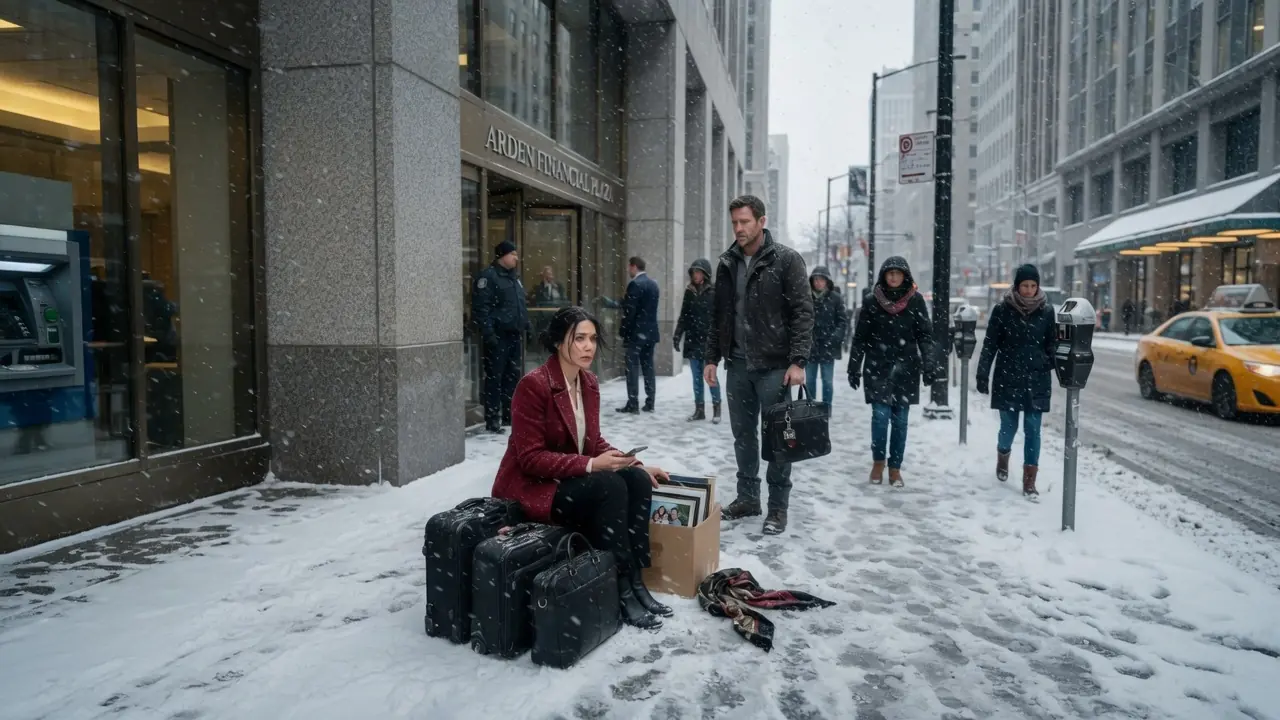
She sat on one of two large suitcases outside the revolving doors of Arden Financial Plaza. A cardboard box rested at her feet. A leather briefcase lay in the snow beside it.
She wore an expensive charcoal coat, but it had not been designed for standing still in a Chicago storm. Snow had gathered along her shoulders and in her dark hair.
People slowed long enough to recognize her.
Some whispered.
One man in a delivery jacket lifted his phone and began recording.
Through the glass doors, a security guard watched from the warm lobby without moving.
Daniel stopped.
The woman’s face was familiar, although he could not immediately place it. She looked to be in her late thirties. Her posture remained straight despite the cold, as if some part of her still refused to collapse in public.
But her hands betrayed her.
They were trembling.
Daniel bent down and picked up the scarf.
He brushed off the snow, folded it once, then again, and held it toward her.
She looked up sharply.
Her eyes were nearly black.
Whatever composure she had once possessed was still visible in her face, but only as a cracked outline. She looked like someone accustomed to maintaining perfect surfaces who had suddenly discovered there was nothing beneath her feet.
“Hey,” Daniel said. “Are you okay?”
It was a foolish question.
He knew that as soon as he spoke.
She glanced at the suitcases, the box, and the glass doors behind her.
“I’m fine,” she said. “I only need a minute.”
Her voice was controlled and precise.
The voice of someone who expected emergencies to wait until she finished speaking.
Daniel looked through the revolving doors.
The guard immediately turned away.
A man in a dark suit stood near the elevators. He had been watching the woman, but when Daniel met his eyes, he looked down at his phone.
Daniel raised his gaze toward the silver letters above the entrance.
ARDEN FINANCIAL PLAZA.
He had seen the building’s name recently.
Then he remembered.
A headline in the business section of the Chicago Tribune, read while he waited for his break to end.
CARTER DYNAMICS BOARD REMOVES FOUNDER IN SURPRISE LEADERSHIP VOTE.
Daniel looked at the woman again.
“You’re Sophia Carter.”
It was not really a question.
She said nothing.
The crowd had thinned. The delivery driver finally lowered his phone and continued down the sidewalk. Snow collected on the cardboard box.
Daniel noticed a framed photograph near the top, wrapped loosely in newspaper.
He picked up one suitcase.
Sophia stood.
“What are you doing?”
“It’s eleven below zero.”
“I can manage my own luggage.”
“I’m sure you can.”
He lifted the second suitcase.
“But nobody manages well after sitting in snow for half an hour.”
“I have not been here half an hour.”
“Twenty minutes, then.”
She looked offended that he had noticed.
“I have people I can call.”
Daniel glanced at the phone in her hand.
The screen remained dark.
“Call them somewhere warm.”
“I don’t know you.”
“Daniel Marsh.”
He shifted the suitcases in his hands.
“I work at Halsted Cold Storage. I have a nine-year-old daughter named Abigail, an apartment four train stops north, and chicken soup on the stove. That’s the entire sales pitch.”
“You invite strange women into your home often?”
“Only the ones being publicly removed from office buildings during snowstorms.”
“This is insane.”
“Probably.”
Daniel did not argue.
He simply waited.
The wind swept another line of snow across the sidewalk.
Sophia turned toward the revolving doors.
The security guard was no longer visible.
Neither was the man near the elevators.
She looked down at the cardboard box containing what appeared to be the final pieces of a life she had spent nearly twenty years building.
“I need the box,” she said.
“I’ll carry it.”
“I can carry something.”
Daniel nodded toward the briefcase.
“You take that.”
She almost objected again.
Then she picked up the briefcase and the cardboard box.
Together, they walked toward the train station.
Neither spoke about the people filming.
Neither spoke about the company.
Daniel did not ask how a woman who had founded one of the country’s fastest-growing software firms had ended up sitting outside her own headquarters in the snow.
He assumed she would tell him if she wanted him to know.
If she did not, soup did not require an explanation.
Daniel lived in a third-floor apartment on South Loomis Street in Pilsen.
The elevator had stopped working in October. A handwritten sign still promised that repairs would begin “soon.”
They carried Sophia’s belongings up the stairs.
Daniel took the suitcases.
Sophia carried the box and briefcase.
“Second landing,” he said. “Then left.”
“That is not encouraging.”
“You should see it as free cardiovascular exercise.”
She gave him the faintest look of disbelief.
It was the first expression she had made that did not appear carefully selected.
The apartment was small but clean.
The living room also served as the dining room. The kitchen was narrow enough that two people could not pass without one turning sideways. A short hallway led to one bedroom and one bathroom.
A faded quilt was folded on one end of the couch.
On the kitchen table lay a half-finished drawing of the water cycle.
EVAPORATION.
CONDENSATION.
PRECIPITATION.
The arrows were too large, but the science appeared correct.
Carolyn Briggs, Daniel’s sixty-eight-year-old neighbor, sat in the armchair reading a mystery novel.
She looked at Daniel.
Then at Sophia.
Then at the suitcases.
Her face settled into the careful neutrality of someone experiencing enormous curiosity but refusing to embarrass anyone with it.
“Carolyn,” Daniel said, “this is Sophia.”
“I assumed as much.”
“You know who I am?” Sophia asked.
Carolyn closed her book.
“I read newspapers.”
Daniel placed the suitcases beside the wall.
“Sophia will stay here tonight.”
Sophia turned toward him.
“I haven’t agreed to that.”
“You can argue after your hands stop shaking.”
Carolyn stood and collected her coat.
“Abigail is asleep,” she told Daniel. “We finished the water cycle, although she strongly believes clouds make decisions.”
“She has theories.”
At the doorway, Carolyn paused beside Sophia.
“There’s soup on the stove,” she said gently. “He makes it well.”
Then she left.
Daniel filled a bowl without asking whether Sophia was hungry.
He placed it on the table with a spoon.
She remained standing in her coat.
“You should take that off.”
“I won’t be staying.”
“Then you can put it back on when you leave.”
He returned to the stove and filled a second bowl.
Sophia sat.
The soup was simple.
Chicken broth.
Egg noodles.
Carrots.
Celery.
A bay leaf Daniel would forget to remove until someone found it.
Sophia took one spoonful.
Then another.
Daniel carried both suitcases down the hallway.
“You can use my room.”
She looked up.
“I’m not taking your bedroom.”
“The couch is comfortable.”
“You have a daughter.”
“She has her own room.”
“And where will you sleep?”
“On the couch.”
“I can sleep there.”
“You were sitting in a snowstorm less than an hour ago. You get the bed.”
He said it without false gallantry.
It was only a practical decision.
Sophia studied him as he sat across from her.
“Why are you doing this?”
Daniel considered the question.
Not because the answer was difficult, but because he did not want to decorate it.
“You were sitting outside with your life in a cardboard box,” he said. “Everyone else walked past.”
“I have attorneys.”
“I assumed so.”
“I have friends.”
“I hope so.”
“I have options.”
“Then use them tomorrow.”
She looked down at the soup.
“This is not pity?”
“No.”
“What is it?”
“A warm room.”
He tore a piece of bread in half.
“A couch. Soup. Nothing else.”
Sophia’s eyes shifted.
For one second, something inside her threatened to surface.
Grief.
Humiliation.
Relief.
Perhaps all three.
She lowered her face and continued eating.
The silence between them was not uncomfortable.
It was simply honest.
Daniel had spent enough time around exhausted people to know that conversation was sometimes another demand.
When Sophia finished, he showed her the bedroom and placed fresh towels outside the bathroom.
“There’s a new toothbrush under the sink.”
“You keep spare toothbrushes?”
“I have a nine-year-old. Children create emergencies adults cannot predict.”
She stood in the doorway of his room.
The bed was neatly made. A photograph on the dresser showed Daniel beside a smiling woman and a much younger Abigail.
Sophia noticed it.
Daniel noticed her noticing.
“My wife, Elena,” he said. “She died five years ago.”
“I’m sorry.”
“Thank you.”
He turned toward the hallway.
“Good night, Sophia.”
“Daniel.”
He looked back.
She held the silk scarf.
“Thank you.”
He nodded once.
“You’re welcome.”
The following morning, Sophia woke to a child laughing.
For several seconds, she did not know where she was.
The room smelled faintly of laundry soap. Snowy daylight entered through inexpensive blinds. The sounds of a spatula against a pan and a child arguing about toast came from the kitchen.
Sophia sat up.
She had fallen asleep fully dressed.
At some point during the night, she had removed her coat and placed it over the chair. Her briefcase rested beside the bed.
She walked into the living room.
Abigail sat at the kitchen table in purple pajamas, adding blue marker to the water-cycle drawing.
She had Daniel’s brown eyes and Elena’s dark curls.
Abigail looked up.
“You’re awake.”
“Apparently.”
“I’m Abigail.”
“Sophia.”
“I know. Dad told me.”
Daniel stood at the stove making eggs.
“Coffee’s on the counter,” he said. “Milk’s in the fridge.”
Abigail examined Sophia openly.
“Dad said you lost your company.”
Daniel turned.
“I said she was having trouble with her company.”
“That means she lost it.”
Sophia sat at the table.
“Temporarily.”
Abigail nodded as if the clarification mattered.
“That’s sad.”
“It is.”
“You can stay here until you find it.”
Sophia almost laughed.
“I’m not sure companies work that way.”
“Everything is somewhere.”
Daniel placed a plate in front of Sophia.
“Eat before she reorganizes your entire life.”
Abigail pointed at her drawing.
“Do you know about condensation?”
“A little.”
“I think clouds get full and then the water falls out.”
“That is broadly correct.”
Daniel placed Abigail’s breakfast beside her.
“She also believes rain has opinions.”
“It does,” Abigail said. “Some rain is mean.”
Sophia looked toward the snow outside.
After breakfast, Sophia began making calls.
Her phone had accumulated dozens of messages.
Some came from attorneys.
Some came from reporters.
Several were from executives who claimed to be concerned but had voted against her the previous afternoon.
She ignored those.
Daniel prepared for work.
“You can stay here today.”
“I should find a hotel.”
“You can.”
He put on his warehouse jacket.
“But you don’t have to decide in the next ten minutes.”
Sophia looked around the small apartment.
“I may need several days.”
“Then take several.”
“I can pay you.”
“No.”
“Daniel—”
“No.”
He pulled on his gloves.
“You can buy groceries if staying without contributing makes you uncomfortable.”
“It does.”
“Then buy groceries.”
He looked at Abigail.
“School bag.”
She ran toward her room.
Daniel lowered his voice.
“Carolyn is next door. She has a key. Call me if anyone bothers you.”
“I am capable of protecting myself.”
“I believe you.”
“Then why say that?”
“Because capable people still deserve backup.”
The sentence stayed with Sophia long after he left.
The days developed an unexpected rhythm.
Sophia spent mornings at the kitchen table with her laptop, reviewing financial records and speaking to attorneys in controlled tones.
Daniel worked at the warehouse.
Abigail attended school, returning in the afternoon with stories, questions and worksheets.
At night, the three ate together.
Sophia tried to book a hotel twice.
Both times, she stopped before confirming the reservation.
The first time, Abigail asked whether she could help build a model volcano.
The second time, Daniel returned from work with a fever and insisted he was fine until Sophia ordered him to sit down.
She made the soup that evening.
It was not as good as his.
Abigail ate two bowls anyway.
Sophia learned that Daniel had once studied mechanical engineering at community college. He had left when Elena became pregnant and taken warehouse work because it offered reliable insurance.
He never returned to school.
He worked overtime when available and repaired appliances for neighbors on weekends.
His life was small only when measured by money.
In every other way, it appeared full.
Daniel learned that Sophia had founded Carter Dynamics at twenty-three from a rented office above a dental practice.
She had built inventory-management software for manufacturers and retailers. Within fifteen years, the company employed more than eight thousand people.
The board removed her after she refused to approve a merger that would have eliminated nearly two thousand jobs.
“They said I had become emotionally attached to the workforce,” she told him one night.
Daniel sat across from her with tea.
“Were you?”
“Yes.”
“Then they were right.”
“That is not considered a compliment in business.”
“It should be.”
Sophia looked at the headlines on her laptop.
They described her as unstable.
Difficult.
Unable to adapt.
One article suggested that her removal had been necessary to protect the company from its founder’s declining judgment.
“They made it look like I failed,” she said.
“People who take something always rewrite the story so they appear entitled to it.”
“You sound certain.”
“I work in a warehouse.”
He lifted his mug.
“I’ve seen supervisors take credit for ideas from people they later fired.”
“That is not the same.”
“Different building. Same behavior.”
She closed the laptop.
“Why do you believe the truth eventually matters?”
Daniel glanced toward Abigail’s bedroom.
“Because I’m raising a child.”
Sophia waited.
“If truth doesn’t matter,” he continued, “then everything I teach her is decoration.”
The legal fight intensified.
Sophia’s former board had prepared carefully.
Documents were missing.
Access logs had been altered.
Two executives she had trusted denied conversations they had held only weeks earlier.
Her corporate apartment was owned through the company, which explained why her belongings had been packed and placed outside.
Her personal accounts remained accessible, but several assets were tied up in pending litigation.
She was not poor.
But for the first time in her adult life, money did not immediately solve the problem.
Daniel never asked what she had.
He never asked what staying in his apartment might eventually be worth.
He accepted grocery money only after Sophia began arriving home with enough food to supply an army.
“You bought six kinds of cheese,” he said.
“I didn’t know what you liked.”
“One kind would have been a reasonable experiment.”
Abigail opened the refrigerator.
“I like all six.”
Sophia became part of the household almost without anyone deciding it.
She corrected Abigail’s water-cycle diagram.
She read books at bedtime when Daniel worked late.
She learned how to cook three meals that did not involve ordering food.
She washed dishes, although Daniel repeatedly informed her that placing them near the sink did not count.
Abigail asked about office towers, private planes and meetings with senators.
Sophia answered honestly.
Then Abigail asked whether rich people became lonely.
Sophia took longer to answer.
“Yes,” she finally said. “Sometimes they become very good at hiding it.”
One afternoon, Abigail arrived home carrying a drawing.
It showed three figures holding hands.
One was tall and broad.
One wore a dark coat.
The smallest stood between them beneath an enormous yellow sun.
“That’s us,” Abigail said.
Sophia looked at the picture.
The room became strangely quiet.
Daniel stood near the kitchen counter watching her.
Abigail pointed.
“That’s Dad. That’s me. That’s you.”
Sophia touched the paper.
“You made me very tall.”
“You wear tall shoes.”
Daniel looked away to hide a smile.
Abigail taped the drawing to the refrigerator beside the water cycle.
Sophia remained in front of it for several seconds after the child ran to her room.
“I should probably find my own place,” she said.
Daniel’s expression did not change.
“Do you want to?”
“No.”
“Then don’t decide because you think you’re supposed to.”
She looked at him.
“You make everything sound simple.”
“No. I remove the parts people add to avoid saying what they mean.”
“And what do you mean?”
Daniel opened the refrigerator.
“I mean dinner will be ready at seven.”
It was not an answer.
It was also an answer.
The knock came on a Thursday evening.
A well-dressed man stood in the hallway holding a sealed envelope.
“Ms. Carter?”
Sophia stepped forward.
“I’m with Bellman and Lowe. This is from the board.”
He gave her the envelope and left without meeting Daniel’s eyes.
Sophia opened it at the kitchen table.
The board offered a settlement.
She would receive a substantial payment, retain her remaining stock and agree never to speak publicly about the circumstances of her removal.
The agreement also prohibited her from starting a competing company for five years.
Daniel read nothing over her shoulder.
He waited until she put the letter down.
“What are you going to do?”
Sophia folded the pages slowly.
“I’m going to fight them.”
“Good.”
“You don’t know whether that is the smart decision.”
“No.”
“Then why say good?”
“Because it’s the first thing you’ve said about the company that sounds like you want it.”
She looked at him.
“And if I lose?”
“Then you lose fighting for your own name instead of selling it back to them.”
Sophia met the board in a neutral conference room downtown.
She wore the charcoal coat from the night Daniel found her.
The silk scarf was tied neatly at her throat.
The directors entered expecting desperation.
Instead, they found the woman who had built the company they now controlled.
Sophia brought evidence.
Copies of internal emails.
Financial projections showing the merger would devastate the workforce while enriching senior directors.
Messages proving several board members had coordinated with the acquiring company before the vote.
She also had testimony from the former general counsel, who had finally agreed to speak after Sophia promised protection.
The negotiations lasted six hours.
The board offered to restore her title under supervision.
Sophia refused.
They offered a board seat and partial control.
She refused again.
“You stole the company’s name from the people who built it,” she said. “You can keep the offices.”
One director leaned forward.
“You’ll regret walking away.”
Sophia gathered her papers.
“I regretted staying as long as I did.”
When she left the building, snow had begun falling again.
Daniel waited across the street in his warehouse jacket.
He had taken an unpaid afternoon off.
Sophia stopped in front of him.
“How did it go?” he asked.
She looked back at the tower.
“I did not get my company back.”
Daniel waited.
“I got myself back.”
A smile appeared on her face.
Not the careful corporate expression from magazine covers.
Something smaller.
Real.
Daniel pulled her into his arms.
For a moment, she remained stiff with surprise.
Then she held him.
Pedestrians passed.
A cab sounded its horn.
Snow fell into Daniel’s hair.
Neither of them noticed.
Sophia founded a new company three months later.
She called it Lantern Systems.
The first office was located above a neighborhood pharmacy.
It had six employees, used secondhand furniture and possessed one coffee machine that leaked whenever someone made more than four cups.
The company developed logistical tools for small manufacturers and worker-owned businesses.
Sophia offered profit sharing to every employee.
She refused outside investment from anyone demanding full control.
Daniel helped assemble desks on weekends.
Abigail drew the first company logo, which looked less like a lantern than an orange mushroom.
Sophia used it anyway.
By spring, she rented an apartment three blocks from Daniel.
She claimed she needed her own space.
Abigail considered this unreasonable.
“You already have a room here,” she said.
“It belongs to your father.”
“He sleeps on the couch.”
“That is part of the problem.”
Daniel eventually reclaimed his bedroom.
Sophia’s belongings moved out.
Her presence did not.
She joined them for breakfast on Saturdays.
She helped Abigail with school projects.
Daniel taught her to make soup without reading instructions.
She burned the onions twice.
He ate both attempts.
On warm evenings, they walked through Harrison Park.
Sometimes Abigail ran ahead.
Sometimes she held one hand from each of them.
Neither Daniel nor Sophia discussed what the arrangement resembled.
They were both afraid naming it might place a weight on something that had grown naturally.
One evening, after Abigail had fallen asleep, Sophia and Daniel sat on the couch.
The quilt lay folded between them.
Sophia looked at the child’s latest drawing on the refrigerator.
This one showed a house far larger than Daniel’s apartment. It had three bedroom windows, a tree and a dog Abigail had already named despite not owning one.
“I love you,” Sophia said.
Daniel turned.
There was no lead-up.
No prepared speech.
Only the truth placed between them.
Sophia’s hands rested together in her lap.
“I didn’t mean to say it like that.”
“How did you mean to say it?”
“With more control.”
“That would have sounded less like you.”
She laughed nervously.
“You make me feel as though all the years I spent learning how to manage a room were wasted.”
“They weren’t wasted.”
He shifted closer.
“You just don’t have to manage this one.”
Sophia looked at him.
“How long have you known?”
“That I loved you?”
She nodded.
Daniel thought about the scarf in the snow.
The soup.
The water-cycle drawing.
The first time Sophia laughed because Abigail said rain had opinions.
“The first night,” he said. “Maybe not love exactly. But something started when I picked up your scarf.”
“You invited me home because you loved me?”
“I invited you because you were freezing.”
“That is less romantic.”
“It is more accurate.”
She smiled.
Daniel reached across the quilt and touched her cheek.
“I love you now.”
He kissed her slowly.
It was not the desperate kiss of two people afraid of losing a moment.
It was the kiss of people who had already built months of trust and were finally willing to admit what stood on top of it.
When they separated, Sophia remained close.
“Stay,” Daniel said.
“I live three blocks away.”
“You know what I mean.”
Her eyes filled.
“Not only tonight?”
“No.”
She rested her forehead against his.
“I’m not going anywhere.”
Abigail discovered the relationship the following morning when she entered the kitchen and saw Sophia wearing one of Daniel’s shirts.
She stared at both adults.
Daniel prepared himself for questions.
Abigail opened the refrigerator.
“Does this mean Sophia can move back?”
Sophia covered her face.
Daniel laughed for nearly a full minute.
Their wedding took place the following autumn in Harrison Park.
It was small.
Carolyn stood beside Sophia.
Two of Daniel’s warehouse friends attended with their families.
Employees from Lantern Systems filled several rows of folding chairs.
Sophia wore a simple ivory dress and the blue silk scarf around her shoulders.
Daniel wore a dark suit that Abigail had helped select.
Abigail scattered flower petals with enough force to endanger the first row.
During the ceremony, the officiant asked Daniel when he had known Sophia was the person he wanted to marry.
He looked at her.
“She was sitting in the snow,” he said. “Everyone else saw a public failure. I saw someone who needed to get warm.”
Sophia’s eyes filled.
When asked the same question, she looked at Daniel and Abigail.
“He gave me soup without asking what I could give him in return.”
The guests laughed softly.
Sophia continued.
“I had spent my life around people who measured everything. Daniel was the first person who showed me that the most valuable things are often given before anyone knows their worth.”
They moved into a larger home the next year.
Not a mansion.
Sophia could have purchased one, but neither of them wanted rooms no one used.
They found a brick house with three bedrooms, a small yard and a kitchen large enough for two people to stand without negotiating.
Abigail finally got a dog.
She named him Precipitation.
Lantern Systems grew steadily.
Sophia created programs for women rebuilding careers after public failures, divorces, illness and financial loss.
She hired experienced workers who had been dismissed as too old.
She funded scholarships for single parents.
Daniel remained at Halsted Cold Storage until Sophia finally persuaded him to complete the engineering degree he had abandoned years earlier.
He attended evening classes.
He complained about mathematics he had once known and forgotten.
Abigail helped him study by drawing deeply inaccurate diagrams.
After graduating, Daniel joined a worker-owned manufacturing cooperative as operations director.
He refused an executive title.
Sophia told him that operations director was an executive title.
He claimed that was not the point.
Years later, on a winter evening, Sophia opened a drawer while searching for an old photograph.
She found the silk scarf.
The blue had faded slightly along one fold.
She carried it to the window.
Snow fell outside, covering the street in a clean white layer.
Daniel entered the room behind her.
He had more gray in his hair now. Sophia had learned to stop hiding hers.
He wrapped his arms around her waist.
“Still cold out there?” he asked.
She leaned back against him.
“Not anymore.”
They framed the scarf.
It hung in the hallway beside Abigail’s original water-cycle drawing and the picture of three figures holding hands beneath an enormous yellow sun.
Visitors sometimes asked why an old scarf deserved a place on the wall.
Sophia never explained the entire story.
She only said it reminded her of the night her life appeared to end.
Daniel would correct her.
“The night it changed.”
Outside, Chicago continued moving.
Boards voted.
Companies rose and fell.
Powerful people rewrote stories to justify what they had taken.
But inside the Marsh home, soup simmered on the stove.
A dog named Precipitation slept beneath the table.
Abigail, older now, studied upstairs while music played softly through her bedroom door.
Sophia stood beside the man who had found her sitting in the snow and offered her something no board could remove.
A warm room.
A bowl of soup.
A place where she did not need to perform competence.
Her polished surfaces had cracked that winter night.
For years, she had believed those surfaces were holding her together.
Only after they broke did she understand they had been keeping everyone else out.
What grew through the cracks was not the life she had planned.
It was smaller in some ways.
Messier.
Louder.
Filled with burned onions, school projects, tuition bills, crowded kitchens and arguments about whether rain possessed feelings.
But it was real.
And when winter winds moved between the buildings and silk scarves disappeared beneath the snow, Sophia remembered the stranger who had stopped when everyone else kept walking.
Sometimes a life does not begin when someone gives you everything.
Sometimes it begins when you have lost everything…
and one person quietly says:
“Come inside. There’s soup on the stove.”