The motorcycle died beneath the gray Portland sky with one final cough.
Its engine sputtered twice, released a thin breath of smoke, and fell silent in the middle of the narrow street outside Thompson Motor Works.
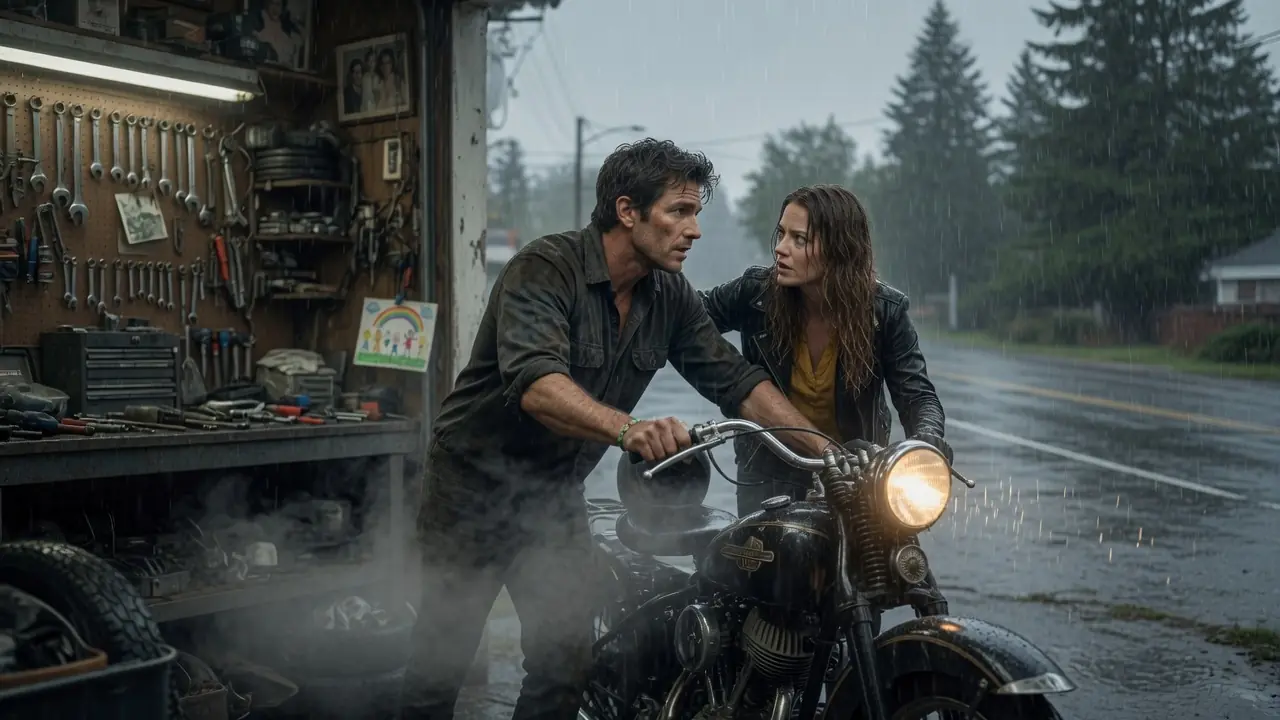
The woman riding it managed to guide the heavy machine beneath the garage awning before the rain became harder. By the time she lowered the kickstand, dark hair had come loose from beneath her helmet and rainwater was running down the shoulders of her leather jacket.
Inside the garage, Marcus Thompson looked up from the carburetor he was rebuilding.
The late-afternoon rain drummed against the tin roof. An old radio played quietly beside the tool cabinet, though static had swallowed most of the song.
Marcus wiped his hands on a stained rag and walked toward the open bay.
“You all right?”
The woman removed her helmet.
She appeared to be in her early thirties, perhaps thirty-four, with clear green eyes, a pale face sharpened by exhaustion, and the controlled posture of someone accustomed to hiding discomfort.
“I’m fine.”
Marcus glanced at the motorcycle.
It was a 1972 Harley-Davidson FLH Electra Glide, black with faded silver trim. The machine had been maintained carefully, but the engine sounded wrong even while dying.
“Your bike disagrees.”
She looked over her shoulder.
“It started losing power about five miles back.”
“Any knocking?”
“No.”
“Backfire?”
“Once.”
“Fuel smell?”
She hesitated.
“I smelled something, but I thought it was traffic.”
Marcus crouched beside the engine.
Rainwater ran from the front fender and gathered beneath the frame. He reached toward the fuel line, then stopped.
“May I?”
The woman seemed surprised he had asked.
“It’s a motorcycle.”
“It’s your motorcycle.”
She nodded.
Marcus examined the line and found a hairline split near the carburetor. Fuel had begun seeping through the old rubber. Another few miles could have brought the leak dangerously close to the hot exhaust.
“You were lucky it stopped.”
“How lucky?”
“Lucky enough that we’re discussing repairs instead of a fire.”
She looked at the dark stain beneath the engine.
Her expression changed for only a moment.
Marcus noticed.
“You can wait inside,” he said. “It’s warmer.”
“I’d rather stay with the bike.”
“That’s fine too.”
He stood and extended one hand.
“Marcus Thompson.”
The woman looked at the grease embedded around his fingernails before shaking it.
“Anna.”
“Last name?”
“Reed.”
The pause before the answer was small.
Marcus heard it anyway.
He did not question her.
People sometimes came into his garage carrying more than broken machinery. He had learned that forcing someone to explain before they were ready rarely improved the repair.
“I’ll roll it inside, Anna Reed.”
“I can help.”
“You’ve been riding in freezing rain.”
“I’m capable of moving my own motorcycle.”
Marcus stepped aside.
“Go ahead.”
She gripped the handlebars and pushed.
The Harley moved six feet before its weight shifted unexpectedly. Her wet boot slipped across the concrete.
Marcus caught the handlebar before the bike fell.
Anna regained her balance.
Neither of them spoke for a second.
Then Marcus said, “Very capable.”
She looked at him.
He expected irritation.
Instead, the corner of her mouth lifted.
“Don’t become unbearable.”
“It’s too late. My daughter says I passed unbearable three years ago.”
“You have a daughter?”
“Eight years old. Her name is Lily.”
As though summoned by the sound of her name, a small face appeared behind the window separating the garage from the office.
Lily Thompson pushed open the door.
She wore purple rain boots, jeans covered in marker stains, and an oversized gray sweatshirt with OREGON SCIENCE FAIR printed across the front.
“Dad, the printer ate my paper again.”
“It doesn’t eat paper.”
“It made the noise.”
“That noise means you put fourteen sheets in at once.”
“It was six.”
Marcus looked toward Anna.
“My most demanding customer.”
Lily noticed the stranger.
Her eyes moved from Anna’s wet hair to the vintage Harley.
“Is that yours?”
“Yes.”
“It’s beautiful.”
Anna’s expression softened.
“Thank you.”
“Dad says motorcycles are beautiful when people take care of them and dangerous when people think they’re smarter than gravity.”
Marcus sighed.
“I say many things that shouldn’t be repeated.”
Lily walked closer to the bike.
“Is it broken?”
“Fuel line,” Marcus said. “Possibly more.”
“Can you fix it?”
“I haven’t looked at everything.”
Lily stared at him.
Marcus knew the look.
He had seen it whenever a school project failed, a bicycle chain slipped, or a neighbor brought in a lawn mower everyone else had abandoned.
“What?”
“You always say broken isn’t the same as finished.”
Anna looked toward Marcus.
He shifted uncomfortably.
“I also say children should finish their homework before questioning professional mechanics.”
“The printer ate it.”
“Office.”
Lily turned toward Anna.
“We have hot chocolate.”
“Lily.”
“She’s freezing.”
Anna glanced toward the rain beyond the bay.
“I might accept that.”
Lily smiled as though she had won something.
Marcus pushed the Harley onto the lift.
The garage was small but orderly. Tools hung in precise rows above two workbenches. Shelves held labeled containers of bolts, wires, seals, and parts salvaged from machines no longer supported by their manufacturers.
Old photographs covered one wall.
Marcus as a teenager beside a broad-shouldered man with a gray beard.
Marcus holding a newborn Lily.
Three riders standing beside motorcycles on the Oregon coast.
A woman with auburn hair sitting on the workbench, laughing at someone outside the frame.
Anna looked at the final photograph longer than the others.
Marcus noticed but said nothing.
He removed the side panel from the Harley and inspected the electrical connections.
“When was the last full service?”
“Six months ago.”
“Where?”
“Seattle.”
“Dealership?”
“A private mechanic.”
“Did he mention replacing the fuel lines?”
“He said they were fine.”
“They were fine when Nixon was president.”
Anna almost smiled again.
Marcus continued examining the bike.
The fuel line could be replaced easily. The deeper problem was inside the ignition system. A damaged wire had been patched badly and hidden beneath newer insulation.
“This repair wasn’t done six months ago.”
“What?”
“Someone wrapped fresh material over an old failure.”
“Can you repair it?”
“Yes.”
“How long?”
“If the coil is good, a few hours. If it isn’t, I’ll need a part.”
“I need to be back in Seattle tonight.”
Marcus looked toward the storm.
“You shouldn’t ride this bike north tonight even after I fix it.”
“I have a meeting tomorrow morning.”
“Then rent a car.”
“I don’t leave this motorcycle.”
“Most people who say that eventually meet a motorcycle that leaves them.”
Her posture became guarded.
“I asked whether you could repair it.”
“And I’m telling you a repair doesn’t control weather, visibility, or the drivers on Interstate 5.”
“I didn’t ask for a lecture.”
“No. You brought me a leaking Harley and a deadline. They usually arrive with lectures included.”
Anna stared at him.
Marcus waited.
Then Lily opened the office door carrying a chipped mug of hot chocolate.
“Are you fighting?”
“No,” Marcus said.
“Yes,” Anna answered.
Lily handed her the mug.
“Dad fights when he’s worried.”
“I am not worried.”
“You make that wrinkle.”
She pointed between his eyebrows.
Marcus looked toward the ceiling.
“Homework.”
Lily disappeared into the office.
Anna held the warm mug between both hands.
“Your daughter is direct.”
“She inherited it from her mother.”
His voice changed slightly on the final word.
Anna glanced again at the photograph of the laughing woman.
“Where is she?”
Marcus picked up a wrench.
“She died four years ago.”
“I’m sorry.”
“So am I.”
The answer was not cold.
It was simply complete.
Anna lowered her eyes.
Marcus loosened the fuel tank mounts.
“Cancer,” he said after a moment. “Eighteen months from diagnosis to funeral.”
“That must have been difficult for Lily.”
“She was four. Some days she remembers everything. Other days she remembers almost nothing and feels guilty about it.”
“And you?”
Marcus looked at the motorcycle.
“I remember enough for both of us.”
Rain struck the roof harder.
For the next hour, Anna sat in the office while Marcus worked. Lily completed half a page of homework and asked twenty-three questions, most of them unrelated to school.
Where did Anna live?
Why did she ride alone?
Did rich people ride old motorcycles?
Was she rich?
Marcus nearly dropped a screwdriver when Lily asked the last question.
Anna remained calm.
“What makes you think I’m rich?”
“Your boots.”
Anna looked down.
“What about them?”
“They’re wet, but they still look expensive.”
Marcus turned from the lift.
“Lily.”
“What? They do.”
Anna examined the black leather boots as though seeing them for the first time.
“They were a gift.”
“From who?”
“My father.”
“Is he dead too?”
Marcus closed his eyes.
Anna’s hands tightened slightly around the mug.
“Yes.”
Lily’s expression changed.
“I’m sorry.”
“Thank you.”
“My mom gave Dad that red toolbox before she died.”
Anna looked toward the workbench.
A weathered red toolbox sat beneath the window.
“Does he still use it?”
“Every day.”
Anna nodded slowly.
“My father gave me the motorcycle.”
That explained the way she had refused to leave it.
Marcus returned to the repair.
“It was his?”
“Since 1974.”
“He bought it used?”
“How do you know?”
“Seventy-two model. You said he gave it to you, not that he bought it for you.”
“He bought it after returning from Europe. He said it was the first thing he ever owned that made him feel like his life belonged to him.”
Marcus paused.
Anna continued quietly.
“He died two years ago. The motorcycle stayed in storage until last month.”
“You just started riding it?”
“I learned years ago. He taught me.”
“But you didn’t ride after he died.”
“No.”
“What changed last month?”
She looked toward the rain-darkened window.
“I realized I had inherited everything from him except the part of his life that made him happy.”
Marcus understood that more than he wanted to admit.
He had inherited the garage from his father. The business was not profitable enough to make him wealthy, but it kept Walter Thompson’s name on the sign and his tools in use.
Some inheritances could not be measured in money.
By seven, Marcus had replaced the fuel line and repaired the damaged ignition wire. The coil tested weak but usable.
He reassembled the system and started the engine.
The Harley came alive with a heavy, uneven rhythm.
Anna left the office immediately.
She stopped beside the lift.
For a moment, she looked younger.
Not a composed stranger in an expensive jacket.
A daughter hearing her father’s voice inside a machine.
Marcus let the engine run long enough to warm.
Then he turned it off.
“What’s the verdict?” she asked.
“It will run.”
“But?”
“The coil needs replacement soon. The rear tire is older than it looks, and the front brake line should be changed before a long trip.”
“How much?”
“For tonight? Fuel line, wiring repair, inspection.”
He wrote the amount on a paper invoice.
Anna stared at it.
“This is too low.”
“It’s the price.”
“You worked for three hours.”
“I also drank two cups of coffee and argued with you. I deducted for entertainment.”
She opened her purse.
Marcus noticed the wallet.
Custom leather.
Several black cards.
She removed five hundred-dollar bills.
“I don’t keep much cash.”
Marcus looked at the money.
“No.”
“It covers the repair.”
“It covers five repairs.”
“Keep the rest.”
“No.”
“I can afford it.”
“That isn’t relevant.”
Her expression sharpened.
“Why are you making this difficult?”
“I’m not. I’m charging what the work costs.”
“You stayed late.”
“I own the garage.”
“Your daughter is still here.”
“She’s always here.”
Anna placed the money on the bench.
Marcus took one bill and pushed the others back.
“The invoice is eighty-six dollars.”
“You don’t have change.”
“I have a cash drawer.”
“You could use the money.”
Marcus became still.
Anna heard the mistake the moment it left her.
She looked around the garage.
The old heater.
The patched ceiling.
The second lift that had not worked in months.
“I didn’t mean—”
“I know what you meant.”
“I was trying to thank you.”
“Then say thank you.”
Her face changed.
People probably rarely refused money from her.
Marcus opened the cash drawer and counted fourteen dollars onto the bench.
Anna took it.
“Thank you.”
“You’re welcome.”
The rain had not weakened.
Marcus checked the weather radar.
A wind advisory covered the route north. Temperatures were expected to drop near freezing after midnight.
“You still can’t ride to Seattle.”
“I have to leave.”
“You can take my truck.”
She stared at him.
“You won’t take a tip, but you’ll lend a stranger your truck?”
“I didn’t say free. You leave the motorcycle here as collateral.”
“What would you do with it if I stole the truck?”
“Sell it to someone with better tires.”
She laughed.
A genuine laugh this time.
Marcus felt something unexpected move through him.
It had been years since the sound of a woman laughing inside the garage had not hurt.
Lily opened the office door again.
“She can sleep in our guest room.”
“We don’t have a guest room,” Marcus said.
“We have the couch.”
“That is not a guest room.”
“It turns into a bed.”
Anna looked between them.
“I’ll find a hotel.”
Every hotel nearby was booked because of a medical conference and a college football game. After four calls, the nearest available room was forty minutes away.
Marcus pointed toward the office.
“The couch is terrible.”
“I’ve slept in airports.”
“Then you’re prepared.”
Anna hesitated.
Staying in a stranger’s home was another risk.
Marcus saw the calculation in her eyes.
“You can take the truck and find somewhere else.”
“What about you?”
“Lily and I live upstairs.”
Only then did Anna notice the narrow staircase behind the parts shelves.
The apartment occupied the floor above the garage.
“You live here?”
“Convenient commute.”
Lily smiled.
“We’re having grilled cheese.”
That decided it.
Anna Reed spent the night above Thompson Motor Works.
The apartment was small, warm, and full of evidence that two people were building a life without having enough time to make it look organized.
School papers covered half the dining table.
Motorcycle magazines shared shelves with children’s books.
A basket of unfolded laundry sat near the couch.
Anna stood near the doorway, uncertain where to place herself.
Lily gave her a towel and an old sweatshirt.
The sweatshirt belonged to Marcus.
OREGON VETERANS RIDE, 2019.
Anna changed in the bathroom and returned wearing clothes several sizes too large.
Marcus looked once, then quickly returned his attention to the frying pan.
She noticed.
For reasons she could not explain, the restraint pleased her.
They ate grilled cheese and tomato soup at the small kitchen table.
Lily talked enough for everyone.
She explained that her father could repair any motorcycle but could not braid hair properly.
Marcus objected.
Lily produced photographic evidence.
Anna laughed until she had to cover her mouth.
After dinner, Marcus put Lily to bed.
When he returned, Anna was washing the dishes.
“You don’t have to do that.”
“I ate from them.”
“That argument sounds familiar.”
“My father believed anyone who accepted a meal should help clean up.”
“He sounds sensible.”
“He was complicated.”
“Most parents are.”
Anna dried her hands.
“What was your father like?”
Marcus glanced toward the floor, as though the garage below remained visible through it.
“Stubborn. Quiet. Better with engines than people.”
“Like you?”
“I’m excellent with people.”
“You argued with me within three minutes.”
“That was excellent work.”
She smiled.
Marcus made tea.
They sat at the table after midnight while rain moved against the windows.
Anna asked about the garage.
Marcus told her his father opened it in 1989. The neighborhood had been industrial then. Riders, delivery drivers, and warehouse workers filled the streets.
Now developers were buying entire blocks.
Luxury apartments had replaced repair shops.
Property taxes rose.
The garage building belonged to a private holding company that had recently purchased it from the elderly landlord.
Marcus had six months remaining on the lease.
“Do you know who bought it?” Anna asked.
“Northwest Urban Mobility Partners.”
Her fingers tightened around the cup.
Marcus did not notice.
“They’re planning some enormous redevelopment. Offices, retail, electric vehicle research, expensive apartments no one here can afford.”
“Have they sent you a notice?”
“Not yet.”
“But you expect one.”
“Everyone expects one.”
He looked around the apartment.
“If they end the lease, I lose the garage and our home at the same time.”
“What will you do?”
“Find another place.”
“Can you afford one?”
Marcus smiled without humor.
“You ask direct questions.”
“I was trained to.”
“By your father?”
“By necessity.”
He leaned back.
“No. I can’t afford another property in Portland. I might move east. Smaller town.”
“What about Lily?”
“She loves her school.”
“That doesn’t answer the question.”
“It’s the only answer I have tonight.”
Anna looked toward the hallway leading to Lily’s bedroom.
For the first time, the redevelopment plan her company had approved seemed to contain actual faces.
She knew Northwest Urban Mobility Partners.
It was a subsidiary of Ward Meridian Group.
Her company.
Her name was not Anna Reed.
It was Evelyn Ward.
At thirty-five, Evelyn was the controlling shareholder and chief executive of Ward Meridian, a transportation, real-estate, and technology company valued at more than eighteen billion dollars.
Northwest Urban Mobility Partners had been created to develop a large Portland campus focused on electric transportation.
The board called it progress.
Press releases promised jobs, housing, research, and sustainable growth.
No one had mentioned Thompson Motor Works.
No presentation contained Lily’s school drawings, Marcus’s red toolbox, or the apartment above the garage.
Her chief operating officer, Daniel Mercer, had described the block as underutilized commercial property.
Evelyn had signed the preliminary authorization.
She felt suddenly ill.
“Are you all right?” Marcus asked.
“Yes.”
“You went pale.”
“Long day.”
He watched her.
She had lied smoothly in boardrooms, negotiations, and interviews.
Lying at Marcus’s kitchen table felt different.
“Get some sleep,” he said.
“I should tell you something.”
Her phone rang before she could continue.
The screen displayed DANIEL MERCER.
Marcus looked away politely.
Evelyn answered.
“What?”
Daniel’s voice came sharp through the receiver.
“Where are you? Security has been trying to locate you for six hours.”
“I’m safe.”
“You missed the investor dinner.”
“I was stranded.”
“Send me your location.”
“No.”
“Evelyn.”
Marcus looked toward her.
She turned away.
Daniel continued.
“The Portland acquisition closes Monday. I need your approval on the final tenant-removal schedule.”
Evelyn’s eyes moved toward Marcus.
He could not hear every word.
He heard enough.
“Evelyn?” he repeated.
She closed her eyes.
Daniel spoke again.
“Who is that?”
Evelyn ended the call.
The kitchen became silent.
Marcus stood.
“Your name is Evelyn.”
“Yes.”
“Who was talking about tenant removal?”
She placed the phone on the table.
“I can explain.”
“Start with your full name.”
“Evelyn Ward.”
Marcus stared at her.
Recognition arrived slowly.
Then completely.
Ward Meridian.
The woman whose photograph appeared in business magazines.
The signature attached to the company purchasing his building.
“You own Northwest Urban Mobility.”
“Ward Meridian owns it.”
“You control Ward Meridian.”
“Yes.”
Marcus moved away from the table.
Lily’s drawing of three motorcycles hung from the refrigerator behind him.
“You knew about the garage.”
“Not when I arrived.”
“But you knew tonight.”
“I realized when you named the subsidiary.”
“And you sat here asking what I would do when your company threw us out.”
“I was trying to understand.”
“You could have started by telling the truth.”
“I tried.”
“After eating dinner? After letting my daughter invite you into our home?”
Her face tightened.
“I didn’t plan any of this.”
“People with your kind of power never plan the moment they become real to the people affected by their decisions.”
The words struck harder than shouting.
Evelyn stood.
“I did not know Daniel intended to remove tenants this quickly.”
“You approved the project.”
“I approved a concept based on information provided to me.”
“You signed it.”
“Yes.”
Marcus looked toward the sweatshirt she wore.
His sweatshirt.
The scene suddenly felt intimate in a way that made the deception worse.
“You should leave.”
“The storm—”
“Take the truck.”
“I don’t want your truck.”
“Then call one of the people searching for you.”
“Marcus.”
“My daughter is asleep.”
His voice lowered.
“I don’t want her waking up and discovering the woman she trusted was pretending to be someone else.”
“I wasn’t pretending with her.”
“You gave us a false name.”
“Reed was my mother’s name.”
“That doesn’t make it true.”
Evelyn had defended billion-dollar decisions before hostile boards without losing control.
Now her eyes filled.
Marcus did not soften.
Trust was already too fragile in his home.
He could not let sympathy erase what she had done.
Evelyn changed back into her clothes, collected her things, and called a car.
Before leaving, she placed the folded veterans’ sweatshirt on the couch.
Marcus stood beside the window but did not turn.
“I am going to stop the eviction process.”
“Don’t do it for me.”
“I’m doing it because it is wrong.”
“Then you should have known before your motorcycle broke down.”
She left.
The following morning, Lily found the empty couch.
“Where’s Anna?”
“She went home.”
“Why?”
Marcus poured cereal.
“Her name isn’t Anna.”
Lily frowned.
“Did she lie?”
“Yes.”
“About everything?”
Marcus looked toward the garage floor beneath them.
“No.”
That was the hardest part.
Evelyn’s laughter had been real.
Her grief over her father had been real.
The way she listened to Lily had been real.
So was the company notice taped to the garage door on Monday morning.
TENANCY TERMINATION
PROPERTY REDEVELOPMENT
VACATE WITHIN 120 DAYS
Marcus stared at Evelyn Ward’s company logo at the top.
A news crew arrived before noon.
Daniel Mercer had leaked the story before Evelyn could stop him.
Photographs from a security camera showed her entering Marcus’s apartment during the storm.
The headlines suggested a secret relationship between the billionaire CEO and a mechanic occupying valuable company property.
One article called Marcus an opportunist attempting to influence a development decision.
Another claimed Evelyn had spent the night with a tenant days before reviewing his compensation package.
Marcus lost three customers by the end of the week.
One accused him of creating publicity to force a larger buyout.
At school, a classmate told Lily her father was trying to marry a billionaire.
She came home crying.
Marcus called Evelyn for the first time.
She answered before the second ring.
“What happened?”
“My daughter is being mocked because of your company.”
Evelyn became silent.
“I’m sorry.”
“I don’t need sorry. I need the reporters away from her school.”
“I’ll handle it.”
“No. You’ll tell me what you’re going to do, and I’ll decide whether it helps.”
The correction landed.
Evelyn took a breath.
“I will issue a statement confirming that your garage performed emergency work on my motorcycle, that you refused excess payment, and that you had no knowledge of my identity or the acquisition.”
“What about the eviction?”
“I suspended it.”
“The notice is on my door.”
“Daniel released it after I ordered a review.”
“Then your orders don’t mean much.”
“I’m removing him.”
Marcus paused.
“What?”
“I discovered he accelerated tenant removals to lower project costs before the final board vote. Several relocation reports were altered. Community consultation meetings listed in our filings never occurred.”
“You signed the filings.”
“Yes.”
“You keep saying that like admitting it fixes something.”
“It doesn’t.”
For the first time, she sounded less like a CEO and more like the woman who had stood in his kitchen wearing an oversized sweatshirt.
“I failed,” she said. “I trusted a system because it benefited me to believe it worked.”
Marcus sat at the workbench.
“What happens now?”
“There is a public review Thursday.”
“Corporate performance?”
“No. City hearing.”
“You expect me to speak?”
“I hope you will.”
“Beside you?”
“If you choose.”
The word mattered.
He heard that she had remembered.
Thursday evening, the city hearing chamber was full.
Garage owners, renters, warehouse employees, artists, restaurant workers, and residents filled every seat.
Marcus sat near the back with Lily beside him.
Evelyn entered through a side door wearing a dark suit.
Cameras followed her.
Daniel Mercer sat with attorneys across the aisle. He looked composed and offended, as though accountability were an administrative inconvenience.
The board chair called Evelyn first.
She described altered reports, missing consultations, and the pressure her company placed on tenants.
Then she said something Daniel’s attorneys clearly had not expected.
“The responsibility is mine.”
The room quieted.
“I signed the acquisition authorization. I accepted summaries instead of meeting the people described inside them. Mr. Mercer concealed information, but concealment succeeded because I was willing to remain distant.”
Daniel leaned toward his lawyer.
Evelyn continued.
“Ward Meridian is withdrawing the current redevelopment application.”
Murmurs spread through the room.
“The property will not be donated, and I will not use corporate charity to avoid accountability. We will offer existing commercial tenants long-term leases at rates tied to prior assessments rather than speculative redevelopment values.”
She looked toward the residents.
“A community land trust will receive the first opportunity to purchase the residential portion with independent financing and city oversight.”
One board member asked, “What happens to the transportation research campus?”
“We build it somewhere that does not require pretending occupied homes and functioning businesses are empty land.”
The statement drew the first applause.
Evelyn did not smile.
Marcus understood why.
Repair was not applause.
Repair was what happened afterward.
Daniel’s attorneys accused her of allowing a personal relationship to influence corporate policy.
Daniel himself turned toward Marcus.
“This mechanic gave her shelter, developed private access, and now receives a protected lease. The conflict is obvious.”
Marcus stood.
He had not planned to speak.
Lily touched his arm.
“Dad?”
“I’ll be back.”
He approached the microphone wearing clean work clothes, not a suit.
“My name is Marcus Thompson. I own Thompson Motor Works.”
Daniel’s attorney asked whether Evelyn had spent the night in his apartment.
“She slept on my couch during a dangerous storm.”
“Did you know who she was?”
“No.”
“Did you discuss your lease?”
“I discussed losing my business with a stranger who asked why I looked tired.”
Laughter moved softly through the room.
The attorney continued.
“Have you received financial benefit from Ms. Ward?”
“I charged her eighty-six dollars to repair her motorcycle.”
“Nothing else?”
“She offered five hundred. I returned four hundred fourteen.”
The room reacted.
Marcus looked toward Daniel.
“I did not ask Evelyn Ward to protect my garage.”
He paused.
“I asked her to tell the truth about what her company was doing.”
The attorney opened another folder.
Marcus continued before he could speak.
“And I’m not supporting this plan because she and I are friends.”
Evelyn’s face changed slightly at the word friends.
“I’m supporting it because a business should not call a neighborhood empty simply because the people living there have less power than the people buying it.”
The applause became louder.
The hearing lasted four hours.
By the end, the city delayed all demolition permits and opened an investigation into the altered reports.
Daniel Mercer was removed from Ward Meridian the next morning.
Three weeks later, prosecutors began examining whether his false consultation records violated state law.
The garage remained open.
That did not repair everything between Marcus and Evelyn.
For two months, they spoke only about the lease, the hearing, and the motorcycle.
The Harley remained inside Marcus’s garage because the replacement coil had arrived after the scandal began.
He could have sent it to her.
He did not.
She could have ordered someone to collect it.
She did not.
On a quiet Saturday morning in January, Evelyn entered the garage wearing jeans, a dark coat, and no security detail.
Marcus was adjusting the Harley’s ignition timing.
Lily sat at the workbench painting a model motorcycle.
She looked up.
“Anna.”
Then she corrected herself.
“Evelyn.”
“Hello, Lily.”
“Are you still a liar?”
Marcus nearly dropped the timing light.
Evelyn remained still.
“Sometimes. But I’m working on it.”
Lily considered the answer.
“Dad says people who say they never lie are usually lying.”
“That sounds like him.”
Marcus set down the tool.
“Why are you here?”
“My motorcycle.”
“It’s finished.”
“I know.”
“You could have sent someone.”
“I know.”
He looked at her.
She had changed in small ways.
Less armor around the eyes.
More tiredness allowed to remain visible.
“Do you want coffee?” he asked.
“Yes.”
Lily returned to her model as though the difficult work had been completed.
Marcus poured two cups from the old machine.
Evelyn stood beside the Harley.
“I found something,” he said.
He removed the seat and reached beneath the rear bracket.
A small metal plate had been fixed inside the frame.
Years of dirt had hidden the engraving.
Marcus handed her a flashlight.
The words were faint.
FOR HENRY WARD
KEEP HER RUNNING
WALTER THOMPSON, 1987
Evelyn looked at him.
“Walter Thompson?”
“My father.”
She touched the engraving.
“My father knew your father.”
“Apparently.”
Marcus brought out an old service ledger.
Inside, beneath a date from August 1987, Walter had written:
Henry Ward. Black FLH. Electrical failure outside Salem. Wouldn’t leave bike. Stubborn as a fence post. Good man.
Evelyn laughed through sudden tears.
“That sounds like him.”
“There’s more.”
Marcus turned the page.
Henry returned with parts and paid double. Refused refund. Said a man should be allowed to thank someone properly. I told him to come back if the machine ever needed me.
Evelyn looked toward the Harley.
“My father never mentioned Portland.”
“My father never mentioned Henry Ward.”
“They met once?”
“Maybe twice.”
She traced the old handwriting.
“The motorcycle brought me to the same garage.”
Marcus leaned against the bench.
“Old machines remember roads people forget.”
Her eyes lifted.
“Do you believe that?”
“No.”
A pause.
“Maybe.”
She smiled.
Then the smile faded.
“I owe you an apology that isn’t attached to a legal process.”
Marcus waited.
“I should have told you who I was as soon as I understood the connection.”
“Yes.”
“I was afraid.”
“Of losing control?”
“Of losing the way you looked at me before you knew.”
The honesty disarmed him.
Evelyn continued.
“Most people meet my name before they meet me. You met me cold, stranded, dishonest about my identity, and wearing terrible wet boots.”
“They were expensive boots.”
“Lily was right.”
“She usually is.”
“You saw a person. I wanted another hour of that.”
Marcus looked down at his coffee.
“I understand why.”
“That doesn’t excuse it.”
“No.”
“I hurt you.”
“Yes.”
“And Lily.”
“Yes.”
Evelyn accepted every answer.
No defense.
No correction.
Marcus finally looked at her.
“What are you looking for now?”
She glanced toward the Harley.
“I thought I was looking for the part of my father I lost.”
“And?”
“I found that.”
She touched the fuel tank.
“Then I found a place where people expected me to clean my own plate.”
Marcus smiled faintly.
“High standards.”
“I found a child who asked questions no board member would dare ask.”
“Terrifying.”
“And I found a man who refused my money, challenged every decision I made, threw me out of his home, and still repaired my motorcycle properly.”
“That last part is professional pride.”
“I don’t know what happens next.”
Marcus appreciated the statement more than a declaration.
Evelyn Ward was accustomed to five-year plans.
Now she stood inside his garage admitting she did not know.
“Start the bike,” he said.
She stared at him.
“That’s all?”
“That’s what you came for.”
Evelyn mounted the Harley.
Marcus explained the new coil, brake line, and rear tire. Then he stepped back.
She turned the ignition and pressed the starter.
The engine came alive immediately.
Its deep rhythm filled the garage.
Evelyn closed her eyes.
For several seconds, she was somewhere else.
Marcus did not interrupt.
When she opened them, Lily stood beside the bike holding two helmets.
“Dad says it needs a road test.”
Marcus looked at his daughter.
“I said I need to road-test it.”
“You need someone to follow you.”
Evelyn looked toward Marcus.
“Do I?”
He picked up the second helmet.
“Your decision.”
She smiled.
They rode through Portland beneath a winter sky bright enough to make the wet streets shine.
Evelyn led on her father’s Harley.
Marcus followed on an old Triumph from the garage.
They crossed the river, moved through the hills, and stopped at an overlook above the city.
For a while, neither spoke.
“You fixed more than the motorcycle,” Evelyn said.
Marcus removed his gloves.
“That sounds dangerously symbolic.”
“I’m serious.”
“I didn’t fix you.”
“I know.”
She looked toward the city.
“You gave me somewhere honest to stand while I did some repairs myself.”
“That’s better.”
She turned toward him.
“I’m not searching for someone impressed by my life.”
“What are you searching for?”
“Someone willing to share an ordinary one.”
Marcus thought about Lily.
The garage.
Laundry on the couch.
Bills beside the toaster.
The empty side of his bed that had remained untouched for four years.
“I’m not ready to promise anything large.”
“Good.”
“Good?”
“Large promises are how my world avoids small actions.”
She stepped closer.
“We could begin with coffee.”
“We already had coffee.”
“Dinner.”
“Lily will interrogate you.”
“I’ve survived shareholders.”
“She’s worse.”
“I know.”
They began there.
Not with a merger of worlds.
Not with Evelyn buying Marcus a new garage or Marcus rescuing her from loneliness.
With dinner.
Then another road test.
A school science fair where Evelyn sat in a folding chair beside Marcus and cheered when Lily’s model bridge held twice the required weight.
A board meeting Evelyn left on time because she had promised to attend Lily’s birthday.
A Sunday morning when Marcus finally allowed Evelyn to pay for parts at the same price as every other customer.
Trust returned slowly.
The garage received a fifteen-year lease under the new community agreement.
Marcus paid rent.
Evelyn did not reduce it secretly.
She understood now that generosity without consent could feel like control.
Ward Meridian built its research campus on an abandoned industrial site near the airport. Existing businesses there were offered partnerships and relocation choices before plans were finalized.
Evelyn required every executive to attend community meetings personally.
No summaries.
No phrases such as underutilized property without photographs showing exactly who was using it.
A year after the Harley broke down, Marcus stood beneath the garage awning while rain crossed the street.
The black motorcycle approached through the weather and stopped exactly where it had died the first time.
Evelyn removed her helmet.
“Engine trouble?” Marcus asked.
“No.”
“Fuel leak?”
“No.”
“Then why are you blocking my bay?”
She looked toward the apartment windows above the garage.
“Lily invited me for grilled cheese.”
“Did she?”
“She said it was important.”
Marcus narrowed his eyes.
His daughter appeared in the office doorway holding a folded sheet of paper.
“Come upstairs.”
At the kitchen table, Lily placed the paper between them.
It showed three figures beside two motorcycles.
Marcus.
Lily.
Evelyn.
Above them, she had written:
OUR FAMILY, MAYBE.
Evelyn read the words twice.
Then she looked toward Marcus.
He had not known about the drawing.
“Why maybe?” Evelyn asked.
Lily shrugged.
“Because adults get nervous about family.”
“That’s true.”
“Dad says we shouldn’t pressure people.”
Marcus looked suspiciously at his daughter.
“I said that about letting customers decide whether to approve expensive repairs.”
“Same idea.”
Evelyn folded the drawing carefully.
“I don’t want to be your mother instead of your mother.”
Lily’s face became serious.
“I know.”
“I can’t replace her.”
“I know that too.”
“But I love you.”
Lily looked toward Marcus.
He felt his throat tighten.
“And I love your father.”
Lily nodded.
“Okay.”
“Okay?”
“You can cross out maybe when you’re ready.”
Evelyn looked toward Marcus.
He moved his chair closer.
“No one is asking you to decide tonight.”
She smiled through tears.
“That is why I already have.”
Evelyn took a pencil from the table.
She did not erase maybe.
Instead, beneath it, she wrote:
CHOSEN.
The framed drawing eventually hung inside the office of Thompson Motor Works.
Not inside Evelyn’s corporate headquarters.
Not inside the house they later chose together.
The garage was where the story began, so the drawing remained there.
Years later, customers still asked about the black 1972 Harley parked near the first bay.
Marcus told them it belonged to a woman whose motorcycle failed during a storm.
Lily told them her father charged the woman only eighty-six dollars even though she was a billionaire.
Evelyn corrected both of them.
“The motorcycle did not fail,” she said. “It chose the right garage.”
Marcus always rolled his eyes.
But he never removed the small metal plate beneath the seat.
FOR HENRY WARD
KEEP HER RUNNING
WALTER THOMPSON, 1987
Two fathers had met on an Oregon road decades earlier.
One repaired a stranger’s motorcycle.
The other remembered the kindness without ever knowing how far it would travel.
Years later, their children found one another because the same machine stopped beneath the same rain.
Marcus did not save Evelyn with a wrench.
Evelyn did not save Marcus with money.
He showed her that help could be offered without ownership.
She showed him that loving someone new did not erase the person he had lost.
And Lily showed both of them that family did not always begin with blood, marriage, or a perfect plan.
Sometimes it began with a broken fuel line.
A cup of hot chocolate.
A couch above a small garage.
And two people who had spent years carrying life alone, slowly learning that accepting another hand did not make either of them weak.