Single Dad Helped a Paralyzed Girl at the Bus Stop — Then Something Changed in His Life
Snow fell quietly over the deserted bus stop, each flake glowing for a brief moment beneath the yellow streetlight before settling into the growing drifts.
Lily Hartman sat alone in her wheelchair.
The bright red of her dress blazed against the white night. An old leather travel bag rested beside her, its broken handle repaired with a strip of black tape. Snow had gathered on the toes of her shoes and along the rims of her wheels.
She had been waiting for nearly two hours.
The last bus should have arrived at nine-fifteen.
It was now eleven-seven.
No headlights appeared on the empty road.
No buildings remained open nearby.
Only a closed pharmacy, a dark laundromat, and a diner whose glowing sign had gone out shortly after Lily arrived.
Three hours earlier, she had been sitting inside one of the most expensive restaurants in Maple Ridge while her fiancé explained why he could no longer marry her.
Ethan had chosen a private dining room for the conversation.
Their parents were present.
So were his older brother, his sister-in-law, and two close friends who had helped plan the wedding.
Lily initially believed the gathering was meant to discuss the ceremony.
Instead, Ethan placed both hands on the table and said, “We need to be realistic.”
Lily had already learned to fear that sentence.
People often used realism when they wanted cruelty to sound responsible.
“Realistic about what?” she asked.
Ethan glanced toward her wheelchair.
He had done that more often since the accident.
Not looked at her.
Looked at the chair first.
“The future.”
“Our wedding is in four months.”
“That is exactly why we need to talk now.”
Lily’s mother stopped touching her water glass.
Ethan’s father leaned back as though the matter had already been discussed without her.
Lily looked around the table.
“Everyone knew?”
Nobody answered.
Ethan swallowed.
“I love you.”
“Then why does this sound like a resignation?”
“Because love doesn’t solve everything.”
Lily waited.
He continued.
“The accident changed our lives.”
“It changed my body.”
“It changed everything.”
“No. It revealed everything.”
Ethan’s expression hardened.
He had remained beside her through the first year after the collision.
He brought flowers to the hospital.
Posted photographs from rehabilitation.
Told friends he would never abandon her.
People praised him constantly.
They called him loyal.
Patient.
Remarkable.
Nobody praised Lily for surviving.
But they praised Ethan for witnessing it.
“I have tried,” he said.
Lily felt the room becoming smaller.
“Tried what?”
“To accept that this is permanent.”
“My paralysis?”
“Our limitations.”
Lily placed one hand on the wheel of her chair.
“My limitations or yours?”
His mother whispered his name, but not to stop him.
Only to encourage him to choose gentler words.
Ethan looked toward the engagement ring on Lily’s hand.
“I want children.”
“So do I.”
“You don’t know if you can have them.”
“My doctors said pregnancy may still be possible.”
“May be.”
His voice sharpened.
“And even if it is, what happens afterward? How do we manage a baby? A house? Travel? Everything would have to be planned around your condition.”
“My life is not a condition.”
“You know what I mean.”
“I know exactly what you mean.”
Ethan exhaled.
“I can’t spend the rest of my life caring for damaged goods.”
The words fell into the room and stayed there.
For one second, Ethan looked shocked by his own honesty.
Then embarrassed.
Not because he believed the words were wrong.
Because he had said them aloud.
Lily looked at her mother.
Her mother’s eyes filled with tears, but she remained silent.
Her father stared down at the table.
Nobody defended her.
Lily removed the engagement ring.
She placed it beside Ethan’s plate.
The diamond touched the porcelain with a small, clear sound.
“Then you’re free.”
“Lily, wait.”
“You don’t need to explain.”
“I didn’t mean it like that.”
“You meant it exactly like that.”
She turned her wheelchair away from the table.
Ethan reached toward her shoulder.
Lily stopped and looked at his hand until he pulled it back.
“Do not touch me.”
Her mother followed her into the restaurant lobby.
“Please don’t leave angry.”
“How would you prefer I leave?”
“He’s frightened.”
“So am I.”
“He has been under enormous pressure.”
Lily laughed bitterly.
“Because I was hit by a drunk driver?”
“That isn’t what I meant.”
Her mother’s silence answered.
“How long?”
“Ethan spoke with us last week.”
“And you said nothing.”
“We hoped he would reconsider.”
“You hoped he would marry me out of obligation.”
“We hoped he would remember how much he loves you.”
Lily looked through the glass doors at the falling snow.
“Love should not need to be reminded that I am human.”
She rolled outside.
Her accessible van was parked at Ethan’s apartment because they had arrived in his vehicle. Her phone showed four percent battery. Every rideshare driver canceled after seeing the note about her wheelchair.
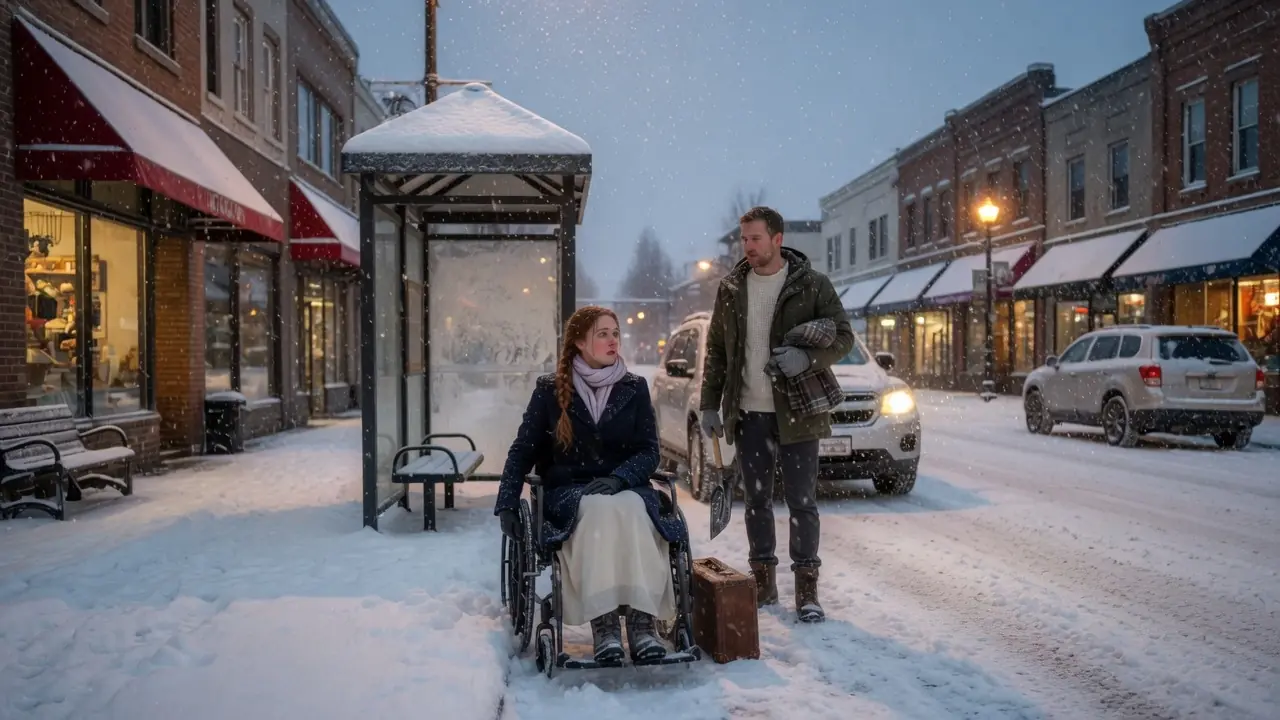
The city bus was her final option.
She reached the shelter just before nine.
Then the bus never came.
At ten-thirty, her phone died.
By eleven, the cold had settled through her dress, her coat, and the blanket over her legs.
Lily had endured spinal surgery, months of rehabilitation, nerve pain, inaccessible buildings, and strangers addressing her companions instead of her.
Yet sitting alone in the snow after being called damaged felt like a different kind of injury.
It entered through every insecurity she believed she had defeated.
A pair of headlights finally appeared beyond the trees.
An old dark-green pickup approached slowly.
It passed the shelter.
Lily watched its taillights recede through the snowfall.
Then the brakes glowed.
The truck stopped.
For several seconds, nothing happened.
It reversed carefully along the shoulder.
The driver’s door opened.
A man stepped into the snow wearing a work jacket, faded jeans, and heavy boots. He was tall and broad-shouldered, perhaps thirty-eight, with short brown hair and a tired face.
He glanced at Lily, then at the road.
“Are you waiting for a bus?”
Lily looked toward the empty highway.
“I was beginning to suspect I’d chosen the wrong place.”
The man smiled faintly.
“The last bus was canceled because of the storm.”
“Of course it was.”
“Didn’t they notify you?”
“My phone died.”
He remained several feet away.
That mattered.
Many strangers approached her wheelchair as though personal boundaries ended where disability began.
“My name is Jack,” he said.
“Lily.”
“Do you have someone coming?”
“No.”
“Anyone I can call?”
“There’s nobody I want to call.”
Jack looked at the snow gathering around her wheels.
“Where are you headed?”
“Anywhere with heat.”
“That broadens the options.”
A small face appeared inside the truck.
A boy leaned toward the passenger window.
Jack glanced back.
“That’s my son, Caleb.”
“How old?”
“Eight.”
The window lowered.
“Dad, her dress is getting buried.”
“I can see that.”
The boy looked toward Lily.
“Are you going to a Christmas party?”
“No.”
“A wedding?”
“No.”
Jack gave him a warning look.
Caleb ignored it.
“My dad says I ask too many questions.”
“You do.”
“He also says curiosity is important.”
“In school.”
Lily smiled despite herself.
Jack looked toward the chair.
“My truck isn’t accessible.”
“I can transfer if the seat isn’t too high.”
“It’s fairly high.”
“I’ve done worse.”
“Do you have a transfer board?”
“In my bag.”
Jack nodded.
“Tell me what to do.”
Not, I know how to help.
Not, Let me carry you.
Tell me what to do.
Lily looked at him more carefully.
“Bring the truck closer. Passenger side parallel to the shelter.”
Jack followed her instructions.
He cleared snow around the wheelchair and positioned the transfer board without touching Lily until she asked.
“Lock the brakes.”
He did.
“Move the footplate.”
He waited for her to show him.
“Stand close enough to catch me, but don’t pull.”
“Understood.”
Lily pushed herself onto the board.
Her arms trembled from the cold.
Halfway across, her wet glove slipped.
Jack moved instantly but did not grab her body. He stabilized the board and placed one hand near her shoulder.
“I’m here.”
She recovered and completed the transfer.
Jack folded the chair carefully and secured it in the truck bed beneath a canvas tarp.
Caleb climbed into the rear seat.
Lily settled beside Jack as warm air blew from the vents.
A child’s backpack rested near her feet. Crayons, work receipts, and an unopened package of crackers covered the center console.
The truck smelled like sawdust, coffee, and peppermint gum.
Jack turned the heater higher.
“Where do you live?”
Lily hesitated.
The apartment she shared with Ethan was no longer home.
“The Grand River Hotel.”
“Do you have a reservation?”
“No.”
“Accessible room?”
“I’ll ask when we arrive.”
Jack glanced toward her.
“Never trust a hotel’s idea of accessible.”
Lily raised an eyebrow.
“You sound experienced.”
“My wife used a wheelchair near the end of her life.”
The warmth inside the truck suddenly felt fragile.
“I’m sorry.”
“She had ovarian cancer.”
Caleb grew quiet in the back seat.
Jack kept his eyes on the road.
“She could walk most days at first. Then fewer days. By the last six months, every place we visited became a list of questions.”
“Steps?”
“Yes.”
“Bathroom door width?”
“Yes.”
“Bed height?”
“Shower bench that looks stable but isn’t?”
Jack smiled sadly.
“That one almost sent me through a hotel wall.”
Lily looked toward the passing trees.
“How long ago?”
“Three years.”
“What was her name?”
“Anna.”
Caleb spoke softly.
“She painted the kitchen yellow.”
Jack looked into the mirror.
“She did.”
“She said houses should look happy inside.”
Lily turned toward the boy.
“She sounds wonderful.”
“She was.”
The truck continued through the snow.
They reached the Grand River Hotel twenty minutes later.
Jack unloaded Lily’s chair while Caleb carried the old travel bag.
Inside, the night clerk searched the computer.
“We have one room left.”
“Accessible?” Lily asked.
The clerk winced.
“No.”
“Can I see it?”
“It’s on the second floor.”
“Elevator?”
“Temporarily out of service.”
Lily stared.
“You have no accessible rooms available?”
“One, but the bathroom is being repaired.”
“What happened?”
“A pipe burst.”
Jack looked toward the ceiling.
“Which room?”
The clerk checked.
“Fourteen.”
“I repaired that pipe last month.”
The clerk recognized him.
“Mr. Bennett.”
Jack folded his arms.
“Why is the bathroom still closed?”
“The replacement tile hasn’t arrived.”
“Does the plumbing work?”
“Yes.”
“Is the toilet accessible?”
“Yes.”
“Shower?”
“Yes, but the wall is unfinished.”
Lily looked at the clerk.
“I do not care about unfinished tile.”
“Hotel policy—”
“Call the manager.”
“It’s after midnight.”
“Then wake him.”
The clerk hesitated.
Jack leaned toward the counter.
“She has been waiting outside in a snowstorm for two hours.”
The man looked embarrassed.
“I’m sorry, but I cannot release a room listed as under renovation.”
Lily closed her eyes.
Exhaustion was replacing anger.
Jack stepped back.
“I have a guest apartment.”
She looked toward him.
“No.”
“It’s behind my house. Private entrance. Accessible bathroom.”
“You bring many women from bus stops there?”
“Only the ones dressed for formal events.”
Caleb laughed.
Jack continued.
“My mother lives across the driveway. You can call the police, send someone the address, photograph my license, and lock the apartment from inside.”
“That is a suspiciously detailed argument.”
“I raised it with myself before asking.”
Lily looked at Caleb.
The boy was struggling to stay awake while holding her bag.
“You should take him home.”
“I’m trying.”
She looked once more toward the hotel clerk.
Then back at Jack.
“One night.”
“One night.”
Jack’s house stood at the edge of a small farm outside Maple Ridge.
It was not large.
White siding.
A deep porch.
A detached workshop.
Christmas lights wrapped unevenly around the railing, stopping halfway because one section had burned out.
A small cottage stood behind the main house.
The path leading to it had been cleared and sloped gently from the driveway.
Jack opened the door.
Warm light filled a single bedroom, compact kitchen, and accessible bathroom.
Everything had been designed carefully.
Wide doors.
Low switches.
Open space beneath the sink.
A roll-in shower with a sturdy bench.
Shelves placed within reach from a seated position.
Lily looked around.
“You built this for Anna.”
Jack nodded.
“She wanted privacy when nurses stayed overnight. We converted the old garage office.”
“It’s better than most rehabilitation apartments.”
“She was difficult to impress.”
“She had good standards.”
“She did.”
Caleb placed Lily’s bag beside the bed.
“I can get you pajamas.”
“Caleb.”
“What?”
“She has her own clothes.”
The boy looked at the small bag.
“Not many.”
Lily smiled.
“You’re right.”
Jack brought her a clean gray shirt and drawstring pants.
“They’re mine. I can find something else if—”
“These are fine.”
A knock came at the door.
An older woman stood outside holding towels and a bowl of soup.
Jack sighed.
“Mom.”
“You brought a freezing woman home and thought I wouldn’t notice?”
“This is Lily.”
The woman entered.
“I’m Margaret. Jack’s mother.”
Lily looked toward the soup.
“I don’t want to inconvenience anyone.”
Margaret placed the bowl on the low table.
“Honey, I raised Jack. Everything after that feels convenient.”
Caleb laughed loudly.
Jack pointed toward the main house.
“Bed.”
The boy hugged his grandmother, then looked toward Lily.
“Are you staying for breakfast?”
“Caleb.”
“What? Breakfast is normal.”
Lily glanced at Jack.
“One night apparently includes breakfast.”
Caleb smiled.
After they left, Lily changed clothes and sat on the edge of the bed.
The red dress lay across her lap.
Ethan’s mother had chosen it.
“It makes you look strong,” she said at the store.
As though strength could be purchased in the correct color.
Lily reached into the pocket and found the engagement dinner menu.
On the back, Ethan had written:
I’m sorry. Someday you’ll understand this is better for both of us.
Lily stared at the message.
He wanted forgiveness before she had even left the building.
He wanted her to carry away his guilt so he could begin his new life without it.
She tore the paper into small pieces.
Then she cried.
Not quietly.
Not beautifully.
She cried until her chest hurt and the room blurred.
She cried for the wedding.
For the man she thought Ethan was.
For the parents who remained silent.
For every moment after the accident when she forced herself to appear grateful simply because someone had stayed.
A gentle knock sounded.
“Lily?”
It was Jack.
She wiped her face.
“Yes?”
“I left a phone charger outside.”
“Thank you.”
He paused.
“You don’t need to stop crying because I can hear you.”
Lily froze.
Jack continued.
“This cottage has thin walls.”
She almost laughed.
Almost.
“I’m fine.”
“No, you aren’t.”
She stared toward the door.
“Do you always argue with strangers?”
“Only when they lie through walls.”
Lily opened the door a few inches.
Jack stood on the path holding the charger.
He did not try to enter.
“Someone hurt you,” he said.
“That is an impressive conclusion.”
“You’re wearing a formal dress at midnight with one bag.”
Lily accepted the charger.
“My fiancé ended our engagement.”
Jack’s expression changed.
“Tonight?”
“Yes.”
“Then left you at a bus stop?”
“No. I left the restaurant.”
“He let you go into a snowstorm?”
“He was busy protecting his future.”
Jack looked at her.
“What did he say?”
Lily should not have answered.
But the words escaped.
“He called me damaged goods.”
Jack became very still.
The anger in his face was immediate and quiet.
“That man is a fool.”
“You don’t know me.”
“I know you sat in freezing weather rather than call someone who treated you that way.”
“That may also make me a fool.”
“No.”
Jack shook his head.
“It makes you done.”
Lily looked down at the charger.
“You should go inside.”
“Yes.”
He stepped away.
“Jack?”
He turned.
“Thank you for stopping.”
He looked toward the snow-covered path.
“I almost didn’t.”
The honesty surprised her.
“Why did you?”
“Caleb saw you.”
Jack glanced toward the house.
“He said nobody wears a red dress alone in a snowstorm unless something terrible happened.”
Lily smiled through tears.
“He asks too many questions.”
“He notices too many answers.”
The next morning, Lily woke to the smell of coffee and maple syrup.
A note had been pushed beneath the door.
CALEB INSISTED ON PANCAKES.
I TRIED TO DEFEND YOU.
—JACK
Lily found them in the main kitchen.
Margaret stood at the stove.
Caleb was arranging blueberries into faces.
Jack sat at the table reading messages on his phone.
He rose when Lily entered, then seemed uncertain whether offering help would offend her.
She noticed.
“The table is accessible,” she said.
“I measured.”
“For me?”
“For Anna.”
The answer carried no embarrassment.
Lily moved into place.
Caleb placed a pancake in front of her.
“This one is supposed to be a snowman.”
“It looks injured.”
“He melted.”
Margaret poured coffee.
“Jack said your phone died.”
“It’s charging.”
“Anyone expecting you?”
Lily thought of her mother.
Ethan.
Her business partner, Nora.
“Yes.”
“Anyone worth calling?”
“One.”
After breakfast, she phoned Nora.
Her friend answered before the first ring ended.
“Where are you?”
“I’m safe.”
“Your mother called me. Ethan called me. He said you were unstable.”
Lily closed her eyes.
“Of course he did.”
“What happened?”
She explained.
Nora’s voice became dangerously calm.
“Send the address. I’ll bring your van.”
“It’s at Ethan’s apartment.”
“I know.”
“How?”
“I called him.”
“Nora.”
“I was polite for almost eight seconds.”
Lily smiled.
“Bring the van and my office laptop.”
“And your clothes?”
“Only what’s mine.”
“That may require a truck.”
“It won’t.”
The truth hurt.
Lily had shaped most of her life around Ethan during the two years before the accident and the eighteen months after it.
His apartment.
His schedule.
His friends.
His interpretation of support.
She owned less than she realized.
While they waited, Jack examined Lily’s chair.
“One caster is sticking.”
“It started last week.”
“You should replace the bearing.”
“I know.”
“Do you have the part?”
“No.”
Jack walked toward the workshop.
“Wait.”
He turned.
“I can pay you.”
“I haven’t done anything yet.”
“You’re about to.”
“Possibly.”
“I don’t want favors.”
Jack leaned against the doorway.
“Why?”
“Because favors change.”
“Into what?”
“Debts. Expectations. Control.”
Jack considered that.
“Then I’ll invoice you.”
Lily blinked.
“You will?”
“Full labor rate.”
“Good.”
“Plus emergency call fee.”
“Absolutely not.”
He smiled.
“You wanted business.”
“I also negotiate.”
They found a replacement bearing in his workshop.
Jack repaired the caster while Lily watched.
He asked before turning the chair.
Asked before removing the wheel.
Asked how she preferred the brake tension.
Nothing about the repair was extraordinary.
Yet Lily felt something inside her relax.
Jack did not treat her independence as a threat to his usefulness.
Nora arrived before noon driving Lily’s accessible van.
She stepped out wearing a long black coat and fury.
“You’re Jack?”
“Yes.”
She looked toward Caleb.
“And this is your witness?”
“I’m Caleb.”
“He saved her,” the boy said.
Jack immediately corrected him.
“I gave her a ride.”
Nora studied him.
“That was the correct answer.”
She hugged Lily.
Then whispered, “Ethan tried to keep the van.”
“Why?”
“He said the insurance was in his name.”
“It isn’t.”
“I know.”
Nora handed her the keys.
“He knows now too.”
Lily returned to the apartment that afternoon.
Ethan waited inside.
Her suitcase stood near the door.
“You brought people into this?”
“Nora collected my property.”
“She threatened to report the van stolen.”
“It would have been stolen.”
Ethan rubbed his forehead.
“You’re making this ugly.”
Lily looked toward him.
“You called me damaged goods in front of both families.”
“I apologized.”
“You wrote an apology on a menu.”
“I was overwhelmed.”
“You were honest.”
“No, I was angry.”
“Anger does not invent contempt. It reveals it.”
Ethan’s expression tightened.
“You think that carpenter and his kid are going to understand what life with you requires?”
Lily went still.
“You investigated him?”
“I saw where your van was parked.”
“That is none of your concern.”
“He lost his wife. He’s lonely. You’re vulnerable. This is not healthy.”
Lily stared at the man she once planned to marry.
Ethan had always confused control with concern.
Before the accident, it appeared protective.
Afterward, it became impossible to ignore.
“You don’t get to abandon me and then supervise what happens next.”
“I’m trying to protect you.”
“No.”
Lily rolled toward the bedroom.
“You are trying to make sure I fail without you.”
Ethan blocked the doorway.
“This apartment is in my name.”
“Move.”
“You can stay until you find somewhere appropriate.”
“I said move.”
Something in her voice made him obey.
Lily packed two suitcases.
Nora carried them to the van.
Before leaving, Lily placed the spare apartment key beside the engagement ring.
“You’ll regret making decisions while emotional,” Ethan said.
Lily looked back.
“This is the first decision I’ve made without asking whether it will inconvenience you.”
For the next month, she lived in a downtown hotel.
It was expensive, sterile, and technically accessible.
The bathroom mirror was too high.
The bed was six inches above safe transfer height.
The shower controls could not be reached from the bench.
Lily photographed everything.
Before the accident, she had worked as an interior architect specializing in boutique stores and private homes.
After the accident, she began noticing the quiet cruelty built into ordinary spaces.
A beautiful restaurant with a service entrance as its only accessible route.
A hotel bathroom that met legal standards but could not be used independently.
A ramp hidden behind garbage bins.
Accessibility added after the design was considered complete.
Her firm was struggling.
Several clients disappeared during her rehabilitation.
Ethan had invested money in the office and now wanted repayment.
Lily considered closing.
Then Jack called.
“Your caster still working?”
“Yes.”
“Good.”
A pause.
“I have a client.”
“What kind?”
“A retired teacher injured in a farm accident. He wants to renovate his house before leaving rehabilitation.”
“He needs an architect.”
“He has one.”
“Then why are you calling me?”
“The architect put a five-foot turning circle in a bathroom with a four-foot clear space.”
Lily sat straighter.
“He did what?”
“And the kitchen island blocks the wheelchair route.”
“Send me the drawings.”
Jack did.
The plans contained twelve major problems.
Lily marked them and called the homeowner.
That consultation became a full redesign.
Jack handled construction.
They argued almost immediately.
“The cabinets need to be lowered,” Lily said.
“He has a wife who stands.”
“Then use adjustable sections.”
“That triples the hardware cost.”
“He spent twenty thousand dollars on a stone fireplace.”
“That isn’t the same budget.”
“It is exactly the same budget. People accept expense for beauty and question it for independence.”
Jack looked at her.
Then at the plans.
“Adjustable sections.”
“Thank you.”
“You enjoy winning.”
“I enjoy being correct.”
The project led to another.
Then three more.
Jack began recommending Lily to clients whose architects understood regulations but not daily life.
Lily recommended Jack because he listened before building.
Their professional partnership became friendship slowly.
He never appeared at her hotel without asking.
Never turned kindness into pressure.
He invited her to dinner with Caleb and Margaret.
Accepted when she said no.
Asked again two weeks later without mentioning the first refusal.
She went.
Caleb showed her every room in the house.
Including the unfinished treehouse.
“It has no roof,” he said.
“I noticed.”
“Dad keeps promising.”
“Your father appears unreliable.”
Jack looked up from the grill.
“I helped you in a snowstorm.”
“That was one successful project.”
Caleb laughed.
Lily helped design the roof.
Jack built it the following weekend.
Spring arrived.
Lily moved into an accessible apartment near her studio.
Her parents visited.
They apologized for remaining silent during the dinner.
Her mother cried.
Her father admitted he had encouraged Ethan to wait until after the wedding to discuss his doubts because deposits had already been paid.
That confession hurt more than Lily expected.
“You were willing to let me marry someone who considered me a burden.”
“We thought marriage might help him adjust.”
“I am not exposure therapy.”
Her father lowered his head.
They did not repair the relationship that day.
They began.
Lily learned that forgiveness and access were separate decisions.
She could forgive someone without returning them to the same place in her life.
Jack understood.
He never told her family should be kept close simply because they were family.
He had spent years listening to people advise him to move on from Anna as though grief were a room he had forgotten to leave.
One evening, Lily and Jack worked late inside an old farmhouse.
A thunderstorm cut power to the temporary wheelchair lift.
Lily was on the second floor.
Jack stared at the dead control panel.
“I should have installed the backup yesterday.”
“It arrives tomorrow.”
“I should have ordered it sooner.”
“The supplier delayed it.”
“You’re trapped.”
“I’m delayed.”
“That is the same thing.”
“No.”
Lily turned her chair toward him.
“Trapped means there is no way forward. Delayed means we solve it.”
Jack looked at her.
“You’re not angry?”
“I will be if you carry me down the stairs without asking.”
“I wasn’t going to.”
“You considered it.”
“For half a second.”
They waited beside an open window while rain struck the roof.
Jack sat on the unfinished floor.
“Anna hated needing help.”
Lily remained quiet.
“She apologized for everything,” he continued. “The wheelchair. The appointments. The time.”
“What did you say?”
“That she was never a burden.”
“Did you mean it?”
“Yes.”
“All the time?”
Jack looked down.
“No.”
The honesty mattered.
“I was exhausted,” he said. “Sometimes angry. Sometimes afraid. I hated the illness. Then I hated myself for feeling anything except gratitude that she was still alive.”
“Did you tell her?”
“No.”
“Why?”
“I thought it would confirm her worst fear.”
“That she was a burden.”
“Yes.”
Lily looked toward the rain.
“Ethan used his exhaustion as proof that I was the problem.”
“I used mine as proof that I was a bad husband.”
“Both conclusions were wrong.”
Jack nodded.
“Human beings become tired when life is difficult. That doesn’t make the person beside them the difficulty.”
The power returned.
Neither moved.
Jack looked at Lily.
“I’m afraid of this.”
“What?”
“You.”
She raised an eyebrow.
“That sounded insulting.”
“You know what I mean.”
“I would like to hear you say it.”
He took a breath.
“I care about you.”
Lily’s heart moved painfully.
Jack continued.
“And part of me thinks caring about someone again means I didn’t love Anna enough.”
“You still love her.”
“Yes.”
“That does not frighten me.”
“It should.”
“No.”
Lily moved closer.
“I don’t need the parts of you that belonged to her.”
Jack’s eyes filled.
“I need you to stop believing love is a house with only one room.”
He reached toward her hand and paused.
Lily closed the distance.
Their first kiss happened beside exposed beams and an unplugged wheelchair lift.
It was gentle.
Uncertain.
And completely unlike the relationship Lily had left.
Nothing was promised.
Nothing was taken for granted.
When they separated, Jack rested his forehead against hers.
“Caleb will become unbearable.”
“He already is.”
Caleb was delighted.
He immediately began drawing pictures of three people in front of houses.
Lily always appeared in a red dress.
“Why am I wearing that while camping?” she asked.
“It’s your superhero outfit.”
“It was an engagement dress.”
“You escaped a villain in it.”
Jack nearly choked on his coffee.
“Caleb.”
“What?”
Lily looked at the drawing.
For months, she had considered the red dress a symbol of humiliation.
Caleb saw something else.
She wore it on the night she chose not to accept someone else’s definition of her value.
“You can keep drawing it,” she said.
Her design firm changed direction.
She stopped chasing luxury clients who treated accessibility as an unfortunate compromise.
She specialized in inclusive residential and public design.
Beautiful homes for people whose bodies changed.
Restaurants without separate entrances.
Bathrooms designed for independence.
Spaces where children, older adults, disabled people, parents with strollers, and temporarily injured visitors could all move without being singled out.
Jack became her preferred contractor.
His company grew.
He hired two apprentices and trained them to ask clients how they lived before deciding what needed to be built.
“Code is the minimum,” Lily told them.
Jack added, “And minimum effort produces minimum trust.”
Their largest opportunity arrived eighteen months after the bus stop.
Maple Ridge County planned to convert an abandoned high school into forty accessible apartments and a community rehabilitation center.
Lily designed the proposal.
Jack calculated construction costs.
The project would create homes for veterans, accident survivors, elderly residents, and families needing temporary housing during medical treatment.
At the public hearing, a developer argued that full accessibility was too expensive.
“Not every resident will use a wheelchair,” he said.
Lily rolled toward the microphone.
“Not every resident will remain physically unchanged.”
The room quieted.
“People age. They become injured. They experience illness, pregnancy, surgery, and temporary weakness. They care for parents, partners, and children.”
She looked toward the plans.
“Accessible design is not preparing for a rare type of person. It is accepting the ordinary truth that human bodies change.”
The project was approved.
Construction took two years.
During that time, Jack and Lily’s relationship deepened.
He did not propose quickly.
That was one of the reasons she trusted him.
They discussed money.
Parenting.
Grief.
Care.
Children.
The possibility that Lily might become pregnant and the possibility that she might not.
They discussed what help looked like without pretending help would never be needed.
One afternoon, Ethan visited the construction site.
He stood beside the future courtyard wearing a tailored coat and expensive shoes poorly suited to mud.
“I heard about the project.”
“It has been in the newspaper for months.”
“I wanted to congratulate you.”
“Thank you.”
His eyes moved toward Jack, who was reviewing drainage plans across the site.
“You’re with him.”
“Yes.”
“He has a child.”
“Yes.”
“And his wife died.”
“Yes.”
Ethan looked uncomfortable.
“Does he understand the reality?”
Lily felt the old pain.
But it no longer owned the room inside her.
“I’m not a reality he must endure.”
“That isn’t what I meant.”
“It is exactly what you mean whenever you speak about me.”
He lowered his eyes.
“I regret what I said.”
“Which part?”
“Damaged goods.”
“Do you regret the phrase or the belief?”
Ethan was silent.
Lily nodded.
“That is what I thought.”
“I loved you.”
“I believe you.”
He looked surprised.
“Then why does it feel like that means nothing?”
“Because love without respect becomes another kind of cage.”
Ethan stared toward the unfinished building.
“Do you hate me?”
“No.”
She meant it.
Hatred would require carrying him forward.
Lily had stopped.
“I hope you become kinder,” she said. “But I do not need to witness it.”
He left quietly.
The complex opened the following autumn.
Its name was Haven Street Commons.
The first resident was an elderly mechanic named Samuel Price, who had lived in a nursing facility for nine months because he could not find an accessible apartment.
When Samuel entered his kitchen, he rolled beneath the adjustable counter and rested both hands on its surface.
“I can cook here.”
Lily looked toward Jack.
The sentence contained an entire life.
Independence.
Privacy.
Choice.
That evening, residents, workers, and local officials gathered in the courtyard.
Caleb, now eleven, stood near the garden in a red tie he selected to match Lily’s famous dress.
Jack approached her beneath strings of white lights.
“You changed my life,” he said.
Lily smiled.
“That sounds dangerously like a speech.”
“I practiced.”
“With Caleb?”
“He removed all the serious parts.”
“He has good instincts.”
Jack looked toward the building.
“The night I saw you at the bus stop, I thought I was helping someone survive the cold.”
“You were.”
“I didn’t know you would change my work.”
“We changed each other’s work.”
“My house.”
“You painted over the yellow kitchen.”
“Only one wall.”
“Anna would have objected.”
“She would have.”
He smiled softly.
“You helped Caleb remember his mother without believing every happy day after her was disloyal.”
Lily’s eyes filled.
“You did that too.”
Jack removed a small box from his jacket.
People nearby began noticing.
Lily stared.
“Did Caleb approve this?”
“He designed the entire operation.”
“That explains the public audience.”
Jack lowered himself onto one knee so their eyes were level.
The gesture was not theatrical.
It was considered.
Inside the box rested a simple ring with a deep red stone.
Lily laughed through tears.
“The dress.”
“Caleb’s idea.”
From across the courtyard, the boy shouted, “It represents bravery!”
Jack closed his eyes.
“He was supposed to remain silent.”
“He is physically incapable.”
Jack looked back at Lily.
“I don’t want to rescue you.”
“Good.”
“I don’t want to complete you.”
“Better.”
“I want to build a life where neither of us has to pretend we never need anything.”
Her tears fell freely now.
“A life where Anna can be remembered. Where you can be independent without being alone. Where Caleb can ask terrible questions.”
“Necessary questions,” Caleb called.
Laughter moved through the courtyard.
Jack took Lily’s hand.
“You once said love is a house with more than one room.”
“Yes.”
“Will you build one with us?”
Lily looked toward Caleb.
Toward the apartments filled with people beginning new lives.
Toward the man who stopped not because he believed she needed saving, but because he noticed she should not be left alone in the snow.
“Yes.”
Caleb cheered before Jack placed the ring on her finger.
They married the following winter inside the community hall at Haven Street Commons.
Lily wore the red dress.
She had it altered so the fabric flowed safely around her wheels. The damaged hem was removed, and a new embroidered border was added using thread from Anna’s favorite yellow scarf.
Caleb carried the rings.
Margaret brought the same maple syrup she served on the morning after the bus stop.
Lily’s parents attended.
Their relationship had healed slowly and honestly.
They never asked her to forget their silence.
They learned to sit with the harm it caused.
A framed photograph of Anna rested near the flowers.
Lily had placed it there herself.
“She belongs in the story,” she told Jack.
During the vows, Jack did not promise to carry Lily through life.
Lily did not promise to heal his grief.
They promised to ask before helping.
To speak before resentment became cruelty.
To remember that exhaustion was human, not evidence that the person beside them was a burden.
To make room for the lives they had lived before finding each other.
Years later, people in Maple Ridge still told the story of the single father who helped a paralyzed woman at a bus stop.
Most versions made Jack the hero.
He stopped his truck.
Created a safe transfer.
Gave Lily shelter.
Offered warmth after another man offered humiliation.
All of that was true.
But it was only half the story.
Lily transformed Jack’s small repair business into one of the region’s most respected accessible-construction companies.
She filled his home with conversations he had been afraid to begin.
She helped Caleb grow up understanding that disability was neither tragedy nor inspiration.
It was part of human life.
Most importantly, she taught Jack that loving again did not diminish what he had shared with Anna.
Love had not replaced a room in his heart.
It built another beside it.
Ten years after they met, Jack and Lily drove past the old bus stop during the first snowfall of December.
The shelter had been replaced.
The new structure was enclosed, heated, wheelchair accessible, and equipped with a charging station and emergency call button.
Lily designed it.
Jack’s company built it.
A young man sat inside beside a suitcase, looking anxiously at a dead phone.
Jack slowed.
“Should we stop?”
Lily looked toward him.
“Yes.”
Caleb, now eighteen, opened the back door.
“I’ll ask.”
He crossed the snow toward the shelter.
Jack watched him go.
“That night changed everything,” he said.
Lily smiled.
“Because you found me?”
“No.”
He took her hand.
“Because for the first time after Anna died, I stopped believing my life was only something I had to survive.”
Caleb returned a minute later.
“His sister is coming. He just needed to call her.”
Jack nodded and pulled back onto the road.
Their house waited beyond the hill.
The kitchen lights glowed through the falling snow.
Anna’s yellow wall remained near the breakfast table.
Lily’s architectural plans covered one counter.
Caleb’s college applications covered another.
Nothing about their life was simple.
Nothing important ever had been.
Lily looked through the mirror at the shelter disappearing behind them.
She remembered the woman in the red dress.
Cold.
Angry.
Hearing Ethan’s words louder than everything she knew about herself.
Jack had not restored her value.
It had never been lost.
He had simply treated it as unquestionable when she was struggling to remember.
And Lily had not rescued Jack from grief.
She showed him that grief and hope could share the same home.
The single father helped her leave a frozen bus stop.
Then she entered his life and changed what he believed the future was allowed to become.