The woman stepped into traffic as if the storm had erased the difference between the road and the sidewalk.
Evan Cole saw her from half a block away.
She was barefoot, wearing a black evening dress beneath a soaked wool coat, with one silver shoe clutched in her right hand. Rain whipped her dark hair across her face as she stumbled from the curb and into the path of an eighteen-wheel delivery truck.
The truck’s horn tore through the night.
Its headlights flooded the intersection.
For one frozen second, the woman simply stood there.
Evan dropped his grocery bag and ran.
He reached her just as the truck began sliding on the water-covered pavement. One arm closed around her waist, and he threw both of them toward the sidewalk.
They struck the ground hard.
The truck passed close enough for its tires to spray them with dirty water.
Evan heard metal rattle, brakes scream, and the driver shouting something through the open window.
Then the truck disappeared into the storm.
The woman lay against Evan’s chest, breathing in short, broken gasps.
“You could have died,” he said.
She lifted her face.
Rain ran down her cheeks like tears, though Evan could not tell where one ended and the other began.
“Maybe that was the idea.”
Her words were slurred.
The smell of whiskey followed them.
Evan stared at her.
“What?”
She tried to stand.
Her knees folded immediately.
He caught her again.
“Let go of me.”
“You can’t walk.”
“I’ve been walking all night.”
“You just walked in front of a truck.”
She looked toward the road as if she had forgotten it was there.
Then she laughed.
The sound contained no humor.
“Did I?”
Lightning split the sky above downtown Seattle.
The power flickered inside the closed shops lining the street. Water rushed through the gutters, carrying leaves, paper cups, and the groceries Evan had dropped while running.
His loaf of bread floated toward a storm drain.
The carton of milk had burst.
He watched it for one second, then looked back at the woman.
She could not have been much older than thirty-five. Even soaked and drunk, she carried the signs of money: the expensive coat, the delicate watch, the earrings that flashed when lightning crossed the sky.
But money had not brought anyone into the street looking for her.
“Where do you live?” Evan asked.
She looked at him suspiciously.
“Why?”
“Because you need to get out of this storm.”
“I don’t need anything.”
“Fine. Where would the woman who needs nothing like to be taken?”
She tried to push him away.
Her hand missed his shoulder.
“I had a driver.”
“Where is he?”
“I fired him.”
“When?”
She looked toward the rain.
“Before the second bottle.”
Evan closed his eyes briefly.
He had finished a ten-hour overnight shift less than twenty minutes earlier. His jacket smelled of floor cleaner, wet cotton, and the industrial soap used in the Harlo Systems headquarters.
At home, his seven-year-old daughter was waiting with Mrs. Alvarez from the apartment downstairs. The sitter had already stayed longer than planned because the city buses were delayed by the storm.
Evan had thirty-eight dollars in his checking account.
His groceries were disappearing into a drain.
The intelligent decision was obvious.
Call the police.
Call an ambulance.
Let someone else handle the stranger.
Then the woman looked at the road again.
Not with fear.
With longing.
Evan tightened his grip on her arm.
“Do you have anyone I can call?”
“No.”
“A friend?”
“No.”
“Family?”
Her face changed.
“Don’t have one.”
“Everyone has someone.”
“Not everyone.”
Something in the answer stopped him.
Evan knew what it sounded like when loneliness stopped being a feeling and became a fact.
He had heard it in his own voice after his wife died.
“My apartment is two blocks away,” he said. “You can dry off, charge your phone, and sleep until you’re sober.”
The woman looked at him as if he had suggested something absurd.
“You take drunk women home often?”
“No.”
“Then why me?”
“Because I don’t trust you to remain alive for another five minutes.”
She studied his face.
Rain dripped from the end of his nose.
“You could be dangerous.”
“So could you.”
“I’m serious.”
“So am I.”
Evan removed his wallet, opened it, and held his driver’s license beneath the light of a pharmacy sign.
“Evan Cole. Apartment 3B, Gresham Street. I have a daughter named Sophie and a downstairs neighbor who carries pepper spray inside her bathrobe.”
The woman blinked.
“You tell every stranger where you live?”
“Only the ones I drag away from trucks.”
Another flash of lightning illuminated the street.
She shivered.
This time, she allowed him to support her.
“What’s your name?” he asked.
A pause followed.
“Grace.”
“Grace what?”
“Just Grace.”
“That sounds trustworthy.”
“I’m not feeling very trustworthy tonight.”
They walked slowly through the rain.
Evan kept one arm around her waist while she carried her remaining shoe. She apologized to no one when she nearly pulled him into a puddle. She swore at the wind, the city, the rain, and one traffic light that took too long to change.
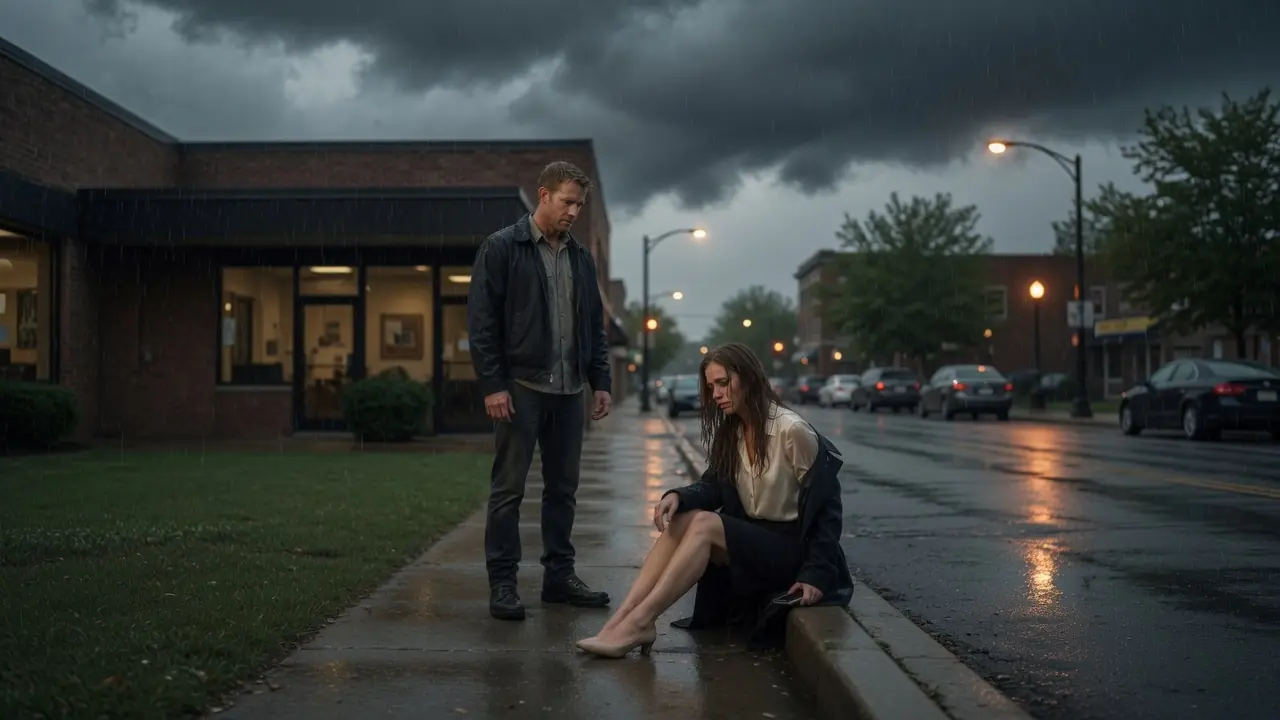
By the time they reached his apartment building, Grace had become quieter.
Mrs. Alvarez opened the main door before Evan could find his keys.
She was sixty-four, five feet tall, and wore a green robe covered with yellow flowers.
Her eyes moved from Evan’s soaked clothes to the woman leaning against him.
“You said you were buying milk.”
“The milk had an accident.”
Mrs. Alvarez looked at Grace.
“What kind of accident?”
“A truck.”
Grace raised one hand weakly.
“I was the accident.”
Mrs. Alvarez stared at Evan.
He sighed.
“I’ll explain upstairs.”
Sophie was asleep on the living-room couch beneath a blanket printed with stars.
She had waited for him despite being told not to.
One small hand still held the blue marker she had been using on a drawing. Her brown hair covered half her face.
Grace stopped in the doorway.
Something in her expression changed.
The bitterness disappeared.
For a moment, she looked frightened in an entirely different way.
“That’s your daughter?”
“Yes.”
“You really brought me home to your child?”
“You can sleep on the other couch.”
“There’s another couch?”
“No. She’s going to her bed.”
Grace watched as Evan gently lifted Sophie.
The child opened her eyes.
“Dad?”
“I’m here.”
“You’re wet.”
“So are you, apparently. You have marker on your face.”
Sophie noticed Grace standing behind him.
“Who’s that?”
“A woman who got caught in the storm.”
Grace looked toward the floor.
Sophie’s sleepy eyes studied her.
“She looks sad.”
Children often spoke the truth before adults had time to build safer versions.
Grace seemed to have no answer.
“She’s tired,” Evan said.
“That too.”
Sophie rested her head on his shoulder.
“Can she have my star blanket?”
Grace looked up sharply.
Evan carried Sophie toward the bedroom.
“We’ll find her another one.”
“No. Stars help.”
Evan glanced at Grace.
Her eyes had filled.
“The star blanket, then,” he said.
He put Sophie in bed and returned to the living room.
Mrs. Alvarez had given Grace a towel and an old set of Evan’s clothes. Gray sweatpants and a faded university sweatshirt belonged to a life before hospital bills, night shifts, and grief.
Grace stood in the bathroom doorway holding them.
“Your neighbor told me to remove my wet clothes before I catch pneumonia and inconvenience everyone.”
“That sounds like her.”
“She threatened to undress me herself.”
“That also sounds like her.”
When Grace returned, the sweatshirt hung loosely around her shoulders. Without the coat, jewelry, and evening dress, she looked younger.
More vulnerable.
She had washed the makeup from her face, revealing swollen eyes and a small scar near her left eyebrow.
Evan made coffee.
Then he changed his mind and made tea.
Grace sat at the kitchen table, staring at the cracks in the old wooden surface.
“You should eat.”
“I’m not hungry.”
“You drank enough whiskey to make a horse reconsider its choices.”
“I don’t think horses drink whiskey.”
“Then you’re already recovering.”
He placed toast and scrambled eggs in front of her.
Grace did not touch them.
Evan leaned against the counter.
“Were you trying to kill yourself?”
Her gaze lifted.
“No.”
“You said maybe that was the idea.”
“I say many things when I’m drunk.”
“Most people say things they’ve been trying not to say sober.”
She looked away.
“I wasn’t trying to die.”
“But you didn’t care if you did.”
Silence answered.
Evan sat across from her.
Six years earlier, he had found his wife, Natalie, sitting on the bathroom floor with an empty bottle of prescription pain medication beside her.
She had survived that night.
She died two years later from an aneurysm no one had known existed.
But Evan never forgot the look in her eyes when she woke at the hospital.
Not the desire to die.
The exhaustion of continuing.
“You need to call someone,” he said.
“I told you. There is no one.”
“That can’t be true.”
Grace looked at him directly.
“My mother died when I was twelve. My father died six months ago. My brother has spent the last ten years trying to remove me from the company he believes belongs to him. My friends are either employees, investors, or people paid to make me feel less alone.”
She pushed the plate away.
“The only person who loved me without wanting something died tonight eight years ago.”
Evan waited.
“Who?”
“My younger sister.”
Grace’s voice became smaller.
“Her name was Emily.”
The storm moved around the building.
Rain struck the windows.
“What happened?” Evan asked.
“She was seventeen. I was twenty-six.”
Grace pressed both hands together.
“I was supposed to collect her from a party. I was working. There was always another call, another meeting, another crisis my father insisted would prove whether I deserved a place in his company.”
Her breathing changed.
“Emily called me three times. I sent her to voicemail.”
Evan said nothing.
“She left with a boy who had been drinking. Their car went off the road.”
Grace’s eyes remained dry now.
The tears had moved somewhere deeper.
“She died before the ambulance arrived.”
“I’m sorry.”
“Everyone said it wasn’t my fault.”
“You don’t believe them.”
“No.”
“Was it your fault?”
Her expression hardened.
“You don’t know anything about it.”
“I know guilt.”
“You don’t know mine.”
“No. But I know guilt likes to dress itself as responsibility because responsibility feels easier to carry.”
Grace stared at him.
Evan continued quietly.
“If it was your fault, then the world still makes sense. You can punish yourself and pretend the punishment changes the past.”
Her lips parted.
No words came.
Evan looked toward Sophie’s closed bedroom door.
“My wife called me from the hospital the day she died. I was working overtime and didn’t answer because I thought she needed me to bring something.”
Grace remained still.
“She left a voicemail asking me to come quickly. By the time I listened, she was unconscious.”
His hand tightened around the edge of the table.
“I spent two years believing that if I had answered one call, she would still be alive.”
“Would she?”
“No.”
Evan’s voice nearly failed.
“The aneurysm had already ruptured. The doctors said nothing I did would have changed it.”
“But you still believed it.”
“Some nights I still do.”
Grace finally touched the toast.
Not to eat it.
Only to pull the plate back toward herself.
“Why are you telling me this?”
“Because you looked like you thought you were the only person who had ever survived the wrong phone call.”
Grace looked down.
After several minutes, she took a bite.
Evan gave her the star blanket and took the armchair near the window.
“You should lock your bedroom door,” she said.
“I don’t have a lock.”
“That seems unsafe.”
“You’re the one who walked into traffic.”
“I’m sober enough to dislike you now.”
“Good sign.”
Grace lay down.
Within minutes, her breathing slowed.
Evan remained awake.
At four in the morning, he checked on Sophie.
At five, he checked on Grace.
At six fifteen, exhaustion finally pulled him under.
When he woke, sunlight filled the apartment.
The storm had passed.
The couch was empty.
The star blanket had been folded carefully.
The borrowed clothes sat on top of it.
Grace’s wet evening dress was gone.
On the kitchen table lay three things.
A note.
A diamond earring.
And five hundred dollars.
The note contained only four words.
I’m sorry. Thank you.
Evan stared at the money.
Then at the earring.
He felt foolishly disappointed.
He had not expected anything from her.
Still, vanishing without saying goodbye made the previous night feel like something she wanted erased.
Sophie entered the kitchen rubbing her eyes.
“Where’s the storm lady?”
“She left.”
“Did she take the star blanket?”
“No.”
“Good.”
Sophie noticed the money.
“Are we rich?”
“No.”
“That’s a lot.”
“It’s too much.”
“What are you going to do?”
Evan folded the bills and placed them inside an envelope.
“Return it.”
“How?”
He looked at the note.
There was no number.
No address.
No last name.
“I’m working on that.”
Monday night, Evan returned to Harlo Systems headquarters.
The forty-two-story glass building stood near the waterfront, reflecting the city lights and the last of the storm clouds.
He entered through the employee service entrance at nine forty-five.
His supervisor, Dennis Parker, was waiting beside the cleaning carts.
Dennis rarely waited for anyone.
He was fifty-seven, permanently irritated, and treated every request as a conspiracy against his schedule.
“You’re late.”
“By three minutes.”
“That’s late.”
“The bus route changed after the flooding.”
“Storm ended yesterday.”
“The road didn’t heal emotionally.”
Dennis looked at him.
“Did you just make a joke?”
“No.”
“Good. Executive board is meeting tomorrow. Forty-first floor needs a full detail. Conference rooms, glass walls, everything.”
Evan pulled on his work gloves.
“Who made the mess?”
“People who earn enough not to notice mess.”
That was Dennis’s closest approach to social criticism.
Evan spent the first hour emptying waste bins and vacuuming offices.
Harlo Systems developed hospital data platforms, emergency-response software, medical logistics systems, and equipment used across the country. Evan knew almost nothing about the products.
He knew which executives left coffee cups on windowsills.
He knew which departments ordered food after midnight.
He knew the chief financial officer dropped shredded paper around his desk like snow.
He had never met the CEO.
Grace Harlo appeared on magazine covers, investor reports, and the large digital screen in the lobby. In photographs, she wore severe suits, controlled expressions, and the same unreadable eyes as the woman he had pulled from the road.
But Evan rarely looked at corporate displays.
He entered through the service door.
He worked after most employees left.
To him, the company’s CEO was only a name attached to annual speeches no one on the night crew attended.
At eleven thirty, Evan pushed his cart onto the forty-first floor.
The executive conference room stretched along the windows overlooking Elliott Bay.
A large portrait of the company’s founder hung near the entrance.
Beside it stood a photograph of Grace Harlo.
Evan stopped.
The cleaning cart rolled forward another inch and struck his heel.
Grace.
Not just Grace.
Grace Harlo.
Chief executive officer of the building whose floors he had mopped for four years.
The woman who had slept beneath Sophie’s star blanket.
Evan walked closer to the photograph.
The controlled smile looked nothing like the broken expression beneath the storm.
He felt first surprise.
Then embarrassment.
Then anger.
She had given him five hundred dollars as though he were a driver, nurse, rescuer, or inconvenience requiring payment.
He took the envelope from his coat pocket.
He had carried it all day without knowing how to return it.
Now he placed it on the center of the conference table.
The diamond earring sat inside with the cash.
On the front, he wrote:
MS. HARLO
YOU LEFT THIS AT MY HOME.
EVAN COLE, NIGHT MAINTENANCE
He finished cleaning the floor.
Then he went home.
The following evening, Grace Harlo stood outside apartment 3B.
She was sober.
She wore a dark-gray coat, plain trousers, and no visible jewelry. Her hair was tied behind her head.
In one hand, she held the envelope Evan had left.
In the other, she held a thick blue file.
Sophie opened the door before Evan reached it.
“Storm lady.”
Grace’s expression softened immediately.
“Hello, Sophie.”
“You left without saying goodbye.”
“I know.”
“That was rude.”
“Yes.”
“Did you take the money back?”
Grace looked over Sophie’s head at Evan.
“He returned it.”
“Good. Dad doesn’t like extra money.”
“That is an unusual problem.”
Evan stepped forward.
“Sophie, finish your homework.”
“I’m learning more here.”
“Bedroom.”
She looked at Grace.
“Are you staying for dinner?”
Grace hesitated.
Evan answered first.
“No.”
Sophie walked away reluctantly.
Grace waited until the bedroom door closed.
“I owe you an apology.”
“You left one.”
“Four words were insufficient.”
“So were five hundred dollars.”
Her fingers tightened around the envelope.
“I did not know how else to thank you.”
“You could have stayed until I woke up.”
“I was ashamed.”
“Of what?”
“Everything.”
Grace looked toward the stairs.
“I woke on a stranger’s couch wearing his clothes, with no clear memory of how I arrived. I saw your daughter’s blanket over me and understood that I had brought my collapse into a child’s home.”
“You didn’t harm Sophie.”
“I frightened myself.”
“So you ran.”
“Yes.”
The honesty prevented him from dismissing her immediately.
Grace held out the envelope.
“I’m not asking you to take the money.”
“Good.”
“I came because there is something you need to see.”
She raised the blue file.
Evan’s surname was written across the label.
COLE, NATALIE E.
His body became cold.
“Where did you get that?”
“From Harlo Systems’ restricted legal archive.”
“Why does your company have a file on my wife?”
Grace looked toward Sophie’s bedroom.
“We should not discuss this in the hallway.”
Evan almost refused.
Then he saw the name again.
Natalie E. Cole.
He stepped aside.
Grace entered.
She sat at the kitchen table where she had eaten toast less than forty-eight hours earlier.
Evan remained standing.
“Start talking.”
Grace opened the file.
“Your wife worked for Harlo Systems.”
“No.”
“She did.”
“Natalie was a nurse.”
“She was also a clinical consultant for an outside testing company.”
Evan remembered late nights.
Temporary projects.
Natalie saying the hospital had asked her to review a new patient-monitoring platform.
“What platform?”
“Sentinel Bridge.”
The name meant nothing to him.
Grace removed a document.
“Eight years ago, Harlo Systems was preparing to release software connecting emergency-room monitors, medication alerts, and patient records.”
“What does this have to do with Natalie?”
“She found a failure.”
Grace turned the paper toward him.
Natalie’s signature appeared beneath the heading CLINICAL SAFETY ASSESSMENT.
“She discovered that under certain network interruptions, the system delayed critical alerts while displaying the patient connection as active.”
Evan read the sentence twice.
“What kind of alerts?”
“Cardiac events. Oxygen loss. Medication conflicts.”
His throat tightened.
“Did anyone die?”
Grace looked at him.
“Three patients were injured during pilot testing. One died.”
Evan pulled out a chair and sat.
“Natalie reported it?”
“Yes.”
“Then why have I never heard about this?”
“Because my father buried the report.”
The apartment became silent.
Grace continued.
“Harlo Systems was weeks from a major federal contract. A public safety failure would have destroyed the deal and possibly the company.”
“So your father hid it.”
“He ordered the software team to correct the issue privately. Then he pressured the testing company to classify the incidents as hospital-network errors.”
“And Natalie?”
“She refused to change her findings.”
Evan looked down at the signature.
That sounded like her.
Natalie would argue with a surgeon, hospital director, or insurance executive if she believed a patient was being placed at risk.
“What did he do to her?”
“He threatened legal action for violating confidentiality. Her consulting contract ended. She was warned that releasing the report could cost her nursing license because patient data was included.”
Evan felt anger building behind his ribs.
“She never told me.”
“She was trying to protect you.”
Grace removed another document.
A handwritten letter.
Evan recognized the narrow, slightly uneven writing before reading a word.
Natalie’s handwriting.
His hands began to shake.
The letter was addressed to Grace.
Grace,
You don’t know me. Your father made sure we never met.
I am sending this because someday you may inherit his company, and if you do, you deserve to know what it cost to protect it.
Sentinel Bridge can be repaired. What cannot be repaired is a culture that treats silence as loyalty.
I have a husband and a little girl. I am frightened of what your father could do to us. I have therefore placed the full evidence with an attorney, with instructions that it be released if the system harms another patient.
I hope you become a different kind of leader.
Natalie Cole
Evan stopped reading.
Sophie had been one year old then.
“Why didn’t the evidence come out?”
“The flaw was repaired before commercial release. No further patients were harmed.”
“That doesn’t answer me.”
Grace lowered her eyes.
“The attorney handling the file died two years later. His practice closed. The materials were transferred to storage and effectively disappeared.”
“And your father kept this letter?”
“He kept records on everyone he considered a threat.”
Evan looked toward the file.
“Why are you showing me now?”
“Because I found it yesterday morning.”
“After you left my apartment?”
“Yes.”
Grace’s voice changed.
“I went to the office because I could not go home. I had spent the night telling a stranger that I failed my sister because I ignored her calls.”
She touched Natalie’s letter.
“Then I found proof that another woman had called my family for help, and my father chose not to listen.”
Evan stared at her.
“I searched the employee system for your name because I wanted to know who you were.”
“That’s an invasion.”
“Yes.”
“You searched my private records.”
“Yes.”
“Stop agreeing like it makes this acceptable.”
“It doesn’t.”
Grace closed her eyes briefly.
“When I found your emergency contact history, I saw Natalie’s name. I remembered it from the archive index.”
She opened another section of the file.
“There is more.”
Evan did not want more.
He also could not stop.
Grace placed a payment record before him.
An internal settlement account had transferred one hundred twenty thousand dollars into a trust under Sophie’s name six years earlier.
Evan looked up.
“What is this?”
“My father created a private fund for several people involved in the Sentinel testing.”
“We never received this.”
“The trustee was instructed not to notify you until Sophie turned eighteen.”
“Why?”
“To prevent questions.”
Evan pushed the document away.
“He bought silence from a dead woman’s child.”
“Yes.”
The word came quietly.
“Did Natalie accept this?”
“No. It was created after her death.”
Evan stood so quickly the chair struck the wall.
Grace remained seated.
“My wife died believing your family could destroy ours.”
“I know.”
“She carried this alone.”
“I know.”
“Stop saying that.”
Grace rose.
“What would you like me to say?”
“That you can fix it?”
“I can’t.”
“That you’re sorry?”
“I am.”
“Sorry is easy when you inherited the company built from everyone else’s fear.”
Her face tightened, but she did not defend herself.
Evan continued.
“You came here with a file because you needed to feel different from your father.”
“No.”
“Yes.”
“You think exposing his secret makes you brave?”
“No.”
“You want me to forgive you because you got drunk, walked into traffic, and woke up near the family your company harmed?”
Grace’s eyes filled.
“No.”
“Then what do you want?”
She placed both hands flat against the table.
“I want you to know your wife was brave.”
Evan stopped.
Grace’s voice trembled.
“I want Sophie to know her mother protected people she would never meet.”
She took a breath.
“And I want to open every sealed file my father left behind, even if it destroys my position.”
Evan stared at her.
“Why should I believe you?”
“You shouldn’t.”
The answer surprised him.
“You should watch what I do next.”
Grace closed the file.
“I’m announcing an independent investigation tomorrow.”
“You’ll lose the company.”
“Maybe.”
“Your brother will use this against you.”
“Yes.”
“Investors will remove you.”
“They may.”
“And the trust?”
“It belongs to Sophie legally. But the decision about whether to accept it should be yours until she is old enough to understand.”
Evan looked toward the bedroom.
“I don’t want blood money.”
“Then don’t take it.”
“You could redirect it.”
“Not without violating the trust.”
“Your father designed it well.”
“He designed everything well.”
Grace picked up her coat.
At the doorway, she stopped.
“Natalie wrote one more thing.”
Evan did not respond.
Grace opened the file and read from the final page.
If anything happens to me, tell Evan I did not stay silent because I lacked courage. I stayed silent because courage becomes complicated when someone you love can be punished for it.
Evan turned away.
Grace left the page on the table.
Then she walked out.
The investigation began the following morning.
Grace stood before employees, journalists, regulators, and investors inside the Harlo Systems lobby.
Evan watched from a break room on the eighteenth floor.
He was supposed to be cleaning an executive hallway.
Instead, he stood beside Dennis while Grace admitted that the company had concealed clinical-safety findings eight years earlier.
She did not blame only her father.
She admitted that the secrecy remained possible because current executives had never reviewed the restricted archive.
She announced that all safety records would be opened to independent investigators.
Then she stepped down temporarily as chief executive while the board reviewed her conduct.
Dennis stared at the screen.
“This place is about to explode.”
Evan said nothing.
“Did you know about this?”
“No.”
It was not exactly a lie.
He had known for twelve hours.
By noon, Grace’s brother, Richard Harlo, appeared on every business network.
He described Grace as emotionally unstable.
He referred to her conduct during the charity gala without explaining what had happened.
He claimed she had developed an inappropriate relationship with a maintenance employee and was releasing confidential materials under personal pressure.
Evan’s name appeared online before the end of the day.
Photographers waited outside his apartment.
Sophie’s school called after strangers attempted to question parents near the entrance.
Harlo Systems suspended Evan pending an internal review, claiming it was for his protection.
His paycheck stopped immediately.
Grace called him that night.
He did not answer.
She left no voicemail.
On the third day, Sophie found Natalie’s letter.
Evan had placed the file on top of the refrigerator, believing she could not reach it.
He underestimated a child with a kitchen chair.
“What’s Sentinel Bridge?” she asked.
Evan froze.
Sophie stood in the doorway holding the paper.
“Give me that.”
She pulled it closer.
“Mom wrote it.”
“Yes.”
“Why?”
He sat at the table.
For years, he had told Sophie stories about Natalie.
How she sang badly while cooking.
How she once rescued a pigeon and regretted it immediately.
How she kept emergency snacks in every purse.
He had never had the chance to tell Sophie that her mother had been courageous in a way larger than their family.
So he told her.
Not everything.
Enough.
Sophie listened silently.
“Was Mom scared?”
“Yes.”
“Did she do it anyway?”
“She tried.”
Sophie looked toward the letter.
“That counts.”
Evan felt something inside him break open.
Children sometimes understood morality more clearly because they had not yet learned how adults complicated it for convenience.
“Grace found this?” Sophie asked.
“Yes.”
“Is she the storm lady?”
“Yes.”
“Is she bad?”
Evan considered the question.
“No.”
“Is she good?”
“I don’t know.”
“That’s confusing.”
“Yes.”
Sophie sat beside him.
“Mom did something good when she was scared.”
“She did.”
“Maybe Grace is trying too.”
Evan looked at his daughter.
“You like her.”
“She gave back the star blanket.”
“That’s your standard?”
“It’s a good blanket.”
The following week, Evan attended the public hearing into Sentinel Bridge.
Grace sat alone at one table.
Her brother sat behind six attorneys at another.
The board had removed her as CEO two days earlier.
Richard now served as interim chief executive.
He testified that his father made all decisions related to the pilot program and that Grace had no direct involvement.
Then he accused Grace of disclosing protected patient information recklessly.
Grace’s attorney produced records showing all identifying information had been redacted before release.
Richard changed his argument.
He claimed Natalie Cole had exaggerated the flaw to obtain money.
Evan stood before he realized he was moving.
The hearing officer looked toward him.
“Sir, please sit.”
Richard’s attorney whispered something and smiled.
Evan sat.
Grace did not look back.
Then a retired software engineer named Samuel Burke took the witness seat.
He had worked on Sentinel Bridge.
He confirmed Natalie’s findings.
He also produced an audio recording made during a meeting with Grace’s father and Richard.
Richard’s voice was unmistakable.
If the nurse won’t revise the report, bury her under litigation. She has a husband with a maintenance job and a baby. People become reasonable when their families are exposed.
The room changed.
Grace turned slowly toward her brother.
Richard’s face became pale.
He had not been a distant observer.
He had helped create the threat.
Samuel explained that Natalie’s refusal forced the engineering team to repair the system before release. Her actions had likely prevented further deaths.
When the hearing recessed, reporters crowded the hallway.
Evan found Grace standing alone near a service exit.
She looked exhausted.
“You knew about the recording?” he asked.
“No.”
“Samuel contacted your investigators?”
“Yes.”
“Your brother is finished.”
“Probably.”
She looked toward him.
“How is Sophie?”
“Angry that reporters frightened her friend.”
“I’m sorry.”
“She read Natalie’s letter.”
Grace closed her eyes.
“I should have warned you to hide it.”
“I should have hidden it better.”
“What did you tell her?”
“The truth, carefully.”
Grace nodded.
“She deserves that.”
Evan looked at the woman who had once stood barefoot in front of a truck.
“You really expected to lose everything.”
“Yes.”
“Why?”
“Because your wife was right.”
Grace’s voice lowered.
“A culture that treats silence as loyalty cannot be repaired with private apologies.”
For the first time since she brought the file, Evan’s anger loosened.
Not disappeared.
Loosened.
“Come to dinner,” he said.
Grace stared at him.
“Tonight?”
“Sophie has been asking whether you’re in jail.”
A tired laugh escaped her.
“I’m not.”
“She’ll be disappointed. She thinks prison uniforms are orange everywhere.”
“I can explain legal jurisdiction.”
“She’ll love that.”
Grace became serious.
“Are you sure?”
“No.”
He thought about the night of the storm.
The choice to step toward a stranger instead of continuing home.
“Come anyway.”
Grace returned to apartment 3B with no money, no file, and no expectation of forgiveness.
Sophie opened the door.
“You’re not the boss anymore.”
Grace blinked.
“No.”
“Are you sad?”
“Yes.”
“Dad lost his job too.”
“I know.”
Sophie considered both adults.
“Then you can help each other find jobs.”
Evan laughed for the first time in days.
Dinner was spaghetti.
Grace washed the dishes without being asked.
When Sophie went to bed, Grace and Evan sat near the window.
The city lights reflected against the glass.
“What happens to Harlo Systems?” Evan asked.
“The board will remove Richard. Regulators may fine the company. Several hospital clients are reviewing contracts.”
“And you?”
“I don’t know.”
“Do you want the job back?”
She considered the question.
“I want the company to survive without needing another person like Natalie to risk everything alone.”
“That wasn’t the question.”
Grace looked down.
“I don’t know who I am without that company.”
“I knew you before I knew the company.”
“You knew me drunk.”
“I knew you broken.”
“That’s worse.”
“It’s more honest.”
Grace looked toward him.
“You still don’t trust me.”
“No.”
“I understand.”
“But I believe you’re trying.”
Her eyes filled.
“That is more than I expected.”
Evan reached across the space between them.
He did not take her hand.
He placed his palm upward on the couch.
Grace looked at it.
Then she made the final movement.
Her fingers settled into his.
Months passed.
Richard Harlo was charged with obstruction, conspiracy, and falsification of safety records. The company entered a settlement requiring independent safety oversight and the creation of a protected whistleblower division.
Grace was offered her position again.
She accepted under conditions the board initially considered extreme.
Employee-elected safety representatives.
Public reporting of clinical concerns.
Personal legal protection for contractors and temporary workers.
No confidential settlement involving patient safety without independent judicial review.
The company survived.
Smaller.
Less profitable.
More honest.
Evan did not return as a night cleaner.
Grace offered nothing directly.
She remembered.
Instead, Dennis called him.
Harlo Systems had created a new facilities-safety liaison position after investigators discovered how often maintenance employees observed problems no executive noticed.
Dennis recommended Evan.
The job paid more, allowed daytime hours, and included training.
Evan applied.
He interviewed like everyone else.
He got it.
The trust created for Sophie remained untouched.
Years later, when she was old enough to understand, she chose to use part of it to fund scholarships for nurses and clinical testers who reported safety concerns.
She named the scholarship after Natalie.
Grace began visiting apartment 3B without storms, scandals, or files.
At first, she came for dinner.
Then Sophie’s school play.
Then Saturday breakfast.
She learned that pancakes were supposed to be uneven.
She learned not to buy Sophie expensive gifts without asking Evan.
She learned that loneliness did not vanish merely because people entered the room. It vanished when a person believed they would remain after seeing the parts she preferred to hide.
Evan learned too.
He learned that protecting Sophie did not require controlling every possibility.
He learned that accepting help did not dishonor Natalie.
He learned that grief was not a locked room with only one person’s name on the door.
One evening, nearly two years after the storm, Grace stood in Evan’s kitchen holding Sophie’s star blanket.
The child had outgrown it.
Most of the printed stars had faded.
“I should return this properly,” Grace said.
“You returned it the first morning.”
“No. I folded it and ran.”
Evan leaned against the counter.
“True.”
Grace placed the blanket over the back of the couch.
“That night, I thought survival meant waking up and pretending nothing had happened.”
“And now?”
“I think survival means allowing what happened to change you without allowing it to define the rest of your life.”
Evan smiled slightly.
“That sounds rehearsed.”
“I’m still an executive.”
Sophie entered carrying a framed photograph.
It showed Natalie holding her as a baby.
Sophie placed it on the shelf beside a photograph taken recently at the waterfront: Evan, Sophie, and Grace laughing beneath an umbrella that had turned inside out.
Grace looked at the two pictures.
“You don’t have to put them together,” she said.
Sophie frowned.
“Why not?”
“I don’t want your mother to feel replaced.”
Sophie looked toward the photograph.
“Mom’s dead.”
Evan closed his eyes.
Grace looked startled.
Sophie continued with the practical seriousness only children possessed.
“She can’t be replaced. She’s Mom.”
Then she pointed toward Grace.
“You’re Grace.”
“What does that make me?”
Sophie thought.
“Still deciding.”
Grace laughed softly.
“That’s fair.”
A year later, Evan and Grace stood at the same intersection where they had met.
The city had installed new drainage, brighter streetlights, and a pedestrian barrier near the corner.
Rain fell lightly.
Nothing like the storm that nearly swallowed them.
Grace looked toward the road.
“I remember the headlights.”
“So do I.”
“I remember thinking I was tired enough not to move.”
Evan took her hand.
“Do you still feel that way?”
“Sometimes.”
He looked at her.
She did not pretend otherwise.
“But now I tell someone.”
“Who?”
“Sophie, usually.”
“That seems dangerous.”
“She gives very aggressive advice.”
“She’s good at it.”
Grace looked toward him.
“And you.”
Evan squeezed her fingers.
“I’m glad you were there.”
“I almost wasn’t.”
“But you were.”
They crossed the street together.
Years later, people inside Harlo Systems still told the story incorrectly.
Some said the CEO fell in love with a janitor who saved her life.
Some said Evan Cole exposed the company’s darkest secret and forced a billionaire to change.
The truth was less simple.
Evan saved Grace from one truck.
Natalie had saved strangers from a system that might have failed them.
Grace brought Natalie’s courage into the light.
Sophie reminded both adults that trying while afraid still counted.
No single person rescued everyone.
They simply arrived at the moments when another person could no longer carry everything alone.
On the night they met, Evan saw only a barefoot woman stumbling into traffic.
He did not know her name.
He did not know she signed his paycheck.
He did not know she carried the key to the secret his wife had taken to her grave.
He knew only that the truck was coming.
Everyone else had disappeared into the storm.
And someone had to move.
So he did.