Rain hammered the cracked road outside Chicago so hard that Noah Bennett could barely see beyond the hood of his truck.
The storm had turned the shoulder into brown water.
Ditches overflowed.
Traffic crawled.
Thunder rolled low enough to vibrate through the steering wheel.
Noah looked at the clock.
8:48 a.m.
His interview started at nine.
He tightened both hands around the wheel.
Dalton Technologies.
Logistics coordinator.
Full-time.
Benefits.
Steady hours.
A salary large enough that he could stop calculating groceries in his head before reaching the register.
He had been preparing for three weeks.
His son had helped him iron his only good shirt the night before.
“Don’t be late, Dad.”
Noah smiled at the memory.
“I won’t.”
That had been the promise.
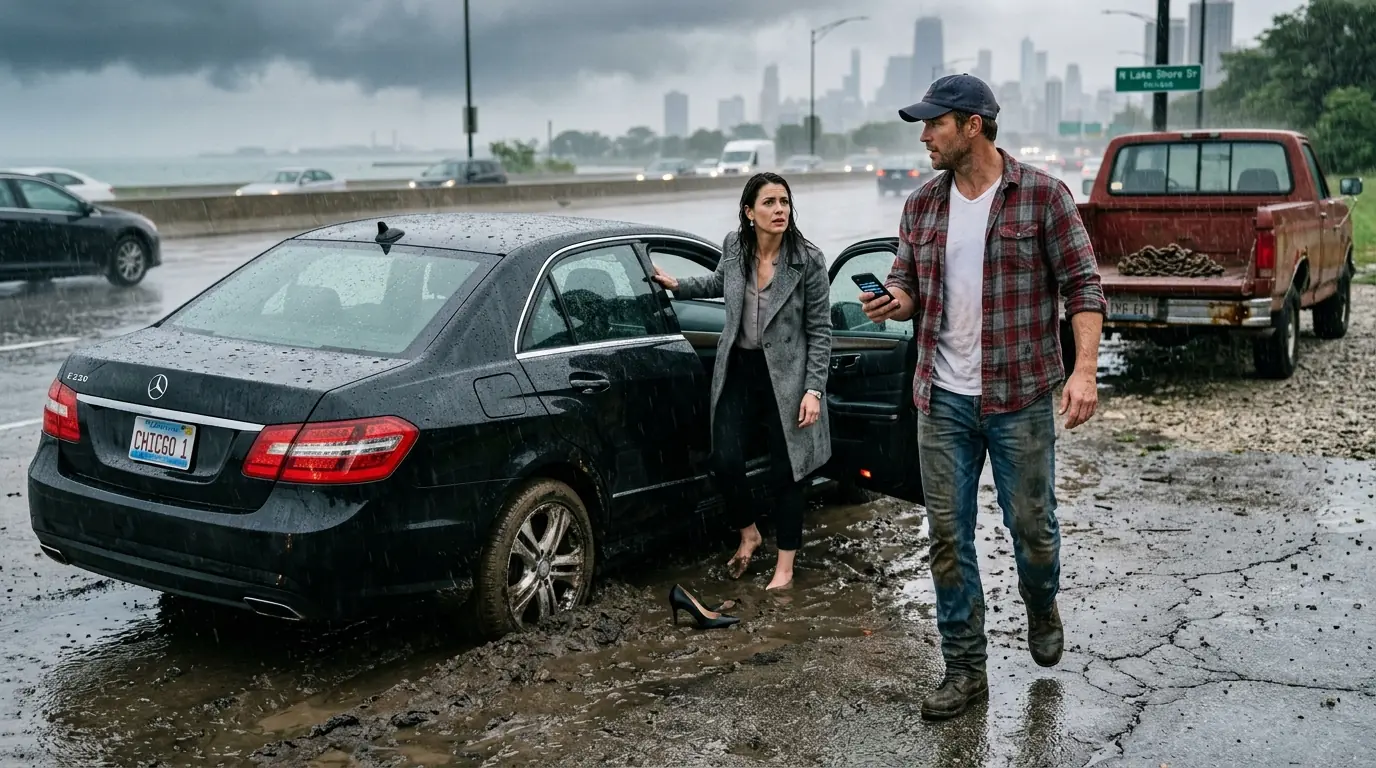
Then he saw the black sedan.
It sat half off the road, one rear wheel buried deep in mud.
Hazard lights blinked through the rain.
A woman stood beside it in a gray coat, pulling helplessly at one shoe trapped in the muck.
Noah looked at the clock again.
8:49.
He should have kept driving.
Every practical thought told him to.
This interview mattered.
His rent was overdue.
His son’s sneakers were splitting at the sides.
The refrigerator had started making a noise that usually meant money.
Noah slowed anyway.
Then stopped.
“Damn it.”
He pulled onto the shoulder.
By the time he stepped from the truck, rain had already soaked through his shirt.
The woman turned when she heard him approach.
Dark hair clung to her face.
Her expression carried equal parts anger and embarrassment.
“I’m fine.”
Noah looked at the heel buried almost to the ankle.
“No, you’re not.”
She narrowed her eyes.
“I can handle it.”
“You’re going to twist your ankle.”
“I said—”
Noah crouched.
“Hold still.”
He gripped the shoe.
One hard pull.
Mud released it with a wet sucking sound.
The woman nearly lost her balance.
Noah caught her elbow.
“There.”
She looked at the shoe in his hand.
Then at him.
“Thank you.”
He handed it back.
“Get in your car.”
“What?”
“I’ll pull you out.”
“You don’t have to.”
“I know.”
Noah turned toward the truck.
The woman watched him trudge through the rain.
His pickup was old enough to be embarrassing in some neighborhoods.
Rust around the wheel wells.
Cracked rear bumper.
Different-colored replacement tailgate.
But a recovery chain sat behind the cab.
So did a toolbox.
Noah had spent enough years working construction sites, warehouses, and bad roads to know how to free a stuck vehicle.
He positioned the truck.
Attached the chain.
Checked the angle twice.
Then climbed behind the wheel.
The sedan came free slowly.
No spinning tires.
No dramatic jerk.
Just steady torque.
By the time Noah disconnected everything, his watch read 9:03.
He had missed the interview.
The woman lowered her window.
“Wait.”
Noah turned.
She held out several folded bills.
“No.”
“Please.”
“I said no.”
“You’re completely soaked.”
“So are you.”
“You missed something because of me.”
Noah hesitated.
“What?”
He looked toward the road.
“A job interview.”
Her face changed.
“When?”
“Nine.”
She checked the time.
“Oh.”
“Yeah.”
“I’m sorry.”
Noah shrugged.
“You were stuck.”
“That doesn’t make your interview less important.”
“No.”
He pulled his cap lower against the rain.
“But leaving you there wasn’t going to make me better qualified.”
She stared at him.
Noah nodded once.
“Take care.”
Then walked back to his truck.
His name was Noah Bennett.
Thirty-six.
Former Marine.
Single father.
Warehouse supervisor once.
Small delivery business owner for three years after leaving the military.
Then the business failed.
Not because Noah was lazy.
Because one major client stopped paying.
Fuel prices climbed.
Two trucks broke in the same month.
And Noah spent nearly a year trying to save something that had already died.
By the time he closed the company, most of his savings were gone.
His son, Eli, was nine.
Eli did not understand debt.
He understood that Dad stopped buying coffee away from home.
That the truck made strange noises.
That sometimes dinner was pancakes because eggs and flour lasted longer than meat.
Noah never told him they were struggling.
Children should know they are loved before they know what the electric bill costs.
That was Noah’s rule.
The Dalton Technologies position could change everything.
Not dramatically.
No mansion.
No miracle.
Just stability.
Health insurance.
Predictable pay.
An employer large enough that one broken vehicle would not destroy the business.
Noah drove toward downtown anyway.
Maybe they would still see him.
Maybe.
The storm had other plans.
A collision blocked two lanes.
Traffic stopped.
9:17.
9:31.
9:44.
By the time Noah reached the glass tower, it was nearly ten.
He entered through the lobby looking exactly like what he was.
Wet.
Tired.
Desperate not to look desperate.
The receptionist checked the schedule.
“I’m sorry. They’ve moved to the next candidates.”
Noah swallowed.
“I understand. Could I wait in case someone has time?”
“The hiring manager is fully booked.”
“I came through the storm.”
“I understand.”
Her tone suggested she did not.
Noah nodded.
“When can I reapply?”
“Six months.”
Six months.
He nearly laughed.
Instead:
“Thank you.”
He walked outside.
The rain had become a drizzle.
That somehow felt worse.
During heavy rain, disappointment had company.
Now the city simply continued.
People hurried past holding coffee.
Cars splashed through intersections.
Office workers checked phones.
Noah stood beneath the awning and thought about Eli.
How do you explain to a nine-year-old that keeping one promise might have cost you another?
He started walking toward the truck.
Then a black SUV pulled alongside him.
The passenger window lowered.
The woman from the roadside sat inside.
Dry now.
Hair pulled back.
Gray coat replaced by a dark blazer.
Noah stopped.
She looked at him.
“You missed it.”
“Yeah.”
“Because of me.”
“Because of weather.”
“And because of me.”
Noah smiled faintly.
“You planning to argue until I blame you?”
“If necessary.”
He continued walking.
The SUV rolled beside him.
“Get in.”
Noah looked over.
“I appreciate the offer, but my truck is three blocks away.”
“I know.”
“You know?”
“I saw it.”
He frowned.
“Why are you following me?”
She looked almost embarrassed.
“Because I owe you an explanation.”
“You don’t owe me anything.”
“That seems to be your favorite sentence.”
The rear door opened.
Noah stared at it.
Then at her.
“Five minutes.”
She nodded.
“Five minutes.”
He got in.
The interior smelled faintly of leather and coffee.
Noah immediately felt underdressed.
The woman extended one hand.
“Charlotte Dalton.”
Noah shook it.
“Noah Bennett.”
“I know.”
His hand stopped.
“What?”
She reached toward a folder beside her.
On the front:
DALTON TECHNOLOGIES
Noah stared.
Then looked at her.
“No.”
Charlotte almost smiled.
“Yes.”
“You’re…”
“Founder and CEO.”
Noah looked out the window as if checking whether he had entered another wrong vehicle.
“You’re Charlotte Dalton.”
“Unfortunately.”
“I just got rejected from your building.”
“I know.”
“You were on the side of the road.”
“Also true.”
Noah rubbed one hand over his face.
“This is ridiculous.”
Charlotte laughed quietly.
It was the first sound from her that did not feel controlled.
“You were interviewing for logistics coordinator.”
“Was.”
“I looked at your application after I got back.”
Noah’s expression changed.
“You looked at it because I helped you.”
“Yes.”
“Then I don’t want special treatment.”
Charlotte studied him.
“That response is partly why we’re still talking.”
“No.”
He shook his head.
“I mean it.”
“So do I.”
She placed the folder between them.
“Your resume had already been flagged for second review.”
Noah looked skeptical.
“By who?”
“One of our operations managers.”
“Then why wouldn’t they see me late?”
“Because recruiting follows schedules.”
“That sounds like a polite way of saying no one cares why.”
Charlotte nodded.
“That is sometimes exactly what procedure becomes.”
Noah looked at her.
“What do you want from me?”
“An hour.”
“For what?”
“To see something.”
The SUV entered the private garage beneath Dalton Technologies.
Noah should have said no.
He knew that.
But the same instinct that made him stop at the flooded road told him something important was happening.
The elevator opened onto an operations floor.
Not the executive level he expected.
Monitors everywhere.
Dispatch boards.
Maps.
Shipment numbers.
People moving fast.
Nobody was celebrating.
A man in a white shirt approached Charlotte immediately.
“We still have forty-seven outbound orders showing mismatched location data.”
Charlotte nodded.
“Any confirmed losses?”
“Not yet.”
“Client impact?”
“Three medical equipment accounts at risk if we miss afternoon transfers.”
Noah glanced toward the main display.
Routes.
Warehouse numbers.
Transfer hubs.
Color-coded exceptions.
He recognized the problem shape immediately.
Not the software.
The shape.
He had lived inside logistics long enough.
Missing freight rarely vanished.
Usually information and reality stopped agreeing.
Charlotte noticed him looking.
“This is why I brought you up.”
Noah stared.
“You want me to fix your computers?”
“No.”
“Good.”
He almost smiled.
“Our systems team says the platform is functioning.”
“Then why is everyone panicking?”
“Because the platform says inventory is in places where operations staff say it isn’t.”
Noah stepped closer to the screen.
“Who changed routes last night?”
A manager turned toward him.
“Excuse me?”
Noah pointed.
“These six loads.”
The man approached.
“We rerouted them after flooding shut down the south hub.”
“Manually?”
“Yes.”
“Who updated container IDs?”
“Dispatch.”
“All of them?”
The manager hesitated.
“Should have.”
Noah looked at the screen.
“Should have is where freight disappears.”
Charlotte said:
“Show me.”
Noah moved to a table covered with printed dispatch sheets.
That was what he trusted.
Paper.
Times.
Drivers.
Trailer numbers.
Warehouse scans.
He compared the physical transfer records with the software exceptions.
Ten minutes passed.
Then twenty.
Noah drew circles around several numbers.
“Here.”
The operations manager leaned closer.
“What?”
“You didn’t lose forty-seven orders.”
“How do you know?”
“You changed trailers at the temporary hub.”
“Yes.”
“But half the replacement trailers kept the old route group identifiers.”
The manager frowned.
“That wouldn’t cause this.”
“Not by itself.”
Noah pointed lower.
“Then somebody reassigned drivers by destination but didn’t remap pallet groups.”
Silence.
He continued.
“Your system thinks pallets followed original trailers.”
He flipped another page.
“But the drivers followed new destinations.”
Charlotte leaned closer.
“So the goods…”
“Are probably exactly where they should be.”
Noah tapped the screen.
“Your database is following the containers. Your people moved the freight.”
The systems engineer looked offended.
“That’s oversimplifying.”
“It’s logistics.”
Noah shrugged.
“It’s always oversimplifying until someone finds the box.”
Charlotte looked at the manager.
“Can we verify?”
“Give me twenty minutes.”
Calls went out.
Warehouse supervisors checked.
Drivers confirmed.
Scanning teams physically counted.
One by one, the red exceptions changed.
Green.
Green.
Green.
Thirty-five minutes later, all but three shipments had been located.
The remaining three were discovered at a cross-dock under temporary manual labels.
Nothing was lost.
The data reconciliation was corrected.
The room exhaled.
Noah stepped back.
“That’s it.”
One manager stared at him.
“We’ve been working this for six hours.”
“You were looking at system health.”
Noah pointed toward the dispatch sheets.
“The software was healthy.”
“The handoff wasn’t.”
Charlotte crossed her arms.
“You’ve done this before.”
“For twelve years.”
“I mean exactly this.”
“No.”
Noah looked toward the board.
“But I’ve seen ten versions of it.”
That answer impressed Charlotte more than claiming genius would have.
Pattern recognition.
Experience.
No theater.
She took Noah into a smaller conference room afterward.
He remained standing.
Charlotte sat.
“You were late for your interview.”
“Yes.”
“You still want the position?”
Noah hesitated.
“Honestly?”
“Yes.”
“I wanted it this morning.”
“And now?”
“Now I’m worried you’re about to offer it because I pulled your car out of mud.”
Charlotte nodded.
“Fair.”
Noah waited.
“So I won’t.”
That surprised him.
“What?”
“I’m not offering you the coordinator job.”
His stomach sank.
Charlotte continued.
“I’m offering you the interview you missed.”
Noah looked at her.
“A real one.”
“Today?”
“Today.”
“With the same hiring team.”
“Yes.”
“No instruction telling them to hire me?”
“No.”
“No CEO recommendation?”
“I will tell them one fact.”
“What?”
“That you identified the cause of today’s logistics mismatch.”
Noah thought.
“That seems like a pretty big recommendation.”
“It is work evidence.”
“Not roadside charity.”
“Exactly.”
He sat.
Charlotte smiled.
“Now we understand each other.”
The interview lasted ninety minutes.
Noah did not perform perfectly.
He was too blunt in one answer.
Admitted he disliked unnecessary meetings.
Described one former supervisor as “a man who could complicate boiling water.”
The panel laughed.
Then asked harder questions.
Why had his business failed?
Noah answered honestly.
“I waited too long to admit our biggest customer would never pay us.”
“What did you learn?”
“That optimism without a cash-flow plan is just denial.”
“How do you manage conflict?”
“Preferably early.”
“How do you handle employees who make mistakes?”
“Depends whether they hide them.”
One panelist asked:
“Why should we hire someone without a four-year degree when other candidates have one?”
Noah paused.
“You shouldn’t if the degree makes them better for the work.”
“And if it doesn’t?”
“Then you’re hiring the paper.”
Noah left believing he had probably destroyed his chances.
Charlotte did not attend.
She had promised not to.
That mattered.
At six that evening, he was changing a belt on his truck when the call came.
“Mr. Bennett?”
“Yes.”
“This is Dalton Technologies.”
He stopped moving.
“We’d like to offer you the logistics coordinator position.”
Noah sat slowly on the curb.
The recruiter continued with salary.
Benefits.
Start date.
It was more than he had expected.
Not executive money.
Not six figures.
A realistic salary for the role.
But enough.
Enough was a beautiful number.
“Mr. Bennett?”
“I’m here.”
“Would you like some time to consider?”
Noah looked toward his apartment window.
Eli was inside doing homework at the kitchen table.
“No.”
He smiled.
“I accept.”
Eli took the news better than Noah expected.
“You got it?”
“I got it.”
“The rain job?”
“The rain job.”
Eli jumped into his arms.
Noah laughed.
“You’re heavy.”
“I’m nine.”
“Exactly.”
“Can we buy new shoes?”
The question nearly broke him.
Noah closed his eyes.
“Yes.”
“Today?”
“Tomorrow.”
Eli leaned back.
“Can I get the ones with red?”
“Within reason.”
“What does that mean?”
“It means I regret telling you already.”
Noah started two weeks later.
His first month was difficult.
Corporate systems moved differently from small operations.
Meetings had acronyms.
People used words like “synergy” without irony.
Noah hated presentations.
He loved warehouse floors.
He spent more time talking to dispatchers, drivers, dock workers, and receiving clerks than the other coordinators did.
One afternoon Charlotte found him eating lunch beside the loading area.
“You know we have an executive cafeteria.”
“I’m not an executive.”
“Employee cafeteria.”
“Food’s better here.”
She looked at the sandwich.
“That looks terrible.”
“It’s excellent.”
She sat beside him anyway.
Their relationship did not turn romantic immediately.
That would have been too easy.
Charlotte was his CEO.
Noah was new.
Both understood the complications.
So they kept distance.
Mostly.
But Charlotte occasionally asked his opinion.
Noah occasionally disagreed with her.
Publicly.
The first time he did, the conference room went silent.
Charlotte presented a plan to consolidate two regional distribution centers.
Noah raised his hand.
“The numbers look good because you’re not counting driver turnover.”
One vice president stared at him.
Charlotte asked:
“Explain.”
He did.
The plan required longer overnight routes.
Experienced drivers would likely leave.
Recruitment costs were understated.
Charlotte asked for the model to be revised.
Afterward, Noah approached her.
“Was that okay?”
“What?”
“Disagreeing in there.”
Charlotte looked amused.
“Why would I hire you to tell me what I already think?”
Noah nodded.
“Good.”
She watched him walk away.
That was the moment she began liking him more than was professionally convenient.
Months passed.
Noah became good at the job.
Not because he was a miracle worker.
Because he listened.
Warehouse workers trusted him.
Drivers called him before small problems became expensive ones.
He knew systems.
But he also knew fatigue.
Weather.
Broken forklifts.
Bad loading docks.
Human shortcuts.
The messy physical world beneath clean dashboards.
His supervisors noticed.
So did Charlotte.
Eli noticed something else.
“You talk about Charlotte a lot.”
Noah nearly choked on coffee.
“What?”
“The CEO lady.”
“I do not.”
“You said her name three times yesterday.”
“I work for her company.”
“Do you like her?”
Noah stared.
“You need to go to school.”
“That means yes.”
“Shoes.”
“I have them on.”
“Backpack.”
“Already.”
“Leave.”
Eli grinned.
“Definitely yes.”
The door closed.
Noah sat alone.
Then muttered:
“Traitor.”
Charlotte had her own reasons for caution.
Her marriage had ended six years earlier.
No children.
Her former husband had loved the public version of their life.
Private travel.
Important people.
The house.
The access.
When the company entered a difficult period, so did the marriage.
Charlotte learned an ugly lesson.
Some people loved proximity to success more than the person carrying it.
Noah seemed different.
Which was precisely why she distrusted her own feelings.
She did not want to turn his kindness into another test.
Did not want to wonder whether he would have helped if he knew her name.
He already had.
That part was settled.
The harder question was whether she could meet him as an equal human being while still occupying a position of power over his career.
Eventually she did something unusual.
She transferred Noah’s reporting line away from any division she directly supervised.
Not because she planned to date him.
Because she realized even friendship had begun to blur boundaries.
She told him.
“I changed your reporting structure.”
Noah frowned.
“Why?”
“Because I need to tell you something without you wondering whether your answer affects your job.”
He went still.
“That sounds serious.”
“It is.”
They sat in a quiet coffee shop several blocks from headquarters.
No assistants.
No company building.
Charlotte folded her hands.
“I like you.”
Noah blinked.
She continued before losing courage.
“More than is professionally uncomplicated.”
He stared at her.
Then:
“That was very CEO.”
She closed her eyes.
“I rehearsed it.”
“I can tell.”
“I am trying to be responsible.”
Noah smiled.
“I like you too.”
Charlotte opened her eyes.
“That was annoyingly easy.”
“No.”
His smile faded.
“It isn’t.”
He looked toward the street.
“I have Eli.”
“I know.”
“He comes first.”
“I know.”
“You can’t enter his life halfway.”
Charlotte did not answer immediately.
Then:
“I wouldn’t want to.”
Noah studied her.
“And I’m not asking you to promise anything now.”
“That’s good.”
“Dinner?”
He smiled.
“Dinner I can handle.”
Their first date was not expensive.
Noah refused anywhere requiring a jacket.
Charlotte chose a neighborhood Italian restaurant.
Eli met her properly several weeks later.
He looked at Charlotte.
“So you’re the mud lady.”
Noah covered his face.
Charlotte laughed.
“Yes.”
“And Dad saved you?”
“Yes.”
“And then you gave him a job?”
“No.”
Eli looked suspicious.
“He interviewed.”
Charlotte nodded.
“And other people decided.”
“Dad says rich people sometimes make simple things complicated.”
Noah stared at his son.
“I have never said that.”
“You said companies do.”
Charlotte smiled.
“Close enough.”
She liked him immediately.
Eli did not immediately love her.
That mattered.
He needed time.
Charlotte gave it.
She showed up.
School events.
One baseball game.
Then another.
She missed one because of a board emergency and called Eli herself to apologize.
No expensive gift afterward.
No attempt to buy forgiveness.
Just:
“I said I would come, and I didn’t. I’m sorry.”
Eli thought.
“Okay.”
Then:
“Next Thursday?”
“I’ll be there.”
She was.
Noah noticed.
Trust accumulated that way.
Quietly.
A year after the storm, Noah was promoted to regional operations manager.
He earned it.
Charlotte stayed completely out of the process.
That was important to both of them.
When Noah got the call, he drove to the same road where he had found her car stuck.
The shoulder had been repaired.
Drainage improved.
No mud.
Charlotte met him there.
“You’re sentimental.”
“No.”
“You asked me to come to the scene of our first meeting.”
“I needed to confirm something.”
“What?”
He opened the bed of the truck.
The old recovery chain was still there.
Charlotte laughed.
“You kept it?”
“Of course.”
“You keep everything.”
“I’m practical.”
“You drive a truck with three colors of paint.”
“It runs.”
“Sometimes.”
Noah leaned against the tailgate.
“You know what I thought that morning?”
“What?”
“That stopping for you was probably the stupidest financial decision I had made all year.”
Charlotte smiled.
“Only that year?”
“Business failure set a high bar.”
She laughed.
Noah became serious.
“But I’d do it again.”
“Even knowing you’d miss the interview?”
“Yes.”
“Why?”
He looked at her.
“Because I don’t want Eli growing up with a father who teaches him that people matter only when helping them is convenient.”
Charlotte’s expression softened.
Then Noah added:
“Though I’d probably call the recruiter while hooking up the chain.”
“Growth.”
“Exactly.”
Three years later, Noah no longer counted grocery totals before reaching checkout.
Eli had grown taller.
The old truck finally died.
Noah held a small funeral speech in the driveway.
Charlotte bought him nothing.
She knew better.
Noah chose his own used pickup.
Paid for it himself.
Charlotte attended the purchase like a proud but restrained spectator.
They eventually married.
Small ceremony.
Family.
Friends.
Several warehouse employees.
Some executives.
No headlines.
No business magazines.
Eli stood beside Noah.
Before the ceremony, he handed Charlotte something.
A short length of rusted chain.
She stared.
“What is this?”
“Dad cut it from the recovery chain.”
Noah looked horrified.
“You cut my chain?”
“It was rusty.”
“It was historically significant.”
Eli ignored him.
He gave Charlotte the metal piece.
“So you remember.”
Charlotte smiled.
“Remember what?”
“That Dad pulled you out of the mud.”
Noah added:
“And she pulled me out of unemployment.”
Charlotte shook her head.
“No.”
They looked at her.
She held the small piece of chain.
“You did that yourself.”
Noah smiled.
“Better answer.”
Years later, Dalton Technologies used Noah’s story during management training.
Not the romantic part.
Not the CEO reveal.
The hiring lesson.
A candidate missed an interview.
Why?
Was lateness always indifference?
Did process allow context?
Were unconventional resumes being rejected because recruiters could not easily categorize them?
Did hiring systems reward polish more than resourcefulness?
Charlotte spoke to new managers once a year.
She showed them two resumes.
One belonged to a polished candidate with an advanced degree and large-company experience.
The other was Noah’s old resume.
Military service.
Failed small business.
Warehouse work.
Volunteer work.
Gaps.
Messy.
She asked:
“Which one looks safer?”
Most chose the first.
Then:
“Which one would you interview?”
Answers varied.
Charlotte nodded.
“That’s the point.”
She never told them to hire people because of heroic roadside stories.
Instead she said:
“Your job is not to find the person whose life looks easiest to explain.”
She pointed toward Noah’s resume.
“It is to identify capability even when it arrives in a form your process was not designed to admire.”
Noah heard her give that talk once.
Afterward he said:
“That sounded expensive.”
“What?”
“The sentence.”
“Everything I say sounds expensive.”
“That’s true.”
They walked toward the parking lot.
Rain had begun.
Charlotte looked up.
Noah noticed.
“You nervous?”
“About rain?”
“About mud.”
She smiled.
“I know someone with a truck.”
He took her hand.
And that became the version of the story they preferred.
Not the billionaire CEO who rewarded a poor man for kindness.
Not the single father whose life changed because he rescued the right stranger.
Those versions got the lesson backward.
Noah had no idea who Charlotte Dalton was when he stopped.
That was why the act mattered.
Charlotte had no obligation to hire him because he helped her.
That was why she made him interview.
He got the job because he could do the work.
She noticed him because he had already shown something a résumé struggled to measure.
Judgment.
Calm.
Resourcefulness.
And character when no reward was visible.
On the morning they met, Noah Bennett thought he had sacrificed his best chance at a better life by turning his truck toward a stranger stranded in the storm.
He was wrong.
But not because the stranger happened to be rich.
He was wrong because a decent choice is not wasted simply because nobody pays you for it.
Sometimes nothing comes back.
Sometimes it does.
Either way, Noah wanted to remain the kind of man who stopped.
And years later, whenever Eli asked why his father had risked missing the most important interview of his life for a woman he did not know, Noah always gave him the same answer.
“She was stuck.”
Eli would roll his eyes.
“That’s it?”
Noah would smile.
“That should be enough.”