Caleb Morrison had grease under his fingernails, a sleeping daughter in the backseat, and exactly forty-three dollars left in his wallet when he saw the broken tractor in the ditch. It sat crooked along County Road 7 outside Grover Falls, Nebraska, its green hood propped open and one rear tire sunk into the muddy shoulder. The late-April fields stretched flat and young on both sides of the road, with new corn pushing through dark soil and a thin breeze moving dust over the gravel. Caleb should have kept driving, because his own life was coming apart one bill at a time, but a broken machine and a stranded woman were two things he had never been able to ignore.
The woman stood beside the tractor with her arms crossed, wearing canvas work pants, muddy boots, a practical jacket, and a wide-brimmed hat pulled low against the sun. She looked older, maybe late sixties, but not frail. Her posture was straight, her face weathered, and her eyes sharp enough to make Caleb feel like she was measuring him before he even stopped the truck. She had a phone in one hand, but the blank look on the screen told him she had no signal.
Caleb eased his old pickup onto the shoulder and put it in park. In the backseat, his seven-year-old daughter Lily slept with her cheek against her backpack, her mouth slightly open, one hand still wrapped around a pencil from the drawing she had been working on before the ride lulled her out. Caleb looked at her for a moment, then looked back at the woman and the tractor. He rolled down the window.
“You need a hand?” he called.
The woman turned toward him. She did not smile. “Depends on whether you actually know what you’re looking at.”
That was not the helpless answer he expected, and for some reason, it made him like her immediately. Caleb cut the engine, stepped out, and walked toward the tractor with the slow caution of a man who knew that old farm equipment could hurt you faster than most people could blink. He wiped his hands on a rag from his back pocket and glanced into the open engine compartment. “I know enough to start looking,” he said.
“My name is Elaine,” the woman said.
“Caleb Morrison.”
They shook hands, and her grip was firm, dry, and work-hardened. Not the handshake of someone who had only posed beside tractors for photographs. Caleb noticed that first, then noticed the way she stood back and gave him room without hovering. She was not panicked. She was not embarrassed. She looked irritated, but not at him, more at the machine for failing at an inconvenient time.
Caleb leaned over the engine and let his eyes move before his hands did. His father had taught him that a good mechanic listened even before a machine ran, because every part told a story if you knew how to read it. He checked the fuel lines, the pump housing, the timing marks, and the seepage along the seal. It took him less than five minutes to understand the problem.
“Fuel injection pump seal is cracked,” Caleb said. “Timing’s been drifting for weeks too.”
Elaine’s eyebrows lifted slightly. “You got that from looking?”
“Looking, smelling, and seeing where the leak dried.” He pointed with the wrench he had pulled from his truck. “It’s not a full roadside repair. I can get it running rough enough to move out of the ditch, but you’ll need a proper repair in the next day or two. If you keep pushing it like this, you risk bigger damage.”
Elaine watched him closely. “Most men would tell me it was worse than that.”
“Most men like bigger invoices.”
“Do you?”
Caleb looked up at her. “I like honest ones.”
For the first time, Elaine’s face shifted. It was not exactly a smile, but something softened at the corner of her mouth. Caleb returned to the tractor, working with the small roadside kit he kept behind the seat. He had sold half his best tools over the past two years, but he still carried enough to handle a temporary fix. Losing tools had felt like selling pieces of his own hands, but a man with a child did not always get to keep the things that hurt to lose.
His shop, Morrison Mechanical, had once meant something in Grover Falls. The converted barn on the edge of town had a hand-painted sign above the door and a reputation among old farmers who liked a mechanic who did not speak in mysteries. Caleb could hear engine trouble by sound, rebuild small diesel pumps, coax dying trucks back to life, and explain a repair without making a customer feel stupid. For years, that had been enough.
Then the franchise shop opened twelve miles away.
It had bright signs, computer diagnostics, discount coupons, and a waiting room with coffee. Caleb had one lift that groaned when it rose, shelves of parts organized in coffee cans, and a rent payment that came every month whether customers came or not. Older farmers still trusted him, but older farmers were retiring. Younger operations had contracts with bigger service centers, and every season Caleb’s customer list grew thinner.
That morning, he had received the letter he had been dreading. His landlord was raising the rent by forty percent at the start of the next quarter. If Caleb could not pay, he had sixty days to vacate the property. He had folded the letter and placed it in his shirt pocket, where it now rested against his chest like a small, flat stone.
He had not driven out on County Road 7 for work. He had driven because the walls of his shop had started to feel too close, because Lily had no school that day, because he needed movement more than he needed a destination. He had forty-three dollars in his wallet, half a tank of gas, overdue invoices, and a daughter who still believed her father could fix anything. That belief was both the best and heaviest thing in his life.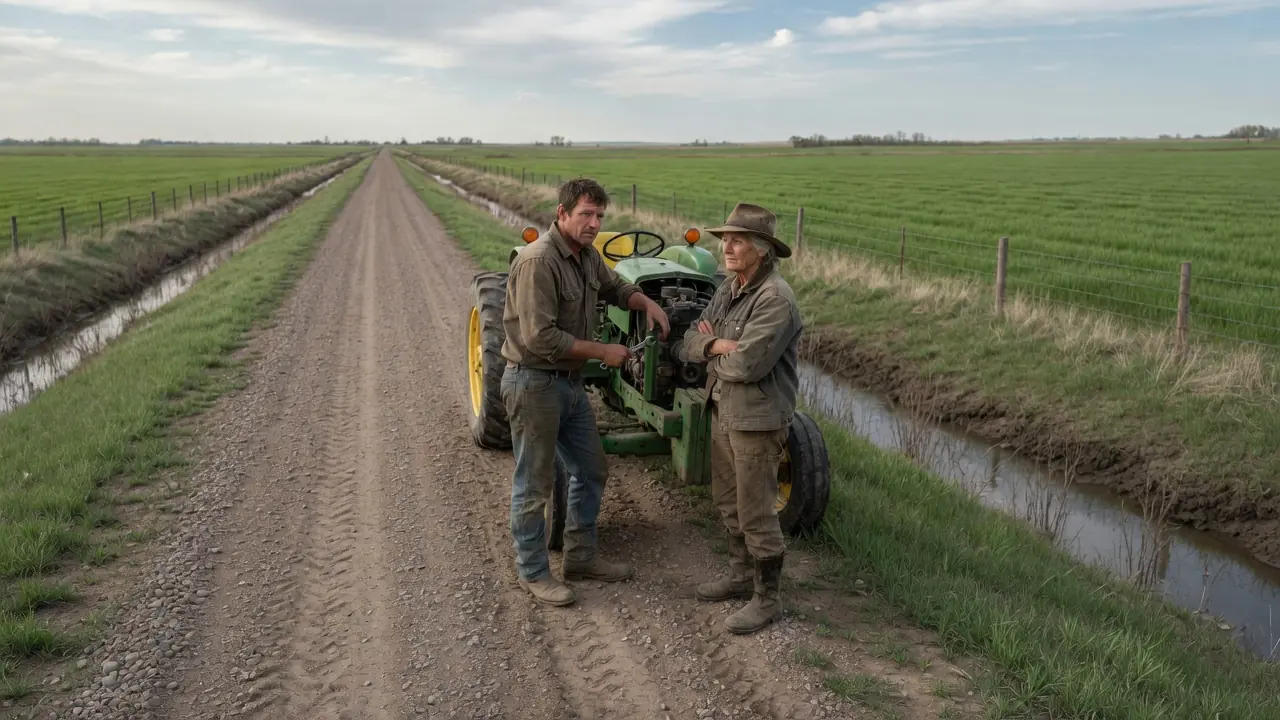
“You always carry parts like that?” Elaine asked.
“Not parts. Materials.” Caleb tightened a fitting gently. “There’s a difference.”
“Explain it.”
He glanced at her. “Parts replace. Materials persuade. This tractor needs replacing. I’m persuading it to behave long enough to get you off the road.”
Elaine gave a small sound that might have been amusement. “That’s a mechanic’s answer.”
“It’s the only kind I’ve got.”
By then, Lily had begun to stir in the truck. She sat up slowly, rubbed her eyes, and looked through the windshield at her father bent over the tractor. After a moment, she opened the door and climbed down, her hair messy from sleep and one shoelace untied. Caleb saw her from the corner of his eye and straightened.
“Stay back from the road, Lil.”
“I know, Dad.”
Elaine turned toward the girl. “And who are you?”
“Lily Morrison,” she said, stepping close enough to her father to feel safe, but not so close that she got in the way.
Elaine looked at the tractor. “Do you know what your father is fixing?”
Lily studied the engine like she was taking a test. “The fuel thing. The pump part. He explained it once when Mr. Henson’s combine broke.”
Caleb tried not to smile too hard. Elaine did smile this time, and it reached her eyes. “That is a good answer.”
Lily looked up at her. “Dad explains things even when people don’t ask.”
“That can be useful,” Elaine said.
“It can also be annoying,” Lily added.
Caleb pointed his wrench at her gently. “Careful.”
She grinned and moved back toward the truck.
Caleb finished the temporary seal and adjusted the timing enough to let the old tractor catch. When he turned the key, the engine coughed hard, sputtered, then settled into an uneven but steady rumble. It did not sound healthy, but it sounded willing. He listened for another few seconds, then nodded.
“She’ll move,” he said. “Don’t push her. Low gear. Straight to a shop or back to your place if it’s close.”
Elaine crossed her arms again. “And what do I owe you for stopping?”
“Nothing.”
Her eyes narrowed. “Nothing?”
“It took less than thirty minutes, and I used scraps I already had.”
“That is still work.”
Caleb wiped grease from his hands. “A person shouldn’t be charged for someone doing what’s right.”
Elaine went very still.
The words had come easily because they were the sort of thing Caleb believed without dressing up. His father had said a version of it often, usually while fixing a neighbor’s baler after supper or pulling someone from a snowdrift without asking for gas money. Caleb did charge for his work when work was business. But there was a line between business and decency, and he had never liked men who blurred it when someone was stuck.
Elaine looked at him for a long moment. “Where is your shop?”
He hesitated, then pulled a card from his wallet. It was bent at one corner and printed on cheap stock, but the name was clear: Morrison Mechanical. He handed it to her. She read it, then turned the card over as if the back might reveal more. “Grover Falls,” she said.
“Yes, ma’am.”
“You work on farm equipment?”
“All my life.”
“Big machines?”
“Small ones, big ones, stubborn ones. If I can get parts or make parts behave, I can usually keep them alive.”
Elaine folded the card into her pocket with unexpected care. “Thank you, Caleb Morrison.”
He nodded, helped Lily back into the truck, and drove home.
He did not know that Margaret Elaine Calloway watched the truck until it disappeared beyond the rise. He did not know that the woman in muddy boots was the founder and majority owner of Calloway Agricultural Holdings, one of the largest privately held farming operations in the United States. He did not know she controlled land across seven states, owned grain processing facilities, seed distribution networks, and equipment fleets larger than anything his county had ever seen. To him, she was just Elaine, a stranded woman with a tractor problem and good questions.
Two days later, Caleb’s phone rang while he was changing brake pads on a ten-year-old pickup. He almost let it go to voicemail because he was tired of calls from creditors and people asking for estimates they never approved. But something made him wipe his hands and answer. “Morrison Mechanical.”
“Mr. Morrison, my name is Thomas Greer. I am legal counsel and operations director for Calloway Agricultural Holdings.”
Caleb froze.
The brake pad slipped from his fingers and clattered to the floor.
“I’m sorry,” he said. “Who?”
“Thomas Greer, Calloway Agricultural Holdings. I’m calling on behalf of Ms. Margaret Elaine Calloway.”
Caleb sat down on the rolling stool beside the truck. Everyone in the agricultural Midwest knew the Calloway name. They were not just farmers. They were a force, the kind of operation that shaped markets, bought equipment in bulk, funded research, and appeared in agricultural magazines beside words like innovation and legacy. Caleb had never met anyone connected to them, at least not knowingly.
“Elaine,” he said quietly.
“Yes,” Thomas replied. “She said you know her by that name.”
Caleb looked around the shop as if the old barn had suddenly become part of a dream. “Is this about the tractor?”
“In part. Ms. Calloway took the machine to the certified dealer you recommended. Their assessment matched yours exactly. Cracked fuel injection pump seal, timing drift, early-stage damage prevented by immediate attention.”
“I told her it needed proper repair.”
“You did. She was impressed by your accuracy. More importantly, she was impressed by your honesty.”
Caleb did not know what to say.
Thomas continued. “Ms. Calloway would like to offer you a contract for on-site mechanical services for three of our Nebraska operations. It would begin with equipment inspection and preventative maintenance review, with potential expansion depending on performance.”
Caleb stood up too fast, then sat back down again. “I’m sorry, is this a joke?”
“No.”
“Am I being recorded?”
“No, Mr. Morrison.”
“This is legitimate?”
“I understand your skepticism. I can send the documents for independent review before any signature is required.”
The contract arrived by email within the hour. Caleb printed it on his old office printer, page by page, listening to the machine wheeze like it was offended by legal language. The document was thicker than any job agreement he had ever seen. Two-year term. Monthly retainer. Renewal options. On-site response fees. Parts reimbursement. Equipment access. Liability provisions.
The monthly retainer alone was more than his shop had made in the previous eight months combined.
He called the only lawyer he knew, Dale Hutchins, who usually handled land closings and small-town estate documents. Dale asked him to bring the paperwork over immediately. Two hours later, Dale called back, and his voice sounded different. Careful. Serious.
“Caleb, this is real,” Dale said. “Very real.”
“You’re sure?”
“Yes. And I need you to understand something. If you fulfill this contract well, it will change your situation permanently.”
That evening, after Lily fell asleep on the small couch in the shop office, Caleb sat alone at his workbench and read the contract three more times. He looked at the landlord’s letter still folded beside his coffee mug. He looked at the framed photograph of Lily sitting on his shoulders at the county fair, laughing at something above the camera. He looked at his father’s old wrench hanging on the wall.
The next morning, he signed.
The first month nearly broke him from exhaustion. Calloway’s Nebraska operations were bigger than anything he had handled alone, with equipment spread across multiple sites, from planting machines and combines to irrigation pumps and specialized transport vehicles. Caleb had to build schedules, record systems, parts lists, and emergency protocols. He slept too little, ate from gas stations, and learned the back roads between sites by memory.
But he was good at the work.
That mattered.
He noticed problems others had normalized. Improper winter storage practices had been causing accelerated belt and seal failures. Certain machines were being serviced on calendar intervals instead of usage hours, wasting money in some places and creating risk in others. Irrigation controllers were being protected from weather poorly, leading to repeated electrical issues. Caleb documented everything, not with fancy language, but with clear notes, photographs, and practical solutions.
On the third week, Elaine arrived at one of the operation sites without announcement. She drove herself in an old muddy pickup, stepped out in boots, and walked straight to the machine Caleb was inspecting. No entourage. No performance. Just Elaine, asking specific questions.
“You believe the failure rate on these pumps is preventable?” she asked.
“Yes.”
“How?”
“Storage, flushing, and earlier seal checks. You’re treating them like they fail from use. They’re failing from sitting wrong.”
Elaine looked toward the maintenance supervisor, then back at Caleb. “Show me.”
So he did.
For two hours, she walked beside him, listening while he explained what he saw. She did not interrupt to prove she already knew things. She asked because she wanted the answer. Caleb had worked for men who asked questions only to set traps, and he recognized the difference immediately. Elaine Calloway wanted the truth more than she wanted flattery.
That was rare.
Over the next months, Caleb’s recommendations saved Calloway’s Nebraska operations hundreds of thousands of dollars. Thomas Greer sent formal summaries. Regional managers began calling Caleb before problems became disasters. Equipment operators trusted him because he spoke to them like people who mattered. Elaine noticed all of that.
She also noticed Lily.
On school holidays, when Caleb could not find care, Lily came along. She sat in the truck with books, sketchpads, and snacks, never wandering into dangerous areas and never complaining about long days. Sometimes she asked questions when Caleb stopped to check on her. Why did the belts wear unevenly? Why did irrigation pumps need filters? Why did one machine sound different from another?
Caleb answered when he could.
One afternoon, Elaine found Lily sketching a combine from the passenger seat.
“That is very detailed,” Elaine said.
Lily looked up, startled. “I like knowing how things fit.”
“What do you want to be when you grow up?”
Lily thought about it seriously. Most adults expected children to say doctor, teacher, firefighter, artist, or something simple enough to smile at. Lily did not do that. She tapped her pencil against the notebook.
“I want to know how things work,” she said. “All kinds of things. Machines, farms, people, weather. Everything.”
Elaine was quiet for a moment. “That is the right answer.”
Caleb heard about it later and held the memory close.
By the end of the first contract year, Morrison Mechanical no longer looked like a dying shop. Caleb had caught up on rent, paid the overdue utility bills, bought back some of the tools he had sold, and hired one part-time mechanic named Rob Ellis, who had lost his job at a dealership and needed steady work. The old barn still leaked in two places, but it sounded alive again. Phones rang. Trucks came and went. Farmers who had drifted to the franchise began returning after hearing Caleb was handling Calloway equipment.
Then Elaine called him to her personal office at the main Calloway property.
Her office was nothing like Caleb expected. No glass walls, no polished trophy shelves, no giant portrait of herself standing in a wheat field. It was a working office with binders, maps, soil reports, machinery schedules, old photographs, and stacks of paper that looked used rather than displayed. Elaine sat behind a wooden desk with a coffee cup, reading glasses, and a folder already open.
“Sit down, Caleb.”
He sat.
“I want to expand your contract to all Nebraska operations.”
Caleb stared at her. “All of them?”
“Yes.”
“That would require more staff.”
“I assumed so.”
“And equipment.”
“I assumed that too.”
“And a larger space.”
Elaine leaned back. “Then build what you need.”
Caleb swallowed. “That is not a small step.”
“No. It is not.”
He expected the conversation to end there, but Elaine opened another folder. “There is something else.”
Caleb braced himself.
“Years ago, I established a small foundation for vocational and technical scholarships. It supports children from agricultural communities who show unusual aptitude in mechanical, scientific, or engineering fields.” Elaine slid the folder across the desk. “I want Lily to be considered for the twelfth scholarship when she reaches high school age.”
Caleb could not speak.
The room blurred for a moment, not because he was crying exactly, but because the force of the offer went somewhere deeper than business. Lily’s future had always existed in his mind as a locked door he did not know how to open. College, technical school, engineering programs, all of it had felt like distant country. He could teach her to work hard, be honest, and think clearly, but he did not know if he could afford to give her the education her mind deserved.
“Why?” he finally asked.
Elaine folded her hands on the desk. “Because on a Tuesday morning in April, a man with forty-three dollars in his wallet and his daughter asleep in the backseat stopped on a road where he did not have to stop. He fixed something he did not have to fix. He refused money he could have taken.”
Caleb looked down.
“And when I asked him why,” Elaine continued, “he told me a person should not be charged for someone doing what is right.”
He remembered saying it. He had not known it mattered.
“I have spent forty years building something,” Elaine said. “I have worked with hundreds of people. Very few operate that way. The ones who do are the ones worth building something with.”
Caleb drove home that evening on the same kind of roads he had driven his whole life. Lily slept in the backseat again, one arm wrapped around her backpack, her hair falling across her cheek. The fields were greening in the late spring light, and the sky over Nebraska looked wider than usual. For the first time in years, Caleb did not feel like the road was only carrying him from one problem to another.
Within eighteen months of that first roadside repair, Caleb moved Morrison Mechanical into a proper commercial space outside Grover Falls. He hired two full-time mechanics, then a parts coordinator, then an apprentice fresh out of high school who reminded him of himself at eighteen. He signed a long-term partnership agreement with Calloway Agricultural Holdings as their preferred regional service provider. The franchise shop still had brighter signs, but Caleb had something better: trust that had been earned one honest repair at a time.
Lily got her own corner in the new shop office with a desk, a lamp, and shelves for her notebooks. She kept drawing machines and asking questions that made grown mechanics pause. Elaine visited sometimes and always made time to ask what Lily was studying. The girl answered seriously, and Elaine listened just as seriously.
One morning, Caleb arrived early, parked outside the new building, and sat in his truck with coffee while the fields woke up around him. The sign above the door still said Morrison Mechanical, but it was cleaner now, stronger, lit from below. He thought about his father, who had taught him that the quality of your work was the only advertisement you ever needed. He thought about the broken John Deere on County Road 7.
He thought about how close he had been to driving past.
Not because he was cruel. Not because he did not care. But because worry can make a man small, and Caleb had been carrying so much worry that day he could barely see beyond the windshield. Still, he had stopped. He had stepped out. He had helped a stranger because helping was the one thing he still knew how to do, even when he had almost nothing left.
That was the part he never forgot.
A person does not always know which ordinary moment is the hinge of a life.
Sometimes it looks like a muddy ditch, a broken tractor, a woman in work boots, and a sleeping child in the backseat.
Sometimes it looks like thirty minutes of honest work done for free.
And sometimes the road you were never supposed to be on becomes the road that brings you home.