Single Dad Helped a Paralyzed Woman at the Bus Stop — Then She Gave Him a Warm Home
Snow fell quietly over the deserted bus stop on the edge of Maple Ridge, each flake glowing for one brief second beneath the yellow streetlight before disappearing into the white drift below.
The town had gone still in the way small towns did during the first hard snowfall of December.
Storefront lights were dimming along Main Street.
The pharmacy had already locked its doors. The bakery’s red sign went dark. A snowplow moved slowly through the central intersection, pushing a ridge of white toward the curb.
By eight-thirty, almost everyone in Maple Ridge had found somewhere warm to be.
Almost everyone.
Daniel Brooks saw the wheelchair as he drove past the bus stop.
At first, it appeared to be empty.
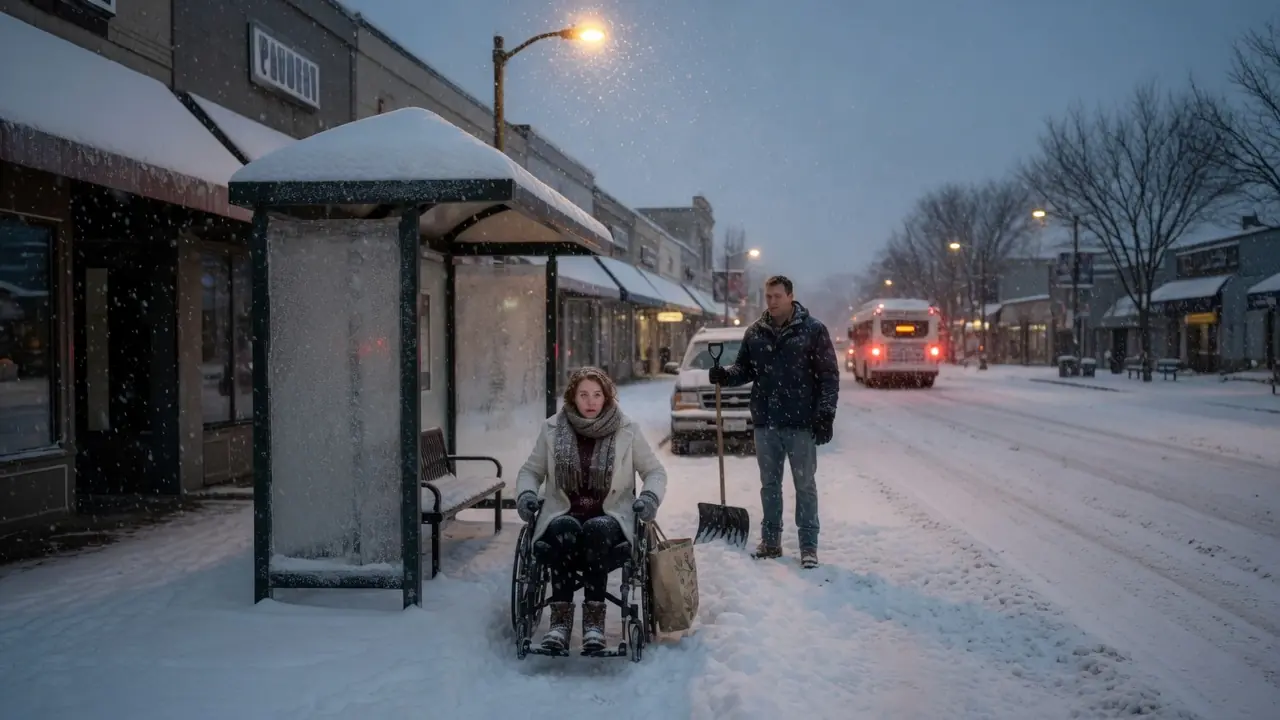
Then his headlights swept across the shelter and revealed a woman seated beneath its narrow metal roof.
Snow had collected along the wheels of her chair.
A dark wool blanket covered her legs, but the edges were wet. Her gloved hands rested tightly around the armrests, and a canvas bag hung from one handle.
Daniel continued another fifty yards before braking.
His eight-year-old daughter, Emily, looked up from the book in her lap.
“Why are we stopping?”
Daniel glanced into the mirror.
“There’s someone at the bus stop.”
“So?”
“The buses stopped running an hour ago.”
Emily turned to look through the rear window.
“Maybe she doesn’t know.”
“Maybe.”
Daniel pulled his old pickup onto the shoulder.
He did not immediately get out.
The heater hummed through the cab. A paper bag containing tomato soup and grilled-cheese sandwiches rested between him and Emily. They had picked up dinner after Daniel spent the evening repairing a frozen pipe at the elementary school.
It had already been a long day.
He wanted to go home.
Their small rented house stood twelve miles outside town, and the weather was worsening. Snow had begun covering the road almost as quickly as the plows cleared it.
Daniel had learned over the previous three years that helping could become expensive.
Time.
Money.
Responsibility.
After his wife died, every unexpected problem felt dangerous because there was nobody else to carry the consequences.
Then Emily pressed her face close to the window.
“She’s alone.”
Daniel looked at the woman again.
She was watching the road, but there was no expectation in her posture anymore.
Only endurance.
He shifted into park.
“Stay inside.”
Emily closed her book.
“I’m coming.”
“No.”
“But—”
“Emily.”
She sighed and remained in the seat.
Daniel pulled on his work gloves and stepped into the snow.
The wind caught his jacket immediately.
He crossed toward the shelter, keeping enough distance not to startle the woman.
“Excuse me.”
She looked up.
She appeared to be in her early thirties, with pale skin, dark brown eyes, and shoulder-length auburn hair partly hidden beneath a knitted hat. Her face was composed, but her lips had begun losing color from the cold.
“Yes?”
“The last bus left at seven-thirty.”
“I know.”
Daniel stopped.
“You know?”
“I watched it leave.”
“Why are you still here?”
The question sounded harsher than he intended.
The woman glanced toward the road.
“My ride didn’t come.”
“How long have you been waiting?”
“About ninety minutes.”
Daniel looked at the snow collected around her wheels.
“You called them?”
“My phone died.”
“Is there someone else you can contact?”
“There is always someone else people think I should contact.”
Her tone was controlled, but tired.
Daniel recognized defensiveness when he heard it.
He used it himself.
“I’m not trying to interfere,” he said.
“You stopped your truck.”
“That was the interfering part.”
For the first time, a faint smile appeared.
Then she shivered.
Daniel took out his phone.
“You can use mine.”
She looked at it but did not reach.
“Thank you. It won’t help.”
“Why?”
“The person who was supposed to collect me is my brother. He’s probably been drinking.”
Daniel’s expression changed.
“You knew that when you arranged the ride?”
“No.”
“How do you know now?”
“Because when he forgets me, that is usually why.”
Snow moved between them.
Daniel looked toward his truck.
Emily was watching through the window.
“Where do you live?”
“Pine Hollow Road.”
“That’s north of town.”
“Eleven miles.”
“Near the old Ashford property?”
The woman’s expression shifted.
“Yes.”
“I’m headed that direction.”
“You don’t need to drive me.”
“No.”
Daniel looked at the road.
“But you can’t stay here.”
She glanced toward the pickup.
Then back at him.
The question stopped him.
Daniel looked at the high passenger seat.
The narrow door.
The wheelchair.
“No.”
“It’s fine.”
She adjusted the blanket.
“I’ll wait.”
“For what?”
“Someone will come eventually.”
“In this weather?”
“I’ve been in worse.”
Daniel heard the answer she intended him to accept.
He also heard what it concealed.
She had spent much of her life being told that inconvenience was unavoidable.
That waiting was easier than asking others to adapt.
“What would you need?” he asked.
She studied him.
“To get into the truck?”
“Yes.”
“A transfer board would help.”
“Do you have one?”
“In my bag.”
“What about the chair?”
“It folds.”
Daniel nodded as though they were discussing moving a piece of furniture.
“All right.”
She remained still.
“You don’t have to prove anything,” she said.
“I’m not.”
“People sometimes do.”
“Do what?”
“Help loudly.”
Daniel understood.
Some people offered assistance because they wanted gratitude to become visible.
He looked toward his truck.
“I have soup getting cold and a child who will complain for the next eleven miles if we leave you here.”
From inside the cab, Emily lowered the window.
“I can hear you.”
Daniel closed his eyes.
The woman laughed softly.
It was the first warm sound in the frozen shelter.
“What’s your name?” he asked.
“Grace.”
“Daniel.”
He motioned toward the truck.
“The loud person is Emily.”
“I heard.”
Daniel retrieved the transfer board from Grace’s bag.
She explained how to position the wheelchair beside the passenger seat.
He followed her instructions rather than lifting her without permission.
That seemed to surprise her.
“Lock the brakes,” she said.
He did.
“Move the footrests aside.”
He did.
“Now stand close in case I lose balance, but don’t pull me.”
Daniel nodded.
Grace placed the board between the chair and the truck seat.
The height difference made the transfer difficult.
She pushed herself upward with both arms.
For a second, her weight shifted dangerously toward the open door.
Daniel moved closer but did not grab her.
“I’ve got the board,” he said.
Grace steadied herself.
Then completed the transfer.
She breathed heavily when she settled into the passenger seat.
“Are you all right?”
“Yes.”
“Are you sure?”
“I’m paralyzed, not fragile.”
Daniel looked toward her.
“I didn’t say either.”
“No.”
Grace adjusted her coat.
“You didn’t.”
They folded the wheelchair and secured it beneath a tarp in the truck bed.
Emily moved to the back seat.
Grace looked down at the paper bag between them.
“You weren’t exaggerating about dinner.”
“We take soup seriously.”
Emily leaned forward.
“Dad does. I wanted pizza.”
“You had pizza yesterday.”
“That was yesterday’s problem.”
Grace smiled.
Daniel returned to the road.
For the first few miles, nobody spoke.
Snow swept through the headlights. The truck moved slowly along a road disappearing beneath white.
Grace held her hands near the heater.
Color gradually returned to her face.
Emily watched her from the back seat.
Children did not understand the social rules adults used to avoid direct questions.
“How did your legs stop working?”
Daniel glanced sharply into the mirror.
“Emily.”
Grace turned slightly.
“It’s all right.”
“You don’t have to answer.”
Grace looked toward Emily.
“I was in a car accident.”
“Did it hurt?”
“Yes.”
“Does it hurt now?”
“Sometimes.”
“Can doctors fix it?”
“No.”
Emily considered this.
“Do people ask you that a lot?”
Grace smiled faintly.
“Yes.”
“Does it get annoying?”
“Sometimes.”
Emily nodded.
“I won’t ask again.”
“Thank you.”
A minute passed.
“Can I ask about your chair?”
Daniel sighed.
Grace laughed.
“You can ask about the chair.”
By the time they reached Pine Hollow Road, Emily knew that Grace’s wheelchair had lightweight titanium wheels, that she could transfer into a car independently when the seat was low enough, and that she hated being pushed without warning.
Daniel learned something too.
Grace did not need rescuing from disability.
She needed a ride because someone had failed to keep a promise.
The distinction mattered.
“Turn left at the stone pillars,” Grace said.
Daniel slowed.
Two old pillars stood on either side of a narrow driveway almost hidden beneath snow.
Beyond them, the road curved through tall pines.
“Your house is back here?”
“Yes.”
“I thought the Ashford place was abandoned.”
“It was.”
The property had once belonged to one of Maple Ridge’s wealthiest families.
The original house was built in the 1920s and stood on thirty acres overlooking the valley. For years, townspeople referred to it as the Ashford estate, though the family had not lived there in decades.
Daniel remembered driving past as a child.
The house had seemed enormous.
A stone-and-timber structure with tall chimneys, broad porches, and rows of dark windows.
After the final Ashford owner died, the property passed through several companies and was eventually left empty.
Daniel turned around the last bend.
The house emerged through the snow.
Several windows glowed.
Smoke rose from one chimney.
The front porch had been repaired recently, and a long wooden ramp curved toward the entrance.
“You live here?” Emily asked.
Grace looked toward the house.
“For now.”
Daniel parked beside the ramp.
A smaller accessible van stood near the garage, partly covered in snow.
“Is that your vehicle?”
“Yes.”
“Why were you taking the bus?”
“It wouldn’t start this morning.”
“You left it here?”
“My brother drove me into town.”
“And forgot to collect you.”
“Yes.”
Daniel looked toward the dark garage.
“Battery?”
“I don’t know.”
“I can check tomorrow.”
Grace turned toward him.
“You’ve already done enough.”
“I repair things.”
“Professionally?”
“Mostly houses.”
Emily leaned forward.
“He repairs everything except the kitchen drawer.”
“It requires a specific part.”
“It has required that part for six months.”
Grace smiled.
Daniel helped unload the wheelchair but again followed her instructions during the transfer.
When she reached the ramp, Grace looked toward the truck.
“You should both come inside.”
Daniel shook his head.
“It’s late.”
“The roads are worsening.”
“We only live a few miles farther.”
A gust pushed snow across the driveway.
Grace looked at Emily.
“At least let her eat somewhere warm.”
Emily opened the door immediately.
“Good idea.”
Daniel looked at his daughter.
“You were supposed to wait.”
“You said she invited both of us.”
Grace lifted one eyebrow.
Daniel surrendered.
The front door opened into a large entrance hall.
Warm air surrounded them.
A fire burned in a stone fireplace at the far end of the sitting room. Lamps cast soft light across wooden floors, old bookshelves, and furniture covered in mismatched fabric.
The house was grand, but not polished.
Buckets stood beneath two ceiling leaks.
Several walls had unfinished plaster.
A long crack ran above the staircase.
Tools and architectural drawings covered the dining-room table.
“You’re renovating,” Daniel said.
“Trying to.”
Grace removed her wet gloves.
“My grandmother left me the house.”
“You’re an Ashford?”
“My mother was.”
Grace moved through the room with practiced ease.
Most pathways had been cleared of furniture. Doorways appeared wider than those in an ordinary old house. Brass plates protected the lower parts of several frames.
She nodded toward the kitchen.
“Bring the soup.”
The kitchen was warmer than the rest of the house.
Copper pans hung above a large island. One wall had been partially removed, exposing old beams. The counters were lower than standard height, and the sink had open space beneath it for a wheelchair.
Daniel noticed the details.
“You redesigned this.”
Grace set bowls on the counter.
“I’m an architect.”
“You work locally?”
“I used to work in Boston.”
“What happened?”
“The accident.”
She said it without self-pity.
Daniel did not ask for more.
They ate tomato soup and grilled cheese at the kitchen island.
Grace found cocoa for Emily.
For an hour, the old house felt less abandoned than it probably had in years.
Emily talked about school.
Grace asked serious questions about her drawings.
Daniel inspected the exposed beams almost unconsciously.
“You have water coming through the north wall,” he said.
Grace looked toward him.
“How do you know?”
“Stain direction. The roof leak isn’t directly above the buckets.”
“I’ve had two contractors inspect it.”
“What did they say?”
“Replace the entire roof.”
Daniel looked upward.
“They would.”
“You disagree?”
“The flashing around the old chimney is probably failing. Water travels along the rafters before dropping.”
Grace studied him.
“What would that cost?”
“To repair?”
“Yes.”
“A fraction of a new roof.”
She was quiet.
Daniel recognized the expression of someone who had already paid too much for bad advice.
“Who’s managing the renovation?” he asked.
“I am.”
“Alone?”
“I hired a company.”
“And?”
“I fired them last month.”
“Why?”
“They charged me for materials that never arrived and completed work I couldn’t use.”
Daniel glanced toward the ramp outside.
“Accessibility work?”
Grace nodded.
“They installed a bathroom rail too far from the toilet. Built a threshold I couldn’t cross. Then explained that modifications in historic properties are complicated.”
“That isn’t complicated.”
“That’s what I said.”
Emily dipped her sandwich into the soup.
“Dad can fix it.”
Daniel looked at her.
“We are not applying for work during dinner.”
“I’m helping.”
Grace smiled.
“What kind of business do you own?”
“Brooks Home Repair.”
“I’ve heard of it.”
Daniel was surprised.
“Not many people have.”
“My grandmother used your father’s company.”
Daniel stopped.
“Brooks & Son?”
Grace nodded.
“Your father repaired the west porch twenty years ago.”
Daniel looked toward the window.
His father had died eight years earlier.
The business name disappeared after Daniel downsized and began working alone.
“He talked about this house.”
“What did he say?”
“That it was beautiful and impossible.”
“Accurate.”
Grace looked around the kitchen.
“He also said the foundation would outlive all of us.”
“Probably.”
The wind struck the windows.
Daniel checked his phone.
A weather alert warned drivers to remain off county roads.
Grace saw it.
“You’re not leaving tonight.”
“I can make it.”
“No.”
The firmness surprised him.
“You helped me because staying outside was unsafe.”
She motioned toward the storm.
“Now I’m returning the favor.”
Daniel hesitated.
He disliked depending on anyone.
Since Sarah’s death, he had built his life around the belief that accepting help created obligations he might not be able to repay.
Emily yawned.
Grace noticed.
“There are twelve bedrooms.”
“Most probably colder than outside,” Daniel said.
“Only five.”
Emily smiled sleepily.
Daniel looked toward the window again.
“All right.”
Grace showed Emily to a bedroom near the kitchen.
The room contained an old four-poster bed, thick quilts, and wallpaper patterned with tiny blue flowers.
Emily walked toward the window.
“It looks like a princess room.”
“It belonged to my mother when she was your age.”
“Was she a princess?”
“She believed she was.”
After Emily fell asleep, Daniel joined Grace in the sitting room.
The fire had burned lower.
Grace sat near it beneath a knitted blanket.
Daniel placed another log onto the flames.
“Thank you,” she said.
“For the wood?”
“For stopping.”
“You would have found another ride.”
“Eventually.”
Daniel sat across from her.
“Why didn’t you call a taxi before your phone died?”
“There are no accessible taxis in Maple Ridge after six.”
“What about the county service?”
“Reservations must be made twenty-four hours ahead.”
“And emergencies?”
“Apparently disabled people are expected to schedule those.”
Daniel looked into the fire.
“I didn’t know.”
“Most people don’t.”
Grace said it without accusation.
That made the truth more uncomfortable.
She looked toward the dark windows.
“After the accident, I thought the hardest part would be not walking.”
“What was?”
“Losing spontaneity.”
Daniel looked toward her.
“Before, I could leave work late, enter any restaurant, borrow someone’s car, visit a friend without checking the entrance.”
She tightened the blanket around herself.
“Now every ordinary decision requires research.”
“Can I enter?”
“Can I use the bathroom?”
“Will there be a step nobody mentioned?”
“Will the driver who promised to return remember that I can’t simply walk home?”
Daniel thought about the bus stop.
“You weren’t angry when I found you.”
“I was furious.”
“You hid it.”
“Anger makes people call disabled women difficult.”
“And waiting in the snow?”
“That makes them call us brave.”
Her smile carried no humor.
Daniel leaned back.
“People call single fathers brave too.”
“Are you?”
“No.”
“What are you?”
“Tired.”
Grace laughed softly.
“Honest.”
He told her about Sarah.
Not everything.
Only enough.
Sarah had died from an aggressive infection following what should have been routine surgery.
One week, she was helping Emily choose a Halloween costume.
The next, she was in intensive care.
Daniel had entered the hospital expecting to bring his wife home.
He left carrying her wedding ring and a folder explaining grief support for children.
Afterward, he sold the larger business.
Stopped accepting major contracts.
Focused only on repairs he could complete around Emily’s schedule.
“You gave up a lot,” Grace said.
“I kept what mattered.”
“That isn’t the same answer.”
Daniel looked toward the fire.
“No.”
“What did you give up?”
He considered.
“Growth. Employees. A better house.”
“What house do you live in?”
“A rental outside town.”
“You build and repair homes for everyone else.”
“Yes.”
“But you don’t own one.”
“No.”
“Why?”
“Sarah’s medical bills.”
Grace lowered her eyes.
“I’m sorry.”
“They’re almost paid.”
“And then?”
Daniel had no answer.
He had spent three years surviving the month in front of him.
Planning beyond debt felt almost disloyal to the life he lost.
Grace understood more than he said.
They remained near the fire until after midnight.
In the morning, the world outside was buried beneath nearly two feet of snow.
County roads remained closed.
Daniel repaired the chimney flashing temporarily using materials stored in the garage.
Then he tested Grace’s van.
The battery was dead.
The alternator was failing.
He drove into town two days later, found the correct replacement, and installed it.
Grace insisted on paying.
Daniel charged only for the part.
She objected.
“You worked six hours.”
“You gave us two nights in a warm house.”
“That was hospitality.”
“This is repair.”
“You run a business.”
“Barely.”
“That isn’t reassuring.”
Grace transferred money to him anyway.
Twice the amount he requested.
Daniel returned half.
Their argument lasted through three messages and one phone call.
Emily found it entertaining.
A week later, Grace called him again.
“The chimney repair worked.”
“I expected it to.”
“I need a contractor.”
“I’m busy.”
“You said your business was barely functioning.”
“I said nothing of the kind.”
“You implied it.”
Daniel looked at the schedule taped above his workbench.
Small jobs.
Low-paying repairs.
Nothing that would secure the next year.
“What kind of work?” he asked.
“Finish the accessible renovation.”
“That house requires months.”
“Yes.”
“I work alone.”
“Hire people.”
“I don’t have employees.”
“You used to.”
Daniel was silent.
Grace continued.
“I don’t need charity, Daniel. I need someone who listens before building.”
He accepted an inspection visit.
Only an inspection.
That was what he told himself.
Grace had architectural plans for the entire house.
Her vision was not to restore it as a private estate.
She wanted to transform it into an accessible retreat center.
Short-term housing for people leaving rehabilitation hospitals who were not yet prepared to return home.
Training rooms.
Accessible kitchens.
Gardens with level paths.
Temporary apartments for families learning how to support someone after a spinal injury.
Daniel looked through the drawings.
“This is enormous.”
“I know.”
“Do you have funding?”
“Some.”
“How much is some?”
“Enough for the first phase.”
“And after that?”
“Grants. Donations. Partnerships.”
“You said you were an architect, not a fundraiser.”
“I contain multitudes.”
Daniel looked toward her.
She smiled.
The project began in January.
Daniel hired two former employees.
Then three more.
He repaired structural damage, rebuilt bathrooms, widened doors, and corrected work completed by the previous contractor.
Grace supervised every design decision.
They argued constantly.
About ramps.
Cabinet heights.
Door swing directions.
Daniel sometimes assumed a solution would work because it met official building standards.
Grace made him test it from a wheelchair.
One afternoon, he installed a handle according to code.
She tried to use it.
Her elbow struck the wall.
Daniel frowned.
“It meets the requirement.”
“It doesn’t meet me.”
He moved it.
That sentence reshaped how he worked.
Accessibility was not a checklist.
A technically compliant space could still be exhausting, humiliating, or impossible to use.
Grace taught him to notice turning radius, reach, weight, texture, and the difference between being able to enter a room and being able to live independently inside it.
Daniel taught Grace something too.
Old houses resisted perfect plans.
Beams appeared where drawings said nothing existed.
Floors sloped.
Walls concealed pipes installed decades earlier.
Grace wanted exactness.
Daniel understood adaptation.
“You cannot force an old structure to become new,” he told her.
“Then what do you do?”
“Learn what it can carry.”
Their conversations stopped being only about the house.
Emily began spending afternoons at the property after school.
She did homework at the kitchen island while Grace worked nearby.
Sometimes she followed Daniel with a small tool belt.
Other times she helped Grace select colors and furniture.
The blue bedroom became hers whenever snow or late work kept them overnight.
By March, Daniel realized they were spending more evenings at Ashford House than at the rental.
He also realized Emily had begun calling it home.
Not intentionally.
The word simply appeared.
“Did I leave my book at home?”
“Which home?” Daniel asked.
Emily looked confused.
“The warm one.”
Their rental had heat.
But Daniel understood what she meant.
Ashford House contained voices.
Food cooking.
Doors opening and closing.
Plans for tomorrow.
Their rental contained the life they returned to after the day ended.
Grace heard the comment.
She said nothing then.
That evening, she found Daniel repairing trim in the west hallway.
“She could have a permanent room.”
Daniel stopped working.
“You don’t have to do that.”
“I know.”
“We’re already here too often.”
“I know.”
“You hired me.”
“Yes.”
“This is becoming complicated.”
Grace looked toward him.
“Is it?”
Daniel set down the hammer.
“You’re my client.”
“The contract ends in June.”
“You’re also…”
He stopped.
“What?”
He could not answer.
Grace had become the person he called when Emily received a good school report.
The person he wanted to tell when a difficult repair worked.
The person whose voice changed the shape of an ordinary evening.
But desire frightened him.
Not because Grace used a wheelchair.
Because loving anyone meant reopening the part of his life that death had closed violently.
Grace watched him struggle.
“You think caring about me is betrayal.”
Daniel looked up.
“No.”
“You think being happy here means the life with Sarah mattered less.”
His expression changed.
“That isn’t fair.”
“No.”
Grace’s voice softened.
“But it may be true.”
Daniel turned toward the unfinished window frame.
“You don’t know what I think.”
“I know what it is to build your entire identity around what was taken from you.”
He faced her.
“And what did you do?”
“For two years, I treated every offer of help like an attempt to control me.”
“That isn’t what you do now?”
“Only with you.”
He laughed despite himself.
Grace moved closer.
“I don’t need you to save me.”
“I know.”
“Do you?”
“Yes.”
She studied his face.
“I need a partner who understands that sometimes I need help and sometimes I don’t.”
Daniel nodded.
“I need someone who asks.”
“Yes.”
“And you?”
He looked toward the hallway where Emily’s laughter came from the kitchen.
“I think I need someone who reminds me that surviving isn’t the same as living.”
Grace reached for his hand.
He allowed her to take it.
Their first kiss happened beside an unfinished window while sawdust covered Daniel’s boots and paint marked Grace’s sleeve.
It was careful.
Brief.
Real.
Then the front door opened.
Grace’s brother entered.
Michael Ashford was thirty-eight, handsome, expensive-looking, and visibly angry.
He stared at Daniel.
Then at Grace.
“What is this?”
Grace released Daniel’s hand.
“You remembered where I live.”
Michael ignored the remark.
“I heard you’re spending the trust on this place.”
“I’m using my money.”
“It is family money.”
“It was left to me.”
“To protect you.”
Grace’s expression hardened.
“From what?”
“Bad decisions.”
Michael looked toward Daniel.
“And people who see an opportunity.”
Daniel stepped back.
“This is between you.”
“No,” Michael said. “You’ve made it your business.”
Grace moved between them.
“Daniel is restoring the house.”
“He’s living here.”
“He stays when work or weather requires it.”
“With his daughter?”
“Yes.”
Michael laughed once.
“You’re turning Grandmother’s estate into a charity project and inviting a contractor to play family.”
Grace’s hands tightened on the wheelchair rims.
“You left me at a bus stop in a snowstorm.”
Michael’s face changed.
“I made a mistake.”
“You forgot me.”
“I was drinking.”
“That is not a defense.”
“I apologized.”
“You sent flowers.”
“I had problems.”
“So did I.”
Michael looked toward Daniel.
“You took advantage of the situation.”
Daniel’s jaw tightened.
Grace spoke before he could.
“He asked how to help.”
“What?”
“He asked.”
Her voice rose.
“He did not grab me. He did not decide for me. He listened.”
She looked directly at her brother.
“Do you understand how rare that is?”
Michael lowered his voice.
“You can’t trust someone you found beside a road.”
“She found me beside the road.”
Daniel looked toward her.
Grace continued.
“I was the one abandoned. He was the one who stopped.”
Michael stared around at the construction.
“Father would never approve this.”
“Father is dead.”
The sentence struck hard.
Grace softened only slightly.
“And Grandmother left the house to me because she knew I would do something useful with it.”
Michael’s expression turned cold.
“You think converting bedrooms for strangers is useful?”
“Yes.”
“Who will pay for it?”
“I will.”
“For how long?”
“As long as I choose.”
Michael looked toward Daniel again.
“This ends badly.”
Grace’s face became calm.
“No. What ends today is your belief that being my brother makes you my guardian.”
He left.
But the confrontation did not disappear with him.
Two weeks later, Grace received a legal notice.
Michael had petitioned the court for an examination of the trust management, claiming Grace was being financially exploited and might not be capable of managing the property independently.
Daniel read the document twice.
“This is because of me.”
“It is because Michael cannot tolerate losing control.”
“If I leave, his argument weakens.”
Grace stared at him.
“You think abandoning me will prove I’m independent?”
“That isn’t what I mean.”
“It is exactly what you mean.”
“I don’t want him using our relationship against you.”
“Our relationship?”
Daniel hesitated.
Grace’s eyes hardened.
“Say it.”
“I don’t know what it is yet.”
“Then do not destroy it to make my brother comfortable.”
Daniel looked away.
Fear told him to leave.
He had a daughter.
A fragile business.
No savings for lawyers.
Michael’s family had money, influence, and the ability to turn help into suspicion.
That night, Daniel packed his tools.
Emily found him loading the truck.
“Are we going home?”
“Yes.”
“Why?”
“The work is paused.”
“Grace said the east rooms are ready.”
“They are.”
“Then why?”
Daniel closed the toolbox.
“Things became complicated.”
Emily looked toward the glowing windows.
“Mom got sick and everything became complicated.”
Daniel became still.
“You didn’t leave her.”
“That was different.”
“Why?”
Because Sarah was his wife.
Because promises had been made.
Because death had removed choice.
None of those answers sounded right when compared with the pain on Emily’s face.
“Grace isn’t asking you to carry her,” Emily said.
Daniel stared at his daughter.
“She makes you less sad.”
“It isn’t your job to worry about that.”
“I know.”
Emily looked toward the house.
“But I like when this feels like our home.”
Daniel did not leave.
Instead, he hired an attorney.
Grace fought Michael’s petition.
The court-appointed evaluator found no evidence of incapacity or financial exploitation. Grace presented budgets, contracts, architectural documents, and grant applications more organized than most professional developments.
Daniel testified about how they met.
Michael’s lawyer asked whether he expected to benefit from Grace’s wealth.
Daniel answered honestly.
“My company benefited from the contract.”
“And personally?”
“I found people I love.”
The courtroom became quiet.
Grace looked toward him.
The attorney asked, “Do you intend to live at Ashford House?”
Daniel glanced at Grace.
“I intend to live wherever we choose together.”
Michael’s petition was dismissed.
The judge warned him that disability did not reduce his sister’s legal autonomy and that disagreement with her choices did not justify stripping away control of her life.
Outside the courthouse, Michael approached Grace.
For a moment, Daniel expected another argument.
Michael looked exhausted.
“I thought I was protecting you.”
Grace nodded.
“I know.”
“You make it sound like that means nothing.”
“It means you were afraid.”
She looked toward him.
“But fear does not give you ownership.”
Michael lowered his eyes.
“I’m sorry about the bus stop.”
Grace studied him.
It was the first apology that did not contain an excuse.
“I believe you.”
Forgiveness took longer.
But it began.
Ashford House opened the following autumn under a new name.
Harrison House for Independent Living.
Grace objected when the board suggested calling it Ashford House.
She did not want a family name associated only with wealth.
Daniel objected to Harrison because it was not his surname.
Grace explained that the original structure had been designed by architect Clara Harrison in 1924, one of the first women to establish an architectural practice in the state.
The name belonged to the house’s history.
Not Daniel.
He still suspected Grace enjoyed the coincidence.
The first residents arrived in October.
A high-school teacher adjusting to life after a spinal injury.
A construction worker who had lost both legs.
A college student preparing to return to campus.
A mother learning how to care for her teenage son after an accident.
They stayed for weeks or months.
They practiced cooking.
Transfers.
Travel.
Work routines.
Most importantly, they lived somewhere designed around possibility rather than limitation.
Daniel’s company grew.
He became known across the region for accessible restoration work.
He trained younger builders to listen to the people using the space before deciding what they needed.
Grace returned to architecture full-time and specialized in adaptive historic design.
Emily gained a bedroom in the west wing with blue walls, a window seat, and more books than shelves.
Daniel kept the rental for three additional months.
Then Grace placed a folder beside his breakfast.
“What is this?”
“A lease.”
He looked at her.
“You’re charging me rent?”
“One dollar per year.”
“That is not a real lease.”
“It creates boundaries.”
“You made that up.”
“My attorney did.”
Daniel read the first page.
The document gave him and Emily permanent residential rights while preserving Grace’s ownership and protecting the house’s charitable mission.
He looked toward her.
“You planned this.”
“Yes.”
“For how long?”
“Since the court case.”
“And if we break up?”
“You and Emily remain protected for one year.”
Daniel stared.
Grace’s expression softened.
“You gave me a ride without knowing who I was.”
“That lasted eleven miles.”
“You gave me more than that.”
She looked around the kitchen.
“You made this house usable.”
“You designed it.”
“We built it.”
Daniel closed the folder.
“What if I don’t want a lease?”
“What do you want?”
He took a small box from his jacket.
Grace froze.
Emily appeared from the hallway at exactly the wrong moment.
“Is that the ring?”
Daniel closed his eyes.
Grace began laughing.
“You told her?”
“I needed help choosing it.”
Emily stepped into the kitchen.
“He picked an ugly one first.”
“It was not ugly.”
“It looked like a door handle.”
Grace wiped tears from her eyes.
Daniel moved beside her chair and knelt.
Not because he believed proposals required kneeling.
Because he wanted their eyes level.
“Grace Ashford, I stopped because you were cold.”
Her expression softened.
“You let us inside because we were too stubborn to leave.”
“Accurate.”
“You gave Emily a place where grief could exist without making every room sad.”
Grace’s eyes filled.
“And you gave me a home I did not know how to ask for.”
He opened the box.
Inside was a simple ring with a small blue stone.
“I don’t want to take care of you.”
Grace lifted one eyebrow.
“Promising beginning.”
“I want to care about you.”
Daniel smiled.
“And I want to keep asking before I help.”
“That part needs work.”
“Will you marry me?”
Grace looked toward Emily.
The child was bouncing slightly in place.
“Did you approve this?”
“Yes.”
“Did he ask your permission?”
“No. He asked my opinion.”
Grace looked back at Daniel.
“Good answer.”
She held out her hand.
“Yes.”
Their wedding took place the following spring in the accessible garden behind Harrison House.
The paths were wide and level.
Raised flower beds surrounded the central lawn.
Residents, former residents, contractors, nurses, neighbors, and townspeople filled the garden.
Michael attended.
He arrived sober and early.
Before the ceremony, he approached Daniel.
“Thank you for stopping that night.”
Daniel looked toward Grace, who was speaking with Emily near the roses.
“She would have survived without me.”
“I know.”
Michael swallowed.
“That makes what I did worse.”
“Yes.”
Daniel did not soften the truth.
Michael nodded.
“I’m trying to be better.”
“That’s all anyone can do after the apology.”
Grace wore a simple ivory dress adapted so the fabric would not catch beneath her wheels.
Emily walked beside her.
No one gave Grace away.
She did not belong to anyone.
When she reached Daniel, he leaned close.
“You’re beautiful.”
“I know.”
He laughed.
During their vows, Daniel did not promise to carry her through every hardship.
Grace did not promise to make his life whole.
They promised something more honest.
To ask.
To listen.
To stay when staying was chosen rather than owed.
Years later, people in Maple Ridge still told the story of the single father who found a paralyzed woman waiting alone at a bus stop during a snowstorm.
Most versions said Daniel rescued Grace.
Neither of them liked that word.
Daniel gave her a ride.
Grace gave him shelter.
He repaired her house.
She helped rebuild his life.
He taught her that accepting help did not always mean surrendering control.
She taught him that allowing others to care for him did not create weakness or debt.
The exchange was never one-sided.
That was why it lasted.
Harrison House eventually expanded into a second building.
Daniel’s company constructed small accessible homes for residents ready to live independently.
Grace designed them.
Emily, when she grew older, studied occupational therapy and returned to work at the center.
The old bus shelter remained on the edge of town.
Years after the storm, Maple Ridge replaced it with an enclosed accessible station equipped with heat, emergency charging ports, and a direct call system for late transportation.
Grace had designed it free of charge.
A small plaque inside carried no names.
Only one sentence:
HELP SHOULD NEVER REQUIRE SOMEONE TO SURRENDER THEIR DIGNITY.
One December evening, Daniel and Grace drove past during another snowfall.
A young man in a wheelchair waited inside the heated shelter, looking at his phone.
Daniel slowed automatically.
Grace glanced toward him.
“The shelter is warm.”
“He may need a ride.”
“He has a phone.”
“He could still need help.”
Grace smiled.
“Then ask.”
Daniel lowered the window.
The young man looked up.
“Everything all right?”
“My van is coming in five minutes.”
“Good.”
Daniel started to drive.
The man called after them.
“Thanks for checking.”
Grace looked toward Daniel.
“You’re learning.”
“I asked.”
“You did.”
They continued toward Harrison House, where lights glowed from nearly every window.
The home was filled with residents preparing dinner, staff finishing their shifts, Emily returning from college, and guests arriving for the annual winter gathering.
Daniel remembered the first night he entered that house.
Buckets beneath leaks.
Empty bedrooms.
A woman who believed she had to wait alone because asking for help had cost her dignity too many times.
He had thought he was bringing Grace somewhere warm.
He did not yet understand that she was leading him there too.
The snowstorm lasted only two nights.
The home they created endured for the rest of their lives.