Single Dad Helped a Paralyzed Girl at the Bus Stop — Then Something Changed in His Life
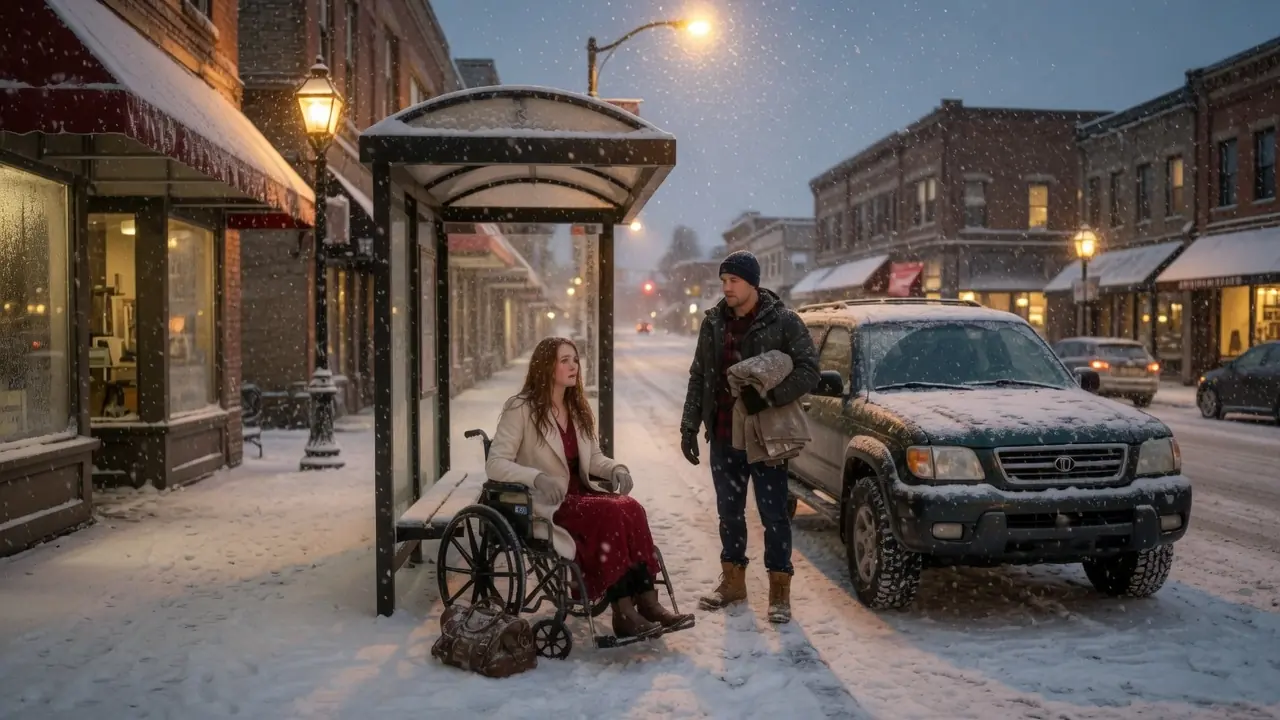
Snow fell quietly over the deserted bus stop, each flake glowing for a brief second beneath the yellow streetlight before disappearing into the white drift below.
Lily Hartman sat alone in her wheelchair.
The red of her dress blazed against the snow, far too elegant for a forgotten roadside shelter on the edge of Maple Ridge. A black coat lay loosely across her shoulders, but it was too thin to protect her from the December cold.
Beside her rested an old leather bag.
Three hours earlier, her fiancé had looked at her across a crowded engagement dinner and called her damaged goods.
He had not shouted.
That would have been easier.
Ethan Cole had spoken quietly, with the careful tone of a man explaining an unfortunate business decision.
“I’ve tried, Lily.”
She had stared at him from the head of the long restaurant table.
Their parents sat nearby.
His sister was pouring wine.
Two friends were discussing wedding flowers at the other end of the room.
“Tried what?” Lily asked.
Ethan lowered his eyes toward her wheelchair.
“To accept how different our life will be.”
The conversation around them had slowly stopped.
Lily felt every face turn.
They had been engaged for eight months.
The wedding was scheduled for spring.
She had believed the difficult part was behind them.
The accident.
The surgeries.
The months of rehabilitation.
Learning to transfer from bed to chair.
Learning to drive with hand controls.
Learning how quickly strangers stopped speaking to her and began speaking to whoever stood beside her.
Ethan had remained through the first year.
He held her hand in the hospital.
Pushed her wheelchair even when she asked him not to.
Told everyone they were strong enough to survive anything.
Lily had mistaken performance for devotion.
“What are you saying?” she asked.
Ethan glanced toward his father, who gave him a nearly invisible nod.
“I’m saying I don’t think marriage is fair to either of us.”
“Fair?”
“I want children.”
“So do I.”
“You don’t know whether that’s possible.”
“My doctors said it may be.”
“It may be.”
His voice tightened.
“And then there’s everything else. The house. Travel. Caring for you.”
“I care for myself.”
“Most of the time.”
Lily felt something cold move through her that had nothing to do with winter.
Ethan continued.
“I’m thirty-four years old. I can’t spend the rest of my life pretending this isn’t a burden.”
His mother looked down at her napkin.
Nobody defended Lily.
Not her parents.
Not Ethan’s family.
Not the friends who had praised his loyalty while treating her survival like a romantic test of his character.
Lily placed both hands on the wheels of her chair.
“Then don’t.”
Ethan blinked.
“What?”
“Don’t spend another minute pretending.”
“Lily, I didn’t mean—”
“You meant every word.”
She removed the engagement ring and placed it beside his wineglass.
Then she turned and rolled away from the table.
Her mother followed her into the restaurant lobby.
“Lily, please wait.”
Lily did not stop.
“He’s frightened,” her mother said. “People say things badly when they’re frightened.”
“He called me a burden.”
“He said the situation was a burden.”
“There is no situation without me in it.”
Her mother’s silence answered more honestly than words could have.
Lily turned.
“Did you know?”
Her mother looked away.
“How long?”
“Ethan spoke to your father last week.”
“And nobody told me.”
“We hoped he would reconsider.”
Lily laughed once.
“You hoped he would marry me out of guilt.”
“That isn’t fair.”
“No.”
Lily opened the restaurant door.
“It isn’t.”
She rolled into the cold night before anyone could stop her.
Her accessible van had been left at Ethan’s apartment because they arrived together in his car. Her phone battery was nearly dead, and every rideshare request was canceled when drivers saw the wheelchair note.
The last city bus was supposed to arrive at nine.
It never came.
By ten-thirty, Lily’s phone had gone black.
By eleven, the snow had covered the sidewalk ramp.
By eleven-fifteen, she could no longer feel her fingers properly.
She hated herself for being afraid.
Not because fear was weakness.
Because Ethan’s words had planted something poisonous in her mind.
A burden.
Every inaccessible entrance suddenly felt like proof.
Every canceled ride.
Every stranger who avoided eye contact.
Every moment she needed assistance.
Lily knew better.
She was twenty-nine years old.
She had a master’s degree in interior architecture.
She owned a small design firm.
She paid her bills, managed employees, drove, cooked, traveled, and had survived injuries doctors once believed might kill her.
But loneliness could make even a strong person hear the wrong voice.
A pair of headlights appeared beyond the falling snow.
Lily straightened.
The vehicle was an old blue pickup truck with a ladder rack and a dented front bumper. It passed the bus shelter slowly.
Then its brake lights glowed.
The truck stopped thirty yards ahead.
Lily watched it reverse carefully along the shoulder.
A man stepped out wearing a brown work jacket, jeans, and heavy boots. He was perhaps thirty-seven, with short dark hair and a tired face that looked older beneath the streetlight.
He glanced toward the wheelchair, then toward the road.
“Are you waiting for the bus?”
Lily almost laughed.
“I was.”
“The last bus stopped running two hours ago.”
“I’ve gathered that.”
The man approached but stopped several feet away.
He did not grab the chair.
Did not touch her bag.
Did not bend over as though speaking to a child.
“My name is Ben,” he said.
“Lily.”
“Do you have someone coming?”
“No.”
“A phone?”
“Dead.”
He took out his own.
“You can use mine.”
“There’s nobody I want to call.”
Ben studied her face but did not ask why she was wearing a red formal dress at an abandoned bus stop in a snowstorm.
That restraint made Lily trust him slightly more.
“Where do you need to go?” he asked.
“The Riverside Hotel.”
“That’s nine miles east.”
“Yes.”
“The roads are getting bad.”
“I know.”
Ben looked toward the pickup.
“My truck isn’t accessible.”
“I can transfer if the passenger seat isn’t too high.”
“It’s high.”
“Then I’ll wait.”
“For what?”
Lily looked down the empty road.
“Something lower.”
Ben glanced at the snow gathering on her blanket.
“You’ll freeze before something lower arrives.”
“I’ve been told I’m difficult to accommodate.”
The bitterness escaped before she could stop it.
Ben did not pretend not to hear.
“Whoever told you that was an idiot.”
Lily looked up.
He said it so matter-of-factly that she almost smiled.
A small face appeared inside the truck’s back window.
A little girl pressed both hands against the glass.
Ben noticed.
“That’s my daughter, Sophie.”
“How old?”
“Seven.”
“She’s staring.”
“She’s trying not to.”
The rear window lowered halfway.
“Dad, she can see me.”
“I know.”
The girl leaned forward.
“Hi.”
Lily lifted one gloved hand.
“Hi.”
Sophie looked at her father.
“She’s turning blue.”
“I am not,” Lily said.
“Your lips are.”
Ben sighed.
“My daughter has no filter.”
“My teacher says honesty is important,” Sophie replied.
“Your teacher doesn’t live with you.”
Lily laughed.
The sound surprised her.
Ben looked toward the chair again.
“What do you need for a safe transfer?”
“A stable board would help.”
“I have plywood.”
“That is not the same as a transfer board.”
“I build houses. I can smooth the edge and cover it.”
“At midnight?”
“I also have a saw.”
“Of course you do.”
Ben opened the truck’s tool compartment.
He found a short piece of finished shelving, wrapped it with a folded moving blanket, and placed it between Lily’s chair and the passenger seat according to her instructions.
“Lock the brakes,” she said.
He did.
“Move the footplate.”
He waited for her to show him how.
“Stand close, but don’t lift me unless I ask.”
“Understood.”
Lily positioned her hands.
The seat was several inches higher than she expected.
She pushed upward.
Her arms shook from the cold.
For one second, she slipped backward.
Ben moved closer but did not grab her.
“I’m here.”
The words were simple.
No pity.
No panic.
Lily tried again.
This time, she reached the seat.
Ben waited until she was secure before folding the wheelchair and placing it carefully in the truck bed beneath a tarp.
Sophie moved to the middle of the rear bench.
Lily adjusted her dress around her legs.
The heater blew warm air across her frozen hands.
A pink backpack, two storybooks, and a child’s winter coat filled the space behind them.
“Where were you going?” Lily asked.
“Home.”
“At this hour?”
“Emergency repair.”
Ben nodded toward the tools.
“A pipe burst at the elementary school.”
“You repair plumbing?”
“I repair whatever people are willing to pay me to repair.”
Sophie leaned between the seats.
“He fixes houses.”
“Sit back,” Ben said.
“He made our kitchen cabinets.”
“Seat belt.”
“He built me a treehouse, but it doesn’t have a roof.”
“It will.”
“You’ve said that since August.”
Lily looked toward Ben.
“She keeps records.”
“Only broken promises.”
The warmth slowly returned to Lily’s body.
She watched the town pass beyond the windshield.
Closed shops.
Snow-covered sidewalks.
Christmas lights strung around porches.
Families were asleep inside warm homes while she traveled through the night beside two strangers.
“Riverside Hotel?” Ben asked.
“Yes.”
“Do you have a reservation?”
“No.”
“Do they have accessible rooms?”
Lily hesitated.
“I assume so.”
“Never assume that.”
She turned toward him.
Ben kept his eyes on the road.
“My wife used a wheelchair during the last year of her life.”
Lily said nothing.
Sophie became quiet in the back seat.
Ben continued.
“She had cancer. Some days she could walk. Some days she couldn’t.”
“I’m sorry.”
“Thank you.”
He slowed for a curve.
“We learned that ‘accessible’ can mean a metal bar placed wherever the installer felt inspired.”
Lily looked toward him.
“That is painfully accurate.”
“Riverside has one accessible room. It was out of service last week because the shower flooded.”
“How do you know?”
“I repaired it.”
Lily almost laughed again.
“Is it available now?”
“Probably.”
The hotel parking lot appeared fifteen minutes later.
Ben parked near the entrance.
He unloaded the wheelchair and helped Lily transfer.
Inside, the night clerk typed her name into the computer.
“I’m sorry. We’re fully booked.”
Lily stared.
“You have no rooms?”
“One suite, but it isn’t accessible.”
“Could I use it for one night?”
The clerk glanced toward the wheelchair.
“The bathroom doorway is narrow.”
“How narrow?”
“I don’t know.”
“Can we look?”
The clerk hesitated.
“Hotel policy doesn’t allow room inspections without booking.”
Ben folded his arms.
“What happens if she books it and cannot enter the bathroom?”
The clerk looked uncomfortable.
“I can call my manager.”
“At midnight?” Lily asked.
“He won’t answer.”
Ben looked toward Lily.
“My house is twenty minutes away.”
She understood immediately.
“No.”
“You could use Sophie’s room. She can sleep in mine.”
Sophie shook her head.
“She can have Dad’s room. Dad snores.”
“I do not.”
“You wake yourself up.”
Lily smiled despite herself.
Then shook her head.
“I appreciate it, but I can’t go home with a stranger.”
“That is a sensible rule.”
Ben considered.
“There’s a guest apartment above the garage.”
“Accessible?”
“Ground-floor entrance. Wide door. Bathroom has a walk-in shower because my wife used it.”
Lily looked toward him.
He noticed the suspicion in her face.
“You can call the police and tell them where you are. You can photograph my license. Sophie’s grandmother lives next door.”
The clerk cleared his throat.
“There is a twenty-four-hour motel near the interstate.”
“Accessible?” Ben asked.
“I’m not sure.”
Lily closed her eyes.
She was exhausted.
Her arms hurt.
Her wet dress had become cold against her legs.
Ben did not pressure her.
He simply waited.
“All right,” she said eventually. “One night.”
Sophie smiled.
“We have pancakes.”
“At midnight?” Ben asked.
“We could.”
“We are not making pancakes at midnight.”
“We could make quiet ones.”
Ben’s house stood at the end of a narrow road outside Maple Ridge.
It was modest but carefully maintained, with white siding, dark shutters, and a porch wrapped in Christmas lights.
A smaller building stood behind it.
The garage apartment had a private entrance with a gently sloped concrete path.
Ben opened the door.
Warm air met them.
The space was simple.
A small bedroom.
Kitchenette.
Accessible bathroom.
Low light switches.
Wide pathways.
Lily looked around.
“You designed this for your wife.”
Ben nodded.
“Rachel wanted somewhere private during treatment. Her mother stayed with us for several months too.”
Everything had been considered.
The bed height.
Open space beneath the sink.
Grab bars positioned where a person could actually reach them.
Shelves no higher than shoulder level from a seated position.
Lily ran one hand along the edge of the counter.
“You built this yourself?”
“Yes.”
“It’s better than most accessible hotel rooms.”
“That is not a high standard.”
Sophie appeared with folded pajamas.
“These are Dad’s.”
Ben looked horrified.
“Those are my clean work clothes.”
“They’re soft.”
Lily accepted the gray shirt and drawstring pants.
“Thank you.”
Sophie looked at the red dress.
“Were you at a party?”
Ben spoke before Lily had to answer.
“It’s late.”
“I’m just asking.”
Lily looked toward the child.
“I was at an engagement dinner.”
“What’s that?”
“A dinner people have before getting married.”
“Are you getting married?”
“No.”
Sophie considered the answer.
“Did you change your mind?”
“Someone else did.”
“That was rude.”
Ben placed one hand on his daughter’s shoulder.
“Bed.”
After they left, Lily transferred onto the edge of the bed and stared at the red dress.
It had been chosen for the dinner by Ethan’s mother.
“You need something elegant but not too attention-seeking,” she had said.
Even the color felt like a decision made by someone else.
Lily removed the dress.
A folded note fell from the pocket.
Ethan had slipped it there before she left the restaurant.
Please don’t turn this into something ugly. I hope one day you understand I’m doing what is best for both of us.
Lily read it twice.
Then tore it down the middle.
Not because she hated him.
Because she understood him perfectly.
Ethan wanted freedom without guilt.
He wanted Lily to agree that leaving her was kindness.
She dropped the pieces into the trash.
In the main house, Ben stood in the kitchen while Sophie ate cereal despite his insistence that midnight was not breakfast.
“Is she going to stay?” Sophie asked.
“One night.”
“She looks sad.”
“Yes.”
“Like you used to?”
Ben stopped.
Sophie stirred the cereal.
“You used to stare at the wall after Mom died.”
“I was tired.”
“You were sad and tired.”
Children reduced complicated grief to accurate sentences.
Ben sat across from her.
“Lily had a difficult night.”
“Can we make it better?”
“We gave her somewhere safe to sleep.”
“That isn’t the same as making it better.”
“No.”
“What is?”
Ben looked toward the window facing the apartment.
“I don’t know.”
The next morning, Lily woke to the smell of pancakes.
A handwritten note had been pushed beneath the door.
SOPHIE WON.
BREAKFAST AT EIGHT.
—BEN
Lily smiled.
Then remembered the previous night.
The restaurant.
The ring.
The bus stop.
Ethan’s face as he said burden.
Pain returned in full.
Her phone remained dead, but Ben had placed a charger on the counter.
When it turned on, thirty-seven messages appeared.
Her mother had called eleven times.
Her father sent three short texts.
Please call us.
Ethan sent one.
We need to discuss the practical arrangements.
Lily deleted it.
She called her business partner, Maria.
“Where are you?” Maria demanded.
“I’m safe.”
“That was not my question.”
“At a stranger’s house.”
Silence.
“He has a seven-year-old daughter.”
“That does not eliminate murder as a possibility.”
“I’m fine.”
“What happened?”
Lily told her.
Maria swore loudly.
“Send me the address. I’m coming.”
“The roads are bad.”
“I don’t care.”
“I do.”
Maria paused.
“Do you want me there?”
Lily looked around the apartment.
“No. Not yet.”
“All right.”
Another pause.
“Do you need anything?”
The question almost broke her.
Not because it was difficult.
Because it did not assume the answer.
“My van is at Ethan’s apartment.”
“I’ll get it.”
“He may refuse to give you the keys.”
“Then I’ll become memorable.”
Lily smiled.
“Thank you.”
She entered the main house at eight-fifteen.
Sophie sat at the kitchen table surrounded by pancakes shaped like stars, circles, and one creature Ben claimed was a rabbit.
“It looks like Ohio,” Lily said.
“Thank you,” Ben replied.
“That was not praise.”
Sophie slid a plate toward her.
“Dad said you might want privacy, but I said lonely people need breakfast.”
“Sophie.”
“What?”
Lily settled beside the table.
“She’s right.”
The kitchen was small and imperfect.
One cabinet door hung slightly crooked.
Children’s artwork covered the refrigerator.
A photograph of Ben, Rachel, and a younger Sophie stood near the window.
Rachel was thin and wore a patterned scarf around her head. Ben stood behind her with both arms around her shoulders.
They looked tired.
They also looked happy.
Lily noticed Ben watching her.
“She died two years ago,” he said.
“I’m sorry.”
“She was sick for eighteen months.”
Sophie cut a pancake.
“Mom said Dad needed instructions after she was gone.”
Ben looked toward her.
“What instructions?”
“She made a notebook.”
Lily glanced at him.
Ben sighed.
“Rachel wrote down everything.”
School schedules.
Favorite meals.
Sophie’s fears.
Birthday traditions.
Names of parents Ben could call when he forgot costume day.
“She was organized,” Lily said.
“She was terrified.”
Ben looked toward the photograph.
“She knew she was leaving us and tried to turn love into a manual.”
Lily understood more than she wanted to.
“Did it help?”
“Yes.”
He poured coffee.
“And no.”
After breakfast, Ben inspected Lily’s wheelchair.
One front caster had begun sticking because snow and grit entered the bearing.
“You have tools for that?” she asked.
“I have tools for everything.”
“Except treehouse roofs,” Sophie said.
Ben cleaned the bearing and adjusted the wheel.
Lily watched his hands.
He did not treat the chair like medical equipment.
He treated it like machinery that needed repair.
That felt strangely respectful.
“How much?” she asked.
“For what?”
“The repair.”
“Nothing.”
“I can pay.”
“I know.”
“Then let me.”
Ben sat back.
“You’re in my kitchen wearing my sweatpants. Charging you for five minutes of work would feel strange.”
“Allowing people to help without payment feels strange to me.”
“Why?”
“Because help develops expectations.”
Ben looked toward her.
“Not always.”
“Usually.”
He understood that answer had a history.
He did not ask for it.
Maria arrived before noon in Lily’s accessible van.
She marched through the snow wearing a long black coat and the expression of a woman prepared to fight an entire family.
She stopped when she saw Ben.
“You’re the stranger?”
“Ben.”
Maria looked toward Sophie.
“And this is the child alibi?”
“I’m Sophie.”
“She asks many questions,” Ben warned.
“So do I.”
Maria turned toward Lily.
“I retrieved your van. Ethan tried to stop me. His neighbor filmed the argument, so expect us both to become internet famous.”
Lily looked toward the driveway.
“You drove it here?”
“Yes.”
“You know how to use hand controls?”
“Poorly.”
Ben looked alarmed.
“The van is unharmed,” Maria added. “Mostly.”
She handed Lily the keys.
Then her expression softened.
“Are you all right?”
Lily looked around the kitchen.
At Sophie’s pancakes.
Ben’s tools near the doorway.
The borrowed clothes.
“I don’t know.”
Maria nodded.
“That is allowed.”
Lily returned to her apartment that afternoon.
It was not truly hers.
She and Ethan had chosen it together, but the lease carried his name because his credit score was higher. Most furniture belonged to him.
Her clothes remained.
Her drafting equipment.
Books.
A few framed photographs.
Ethan waited in the living room.
“You disappeared.”
“I left.”
“Your mother was frantic.”
“She knew why.”
He rubbed one hand across his face.
“You’re making this harder than necessary.”
“For whom?”
“For everyone.”
Lily moved toward the bedroom.
Ethan blocked the hallway.
“We need to be reasonable.”
“Move.”
“The lease is mine.”
“I know.”
“You can stay until you find somewhere accessible.”
The offer sounded generous.
It was designed to sound generous.
“And where will you be?”
“With my brother.”
“How noble.”
“Lily, I’m trying.”
“No. You’re managing your guilt.”
His face hardened.
“You can’t speak to me like I’m a villain because I admitted something difficult.”
“You called me damaged goods.”
“I said I felt damaged by the situation.”
“No.”
Lily looked directly at him.
“You said, ‘I love you, but I can’t build a future around damaged goods.’”
Ethan’s eyes shifted.
He had hoped nobody remembered the exact wording.
“I was overwhelmed.”
“You were honest.”
“That isn’t who I am.”
“It is who you were when kindness became inconvenient.”
Lily rolled past him.
She packed two suitcases.
The apartment had no elevator access to the underground parking garage, so Maria and a neighbor carried everything down the exterior ramp.
Lily moved into a hotel for three weeks.
Not Riverside.
A modern hotel downtown with an accessible suite designed by someone who had clearly never used a wheelchair.
The bathroom mirror was too high.
The bed too tall.
The shower bench unstable.
Lily documented every flaw.
Work became her refuge.
Before the accident, her design firm specialized in expensive homes and boutique restaurants. Afterward, she began noticing how often accessibility was added only after every beautiful decision had already been made.
A ramp behind the building.
A bathroom beside the kitchen.
A separate entrance.
Compliance without dignity.
Lily wanted to change that.
Her business partner supported the idea, but clients resisted.
“Accessible design is a narrow market,” Maria warned.
“Only because architects keep treating disabled people like a narrow population.”
“You want to restructure the company?”
“Yes.”
“With what money?”
Lily did not answer.
Ethan had invested in the firm’s original office lease. Their separation meant he could demand repayment of a loan she believed had been a gift.
Her parents offered help.
Lily refused.
They had sat silently while Ethan humiliated her.
Forgiveness might come later.
Dependence would not.
One afternoon, Ben called.
She had not expected to hear from him again.
“Your wheel still turning?”
“Yes.”
“Good.”
A pause followed.
“Sophie wants to know whether red dresses are only for engagement dinners.”
Lily smiled.
“No.”
“She has a school winter concert.”
“Is she asking to borrow mine?”
“She is seven.”
“That did not answer my question.”
Ben laughed.
Then his tone changed.
“I have a project.”
“What kind?”
“A house renovation. The owner uses a wheelchair after a construction accident.”
“Has an architect been hired?”
“Yes.”
“Then why call me?”
“The plans are terrible.”
“That is an unprofessional assessment.”
“The bedroom door opens into the transfer space, the kitchen island blocks the turning radius, and the ramp looks like something used to load cattle.”
Lily sat straighter.
“You noticed all that?”
“Rachel taught me.”
“Send the plans.”
Ben did.
They were worse than he described.
Lily marked fifteen problems within the first hour.
She called the homeowner, explained the issues, and offered a consultation.
That one project became three.
Ben began recommending Lily to clients who needed accessible renovations.
Lily began hiring Ben’s company because he listened before building.
They argued frequently.
She wanted precise lines.
He understood old houses rarely respected drawings.
He wanted practical solutions.
She demanded that practical never become ugly simply because the client was disabled.
“Why does every grab bar look like hospital equipment?” she asked during one meeting.
“Because it has to carry weight.”
“So does a staircase railing, and people manage to make those beautiful.”
Ben looked at the specifications.
“You want custom bronze supports.”
“Yes.”
“They cost three times more.”
“The client chose marble counters.”
“That is unrelated.”
“It proves he has money.”
Ben smiled reluctantly.
“Fine.”
Months passed.
Sophie became part of Lily’s life without asking permission.
She visited the design studio after school.
Drew impossible houses with slides instead of stairs.
Insisted every bedroom needed a secret tunnel.
Asked Lily direct questions adults avoided.
“Do your legs feel anything?”
“Some things.”
“Can you have a baby?”
“Possibly.”
“Do you want one?”
Lily looked toward Ben, who nearly dropped the cabinet sample he was carrying.
“Sophie.”
“What?”
Lily answered.
“Yes. Someday.”
Sophie nodded.
“Dad says someday when he means he’s scared.”
Ben stared at the ceiling.
Lily laughed.
Her friendship with Ben deepened slowly.
He never behaved as though basic decency entitled him to affection.
He invited her to dinner.
Accepted when she declined.
Asked before moving her chair.
Learned when assistance was useful and when it was insulting.
Lily learned his quietness was not emotional strength.
It was fear.
Ben feared loving again would mean betraying Rachel.
He feared Sophie would believe her mother was being replaced.
He feared happiness because happiness gave life something new to take.
One evening, they worked late inside a century-old house undergoing renovation.
Rain struck the windows.
The power failed.
Emergency lights cast a pale glow across the unfinished rooms.
Ben found Lily near the new kitchen.
“You all right?”
“Yes.”
“The lift is electric.”
“I know.”
“You can’t leave until power returns.”
“I also know.”
“I should have checked the backup system.”
“Yes.”
He expected anger.
Instead, she smiled.
“You hate being unable to fix something immediately.”
“I hate trapping you.”
“You didn’t cause the outage.”
“I designed the temporary access.”
“And now you’ll improve it.”
Ben sat on an overturned bucket.
“I’m sorry.”
Lily moved closer.
“You apologize for everything.”
“So do you.”
“When?”
“Every time you need help.”
She looked at him.
Ben continued.
“You say sorry before asking me to carry materials. Sorry when a doorway is narrow. Sorry when snow blocks a ramp someone else failed to clear.”
Lily’s hands rested on her wheels.
“I don’t want people thinking—”
“That you’re a burden?”
The word entered the room like cold air.
Lily looked away.
Ben understood.
“He said that.”
“He said worse.”
“I’m sorry.”
“There you go again.”
He smiled faintly.
Then became serious.
“Rachel needed help at the end.”
Lily remained quiet.
“She apologized constantly,” Ben said. “For the wheelchair. The medical equipment. The time. For making me tired.”
His voice tightened.
“I kept telling her she was never a burden.”
“Did she believe you?”
“Sometimes.”
“What didn’t you tell her?”
Ben looked toward the rain.
“That I was tired.”
Lily waited.
“That I was frightened. Angry. That I hated what was happening.”
“You thought admitting that would confirm her fear.”
“Yes.”
“So you hid it.”
“Yes.”
“Did that help?”
“No.”
Ben looked at Lily.
“Needing help is not the same as being the problem.”
Her eyes filled.
“I know that.”
“Knowing and believing are different.”
The lights returned.
Neither moved.
Ben reached toward her hand, then stopped.
Lily closed the distance herself.
Their first kiss was not dramatic.
No music.
No perfect setting.
Only rain, sawdust, emergency lights fading overhead, and two people tired of allowing the worst things said to them to determine what came next.
Afterward, Ben rested his forehead against hers.
“This is complicated.”
“Yes.”
“I have a daughter.”
“I noticed.”
“I still love my wife.”
“I would be worried if you didn’t.”
Ben looked at her.
Lily continued.
“I’m not asking you to erase anyone.”
“What are you asking?”
“For honesty.”
He nodded.
“I’m scared.”
“So am I.”
“That is honest.”
“Yes.”
Their relationship grew carefully.
Sophie was delighted and immediately unbearable.
She began leaving drawings of three people in front of houses.
Lily always appeared in a bright red dress, regardless of the setting.
“Why am I dressed like that at the beach?” Lily asked.
“It’s your brave dress.”
Lily looked toward her.
“My what?”
“The dress you wore when Dad found you.”
“That was not a brave night.”
“You left someone mean.”
Sophie colored another window.
“Dad says leaving can be brave.”
Ben looked away.
Lily stared at the child’s drawing.
She had thought of the red dress as evidence of humiliation.
Sophie saw it as the clothing Lily wore when she chose herself.
The difference mattered.
Six months after the bus stop, Lily’s design firm received its largest contract.
The county planned to convert an abandoned school into thirty accessible apartments for injured veterans, elderly residents, and people leaving rehabilitation centers.
Lily submitted a proposal with Ben’s construction company as its primary partner.
Their plan did not create separate “special” units.
Every apartment included adaptable features.
Wide doorways.
Adjustable counters.
Beautiful support rails.
Bathrooms designed around independence rather than minimum code.
Gardens with level paths.
Community spaces everyone could use.
The contract would save both companies.
Then Ethan appeared at Lily’s office.
He wore the same tailored coat from their engagement dinner.
“I heard about the county project.”
“So did most local newspapers.”
“Congratulations.”
“Thank you.”
He looked around the renovated studio.
“You’ve done well.”
“Yes.”
“I wanted to apologize.”
Lily waited.
“I was cruel.”
“Yes.”
“I was frightened about the future.”
“That did not make the words less cruel.”
“No.”
Ethan looked toward a photograph on her desk.
Lily, Ben, and Sophie stood beside a completed accessible home.
“You’re with him?”
“Yes.”
“The contractor?”
“His name is Ben.”
Ethan nodded.
“Does he understand what he’s taking on?”
Lily felt the old wound open.
Then something unexpected happened.
It no longer controlled her.
“I’m not something he is taking on.”
“That isn’t what I meant.”
“It is always what you mean.”
Ethan lowered his eyes.
“I loved you.”
“I believe you did.”
“Then why does it sound like that means nothing?”
“Because love without respect becomes another way to own someone.”
He stood quietly.
Lily continued.
“You wanted the version of me who made your life easy.”
“That’s not fair.”
“You called the rest damaged.”
Ethan flinched.
“I will regret that sentence forever.”
“I hope you regret the belief behind it more.”
He looked toward the door.
“Do you hate me?”
“No.”
The answer surprised him.
Lily meant it.
Hatred required carrying Ethan farther into her future than he deserved to travel.
“I hope you become kinder,” she said. “But I don’t need to watch it happen.”
After he left, Lily sat alone for several minutes.
Then Ben entered carrying coffee and a set of floor samples.
“I saw Ethan downstairs.”
“Yes.”
“Do I need to dislike him more actively?”
“No.”
“I can.”
“I know.”
He placed the coffee beside her.
“How are you?”
Lily considered.
“Fine.”
“Actual fine?”
“Yes.”
Ben smiled.
“That must feel strange.”
“It does.”
The county project began in spring.
During demolition, workers discovered water damage far worse than expected.
Costs rose.
One funding partner withdrew.
Critics argued that accessible housing was too expensive.
At a public meeting, one developer suggested reducing the number of modified units.
“Not every resident will need those features,” he said.
Lily rolled toward the microphone.
“Every resident will age.”
The room quieted.
“Every person may experience injury, illness, pregnancy, temporary weakness, or the need to care for someone else.”
She looked toward the plans displayed behind her.
“Accessibility is not a favor for a small group. It is the decision to build a world that remains usable when human bodies change.”
The funding was restored.
Hawthorne Commons opened eighteen months later.
The first resident was a sixty-four-year-old veteran named George Ellis, who had spent nine months in a nursing facility because he could not find an accessible apartment.
When he entered his new home, he rolled beneath the kitchen counter and placed both hands flat against the surface.
“I can cook here,” he whispered.
Lily looked toward Ben.
He understood what the sentence meant.
Not convenience.
Life.
That evening, the project team gathered in the central courtyard.
Sophie, now nine, ran between tables wearing a red dress she insisted on choosing herself.
Ben stood beside Lily beneath strings of lights.
“You changed this whole place,” he said.
“We changed it.”
“You designed it.”
“You built it.”
He looked toward the apartments.
“The night I found you, I thought I was helping someone get out of the cold.”
“You were.”
“I didn’t know you would change everything.”
Lily looked at him.
“What did I change?”
Ben’s gaze moved toward Sophie, laughing near the garden.
“I thought keeping life small would keep us safe.”
His voice softened.
“Small house. Small business. No expectations.”
“Did it work?”
“No.”
He took a small box from his pocket.
Lily stared.
“Ben.”
“I know.”
“You have chosen the least private moment possible.”
“Sophie said you would accuse me of hiding behind fear if I waited.”
“She is becoming dangerous.”
He knelt, bringing his eyes level with hers.
Lily looked around.
Several people had noticed.
Sophie stood completely still, both hands covering her mouth.
Ben opened the box.
Inside was a simple ring with a deep red stone.
“It matches the brave dress,” Sophie shouted.
Everyone laughed.
Ben closed his eyes briefly.
“I had a speech.”
“You should continue.”
He looked at Lily.
“You never needed me to rescue you.”
“No.”
“But you allowed me to stop.”
“Yes.”
“You taught me that helping someone doesn’t mean deciding what they need.”
Lily’s eyes filled.
“You gave Sophie a person who listens to every story, even the ones without endings.”
“That is a questionable strength.”
“And you gave me permission to imagine a future without feeling that I had betrayed the past.”
Ben’s voice trembled.
“I don’t want to give you a life.”
He took her hand.
“I want to build one with you.”
Lily looked at the man kneeling in front of her.
At Sophie in the red dress.
At the home they had designed for people the world too often treated as problems to be managed.
“Yes.”
Sophie screamed before Lily finished the word.
The wedding took place the following winter.
Not at a hotel.
Not in an expensive restaurant.
In the central hall of Hawthorne Commons.
Residents decorated the room.
George Ellis cooked.
Maria organized everything with military precision.
Sophie walked beside Lily carrying flowers and Rachel’s photograph.
That had been her idea.
“She should be here,” Sophie said.
Lily agreed.
Ben’s late wife was not a rival.
She was part of the road that brought all of them together.
Lily wore the same red dress from the night at the bus stop.
It had been altered.
The damaged hem was removed.
The fabric was reshaped so it fell cleanly over her chair.
Her mother objected at first.
“That dress carries terrible memories.”
“No,” Lily said. “It carried me out.”
Her parents attended.
Their relationship had healed slowly.
Lily never pretended their silence at the engagement dinner had not hurt her.
They apologized without asking her to forget.
Ethan did not come.
He sent a short letter wishing her happiness.
Lily read it once and placed it away.
Before the ceremony, Ben waited near the entrance.
When he saw Lily in red, his eyes filled.
“You kept it.”
“I changed it.”
He smiled.
“You do that.”
“Do what?”
“Find something people gave up on and make it useful again.”
Lily reached for his hand.
“You’re describing your construction business.”
“I’m describing my life.”
They married beneath a wooden arch Ben built and Lily designed.
Their vows contained no promises about carrying each other.
No declarations that love would make hardship disappear.
They promised to ask.
To listen.
To tell the truth when fear made silence easier.
To allow grief and joy to live in the same home.
Years later, people in Maple Ridge still told the story of the single father who found a paralyzed young woman abandoned at a bus stop during a snowstorm.
The popular version made Ben the hero.
He stopped.
Built a makeshift transfer board.
Gave Lily shelter.
Offered kindness when someone else offered humiliation.
All of that was true.
But it was only half the story.
Lily changed Ben’s work.
His small repair company became one of the region’s leading accessible-home builders.
She changed his house.
Not by replacing Rachel, but by helping grief become a memory they could speak about without losing the entire day.
She changed Sophie’s life.
Teaching her that love did not require pretending bodies never changed.
Most of all, Lily changed the future Ben believed he was allowed to have.
One snowy evening, nearly ten years after they met, the family drove past the old bus stop.
The shelter had been replaced.
The new one was enclosed, heated, wheelchair accessible, and equipped with an emergency charging station.
Lily had designed it.
Ben had built it.
A young woman sat inside beside a dead phone, waiting for a late bus.
Ben slowed the truck.
“Should we stop?”
Lily looked toward the shelter.
The woman appeared safe, but worried.
“Yes.”
Ben pulled over.
Sophie, now seventeen, leaned forward from the back seat.
“I’ll ask.”
She walked toward the shelter while snow moved through the streetlight.
Lily watched her.
“You know,” Ben said, “that night really did change my life.”
Lily looked toward him.
“Because you found me?”
“No.”
He smiled.
“Because I stopped long enough to let someone else enter it.”
Lily reached for his hand.
Outside, Sophie spoke with the stranded passenger.
A minute later, she returned.
“Her bus is coming. Her phone died, so I let her call her mother.”
Ben started driving again.
The warm lights of their home waited beyond the hill.
Lily looked through the side mirror at the shelter shrinking behind them.
She remembered the woman she had been that night.
Cold.
Humiliated.
Hearing one cruel man’s judgment louder than everything she knew about herself.
Ben had not given her worth.
She already possessed it.
He had simply treated her as though it had never been in question.
Sometimes that was enough to help a person remember.
The single father stopped because he saw a woman freezing beside the road.
He believed he was giving her one warm night.
He did not know she would bring warmth back into a house that had been quiet for years.
He did not know she would become part of his daughter’s childhood, his work, his healing, and every future he had been too frightened to imagine.
That was the part people often misunderstood.
Lily had never been damaged goods.
She was not the burden Ethan feared or the helpless stranger others wanted to praise Ben for rescuing.
She was an architect.
A business owner.
A survivor.
A woman who could turn abandoned buildings into homes and grief into something a family could live beside.
Ben helped her leave the bus stop.
Then Lily taught him how to move forward.