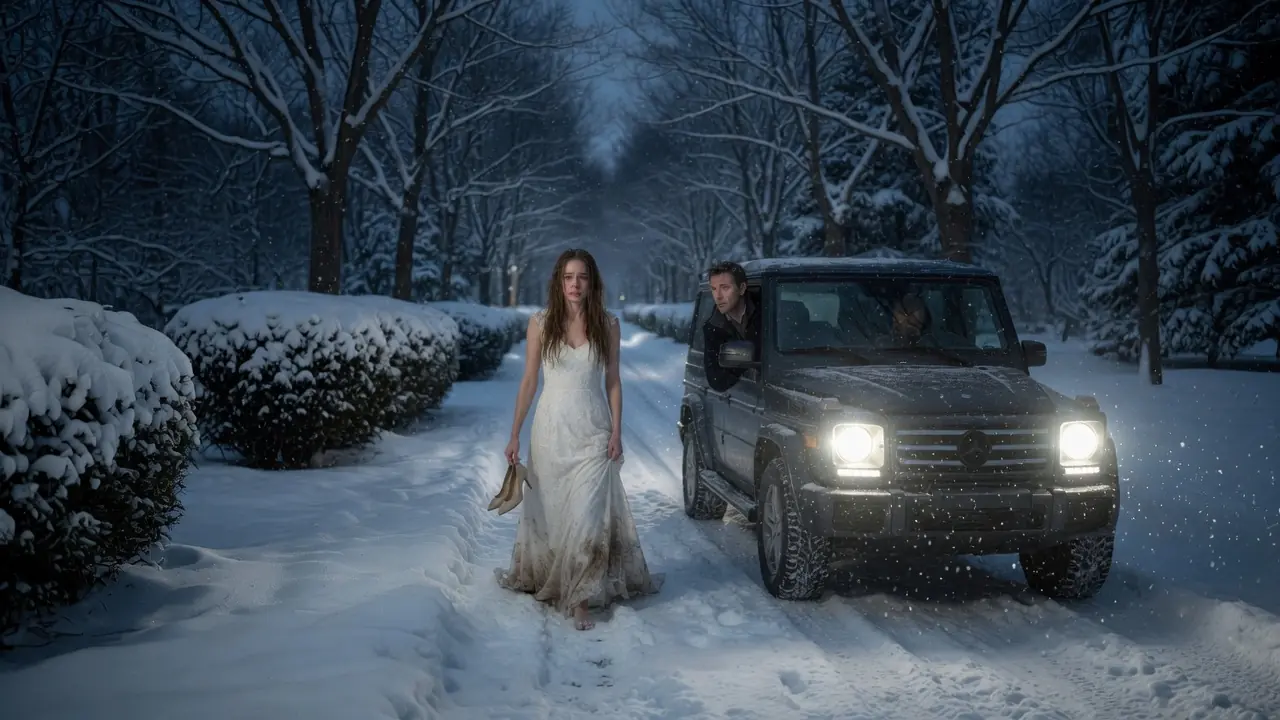
The headlights found her in the snow at 9:17 on a Thursday night.
William Harrison had just rounded a bend on Route Nine outside Greenwich when a white shape appeared at the edge of the road.
At first, he thought it was a sheet of plastic caught in the wind.
Then the figure moved.
A woman was walking alone along the shoulder in a wedding dress.
The gown had once been immaculate. Now its hem was torn and soaked gray from slush. One side of the skirt dragged across the asphalt, and the delicate beadwork caught his headlights like ice. She carried a pair of silver high heels by their straps, and damp strands of dark hair clung to her face.
Will slowed.
For several seconds, he considered continuing.
He had learned not to interfere in other people’s emergencies unless they asked. Grief had taught him that help offered at the wrong moment could feel like another demand.
But the woman was walking without a coat in a storm growing heavier by the minute.
He pulled onto the shoulder twenty feet ahead of her.
She stopped.
Will lowered the passenger window.
“Do you need help?”
The woman looked toward the dark road behind her before facing him.
Even exhausted and disheveled, she carried herself with the careful composure of someone raised to believe that strangers were always watching.
“I’m fine,” she said.
Will glanced at the snow collecting on her bare shoulders.
“Of course.”
A brief, unwilling smile touched her face.
He shifted the car into park.
“Just taking an evening walk?”
“In a wedding dress.”
“In a snowstorm.”
“When you put it that way, it sounds a little dramatic.”
“A little.”
She looked back down the empty highway.
Will recognized something in her expression.
Not confusion.
Escape.
He had seen it in his own face after Sarah’s funeral, when everyone finally left the house and he realized there was nowhere he could drive that would make his life belong to him again.
“Look,” he said, “I don’t need to know what happened. I’m not going to ask where the groom is or why you’re walking along a highway. But you’re going to freeze if you stay out here.”
Her fingers tightened around the shoes.
“No judgment?”
“No judgment.”
“No police?”
“Not unless you ask for them.”
She studied him.
He was forty-one, dressed in a charcoal overcoat and open-collared shirt, with tired brown eyes and the faint beginnings of gray at his temples. Nothing about him looked dangerous, but she had probably spent the evening surrounded by respectable people who had made her feel trapped.
“You could be anyone,” she said.
“So could you.”
That almost made her smile again.
Will reached across and opened the passenger door.
“Warm car. Destination of your choice.”
Her expression changed.
“I don’t have a destination.”
“Then we can begin with heat.”
She entered carefully, gathering the enormous skirt around her legs. The seat belt barely reached across the layers of silk and lace.
For one strange moment, Will nearly laughed at the contrast.
She noticed.
“I look ridiculous.”
“You look like someone having the worst night of her life.”
She turned toward the window.
“That may be accurate.”
Will pulled back onto the road.
Snow whispered against the windshield.
For several miles, neither spoke.
The woman shivered despite the warm air.
Will reached into the back seat and found a faded wool blanket decorated with cartoon rabbits. It had belonged to his daughter since preschool and migrated between the house, car, and school without permission.
“Here.”
The woman accepted it.
She wrapped the childish blanket over the expensive gown and looked down at herself.
“This improves the situation considerably.”
“It was either that or a reusable grocery bag.”
She laughed.
The sound surprised both of them.
“I’m Will.”
She hesitated.
“Tori.”
He suspected it was either a shortened name or not her name at all.
He did not ask.
Will had been driving home from his daughter’s parent-teacher conference. Charlie’s teacher had spoken gently about the eight-year-old’s withdrawal, her unfinished assignments, and the way she sat alone during lunch even when other children invited her to join them.
“She’s polite,” Mrs. Peterson had said. “She follows instructions. But she seems to be making herself smaller.”
Will knew why.
Sarah had been dead for two years, but grief did not follow the calendar adults wanted it to. Charlie had spoken less as each month passed. She no longer asked when her mother was coming back.
That silence frightened him more than the questions had.
The roads through Greenwich were familiar. Large colonial homes stood behind stone walls and bare oak trees. During spring, the route became green and beautiful. That night, everything beyond the headlights seemed erased.
Will glanced at Tori.
“Are you hurt?”
“No.”
“You’re sure?”
There was redness around it, as though someone had held her too tightly.
“I’m not injured.”
He accepted the distinction.
“Would you like me to take you to a hotel?”
“I don’t have my purse.”
“Friend’s house?”
She shook her head.
“Parents?”
“No.”
The answer was immediate.
Will kept driving.
“My house is five minutes away,” he said eventually. “I have a guest room. My daughter is staying with a friend tonight.”
Tori looked at him sharply.
“You invite strange women in wedding dresses home often?”
“Only during snow emergencies.”
“You don’t know me.”
“No.”
“I could steal everything.”
“You’re not wearing practical shoes for burglary.”
She looked at the heels in her hand.
“That is true.”
His humor faded.
“You can lock the guest-room door. In the morning, I’ll take you wherever you need to go.”
Tori watched the road.
“Why are you helping me?”
Will thought of Sarah’s last weeks.
Of nurses who adjusted blankets without being asked.
Of neighbors who left food without waiting to be thanked.
Of strangers who carried pieces of his life when he had no strength to lift them.
“Because somebody should.”
She looked at him for a long time.
“All right.”
The Harrison home stood on a quiet street lined with maples and old stone walls. It was a white colonial revival with dark shutters, a wide porch, and too many rooms for a father and one child.
Sarah had chosen it eight years earlier.
She loved the built-in bookshelves, the deep kitchen windows, and the neglected garden behind the house. She said they could restore it slowly.
Will had not touched the garden since she died.
He parked in the driveway.
Tori remained seated for a moment.
The porch light cast a warm pool across the snow.
“This is your house?”
“Yes.”
“It’s beautiful.”
“My wife chose it.”
He opened his door.
Then added, “My late wife.”
Tori’s expression softened.
“I’m sorry.”
“Thank you.”
Inside, the house felt different with another adult standing in the entryway.
Family photographs lined a narrow table.
Charlie’s school drawings covered one side of the refrigerator.
A pink backpack rested beneath the stairs. One mitten lay beside it without its partner.
The rooms were not polished or carefully staged. They looked lived in.
Tori stood beneath the entry light in the ruined gown.
Will removed his coat.
“Coffee?”
“At this hour?”
“I don’t think either of us is sleeping soon.”
While he worked in the kitchen, Tori moved slowly through the living room.
She stopped before the photographs.
Will and Sarah on their wedding day.
Sarah pregnant, laughing as Will tried to assemble a crib.
Charlie at three with paint covering both hands.
A family at a beach in Maine.
The pictures were imperfect.
People blinked.
Hair blew into faces.
Coffee cups appeared in the background.
But the affection in them was unmistakable.
Will returned with two mugs.
“That was Sarah,” he said.
Tori looked at the wedding photograph.
“She was beautiful.”
“She was.”
“How long ago?”
“Two years.”
“What happened?”
“Cancer.”
“I’m sorry.”
“It was quick.”
He sat in the armchair opposite the sofa.
“People told me that was a blessing.”
“Was it?”
“Some days.”
Tori lowered herself onto the couch, arranging the gown around her.
“What was she like?”
Will looked at the photographs.
“She was a pediatric nurse. She believed everyone deserved to be spoken to gently, especially when they were afraid.”
“She sounds extraordinary.”
“She would have said she was tired.”
Tori held the coffee between both hands.
For several minutes, they sat in silence.
Then Will asked, “What happened tonight?”
She stared into the mug.
“I was supposed to marry someone.”
“I gathered that much.”
“Theodore Blackstone.”
Will knew the name.
Blackstone Capital appeared regularly in financial news. Theodore’s father had built a real estate and investment empire. Theo had expanded it into technology, hospitality, and private equity.
“You were marrying Theodore Blackstone?”
Tori gave him a tired smile.
“Now you’re wondering whether I’m insane.”
“I was wondering why someone marrying him was walking along Route Nine without a coat.”
“The church was four miles back.”
“You walked four miles?”
“I ran the first one.”
Will waited.
Tori’s eyes settled on the wedding photograph across the room.
“There were almost five hundred guests. Half of them were business contacts. The other half were people my parents considered socially important.”
“Any friends?”
“Three.”
“That sounds lonely.”
“It was organized beautifully.”
Her voice sharpened slightly.
“The flowers were flown in from France. The orchestra rehearsed for weeks. Every table at the reception had hand-painted place cards. My mother spent eighteen months ensuring nothing could go wrong.”
“What did go wrong?”
“I understood what I was doing.”
She looked at him.
“I was standing behind the church doors waiting for them to open. The wedding planner was fixing my veil. My father kept checking his watch because the ceremony was six minutes late.”
Her fingers tightened around the mug.
“I could hear the guests. I could see Theo at the altar. And suddenly I realized every decision about my future had already been made.”
“You had agreed to marry him.”
“Yes.”
“Did you love him?”
“I thought I did.”
“That is not the same answer.”
“No.”
She lowered her eyes.
“I loved how certain he seemed. He always knew where we would live, where we would travel, how many children we would have, which schools they would attend. My parents called it stability.”
“And you?”
“I called it relief.”
“From what?”
“Making choices.”
The admission appeared to shame her.
Will said nothing.
Tori continued.
“I spent my entire life becoming what people approved of. Good schools. Proper friends. The right degree. The right job. Then Theo told me I didn’t need to work after we married.”
“Did you want to stop?”
“At first, I thought it meant he valued me.”
“And later?”
“I realized he valued availability.”
The snow thickened beyond the windows.
Tori pulled Charlie’s blanket tighter around her shoulders.
“Standing in the church, I imagined myself ten years from now. I could see the houses, the vacations, the photographs.”
“What could you not see?”
“Me.”
The word cracked.
She looked away quickly.
Will understood enough not to fill the silence.
“I turned around,” she said. “My mother grabbed my arm. My father told me not to embarrass the family. Theo came into the hallway and said we could discuss my panic after the ceremony.”
“After?”
“He said the guests were waiting.”
Will’s jaw tightened.
“So I ran.”
“Did anyone follow?”
“Security. My brother. Theo. I went through the reception hall, out through the catering entrance, and into the woods behind the property.”
“In that dress?”
“Yes.”
“I’m impressed you made four miles.”
“So are my feet.”
They talked until nearly three in the morning.
Will told her about raising Charlie alone and the parent-teacher conference that evening. He admitted that he often felt like a substitute filling a role Sarah had performed naturally.
“She knew how to talk about feelings,” he said. “I know how to solve practical problems.”
“Children need both.”
“I think Charlie needs someone who can hear the things she doesn’t say.”
“Maybe she needs you to stop assuming you cannot.”
Will looked at Tori.
“That sounded suspiciously wise.”
“I’m much more competent with other people’s lives.”
When exhaustion finally overtook them, Will led her to the guest room.
He left a pair of Sarah’s jeans and a soft gray sweater outside the door.
It felt strange touching the clothes.
For two years, they had remained in boxes he could not donate and could not open.
He stood in the hallway longer than necessary.
Behind the door, Tori spoke.
“Will?”
“Yes?”
“Thank you for stopping.”
He rested one hand against the wall.
“Get some sleep.”
The next morning, Will woke to voices in the kitchen.
For one disoriented second, he thought Sarah was making breakfast.
Then he remembered.
He entered the kitchen and found Tori at the stove wearing Sarah’s gray sweater and jeans. Her hair was pulled into a loose ponytail, and without the wedding makeup she looked younger and more tired.
Charlie sat at the table watching her with intense curiosity.
“Dad.”
Will stopped.
“What are you doing home?”
“Emma got sick, so her mom brought me back.”
Charlie pointed at Tori.
“There was a lady making pancakes.”
Tori tried not to smile.
“This is Tori,” Will said.
Charlie looked at the sweater.
“That was Mom’s.”
The room became still.
Tori immediately touched the hem.
“I’m sorry. Your dad said I could borrow it, but I can change.”
Charlie studied her.
“No. It looks okay.”
Will released the breath he had been holding.
Charlie looked at the pancakes.
“Dad makes them too thick.”
“I heard,” Tori said.
“Mom made them thinner.”
“We can try.”
Charlie looked at Will.
“Is she your girlfriend?”
“Charlie.”
Tori crouched beside the table.
“I’m a friend who needed somewhere safe last night.”
“My dad helps people.”
“Does he?”
“He helped me when Mom died.”
Will’s throat tightened.
Charlie had not spoken about Sarah so directly in months.
Tori looked at her gently.
“Your mom must have been very special.”
“She was the best.”
“I believe you.”
Over breakfast, Charlie talked more than Will had heard her talk in weeks.
She explained school projects, a disagreement with Emma, and her plan to draw a garden for art class.
Tori listened without correcting or rushing her.
When Charlie described Sarah’s old garden, Tori asked what flowers had grown there.
“Roses. Lavender. Yellow things.”
“Black-eyed Susans?” Tori asked.
“Maybe.”
Will watched them.
The house felt warmer.
Not healed.
Alive.
His phone rang before breakfast ended.
The screen displayed an unfamiliar number.
Will answered.
“Mr. Harrison?”
“Yes.”
“This is Jonathan Ashford. My daughter is believed to be with you.”
Will looked toward Tori.
Her face changed.
“How did you get this number?”
Will’s unease sharpened.
“Your daughter is safe.”
“I need you to bring her home immediately.”
“She is thirty-two.”
“She is under severe emotional distress.”
Tori stood.
“Give me the phone.”
Will handed it to her.
“Hello, Father.”
A man’s voice rose through the receiver.
Tori listened for several seconds.
“No.”
Another pause.
“I understand the consequences.”
Her hand trembled.
“No. I will not speak to Theo privately.”
She ended the call.
Charlie watched from the table.
Tori forced a smile.
“Family disagreement.”
“Do they yell a lot?” Charlie asked.
“Sometimes.”
“You can stay here.”
Will looked at his daughter.
Charlie returned to her pancakes.
“Dad has a guest room.”
The offer nearly broke Tori’s composure.
That afternoon, Tori and Charlie went into the backyard.
Snow covered most of the ground, but the overgrown garden remained visible beneath dead vines and bent wooden borders.
Tori knelt near the old rose trellis.
“Your mom built this?”
“Dad helped.”
“I held things,” Will said from behind them. “Sarah built it.”
Charlie pointed toward a patch near the shed.
“We could plant something there.”
Tori brushed snow from one of the boards.
“Maybe in spring.”
“What kind?”
“Whatever your mom liked. And something new.”
Charlie considered that.
“Can we have both?”
“Yes.”
Will looked toward the dead garden.
For two years, he had avoided it because restoring the space felt like admitting Sarah would never return to it.
Now Charlie was asking whether memory and change could occupy the same ground.
“All right,” he said.
“We’ll make a plan.”
Three days later, Theodore Blackstone arrived.
Two black SUVs entered first.
A silver Bentley followed.
Will was working in his home office when he saw the vehicles through the window.
He walked downstairs before anyone reached the door.
Theo stood on the porch in a dark tailored coat. He was tall, handsome, and composed in the polished manner of someone accustomed to entering rooms where everyone already knew his value.
Two security men waited near the SUVs.
Theo smiled.
“William Harrison?”
“Yes.”
“I’m Theodore Blackstone.”
“I know.”
“I believe Victoria is here.”
“She is.”
“I’m taking her home.”
Will remained in the doorway.
“That will be her decision.”
Theo’s smile thinned.
“She is not thinking clearly.”
“She appeared clear enough when she said no.”
“You do not know her.”
“Neither do I, very well.”
“Then perhaps you should stop interfering.”
Theo stepped closer.
“Victoria has responsibilities. Her disappearance caused public embarrassment, financial loss, and concern for her family.”
“Concern did not seem to stop anyone from sending security teams after her.”
“They were trying to protect her.”
“From leaving?”
Theo looked past him.
“Victoria!”
Tori appeared in the hallway.
Charlie stood behind her.
Tori’s face had gone pale, but she walked forward.
“Hello, Theo.”
His expression softened immediately.
“Thank God.”
He opened his arms.
She did not move.
Theo lowered them.
“Everyone is terrified.”
“I called my father.”
“Your mother has barely slept.”
“That happens when a wedding does not go as planned.”
“This isn’t funny.”
“No.”
Tori stepped beside Will.
“It isn’t.”
Theo glanced at Charlie.
“Can we speak privately?”
“No.”
“Victoria, you are making this worse.”
“I am ending our relationship.”
“You were overwhelmed.”
“I was trapped.”
“You had every opportunity to tell me you were unhappy.”
“I tried.”
“When?”
“When I asked to keep working.”
“That was not unhappiness. That was uncertainty.”
“When I said I did not want to move into your parents’ estate.”
“We discussed that.”
“You told me I would adjust.”
Theo’s jaw tightened.
“I gave you everything.”
Tori looked at him.
“You gave me decisions that had already been made.”
“A home. Security. A future.”
“Your future.”
Theo’s gaze moved toward Will.
Understanding appeared in his face, followed by contempt.
“I see.”
“No, you don’t,” Tori said.
“This man picks you up on the road, gives you a room, and now you believe you have discovered some authentic little life?”
Will remained quiet.
Theo turned toward him.
“You are a widower with a child and a house you can barely maintain. What exactly do you think you can offer her?”
“Nothing she has not chosen.”
Theo laughed.
“You think this is noble?”
“I think people do not belong to other people.”
Theo looked at Tori again.
“Your trust is controlled by your parents. Your apartment belonged to one of my companies. Your accounts are connected to the wedding agreement.”
“I know.”
“You have no home.”
Tori’s hands shook.
She clasped them together.
“No job.”
“I can find one.”
“No independent money.”
“I can earn it.”
“You have not worked in fourteen months.”
“I worked before you asked me to stop.”
“You agreed.”
“Yes.”
Her voice strengthened.
“And I am allowed to regret agreeing.”
Theo stepped closer.
“If you leave now, do not expect me to protect you from the consequences.”
Tori looked toward Charlie.
The child stood frozen near the staircase.
Then Tori looked back at Theo.
“I spent my whole life being protected from consequences.”
She took a slow breath.
“I think I would rather meet them.”
Theo’s expression became cold.
“You’ll come back.”
“No.”
“When the fantasy ends.”
“No.”
“When you understand what you lost.”
Tori held his gaze.
“I understand what I almost lost.”
Theo turned toward Will.
“This will not end well for you.”
Will opened the door wider.
“It will end with you leaving my property.”
For several seconds, Theo did not move.
Then he walked back toward the Bentley.
The vehicles left without another word.
Inside, the house became painfully quiet.
Charlie ran upstairs.
Will heard her bedroom door close.
Tori stood near the window with both arms around herself.
“What he said is true.”
“Some of it.”
“I have nothing.”
“You have a degree.”
“A year-old résumé.”
“Work experience.”
“Contacts tied to my parents.”
“Skills.”
She shook her head.
“I don’t know whether I can do this.”
Will stepped closer without touching her.
“You already did the hardest part.”
“Running away?”
“Admitting the life did not belong to you.”
Tori looked at him.
“Why are you helping me?”
He thought about Sarah.
Near the end, she had spoken less about death than about what Will and Charlie should do afterward.
One evening, when pain medication made her voice faint, she told him not to make grief into a locked room.
“If you ever meet someone who has forgotten who they are,” she said, “help them remember. That is one way love continues.”
Will had dismissed it as something beautiful she said while dying.
Now it returned.
“Sarah asked me to help people find their way back to themselves when I could.”
Tori’s eyes filled.
“She sounds impossible to live up to.”
“She would hate that sentence.”
Tori laughed through tears.
“What would she say?”
“That love is not a competition.”
That evening, Charlie remained quiet at dinner.
Afterward, Will found her sitting on the floor beside Sarah’s photograph.
“Did Theo scare you?”
Charlie nodded.
“Is Tori leaving?”
“I don’t know.”
“Do you want her to?”
Charlie shook her head.
Will sat beside her.
“Having someone new here does not mean we forget Mom.”
“I know.”
“Do you?”
Charlie touched the photograph.
“I think Tori knows Mom was here.”
“She does.”
“She doesn’t act like we’re supposed to stop talking about her.”
“No.”
Charlie looked at him.
“You smile more.”
Will did not know how to answer.
The next morning, Tori told them she would stay for one week.
Then another.
She created boundaries quickly.
She insisted on contributing to groceries once she found work.
She moved Sarah’s clothes back into their box and purchased several inexpensive outfits from a secondhand store.
She slept in the guest room and refused to let Charlie call it her room.
“Not yet,” she said.
Will respected the distinction.
Tori contacted former colleagues carefully. Some stopped responding after learning she had left Theo. Others quietly offered support.
A local nonprofit called Open Door Connecticut needed part-time help with donor communications and fundraising campaigns.
The salary was modest.
The office occupied three rooms above a bakery.
Tori accepted immediately.
On her first morning, she stood in the hallway wearing a navy blouse and holding a borrowed briefcase.
“I feel sixteen.”
“You look thirty-two,” Will said.
“That was deeply comforting.”
Charlie hugged her.
“You’ll be good.”
“How do you know?”
“You make people listen.”
Tori returned that evening exhausted and happy.
She had written an email campaign.
Designed a fundraising page.
Helped secure a meeting with a local business owner.
No one asked about her family name.
No one cared whom she almost married.
They valued the work.
For the first time in years, she earned money that belonged only to her.
She framed the first paycheck stub.
Spring came early.
Snow retreated from the backyard, exposing dead stems, broken edging, and weeds hardened beneath winter.
Tori, Charlie, and Will began clearing the garden.
They worked slowly.
Sarah’s roses had survived beneath the neglect.
Two produced small red buds.
Charlie cried when she saw them.
“Mom’s flowers are alive.”
Tori knelt beside her.
“Some plants look gone before they’re ready to return.”
Together, they planted lavender, marigolds, vegetables, and black-eyed Susans.
They did not recreate Sarah’s garden exactly.
They preserved what remained and built around it.
Will understood the meaning before anyone spoke it aloud.
Tori became part of the household without claiming a role that was not hers.
She listened when Charlie told stories about Sarah.
She asked questions.
She never said Sarah would have wanted something unless Will or Charlie had told her.
When Charlie became angry, Tori did not try to solve it immediately.
She sat nearby.
That was often enough.
One evening, Charlie found Tori cleaning dirt from her hands at the outdoor faucet.
“Do you think Mom would like you?”
Tori stopped.
“I hope so.”
“I think she would.”
“Why?”
“Because you don’t try to make us less sad.”
Tori looked toward Will, who stood near the porch.
He turned away before they saw his eyes fill.
Theodore did not disappear quietly.
His attorneys sent letters demanding the return of jewelry and clothing purchased during the engagement.
Tori returned everything.
Her parents froze access to her trust.
She challenged nothing.
When her mother called and accused her of destroying the family’s reputation, Tori listened until the insults began.
Then she ended the call.
Each boundary cost her something.
But the fear weakened.
Months passed.
The garden filled the backyard with color.
Tori’s work at Open Door expanded. She developed a campaign that funded temporary housing for women leaving coercive relationships.
The irony was not lost on her.
She rarely told clients her own story.
She did not need to.
Her work became practical.
Transportation vouchers.
Emergency hotel funding.
Résumé assistance.
Legal referrals.
The things a frightened person needed after courage carried them through the first door.
Will returned to consulting more regularly.
He no longer scheduled every meeting around the possibility that Charlie might need him, because he finally understood that being present did not require being terrified at all times.
Charlie began eating lunch with other children.
Her teacher noticed she spoke more during class.
At the end of the school year, Mrs. Peterson told Will, “She seems larger somehow.”
Will smiled.
He understood exactly what she meant.
His feelings for Tori changed quietly.
There was no single moment when gratitude became love.
It happened while washing dishes.
While comparing grocery prices.
While listening to her and Charlie argue over garden labels.
While watching her return from work carrying exhaustion she had chosen.
The change frightened him.
One night, he found Tori sitting on the back porch.
The garden smelled of wet soil and lavender.
“Charlie asked whether we are going to get married,” he said.
Tori nearly spilled her tea.
“What did you say?”
“That I had not asked you.”
She looked at him.
“Will.”
“I’m not asking tonight.”
“Good.”
He laughed.
“I am trying to say something else.”
She waited.
“I love you.”
Tori became very still.
He continued before fear could stop him.
“I love the person you are when no one is deciding for you. I love how you listen to Charlie. I love that you speak about Sarah without acting as if her memory is your enemy.”
Tori’s eyes filled.
“I’m not asking you to fit into an empty place.”
“There is no empty place,” she whispered.
Will nodded.
“I know.”
“That was what scared me at first.”
“What?”
“I thought loving you meant taking something from her.”
“It doesn’t.”
“I know that now.”
She looked toward the rose trellis.
“Love isn’t a room with one chair.”
Will sat beside her.
“No.”
“I love you too.”
He reached for her hand.
Tori let him hold it.
“But I am terrified of making another mistake.”
“Then we move slowly.”
“What if I’m never ready for marriage?”
“Then we don’t marry.”
“What if I need more time?”
“I’m not going anywhere.”
Tori smiled through tears.
“That is dangerously close to something Theo used to say.”
Will released her hand immediately.
She laughed.
“The difference is you mean I am free to stay. He meant I was not free to leave.”
Three months later, Charlie ran into the kitchen holding a drawing.
In careful crayon lines, she had drawn the white house, the garden, and three people standing beneath a large sun.
Will.
Charlie.
Tori.
Sarah appeared too, drawn as a small figure beside the roses with wings Charlie had colored yellow.
At the bottom, she had written:
MY FAMILY CAN GROW WITHOUT FORGETTING.
Tori covered her mouth.
Charlie looked worried.
“Do you like it?”
“I love it.”
“Mom is in the garden.”
“I see.”
“Because it was hers first.”
Tori crouched and hugged her.
“That is perfect.”
Will hung the drawing on the refrigerator beside older pictures.
Sarah’s photographs.
School notices.
Shopping lists.
A calendar covered in appointments.
All the ordinary evidence of a family continuing.
Tori looked at both of them.
“I have something to say.”
Charlie sat immediately.
Will leaned against the counter.
Tori took a breath.
“For most of my life, I thought belonging meant doing whatever was required to keep people pleased with me.”
She looked at Charlie.
“Then I came here.”
Her eyes moved to Will.
“You both gave me a place without telling me who I had to become inside it.”
Charlie waited impatiently.
“Does this mean you’re staying?”
Tori laughed.
“Yes.”
“Forever?”
“Charlie.”
“What? Forever is useful information.”
Tori looked at Will.
“I would like to build a life here. Not because I need rescuing. Not because I have nowhere else to go.”
Her voice strengthened.
“Because I choose you.”
Will crossed the kitchen and took her hands.
“Are you sure?”
“No one has ever asked me that enough.”
He smiled.
“Are you sure?”
“Yes.”
Charlie launched herself between them.
The three stood beside the refrigerator, laughing and crying.
There was no orchestra.
No imported flowers.
No five hundred guests waiting in silence.
Only coffee cups in the sink, dirt beneath Tori’s fingernails, and a child trying to fit both adults into one embrace.
Will proposed several months later in the garden.
No crowd watched.
Charlie held the ring box.
Tori wore jeans and gardening gloves.
When Will asked, she did not answer immediately.
He waited.
That was the gift.
She looked at the house.
At Charlie.
At Sarah’s roses growing beside the flowers they had planted together.
Then she said yes.
Their wedding took place the following spring beneath the old maple tree.
Thirty-two people attended.
Tori chose her own dress.
Simple.
Comfortable.
She walked toward Will without anyone leading her.
Charlie stood beside him carrying a small bouquet containing one rose from Sarah’s garden.
Before the ceremony, Tori paused at the end of the path.
Snow had begun falling lightly despite the season.
For a brief moment, she remembered another road.
A ruined gown.
Bare shoulders.
Headlights stopping in the darkness.
Will looked at her.
He did not motion for her to hurry.
He only waited.
Tori smiled and continued.
Years later, when Charlie asked how they met, Will told her the truth.
“I found Tori walking through a snowstorm.”
Tori always corrected him.
“You stopped. That is different.”
The distinction mattered.
Will had not found her like something lost that became his.
He had seen her.
Offered warmth.
Opened a door.
Everything after that had been her choice.
The garden grew larger with each season.
Sarah’s roses remained near the trellis.
Tori planted new varieties around them.
Some years, the old bushes bloomed beautifully.
Other years, disease weakened them.
No one suggested removing them.
They pruned what was damaged, supported the living branches, and allowed new growth to share the soil.
Charlie eventually understood that the garden was not a symbol of one woman replacing another.
It was evidence that love could remember and still continue.
The night Tori walked away from the church, she believed she had destroyed her future.
In truth, she had only refused the one other people had written for her.
The life she built afterward was quieter.
Less perfect.
More demanding.
Bills arrived.
Children became angry.
Grief returned unexpectedly.
Love required apology, patience, and repeated choice.
It did not resemble the fairy tale her parents had planned.
It was better.
Because when Tori stood in the kitchen, looked through the window at the garden, and heard Will helping Charlie with homework in the next room, she never wondered who had chosen that life.
She had.
And on winter nights, when headlights moved along Route Nine beyond the distant trees, Will sometimes remembered the woman in the torn wedding dress walking alone through the snow.
He used to believe he had rescued her.
Age taught him otherwise.
He had only stopped the car.
Tori had done the rest.