“Please. I haven’t eaten since yesterday. Just a little bread.”
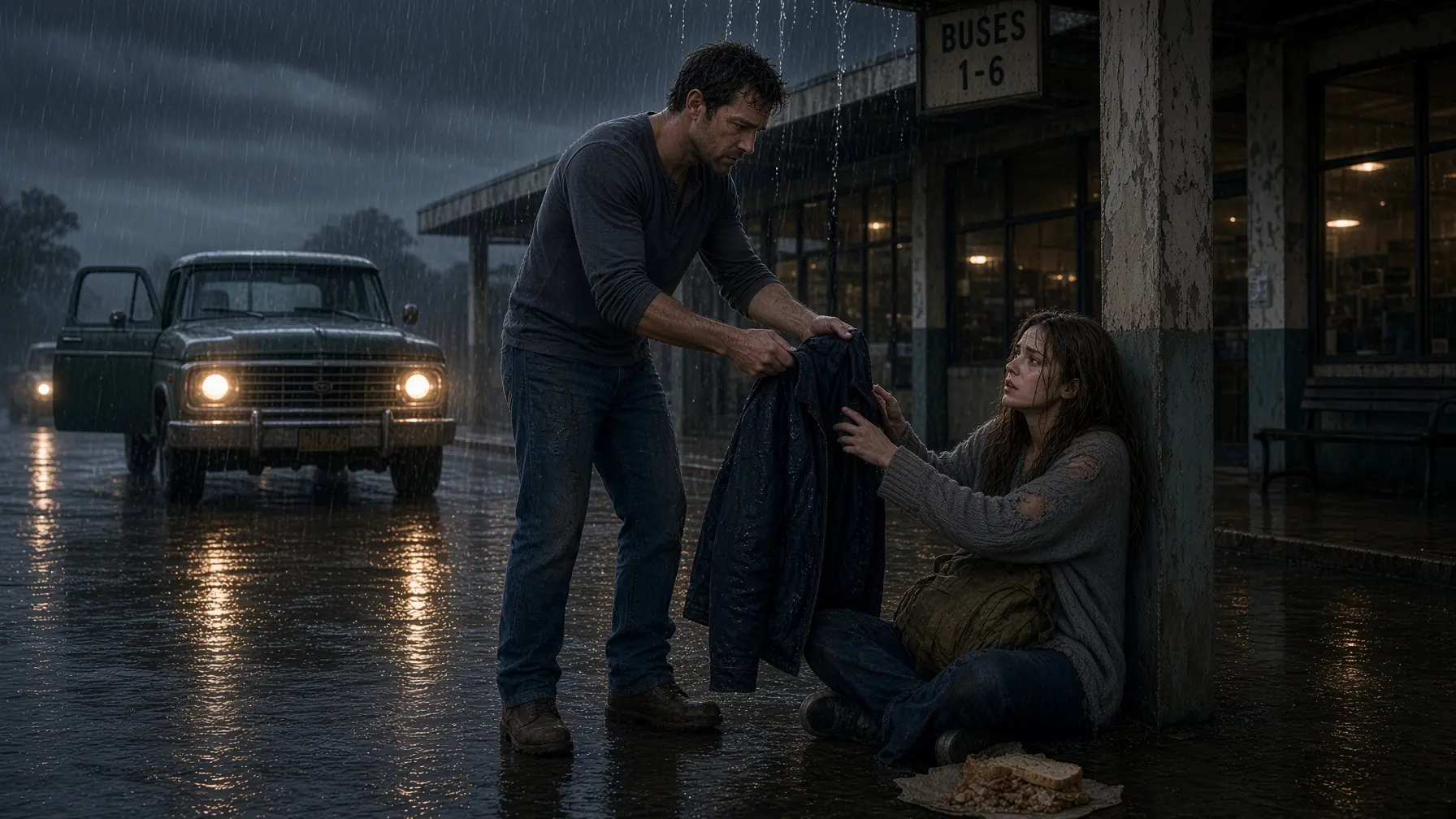
The woman’s voice was barely louder than the traffic rushing past her. She stood beside a bakery on a busy downtown corner wearing a torn gray sweater beneath an oversized coat that looked as though it had spent too many nights outdoors. Her chestnut hair had been twisted into a loose knot and then abandoned there, strands hanging around a face made older by exhaustion. One hand gripped the strap of a battered backpack. The other remained open in front of her, not demanding, not reaching, just waiting.
Most people never looked at her long enough to decide whether they believed her. A young man wearing headphones stepped sideways without slowing. Two office workers crossed toward the opposite curb. A woman pushing a stroller pulled her child closer, though the stranger had done nothing except ask for food. The homeless woman lowered her hand each time someone passed and raised it again only when another person approached, as though every rejection required her to rebuild enough courage for the next attempt.
Then three people stopped.
The first was a woman in a camel-colored coat and designer sunglasses. Her heels clicked once against the pavement before she froze. The second woman, slightly older, followed her gaze and covered her mouth in disbelief. The man with them looked longer than either woman before a slow smile formed across his face.
“My God,” the woman in sunglasses said. “Is that actually you?”
The homeless woman’s expression changed immediately. It was subtle, but something inside her seemed to retreat. She lowered her eyes and tightened her grip on the backpack.
The second woman laughed softly. “I don’t believe this.”
The man folded his arms. “So this is where life brought you.”
The woman swallowed. “I’m only asking for something to eat.”
The first woman removed her sunglasses. “You remember me?”
“Yes.”
“Do you?”
The homeless woman nodded.
The other woman leaned closer. “Funny. You used to walk through a room and people stood up before you even noticed them.”
“Please,” the woman whispered. “I’m not asking you for anything except food.”
The man shook his head. “You’ve got nerve.”
A few pedestrians slowed now, sensing drama.
The woman in sunglasses said, “You know how many people begged you for meetings? How many careers disappeared because somebody didn’t matter enough to you?”
“I know.”
“That all you have to say?”
The homeless woman closed her eyes briefly. “No. But I don’t think you stopped because you wanted to hear the rest.”
That struck harder than anger would have.
The second woman reached into her handbag.
For a second, hope crossed the stranger’s face.
Instead, she pulled out her car keys.
“Come on,” she said. “We’re wasting time.”
The three walked away laughing quietly.
The homeless woman did not answer them.
She simply sat on the edge of a concrete planter and stared at the pavement.
That was when James Carter and his eight-year-old daughter Mila came out of the grocery store half a block away.
James was carrying two paper bags against his chest while Mila walked beside him with a loaf of bread tucked beneath one arm because she had insisted on helping. He was thirty-nine, broad-shouldered, tired around the eyes, and dressed in the work clothes he had worn all day repairing commercial heating systems. Five years earlier, he had become the only parent in the Carter household after his wife, Sarah, died from complications following an illness that moved faster than anyone expected.
Since then, James had become very good at practical survival.
School lunches.
Work schedules.
Laundry.
Doctor appointments.
Hair detangler.
Remembering which stuffed bear was allowed in bed and which one had apparently committed some unforgivable offense.
He was less good at questions that did not have practical answers.
Mila saw the woman first.
“Dad.”
James adjusted the grocery bag.
“What?”
Mila pointed.
The woman was standing again.
As they approached, she lifted her head.
“Sir?”
James stopped.
“I don’t need money.”
He waited.
She looked toward the grocery bags.
“Could you spare some food?”
James glanced at Mila.
His daughter was already holding out the loaf.
“Not that one,” he said quietly.
Mila frowned.
“Why?”
“Because it’s for your lunches.”
“We can buy another.”
James almost smiled.
Then he looked toward the bakery beside them.
“Give me a minute.”
He went inside.
The woman seemed confused.
Less than two minutes later James returned with a warm turkey sandwich, two rolls, an apple, and a bottle of water.
He put them into a small paper bag and held it toward her.
She did not immediately take it.
“It’s yours.”
Her eyes moved to his face as though searching for the trick.
“There isn’t one,” James said.
Finally she accepted the bag.
“Thank you.”
She held it close to her chest.
Mila looked at the woman’s shoes. The left sole had begun separating near the toe.
“What’s your name?”
James glanced at his daughter.
“Mila.”
“What?”
“We don’t ask strangers personal questions.”
The woman surprised him by smiling.
“It’s all right.”
She looked at Mila.
“Grace.”
“I’m Mila.”
“I heard.”
Mila pointed at James.
“That’s my dad.”
“I also figured that out.”
James smiled faintly.
“Anything else, ma’am?”
Grace’s smile faded.
She looked toward the ground.
“There is.”
James waited.
“I don’t have anywhere to sleep tonight.”
His stomach tightened before she finished.
Grace continued quickly, already seeing the answer on his face.
“I’m not asking for your house. A porch. Garage. Shed. Somewhere dry. I’ll leave before sunrise.”
James looked at Mila.
Then back at Grace.
He hated the next words while he was saying them.
“I’m sorry.”
Grace nodded immediately.
James continued, “I have a little girl. I can’t bring someone I don’t know into the house.”
“I understand.”
“You really do?”
“Yes.”
She gave him a tired smile.
“You already did more than most people today.”
James stood there another second.
He almost asked whether she knew of a shelter.
Almost offered to call somewhere.
But Grace had already turned toward the bench.
Mila tugged his sleeve.
“Dad?”
“Come on.”
They walked toward the truck.
Mila kept looking back.
Grace sat beneath the bakery awning with the food bag in her lap.
Inside the truck, James started the engine.
Neither spoke.
Two blocks passed.
Then Mila asked:
“We have the guest room.”
James stared through the windshield.
“I know.”
“Nobody uses it.”
“I know.”
“So why couldn’t Grace?”
“Because I don’t know Grace.”
“You know her name.”
“That isn’t what I mean.”
Mila frowned.
“Because she’s homeless?”
“No.”
“Because her clothes are dirty?”
“No.”
“Because she’s a stranger?”
“Yes.”
Mila looked through the passenger window.
Traffic lights reflected across the glass.
Then she asked:
“What if Mom was the stranger?”
James’s hands tightened around the steering wheel.
He said nothing.
Mila seemed to realize she had touched something painful.
“Sorry.”
“You don’t have to apologize.”
“Would Mom bring her home?”
James thought about Sarah.
She had once driven an injured dog forty miles because the nearest veterinary clinic was closed. She gave grocery money to a waitress whose car broke down. She also locked every door twice at night and would have punched James herself if he invited a stranger into a house with their child without thinking.
“She would make me figure out a safer way to help.”
Mila considered that.
“Did we?”
James had no answer.
That evening, rain arrived.
Not ordinary rain.
A summer thunderstorm rolled across the city shortly after nine, turning gutters into shallow rivers and slamming water against the windows hard enough to drown out the television.
James tucked Mila into bed.
She held her teddy bear against her chest.
“Do you think Grace found somewhere?”
“I hope so.”
“Do you think she ate?”
“Yes.”
He said it too quickly.
Mila noticed.
“You don’t know.”
“No.”
She looked toward the window as lightning flashed.
“Mom would go back.”
James closed his eyes briefly.
“Go to sleep.”
She did.
He could not.
At nine forty-five, James stood in the kitchen holding his truck keys.
He told himself returning downtown was unnecessary.
Grace was an adult.
She could have found a shelter.
Police patrols knew where people congregated.
There were organizations designed for exactly this kind of problem.
He was a father with a sleeping child upstairs.
Then he realized the child upstairs was the reason he could not ignore it.
James called his neighbor, Mrs. Alvarez, whose bedroom window faced the Carter house and who had babysat Mila more times than either family could count.
Ten minutes later she was sitting in James’s living room wearing slippers and looking irritated.
“You’re going back for the woman.”
James blinked.
“How did you—”
“Mila called me before bedtime.”
James stared.
“She what?”
Mrs. Alvarez waved one hand.
“She asked whether I thought a person could freeze in summer rain.”
James sighed.
“I’ll be twenty minutes.”
“You’ll be however long it takes.”
“Thank you.”
“Go.”
James drove back downtown.
The rain made every intersection slower.
When he reached the bakery, the bench was empty.
His stomach dropped.
He parked anyway.
The awning offered shelter to nobody.
He checked the bus stop.
The pharmacy entrance.
An alley he immediately regretted entering.
Nothing.
A janitor pushing trash containers beneath an overhang noticed him.
“You looking for somebody?”
James described Grace.
The janitor nodded.
“Woman like that went toward the old central bus terminal maybe half an hour ago.”
“Thanks.”
The terminal had closed years earlier except for one remaining commuter platform. Most of the building sat dark behind temporary fencing and boarded ticket windows.
James entered through the open shelter area.
Water dripped through sections of damaged roof.
“Grace?”
Nothing.
He checked behind benches.
An empty vending area.
The restroom corridor.
Then he saw shoes beneath a concrete divider.
He walked around it.
Grace was curled against the wall.
Completely soaked.
James’s jacket was not there because he had never given her one.
The sandwich bag was.
Untouched.
He crouched.
“Grace.”
Her eyes opened.
For one second she looked frightened.
Then confused.
“You?”
“Why didn’t you eat?”
Grace looked toward the bag.
“I was saving it.”
“For what?”
“Tomorrow.”
James opened the bag.
Rainwater had found its way through.
The sandwich was ruined.
He stared at it.
“You were hungry enough to ask strangers for food, and then you saved the food?”
Grace looked embarrassed.
“You learn not to assume tomorrow gives you something.”
James picked up the bag.
“Come on.”
“Where?”
“My truck.”
“No.”
“Grace.”
“You said no earlier.”
“I changed my mind.”
“You had a good reason.”
“I still have a good reason.”
She looked at him.
“That doesn’t make sense.”
“It does to parents.”
He removed his rain jacket and held it toward her.
Grace hesitated.
“I’ll get it dirty.”
“It’s a work jacket.”
She accepted it.
When she stood, James noticed the limp.
“What happened?”
“Nothing.”
“You’re limping.”
“My shoes.”
He looked down.
The sole had nearly separated.
“That isn’t nothing.”
“It’s not an injury.”
“Good.”
James led her toward the truck.
Before entering, Grace wiped her shoes carefully against the curb.
James noticed.
“You don’t need to do that.”
“I know.”
She did it anyway.
Inside, warm air rushed from the vents.
Grace held her hands nearby but not directly against them.
For several minutes, neither spoke.
Then James said:
“I’m James.”
Grace smiled weakly.
“I remember.”
“Right.”
“My memory survived homelessness.”
“That came out wrong.”
“A little.”
He smiled.
Grace looked through the windshield.
“You said your daughter’s Mila.”
“Yes.”
“She asks difficult questions.”
“You noticed.”
“She asked me one too.”
“What?”
Grace looked down.
“She asked whether I had a family.”
James waited.
“And?”
“I told her I used to.”
He did not press.
That earned him something he would not understand until later.
When they reached the house, Mrs. Alvarez was waiting inside.
James introduced Grace.
Mrs. Alvarez looked at the soaked woman for exactly two seconds before disappearing upstairs.
She returned carrying sweatpants, a T-shirt, socks, and a robe.
“My daughter left these here.”
Grace took them.
“I’ll return—”
“No.”
Mrs. Alvarez pointed toward the staircase.
“Bathroom is first door left. Towels under sink.”
Grace blinked.
“Thank you.”
“Mila wakes at six thirty and speaks immediately.”
James said:
“That is an important warning.”
Grace laughed.
The sound was small.
Real.
After Mrs. Alvarez went home, James showed Grace the guest bedroom.
The room had belonged to Sarah’s younger sister before she moved across the country. Since then, it had become half guest room, half storage.
Grace stood in the doorway.
“There’s a lock on the inside,” James said.
She looked at him.
“I thought you might want to know.”
Something changed in her expression.
“Thank you.”
“If you need anything, knock.”
“I’ll leave early.”
“You don’t have to sneak out.”
“I know.”
That should have warned him.
At six twenty the next morning, James walked downstairs.
The guest bed was made.
Grace was gone.
His jacket rested folded across the dining table.
Beside it lay a note.
James,
Thank you for coming back. Please tell Mila that she reminded me kindness still exists. I am sorry for leaving without goodbye. It is easier this way.
— Grace
Mila found him reading it.
“She left?”
“Yes.”
“Why?”
“I don’t know.”
Mila looked around.
“Where’s the bread?”
James checked.
One loaf missing.
Half a jar of peanut butter.
Three apples.
Nothing else.
No cash.
No electronics.
No jewelry from the hall drawer.
Mila smiled.
“She took food.”
“She did.”
“Good.”
James looked at her.
“That isn’t usually what you say when someone takes things without asking.”
“She needed it.”
That afternoon, James went back to the bakery.
He told himself he was buying lunch.
The owner, a Lebanese-American man named Sami Haddad, recognized him from the previous day.
“You found her?”
“You saw me?”
“You bought half my lunch counter for one woman.”
James smiled.
“She came back this morning?”
Sami nodded.
“She asked for hot water.”
“Why?”
“Probably because it was free.”
“What happened?”
Sami pointed through the window.
“There was an older man sitting across the street. Walter. Been around here maybe two years.”
James knew who he meant.
“He can barely walk.”
“Yes.”
Sami continued.
“Your Grace sat with him.”
“My Grace?”
“You’re searching. That makes her yours temporarily.”
James frowned.
“What did she do?”
“Gave him the bread.”
“All of it?”
“Most.”
“And peanut butter?”
“Yes.”
James stared through the window.
“She didn’t keep anything?”
“One apple.”
Sami wiped the counter.
“I see people with nothing every day.”
He paused.
“The interesting thing is how quickly nothing gets divided.”
James found Grace again that evening.
She was sitting on the same bench.
Walter sat beside her eating soup from a foam cup.
James approached carrying two paper bags.
Grace looked up.
“You came back again.”
“You are becoming inconvenient.”
“That’s fair.”
He handed Walter one bag.
Then Grace another.
She opened it.
Soup.
Bread.
Chicken.
Water.
Two protein bars.
“You plan to feed me for a week?”
“I’m learning.”
Walter laughed.
Grace finally began eating.
James sat beside her.
“You left.”
“I said I would.”
“Without goodbye.”
“That wasn’t part of the agreement.”
“Mila was upset.”
Grace stopped eating.
“I’m sorry.”
“She’ll recover.”
Grace nodded.
After Walter left, James said:
“You can stay again.”
“No.”
“Why?”
“One night becomes two.”
“Yes.”
“Two becomes three.”
“Usually.”
“Then you get used to me.”
James looked at her.
“That’s the problem?”
Grace stared ahead.
“No. I get used to you.”
The answer surprised him.
She continued quietly.
“Then one morning someone decides they’ve done enough. Or I become inconvenient. Or embarrassing. Or a problem they don’t know how to solve.”
James leaned forward.
“You think I’m going to throw you out.”
“I think everybody has a limit.”
“That’s true.”
Grace looked at him.
He continued.
“I’m not promising you unlimited anything.”
That made her listen.
“I have a daughter. I have work. I have bills. I don’t know you. I can’t promise to fix your life.”
Grace’s face softened.
James added:
“But you don’t have to sleep on a bench tonight.”
A black SUV slowed near the curb.
Grace saw it first.
Everything about her changed.
Her shoulders tightened.
The soup stopped halfway toward her mouth.
The vehicle continued twenty yards.
Stopped.
Grace lowered her head.
“Don’t turn around.”
James looked at her.
“What?”
“Please.”
The SUV remained.
James saw its reflection in the bakery window.
Dark windows.
No visible markings.
“Do you know them?”
Grace stood.
“I need to go.”
“Are you in danger?”
“No.”
“That wasn’t convincing.”
She grabbed the backpack.
“Grace.”
She finally looked at him.
“They’re looking for someone.”
“Who?”
Grace’s eyes filled with something he could not name.
“The woman I used to be.”
Then she walked away.
The SUV pulled into traffic several seconds later.
James watched both disappear in opposite directions.
That night Mila noticed immediately.
“You found her.”
“Yes.”
“Why didn’t she come home?”
“She didn’t want to.”
Mila thought.
“Did you ask why?”
“Yes.”
“And?”
“Complicated.”
Mila hated that word.
Adults used it whenever they wanted children to stop asking questions.
She folded her arms.
“Were the people in the black car bad?”
James stared.
“How do you know about the black car?”
“I don’t.”
She shrugged.
“You looked worried.”
That was Sarah in her.
Observation before explanation.
James sat beside her.
“I don’t know whether they’re bad.”
“Grace was scared?”
“Yes.”
“Then maybe they don’t have to be bad to scare her.”
James looked at his daughter.
Children occasionally said simple things adults spent years learning to articulate.
The next morning James found Walter beneath the bus shelter.
“You’re looking again,” the old man said.
“Yes.”
Walter pointed toward an old church three blocks east.
“She goes there when she wants quiet.”
St. Matthew’s was nearly empty.
A custodian polished the side aisle.
Two elderly women sat near the front.
Grace was in the last pew.
She saw James before he sat down.
“You’re persistent.”
“So I’ve been told.”
“You shouldn’t be looking for me.”
“Then stop making it easy.”
She almost smiled.
James waited.
Finally he asked:
“Who was in the SUV?”
Grace stared toward the stained-glass windows.
“People from work.”
“What kind of work?”
She reached into her backpack.
From an inner pocket she removed a battered leather card holder.
Inside was an identification card.
The photograph showed Grace with clean hair, tailored clothing, and the composed expression of someone accustomed to cameras.
The name beneath it read:
Grace Ashford
Ashford Systems Group
Executive Chair
James looked up.
The name Ashford meant something.
Not enough.
“I should know this?”
“Probably not.”
She took back the card.
“My father founded the company.”
“What company?”
“Ashford Systems.”
James frowned.
Then recognition arrived.
The company made cloud infrastructure, medical data systems, logistics software, and enterprise security products. James had heard the name on financial news but never associated it with a person.
“That Ashford Systems?”
“Yes.”
“You work there.”
Grace looked toward him.
“I own a controlling interest.”
James stared.
For several seconds he said nothing.
Then:
“You’re rich.”
Grace laughed without humor.
“Technically.”
“How rich?”
“Enough that the answer usually ruins conversations.”
James leaned back.
He looked at the torn coat.
The shoes.
The backpack.
Then her face.
“You’re telling me you could walk into a hotel and buy the building.”
“Probably not the building.”
“You know what I mean.”
“Yes.”
“Then why were you sleeping in a bus terminal?”
Grace became quiet.
“I left.”
“That doesn’t answer it.”
“It’s the only answer I have that doesn’t take an hour.”
“I have an hour.”
So she told him.
Not everything.
Enough.
Grace Ashford had inherited voting control of Ashford Systems after her father died eighteen months earlier. She had worked inside the company for twelve years before that, first in operations, later corporate strategy, eventually on the board. Her father’s death placed her in a role she was legally prepared to occupy and emotionally unprepared to survive.
People changed.
Not all.
Enough.
Old friends became strategic relationships.
Executives began framing conversations around what Grace’s signature could accomplish.
Family members she had barely seen in years discovered concerns about her wellbeing that happened to involve trust structures and money.
Every dinner became information.
Every kindness raised questions.
Every disagreement became market-sensitive.
Then she made a series of hard decisions.
One division closed.
Hundreds of people lost jobs.
Some layoffs were necessary.
Some decisions she later regretted.
Among the people who confronted her publicly were the three who had mocked her outside the bakery.
“They worked for you?”
“One did.”
“What happened?”
“She was laid off when we consolidated operations.”
“And the others?”
“Consultants.”
James looked at her.
“Were they wrong about you?”
Grace took a long time to answer.
“Not entirely.”
That surprised him.
“I had become difficult to reach. I trusted layers of people to filter problems. I told myself it was necessary because I couldn’t talk to everybody.”
She rubbed her hands together.
“Somewhere along the way, necessary became convenient.”
James said nothing.
Grace continued.
“Six months ago, I had a panic attack during a board dinner.”
“Did anyone know?”
“My assistant did.”
“Then?”
“I left the hotel.”
“Just walked out?”
“Yes.”
“What did your company do?”
“Security found me two hours later.”
“And you came back.”
“No.”
She looked toward the church doors.
“I told them I needed time. I appointed temporary authority according to our governance documents. I told the board I was taking medical leave.”
James frowned.
“So you didn’t disappear with people making decisions illegally in your name.”
“No.”
That mattered.
“I wasn’t testing the world like some fairy tale.”
“What were you doing?”
“Failing.”
The word came quietly.
James turned.
Grace looked almost embarrassed.
“I rented a cheap room under my middle name. Then I stopped sleeping. Stopped answering friends. Missed rent. My cards were frozen temporarily because security assumed unusual activity meant compromise. I could have fixed that with one phone call.”
“But you didn’t.”
“No.”
“Why?”
“I don’t know.”
James believed her.
That was perhaps the first useful answer she had given.
She continued.
“At first I told myself I wanted to know whether anyone would help me without knowing who I was.”
“And?”
“That was a story I invented afterward because it sounded better than admitting I didn’t want to go back.”
Her voice shook.
“I was ashamed.”
“Of being rich?”
“Of being unable to manage the life everybody thought I had mastered.”
James looked down.
Grace added:
“And then something strange happened.”
“What?”
“When people ignored me, it hurt.”
She smiled sadly.
“But it also felt honest.”
“How?”
“Nobody wanted anything from me.”
James understood a little.
Then:
“But some people recognized you.”
“The three outside the bakery.”
“Yes.”
“They hated me.”
“Do you blame them?”
Grace stared at the floor.
“No.”
That answer changed James’s opinion of her more than the corporate title had.
“What are the SUVs doing?”
“My security team.”
“They’re not trying to kidnap you?”
“No.”
“Mila was worried.”
Grace smiled.
“They’re trying to keep me alive.”
“Why did you hide?”
“Because if I talk to them, everything starts again.”
James leaned back.
“You realize that isn’t sustainable.”
“I know.”
“Your company knows where you are?”
“They’ve known the city for weeks. I kept moving enough that they respected the line between monitoring for safety and forcing contact.”
“You’re paying people to follow you while you sleep outside?”
Grace winced.
“When you say it like that, it sounds ridiculous.”
“It is ridiculous.”
She laughed.
James did too.
For the first time, the gap between them felt smaller.
Not gone.
Smaller.
Grace said:
“The board meeting is today.”
“What happens?”
“Either I formally return to active authority or extend leave.”
“What do you want?”
“I don’t know.”
James nodded.
“That seems to be the real problem.”
Grace looked at him.
He continued.
“You’ve spent months deciding what you don’t want.”
Silence.
“What do you want?”
Grace stared at the stained glass.
“I want to stop being afraid that every person near me is there because of what I can do for them.”
“That isn’t a company decision.”
“No.”
“I also want to know whether I can run the company without becoming someone I hate.”
“That might be.”
She smiled.
“You’re very irritating for an HVAC technician.”
“I repair systems. Mostly by finding what part everybody assumed wasn’t the problem.”
Grace laughed.
Outside, engines approached.
Three black SUVs stopped near the church.
James stood.
Grace did not.
The doors opened.
Several security staff stepped out.
Then an older man with silver hair.
He entered alone.
No rush.
No drama.
He stopped several feet from Grace.
“Ms. Ashford.”
“Daniel.”
Relief crossed his face.
Not corporate relief.
Human.
Daniel Hart had been Grace’s father’s general counsel and now chaired the board’s governance committee. He looked exhausted.
“We have been worried.”
“I know.”
“The board meets in ninety minutes.”
“I know.”
“You don’t have to attend.”
Grace stared.
Daniel continued.
“We can extend leave. We can appoint someone else. We can restructure your voting delegation.”
Grace seemed surprised.
“You’re not here to drag me back?”
“No.”
“Then why three vehicles?”
“Because your security director is incapable of understatement.”
From outside, someone looked offended.
Grace almost smiled.
Daniel’s eyes moved toward James.
“Friend?”
Grace looked at him.
“Yes.”
That single word landed strangely in James’s chest.
Daniel nodded.
“Then I’ll wait outside.”
Grace stood.
“You’re giving me a choice.”
“You always had one.”
Her expression tightened.
“Did I?”
Daniel absorbed the question.
Then said:
“Legally, yes.”
A pause.
“Practically? Maybe not enough.”
He left.
Grace remained standing.
James asked:
“What are you going to do?”
She picked up the backpack.
“Go to the meeting.”
“You sure?”
“No.”
“Good.”
Grace smiled.
“You say that a lot.”
“Certainty is expensive.”
She looked down at her clothes.
“I can’t walk into a board meeting like this.”
“You own the company.”
“That is not a universal dress code.”
James laughed.
One of the security staff brought a garment bag, shoes, toiletries, and a coat.
Grace declined the change of clothes.
She accepted only the coat and clean shoes.
James raised an eyebrow.
“Statement?”
“No.”
“Then?”
“I don’t want to spend an hour transforming myself into the person everyone expects before I decide whether I still want to be her.”
She slipped the navy coat over the worn sweater.
Clean shoes replaced the broken ones.
The contrast looked strange.
Appropriate.
Before leaving, Grace turned to James.
“I owe you an apology.”
“For what?”
“I hid things.”
“You didn’t owe me your biography.”
“I let you worry.”
“That part was irritating.”
She smiled.
“I’m sorry.”
James nodded.
“Accepted.”
Grace hesitated.
“You still would have bought me the sandwich?”
“Yes.”
“If you knew?”
He looked at her.
“I might’ve made you pay me back.”
She laughed.
A real laugh.
Then she walked toward the SUV.
Three days passed.
James watched enough news to know Grace had returned publicly.
Not dramatically.
Ashford Systems released a statement that Executive Chair Grace Ashford had resumed limited duties following medical leave, while operational leadership remained with the existing executive team. Governance changes would reduce the concentration of daily authority around her position. An independent review would examine layoffs and internal reporting structures in divisions Grace had overseen before leave.
The financial press tried to turn it into a resurrection.
Grace did not cooperate.
She gave no interview.
No homeless-billionaire story appeared.
James was relieved.
Then Saturday morning, a dark sedan pulled up outside his house.
Mila saw it through the window.
“Dad!”
James looked.
Grace stepped out.
Simple navy dress.
Flat shoes.
Hair tied back.
No security visible, though James suspected someone was nearby.
Mila opened the door before he could stop her.
“Grace!”
Grace crouched.
Mila hugged her.
“You left twice.”
Grace looked guilty.
“I did.”
“That’s rude.”
“Yes.”
James folded his arms.
“She’s been practicing that speech.”
“I deserved it.”
Mila pulled Grace inside.
They spent the morning on the porch.
Coffee for the adults.
Hot chocolate for Mila.
Grace listened while Mila explained an upcoming school science project involving bean plants and apparently several unresolved ethical questions about whether talking to plants affected growth.
James watched Grace more than he intended.
She seemed different.
Not because of clean clothes.
Less guarded.
Still tired.
But tired in a way that belonged to someone moving again.
Eventually Mila went into the yard.
Grace placed an envelope on the porch table.
James stared at it.
“No.”
“You haven’t opened it.”
“If it contains a check, no.”
“It doesn’t.”
“Property?”
“No.”
“Stock?”
“No.”
“Private island?”
Grace smiled.
“You are dramatically overestimating my liquidity.”
James opened it.
Inside was a letter.
Not legal paperwork.
A proposal.
Grace had created an education grant in Sarah Carter’s name.
Not only for Mila.
For children of widowed or single-parent households in the county whose parents worked in skilled trades, service jobs, or hourly employment.
James read the first page twice.
He looked up.
“What is this?”
“I wanted to do something for Mila.”
“I told you—”
“I know.”
Grace raised a hand.
“And then I realized you were right before you even said it.”
“About what?”
“If I gave your daughter something enormous because you happened to help a wealthy person, then the lesson becomes that kindness is valuable when the stranger turns out to be important.”
James became quiet.
Grace continued.
“Mila should have opportunities.”
She looked toward the yard.
“So should children whose parents helped people who never turned out to be anyone special.”
James looked down at the letter.
The grant was real but not absurdly large. A foundation would administer it independently. James had no control over applications or awards. Mila would be eligible someday but not guaranteed selection.
“You thought this through.”
“My lawyers did.”
“That’s less romantic.”
“Much safer.”
James smiled.
“Why Sarah’s name?”
Grace hesitated.
“Because every time you talked about kindness, you gave her credit.”
James looked away.
That hurt.
Grace noticed.
“I can change it.”
“No.”
He cleared his throat.
“Don’t.”
They sat quietly.
Then James asked:
“What happened at the board?”
Grace leaned back.
“I stayed.”
“For good?”
“Nothing is for good.”
“Fair.”
“I changed some things.”
She explained.
Operational authority remained with the CEO rather than returning automatically to Grace.
She created a direct employee-review channel independent of divisional management.
The company commissioned outside review of the closure that had affected the woman outside the bakery.
“Did you rehire her?”
“No.”
James looked surprised.
Grace continued.
“An apology doesn’t mean reversing every business decision whether or not it was justified.”
“What did the review find?”
“Some decisions were necessary. The process was worse than it needed to be.”
She looked toward the street.
“People were treated like numbers.”
“You were responsible?”
“Partly.”
“What happens now?”
“Severance corrections in several cases. References. Some rehiring where positions actually exist. Changes to notice procedures.”
“And the woman?”
“She declined contact.”
Grace did not sound offended.
James nodded.
“She doesn’t owe you forgiveness.”
“I know.”
That answer mattered too.
Mila ran back carrying a dandelion.
“This is for Grace.”
Grace accepted it.
“Thank you.”
“It’s a wish flower.”
“I thought those were the white ones.”
“This one hasn’t become wishes yet.”
Grace stared at the yellow flower.
“That might be better.”
Mila ran away again.
Grace turned the stem between her fingers.
“You know what everybody asked when I came back?”
“What?”
“Where were you?”
James waited.
“Not one executive asked whether I was okay.”
“That surprises you?”
“No.”
“Then why mention it?”
“Because Daniel did.”
“The lawyer?”
“Yes.”
Grace smiled faintly.
“He asked before the meeting.”
“That’s one.”
“One matters.”
James looked toward his daughter.
“Yes.”
Months passed.
Grace did not become part of James’s household overnight.
That would have been too easy.
She visited.
Sometimes disappeared for weeks into work.
Sometimes called Mila.
She began seeing a therapist and told James about it only because she wanted him to understand she was no longer expecting strangers or sidewalks to solve a problem that required professional help.
James respected that.
Their relationship settled into something difficult to label.
Friendship first.
Then perhaps something more.
Neither rushed it.
Grace had spent too much of her life surrounded by people who accelerated relationships because access to her mattered.
James had spent five years protecting the space Sarah left behind.
Slow was appropriate.
One evening nearly a year after they met, Grace joined James and Mila at the same bakery downtown.
Sami remembered her.
He placed three sandwiches on the counter.
Grace reached for her wallet.
Sami shook his head.
“No.”
Grace stared.
“Absolutely not.”
He smiled.
“First one free because you were hungry.”
“That was a year ago.”
“Second one because you came back.”
“You are running a terrible business.”
James laughed.
Grace paid anyway.
They sat outside.
The bench remained.
Walter was gone.
A shelter caseworker had helped him enter supportive housing after a hospitalization that winter.
Grace visited him occasionally.
He had no idea what Ashford Systems was.
She liked that.
Mila ate half her sandwich and began feeding crumbs to a pigeon despite repeated instructions not to.
Grace watched pedestrians pass.
“Do you ever think about the first day?”
James asked.
“Yes.”
“What part?”
“The three people who laughed.”
He expected that.
Then Grace shook her head.
“No.”
She looked toward him.
“I think about you saying no.”
James blinked.
“Me refusing to let you stay?”
“Yes.”
“That’s the part?”
“It was the first honest boundary anybody had given me in months.”
He frowned.
Grace continued.
“You helped me, but you didn’t let helping me erase your responsibility to Mila.”
She looked toward the girl chasing a pigeon two yards away.
“I hated it at the time.”
“I hated saying it.”
“I know.”
“And then I went back.”
“Yes.”
Grace smiled.
“That mattered too.”
James looked toward the bakery.
“I still wonder whether going back was stupid.”
“It probably was.”
He stared at her.
She laughed.
“You brought an unknown adult into a house with your daughter after dark.”
“Thank you for validating my parenting.”
“You also called your neighbor, gave me a room with a lock, and kept boundaries.”
She paused.
“Good decisions don’t have to begin with perfect certainty.”
James nodded.
They both understood that better now.
A journalist eventually discovered enough pieces of the story to request an interview.
Grace refused.
The journalist persisted.
She wanted the dramatic version.
The billionaire who disguised herself as homeless to test humanity.
Grace hated it.
“That isn’t what happened.”
The journalist said:
“But you did live on the street.”
“Yes.”
“And someone helped you without knowing who you were.”
“Yes.”
“That’s extraordinary.”
“No.”
Grace’s answer surprised her.
“It should not be extraordinary.”
The journalist leaned forward.
“What do you mean?”
Grace thought about the sandwich.
The rain.
James’s guest room.
Walter eating bread.
Sami’s hot water.
Mrs. Alvarez carrying clothes upstairs without demanding explanation.
Then she said:
“I was not more deserving of food because I owned a company.”
The journalist stopped writing for a moment.
Grace continued.
“The interesting version of the story is not that someone helped a billionaire and later discovered she was important.”
She shook her head.
“The important version is that he helped someone he had every reason to believe could never repay him.”
That became the only quote Grace allowed publicly.
Nothing about James’s address.
Nothing about Mila.
No photographs.
No education grant attached to the story.
She refused to let kindness become an investment strategy.
Years later, Mila would understand why.
At eight, she remembered only a woman in wet clothes sleeping in the guest room.
At fourteen, she learned more.
At eighteen, she read the letter Grace had left on the dining table that first morning.
At twenty-one, while studying social work and public policy, she asked Grace something nobody had asked before.
“Would you have gone back to the company if Dad hadn’t found you?”
Grace took a long time.
“I don’t know.”
“Do you think he saved you?”
“No.”
Mila looked surprised.
Grace smiled.
“He helped me.”
“Difference?”
“A big one.”
Grace continued.
“Your father gave me food. Safety for a night. Later friendship. He didn’t cure me. He didn’t make my decisions. He didn’t become responsible for fixing everything I had broken or everything that had happened to me.”
She touched Mila’s hand.
“People sometimes call help ‘saving’ because it makes one person sound heroic and the other helpless.”
“What would you call it?”
Grace thought.
“Opening a door.”
Mila smiled.
“And you walked through.”
“Eventually.”
James, listening from the kitchen, said:
“After leaving twice.”
Grace called back:
“I was complicated.”
“You were annoying.”
“That too.”
They laughed.
That was what the story became inside their family.
Not billionaire and homeless woman.
Not savior and stranger.
Just people.
Flawed.
Bounded.
Capable of generosity.
Capable of bad judgment.
Capable of returning.
Grace never forgot the first sandwich.
She also never forgot she had not eaten it.
For years that bothered James.
“Why save food when you were starving?”
Grace eventually answered more clearly.
“Because hunger teaches you not to trust abundance.”
He understood.
Not completely.
Enough.
The education grant expanded over time, but slowly. Grace insisted on independent administration, public criteria, and no requirement that recipients perform gratitude. She had seen too much philanthropy structured around making donors feel central to another person’s survival.
Mila’s name never appeared on it.
Neither did James’s.
Sarah’s did.
James accepted that.
Once, Grace asked whether he regretted letting her use the name.
He looked at the annual report showing apprentices, nursing students, mechanics, teachers, and technicians who had received support.
“No.”
Then he smiled.
“Sarah would hate the font.”
Grace laughed.
“She would?”
“Definitely.”
They changed it the following year.
The old bakery eventually moved two blocks because its lease increased.
Sami kept the bench.
Not literally.
The city replaced it.
But Grace still called the new one “the bench.”
On the tenth anniversary of the night James drove back through the rain, she met him there.
Mila was away at college.
Walter had died the previous winter.
Mrs. Alvarez had moved to Arizona.
Life had kept moving.
Grace carried two sandwiches.
She handed one to James.
“For your trouble.”
He stared.
“That sounds familiar.”
“Except this one is worth eleven dollars.”
“Inflation.”
They sat.
People passed.
Most did not know them.
Grace preferred it.
James asked:
“Do you ever miss being anonymous?”
“Yes.”
“You weren’t anonymous. You were hiding.”
“That too.”
He nodded.
Grace looked toward the sidewalk.
“I used to think the worst thing was being invisible.”
“And?”
“It isn’t.”
“What is?”
“Being visible only for the wrong reason.”
James understood.
She continued.
“When I was on the street, people saw poverty and decided things about me.”
“When I was at the company, people saw wealth and decided different things.”
She smiled.
“Both versions were incomplete.”
James took a bite of sandwich.
“What’s complete?”
“Probably nothing.”
“That sounds inconvenient.”
“It is.”
They sat in silence.
Eventually a woman approached the bakery carrying two bags and a small boy.
Near the corner sat another homeless person.
Older man.
Gray beard.
Cardboard sign.
The woman slowed.
James and Grace watched without speaking.
She did not take him home.
Did not hand him money.
Did not perform an extraordinary act.
She entered the bakery.
Came back with soup and bread.
Placed it beside him.
Asked whether he wanted the shelter outreach number printed on the receipt.
Then continued walking with her son.
Grace smiled.
James looked at her.
“What?”
“Nothing.”
“You’re smiling.”
“I know.”
“Why?”
Grace watched the woman disappear into the crowd.
“Because it was ordinary.”
That was what she had wanted all along, though it took her years to understand it.
Not a world where every stranger opened their home.
Not a world where boundaries disappeared in the name of compassion.
Not a world where everyone who asked for help was secretly wealthy, important, innocent, or destined to repay kindness.
A world where a hungry person did not need an impressive identity before someone decided hunger mattered.
James had never bought Grace that sandwich because she was Grace Ashford.
He had not known the name.
He had seen a tired woman asking for food.
That was enough.
And when he refused to bring her home at first, he had not failed some moral test either. He had remembered his daughter and acted cautiously. Then he reconsidered what help he could offer safely.
Grace eventually came to respect both decisions.
The sandwich.
And the boundary.
Because dignity was not the same as blind trust.
Compassion did not require stupidity.
And kindness was strongest when it did not need a dramatic reward.
Grace had returned to a company worth billions.
James returned to work Monday morning repairing air handlers in an office building where nobody knew anything unusual had happened.
Mila returned to school.
The world did not stop.
But one rainy night remained inside all three of them.
A woman learned that accepting help did not make her weak.
A father learned that caution and compassion did not have to be enemies.
And a little girl learned something adults spend years forgetting.
When Mila had asked, “What if Mommy was the stranger?” she had never meant that every stranger should be brought inside.
She had meant something simpler.
What if the person everyone had reduced to a label was still somebody’s person?
Somebody’s mother.
Daughter.
Friend.
Coworker.
Enemy.
Regret.
Hope.
Someone with mistakes behind them and no guarantee ahead.
Someone hungry.
That was the question James heard whenever he remembered Grace sitting beneath the bakery awning.
Not:
What if she turns out to be important?
Something much harder.
What if she never does?
And would the bread still be worth giving?
James knew his answer.
Grace did too.
Yes.