A Shy Shelter Cat Finally Trusted a Girl in a Wheelchair — And Neither of Them Was the Same Again
Luna had spent nearly a year hiding in fear, convinced no one would ever be safe. She made her home in the deepest corner of the kennel, where the concrete wall held the cold and the overhead light barely reached. When footsteps approached, she lowered her body until her whiskers touched the blanket, and she held still as if stillness could erase her from notice. The shelter was loud in ways that never fully stopped, with doors latching, voices stacking in the hallway, and the distant bark of dogs that reminded her how quickly sound could turn into threat.
She had stopped expecting kindness to stay. Hands had come through the bars before with food and fresh water, and sometimes with gentle words, but kindness that arrived and left in the same minute did not teach her to uncurl. Luna learned the rhythm of the building instead, the schedule of cleaning and feeding, the surge of visitors on weekends, and the quiet late afternoons when the aisle emptied and her heartbeat finally slowed. In that rhythm she survived, but survival was not the same as trust, and trust felt like a door she had watched slam too many times.
Every visitor passed her by. They paused at enclosures where cats pressed forward and purred against the glass, where tails flicked with curiosity instead of warning. Families pointed at playful kittens tumbling over one another, laughing at the easy joy that made adoption feel simple. When their eyes slid to Luna’s kennel, they did not linger long enough to see the subtle shift of her ears or the way she tracked movement from the shadows.
Some visitors whispered that she looked broken, as if fear were a permanent label rather than a response that could change under the right conditions. Others said she seemed “too much work,” and the phrase floated through the bars like a verdict Luna could not appeal. Volunteers tried to soften those moments by sitting nearby and speaking in low tones, but they could not force a heart to choose what frightened it. So Luna remained the cat people walked past, the one assumed to be unreachable, the one whose year in the shelter slowly turned into a story everyone told without asking her what she needed.
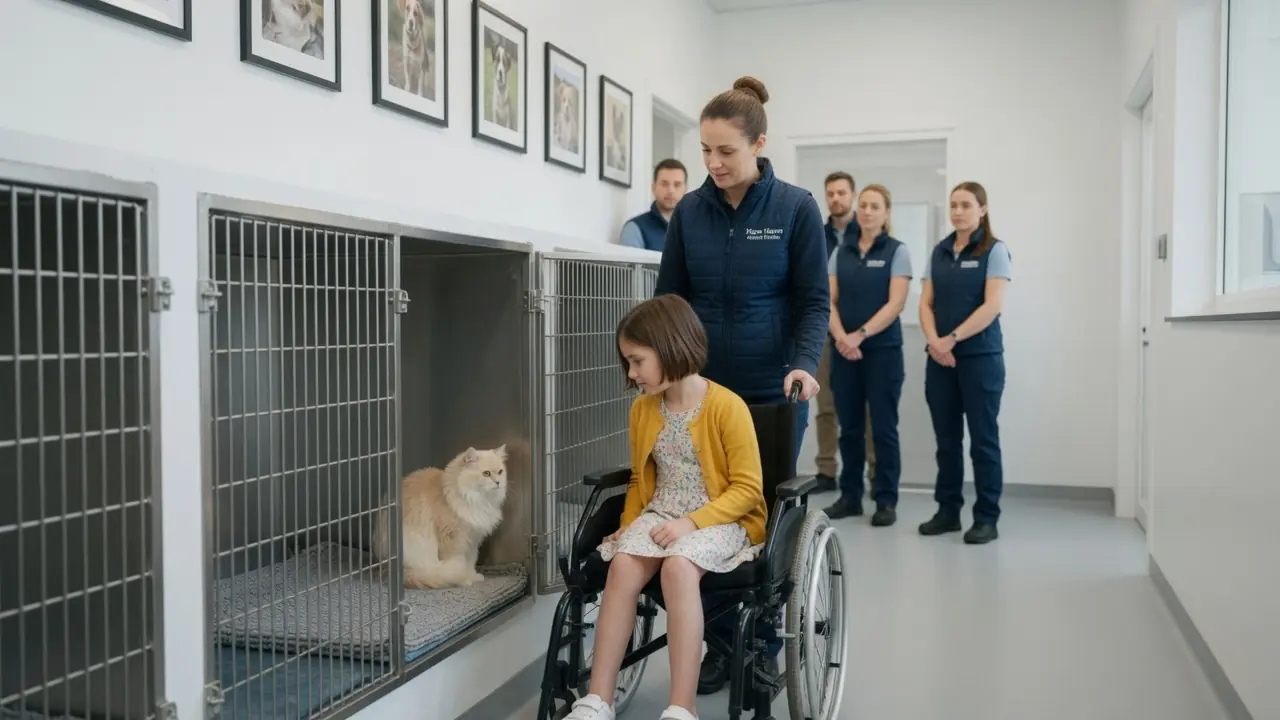
Emma quietly began returning each week with a book. The first time she stopped at Luna’s kennel, the wheels of her chair slowed without scraping, and the chair settled into place with a steadiness that did not jolt the air. Emma did not announce herself or tap the bars to demand attention. She simply positioned herself where Luna could see her if Luna chose to look, and she opened the book on her lap as if the aisle were a library corner that happened to exist beside a frightened cat.
Emma’s presence did not fill the space the way groups did when excitement bounced off the walls. She arrived with one adult nearby at a respectful distance, not hovering, not rushing the moment into a lesson. Emma read in a voice that stayed level, not performing for an audience, not raising her tone to coax a reaction. The words moved forward page by page, and the sound became a thin bridge laid down carefully from the human world into Luna’s corner.
She never forced anything, only stayed, read, and waited. Emma’s hands remained on the book and on her lap, never thrust between the bars, never wiggling fingers in the impatient gesture that treated trust like a trick to be unlocked. When Luna flinched at a sudden noise farther down the hall, Emma did not lean closer to “help.” She kept reading, or she paused and breathed, letting the flinch pass without turning it into failure. Waiting was not passive for Emma; it was the work she had decided to do, week after week, without requiring Luna to pay upfront for companionship.
The shelter staff noticed the pattern before they named it. On certain afternoons, Emma’s chair turned the corner at nearly the same time, and the aisle acquired a small pocket of calm around Luna’s enclosure. Volunteers began to route noisy tours a little wider when they could, not to hide Luna away, but to protect the fragile thread Emma was weaving with patience. No one promised Emma that Luna would ever come forward, and Emma did not ask for promises. She asked only for permission to return, and permission was granted because her method cost the cat nothing.
Slowly, something between them began to change without a single touch being demanded. Luna still hid on days when the building felt too sharp, and she still pressed herself behind the cardboard box that shielded her like a second wall. Yet on Emma’s days, Luna’s posture shifted in increments too small for a casual visitor to measure. Her ears tipped forward before she caught herself and tucked them back. Her eyes stayed on Emma’s face longer than they stayed on any other person who passed.
One week Luna crept closer to the front of the kennel by the length of a single paw, then retreated when a door slammed. The next week she held that ground for an entire chapter, tail wrapped tight, body still braced, but present in a way she had not been present before. Emma did not celebrate out loud when Luna came nearer, because celebration can feel like pressure masquerading as joy. She turned the page softly and kept her voice low, honoring the rule that closeness must remain Luna’s choice.
Month after month, the change accumulated in silence. The shelter’s adoption boards refreshed with names that found homes, and new cats arrived with confused eyes and temporary hope. Luna watched those cycles from her corner and learned again that leaving was possible for others, while she remained behind the bars that both protected and confined her. Emma’s weekly visits did not erase that reality, but they altered the air inside Luna’s kennel, replacing the expectation of passing footsteps with the expectation of one steady return.
Emma brought different books over time, not as a strategy to “entice,” but as the natural rhythm of a reader living her own life while sharing sound. Sometimes she read fiction with bright covers; sometimes she read homework passages with careful pronunciation; sometimes she read a page and then rested the book closed while she simply sat. Sitting was the part Luna learned to trust most, because sitting did not reach, did not grab, did not insist that fear be gone before it was ready to loosen.
Luna began to appear at the front of the enclosure when Emma approached, not always, but often enough that volunteers exchanged glances that carried hope without daring to shout it. She still startled when keys jingled or when a clipboard appeared suddenly in the aisle. She still hated the sharp opening of nearby kennel doors. Yet when Emma’s chair rounded the corner, Luna’s body language carried a new question: is it safe to be seen today, if you are the one seeing me.
The staff had conversations in offices and at the kennel door about what Luna could tolerate, always with the same caution that governed every shy animal. Do not gamble trust for a photo. Do not teach her that closeness ends in capture. Do not rush a first touch because the calendar says adoption season is busy. Emma’s mother listened to the guidance and Emma listened too, because Emma understood something many adults forgot: Luna had been brave in her own language every time she stepped forward an inch.
Emma never asked Luna to perform affection for strangers. When other visitors paused and tried to call Luna forward with clicking sounds, Emma did not explain herself loudly; she simply continued reading, making her side of the bars a refuge from performance. Luna learned the difference between eyes that wanted a moment to post and eyes that wanted a life to share. That difference mattered more than any treat tossed into a kennel, because treats could be eaten and forgotten, but consistency rewired fear at a deeper level.
There were weeks Emma could not come. Appointments, weather, the ordinary disruptions that break routines even when the heart does not want them broken. Luna’s behavior tightened on those missed weeks, and when Emma returned, the first chapters felt like relearning a song. Emma did not scold Luna for retreating. She did not say, “But I came back before, so you should know.” She came back again anyway, and the song resumed where it had paused, not where outsiders wished it would restart.
The shelter labeled Luna shy on paperwork, and shy became a word that followed her like a shadow. Shy explained why families passed. Shy explained why Luna’s photo did not glow on the website the way more outgoing cats’ photos did. Emma never argued with the label in the aisle, but her weekly presence argued in action: shy is not the same as unwilling, shy is not the same as unlovable, shy is sometimes a long road that only patience can walk. Luna could not read paperwork, yet she lived the truth of it in her body, inch by inch.
As the year neared its mark, staff began to discuss whether Luna might accept a controlled meeting outside the bars, not to force adoption, but to learn what she could tolerate without breaking the bond that had taken months to build. The discussions were careful, layered with protocol and with respect for Emma’s role in Luna’s progress. Emma did not treat the meeting like a prize she had earned. She treated it like a door that should open only when Luna stood near it on her own side, choosing proximity again and again until proximity became language.
And the day the kennel door opened, everything they had built in silence finally became real. The decision was not made for the crowd and not made for a deadline. It was made because Luna had been meeting Emma at the front of the enclosure for long enough that the staff believed the next step could be offered without betrayal. The aisle felt different that afternoon, narrowed by attention that tried to be gentle, held by people who knew how easily a frightened cat could lose everything in one wrong motion.
Emma’s chair waited at a distance that honored Luna’s last boundaries, and Emma’s hands stayed visible and still. The door latch clicked, not slammed, and the opening was slow enough that Luna could retreat if she needed to. Luna did not bolt to the back corner. She stood at the threshold of the open door, fur lifted slightly along her spine, eyes wide, breath quick, but feet planted in a choice that stunned the people who had written her off as unreachable.
No one reached to scoop her up. No one called her name in the bright singsong that turns animals into props. Emma read one more sentence softly, then closed the book and let silence become an invitation rather than a command. Luna stepped down, one paw, then another, crossing the line that had separated weeks of reading from the moment touch became possible without being demanded. She moved toward Emma with the deliberate care of an animal that had decided where safety might live, not for a minute, but for longer than a minute.
When Luna climbed onto Emma’s lap, the room held its breath in the way rooms do when they witness something that should not be rushed and was not rushed, and therefore arrived intact. Luna settled against Emma with the weight of a cat that had chosen contact after a year of refusing it, and her purr began as a vibration more felt than heard. The sound grew stronger, not performative, not for applause, but because her body had finally found a place where purring made sense again. It was the first purr since arriving at the shelter, and it changed the meaning of every week Emma had spent reading into the air.
People cried quietly, not the sharp crying of shock, but the soft kind that comes when you see patience turn into proof. Volunteers pressed their lips together to keep from cheering, because cheering would have been for humans, not for Luna. Emma’s hands rested where Luna could feel steady warmth without being trapped, and her face held a calm that did not try to own the moment. The book remained closed on her lap, because this chapter was not on paper; it was written in fur, breath, and the slow undoing of fear.
Neither of them was the same again, though the change did not look like instant transformation from the outside. Luna still startled at loud noises, and she still needed corners when the world felt too wide. Emma still moved through the building in her chair with the same steady competence she had always carried, but she carried something new in her posture: the knowledge that showing up can rewrite a story everyone assumed was finished. They had met in the only way that worked for Luna, with respect first and closeness later, and that order made the open door possible.
In the days that followed, staff and family moved through the ordinary steps that turn a meeting into a future, always watching Luna for signs that trust would hold beyond the first lap. Luna ate with more calm in the room where Emma sat nearby. She groomed in view of people instead of only at night when the building dimmed. She looked toward the door when Emma approached, not away, and each sign was another sentence in the story Emma had been reading all along: you are not stuck in the back forever; someone can sit beside you long enough for the world to change shape.
The shelter’s narrative about Luna shifted in small, practical ways. People paused longer at her enclosure, not to pressure her, but to understand her. A note appeared asking for calm adopters, not as a warning label, but as a request for the kind of patience Emma had modeled without preaching. Luna was no longer only “the cat in the back,” hidden behind a box and a year of silence. She had become a cat who could choose, and choice was the miracle the public could not see until the kennel door opened.
Emma’s weekly books continued even after the first meeting, because trust is not a switch that stays on once flipped. Some afternoons Luna sat on Emma’s lap inside the meeting room; some afternoons she stayed near the chair without climbing, testing the air again and again. Emma never forced a repeat performance for visitors who wanted to see the purr recreated on command. She kept the rule that had carried them from the beginning: no touch demanded, no affection extracted, only space shared until Luna offered what she could offer.
The first purr had been a breakthrough, but the real work remained in the ordinary days after. Luna learned that Emma’s lap did not trap her, that Emma’s hands did not seize, that leaving was allowed and returning was still allowed. Emma learned that trust built in silence could be stronger than trust chased with treats and noise. She learned that a frightened animal can teach a human how to be gentle without being helpless, and how to be patient without being passive.
Families still walked the aisles, and other animals still waited for their turns. The shelter still operated under the pressure of limited space and constant need. Yet Luna’s story stopped being a closed loop of hiding and passing footsteps. It became a path measured in chapters and weekly returns, in a girl who did not reach through bars and a cat who finally walked through a door on her own feet. The investigation of fear did not end in one afternoon; it continued in small confirmations, but the confirmations were enough to change what “possible” meant.
When people retold the moment in the hallway, they spoke about silence more than speech. They spoke about a girl in a wheelchair who read as if sound could be shelter, and about a cat who listened before she believed. They spoke about months that looked like nothing was happening until everything was happening. The story traveled through the building not as gossip, but as a reminder that adoption is not always a hand through the bars and a quick lift into arms.
Sometimes adoption is a book read week after week, a chair parked in the same place, a boundary honored until the boundary is no longer needed. Luna had arrived with no purr, carrying only the habit of retreat and the conviction that no one would ever be safe. Emma arrived with no demand, carrying time and stories and the willingness to sit where she was invited to sit, which was on the outside of the bars until Luna opened the door from within.
Together they rewrote the ending people had assumed. Not the loud ending of instant affection, but the true ending of trust earned in inches and protected in silence. Luna was not “fixed” into a different cat; she was allowed to become herself again, the self that purrs when fear is not the only ruler in the room. Emma was not turned into a symbol; she remained a child who chose consistency over spectacle, and whose consistency became a kind of strength adults often underestimate.
The staff who had cared for Luna through the long year felt the change in their own bodies, a loosening of the dread that shy animals would age into permanent residents not because they lacked value, but because the world rushed past what required slow seeing. Emma did not lecture them about patience; she demonstrated it, and demonstration entered the culture of the aisle in subtle ways. People spoke more softly near Luna’s enclosure. People stopped tapping glass. People began to ask what a cat needed, not only what a cat could give immediately.
Luna’s purr on Emma’s lap became a reference point in conversations about fear-based behavior, not as a fairy tale, but as a case with a timeline. Nearly a year hiding. Weekly visits. No forced touch. Gradual approach. Open door. Choice. Purr. The list was simple, but executing it required the kind of discipline that does not fit neatly on a poster. Emma had executed it without fanfare, and Luna had responded in the only currency that mattered to her: voluntary closeness.
Emma’s mother watched the bond grow with gratitude mixed with protective caution, because love for a child includes wanting the child’s heart protected too. She did not try to turn Luna into a lesson assigned for school. She did not film the first meeting as if it were content. She let the shelter professionals guide health checks and adoption steps, and she let Emma’s relationship with Luna remain what it had always been: honest, unforced, and rooted in respect for a cat who had every reason to doubt. When paperwork eventually moved forward, it moved with the same quiet steadiness Emma had brought to the kennel aisle.
Luna’s body learned new associations in the meeting room: the scent of Emma’s jacket, the sound of pages turning, the low hum of a voice that did not lie about staying. Fear still visited, because fear is not evicted in one day, but fear no longer owned every minute. Luna could sit on a lap and still scan the room, and that scanning was not betrayal of trust; it was the reality of a cat who had survived by watching. Emma accepted the scanning without taking it personally, and that acceptance kept Luna from needing to choose between vigilance and affection.
The day the kennel door opened did not erase Luna’s history. It reframed it. The year in the back corner became evidence of endurance, not defect. The visitors who passed became part of the background that made Emma’s return stand out as different. The silence they built became the foundation that held weight when the door finally opened. Everything they had built in silence became real in the purr, in the chosen lap, in the open door that stayed open without chasing Luna when she stepped away.
In the weeks that followed, Luna practiced trust the way animals practice everything: repetition, retreat, return, repeat. Some days she greeted Emma at the enclosure front with a calm face that would have been unimaginable months earlier. Some days she hesitated and watched from a middle distance, and Emma read anyway, letting the hesitation exist without punishment. The shelter learned to measure progress not only by the dramatic first purr, but by the smaller victories: eating with someone nearby, grooming in daylight, walking toward instead of away.
Emma practiced her own kind of courage, the kind that does not look like running into danger but like returning when progress is invisible. She practiced believing that sitting still could be powerful. She practiced not forcing her own longing for contact onto a creature that had been convinced no one would ever be safe. Her wheelchair remained part of her life as it always had, but the bond with Luna added a new chapter to what that life could mean: not limitation defined by barriers, but connection built across barriers without breaking them down violently.
When Luna finally left the shelter in Emma’s care, the transition was planned with the same care as the first open door. Familiar blanket, familiar book voice, familiar chair nearby, and no flood of strangers pressing in. Luna’s first night in a home carried the ordinary sounds of a refrigerator and distant traffic, and she startled, then located Emma’s calm, then ate, then hid under a bed, then emerged again. Trust did not end at adoption; it entered a new room where fear had to relearn the shape of safety.
Neither of them was the same again because both had been seen in the way that mattered. Luna was seen as more than the cat who hid, more than the cat people passed, more than the year-long silence interpreted as refusal. Emma was seen as more than the girl in the chair, more than a visitor, more than a child adults might underestimate when they confuse quiet with fragility. What grew between them was a bond that stayed gentle even when it became strong, a bond that proved safety could be rebuilt without being demanded at the point of touch.
Luna still had nights where old reflexes pulled her into corners. Emma still had days where the world felt impatient with slow stories. On those days they returned to the method that had saved them: stay, read, wait, let choice lead. The book could be open or closed, but the presence remained steady. Over time, corners became shorter visits rather than permanent addresses. Waiting became less necessary, not because fear vanished, but because fear learned a new endpoint: Emma’s lap, Emma’s voice, Emma’s predictable return.
The shelter remembered them not as a single viral moment, but as a timeline that staff could point to when new volunteers wanted instant results. Nearly a year. Weekly visits. No forced touch. Slow approach. Open door. Purr. Real. The words became a quiet curriculum written by a child and a cat who never performed for applause. Other shy animals benefited indirectly as people adjusted how they stood, how they spoke, how long they were willing to remain present without asking for payment in affection.
Emma grew older in the ordinary way children do, collecting new interests and responsibilities, but she kept the habit of reading aloud when Luna settled near her. Luna grew older too, settling into a home rhythm where the sound of pages meant safety the way the sound of a latch once meant danger. Their story did not promise that every frightened cat would purr on schedule, or that every patient child would be answered with trust. It promised something narrower and more durable: that silence can be shared work, and that doors can open from the inside when no one tries to kick them down.
If someone asked what changed overnight, the honest answer was nothing. The change was everything accumulated across months that looked empty from the outside. The change was Emma returning with a book when every visitor passed. The change was Luna creeping forward without a hand demanding she arrive faster. The change was the shelter learning to protect a fragile thread instead of cutting it for convenience. The change was the day the kennel door opened and Luna walked through it because she wanted to, not because she was grabbed.
And when Luna climbed onto Emma’s lap and purred for the first time since arriving at the shelter, the sound was not an ending. It was a beginning dressed in the same quiet they had practiced. Everything they had built in silence finally became real in contact that was offered, not extracted. Neither of them was the same again, because both had crossed a line together: Luna from convinced unsafety toward chosen closeness, Emma from steady waiting toward proof that waiting can save a life’s softness. The shy shelter cat and the girl in the wheelchair remained linked by the one thing that never lied to them—patience that stayed when fear insisted everyone would leave.