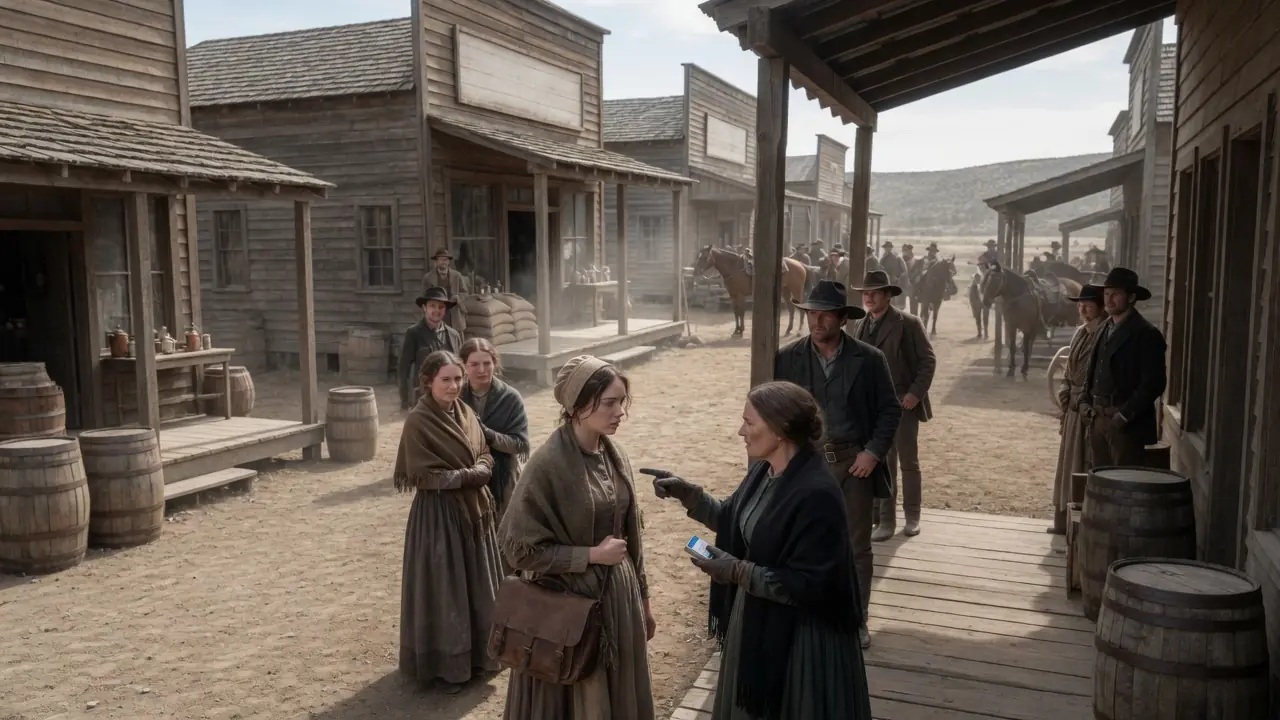
The morning Molly Bennett was called a fraud, the whole town seemed to have gathered just to hear it. Main Street was cold, the kind of cold that made people pull shawls tighter and stamp their boots against the boardwalk while pretending they had stopped for business. The feed store doors stood open, sacks of grain were stacked beside the entrance, and horses shifted at the rail while their breath steamed faintly in the air. Molly stood in the road with her leather satchel at her side, still as a fence post in winter.
Martha Pike stood in front of her, waving a small remedy tin like it was proof of a crime. Martha had a voice made for church announcements, arguments, and making sure no private shame stayed private for long. She shook the tin under Molly’s face and told everyone that her nephew had coughed through the night after taking what Molly had given him. Then she said a woman traveling alone with a bag of herbs and bottles was not a healer, but something far less respectable.
Some people laughed. Not everyone, but enough for the sound to make Molly’s hands tighten on the strap of her satchel. She was twenty-five years old, young enough that the town thought it could embarrass her, but old enough to have stood in streets like this before. Her face did not change, and that made Martha angrier.
“You call this healing?” Martha snapped, holding the tin higher. “My nephew coughed all night, and you still took my money like some road-worn fraud.” Molly looked at her calmly, though the words landed hard. “I gave you what would ease him,” she said. “Not a miracle in a tin.”
A few men near the feed store chuckled at that, though not kindly. Martha stepped closer, one gloved finger jabbing toward Molly’s chest. “You hear that?” she called to the gathering crowd. “She admits it does not cure a thing, yet she takes coin from decent folks.”
Frank Harlan leaned against the feed store post and watched. He was thirty-nine, a rancher, a widower, and not a man who stepped into other people’s noise without cause. His horse was tied nearby, one hoof resting light on the cold dirt, while Frank’s dark hat cast a shadow over eyes that had grown used to measuring trouble. He watched Molly’s stillness and wondered whether the town was mistaking quiet for guilt.
Molly had come through town two days earlier, selling salves, teas, and practical remedies from a satchel that looked older than she was. She had not pushed herself on anyone. She had set up near the pump, answered questions plainly, and charged less than the doctor did when the doctor bothered to pass through at all. Most people had bought from her because they were curious, desperate, or both.
Martha’s nephew had a winter cough, sharp and stubborn. Molly had told Martha he needed rest, steam, warm drink, and patience, then gave her a tin of herb mixture meant to settle the chest and help him sleep. Martha had nodded then, but now she stood on Main Street acting as if Molly had promised to summon heaven itself. That kind of anger was not about medicine alone, and Frank knew it.
Molly knew it too. A woman traveling alone made people uncomfortable because they did not know where to place her. If she was poor, they called her helpless. If she was skilled, they called her suspicious. If she did not apologize for either, they called her dangerous.
Martha raised her voice again. “If this town has any sense, it will run her out before some poor fool trusts her with something serious.” Molly lowered her gaze for a moment, not in defeat, but to steady herself. She had learned long ago that arguing with a crowd often fed the thing you wanted to starve. So she said nothing.
Frank shifted slightly against the post. His jaw tightened when Martha jabbed her finger again, close enough now that Molly had to lean back by an inch. He still had not stepped forward, but the line was drawing itself in his mind. He had seen cruelty dressed as righteousness before, and it always wore the same expression Martha wore now.
Then someone shouted from the direction of the mill. The sound cut through the laughter and pulled every head around. Two men came fast down the street, carrying Charlie Webb between them, a fourteen-year-old mill boy whose hand was wrapped tight in a feed sack. His face was pale, and the men carrying him looked more frightened than he did.
“Doctor!” one of them shouted. “Where is Dr. Henry?” A man near the livery answered that Dr. Henry was three weeks out on his circuit and not due back before the first snow. That news passed through the street like a door closing. The crowd that had been so loud a moment earlier became suddenly useless.
Charlie’s father had a bad back, so Charlie worked the mill before he was old enough to have a man’s strength or a boy’s freedom. He stared at the sky with wide eyes, quiet in a way that made people uneasy. Nobody knew what to do, but everyone knew enough to be afraid. Martha stepped back, her remedy tin lowering slowly to her side.
Frank left the porch. He looked at the boy, then at Molly. “Can you help him?” he asked. It was more than a question. It was a test, an invitation, and a decision all at once.
Molly was already opening her satchel. “Lay him on a table,” she said, her voice clear. “Inside the feed store. I need clean water, strong light, cloth, and someone steady enough to hold his arm.” Men who had mocked her moments earlier began moving because authority sometimes arrives without shouting. Frank took Charlie’s arm when she looked at him and nodded.
They cleared the big table inside the feed store. Grain dust floated in the light from the front windows while townspeople gathered at the doorway and pressed their faces near the glass. Molly rolled up her sleeves, washed her hands, and arranged her instruments in a clean line on a folded cloth. Every movement was exact.
Frank held Charlie’s arm steady and placed his other hand on the boy’s shoulder. “Look at me,” he told him. “Not at your hand. At me.” Charlie obeyed, breathing hard. Frank did not look away, and neither did Molly.
Molly worked with calm that unsettled the room. She cleaned, examined, and handled the boy’s hurt hand with the focus of someone who had done difficult work under worse conditions. She did not explain herself to the spectators. She spoke only to Charlie, Frank, and the task in front of her.
The people at the door grew quiet. Even Martha stopped whispering. The town had expected panic, guessing, maybe failure, but what they saw instead was skill. Molly’s hands were not delicate in the useless way some people praised women for being; they were capable, disciplined, and sure.
Frank watched those hands despite himself. He noticed how she chose each tool without looking twice, how she asked for more light before anyone else realized the lamp had shifted, how she told Charlie when to breathe and when to hold still. The boy listened because her voice gave him something to hold onto. It was the same kind of steadiness Frank had once loved in his late wife Margaret, though the thought came and went before he allowed himself to linger on it.
When Molly finished, Charlie’s hand was wrapped firm and clean. “You will use it again,” she told him. “Not all at once, not soon, and not without care, but you will use it.” Charlie’s eyes filled, but he did not cry because he was fourteen and the whole town was watching. Frank squeezed his shoulder once and let go.
The men carried Charlie home more gently than they had carried him in. Someone murmured thanks, though not loudly enough to count as courage. Martha slipped away before anyone could ask whether she still thought Molly was a fraud. The street outside had changed, but not enough to become kind.
Molly repacked her satchel in the same careful order she always used. Each bottle, cloth, needle, tin, and notebook went back into its place. Frank watched her close the leather flap and buckle it. Then he looked through the feed store window at the town pretending it had not just been wrong.
“The boarding house is full,” he said. Molly looked up. “The freight wagons are delayed, and half the rooms are taken by men waiting them out.” He said it plainly, not as an apology, just as a fact. “My ranch is two miles out. I have a back room off the kitchen with a cot and stove. You are welcome to it until the doctor comes through.”
Molly studied him. “People will talk.” Frank picked up his hat from the table. “People already talk.” He looked toward the street where Martha had stood. “I do not care what they think.”
That should have ended the matter, but Molly had learned not to accept kindness too quickly. “Why?” she asked. Frank understood the question. It was the same question people ask when they have survived too many offers with hooks hidden inside them. “Because you helped that boy,” he said. “And because no decent town should leave a woman with your skill standing in the cold after using what you know.”
She accepted with a small nod. They rode because Frank had his horse tied at the rail. He brought it around, helped her up without making a show of it, and climbed into the saddle in front. Molly settled behind him with her satchel across her lap, keeping space between them where she could. The town watched from windows and doorways, already making stories.
The road to Frank’s ranch cut through brown winter pasture and low hills. The light was fading, pulling color from the grass and leaving the land sharp and gray. Neither of them spoke much. Molly had spent years traveling with silence and knew when silence was kinder than questions.
The back room was small but clean. It smelled faintly of wood, old flour, and cold iron from the little stove. There was a cot, a narrow window facing the fence line, a table, and an outside door that gave the room privacy. Frank built the fire while Molly set her satchel beside the cot.
“You can come and go as you please,” he said. “Kitchen is through that door. Coffee is usually on before first light.” Molly nodded. She had expected conditions, rules, or some reminder that charity came with a price. Frank gave none.
The next morning, the first visitor came before breakfast. Old Mr. Ellery arrived with a chest that rattled when he breathed and pride too thin to hide his fear. Molly listened with her ear near his back, her eyes closed, her face still. Then she gave him instructions, herbs, and a way to sleep sitting up so his breathing would ease.
By the end of the week, more people came. Mothers with coughing babies. Men with stiff hands. Women with fevers that needed watching. Molly treated each case without ceremony, and Frank noticed that people came to her for help but rarely asked about her life. They wanted what she could do, not who she was.
Frank began to learn who she was anyway. He saw how she rose before dawn, how she cleaned every instrument twice, how she wrote notes after every visit, and how she ate only after making sure no one else needed anything. He noticed the way she kept her satchel near the door, as if part of her expected to be asked to leave at any moment. He did not comment, but he noticed.
After two weeks, the house found a rhythm around her presence. Frank worked the stock before sunrise, and Molly often had coffee ready when he came back in. Sometimes they ate in silence. Sometimes he spoke about fence lines, and she spoke about fevers clearing or children sleeping through the night.
One morning, Frank found her standing at the window with a cup in both hands, looking at frost on the fence posts. “You sleep all right?” he asked. Molly considered the question honestly. “Better than I have in a while,” she said. Frank nodded and looked down at his plate, but something in him held onto that answer.
The town warmed to her slowly, in the selfish way towns often do. When Dr. Henry sent word that he had taken a post east of the mountains and would not return to the circuit, people stopped discussing whether Molly belonged and started asking when she would come by. Need has a way of editing judgment. A person who was suspicious on Monday can become necessary by Friday.
Martha remained the last holdout. She kept her lips tight when Molly passed and muttered just loudly enough for others to hear. Then one night, Martha’s nephew took a hard turn, his breathing sharp enough to frighten even her. Pride brought her halfway to Frank’s ranch. Fear brought her the rest.
Molly opened the outside door and saw Martha standing there with the boy wrapped in a blanket. No apology came. None was needed for the moment. Molly took the child inside, worked until his breathing eased, and sent them home before dawn with instructions Martha followed exactly.
After that, Martha stopped speaking against her. It was not an apology, but in that town it carried nearly as far. Molly accepted it without comment. Frank noticed that too.
Weeks passed into the deeper part of winter. Molly was called out at night more often, and Frank began riding with her without announcing he had decided to do so. The first time, she came out with her satchel and found his horse already saddled. She looked at him, then put her foot in the stirrup. After that, it became their way.
He waited outside cabins in the cold while she worked inside. Sometimes he heard babies crying, women praying, men pacing, and Molly’s low steady voice moving through it all like a lamp in a dark room. When she came out tired, he helped her mount and rode home without asking for details unless she offered them. This was not because he did not care. It was because he understood that carrying other people’s pain required somewhere quiet to set it down.
One evening, after a difficult birth kept Molly away for nearly two nights, she came home gray with exhaustion. Frank had coffee waiting and a plate kept warm near the stove. She sat in the chair closest to the fire and closed her eyes before touching either. He sat in the other chair and worked a piece of leather in silence.
The fire burned low. The wind pressed against the windows. Molly’s head slowly tilted until it came to rest against Frank’s shoulder. He went perfectly still, not because he was uncomfortable, but because he understood the trust of it.
He sat that way for a long time. The leather lay forgotten on the arm of the chair. When Molly’s breathing deepened, he carefully reached for a blanket and settled it over her without waking her. In sleep, her face released its watchfulness, and Frank felt something in his chest ache with recognition.
He had been alone since Margaret died. Not only unmarried, not only widowed, but inwardly alone in a house that kept reminding him where a woman’s presence had once been. Molly had not replaced that. She had done something different, something quieter and more dangerous. She had made the house feel alive again.
Molly woke late with the blanket around her and the fire tended. Frank had already gone out before dawn. She sat there for a long while, touching the edge of the blanket. It had been years since anyone had cared for her without needing something in return.
The winter festival came after the last local herd was brought down from high pasture. Lanterns were strung between posts in the square, fiddle music rose into the cold air, and tables were filled with food people had saved carefully for the celebration. Molly went because Frank was going. She wore her better dress and stood near the edge of the lamplight, present without insisting on being seen.
Frank came to stand beside her. The fiddle slowed, and people began pairing off. He looked down at her and said, “Dance with me.” Molly glanced at the square, at the faces already turning toward them. Then she handed him her cup.
He set both cups on the table and offered his hand. She took it. They stepped into the lantern light, and the town watched with the kind of silence that pretended not to be attention. Frank was not graceful, but he was steady, and Molly found that steady mattered more.
His hand rested at her waist, careful and certain. He did not look at the crowd. He looked at her. Molly felt the whole town blur at the edges until there was only the fiddle, the cold, the lamplight, and Frank’s eyes holding hers as if she had never been invisible to him.
When the song ended, neither stepped back right away. Another tune began, livelier, but Frank leaned closer and said, “Walk with me.” They left the square and moved toward the quiet end of the street, where the music became distant and the cold off the ridge felt clean. Frank stopped near the blacksmith shop and looked out at the dark road.
He was arranging words. Molly could see that. He was a careful man, and careful men did not toss important things into the air. They placed them where they meant them to stay.
“The town knows what you are now,” he said. “They need what you do.” He paused. “I need what you do too, but not the medicine.” Molly stood very still. Frank turned toward her fully. “I mean the rest of it.”
Her throat tightened. She thought of coffee left without comment, fires built before dawn, the horse waiting outside every night call, and the spare room that had become less like shelter and more like belonging. She thought of the first time he asked where she had learned her work, the first time anyone had wanted to know something about her beyond what sat in her satchel. She did not move.
“I am asking you to stay,” Frank said. “Permanent. As my wife, if that is what you want.” He looked at her steadily. “Not because it is practical. I want that clear.” It was clear.
Molly’s hand found his at his side. She placed her fingers against his, warm in the cold. “Yes,” she said. “That is what I want.” Frank closed his hand around hers, and for a while they did not go back to the music.
They were married three weeks later on the church steps. The sky was pewter, and a pine bough had been tied over the door because Christmas was close. The minister kept the ceremony brief because Frank had asked him to. More people came than either of them expected.
Charlie Webb was there with his hand lightly wrapped and healing well. He held the door with his good arm and stood proudly as if his presence meant something, because it did. Martha came too, standing near the back with her nephew beside her. She did not apologize, but she looked Molly in the eye, and for Martha that was almost a confession.
Molly carried her satchel to the church steps. At the threshold, she set it down and walked inside without it. The people who saw understood enough to say nothing. For once, the town received her silence properly.
After the vows, Frank’s hand rested at the small of her back, not gripping, only present. They walked home in the early dark along the same road they had taken the first evening. The cold was the same cold, and the fields were the same fields, but Molly was not the same woman who had ridden behind him with nowhere to sleep. She had a home now, and more than that, she had been chosen openly.
By spring, Frank built a small room on Main Street for Molly’s work. It had a proper door, shelves, a table, a clean stove, and a hook by the entrance where her satchel hung when not in use. People came through that door with coughs, fevers, bruised pride, fear, gratitude, and sometimes shame. Molly treated all of them as if the past did not need to be used as a weapon.
Frank kept working the ranch. Molly kept working the town. Some evenings they met in the kitchen with supper between them and wind at the windows, speaking of small things that were not small at all. A fence repaired. A child’s breathing eased. Coffee for morning.
The woman they had called a fraud became the woman they sent for when fear entered the house. The rancher who had offered a spare room became the man who stood beside her in front of the whole town. And the town, which had once laughed at her shame, learned slowly that being useful was not the same as being known, and being known was not the same as being loved.
Frank had given Molly shelter, but not as charity. He had given her room to stand without lowering her head. Molly had brought healing to the town, but not only through medicine. She had taught them that quiet people are not empty, and that a woman carrying a satchel down a lonely road might hold more strength than all the voices raised against her.
Years later, people still told the story of the morning Martha shamed Molly on Main Street. Some remembered the shouting. Some remembered Charlie being carried in from the mill. But Molly remembered something else most clearly.
A man leaning against a feed store post.
A steady voice asking if she could help.
And later, when the town still whispered, that same man saying he had a spare room and did not care what they thought.
That was where her life changed, not because someone rescued her from shame, but because someone looked through it and saw her clearly on the other side.