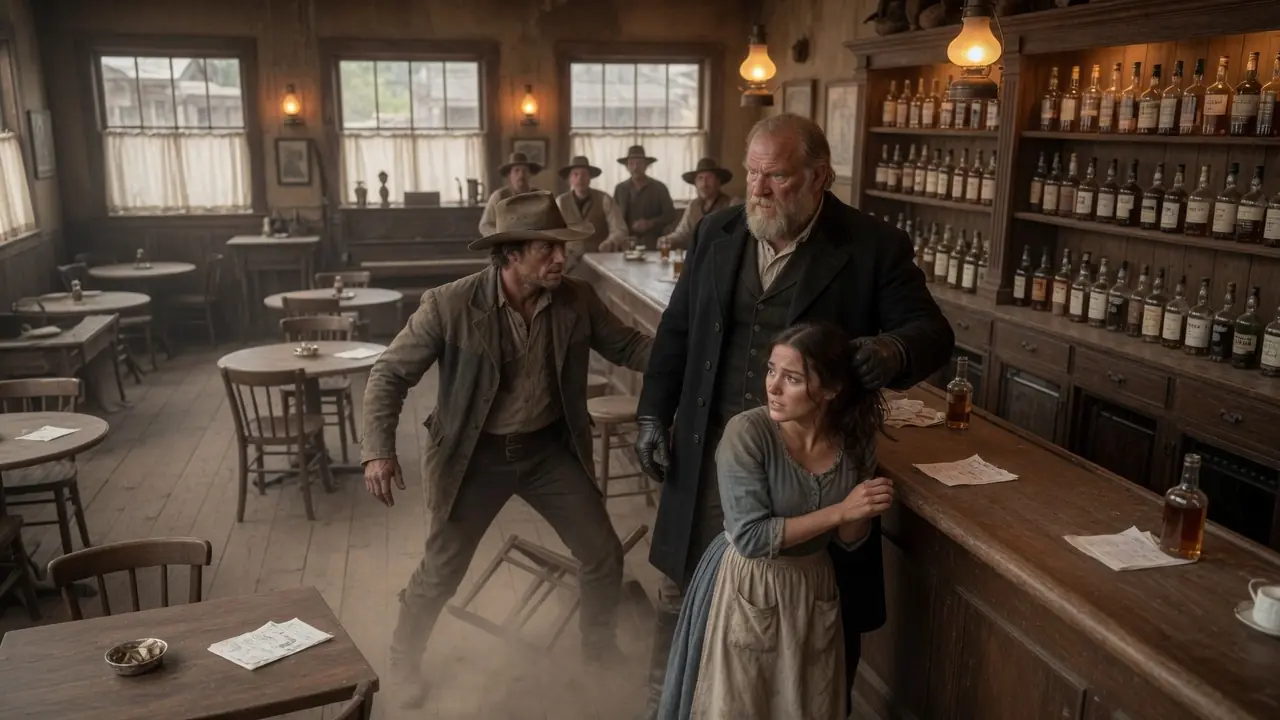
The night Cole Harrison saved Emma Hartley, the Red Canyon Saloon had already gone quiet before anyone understood why. One moment the room was filled with card games, whiskey glasses, boots scraping on wooden floors, and the thin tired sound of the piano in the corner. The next moment, every voice seemed to die under the weight of Vernon McCrae’s shadow. He stood near the bar like a mountain in a black coat, one massive hand tangled in Emma’s loosened dark hair, the other resting beside a folded debt paper that had ruled her life for three years.
Emma did not scream. She wanted to, but pride kept her mouth closed and her chin lifted. Her hands trembled against her white apron, and her green eyes shone with fear, anger, and a stubborn refusal that had survived too many nights behind that saloon bar. Vernon leaned over her, broad shoulders blocking the lamplight, his pale gray eyes cold with the certainty of a man who had never once been told no without making someone suffer for it.
“That paper says you belong to me, Miss Hartley,” Vernon said, his voice low enough that only the front half of the saloon heard him clearly. “Your father owed me, your mother paid me, and now you will answer for what remains.” His gloved fingers tightened just enough to force her to look up, but Emma still did not bow her head. She stared at him with tears trapped behind her eyes and whispered, “No paper can make me yours.”
That was when the chair in the far corner fell backward. The sound cracked through the silence like a warning. Cole Harrison came forward from the dim edge of the room, moving fast, his dust-colored coat swinging behind him and his eyes fixed only on Vernon’s hand. He was not shouting, not waving a weapon, not trying to impress the room; he was simply crossing the saloon with the dangerous purpose of a man who had decided there would be no second warning.
“Take your hand off her,” Cole said. His voice was calm, but every man in the room felt the iron inside it. Vernon turned his head, surprised more than afraid, and Emma saw Cole clearly for the first time since he had arrived in Dusty Springs. He was tall, weathered, hard from the trail, and yet the way he looked at her was not rough at all; it was steady, careful, and strangely gentle.
Vernon gave a cruel little laugh. “You just made yourself part of a private matter, cowboy.” Cole stepped closer, never taking his eyes off Vernon. “A woman being handled like property stops being private the moment the room can see it.” The saloon held its breath while Emma felt the pressure on her hair loosen by the smallest degree.
Vernon’s men shifted near the tables, but none of them moved quickly enough. Cole reached the bar, caught Vernon’s wrist with one hand, and forced it away from Emma’s hair in one clean motion that looked easier than it should have. Vernon was bigger, heavier, and richer than any man in that room, but Cole moved like someone who had spent years surviving men who mistook size for strength. Emma stumbled backward, and Cole caught her before her knees gave out.
For one second, she was against him, one hand clutching his coat, her breath shaking against his chest. Cole looked down at her, and the fury in his face softened into something almost tender. “You all right, Miss Hartley?” he asked quietly. Emma tried to answer, but the strength she had held together for too long finally slipped.
“I can walk,” she said, though her voice betrayed her. Cole looked at the way she was shaking and understood without embarrassing her. “I know you can,” he said. “But tonight, you don’t have to.” Then, before Vernon could step forward again, Cole lifted Emma carefully into his arms and turned away from the bar as if carrying her out of that saloon was the most natural thing in the world.
The room moved aside for them. Men who had looked away for years now lowered their eyes, ashamed to be seen by the woman they had never protected. Emma’s hand rested lightly against Cole’s shoulder, her face turned toward his as if she still could not believe he was real. Behind them, Vernon’s voice cut through the room like a blade. “This is not finished, Harrison.”
Cole stopped at the swinging doors, Emma still in his arms. He did not turn fully around. “For tonight, it is,” he said. Then he carried her out into the dusty summer street, away from the oil lamps, away from the whiskey stink, away from the false debt paper that still lay on the bar like a lie that had finally been challenged.
Outside, the night air touched Emma’s face and broke whatever spell had held her still. The sky above Dusty Springs was wide and black and full of stars, and for the first time in years, the street beyond the saloon did not look like a place she was trapped inside. Cole carried her down the wooden steps and set her gently on a bench near the hitching rail. His hands left her as soon as he knew she could sit upright, as if even kindness needed permission.
Emma drew in a shaky breath. “You should not have done that.” Cole crouched in front of her, his hat casting a shadow over his eyes. “Probably not,” he said. “But I’ve done worse things for poorer reasons.” That almost made her laugh, and the sound came out broken and breathless.
“He owns half this town,” Emma said. “The ranch, the store, the sheriff, maybe even the judge if he needs him.” Cole glanced toward the saloon doors, where Vernon had not yet followed. “Men like him own what people are too scared to take back.” Emma looked at him then, really looked, and saw not a reckless rescuer but a man who knew fear by name and had simply stopped obeying it.
“My mother’s house is tied to that paper,” she said. “That false debt is the only thing he has over me, and it’s been enough.” Cole stood slowly, his expression changing. “False?” Emma nodded, her hands twisting in her apron. “My father never signed it. I have letters, real ones, with his handwriting, but no lawyer here will stand against Vernon unless I can pay more than he can threaten.”
Cole was quiet for a long moment. The saloon noise rose behind them again, cautious and hollow, as if the building wanted to pretend nothing important had happened. Emma expected him to say he was sorry, or that he could not help further, or that a man passing through should not get tangled in a town’s rot. Instead, he said, “Where are the letters?”
“At my mother’s house,” Emma replied. “Two streets over.” Cole looked toward the dark line of buildings. “Then we get them tonight.” Emma stared at him. “We?”
He looked back at her, and there was no smile in it, no flirtation, no grand heroic promise. Just a steady decision. “If Vernon knows you have proof, he’ll try to take it before morning.” Emma swallowed. “And you know where to take it?” Cole nodded once. “Mil Haven. Territorial judge there owes Vernon nothing and likes forged papers even less.”
The ride began before midnight. Emma changed out of her saloon apron and packed the letters in a small wooden box her mother had kept on a shelf beneath a faded lace cloth. Cole waited outside with two horses from the livery, one gray and one chestnut, both saddled and ready. When Emma stepped into the street with the box held to her chest, she found him watching the dark corners of town instead of watching her, guarding her without making a show of it.
They rode out the back way, past shuttered storefronts and sleeping houses, then into the open country beyond Dusty Springs. Emma had ridden before, but never like this, never with fear behind her and hope ahead of her. Cole kept his horse close enough that she could hear his reins move, but far enough that she did not feel crowded. After a mile, he said, “You’re doing fine.”
Emma laughed softly despite herself. “You say that like I’m not half-ready to fall off.” “Being half-ready isn’t falling,” Cole said. “Out here, that counts.” The words were plain, but they warmed her more than praise would have. She had spent years hearing men tell her what she lacked; Cole seemed to see only what she was still managing to do.
Before dawn, Vernon’s riders appeared behind them like dark marks against the pale horizon. Cole saw them first. He guided Emma off the open trail and through a dry wash where cottonwoods grew twisted along the banks. They waited there in silence while two riders passed above them, never seeing the horses tucked under the ridge. Emma held the letter box against her ribs and tried not to breathe too loudly.
When the riders were gone, Cole turned to her. “You afraid?” he asked. Emma thought about lying, then shook her head. “Yes.” Cole nodded as if that was the only sensible answer. “Good. Fear keeps a person careful. It only wins if it makes the choice for you.”
By the second evening, Emma’s hands ached from the reins and her legs burned from the saddle. She said nothing because she had learned too young that complaining rarely changed the work in front of her. Cole noticed anyway. At a creek crossing, he dismounted, came to her horse, and held out his arms.
“I can get down,” she said. “I know,” he answered. “Let me help anyway.” Something in his tone made it impossible to feel small. Emma let him lift her from the saddle, and for one brief second, his hands were warm at her waist, careful and strong, and her heart beat harder than the ride could explain.
They rested beneath a stand of cottonwoods while the horses drank. Cole gave her water first, then bread, then a strip of dried beef from his saddlebag. He did not speak much, but his silence was not empty. It was the kind of quiet that made room for another person to breathe.
“Why are you helping me?” Emma asked after a while. Cole leaned back against his saddle, eyes on the creek. “Because you asked with the truth in your hands.” Emma looked down at the box of letters. “That is not an answer.” “It is part of one,” he said.
After a long pause, Cole told her about Rebecca. He did not give the whole story, only enough for Emma to understand there had once been a wife, a little daughter, and a farm that should have been safe. There had been papers, too, and a rich man who knew how to turn grief into surrender. Cole’s voice stayed even, but Emma heard the ache beneath it.
“I couldn’t save them,” he said. “Not from the fever, not from the men who took what was left after.” Emma did not reach for him, though she wanted to. Instead, she sat close enough that the silence between them became shared instead of lonely. “You saved me last night,” she said softly.
Cole looked at her then, and the guard in his eyes lowered just a little. “No,” he said. “You had already started saving yourself. I just got there in time to stand beside you.” Emma felt those words settle deeper than any compliment she had ever been given. He did not make her helpless to make himself brave.
They reached Mil Haven at noon the next day, tired, dust-covered, and watched from a distance by one of Vernon’s men. Cole rode straight to the marshal’s office and asked for Judge Alderman by name. The marshal knew him, and the way he opened the door told Emma everything she needed to know about Cole’s reputation. People did not welcome a man like Cole Harrison unless he had earned more trust than he claimed.
Judge Alderman was old, sharp-eyed, and impatient with nonsense. He listened while Emma explained the debt, the forged signature, the payments, the house, and the way Vernon had used the paper to keep her afraid. Then she opened the box and laid out her father’s letters beside the debt document. Her hands trembled, but her voice did not.
The judge studied the papers for a long time. Cole stood near the door, not speaking, only present. Emma watched Alderman compare the signatures, the loops, the slant, the pressure of the ink. When the judge finally removed his spectacles, Emma felt the whole room lean toward him.
“This document will not be used to seize your mother’s house,” Alderman said. Emma closed her eyes. “Not today, not tomorrow, not unless a full investigation proves it valid, and from what I see here, Mr. McCrae has a serious problem.” The words did not sound like celebration. They sounded like ground appearing beneath her feet after years of falling.
Vernon arrived before sunset, furious enough to forget caution. He came with two men and a polished expression that shattered the moment he saw Cole standing beside Emma in the judge’s office. “She is confused,” Vernon said. “She is frightened, and this cowboy has filled her head with foolish ideas.” Emma stood before he finished.
“No,” she said. “I was frightened before. Now I am informed.” Cole looked at her, and for the first time since they met, his mouth almost smiled. Vernon saw it and hated it. “You think this man can protect you forever?”
Emma’s answer came before Cole could speak. “I do not need forever,” she said. “I needed one night to reach the truth.” Judge Alderman tapped the desk with one finger. “And she reached it, Mr. McCrae. Sit down or leave this office.”
Vernon sat because the room was no longer his. Over the next hour, his story weakened under every question. The letters contradicted the debt paper, the dates failed, and one of Vernon’s own former ranch hands arrived with knowledge of other families who had paid debts they never owed. By midnight, Judge Alderman had ordered a hold on all collections and sent the marshal to search Vernon’s records.
Emma did not sleep that night. She sat in a small hotel room with the letter box in her lap, listening to footsteps in the hallway and horses moving outside. Cole sat in the chair by the door, hat low, arms folded, awake because he had promised he would be. At some point, Emma whispered, “You do not have to stay.”
Cole did not open his eyes. “Yes, I do.” She looked at him through the soft lamplight. “Because of Rebecca?” This time, his eyes opened, and he looked at her fully.
“At first,” he admitted. “But not anymore.” Emma’s breath caught. Cole leaned forward, elbows on his knees, his voice low and honest. “I stayed because you looked Vernon McCrae in the face with nothing but a box of letters and said no. I stayed because when you were shaking, you still stood. And I stayed because somewhere between Dusty Springs and here, I started wanting a tomorrow that had you in it.”
Emma did not know what to say. She had been wanted before, but always as something to own, use, pity, or silence. This was different. Cole was not asking her to become smaller so he could feel large; he was offering the possibility of standing beside someone who already knew she could stand alone.
By morning, the marshal returned with Vernon’s strongbox. Inside were more letters, more copied signatures, more proof that Emma’s family had not been the only one trapped by false debt. Vernon McCrae’s empire began to crack not because a gun was drawn, but because paper told the truth louder than power could lie. Judge Alderman ordered Vernon held for fraud and intimidation, and by noon, the news had traveled through Mil Haven like fire through dry grass.
Emma stood on the courthouse steps when they brought Vernon past her. He did not look as large then. His shoulders were still broad, his coat still black, his eyes still cold, but the room he carried around himself had shrunk. He looked at Emma as if trying one last time to make her afraid.
She did not look away. “You took three years from me,” she said. “You will not take another hour.” Vernon opened his mouth, but the marshal moved him along before he could answer. Cole stood a step behind Emma, close enough to catch her if she faltered, far enough to let the victory belong to her.
That afternoon, Judge Alderman gave her the order in writing. Her mother’s house was protected. Her payments would be returned once the court finished tracing Vernon’s accounts. Other families would be notified, and the county would be forced to look at the man it had feared for too long.
Emma held the paper in both hands and read it three times. Then she sat down on the courthouse bench because her legs had forgotten how to hold freedom. Cole crouched in front of her, just as he had outside the saloon. “You all right, Miss Hartley?”
She looked at him and laughed through tears. “You keep asking me that.” “You keep giving me reasons to.” Emma wiped her cheek with the back of her hand. “I think I am. I just don’t know who I am without that debt.”
Cole’s eyes softened. “Maybe that is the good part.” Emma looked toward the open street, the courthouse, the hotel, the road beyond town. For the first time, each direction looked like a choice instead of a wall. “And you?” she asked. “Where will you go now?”
Cole looked away, toward his horse tied near the rail. “I had work north of here.” “Had?” Emma asked. He exhaled quietly. “A man can change direction.” The words were simple, but they carried more weight than a promise.
Judge Alderman offered Emma a position two days later, helping review questionable land documents for the territorial court. He said she had an eye for handwriting, patience with detail, and a stubborn dislike of crooked paper. Emma accepted before fear could argue her out of it. The work would be hard, but it would be hers.
On her last evening before returning briefly to Dusty Springs to collect her things, Cole walked with her along the edge of Mil Haven. The sun was dropping behind the hills, and the town smelled of dust, hay, and supper fires. They stopped near the livery, where the horses shifted and stamped in the fading light. Emma looked at Cole and said, “You carried me out of that saloon.”
“I remember,” he said. “I was not helpless.” “I know,” Cole answered. “That is why I carried you carefully.”
She smiled then, a real smile, the first one he had seen without pain behind it. “Carefully matters.” Cole stepped closer, slow enough that she could move away if she wished. She did not. When his hand touched hers, it felt less like rescue and more like arrival.
“I cannot promise I know how to stay,” Cole said. Emma looked down at their joined hands. “Then learn slowly.” His thumb brushed lightly over her knuckles. “With you?” She lifted her eyes to his. “If you mean it.”
Cole did not answer with a speech. He simply removed his hat, held it against his chest, and looked at her with the kind of solemn honesty that made words unnecessary and powerful at the same time. “I mean it,” he said. Emma believed him.
Three weeks later, Emma returned to Mil Haven with her mother’s silver brooch, her father’s letters, two dresses, and no debt. She no longer wore the saloon apron. She walked into Judge Alderman’s office in a plain blue dress with her hair pinned neatly back, carrying herself like a woman who had survived being cornered and had decided never to live in a corner again. Cole was waiting outside with two cups of coffee and a nervousness he tried very hard to hide.
“You look different,” he said. Emma took the cup. “I feel different.” He studied her for a moment, then nodded. “Good.” She laughed. “That is all?” Cole’s mouth tilted at the corner. “If I say more, I might embarrass us both.”
That winter, Vernon McCrae’s name became a warning instead of a power. Families came to Mil Haven carrying old papers, old fears, and old stories they had never thought anyone would believe. Emma sat with them, read every line, and treated each document like a person’s life might be folded inside it. Sometimes, it was.
Cole stayed. Not because Emma needed saving every day, and not because he had nowhere else to go. He stayed because the road behind him had been long enough, and because the woman who once looked up at him from the saloon steps had become the first future he could imagine without grief leading the way. He still rode when work required it, but he always came back.
Years later, people in Dusty Springs told the story incorrectly. They said a lone cowboy had saved a saloon girl from the most powerful man in town. They told it that way because it was simpler, and because people liked stories where rescue arrived wearing a hat and a trail coat. Emma never corrected them too sharply.
But when Cole heard it, he always looked at her and smiled. He knew the truth. He had rushed in, yes; he had pulled Vernon’s hand away, carried her into the night, guarded her on the road, and stood beside her in court. But Emma Hartley had saved herself first, with courage, evidence, and the refusal to belong to any man who mistook fear for ownership.
Still, sometimes on quiet evenings, when the lamps were low and the world outside felt far away, Emma would rest her head against Cole’s shoulder and whisper, “You came for me.” Cole would take her hand, gentle as the night he lifted her from the saloon steps. “Always,” he would say. And this time, the word felt nothing like a debt.
It felt like love.