The Harley died at 4:17 in the afternoon.
One moment, its engine was roaring across the empty Arizona highway.
The next, it coughed twice, backfired, and rolled silently toward an abandoned gas station beneath a sky bleached white by the desert sun.
The rider guided the motorcycle beside a rusted fuel pump and lowered one heavy boot onto the cracked concrete.
He sat still for several seconds.
Then he removed his helmet.
From behind the shattered window of the gas station, sixteen-year-old Toby Reed watched him carefully.
The man was large enough to make the motorcycle look small.
He had a thick gray beard, sun-darkened skin, and scarred hands. A faded leather vest covered his black shirt, and across the back of the vest was a silver-winged skull surrounded by the words:
IRON SERPENTS
ARIZONA
Several patches covered the front.
ROAD CAPTAIN.
FOUNDING MEMBER.
A smaller one read GRIZZLY.
Toby had been hiding inside the gas station since sunrise.
He had not eaten since the previous evening, when a waitress at a roadside diner gave him two biscuits she was supposed to throw away.
His water bottle was almost empty.
His backpack contained one extra shirt, a photograph of his mother, a screwdriver, two wrenches, and seventy-three dollars stolen from the emergency jar in his uncle’s kitchen.
Toby knew taking the money was wrong.
He also knew returning home was not an option.
Not yet.
Maybe never.
Outside, the biker pressed the starter.
The Harley clicked.
Nothing else happened.
He tried again.
Click.
Then silence.
The man climbed off and crouched beside the motorcycle.
Toby remained behind the counter.
He had spent the last five days avoiding adults.
Truckers.
Police officers.
Store clerks who looked too long at his dirty clothing.
Anyone who might ask where he belonged.
The rider outside looked like the last person Toby should approach.
But Toby also knew what was wrong with the motorcycle.
At least, he thought he did.
The Harley was an older Electra Glide with a carbureted engine and enough custom work to make guessing difficult.
But the click from the starter sounded strong.
The lights had not dimmed.
The bike had sputtered before dying.
It was probably not the battery.
When the rider opened the fuel cap and leaned closer, Toby saw him frown.
Then he checked the petcock.
Toby noticed something else.
A thin fuel line near the carburetor had collapsed inward.
Heat.
Old rubber.
Vacuum blockage.
His father had taught him to recognize it.
Before the drinking.
Before the fights.
Before everything changed.
The biker removed a phone from his pocket.
He looked at the screen.
No signal.
That did not surprise Toby.
The abandoned station sat twenty miles from the nearest town and nearly forty from reliable service.
The man returned the phone to his vest.
Then he looked toward the gas station.
Toby ducked.
Too late.
“Come out.”
The voice was deep but not loud.
Toby did not move.
“I saw you.”
Toby tightened his grip on the screwdriver inside his backpack.
The biker waited.
“I’m not going inside after you.”
Toby looked through the broken window.
The man had both hands visible.
He was not approaching.
“You can stay there if you want,” the rider said. “But there’s no water in that building.”
Toby knew.
He had checked every pipe.
The biker took a canteen from his saddlebag and placed it on the ground halfway between the motorcycle and the entrance.
Then he stepped back.
“Water’s clean.”
Toby watched him.
“What do you want?”
The man looked toward the dark window.
“Right now?”
He pointed at the motorcycle.
“I want that stubborn piece of metal to start.”
Toby glanced at the Harley.
“I think I know what’s wrong.”
The biker folded his arms.
“You a mechanic?”
“No.”
“Then what are you?”
Toby hesitated.
“Nothing.”
The man studied the building.
“Nothing usually doesn’t know why a Harley died.”
Toby stepped from the shadows.
The sunlight hurt his eyes.
He wore dusty jeans, a faded green shirt, and sneakers with one sole beginning to separate. His brown hair had grown over his ears, and a healing bruise darkened the left side of his jaw.
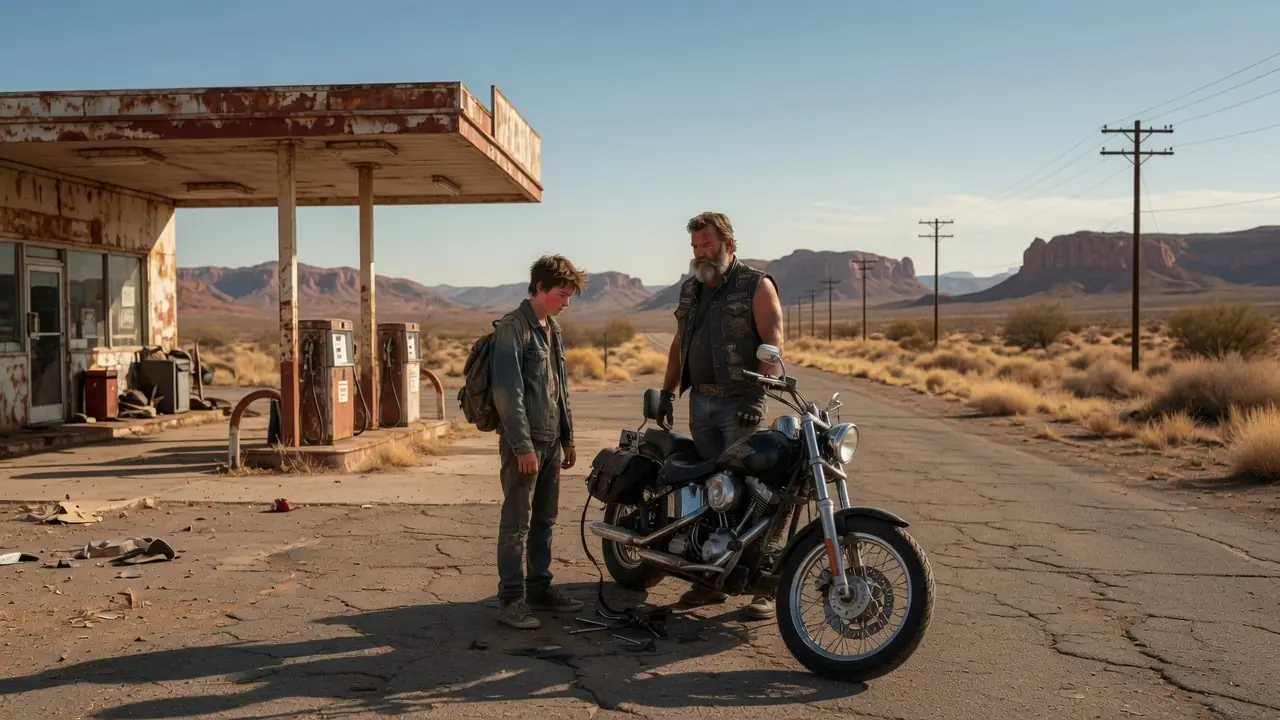
The biker noticed the bruise.
He did not mention it.
Toby walked toward the canteen but stopped several feet away.
“You can take it,” the man said.
Toby picked it up.
He drank too quickly.
Water spilled down his chin.
“Slow down.”
Toby ignored him and drank again.
The biker looked at the boy’s backpack.
“You alone?”
“Yes.”
“That wasn’t what I asked.”
Toby handed back the canteen.
The man accepted it.
“What’s wrong with the bike?”
Toby pointed toward the engine.
“The fuel hose is collapsing when it gets hot.”
The biker looked down.
“You sure?”
“No.”
The answer surprised him.
Toby continued.
“But if the starter is turning and the engine died slowly instead of cutting out, it’s probably fuel.”
The man crouched.
Toby remained several steps away.
“Show me.”
The boy moved closer.
He pointed toward the line.
“It’s soft here.”
The rider pressed it between two fingers.
The rubber remained flattened.
“Vapor lock?”
“Maybe partly.”
Toby examined the line without touching it.
“But this section is old. It’s pulling closed when the pump creates pressure.”
The biker looked at him.
“How would you know that?”
“My dad fixed motorcycles.”
“What kind?”
“Mostly Harleys.”
The boy opened his backpack and removed a small wrench.
The biker raised one eyebrow.
“You carry tools while running around abandoned gas stations?”
Toby froze.
The man looked toward him.
“I didn’t say I’d call anyone.”
Toby’s shoulders remained tense.
“What’s your name?”
“Toby.”
“I’m Walter.”
Toby looked at the vest.
“Thought it was Grizzly.”
“That’s what people call me when they want something.”
“What do they call you when they don’t?”
“Usually worse.”
For the first time in several days, Toby almost smiled.
Walter opened a saddlebag and removed a compact tool roll.
“You think you can fix it?”
“I need another hose.”
“There’s no parts store.”
Toby looked toward the station.
“Maybe there is.”
The building had been abandoned for years.
Most shelves were empty.
The register had been removed.
Sand covered the floor.
But behind the building, Toby had seen an old air compressor connected to a length of rubber tubing.
The hose was cracked at one end, but the middle section remained solid.
“It’s not made for fuel,” Walter said when Toby showed it to him.
“It only has to last until you reach town.”
“You willing to bet my engine on that?”
Toby looked at the motorcycle.
“No.”
“Honest kid.”
Walter examined the hose.
“But you think it will work.”
“Yes.”
They cut away an undamaged section.
Toby worked carefully.
His father’s voice returned in his memory.
Never force old fittings.
Twist first.
Then pull.
Don’t let dirt enter the carburetor.
Check twice before tightening once.
Toby had not thought about those lessons in months.
Whenever he remembered his father, the good memories arrived attached to the bad ones.
The smell of oil in their garage.
A hand guiding Toby’s wrench.
Then the same hand striking the kitchen wall.
The roar of motorcycle engines.
Then shouting behind a closed bedroom door.
Walter held the line steady.
Toby loosened the clamp and removed the damaged section.
His fingers shook slightly.
“Heat getting to you?” Walter asked.
“No.”
“Fear?”
Toby looked up.
“No.”
Walter nodded.
“Then it’s hunger.”
Toby returned to the repair.
“I’m fine.”
“You’re many things.”
Walter looked at the boy’s thin arms.
“Fine isn’t one of them.”
Toby connected the temporary hose.
He checked the clamps.
Then checked them again.
“Try it.”
Walter turned the ignition.
The starter engaged.
The Harley coughed.
Toby leaned closer.
“Again.”
Walter pressed the button.
The engine fired.
It stumbled once, then settled into a deep, steady rhythm.
The sound rolled across the empty desert.
Toby stepped backward.
Walter watched the fuel line.
It held its shape.
He opened the throttle slightly.
The engine responded.
“Not bad.”
Toby placed his wrench back in the backpack.
“It might fail again.”
“How far can I go?”
“Maybe twenty miles.”
“Town is twenty-two.”
“Then don’t ride fast.”
Walter shut off the engine.
Toby frowned.
“What are you doing?”
“Letting it cool.”
“You should leave before it gets hotter.”
“I’m not leaving yet.”
Toby took one step backward.
Walter reached into his vest.
The boy’s hand moved toward the screwdriver.
Walter stopped.
Then slowly removed a folded roll of bills.
“How much?”
Toby stared.
“For the repair.”
“Nothing.”
Walter held out the money.
“You fixed my motorcycle.”
“I used a piece of old hose.”
“And knew where to put it.”
“I don’t want your money.”
Walter studied him.
“Everybody wants something.”
Toby looked toward the highway.
“Not from you.”
“What does that mean?”
“It means I helped. You can go.”
Walter placed the money back inside his vest.
“Why are you here, Toby?”
The boy tightened the backpack straps.
“Just traveling.”
“Without food?”
“I have money.”
“Seventy-three dollars?”
Toby’s head snapped toward him.
Walter nodded toward the backpack.
“You counted it when you thought I wasn’t looking.”
Toby moved farther away.
“You went through my bag?”
“No.”
“I saw the bills when you pulled out the wrench.”
Toby said nothing.
Walter leaned against the motorcycle.
“You running from someone?”
“No.”
“You running toward something?”
Toby looked down.
“No.”
“That usually means the first one.”
Toby turned toward the building.
Walter’s next words stopped him.
“That bruise isn’t from falling.”
The boy’s face hardened.
“You don’t know anything.”
“You’re right.”
Walter’s voice remained calm.
“I know a kid has been sleeping in an abandoned building during an Arizona summer.”
He pointed toward the highway.
“I know the nearest town is more than twenty miles away.”
“I know you haven’t eaten.”
Toby turned.
“And I know you reached into the sun to help someone who scared you.”
The boy swallowed.
“What do you want?”
“The truth.”
“Why?”
“Because I’ve spent enough years around liars.”
Toby looked toward the motorcycle.
“You’re one of them.”
“One of who?”
“Bikers.”
Walter glanced at his vest.
“That’s difficult to deny.”
“My uncle said clubs like yours hurt people.”
“Some do.”
“Yours?”
Walter considered the question.
“We’ve hurt people.”
Toby’s hand tightened around the backpack strap.
Walter continued.
“We’ve also buried friends, rebuilt houses, protected witnesses, delivered medicine in snowstorms, and made more bad decisions than I can count.”
“That doesn’t answer me.”
“No.”
Walter looked at him.
“It’s the most honest answer I have.”
Toby turned away.
A gust of hot wind carried sand across the lot.
Walter opened the saddlebag again and removed a wrapped sandwich.
He placed it on the motorcycle seat.
Toby looked at it.
“Turkey.”
“I don’t want it.”
“Then don’t eat it.”
Walter walked toward the edge of the shade.
Toby waited.
The man did not watch him.
After several seconds, Toby approached the motorcycle.
He took the sandwich.
He ate half before remembering to breathe.
Walter remained silent.
When Toby finished, he wrapped the remaining portion carefully.
“You can eat all of it.”
“I’m saving some.”
“For when?”
“Later.”
Walter looked toward the empty highway.
“Where are you planning to sleep tonight?”
Toby did not answer.
“There’s a storm coming.”
The sky appeared clear.
Toby looked up.
“No, there isn’t.”
Walter pointed west.
A faint wall of brown rose along the horizon.
“Dust storm.”
Toby had seen them from inside his uncle’s house.
Never from an abandoned station with broken windows.
“How long?”
“Maybe an hour.”
Walter removed his phone again.
He walked several yards into the road and lifted it.
Still no signal.
Then he returned to the motorcycle and opened a small compartment near the rear.
Toby saw a radio mounted inside.
Walter turned it on.
Static filled the air.
He adjusted the frequency.
“This is Grizzly.”
More static.
Then a distant voice answered.
“Go ahead.”
“Bike went down near Red Mesa station.”
“You hurt?”
“No.”
“Need a trailer?”
“Maybe.”
Walter looked toward Toby.
“Send one.”
The radio crackled.
“Copy. Nearest group is at the county line.”
“How many?”
“About thirty.”
“Tell them to bring water.”
Toby stepped backward.
“You said one trailer.”
Walter turned.
“I said send one.”
“You asked how many people.”
“That’s how radio calls work.”
“I’m leaving.”
Walter looked toward the growing dust cloud.
“On foot?”
“I’ll find somewhere.”
“There is nowhere.”
Toby began walking toward the rear of the building.
Walter did not follow.
“You can leave.”
The boy stopped.
“But take the canteen.”
Toby looked back.
Walter held it out.
“Why are you helping me?”
“Maybe I have a weakness for mechanics who charge too little.”
Toby did not move.
Walter placed the canteen on the ground.
Then he sat against the gas pump.
“You don’t have to trust me.”
He removed his vest and folded it beside him.
“But the storm will be here before you reach the next mile marker.”
Toby looked at the horizon again.
The brown wall had grown higher.
He retrieved the canteen.
Then he returned to the station.
Walter remained outside until the wind strengthened.
They moved the motorcycle into the service bay behind the building.
The metal door hung partly open, but the concrete walls provided more protection than the shattered storefront.
Within thirty minutes, the sky became copper-colored.
Wind struck the station with a low roar.
Sand poured beneath the door.
Toby sat against the wall with his backpack between his knees.
Walter sat several feet away.
He did not ask questions.
That made Toby more nervous than questions would have.
Finally, the boy spoke.
“My uncle drinks.”
Walter looked toward him.
Toby stared at the floor.
“My mom died last year.”
“I’m sorry.”
“She got sick.”
He swallowed.
“Cancer.”
Walter remained quiet.
“My father left before that.”
“Where?”
“I don’t know.”
Toby traced one finger through the sand on the floor.
“My uncle was the only person who would take me.”
“What’s his name?”
“Roy.”
“He hurt you?”
Toby touched the bruise on his jaw.
“He gets angry.”
“That wasn’t what I asked.”
Toby looked toward him.
“Yes.”
Walter’s expression did not change.
“How long?”
“Since I moved in.”
“Has anyone else seen it?”
“A teacher asked once.”
“What did you say?”
“I fell.”
Walter nodded slowly.
“Why?”
“Because Roy said they’d put me somewhere worse.”
“He tell you that?”
“All the time.”
Outside, the wind screamed against the metal door.
“What happened five days ago?” Walter asked.
Toby’s jaw tightened.
“He came home drunk.”
“What did he do?”
“He wanted the money my mom left me.”
“How much?”
“Four thousand.”
“Where is it?”
“In a savings account.”
“He can’t access it?”
“Not without me signing.”
Walter’s eyes hardened.
“He tried to make you?”
Toby nodded.
“I said no.”
“What happened?”
“He hit me.”
The boy looked at the bruise.
“Then he got a knife.”
Walter became very still.
“Did he cut you?”
“No.”
“He put it on the table.”
Toby’s voice weakened.
“He said next time he wouldn’t ask.”
Walter looked toward the storm.
“So you took the emergency money and ran.”
Toby nodded.
“I was trying to reach Phoenix.”
“Why Phoenix?”
“My dad might be there.”
“Might?”
“I found an old address.”
Walter rubbed one scarred hand over his beard.
“Do you know if he wants to be found?”
“No.”
“Do you know if he’s alive?”
“No.”
Toby looked angry now.
“But I can’t go back.”
“I agree.”
The boy looked surprised.
“You do?”
“Running through the desert isn’t safe.”
Walter’s voice remained firm.
“Going back to a man with a knife is worse.”
Toby studied him.
“You’re not calling the police?”
“I didn’t say that.”
Toby reached for his backpack.
Walter raised one hand.
“Listen first.”
“No.”
“Toby.”
“I’m not going into foster care.”
“You may not have to.”
“You don’t know that.”
“You’re right.”
Walter leaned back against the wall.
“But you’re sixteen. You have legal options. Relatives. Emergency placement. Youth advocates.”
Toby laughed bitterly.
“You sound like a social worker.”
“I’ve met enough of them.”
“Why?”
Walter looked toward the folded vest.
“My daughter used drugs.”
Toby said nothing.
“She had a boy.”
He paused.
“My grandson.”
“What happened?”
“We thought she was getting better.”
Walter looked at the dust entering beneath the door.
“She wasn’t.”
Toby waited.
“When the boy was nine, she disappeared for three days.”
Walter’s voice grew quieter.
“He stayed alone in an apartment with no food and no electricity.”
“What happened to him?”
“He lives with me now.”
Toby looked at Walter differently.
“How old?”
“Fifteen.”
“Does he ride?”
“Not after the mailbox incident.”
Toby almost smiled again.
“What mailbox?”
“He confused the brake and clutch.”
“On a motorcycle?”
“Small dirt bike.”
“Was the mailbox okay?”
“No.”
The wind began to weaken.
Walter looked toward the opening.
“His name is Eli.”
Toby folded his arms across his knees.
“Why are you telling me?”
“Because running children always think every adult is trying to own the decision.”
Walter looked at him.
“Sometimes we’re just trying to keep you alive long enough to make one.”
An engine sounded outside.
Then another.
Toby stood.
Walter rose more slowly.
The roar grew louder.
Not one motorcycle.
Many.
Toby approached a crack in the service-bay door.
Headlights appeared through the brown air.
Motorcycles rolled into the abandoned station one after another.
Five.
Ten.
Twenty.
The first group parked near the pumps.
Then another arrived behind them.
More riders appeared along the highway.
Toby turned toward Walter.
“You said thirty.”
“I said the nearest group had thirty.”
“How many are coming?”
Walter looked through the opening.
“That depends on who heard the call.”
The boy’s face paled.
“Why would they all come?”
Walter opened the service door.
The remaining dust swirled around him.
“Because I’m late.”
Toby stared.
“Late for what?”
“A funeral.”
The riders parked in long rows.
Black leather vests.
Denim jackets.
Helmets hanging from handlebars.
Men and women of different ages climbed from their motorcycles.
Some looked as intimidating as Walter.
Others looked like mechanics, nurses, construction workers, grandparents, and retired soldiers.
A pickup towing an enclosed motorcycle trailer entered last.
A woman in her sixties stepped from the passenger side carrying a medical bag.
She walked directly toward Walter.
“You hurt?”
“No, Doc.”
Her eyes moved toward Toby.
“Who’s the kid?”
“He fixed the bike.”
The woman looked at the temporary fuel line.
“With compressor hose?”
Toby nodded.
She examined it.
“That might actually hold.”
Walter smiled.
“Careful. Compliments make him nervous.”
Toby moved closer to the wall.
More motorcycles continued arriving.
The gas-station lot filled.
The sound of engines surrounded the building.
Toby counted until he reached forty.
Then he stopped.
A younger rider brought cases of water from a support truck.
Another carried food.
Several people began securing Walter’s Harley inside the trailer.
No one approached Toby without permission.
That surprised him.
Finally, a teenage boy climbed from the back seat of the pickup.
He wore jeans, heavy boots, and a black T-shirt.
A thin scar crossed one eyebrow.
He looked around.
Then he saw Walter.
“You missed the service.”
“I know.”
The teenager looked toward Toby.
“Who’s that?”
“Toby.”
Walter gestured between them.
“Toby, this is Eli.”
“The mailbox killer?” Toby asked.
Eli glared at Walter.
“You told him?”
“It was relevant.”
“It is never relevant.”
Toby smiled before he could stop himself.
Eli noticed the backpack.
“You running?”
Toby’s smile disappeared.
Walter looked toward his grandson.
“That is his business.”
Eli nodded.
Then he opened a cooler and removed a bottle of orange soda.
He held it out.
Toby hesitated.
“It isn’t poisoned.”
“That’s exactly what someone says when it is.”
Eli shrugged.
“More for me.”
Toby took it.
“How many motorcycles are there?”
Eli looked toward the road.
“Probably around a hundred.”
“For a funeral?”
“For one of ours.”
Walter stood beside them.
“Raymond Cole.”
Eli lowered his eyes.
“He helped start the club.”
Toby glanced toward Walter’s founding-member patch.
“He your friend?”
“For forty-two years.”
The last group arrived as the sun dropped lower.
Twenty-three motorcycles entered in formation.
Their headlights cut through the remaining dust.
When the engines finally stopped, the sudden silence felt enormous.
A rider with a clipboard walked toward Walter.
“One hundred and twenty.”
Walter nodded.
“All chapters?”
“Six.”
The rider looked toward Toby.
“That the mechanic?”
Toby stiffened.
Walter answered.
“That’s him.”
The man removed one glove and extended his hand.
“I’m Samuel Boone.”
Toby looked at the large hand.
Then shook it.
“Thanks for getting our road captain moving.”
“He didn’t move.”
Samuel laughed.
“Fair point.”
Walter’s Harley was loaded into the trailer.
The riders gathered near the road.
The funeral had already ended, but they planned to travel together to a memorial dinner in Flagstaff.
Walter spoke quietly with several officers.
Toby stood near the service bay with Eli.
“They’re talking about me,” he said.
“Yes.”
“What are they saying?”
“Probably arguing.”
“About what?”
“Whether to call the sheriff, child services, a youth shelter, or all three.”
Toby gripped the soda bottle.
“I’m leaving.”
Eli blocked nothing.
“Okay.”
Toby looked at him.
“You’re not stopping me?”
“No.”
“Why not?”
“Because then you’d run harder.”
Toby glanced toward the highway.
The dust storm had passed, but darkness approached.
Eli leaned against the wall.
“I ran once.”
“From Walter?”
“From my mom.”
“What happened?”
“I slept behind a grocery store.”
“For how long?”
“Two nights.”
“How did he find you?”
“He didn’t.”
Eli looked toward his grandfather.
“I called him.”
“Why?”
“I was hungry.”
Toby laughed quietly.
“That’s it?”
“No.”
Eli looked serious.
“I knew he’d come.”
The answer stayed between them.
Toby watched Walter speaking with the woman carrying the medical bag.
“What if nobody comes for me?”
Eli followed his gaze.
“One hundred and twenty people just came.”
“They came for him.”
“They stayed because of you.”
Toby shook his head.
“They don’t know me.”
“Neither did Walter when you fixed his bike.”
“That was different.”
“Why?”
Toby had no answer.
Walter approached them.
“I spoke with a youth advocate in Flagstaff.”
Toby’s shoulders tightened.
“She can meet us at the hospital.”
“I’m not hurt.”
“The bruise says otherwise.”
“I’m not going.”
Walter nodded.
“Then we have another option.”
“What?”
“You ride in the truck with Eli and Doc.”
“Where?”
“Flagstaff.”
“And then?”
“You eat.”
Toby waited.
“You shower.”
Walter continued.
“You speak to the advocate.”
“She’ll send me back.”
“Not after documenting the knife threat and injuries.”
“You don’t know that.”
“No.”
Walter looked at him steadily.
“But I will be in the room.”
Toby stared.
“Why?”
“Because you repaired my motorcycle.”
“That’s not enough.”
Walter’s expression softened.
“No.”
“It isn’t.”
The boy waited.
Walter looked toward the rows of motorcycles.
“Raymond Cole, the man we buried today, found me when I was seventeen.”
Toby said nothing.
“I was sleeping in a stolen car outside Tucson.”
“You stole a car?”
“I made poor choices.”
“What did he do?”
“He dragged me out.”
Toby looked alarmed.
“Then he fed me.”
Walter almost smiled.
“His methods lacked consistency.”
“What happened after that?”
“He gave me work in his garage.”
“You became a biker?”
“Eventually.”
Walter touched the founding patch.
“He told me a man does not repay kindness backward.”
Toby frowned.
“What does that mean?”
“You don’t repay the person who helped you.”
Walter looked at him.
“You pass it forward when someone else needs it.”
Toby looked toward the abandoned gas station.
“You think I need help.”
“I think you needed help before I arrived.”
Walter paused.
“And you still chose to help me first.”
The support truck waited near the trailer.
Doc opened the passenger door.
Eli climbed into the back.
Toby remained still.
Walter did not rush him.
At last, Toby walked toward the truck.
He stopped beside the open door.
“I’m not promising to stay anywhere.”
“Nobody asked you to.”
“I’m not joining your club.”
“You are sixteen.”
Walter looked toward the motorcycles.
“And most of them are terrible influences.”
Several nearby riders laughed.
Toby climbed into the truck.
The convoy left the gas station after sunset.
One hundred and twenty motorcycles moved through the desert in two long lines.
Toby sat in the back seat beside Eli.
He watched red taillights extend along the highway like a glowing river.
No car passed them.
At the first fuel stop with cell service, Walter contacted the county sheriff and reported Toby’s condition.
The youth advocate met them at Flagstaff Medical Center.
Her name was Maria Alvarez.
She wore plain clothes and spoke to Toby without making promises.
A doctor documented bruising along his jaw, ribs, and upper arms.
The sheriff’s office in Toby’s hometown visited Roy’s house.
They found the kitchen knife described by Toby, damage inside his bedroom, and withdrawal forms Roy had tried to force him to sign.
Roy was arrested for assault, child endangerment, and attempted financial exploitation.
Toby was not sent back.
For three nights, he stayed in an emergency youth home.
Walter visited each day.
So did Eli.
On the fourth afternoon, Maria entered the meeting room carrying a folder.
“We located your father.”
Toby stopped breathing.
“Where?”
“Phoenix.”
The boy leaned forward.
“Does he know?”
“We spoke with him.”
“What did he say?”
Maria sat opposite him.
“He wants to meet you.”
Hope appeared so quickly on Toby’s face that Walter had to look away.
Then Maria continued.
“There are things you need to know first.”
Toby’s father, Daniel Reed, had not disappeared without reason.
He had lost custody after repeated arrests related to drugs and theft.
For years, he remained unstable.
He had recently completed a rehabilitation program and worked at a tire shop.
But he lived in temporary housing and was not approved to take custody.
“He left me,” Toby said.
Maria nodded.
“Yes.”
“He could have called.”
“Yes.”
“He could have found me.”
“Yes.”
Toby looked toward Walter.
The old biker did not defend Daniel.
That mattered.
“What happens now?”
Maria opened the folder.
“We have a temporary foster placement available.”
Toby’s face closed.
“Where?”
Walter cleared his throat.
“My house.”
Toby stared at him.
“You?”
“Only if you agree.”
Maria explained the inspections, background checks, legal process, and supervision requirements.
Walter had already served as Eli’s legal guardian for six years.
His home was approved.
Toby looked toward Eli.
“You knew?”
“Since yesterday.”
“And you’re okay with it?”
Eli shrugged.
“We have a spare room.”
“That’s not what I asked.”
Eli looked at him.
“You fixed Grandpa’s bike.”
Toby frowned.
“That matters too much around here.”
“No.”
Eli smiled faintly.
“You haven’t seen what he does when someone scratches it.”
Toby moved into Walter’s house on a temporary basis.
The property sat outside Flagstaff beside a motorcycle repair shop.
The spare room had a bed, a desk, and a window overlooking the garage.
Toby slept on the floor the first night.
On the second, he placed his backpack beneath the bed.
On the third, he hid food inside the desk drawer.
Walter found the wrappers.
He did not mention them.
The following morning, a box of granola bars appeared on the dresser.
Toby began helping in the shop.
At first, he swept floors.
Then he organized tools.
Walter allowed him to perform oil changes under supervision.
The boy had instinct.
He listened to engines as though they were speaking.
He could feel improper tension through a wrench.
He recognized damaged bearings by sound.
But he also rushed when nervous.
Walter made him repeat simple jobs until patience became habit.
“Fast mechanics create slow repairs,” he said.
Six weeks after the gas-station encounter, Daniel came to visit.
Toby waited inside the shop wearing grease-stained coveralls.
His father looked thinner than he remembered.
Older.
Daniel stopped several feet away.
“Hey, Toby.”
The boy said nothing.
Daniel’s eyes filled.
“I’m sorry.”
Toby wiped his hands on a rag.
“For what part?”
The question struck him.
“All of it.”
“That’s not an answer.”
Daniel looked toward Walter.
The biker remained near the office door.
He did not interfere.
Daniel swallowed.
“For leaving.”
Toby waited.
“For choosing drugs over you and your mother.”
His voice cracked.
“For not coming back when I got sober because I was ashamed of how long it took.”
Toby looked down.
“Mom waited.”
“I know.”
“She died thinking you didn’t care.”
Daniel closed his eyes.
“I know.”
Toby’s anger broke through.
“No, you don’t.”
He threw the rag onto the workbench.
“You didn’t see her sick.”
“You didn’t take her to appointments.”
“You didn’t hear her tell people you were working out of state because she was embarrassed to say you disappeared.”
Daniel began crying.
Toby did not stop.
“You don’t get to show up and say sorry like it fixes everything.”
“I know.”
“Stop saying that.”
Daniel nodded.
“You’re right.”
The room became quiet.
Finally, Toby asked, “Are you sober?”
“Fourteen months.”
“Will you stay sober?”
“I’m trying.”
“That means no.”
Daniel’s face folded.
“No.”
His honesty surprised the boy.
“It means I can promise to work at it every day.”
Toby looked toward Walter.
The older man gave no signal.
The choice belonged to him.
“You can visit again,” Toby said.
Daniel covered his mouth.
“But not alone.”
“Okay.”
“And don’t promise anything.”
Daniel nodded.
“Okay.”
Their relationship rebuilt slowly.
Not into the one Toby had imagined while walking toward Phoenix.
Something smaller.
More cautious.
More real.
Months passed.
The temporary placement became permanent guardianship.
Toby returned to school.
His grades were uneven, but he excelled in technical classes.
He worked weekends in Walter’s garage.
The Iron Serpents began treating him like part of the extended family.
Not a member.
Walter was strict about that.
They brought damaged motorcycles to the shop and pretended not to notice when Toby solved problems before the adult mechanics.
At seventeen, he rebuilt his first Harley engine.
The motorcycle belonged to Samuel Boone.
When it started, the sound filled the garage.
Samuel handed Toby an envelope.
The boy opened it.
Inside was twenty-five hundred dollars.
“I can’t take this.”
“You rebuilt the engine.”
“You bought the parts.”
“And you provided sixty hours of labor.”
Toby looked toward Walter.
“Is this another test?”
Walter continued working.
“No.”
“Then why is everyone staring?”
“Because you are terrible at accepting payment.”
Toby looked at Samuel.
“The first repair was free.”
Samuel nodded.
“That was charity.”
He pointed toward the motorcycle.
“This is work.”
Toby accepted the money.
He used part of it to replace what he had taken from Roy’s emergency jar.
Roy remained in prison.
He would never know.
Toby did it anyway.
At eighteen, Toby graduated from high school.
One hundred and twenty motorcycles arrived at the ceremony.
The principal nearly canceled the event when she saw the convoy.
Walter convinced her not to.
The riders parked in perfect rows outside the football field.
They did not rev their engines.
They stood quietly when Toby crossed the stage.
Daniel attended too.
He had been sober for two years.
He sat several rows behind Walter.
Toby saw both men.
One had given him life.
The other had helped him survive it.
After graduation, Toby enrolled in a technical program specializing in motorcycle and small-engine repair.
He returned to the abandoned gas station one year later.
Walter rode beside him on the same Harley.
The temporary hose had been replaced long ago, but Walter kept the cracked piece inside the saddlebag.
They parked beneath the rusted canopy.
The building looked smaller than Toby remembered.
He walked into the service bay.
Sand covered the floor.
A broken piece of tubing remained near the wall.
“You okay?” Walter asked.
Toby nodded.
“I thought I was going to die here.”
Walter stood beside him.
“You almost saved a sandwich.”
“That was serious planning.”
They laughed.
Toby walked toward the cracked fuel pumps.
“Why did you really stay?”
Walter looked at him.
“When?”
“After the bike started.”
“You were a child alone in the desert.”
“You could have called someone and left.”
“Yes.”
“But you didn’t.”
Walter considered the question.
“Raymond was dead.”
Toby waited.
“The man who helped me when I was seventeen.”
Walter touched the old vest.
“I was riding to his funeral thinking about the debt I could never repay.”
He looked at Toby.
“Then I found you.”
Toby lowered his eyes.
“So you thought I was a debt?”
“No.”
Walter shook his head.
“I thought you were the answer.”
Years later, Toby became the owner of the repair shop.
He renamed it Reed and Boone Motor Works.
Walter objected to being placed second.
Toby ignored him.
The shop hired teenagers from foster homes, shelters, and juvenile programs.
They learned repairs.
More importantly, they learned how to finish something.
Every new apprentice heard the same rule.
Your first act of kindness is free.
Your skill is not.
Toby placed a framed section of old compressor hose above the main workbench.
Customers often asked what it was.
He told them it once kept a Harley running for twenty-two miles.
He did not always tell them the rest.
Some stories were too large to explain during an oil change.
At twenty-nine, Toby received a call from a highway patrol officer.
A runaway fourteen-year-old girl had been found sleeping near an abandoned diner.
She carried a socket set in her backpack and claimed she could repair engines.
The officer knew about Toby’s youth apprenticeship program.
“Can you speak with her?”
Toby drove two hours.
When he arrived, the girl sat in the back of a patrol vehicle with her arms folded.
She glared at him.
“What do you want?”
Toby crouched several feet away.
“Right now?”
He looked toward the broken motorcycle parked beside the diner.
“I want to know why you installed that fuel filter backward.”
She stared at him.
Then looked toward the motorcycle.
“It isn’t backward.”
“It is.”
“No, it isn’t.”
Toby smiled.
“Show me.”
The girl climbed out.
Walter had taught him that kindness was not repaid backward.
It moved forward.
From one damaged person to another.
From a stolen car outside Tucson to a broken Harley in the Arizona desert.
From an old biker grieving his closest friend to a hungry boy who still chose to help a stranger.
People later told the story as though one hundred and twenty motorcycles arrived because Toby repaired Walter’s Harley.
That was only partly true.
They came because Walter was their road captain.
They stayed because they saw a sixteen-year-old boy standing beside him with nowhere to go.
Toby believed those riders surrounded the gas station that evening.
In reality, they surrounded him.
Not to trap him.
To make sure the road behind him was finally closed to the people who had hurt him.
And the road ahead no longer had to be traveled alone.