The body-camera footage began without warning.
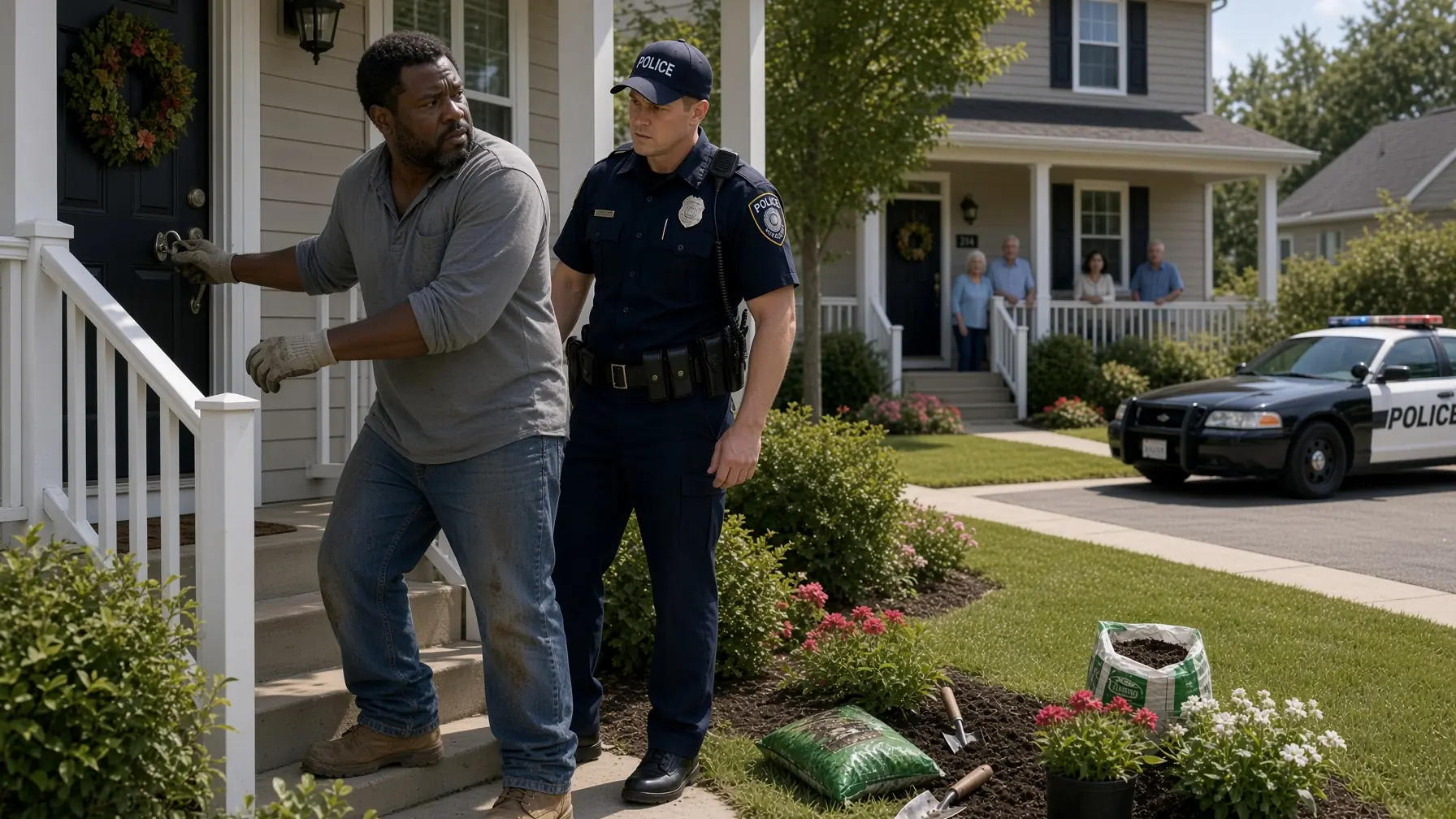
No introduction. No dispatch audio. No explanation.
Just harsh midday sunlight flooding the lens as Officer Ethan Cole crossed a perfectly maintained lawn with quick, determined steps.
It was 12:47 on a Saturday afternoon in Brookstone Heights, a suburban development of red-brick homes, flowering dogwoods, white mailboxes, and lawns trimmed so evenly they sometimes looked artificial.
Near the front flower bed of 1847 Hawthorne Court, a man was kneeling in the soil.
He wore faded khaki work pants, an old navy T-shirt, gardening gloves, and boots covered with dark earth. A wheelbarrow rested beside him. Three bags of mulch lay open near the sidewalk. Bright red salvias and yellow marigolds waited in plastic trays.
The man seemed completely absorbed in what he was doing.
Officer Cole stopped fifteen feet away.
“Hey.”
The gardener looked up.
Cole took another step.
“What are you doing on this property?”
For a moment the man appeared unsure whether the question was actually directed at him.
“Excuse me?”
“Step away from the house.”
The gardener glanced behind himself toward the two-story colonial.
Then back toward the young officer.
“What exactly is this about?”
Cole moved closer.
“Police received a report of a suspicious person on the property.”
The man looked down at his gardening gloves.
Then at the shovel beside him.
Then toward the flowers he had spent most of the morning planting.
“A suspicious person?”
“Yes.”
“Me?”
“You’re the only person here.”
The gardener slowly stood.
He was perhaps fifty-five.
Black.
Broad-shouldered without being particularly large.
His hair was cropped close and beginning to gray around the temples. Dirt streaked one knee of his pants. Sweat darkened the collar of his shirt.
Nothing about him appeared hurried.
Nothing appeared frightened either.
He removed one glove.
Then the other.
“Who called?”
Cole folded his arms.
“That isn’t relevant right now.”
“It seems fairly relevant to me.”
“Do you live here?”
The man gave a short laugh.
There was no humor in it.
“Seriously?”
Cole’s jaw tightened.
“Sir, I asked you a direct question.”
“And I asked why I’m being questioned.”
“Because right now I’m the one asking the questions.”
Something changed.
Not dramatically.
The street remained quiet.
A sprinkler ticked on the lawn next door.
Birds moved through the maple trees.
But the man’s expression shifted.
The confusion disappeared.
He now understood that Officer Cole had not approached to ask a question and hear an answer.
The young officer had already built a story.
Now he wanted the stranger on the lawn to fit inside it.
Across Hawthorne Court, curtains moved.
At number 1850, Evelyn Cross stood behind her dining-room window pretending she was not watching.
Two houses down, retired teacher Margaret Bell came onto her porch carrying a watering can she did not actually need.
A man washing his truck across the intersection turned off the hose.
Brookstone Heights was becoming an audience.
The gardener looked back at Cole.
“Before I answer anything else, what exactly did the caller report?”
Cole reached toward his shoulder microphone.
“That’s not how this works.”
“What did they see?”
“Someone they didn’t recognize around a residence.”
The man nodded slowly.
“Doing what?”
Cole did not answer.
“Breaking a window?”
“No.”
“Trying a door?”
“No.”
“Carrying anything away?”
“No.”
“Looking through windows?”
“Sir—”
“Climbing a fence?”
“No.”
The gardener pointed toward the flower bed.
“So the suspicious behavior was gardening?”
Cole’s mouth tightened.
“That still doesn’t establish you have a right to be here.”
The man stared at him.
For several seconds, the only sound came from the distant lawn mower at the end of the street.
Then Cole lifted his radio.
“Dispatch, Unit Twenty-Four. I’m speaking with the individual now. Subject appears evasive.”
The gardener blinked.
“Evasive?”
Cole ignored him.
“Stand by for identification.”
The man actually looked around as if checking whether another person had suddenly appeared behind him.
Then he pointed toward the wheelbarrow.
“I’ve been outside here since nine o’clock.”
Cole said nothing.
“I unloaded six bags of mulch.”
Nothing.
“I trimmed those hedges.”
Nothing.
“I planted half that flower bed.”
The man’s voice remained calm.
“And somehow the fact that I’m standing here with dirt on my clothes is not evidence I’m supposed to be here, but asking you what crime occurred makes me evasive?”
Cole lowered the radio.
“Do you live here or not?”
The gardener took a slow breath.
“You never gave me a chance to explain anything.”
“I’m giving you one now.”
“No.”
The man shook his head.
“You’re giving me an opportunity to satisfy a conclusion you already made.”
Cole stepped closer.
“Watch your tone.”
The gardener looked at him.
“My tone?”
“You’re being argumentative.”
“I’m asking questions.”
“Same thing right now.”
It was not.
And somewhere beneath the nervous confidence of a twenty-four-year-old rookie officer, Ethan Cole knew that.
He had graduated from the academy five months earlier.
He had spent fourteen weeks with a field-training officer.
He had completed bias training.
De-escalation training.
Constitutional policing.
Report writing.
Scenario exercises where instructors intentionally played angry citizens, frightened citizens, drunk citizens, mentally ill citizens, and people who knew the law better than he did.
He had passed all of it.
But none of those training rooms looked like Hawthorne Court.
No instructor had explained what happened when the person calling police lived in a neighborhood like Brookstone Heights and sounded completely certain.
At 12:39, dispatch had transmitted:
“Unit Twenty-Four, suspicious male, Hawthorne Court. Caller reports unknown Black male working around front of residence. Homeowners possibly away. Caller concerned about burglary or unauthorized landscaping activity.”
Cole had been less than four blocks away.
He knew Brookstone Heights.
Not personally.
But by reputation.
Expensive homes.
Low crime.
Residents who called about unfamiliar cars.
Package theft.
Contractors parking improperly.
Teenagers cutting through yards.
The caller, Evelyn Cross, had sounded credible.
She told dispatch she had lived across the street for twelve years.
She said she knew who belonged there.
That sentence had stayed with Cole.
I know who belongs there.
By the time he turned onto Hawthorne Court and saw a Black man in worn clothes kneeling beside a large colonial home, the call and the image fused together.
Unknown man.
Expensive house.
Possible absent owners.
Suspicious.
Cole had not consciously thought:
He cannot own that house.
He would later insist he never thought those words.
Maybe he didn’t.
Bias rarely arrived as a sentence neat enough to quote.
Sometimes it arrived as certainty.
The certainty that one explanation was more likely than another before enough facts existed to justify either.
Now the gardener looked toward the surrounding houses.
“What exactly made your caller think I shouldn’t be here?”
Cole hesitated.
“They said they hadn’t seen you before.”
Several neighbors instantly looked away.
The gardener noticed.
“So that’s it.”
“That’s part of it.”
“What’s the rest?”
“You’re avoiding the question.”
“No. I’m trying to understand why the burden is on me.”
Cole took another step.
“Sir, I’m going to ask you one final time. Do you live at this residence?”
The gardener stared at him.
Then reached slowly toward the pocket of his work pants.
Cole’s body changed instantly.
His right hand dropped toward his duty belt.
“Stop.”
The gardener froze.
A woman on the sidewalk gasped.
Cole widened his stance.
“Hands where I can see them.”
The man slowly raised both hands.
“You just asked whether I live here.”
“I said keep your hands visible.”
“I’m trying to answer you.”
“With what?”
The gardener looked down toward his pocket.
“My keys.”
Cole stared.
The man’s voice softened.
“Relax.”
It was an unusual thing to say to an armed police officer.
Not disrespectful.
Almost reassuring.
Cole’s embarrassment flashed across his face.
“Move slowly.”
The man did.
Two fingers entered his pocket.
Then emerged holding a plain metal key ring.
Nothing dramatic.
No badge.
No government credential.
No hidden identity.
Just six ordinary keys, a small grocery-store loyalty tag, and a scratched brass keychain shaped like a sailboat.
The keys jingled softly.
The entire street seemed to hear them.
The gardener raised the ring.
Cole’s hand moved away from his belt.
The man walked toward the porch.
Cole followed two steps behind.
“Sir—”
The man inserted one key into the front door.
Turned it.
The lock opened.
He pushed the door inward.
A golden retriever immediately appeared in the hallway, tail wagging so violently its entire body moved with it.
“Back, Milo.”
The dog sat.
The man looked over his shoulder.
He held up the keys.
“Officer.”
Cole stopped on the lawn.
“This is my house.”
Silence.
Real silence.
Even the woman watering flowers across the street had stopped moving.
Water overflowed the pot at her feet.
Cole stared through the open doorway.
Family photographs covered the entry wall.
The gardener appeared in several.
In one, he wore a tuxedo beside a Black woman in a wedding dress.
Another showed the same couple with two children.
A framed university diploma hung near the staircase.
Mail sat on a console table.
A pair of work boots rested near the door.
Nothing could have been more ordinary.
Nothing should have been necessary.
Cole’s face reddened.
“Okay.”
The homeowner stared at him.
“Okay?”
“I needed to verify.”
“No.”
The man shook his head.
“You needed to investigate.”
Cole looked confused.
“That’s what I did.”
“No.”
The man stepped onto the porch.
“An investigation includes facts that can change your mind.”
Cole’s jaw tightened again.
“You could have just answered me.”
“I did answer you.”
“You kept arguing.”
“I told you there had been no crime.”
“You didn’t know that.”
“Neither did you.”