The first man to testify was not an FBI agent.
He was a delivery driver named Carlos Medina.
Carlos stood behind the wooden podium inside the Millbrook City Council chamber wearing a dark suit borrowed from his brother. His wife sat in the second row. His hands trembled slightly as he adjusted the microphone.
Across the room, city attorneys arranged documents into careful stacks.
Police commanders sat beneath the department flag.
Near the rear doors, television cameras waited for the moment everyone already knew was coming—the recording from Riverside Park.
But Carlos spoke first.
“Seven months ago, Officer Tyler Wade stopped me behind an apartment building,” he said. “I was delivering packages.”
A council member leaned closer.
“Was your vehicle marked?”
“Yes.”
“Were the packages visible?”
Carlos nodded.
“My van had the company logo on both sides. I was wearing the uniform. The back doors were open, and the packages were stacked on the sidewalk.”
“What reason did he give for stopping you?”
“He said people sometimes used delivery uniforms to commit burglaries.”
Carlos looked toward the police officials.
“I showed him my license, employee badge, delivery scanner, and route sheet. He still kept me against the van for almost half an hour.”
“Were you arrested?”
“No.”
“Was anything illegal found?”
“No.”
“Did you file a complaint?”
“Yes.”
“What happened?”
Carlos looked down at his prepared statement.
Then he folded it in half and placed it on the podium.
“They said the officer was young and still learning.”
The chamber became quiet.
“He learned something,” Carlos continued. “He learned complaints would disappear.”
The second witness was seventeen-year-old Isaiah Turner.
Eight months earlier, Isaiah had been walking home from basketball practice when Officer Wade stopped him. He carried a school backpack, a pair of shoes, and a half-empty sports drink.
Wade said there had been burglaries nearby.
Department records later showed no burglaries had been reported in that area for more than two weeks.
Isaiah’s mother filed a complaint.
It was closed without discipline.
The third witness was Leonard Briggs, a construction foreman who had been supervising renovations at a large house in Millbrook Heights.
Wade decided Leonard looked out of place beside an expensive pickup truck.
The officer ordered him to kneel on the pavement while searching the vehicle.
Leonard’s employer arrived and confirmed he belonged at the property.
Wade detained him for another eighteen minutes anyway.
Leonard filed a complaint.
It disappeared into the same system.
Now all three men sat inside the council chamber because Officer Tyler Wade had eventually stopped two people whose complaints could not be buried.
FBI Special Agents Andre Mercer and Julian Hayes occupied seats near the back wall.
Neither wore a visible badge.
Andre had spent nine years working organized-crime cases. Julian had served seven.
The public recognized them from the park video, but the men themselves had refused nearly every television interview.
Andre watched Carlos return to his seat.
When the delivery driver passed, their eyes met.
Carlos gave him a small nod.
Andre returned it.
He understood what the gesture meant.
The city had listened to Andre and Julian because they carried federal credentials.
Carlos, Isaiah, and Leonard had spoken first.
The city had simply decided their voices were easier to ignore.
Councilwoman Ruth Franklin turned toward the large monitor mounted on the wall.
“We will now review the recording from April twenty-third.”
A city attorney stood.
“We request that the council begin with the officer’s body-camera footage.”
Andre’s attorney, Rachel Monroe, answered from the opposite table.
“The body camera was not activated until several minutes into the encounter.”
“Which is precisely why the official footage should be considered first.”
Rachel looked toward the council members.
“The recording from Agent Hayes began before the officer approached. It contains the part Officer Wade chose not to preserve.”
The chairwoman nodded.
“Play the complete recording.”
The lights dimmed.
At first, the speakers carried only ordinary sounds.
Children near a playground.
Wind through trees.
Distant traffic.
Two men talking quietly on a park bench.
Then footsteps crossed the grass.
A young officer’s voice entered the recording.
“I knew you two were waiting for something.”
Several council members looked toward Tyler Wade.
He sat beside his attorney at the front table.
He was twenty-seven now, though the park encounter had occurred when he was still twenty-six. His police uniform was gone. He wore a gray suit and kept his eyes fixed on the table.
On the recording, Andre answered calmly.
“Is there a problem, Officer?”
The council chamber disappeared beneath the sound of that afternoon.
Riverside Park had been crowded.
The final cold weeks of spring had passed, and residents were taking advantage of the first warm Thursday in April.
Families gathered near the playground.
Students occupied the grass beside the river.
Joggers followed the curved path around the pond.
Andre and Julian sat near the east entrance with a worn black duffel bag resting between them.
The bag had reached the bench less than a minute earlier.
A warehouse worker named Luis Navarro had delivered it.
Luis did not greet them.
He did not shake their hands.
He stopped, placed the bag beside Andre, and said only four words.
“Everything should be there.”
Then he continued walking.
The exchange took fewer than ten seconds.
To most people, it would have looked unremarkable.
To Tyler Wade, watching from a patrol car near the parking lot, it confirmed a crime he had already invented.
He had noticed Andre and Julian fifteen minutes earlier.
Two Black men sitting on a bench.
Checking their phones.
Looking toward the park entrances.
Waiting.
Wade watched until ordinary behavior began to look suspicious because he had decided in advance that it must be.
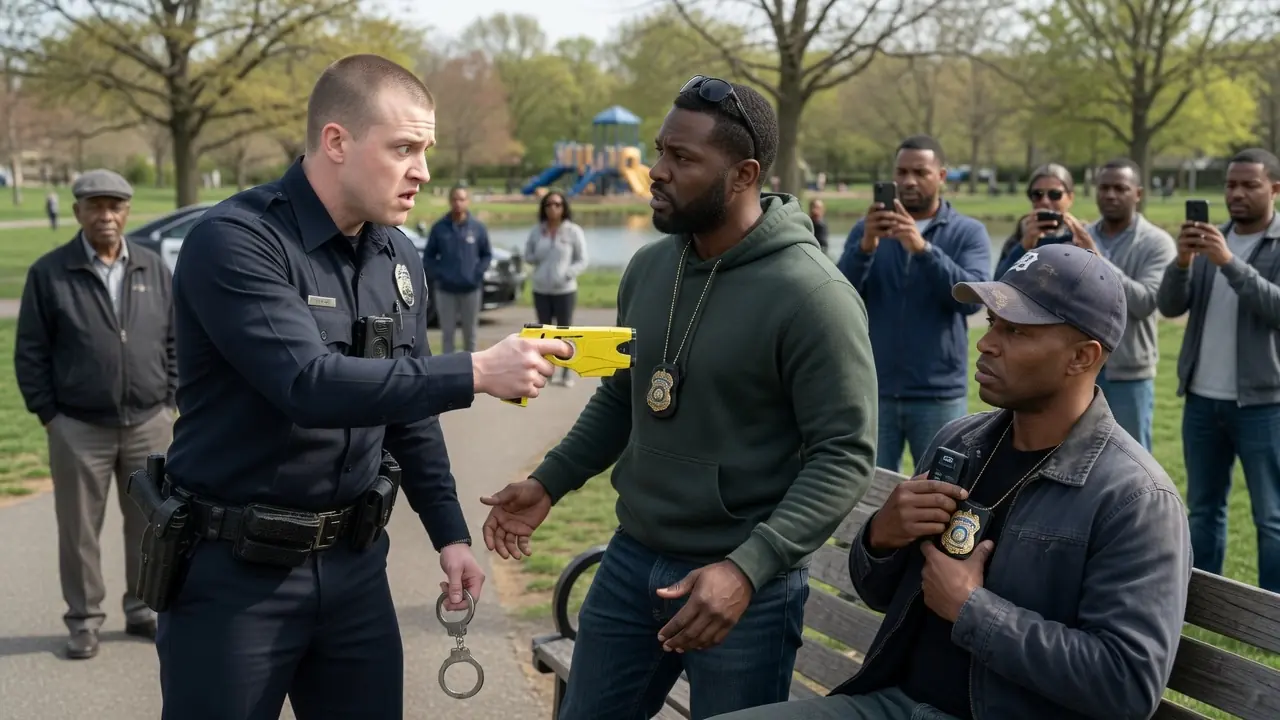
The arrival of the third man gave his assumptions a story.
Three men.
A silent meeting.
A bag.
Drugs, Wade decided.
He never saw narcotics.
He never saw money.
He never heard anyone discuss a crime.
He did not call a supervisor or request assistance from narcotics detectives.
He left his cruiser and crossed the grass with one hand resting near his duty belt.
Andre saw him approaching.
“Local officer,” he said.
Julian continued looking at his phone.
“Coming here?”
“Straight toward us.”
“Did Luis attract him?”
“He was watching before Luis arrived.”
Julian moved one hand beneath his navy jacket.
He did not reach for his service weapon.
He pressed the switch on the small recorder clipped inside the fabric.
The device was meant to document the evidence transfer.
Now it would preserve something else.
Wade stopped in front of the bench.
He did not introduce himself.
He did not ask whether they needed help.
His eyes went immediately to the duffel bag.
“What are you two doing out here?”
Andre looked toward the nameplate on his uniform.
“Enjoying the park.”
“What’s in the bag?”
“That belongs to us,” Julian answered.
Wade’s mouth tightened.
“I asked what’s inside.”
“And we answered that it’s private.”
The officer stepped closer.
“I watched another man hand it to you and leave.”
Andre remained seated.
“Is receiving a bag illegal?”
“You think this is a game?”
“No.”
“I’ve been watching you.”
“For what reason?”
Wade pointed toward the bag.
“Because people don’t sit around a park waiting for silent deliveries unless they’re hiding something.”
A woman pushing a stroller glanced toward them.
Several joggers slowed.
Andre asked, “Are we being detained?”
“I’m asking questions.”
“That was not my question.”
Wade’s face hardened.
“You people always start quoting laws the moment an officer gets close.”
Julian looked at him.
“What do you mean by ‘you people’?”
“You know exactly what I mean.”
Wade reached toward the bag.
Andre placed one hand on its strap.
“We do not consent to a search.”
The officer looked almost pleased.
“There it is.”
“There is what?”
“Obstruction.”
Julian shook his head.
“Refusing an unlawful search is not obstruction.”
Wade raised his voice.
“I saw a suspicious exchange.”
“You saw one person hand another person a bag.”
“I know what a drug deal looks like.”
Andre remained calm.
“Did you see drugs?”
“No.”
“Money?”
“No.”
“Did you hear a discussion about illegal activity?”
“I don’t need to explain police work to you.”
“You do if you intend to detain us.”
Wade noticed people watching.
An elderly man near the pond had raised his phone.
Instead of becoming more careful, the officer became louder.
“Put that phone away!”
The witness did not comply.
Andre looked toward Wade’s chest.
The body camera indicator was dark.
“Officer, is your camera recording?”
Wade glanced down.
That involuntary movement answered the question.
Julian said, “You approached us, accused us of committing a crime, and attempted to search our property without turning it on.”
Wade pressed the activation button.
The camera sounded a short tone.
Only then did the department’s official version begin.
“What happened before you activated it?” Julian asked.
“Nothing.”
“The recording in my jacket will disagree.”
The officer did not seem to hear the warning.
He was too focused on regaining control.
“Stand up.”
Andre remained seated.
“Are we detained?”
“I said stand.”
“State the reason.”
“Suspicion of narcotics activity.”
“Based on a bag?”
“Based on my training.”
Julian looked toward the black duffel.
Inside were photographs of modified freight trailers, payment records, coded delivery schedules, and a burner phone containing communications between an interstate trafficker and someone inside law enforcement.
The evidence had cost six months of work.
Two previous informants had died.
Luis and his family would be at risk if the operation became visible.
The agents could not allow Wade to seize the bag.
They also could not reveal their identities unless necessary.
A uniformed officer appearing at a covert handoff location could already be enough to alarm the criminal organization.
Wade removed handcuffs from his belt.
“Place your hands behind your backs.”
Andre looked at the cuffs.
“For what charge?”
“Resisting.”
“We have not resisted anything.”
“You refused a lawful order.”
“No lawful order was given.”
The metal bracelet clicked open.
The crowd drew farther away.
A child near the slide began crying.
Andre spoke slowly.
“Call your supervisor.”
“I don’t need a supervisor.”
“Yes, you do.”
The officer’s expression changed.
He heard the warning as disrespect.
He returned one cuff to his left hand and drew his taser with the right.
The electrical arc cracked sharply in the afternoon air.
The elderly witness’s video captured several people flinching.
Wade aimed the weapon at Andre’s chest.
“Last chance. Give me the bag.”
Andre spread his hands across his knees.
Julian did the same.
Neither man moved toward his concealed firearm.
“You have no probable cause,” Julian said.
“I decide that.”
“No,” Andre replied. “The law does.”
“You think you know my job better than I do?”
“We know what authority does and does not permit.”
Wade stepped closer.
“You’re making this difficult because you think the rules don’t apply to you.”
Andre looked directly at him.
“Did you approach us because we are Black?”
Wade laughed once.
“That has nothing to do with it.”
“Would you have watched two white men sitting on this bench for fifteen minutes?”
“I watched you because you looked suspicious.”
“What did we do before the bag arrived?”
“You were waiting.”
“In a park.”
“You kept looking around.”
“We were sitting in public.”
Wade’s breathing became heavier.
“All that matters is you’re two Black men receiving a bag.”
The park grew silent around them.
The officer continued before judgment could catch up with anger.
“Your kind does this every day, and I’m not pretending I didn’t see it.”
At the council hearing months later, that was the sentence that made Tyler Wade finally look up.
He saw council members staring at him.
He saw Carlos Medina’s wife wiping tears from her face.
He saw Isaiah Turner sitting beside his mother.
The recording continued.
Julian’s voice remained calm.
“You should walk away before you destroy your career.”
“Threatening an officer is a crime.”
“That was advice.”
Wade raised the taser higher.
“You’re both under arrest.”
Andre and Julian exchanged a glance.
The agents had trained for confrontations in which revealing federal credentials could expose an operation.
They had also trained for the danger of reaching beneath clothing while another armed person was frightened.
Andre spoke carefully.
“We are going to retrieve identification from beneath our shirts.”
“Do not reach.”
“You ordered us to identify ourselves.”
“I ordered you to give me the bag.”
“Our credentials are hanging around our necks,” Julian said. “Tell us how you want us to move.”
Wade stared at them.
The taser remained pointed toward Andre’s chest.
“Two fingers,” he finally said. “Slowly.”
Andre reached beneath his sweatshirt.
Julian opened his jacket.
Two leather credential wallets appeared.
They opened them at the same time.
The gold badges caught the sunlight.
Andre Mercer.
Special Agent.
Federal Bureau of Investigation.
Julian Hayes.
Special Agent.
Federal Bureau of Investigation.
The power inside the encounter reversed instantly.
Wade’s hand began shaking.
The certainty disappeared from his face.
“You should have said that at the beginning.”
Andre let the badge hang against his chest.
“Lower the taser.”
“How was I supposed to know?”
“Lower it.”
Wade slowly lowered the weapon.
Julian looked at him.
“You were not supposed to know we were agents.”
“I was doing my job.”
“Your job required probable cause before the badges appeared.”
“You were acting suspicious.”
“We were sitting on a bench.”
“A man handed you a bag.”
“That is not a crime.”
Wade returned the taser to his belt, fumbling with the clasp.
“If you had identified yourselves, none of this would have happened.”
Andre stood.
The officer stepped backward without realizing it.
That movement angered Andre more than the threat had.
Wade had not become less powerful.
Andre had not become more innocent.
Only the officer’s perception had changed.
“The bag contains evidence in an active federal organized-crime investigation,” Andre said.
Wade looked toward it.
“You almost exposed a confidential informant. You almost seized protected evidence. If you had arrested us or opened that bag, you could have endangered multiple lives.”
“I didn’t know.”
“You keep saying that as though ignorance excuses everything.”
Julian removed the recorder from inside his jacket.
“And everything you said before turning on your camera is here.”
Wade stared at the device.
“What?”
“The accusations. The unlawful demands. The comments about our race. The taser.”
The officer looked around.
Only then did he seem to notice the phones surrounding him.
“Let’s calm this down.”
Andre’s expression became cold.
“We were calm when you arrived.”
Wade reached for his radio, then hesitated.
Julian noticed.
“You don’t want to call anyone.”
“I’m assessing the situation.”
“You’re deciding whether you can leave before your supervisor learns what happened.”
The officer pressed the radio button.
“Dispatch, Unit Fourteen.”
“Go ahead, Fourteen.”
“I need a supervisor at Riverside Park.”
“Nature of request?”
Wade looked at the two badges.
“Officer-involved incident.”
Andre stepped near the shoulder microphone.
“This is FBI Special Agent Andre Mercer. We need a patrol supervisor and watch commander. Officer Wade threatened two federal agents with a taser during an active operation.”
The dispatcher paused.
“Copy. Supervisor responding.”
Wade glared at him.
“You did not have to say all of that over the radio.”
“Yes,” Andre replied. “I did.”
Sergeant Maria Alvarez arrived four minutes later.
She had sixteen years of experience and an expression that rarely revealed what she thought before gathering facts.
She noticed the open handcuffs first.
Then the taser.
Then the badges and the duffel bag.
“What happened?”
Wade answered before anyone else.
“I observed a possible drug transaction. The subjects refused lawful commands and became combative. I displayed the taser for safety. They then identified themselves as federal agents.”
Alvarez turned toward Andre.
“Agent?”
Julian held up the recorder.
“We have the full interaction. Officer Wade approached without witnessing a crime, initiated an unlawful detention, demanded evidence from a federal operation, made explicit racial statements, and threatened us with a taser.”
The sergeant’s expression tightened.
“Explicit statements?”
“He said the only thing that mattered was that we were Black.”
Wade shook his head.
“They are removing the statement from context.”
The elderly witness stepped closer.
“No, they’re not.”
Alvarez turned.
“My name is Harold Kent. I recorded most of it.”
Another woman raised her phone.
“I did too.”
Alvarez looked at Wade’s camera.
“When did you activate your body camera?”
“During the contact.”
“Before or after you attempted to detain them?”
He did not answer.
“Officer Wade, step away from the agents.”
“Sergeant—”
“Now.”
Wade moved toward a second patrol car.
Alvarez asked Andre and Julian whether either had been physically touched and whether the bag had been opened.
When they answered no, she allowed them to leave immediately with the evidence.
Before carrying the bag away, Andre looked toward Wade.
The rookie stood beside his patrol car, staring at the ground.
“You believe this went wrong because we were FBI,” Andre said.
Wade did not answer.
“It went wrong before you knew.”
The agents drove directly to the federal field office.
For the first ten minutes, neither spoke.
Adrenaline faded, leaving anger and exhaustion behind.
Julian looked through the passenger window.
“He almost fired.”
“I know.”
“If he saw the weapon beneath your sweatshirt before the badge—”
“I know.”
Julian closed his eyes.
“My daughter thinks my work is mostly paperwork.”
“It is.”
“The paperwork has tasers now.”
Andre almost smiled.
Then Julian looked toward the bag.
“What about Luis?”
“We move him tonight.”
“The police response might have exposed the handoff.”
“We assume the organization saw it.”
The informant and his family were relocated before sunset.
At the field office, Supervisory Special Agent Dana Whitaker waited behind her desk.
The quieter her voice became, the more dangerous her anger usually was.
“Close the door.”
Andre and Julian sat across from her.
Julian placed the recording device on the desk.
Whitaker listened to the encounter from beginning to end.
When Wade’s racial statement played, she stopped taking notes.
When the taser cracked, her fingers tightened around her pen.
After the recording ended, she remained silent for several seconds.
“Was the evidence damaged?”
“No.”
“Was the source compromised?”
“Unknown.”
“Does the department know what was in the bag?”
“Only that it related to a federal operation.”
Whitaker made three telephone calls.
The police chief.
The United States Attorney’s Office.
The Department of Justice civil-rights coordinator.
By evening, Wade had been placed on administrative leave.
The police department released a statement the next morning promising transparency.
It described the allegations as deeply troubling.
The statement did not mention the previous complaints.
Harold Kent’s phone video reached social media two days later.
It showed Wade standing over the seated men with a taser in one hand and handcuffs in the other.
The audio was clear.
The video spread nationally.
A local reporter named Natalie Cross received copies of the three earlier complaints in an anonymous envelope.
She found Carlos.
Then Isaiah.
Then Leonard.
Their stories followed the same pattern.
Wade saw something ordinary.
He decided it was suspicious.
He escalated when questioned.
His supervisor accepted the officer’s version.
Complaints were closed.
Internal investigators searched department records.
They discovered Wade had activated his body camera late during eleven separate encounters.
They also recovered messages between Wade and Lieutenant Gregory Hall, the supervisor who had reviewed all three complaints.
After Isaiah’s mother filed hers, Wade wrote:
She is making it about race because her son got caught acting suspicious.
Hall replied:
Don’t worry. I’ll handle the paperwork.
After Leonard’s complaint, Wade asked whether the incident could affect his probationary period.
Hall answered:
No video. Your word against his.
The department had not simply failed to correct Wade.
It had rewarded the belief that the truth belonged to whoever wore the uniform.
Wade was fired three weeks after the park incident.
His termination cited racial profiling, unlawful detention, failure to activate his camera, misuse of a taser, dishonesty during the investigation, and interference with a federal operation.
Lieutenant Hall was suspended.
He retired before disciplinary proceedings concluded, but the city investigation found that he had minimized complaints and rewritten summaries to protect officers under his command.
That discovery led to the public council hearing.
The recording ended.
The lights inside the chamber came back on.
Councilwoman Franklin looked toward Wade.
“Did Agent Mercer threaten you before you drew the taser?”
Wade leaned toward the microphone.
“He told me I was making a serious mistake.”
“Was that a threat?”
“At the time, I interpreted it as one.”
“Did he raise his voice?”
“No.”
“Stand?”
“No.”
“Move toward you?”
“No.”
“Reach for a weapon?”
“No.”
Franklin glanced toward the transcript.
“You testified in your initial report that both men were aggressive.”
“They were verbally confrontational.”
“By asking whether they were detained?”
Wade’s attorney shifted in his chair.
The councilwoman continued.
“Did you observe narcotics?”
“No.”
“Money?”
“No.”
“Any known criminal activity?”
“No.”
“What objective fact established a drug transaction?”
“The nature of the handoff.”
“One man giving another man a bag?”
“In context.”
“What context?”
Wade had no answer that did not reveal the same assumptions already captured on the recording.
Franklin looked toward Andre and Julian.
“At what point did the officer’s behavior change?”
Julian answered.
“When he saw the badges.”
“Not when he saw the valid legal objections?”
“No.”
“Not when witnesses challenged his account?”
“No.”
“When he learned your jobs?”
“Yes.”
Andre leaned toward his microphone.
“That is why the badges should not be treated as the twist that made the incident serious. The officer should have respected our rights before knowing whether we were federal agents.”
Carlos Medina lowered his eyes.
Andre looked toward him.
“Mr. Medina had the same rights. So did Isaiah. So did Mr. Briggs.”
The city eventually settled the civil claims for just under one million dollars.
The settlement created an independent review board for complaints involving racial bias.
Supervisors could no longer close such complaints without outside review.
Body-camera systems were modified to alert commanders when officers repeatedly activated them late.
Probationary officers receiving multiple similar complaints would be removed from street duty pending investigation.
Officers were required to document specific, objective facts supporting a search or detention.
The reforms did not erase bias.
They made it harder to hide.
Wade appealed his termination twice.
His attorney argued that he had been inexperienced, poorly supervised, and inadequately trained.
Some of that was true.
His supervisors had encouraged his worst instincts.
They taught him that aggressive behavior would be defended as initiative.
They showed him that complaints could be dismissed without consequence.
But Wade had also made choices.
He chose to watch two men until harmless behavior looked criminal.
He chose not to activate his camera.
He chose to ignore every answer that challenged his assumptions.
He chose the taser.
He chose the words that revealed what he had believed before ever leaving his patrol car.
Both appeals failed.
His law-enforcement certification was revoked.
Meanwhile, the federal operation continued.
Investigators examined the burner phone from the duffel bag and discovered that the trafficking leader’s unidentified police contact was a senior narcotics detective in a neighboring county.
The detective had been selling information about surveillance teams, informants, and upcoming searches.
He had caused the earlier investigations to fail.
Agents arrested him before dawn.
More than one hundred thousand dollars in hidden cash was recovered from his garage.
The trafficking leader was captured hours later while attempting to leave the state on a private plane.
Eleven members of the organization were arrested.
Luis Navarro and his family survived.
Andre and Julian received commendations for protecting the evidence and completing the operation.
Neither displayed the certificate.
Nearly a year after the hearing, Andre returned to Riverside Park.
Children played near the fountain.
Joggers passed beneath the trees.
An elderly couple occupied the same bench where the duffel bag had rested.
Harold Kent recognized Andre near the pond.
He approached with a walking cane.
“Agent Mercer.”
“Mr. Kent.”
Harold raised his phone.
“I still keep it charged.”
Andre smiled.
“You made it difficult for anyone to change the story.”
“That was the idea.”
They watched the park in silence.
After a moment, Harold asked, “Do you believe that officer learned anything?”
“I don’t know.”
“The department?”
“Some people did.”
Harold studied him.
“That doesn’t sound very hopeful.”
Andre looked toward the bench.
“Hope isn’t believing one case fixes everything. Hope is making the next complaint harder to bury.”
A patrol car entered the eastern parking lot.
Andre’s shoulders tightened before he could stop them.
The reaction angered him.
The vehicle parked near the running path.
A female officer stepped out and approached an older man who had fallen beside the curb.
She stopped several feet away.
Asked whether he needed help.
Requested permission before touching his arm.
Called paramedics.
Then she remained beside him until help arrived.
No weapon was drawn.
No accusation was made.
Harold nodded toward the scene.
“That is how it should happen.”
“Yes.”
After Harold left, Andre sat on an empty bench.
He remembered Wade standing over him with the taser.
I decide that.
It was a dangerous belief for anyone carrying authority.
Police officers made difficult decisions.
They entered uncertain situations most people avoided.
But a badge did not make suspicion true.
A weapon did not make an order lawful.
And no one should need federal credentials hanging from his neck before his constitutional rights became visible.
Andre watched people talking, reading, eating lunch, and waiting for friends.
They were doing nothing important.
That was exactly the importance of it.
A public park belonged to people who had no explanation for sitting there beyond wanting a quiet place to rest.
Andre remained until the sunlight began falling behind the city buildings.
Then he stood and walked toward the exit.
No one stopped him.
No one demanded to know what he had been doing.
No one asked him to prove he belonged.
For everyone else, it was an ordinary walk through an ordinary park.
For Andre Mercer, it felt like the quiet return of something that should never have been taken.