The taser made a sharp electric crack in Officer Ryan Caldwell’s hand.
Several people near the playground turned at the sound.
A little boy stopped halfway down a slide. A woman walking a golden retriever pulled the dog closer. Two joggers slowed near the edge of the path, uncertain whether they were watching an arrest or the beginning of something far worse.
Caldwell stood in front of a park bench with his legs spread and his shoulders squared. A pair of handcuffs hung from his left hand. The taser in his right was pointed directly at the two men seated before him.
“Last chance,” he said. “Give me the bag, or both of you are going to jail.”
The taller of the two men, Damon Wright, kept both hands resting openly on his knees.
“We haven’t committed a crime.”
Caldwell stepped closer.
“I decide that.”
Beside Damon, Kelvin Miles looked briefly toward the black duffel bag resting between them. The bag appeared ordinary, almost cheap, with faded stitching along one handle and a small tear near the zipper.
Nothing about it suggested that eleven arrests, six months of federal surveillance, and the lives of three confidential informants depended on it reaching a secure room before sunset.
Kelvin returned his gaze to the officer.
“You don’t have probable cause to search us,” he said.
Caldwell’s face tightened.
“You people always think you know the law better than the police.”
A murmur passed through the nearby crowd.
Damon’s expression did not change, but something behind his eyes became still.
“Officer,” he said, “before you touch that bag, call your supervisor.”
Caldwell laughed.
It was not a nervous laugh. It was the satisfied sound of a young man who believed every person around him had finally understood who was in control.
“My supervisor isn’t here,” he said. “I am.”
Then he lifted the taser higher.
That was the moment everything changed.
But the trouble had begun almost twenty minutes earlier, when Riverside Park still looked peaceful.
It was late April, the kind of Thursday afternoon that made office workers search for excuses to leave early. The sun was bright without being hot, the grass had recently been cut, and the breeze carried the smell of river water and flowering trees through the eastern side of the park.
Families crowded the playground. Retired couples walked slowly around the pond. College students sat in groups with books open but unread.
Damon Wright and Kelvin Miles occupied a wooden bench near the east entrance.
To anyone passing by, they looked like two friends wasting an afternoon.
Damon wore jeans, gray sneakers, and a dark green hooded sweatshirt. At thirty-four, he had a broad, athletic build, but his relaxed posture made him appear smaller than he was. A pair of sunglasses rested on his head, and his phone lay face down beside his thigh.
Kelvin, thirty-two, wore a faded Detroit Tigers cap and a navy jacket. He was thinner than Damon, with the quiet manner of a man who noticed everything while pretending to notice nothing.
They had been FBI special agents for nine and seven years.
Neither man looked like one.
That was intentional.
For the previous six months, they had been part of an undercover investigation into an interstate trafficking organization led by a businessman named Victor Salazar. Salazar publicly owned trucking companies and two warehouse facilities. Privately, he moved narcotics, stolen weapons, and cash through three states using legitimate freight routes.
The Bureau had been close to him twice.
Both times, Salazar had discovered the investigation before agents could move.
A witness disappeared after the first attempt.
A second informant was found dead beside an abandoned railroad line.
This time, the operation had been built differently. Information was divided among small teams. Electronic communication was limited. Even local law enforcement had not been fully briefed because investigators believed someone inside a nearby department might be leaking information.
The black bag on the bench contained the most valuable evidence the operation had produced.
Inside were freight schedules, photographs of hidden compartments in tractor-trailers, records of cash payments, and a burner phone containing messages between Salazar and someone identified only as “R.C.”
Damon checked his watch.
Their contact was six minutes late.
“Think he got nervous?” Kelvin asked without looking up from his phone.
“He’s always nervous.”
“He was less nervous before his cousin disappeared.”
Damon watched a group of children chase one another around a fountain.
“That’s what keeps him alive.”
Kelvin nodded.
The contact was a warehouse worker named Luis Ortega. For three months, Luis had secretly photographed delivery records and copied information from the office of Salazar’s shipping manager.
He had agreed to help after his younger brother died from drugs distributed through one of Salazar’s routes.
Luis was not brave in the way movies portrayed bravery. His hands shook during meetings. He called Damon at odd hours to ask whether he was being followed. Twice, he almost abandoned the operation.
But each time, he returned.
At 3:18 p.m., Luis entered the park through the west gate.
He wore a tan jacket and carried the black duffel bag in his left hand.
Damon saw him first.
Kelvin put his phone into his pocket.
Luis followed the path toward them, never once looking directly at the bench. When he reached them, he stopped, placed the bag beside Damon, and quietly said, “Everything is there.”
Damon nodded.
Luis walked away.
The entire exchange lasted less than ten seconds.
No money changed hands.
No one whispered secret instructions.
One man brought a bag to two other men in a public park and left.
Inside a patrol car parked near the eastern lot, Officer Ryan Caldwell leaned forward over the steering wheel.
He had been watching Damon and Kelvin for nearly fifteen minutes.
Caldwell was twenty-six years old and had worn a police uniform for only eight months. His academy photograph still appeared new on the department’s website. In it, he stood straight-backed and smiling beside a flag, one hand resting proudly on a certificate.
He had entered the academy after leaving community college.
His father had been a corrections officer. His uncle had served as a deputy in another county. From childhood, Ryan had been told that authority belonged to men willing to seize it.
During training, instructors praised his confidence but repeatedly warned him about judgment.
He moved too quickly.
He treated uncertainty as evidence.
He saw disrespect where more experienced officers saw confusion or fear.
During his first eight months on patrol, three residents had filed formal complaints against him.
One was a delivery driver whom Caldwell detained behind an apartment building because he “could not explain his presence,” even though packages were stacked beside his van.
Another was a seventeen-year-old student stopped while walking home from basketball practice.
The third was a construction worker whom Caldwell ordered out of his truck after deciding the man looked “out of place” in an expensive neighborhood.
All three complaints alleged aggressive questioning and stops without legal justification.
All three were closed without discipline.
His training officer, Sergeant Paul Hennessy, had written that Caldwell required guidance but showed initiative.
Lieutenant Martin Voss had gone further.
“Rookies make mistakes,” he told the review board. “We shouldn’t destroy a promising career because a few people didn’t like being questioned.”
Caldwell learned the lesson the department had unintentionally taught him.
Confidence would protect him.
Complaints would disappear.
And suspicion did not need evidence if he described it forcefully enough afterward.
From his patrol car, he watched Luis hand over the bag.
Caldwell’s pulse quickened.
There it was.
The reason he had been waiting.
Three men meeting silently. One carrying a bag. No handshake. No friendly conversation.
To Caldwell, the scene could mean only one thing.
Drugs.
He did not call for backup.
He did not check whether narcotics officers were operating in the park.
He did not observe long enough to see whether money was exchanged.
He opened his door and walked quickly across the grass.
Damon noticed him when he was thirty yards away.
“Local officer,” Damon said.
Kelvin kept his eyes on his phone.
“Coming here?”
“Directly.”
“Did Luis attract attention?”
“No. The officer was already watching us.”
Kelvin slipped the small recording device inside his jacket into the active position.
The device was meant to document the handoff and any conversation with Luis. It would now record whatever came next.
Caldwell stopped directly in front of the bench.
He did not introduce himself.
He looked down at Damon, then at Kelvin, and finally at the bag.
“I knew your kind was always up to something.”
Kelvin slowly raised his eyes.
Damon’s voice remained neutral.
“Excuse me?”
“Don’t play games with me. I’ve been watching you.”
“For what reason?” Damon asked.
Caldwell pointed toward the bag.
“That man walked over, handed you that, and left without saying anything. What’s inside?”
Damon glanced at the officer’s nameplate.
Caldwell.
“Are we suspected of a specific crime, Officer Caldwell?”
“I asked what’s in the bag.”
“And I asked whether we are suspected of a crime.”
Caldwell’s jaw moved as if he were chewing something hard.
“You think you’re clever?”
“No,” Damon said. “I think I’m sitting on a bench in a public park.”
A few yards away, a young mother gathered her toddler and began moving toward the playground exit.
Caldwell noticed people watching.
Instead of lowering his voice, he raised it.
“I saw a suspicious exchange. You’re going to give me the bag.”
Kelvin leaned back slightly.
“We do not consent to a search.”
Caldwell laughed once.
“I don’t need your consent.”
“Then obtain a warrant,” Kelvin said.
The officer’s eyes narrowed.
He had expected nervousness.
He had expected excuses, perhaps an attempt to walk away. Instead, both men remained calm and spoke with a precision that made him feel as though he were the one being examined.
That feeling angered him.
Caldwell stepped closer until the tips of his boots nearly touched Damon’s shoes.
“Stand up.”
Damon did not move.
“Are we being detained?”
“I said stand up.”
“That does not answer the question.”
Caldwell’s right hand moved toward his belt.
The crowd around them had become quieter.
An elderly man sitting near the pond raised his phone and began recording.
Caldwell noticed him.
“Put that phone down,” he shouted.
The man hesitated but kept filming.
Damon spoke slowly.
“Officer, there are witnesses present. Your body camera is recording. You should call your supervisor before you continue.”
The small light on Caldwell’s body camera was not on.
He had never activated it.
Department policy required officers to begin recording before initiating investigative contact, but Caldwell often waited until an encounter became physical. He disliked reviewing footage that showed the uncertain moments before he took control.
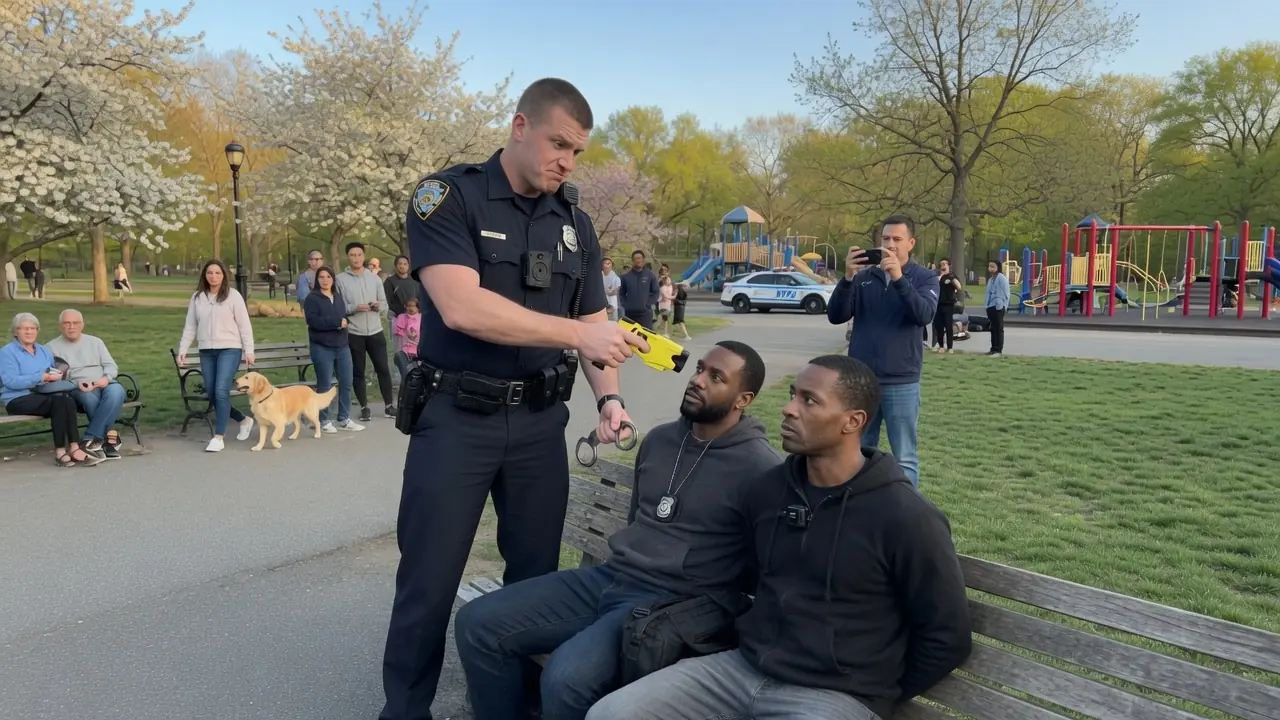
Kelvin looked at the dark camera.
“Your camera isn’t recording.”
Caldwell glanced down.
That single movement revealed that Kelvin was correct.
Caldwell pressed the activation button.
A tone sounded.
The camera began recording after the detention had already started.
“What happened before you turned it on?” Kelvin asked.
“Nothing happened.”
“You accused us of criminal activity and demanded our property.”
“I’m conducting an investigation.”
“Based on what?”
“I saw a drug transaction.”
“No, you saw a bag change hands.”
“I know what a drug deal looks like.”
Damon’s voice hardened slightly.
“Did you see drugs?”
“No.”
“Money?”
“No.”
“Did you hear any conversation about drugs?”
Caldwell’s cheeks reddened.
“I don’t have to explain police work to you.”
“You do when you detain someone.”
Caldwell had reached the point where backing away felt impossible.
If he admitted he had seen nothing illegal, the watching crowd would know he had been wrong.
The two men would know.
His body camera would show him retreating.
He decided that the only way to regain control was to increase the pressure.
“Stand up and put your hands behind your backs.”
Kelvin’s eyes moved briefly to Damon.
Damon remained still.
“On what charge?”
“Obstruction.”
“We haven’t obstructed anything.”
“You refused a lawful order.”
“The order was not lawful.”
Caldwell pulled the handcuffs from his belt.
The metal clicked as he opened one bracelet.
People nearby took several steps back.
“Both of you are under arrest.”
Damon looked at the handcuffs.
“Officer Caldwell, listen carefully. You are making a serious mistake.”
Caldwell heard a threat rather than a warning.
His left hand tightened around the cuffs. With his right, he drew the taser.
A woman near the playground gasped.
Caldwell pointed the weapon at Damon’s chest.
“Threatening an officer is a crime.”
“I didn’t threaten you.”
“You said I was making a mistake.”
“You are.”
“Hands where I can see them.”
Damon spread his fingers over his knees.
Kelvin did the same.
The black duffel bag remained between them.
Caldwell’s breathing became heavier.
“You think the rules don’t apply to you.”
Kelvin’s voice was quiet.
“No. We think the rules apply to everyone, including you.”
The officer’s face changed.
Something controlled inside him broke loose.
“You two have been sitting here acting suspicious from the moment I arrived. Then another one of you walks up and hands you a bag. I know what people like you do.”
The elderly man’s phone captured every word.
Damon looked directly at Caldwell.
“People like us?”
“You know what I mean.”
“Say it clearly.”
Caldwell should have stopped.
He should have heard the warning in Damon’s voice, seen the phones raised around him, or noticed the cold professionalism with which both men studied every movement he made.
Instead, he became more reckless.
“All that matters is you’re two Black men receiving a bag in a park,” he said. “Your kind does this every day, and I’m not pretending I didn’t see it.”
Silence spread across the grass.
Even Caldwell seemed to hear the weight of his own words after they were spoken.
For a fraction of a second, uncertainty entered his eyes.
Then he lifted the taser higher.
“Last chance. Give me the bag.”
Damon inhaled slowly.
“Call your supervisor.”
“I don’t need a supervisor.”
“Yes,” Damon said. “You do.”
“Give me the bag.”
“No.”
Caldwell took one step forward.
“If you reach for us, the contents of that bag may become compromised,” Kelvin said.
“What does that mean?”
“It means you should call someone with enough experience to stop you.”
Caldwell’s thumb moved near the taser’s trigger.
“Stand up.”
Damon and Kelvin looked at one another.
They had both been trained for encounters where displaying federal credentials could destroy months of undercover work. They also knew that a taser strike could cause one of them to fall, exposing weapons concealed beneath their clothing.
If Caldwell saw those weapons before seeing their badges, the encounter could become fatal.
Damon gave Kelvin a slight nod.
“Slow movement,” Damon told the officer. “We are reaching inside our shirts for identification.”
Caldwell’s eyes widened.
“Do not reach.”
“We are federal agents.”
“Hands up!”
Damon stopped.
Kelvin’s hand froze near the zipper of his jacket.
“You told us to identify ourselves,” Damon said.
“I told you to give me the bag.”
Kelvin spoke carefully.
“Our credentials are hanging around our necks. We need permission to retrieve them without being shot or tased.”
A long second passed.
Caldwell stared at them.
The crowd stared at Caldwell.
Finally, he said, “Two fingers. Slowly.”
Damon reached beneath his sweatshirt and pulled out a leather credential case attached to a chain.
Kelvin did the same.
They opened the cases.
Gold badges appeared in the afternoon sun.
Damon Wright.
Special Agent.
Federal Bureau of Investigation.
Kelvin Miles.
Special Agent.
Federal Bureau of Investigation.
The transformation in Caldwell’s face happened almost instantly.
Confidence disappeared first.
Then color.
The taser remained raised, but his hand began to shake.
Damon let the badge hang against his chest.
“Lower the weapon.”
Caldwell stared at the credentials.
“You should have said that from the beginning.”
“Lower the weapon,” Damon repeated.
Caldwell slowly lowered the taser.
“How was I supposed to know?”
Kelvin looked at him with open disbelief.
“You weren’t supposed to know. You were supposed to obey the Constitution whether we had badges or not.”
“I saw a suspicious handoff.”
“You saw no crime.”
“I was doing my job.”
Damon stood.
Caldwell immediately stepped backward.
The shift was unmistakable. Less than a minute earlier, he had stood over Damon like a man certain of his power. Now he moved away without being told twice.
Damon was not much taller than Caldwell, but his presence had changed.
He was no longer merely a man on a bench.
He was an agent whose authority the officer recognized.
That difference made Damon angrier than the taser.
“The bag contains evidence connected to an active federal operation,” Damon said. “If you had seized it, arrested us, or exposed the identity of the man who delivered it, you could have endangered lives.”
Caldwell looked toward the west gate where Luis had disappeared.
“I didn’t know.”
“You keep saying that as though ignorance gives you permission.”
Kelvin removed the small recording device from inside his jacket.
“And everything before you activated your body camera was recorded.”
Caldwell stared at it.
“What?”
“Your first accusation. Your demand to search the bag. Your threat to arrest us. Your racial comments. All of it.”
Caldwell’s lips parted.
“I didn’t mean—”
“You said exactly what you meant,” Kelvin replied.
The officer looked around.
Only then did he seem to notice the witnesses.
Phones were raised in several directions. Parents had pulled their children away, but many adults remained. The old man near the pond was still recording.
Caldwell clipped the taser to his belt and fumbled with the latch.
“Let’s calm this down.”
Damon’s expression was cold.
“We were calm before you arrived.”
“I can explain what happened.”
“You’ll explain it to your supervisor.”
Caldwell reached toward his radio.
Then he hesitated.
Damon saw it.
“You don’t want to make the call.”
“I’m evaluating the situation.”
“No. You’re deciding whether you can leave before anyone in your department learns what you did.”
“That’s not true.”
Kelvin nodded toward the body camera.
“Then call.”
Caldwell pressed the radio button on his shoulder.
“Dispatch, Unit Twenty-Seven.”
“Go ahead, Twenty-Seven.”
“I need a supervisor at Riverside Park, east entrance.”
“Nature of request?”
Caldwell looked at Damon and Kelvin.
“Officer-involved incident.”
Damon stepped closer to the radio.
“Correction. This is FBI Special Agent Damon Wright. We need a patrol supervisor and the watch commander. The officer has threatened two federal agents with a taser during an active operation.”
The dispatcher went silent.
Then her voice returned, suddenly alert.
“Copy. Supervisor and additional units en route.”
Caldwell glared at Damon.
“You didn’t need to say all that over the radio.”
“Yes,” Damon said. “I did.”
The first supervisor arrived four minutes later.
Sergeant Elena Ruiz parked near the east gate and approached quickly. She had sixteen years of experience and the tired, observant face of someone who had learned that the quietest person at a scene often understood it best.
She saw the badges first.
Then the duffel bag.
Then Caldwell’s open handcuffs.
“What happened?” she asked.
Caldwell spoke immediately.
“I observed a suspected drug transaction. The subjects refused lawful commands and became confrontational. I displayed my taser for officer safety. They then identified themselves as federal agents.”
Ruiz looked toward Damon.
“Agent?”
Damon pointed to Kelvin’s recording device.
“We have the full interaction recorded. Officer Caldwell watched us sitting on a bench, approached without observing a crime, demanded classified material, attempted an unlawful arrest, made explicit racial statements, and pointed a taser at us.”
Ruiz closed her eyes briefly.
“Explicit statements?”
Kelvin answered.
“He said the only thing that mattered was that we were Black and that people like us commit these crimes every day.”
Caldwell shook his head quickly.
“That’s being taken out of context.”
A voice came from behind the officers.
“No, it isn’t.”
The elderly man who had been recording stepped forward.
“My name is Arthur Bell. I heard everything. I have it on video.”
Ruiz looked at him.
“Please save that recording, sir.”
“I already sent it to my daughter.”
Another witness raised her hand.
“I recorded some of it too.”
Caldwell’s shoulders dropped slightly.
Ruiz turned toward him.
“Is your body camera active?”
“It is now.”
“When did you activate it?”
“During the contact.”
“Before or after you detained them?”
Caldwell did not answer.
Ruiz’s expression changed.
“Officer Caldwell, step away from the agents.”
He looked stunned.
“Sergeant—”
“Step away.”
Caldwell moved toward the grass.
Ruiz asked another officer to stand with him while she spoke privately with Damon and Kelvin.
“Was either of you physically touched?”
“No,” Damon said.
“Was the bag opened?”
“No.”
“Was your operation compromised?”
“We don’t know yet.”
Ruiz looked toward the park entrances.
“Do you need the area cleared?”
“Our contact is gone. We need to transport the evidence immediately.”
Ruiz nodded.
“I won’t delay you. I need contact information and confirmation that your supervisor will speak with our watch commander.”
“He already will,” Kelvin said.
Damon lifted the duffel bag.
Before leaving, he turned toward Caldwell.
The young officer stood near a patrol car, his face pale beneath the afternoon sun.
“You keep saying you didn’t know we were FBI,” Damon said. “That is not your defense. That is the problem.”
Caldwell looked down.
Damon and Kelvin left Riverside Park without another word.
They drove the bag directly to the FBI field office.
Neither spoke during the first ten minutes.
The adrenaline that had kept their movements precise began to fade, leaving behind exhaustion and anger.
Kelvin broke the silence.
“He almost fired.”
Damon kept his eyes on the road.
“I know.”
“If you’d moved faster for your badge—”
“I know.”
Kelvin looked through the passenger window.
“My daughter thinks I sit at a desk.”
Damon tightened his grip on the steering wheel.
“You do sit at a desk.”
“Sometimes.”
“Most dangerous desk in the building.”
Kelvin almost smiled, but the expression disappeared.
“What happens to Luis now?”
“We move him tonight.”
“Salazar’s people may have seen the police response.”
“We assume they did.”
The incident had not only endangered them.
It had created a visible police scene at a federal handoff point. If Salazar’s organization had been monitoring Luis, they would now know something had gone wrong.
By the time Damon and Kelvin entered the office of Supervisory Special Agent Marcus Harding, relocation teams were already preparing to move Luis and his family.
Harding stood behind his desk.
He was fifty-eight, with silver hair, a broad face, and the habit of becoming quieter as his anger increased.
“Close the door,” he said.
Damon closed it.
Kelvin placed the recorder on Harding’s desk.
Harding did not sit.
“Start at the beginning.”
They described everything.
The surveillance from the patrol car.
The approach.
The demand for the bag.
The failure to activate the body camera.
The threat of arrest.
The racial statements.
The taser.
When they finished, Harding pressed play.
Caldwell’s voice filled the office.
At first, it was impatient.
Then accusatory.
Then openly hostile.
Harding listened without interruption until the recording reached Caldwell’s statement about Black men and crime.
His eyes lifted toward Damon and Kelvin.
“He said this with people around?”
“Yes,” Kelvin answered.
Harding continued listening.
When the taser crack sounded, his hand tightened against the edge of the desk.
The recording ended with Sergeant Ruiz ordering Caldwell to step away.
Harding remained silent for several seconds.
“Is Luis secure?”
“Relocation team is moving him,” Damon said.
“The evidence?”
“In the secure lab.”
“Was the operation exposed?”
“We won’t know until we review Salazar’s communications.”
Harding picked up his phone.
He called the city’s police chief first.
Then the United States Attorney’s Office.
Then the FBI’s Office of Professional Responsibility and the civil rights coordinator assigned to the district.
Within an hour, the incident had become far larger than Caldwell imagined while walking back to his patrol car.
The police department placed him on administrative leave that evening.
Chief Benjamin Howard held a press conference the next morning.
He stood behind a podium beneath the department seal and said the allegations were deeply concerning. He promised transparency, accountability, and a thorough internal review.
He did not mention Caldwell’s three prior complaints.
At that point, the public did not know they existed.
That changed two days later.
Arthur Bell’s video appeared online first.
It showed Caldwell towering over the bench with the taser in his hand. The audio was clear enough to capture the racial statement and Damon’s repeated request for a supervisor.
The video spread rapidly.
Local news stations played it.
National outlets requested interviews.
Civil rights organizations demanded Caldwell’s termination.
Then a reporter named Natalie Reeves received an anonymous envelope at her newsroom.
Inside were photocopies of three complaints filed against Caldwell during his first eight months on the force.
Each one described the same pattern.
Observation without cause.
Aggressive questioning.
Escalation when challenged.
A claim afterward that the resident had behaved suspiciously.
Natalie began investigating.
She interviewed the delivery driver Caldwell had detained.
His name was Miguel Alvarez, a forty-nine-year-old father of three who had delivered packages in the city for eleven years.
“He kept asking why I was behind the building,” Miguel said. “I pointed to the van. I showed him the packages. He said criminals use delivery uniforms too.”
The second complainant was seventeen-year-old Jamal Price.
Caldwell had stopped him while he was carrying basketball shoes and a school backpack.
“He told me the neighborhood had reported break-ins,” Jamal recalled. “Later we found out there hadn’t been any break-ins that week.”
The third complainant, construction worker Leonard Brooks, had been ordered to kneel beside his truck while Caldwell searched the vehicle.
Leonard’s employer had called the department to confirm he was working at the house.
Caldwell kept him there another eighteen minutes.
All three complaints had been reviewed by Lieutenant Martin Voss.
All three had been closed.
Natalie’s report aired on Monday evening.
By Tuesday morning, the department’s internal investigation had expanded beyond Caldwell.
Investigators examined emails, training evaluations, body-camera activation records, and complaint reviews.
They discovered that Caldwell had failed to activate his camera at the beginning of eleven separate encounters.
They also found messages between Caldwell and Lieutenant Voss.
In one message, written after the complaint from Jamal’s mother, Caldwell said, “She’s making it about race because her kid got caught acting suspicious.”
Voss replied, “Don’t worry. I’ll handle the paperwork.”
Another message was more damaging.
After Leonard Brooks filed his complaint, Caldwell asked whether the incident could affect his probationary status.
Voss responded, “As long as there’s no video, it’s your word against his.”
The investigation was no longer about one reckless rookie.
It was about a supervisor who had protected him.
Harding read the messages in his office late one evening.
Damon stood near the window.
Kelvin sat across from the desk.
“This department had warning after warning,” Harding said. “They trained him to believe nothing would happen.”
Kelvin looked at the printed messages.
“Until he pointed a taser at someone with a federal badge.”
Harding nodded slowly.
“That is what bothers me most.”
Damon turned from the window.
“Those three men told the truth before we did.”
“Yes.”
“No one listened.”
Harding leaned back.
“They didn’t have recordings.”
“Arthur Bell did.”
“They didn’t have federal credentials.”
“No.”
Damon looked toward the dark city beyond the glass.
“The facts didn’t change. Only the importance assigned to the people reporting them.”
The police department fired Ryan Caldwell three weeks after the park incident.
His termination letter cited racial profiling, unlawful detention, failure to activate his body camera, misuse of a taser, dishonesty during an internal interview, and conduct that threatened an active federal investigation.
Lieutenant Martin Voss was placed on leave the same day.
He retired before disciplinary proceedings were completed, but the city later revoked portions of his retirement benefits after investigators found he had knowingly concealed misconduct.
Chief Howard announced new training requirements.
Many residents were not satisfied.
Training, they argued, would not explain why three complaints had been ignored.
The city council held a public hearing.
Miguel Alvarez spoke first.
He stood at a wooden podium in a borrowed suit while his wife watched from the second row.
“When Officer Caldwell stopped me, I did everything people tell you to do,” he said. “I stayed calm. I showed identification. I explained my job. I let him search because I was afraid saying no would make things worse.”
He paused and looked toward the council members.
“I filed a complaint because I thought the next person might not be safe. You closed it. Then there was a next person. And another. You did not act until he did it to FBI agents.”
Jamal’s mother spoke after him.
Then Leonard Brooks.
Damon and Kelvin attended but did not speak.
They sat quietly near the back.
For Damon, the most painful moment came when Jamal approached during a break.
The teenager was tall and thin, with the awkward posture of someone still growing into his body.
“You’re Agent Wright?” he asked.
“Yes.”
Jamal nodded.
“My mom said your case is why they finally believed us.”
Damon did not know how to respond.
Jamal continued.
“I’m glad you’re okay.”
“Thank you.”
The teenager looked toward the council chamber.
“But I wish they had believed me first.”
Damon felt the words settle heavily.
“So do I,” he said.
The legal consequences unfolded over the following months.
Damon and Kelvin filed a civil rights lawsuit against Caldwell and the city. Miguel, Jamal, and Leonard joined a separate action after investigators reopened their complaints.
The Department of Justice launched a review of the police department’s stop, search, complaint, and body-camera practices.
City attorneys initially argued that Caldwell had acted independently.
The emails from Lieutenant Voss destroyed that defense.
The evidence showed a department that had repeatedly received warnings and chose convenience over correction.
The city eventually agreed to a settlement.
The amount was substantial, but the reforms mattered more to Damon.
An independent civilian review board was established.
Officers were required to document specific facts supporting investigative stops.
Body-camera systems were modified so supervisors would receive automatic alerts when officers repeatedly activated cameras late.
Complaints alleging racial bias could no longer be closed solely by the officer’s direct chain of command.
Probationary officers with repeated allegations would undergo outside review.
The department also created a policy requiring officers to contact a supervisor before searching property claimed to involve federal, medical, legal, or journalistic materials, unless an immediate threat existed.
Caldwell appealed his termination twice.
Both appeals failed.
During the second hearing, his attorney argued that he had been young, poorly trained, and placed in a difficult situation without adequate supervision.
Damon listened from the rear of the room.
Some of that was true.
Caldwell had been poorly trained.
He had been protected when he should have been corrected.
He had been encouraged to interpret aggression as confidence.
But he had also made choices.
He chose to watch two men until ordinary behavior looked criminal.
He chose not to activate his camera.
He chose to ignore their legal objections.
He chose to draw a taser.
He chose the words that exposed what he had believed before he ever left his patrol car.
The review board upheld the firing.
Caldwell’s state certification was revoked months later.
The federal investigation into Victor Salazar continued despite the incident.
Luis Ortega and his family were moved to a secure location. For two weeks, agents believed the operation had been compromised.
Then technicians examined the burner phone from the duffel bag.
Among its encrypted messages were communications between Salazar and “R.C.”
At first, investigators feared those initials referred to Ryan Caldwell.
They did not.
They belonged to Raymond Cole, a senior narcotics detective in a neighboring jurisdiction.
Cole had been warning Salazar about surveillance operations for nearly two years.
The discovery explained why the earlier investigations had failed.
It also created a final twist no one expected.
Officer Caldwell’s reckless intervention had nearly destroyed the operation, but the evidence in the bag exposed a far more experienced officer who had been selling information to criminals.
Raymond Cole was arrested at his home before sunrise.
Agents found $180,000 in cash hidden beneath the floor of his garage.
Victor Salazar was arrested later that morning at a private airfield while attempting to board a chartered plane.
Eleven additional members of the trafficking organization were taken into custody across three states.
Luis’s information had been accurate.
The case ended with multiple convictions.
Damon and Kelvin received formal commendations, but neither displayed the certificate in his office.
For them, the operation would always be connected to the bench at Riverside Park.
Nearly a year after the incident, Damon returned there alone.
It was another Thursday afternoon.
Children played near the fountain. Joggers passed beneath the trees. An elderly couple occupied the bench where the black duffel bag had rested.
Arthur Bell recognized Damon near the pond.
He approached slowly with a walking cane.
“Agent Wright.”
Damon smiled.
“Mr. Bell.”
Arthur held up his phone.
“I still record faster than most young people.”
“You may have saved us.”
Arthur shook his head.
“You saved yourselves. I only made it harder for them to change the story.”
They stood together watching the park.
After a moment, Arthur asked, “Do you think that officer learned anything?”
Damon considered the question.
“I don’t know.”
“Do you think the department did?”
“Some people did.”
“That doesn’t sound very hopeful.”
Damon looked toward the bench.
“Hope isn’t believing one lawsuit fixes everything. Hope is making sure the next complaint can’t be buried as easily as the last one.”
Arthur nodded.
“That sounds like something an FBI agent would say.”
“It sounds like something my wife told me.”
Arthur laughed.
A patrol car entered the eastern parking lot.
Damon noticed it immediately.
For a moment, his body reacted before his mind did. His shoulders tightened. His eyes followed the vehicle until it parked.
A female officer stepped out and walked toward a man who appeared to have fallen near the running path.
She crouched beside him, asked permission before touching his arm, and called for medical assistance.
The scene was ordinary.
No one was accused.
No weapon was drawn.
The officer helped the man sit up and stayed with him until paramedics arrived.
Damon watched from a distance.
“That’s how it should be,” Arthur said.
“Yes.”
Damon eventually sat on an empty bench near the east entrance.
He thought about the words Caldwell had used that day.
I decide that.
It was a dangerous belief for anyone carrying a badge.
Police officers did make decisions. They faced uncertainty and risk. They entered situations most people tried to escape.
But authority was not ownership.
A uniform did not make suspicion true.
A weapon did not make an order lawful.
And a person should not need a federal badge hanging from his neck before his rights became visible.
Damon looked across the grass.
People sat, talked, read, slept, ate lunch, and waited for friends.
They were doing nothing important.
That was the importance of it.
A public park belonged to the public, including people who had no explanation for being there beyond the simple desire to sit beneath a tree.
Damon remained on the bench until the afternoon sun began to lower behind the buildings.
Then he stood and walked toward the exit.
No one stopped him.
No one asked what he had been doing.
No one demanded that he prove where he belonged.
For most people, it would have been an unremarkable walk across an ordinary park.
For Damon Wright, it felt like the quiet restoration of something that should never have been taken away.