The city attorney asked for the recording to be stopped.
No one on the civilian review board responded.
Inside the packed municipal hearing room, Officer Brandon Keller’s voice continued pouring from the speakers.
“All that matters is you’re two Black men receiving a bag in a public park.”
A pause followed on the recording.
Then Keller spoke again.
“Your kind does this every day, and I’m not pretending I didn’t see it.”
The attorney rose halfway from his chair.
“Madam Chair, we object to the recording being played without additional context.”
Chairwoman Helen Morris looked over her glasses.
“The officer’s own words are the context.”
She allowed the audio to continue.
A taser crack echoed through the hearing room.
Several people in the audience flinched.
At the witness table, former Officer Brandon Keller lowered his eyes.
He no longer wore a police uniform.
His dark suit fit badly across his shoulders, and without the badge, radio, duty belt, and weapon that had once surrounded him with authority, he appeared younger than twenty-seven.
Almost frightened.
Two rows behind him sat the men he had threatened that afternoon.
Ethan Cole and Marcus Reed wore plain suits and no visible badges. Nothing about their appearance revealed that they had spent a combined seventeen years conducting federal investigations.
Beside them sat three other men.
A delivery driver.
A high school student.
A construction foreman.
All had filed complaints against Keller before the incident in Riverside Park.
None had been believed.
The recording reached the moment Ethan warned the officer to call a supervisor.
Keller’s voice answered with complete confidence.
“My supervisor isn’t here. I am.”
The hearing room became still.
Six months earlier, Keller had believed that sentence was true in every way that mattered.
He believed the uniform made him the highest authority present.
He believed the people on the bench had to explain themselves to him.
He believed witnesses could be frightened into silence.
Most dangerously, he believed that even if he were wrong, the police department would protect him afterward.
Until that Thursday afternoon, experience had given him little reason to believe otherwise.
The confrontation began at 3:18 p.m.
At the time, Riverside Park looked peaceful.
Spring sunlight moved through flowering trees along the eastern path. Children crowded the playground. Office workers ate late lunches near the fountain, and retired couples walked slowly beside the river.
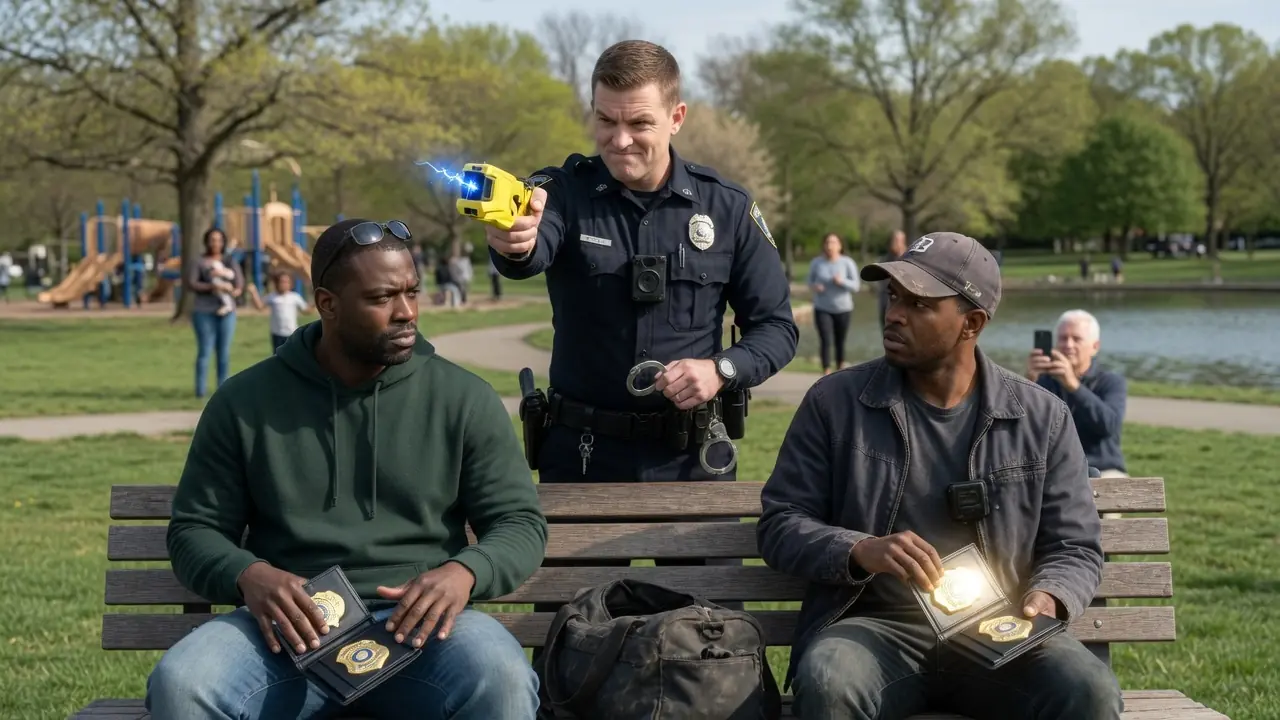
Ethan Cole and Marcus Reed sat on a wooden bench near the park’s east entrance.
To anyone passing, they looked like friends waiting for someone.
Ethan wore faded jeans, gray running shoes, and a dark sweatshirt. At thirty-five, he had a broad build and the relaxed posture of someone accustomed to making himself look less alert than he truly was.
Marcus, thirty-three, wore a navy jacket and an old Cleveland baseball cap. He was slimmer than Ethan and possessed the quiet, observant manner of a man who could remember every vehicle in a parking lot after seeing it only once.
Neither looked like a federal agent.
That was intentional.
For six months, they had been helping investigate an interstate trafficking organization led by shipping executive Adrian Vargas.
Vargas publicly owned two freight companies, several warehouses, and a chain of truck-maintenance centers.
Privately, his organization transported narcotics, illegal weapons, and unreported cash across three states by hiding contraband inside legitimate commercial shipments.
Federal investigators had nearly arrested him twice.
Both operations failed shortly before agents were scheduled to act.
A cooperating witness disappeared after the first attempt.
The body of a second informant was discovered beside an abandoned railway line after the next.
Someone had been warning Vargas.
The Bureau no longer trusted ordinary communication channels. Information was divided between small teams, and most local police departments had not been informed that the investigation existed.
The black duffel bag resting between Ethan and Marcus contained the strongest evidence gathered so far.
Photographs showed hidden compartments built beneath trailer floors.
Printed schedules identified shipments carrying weapons.
A burner phone contained messages between Vargas and an unidentified contact known only by the initials D.H.
Three confidential informants had risked their lives to obtain the material.
If the bag failed to reach the federal field office before sunset, months of work could collapse.
Ethan checked his watch.
Their source was late.
“Four minutes,” Marcus said.
“He’s never on time.”
“He used to be.”
“He used to believe his cousin was still alive.”
Marcus looked toward the western path.
The source’s name was Luis Navarro.
He worked in one of Vargas’s shipping warehouses and had begun cooperating after his younger brother died from drugs distributed through the same network.
Luis was not fearless.
His hands shook during meetings.
He changed telephone numbers constantly.
Twice, he called Ethan after midnight to say he wanted out.
Both times, he returned the next morning.
Fear did not make his actions less courageous.
It made the cost of them clearer.
At 3:22, Luis entered through the west gate.
He wore a tan jacket and carried the duffel bag low beside his leg.
He followed the path without looking toward the bench.
When he reached Ethan and Marcus, he stopped only long enough to set the bag between them.
“Everything’s there,” he murmured.
Ethan nodded.
Luis continued walking.
The exchange lasted fewer than ten seconds.
No money changed hands.
No secret envelope appeared.
One man delivered a bag and left.
From a patrol car parked near the eastern lot, Officer Brandon Keller leaned over his steering wheel.
He had already been watching Ethan and Marcus for nearly fifteen minutes.
Keller had graduated from the police academy eight months earlier.
His official photograph still appeared near the top of the department’s recruitment page. In it, he stood beside the American flag, smiling proudly while holding his certificate.
His father had worked in corrections.
An uncle had served as a sheriff’s deputy.
Keller grew up hearing that criminals survived because authority figures hesitated.
He entered police training determined never to hesitate.
Academy instructors praised his confidence.
They also warned that he treated uncertainty as guilt.
He moved too quickly.
He heard disrespect in ordinary questions.
He escalated minor encounters because backing away felt like weakness.
During his eight months on patrol, three citizens filed formal complaints against him.
A delivery driver said Keller detained him behind an apartment building despite the marked van and packages stacked beside him.
A seventeen-year-old student said Keller stopped and searched him while he walked home from basketball practice.
A construction foreman said Keller ordered him to kneel beside his truck because he appeared “out of place” in an expensive neighborhood.
All three complainants were men of color.
All three described aggressive questioning without legal justification.
All three complaints were closed.
Lieutenant Howard Price, Keller’s shift commander, described him as an energetic officer who needed experience.
When the construction foreman challenged the decision, Price gave a blunter answer.
“We’re not destroying a promising career every time someone dislikes being questioned.”
Keller absorbed the real lesson.
If he described his suspicions confidently enough, supervisors would accept them.
If no recording contradicted him, his version would become the official one.
From inside the patrol car, he watched Luis deliver the bag.
Three men.
Little conversation.
No friendly greeting.
To Keller, the scene confirmed what he had already suspected.
Drugs.
He did not contact narcotics officers.
He did not request backup.
He did not observe long enough to identify an actual crime.
He left the patrol car and crossed the grass.
Ethan saw him approaching from thirty yards away.
“Local patrol.”
Marcus kept his gaze on his phone.
“Watching us?”
“Looks that way.”
“Maybe Luis drew attention.”
“He was staring before Luis arrived.”
Marcus moved one hand inside his jacket and activated the compact audio recorder secured near his chest.
The device had been intended to preserve Luis’s statement during the evidence handoff.
It would now document something no one had planned.
Keller stopped directly in front of the bench.
He looked at Ethan.
Then Marcus.
Finally, the duffel bag.
“I knew you were up to something.”
Marcus slowly raised his eyes.
Ethan noticed the nameplate.
KELLER.
“Is there a problem, Officer?”
“I’ve been watching you.”
“For what reason?”
Keller pointed toward the bag.
“That man walked over, dropped this between you, and left. What’s inside?”
“Are we suspected of a specific crime?”
“I asked what’s inside.”
“And I asked why you’re questioning us.”
Keller’s jaw tightened.
“You think you’re clever?”
“I think we’re sitting in a public park.”
Several pedestrians began slowing nearby.
Keller raised his voice.
“I witnessed a suspicious exchange. Hand me the bag.”
Marcus leaned back slightly.
“We do not consent to a search.”
“I don’t need consent.”
“Then state your legal basis.”
Keller stepped closer.
His boots nearly touched Ethan’s shoes.
The calmness of the two men irritated him.
They did not behave like the nervous suspects he had imagined inside the patrol car.
They asked precise questions.
They watched him as though evaluating his decisions.
“Stand up,” he ordered.
“Are we detained?” Ethan asked.
“I said stand.”
“That does not answer the question.”
Keller’s hand moved toward his duty belt.
A woman near the playground gathered her child and began backing away.
An elderly man standing beside the pond raised his phone.
Keller noticed.
“Stop recording.”
The man kept filming.
“It is legal to record police in a public place,” Marcus said.
Keller looked toward him.
“You need to worry about yourself.”
Ethan glanced at the body camera attached to Keller’s chest.
Its indicator light was dark.
“Officer, your camera is not recording.”
Keller looked down involuntarily.
Marcus saw the movement.
“You initiated a detention without activating it.”
Keller pressed the button.
A tone sounded.
Only then did the official recording begin.
“What happened before you turned it on?” Marcus asked.
“Nothing.”
“You accused us of dealing drugs and demanded our property.”
“I’m investigating suspicious activity.”
“Did you see drugs?”
“No.”
“Money?”
“No.”
“Did you hear us discuss a crime?”
Keller’s face reddened.
“I do not have to explain police procedure to you.”
“You do if you detain us.”
The officer had reached the point where withdrawal felt more humiliating than escalation.
People were watching.
His body camera now recorded every movement.
If he admitted he had no evidence, the two men would know they had forced him to retreat.
He pulled the handcuffs from his belt.
“Stand up and place your hands behind your backs.”
Ethan looked at the cuffs.
“For what offense?”
“Obstruction.”
“We have not obstructed you.”
“You refused an order.”
“An unlawful order.”
The first cuff clicked open.
Several people moved farther away.
Keller lifted it toward Ethan.
“Both of you are under arrest.”
Ethan’s tone remained controlled.
“You need to call your supervisor.”
“I don’t need permission to arrest you.”
“You need someone experienced enough to stop this.”
Keller heard the statement as a challenge.
He returned the handcuffs to one hand and drew his taser with the other.
The weapon produced a sharp electric crack.
Children near the playground fell silent.
The elderly witness’s phone captured the sound clearly.
Keller aimed the taser at Ethan’s chest.
“Threatening an officer is another crime.”
“I did not threaten you.”
“You said I was making a mistake.”
“You are.”
“Hands where I can see them.”
Both men spread their fingers openly across their knees.
The duffel bag remained untouched.
Keller breathed more heavily.
“You people always think the law does not apply to you.”
Marcus’s expression became still.
“No. We believe it applies to you too.”
The officer stepped closer.
His fear of losing authority had become stronger than his fear of being wrong.
“You were acting suspicious from the moment I saw you. Then another one of you brought a bag.”
Ethan looked directly at him.
“Another one of us?”
“You know what I mean.”
“No,” Ethan said. “Explain it.”
Keller should have stopped.
He should have noticed the phones.
He should have heard how carefully the two men were encouraging him to state his assumptions aloud.
Instead, he said the words that would later be played at the hearing.
“All that matters is you’re two Black men receiving a bag in a public park.”
The surrounding crowd became silent.
“Your kind does this every day, and I’m not pretending I didn’t see it.”
For an instant, even Keller appeared surprised by what he had said.
Then pride forced him forward again.
“Last chance. Give me the bag.”
Ethan drew one slow breath.
“Call your supervisor.”
“My supervisor isn’t here.”
Keller lifted the taser higher.
“I am.”
Ethan and Marcus exchanged a brief glance.
Both carried concealed service weapons.
Retrieving federal identification required reaching beneath their clothing.
If Keller saw a firearm before seeing the badge, the confrontation could become fatal.
Ethan spoke carefully.
“We are going to identify ourselves. Our credentials are inside our clothing.”
“Do not reach.”
“You asked who we are.”
“I asked for the bag.”
Marcus kept his hands visible.
“Our identification is hanging beneath our jackets. We need clear permission before moving.”
The officer stared at them.
Around him, phones continued recording.
“Two fingers,” he finally said. “Slowly.”
Ethan reached beneath his sweatshirt and removed a credential wallet attached to a chain.
Marcus did the same.
Both opened them.
Gold badges caught the afternoon sunlight.
SPECIAL AGENT ETHAN COLE
FEDERAL BUREAU OF INVESTIGATION
SPECIAL AGENT MARCUS REED
FEDERAL BUREAU OF INVESTIGATION
The transformation in Keller’s face was immediate.
Confidence disappeared.
Then color.
His hand began shaking around the taser.
Ethan allowed the badge to rest against his chest.
“Lower the weapon.”
Keller stared at it.
“You should have told me earlier.”
“Lower the taser.”
The officer slowly complied.
“How was I supposed to know you were federal agents?”
Marcus looked at him.
“You were not supposed to know.”
Keller blinked.
“You were supposed to respect our rights even if we were unemployed, homeless, or carrying groceries.”
“I observed a suspicious transaction.”
“You observed a bag,” Ethan said.
“I was doing my job.”
“No. You created a crime inside your head and punished us for not agreeing with it.”
Ethan rose slowly.
Keller stepped backward.
That movement revealed more than any apology could have.
A minute earlier, the officer had stood over Ethan because he believed the seated man possessed no authority.
The federal badge changed his posture.
It should not have changed Ethan’s rights.
“The bag contains evidence in an active federal trafficking investigation,” Ethan said. “Three sources risked their lives to collect it.”
Keller looked toward the path Luis had taken.
“If you had opened it publicly, seized it, or arrested us, you could have exposed an informant and compromised multiple arrests.”
“I didn’t know.”
“You keep using ignorance as a defense.”
Marcus removed the recording device from his jacket.
“And the part before you activated your camera is here.”
Keller stared at it.
“You recorded me?”
“We were recording a federal evidence transfer.”
The officer looked toward the witnesses.
Only then did he appear to understand how thoroughly the incident had been documented.
“Let’s calm down.”
Ethan’s expression hardened.
“We were calm when you arrived.”
“I can explain.”
“Call your supervisor.”
Keller reached toward his radio, then stopped.
Marcus noticed.
“You don’t want to make the call.”
“I’m assessing the situation.”
“You’re deciding whether you can leave before your department learns what happened.”
Keller pressed the radio button.
“Dispatch, Unit Thirty-One.”
“Go ahead.”
“I need a supervisor at Riverside Park.”
“Reason?”
He looked at Ethan and Marcus.
“Officer-involved incident.”
Ethan stepped close enough for the radio to capture his voice.
“This is FBI Special Agent Ethan Cole. We need a patrol supervisor and watch commander. Officer Keller pointed a taser at two federal agents during an active operation.”
The dispatcher’s silence lasted less than a second but felt much longer.
“Copy. Units responding.”
“You did not need to say that over the radio,” Keller muttered.
“Yes,” Ethan said. “I did.”
Sergeant Olivia Ramirez arrived four minutes later.
She had sixteen years of patrol and supervisory experience. She approached without rushing, scanning the witnesses, the open handcuffs, the duffel bag, and the badges resting against the men’s chests.
Keller spoke first.
“I observed a suspected narcotics handoff. The subjects refused commands and became aggressive. I displayed the taser for safety. They then identified themselves as federal agents.”
Ramirez looked toward Ethan.
“What happened?”
Marcus held up the recorder.
“We have the complete encounter. Officer Keller approached without witnessing a crime, demanded protected evidence, initiated an unlawful arrest, made explicit racial statements, and threatened us with a taser.”
Ramirez’s face tightened.
“Explicit?”
“He said the only fact that mattered was that we were Black.”
Keller shook his head.
“That is taken out of context.”
The elderly witness stepped forward.
“It is not.”
Ramirez turned.
“My name is Walter Price. I recorded it.”
A woman near the playground raised her phone.
“So did I.”
Ramirez looked back at Keller.
“When did you activate your body camera?”
“During the encounter.”
“Before or after you attempted detention?”
He did not answer.
“Officer Keller, step away from the agents.”
“Sergeant—”
“Now.”
Keller moved toward a second patrol car.
Ramirez asked whether either agent had been touched and whether the bag had been opened.
Then she ordered the park contact ended so they could transport the evidence.
Before leaving, Ethan faced Keller.
The rookie stood beside the patrol vehicle, staring toward the grass.
“You keep saying you didn’t know we were agents,” Ethan said.
Keller did not look up.
“That is not what destroyed your career.”
The federal agents carried the duffel bag to their vehicle.
During the drive to the field office, neither spoke for several minutes.
Marcus eventually looked through the passenger window.
“He almost fired.”
“I know.”
“If you moved faster for the badge—”
“I know.”
Marcus exhaled slowly.
“My family thinks the dangerous part of this job is organized crime.”
Ethan kept his eyes on the road.
“Today it was a park bench.”
“What happens to Luis?”
“We move him immediately.”
“If Vargas had surveillance on the park—”
“We assume he did.”
The police confrontation had created a visible scene at the handoff location.
The informant’s life might already be in danger.
By the time they reached the federal office, Luis and his family were being moved to a protected location.
Their supervisor, Special Agent in Charge Gregory Shaw, listened to the entire recording without interrupting.
When Keller’s racial statement played, Shaw’s hand tightened around the desk.
When the taser crack sounded, he stopped the audio.
“Was the evidence compromised?”
“Unknown,” Ethan said.
“Informant?”
“Relocation in progress.”
Shaw made three calls.
The first went to the police chief.
The second went to the United States Attorney.
The third went to the Department of Justice’s civil-rights division.
By evening, Keller had been placed on administrative leave.
At a press conference the following morning, Police Chief Raymond Ellis promised a complete and transparent investigation.
He called the incident deeply concerning.
He did not mention Keller’s three earlier complaints.
Two days later, someone delivered copies of those complaints to investigative reporter Claire Bennett.
She interviewed each man.
Carlos Mendoza, the delivery driver, described being detained beside his marked van while Keller insisted that criminals sometimes used uniforms.
Seventeen-year-old Isaiah Grant said Keller stopped him after basketball practice and claimed burglaries had been reported in the area.
Records showed no burglaries had occurred that week.
Construction foreman Leonard Shaw described kneeling beside his truck while Keller searched it without finding anything.
All three complaints had been reviewed by Lieutenant Howard Price.
All three were dismissed.
The internal investigation expanded.
Investigators examined body-camera records and discovered Keller had activated his camera late during eleven encounters.
They recovered text messages between Keller and Price.
After Isaiah’s mother complained, Keller wrote:
She is turning it into a race issue because her son got caught acting suspicious.
Price replied:
Do not worry. I will handle the paperwork.
After Leonard filed his complaint, Keller asked whether it might affect his probationary status.
The lieutenant responded:
No video means it is your word against his.
The department had not merely failed to correct Keller.
It had trained him to believe he was protected.
Keller was fired three weeks after the park encounter.
His termination cited racial profiling, unlawful detention, misuse of a taser, failure to activate his camera, dishonesty during the investigation, and interference with a federal operation.
Lieutenant Price retired before disciplinary proceedings concluded.
Later findings established that he had knowingly concealed misconduct and altered complaint summaries to make Keller’s actions appear more reasonable.
The city council scheduled a public hearing.
Carlos Mendoza spoke first.
He stood at the podium in a borrowed suit.
“When Officer Keller detained me, I stayed calm,” he said. “I showed my identification. I explained my job. I allowed the search because I was afraid saying no would make him more aggressive.”
He looked at the council.
“I filed a complaint because I thought the next person might not survive it.”
The room became quiet.
“You ignored me. Then there was a next person and another. You acted only when he pointed the taser at federal agents.”
Isaiah spoke next.
Then Leonard.
Ethan and Marcus sat in the back row.
During a recess, Isaiah approached Ethan.
“You’re the agent from the park?”
“Yes.”
“My mother says your case made them reopen mine.”
Ethan nodded.
“I’m sorry it took that.”
Isaiah studied him.
“I’m glad you’re okay.”
“Thank you.”
“But I wish they believed me first.”
Ethan felt the sentence settle inside him.
“So do I.”
The Department of Justice opened a broader review of the police department’s stop, search, body-camera, and complaint practices.
City attorneys initially described Keller as a lone officer acting outside department values.
The messages from Lieutenant Price destroyed that argument.
The eventual civil settlement created an independent review board, automatic warnings for repeated late camera activation, and outside investigation of racial-bias complaints involving probationary officers.
The city paid substantial damages to Ethan, Marcus, Carlos, Isaiah, and Leonard.
The money drew headlines.
The policy changes mattered more.
Keller appealed his firing twice.
His attorney argued that he had been young, poorly supervised, and inadequately trained.
Some of that was true.
The department had encouraged his worst instincts.
It had dismissed warning signs.
It had taught him that confidence could replace evidence.
But Keller had also made choices.
He chose to interpret two men sitting in a park as criminals.
He chose to ignore their legal questions.
He chose not to activate his camera.
He chose to draw the taser.
He chose the words that revealed the assumptions he carried before leaving the patrol car.
Both appeals failed.
His law-enforcement certification was later revoked.
The trafficking investigation survived.
Technicians examined the burner phone from the black duffel bag and identified the person using the initials D.H.
Investigators originally feared that Keller might somehow be connected to the organization.
He was not.
The initials belonged to Detective Douglas Harris, a senior narcotics investigator in a neighboring county.
For nearly two years, Harris had warned Adrian Vargas about surveillance operations, informants, and planned searches.
His information explained why the earlier federal cases collapsed.
Harris was arrested at his home before dawn.
Agents found more than $200,000 beneath the floor of his garage.
Vargas was captured later that morning at a private airfield while preparing to leave the country.
Eleven additional suspects were arrested across three states.
The operation ended with multiple convictions.
Luis Navarro and his family remained alive.
Ethan and Marcus received formal commendations.
Neither displayed the certificates.
For both men, the case would always be connected to a wooden bench, an ordinary black bag, and a rookie officer who believed suspicion became truth when spoken loudly enough.
Nearly a year later, Ethan returned to Riverside Park.
Children played near the same fountain.
Joggers moved along the river.
The bench where the confrontation occurred was occupied by an elderly couple feeding birds.
Walter Price recognized Ethan near the pond.
The older man approached with a cane.
“Agent Cole.”
“Mr. Price.”
Walter lifted his phone.
“I still record faster than my grandchildren.”
“You made it impossible for them to rewrite what happened.”
“That was the idea.”
They stood together near the path.
After a while, Walter asked, “Do you believe Keller learned anything?”
“I don’t know.”
“The department?”
“Some people did.”
“That doesn’t sound optimistic.”
Ethan looked toward the bench.
“Hope is not believing one lawsuit changes everyone. Hope is making it harder to bury the next complaint.”
Walter nodded.
A patrol car entered the east parking lot.
Ethan’s shoulders tightened before he could stop them.
The response irritated him.
The vehicle parked beside the running path.
A female officer stepped out and approached an older man who had fallen.
She knelt several feet away.
Asked whether she could touch his arm.
Called paramedics.
Stayed beside him until help arrived.
No commands were shouted.
No weapon appeared.
No one was treated as guilty for being present.
Walter watched too.
“That is how it should work.”
“Yes.”
Ethan sat on another bench after Walter left.
He remembered Keller’s words.
I decide that.
Police officers made decisions every day.
They entered uncertain situations.
They carried responsibilities most citizens never wanted.
But authority was not ownership.
A uniform did not make suspicion factual.
A weapon did not make an order lawful.
And a person should never require a federal badge before his constitutional rights became visible.
Across the grass, people talked, ate, waited for friends, and read beneath the trees.
They were doing nothing important.
That was exactly the point.
A public park belonged to people who had no explanation for sitting there beyond wanting a place to rest.
Ethan remained until the sunlight lowered behind the buildings.
Then he walked toward the exit.
No one stopped him.
No one asked what he had been doing.
No one demanded proof that he belonged.
For everyone else, it was an ordinary walk through an ordinary park.
For Ethan Cole, it felt like the quiet return of something that should never have been taken.