The first thing Officer Ryan Caldwell noticed about the two men on the bench was not what they were doing, because they were barely doing anything at all. One man leaned back beneath a flowering sycamore with a paper coffee cup between both hands, while the other scrolled through his phone and occasionally glanced toward children chasing pigeons near the Riverside Park fountain. Families crossed the walking paths, runners passed in bright shirts, dogs tugged impatiently against leashes, and nothing about the quiet Thursday afternoon suggested that anyone near the east entrance needed police intervention. Caldwell nevertheless parked his cruiser beside the maintenance lot, turned off the engine, and began watching the two Black men as though ordinary stillness were merely the opening scene of a crime he had not yet discovered.
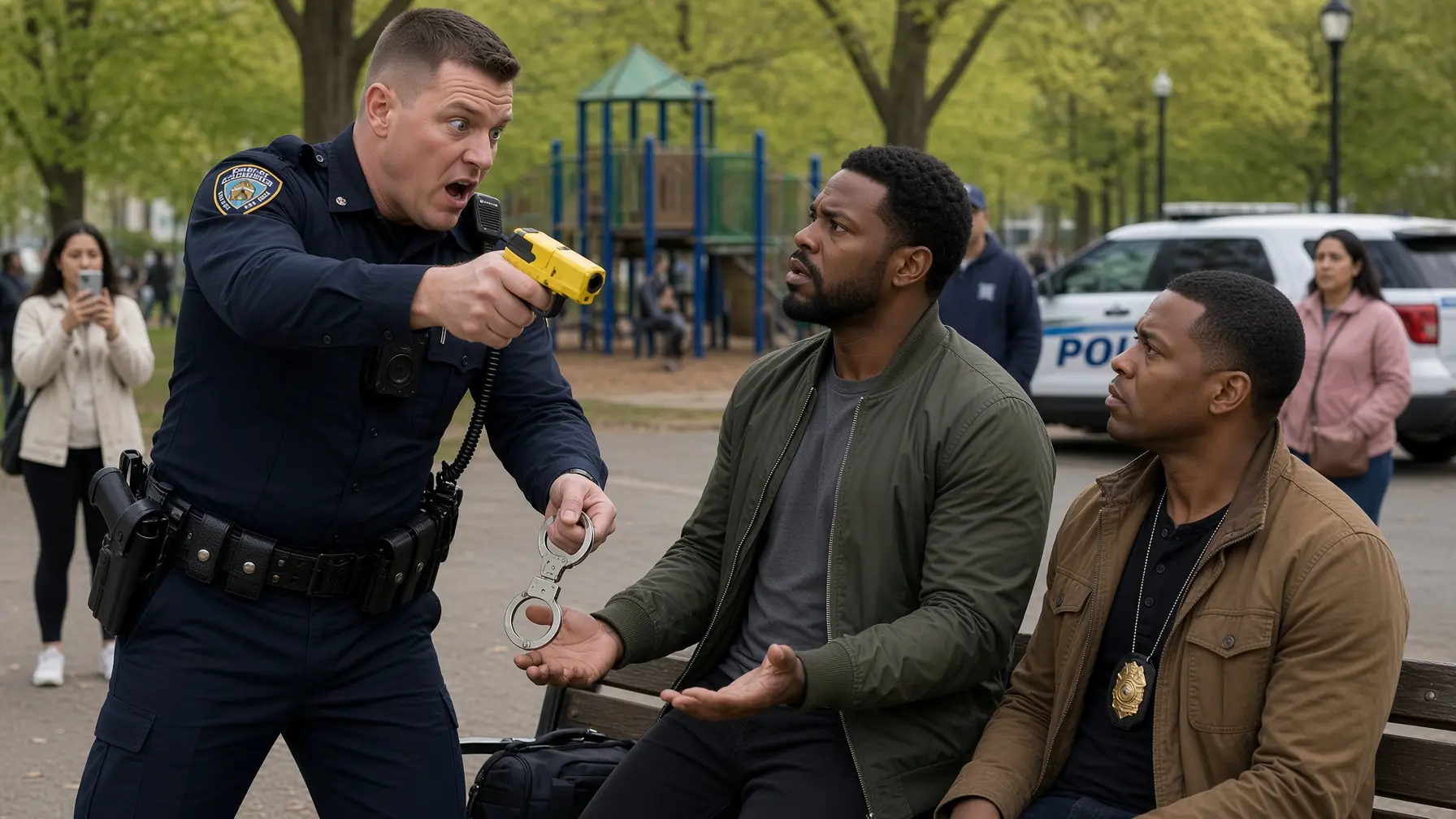
Damon Wright noticed the patrol car about three minutes after it arrived but gave it no more importance than the landscaping truck that had passed earlier. At thirty-four, Damon had spent nine years with the Federal Bureau of Investigation, most recently assigned to an organized-crime squad that relied heavily on surveillance, confidential sources, controlled meetings, and undercover contacts where appearing too interested in law enforcement could get somebody hurt. His partner, thirty-two-year-old Kelvin Miles, had seven years with the Bureau and possessed the irritating ability to look relaxed even during operations that made Damon check exits twice. Neither man wore anything that suggested federal authority that afternoon, because jeans, hoodies, sneakers, and forgettable jackets were precisely what the assignment required.
They were not conducting the kind of glamorous undercover operation that movies would later make people imagine. There were no suitcases filled with cash, hidden snipers watching from rooftops, coded phrases about exotic merchandise, or agents waiting in black vehicles to crash through the park the moment somebody touched the wrong object. Damon and Kelvin had spent six months helping build a case against a regional criminal organization suspected of using trucking businesses to move narcotics, stolen firearms, and cash between three states. That afternoon’s meeting had one narrow purpose: receive a small bag from a cooperating source containing an encrypted phone, handwritten delivery references, and copies of records that investigators hoped would help corroborate information already developed through other lawful means.
The source was late by seven minutes, which Damon considered normal enough not to matter. He checked his watch, watched an elderly man throw bread toward ducks despite a sign specifically asking visitors not to feed them, and said quietly, “If that bird gets any bigger, I’m putting him in the intelligence report.” Kelvin did not look up from his phone when he answered, “You put a duck in my report and I’m telling Harding you’ve been compromised.” Damon smiled, because boring conversation was often what competent surveillance sounded like.
Across the parking area, Ryan Caldwell watched them through the windshield. He was twenty-six years old, eight months out of the academy, physically fit, ambitious, and still young enough in the profession that nearly every confident decision felt to him like evidence he was finally becoming the kind of officer he had imagined. His field-training evaluations described strong initiative, good physical conditioning, quick response to calls, and a tendency to reach conclusions before he had gathered enough information. Three different supervisors had used slightly different phrases for the same concern, but none had yet treated it as something requiring more than coaching.
Caldwell had been praised during his first months for making several arrests that initially looked impressive. He found an outstanding warrant during a traffic stop, recovered a stolen handgun after a lawful arrest, and helped identify a burglary suspect through patient neighborhood canvassing. Those successes mattered, but they also seemed to reinforce his belief that suspicion was valuable mainly when it produced action quickly. When encounters ended with no arrest, Caldwell increasingly treated the lack of an arrest as evidence that a suspect had merely been lucky rather than evidence that his first impression might have been wrong.
Complaints had begun appearing before his sixth month. A Black college student named Jordan Bell alleged that Caldwell stopped him outside an apartment complex and demanded to know why he was standing near a new Lexus even after Jordan explained the vehicle belonged to his mother, while a Latino delivery driver named Miguel Santos said Caldwell questioned him for nearly twenty minutes because he carried sealed boxes between a warehouse and a van after dark. A fifty-eight-year-old Black nurse named Patrice Green filed the third complaint after Caldwell followed her through a shopping-center lot and asked whether the expensive handbag she was carrying belonged to her. None of the incidents produced criminal charges, and none had enough independent evidence at the time to establish intentional misconduct under the department’s existing complaint process.
Jordan’s complaint had been closed after a supervisor concluded that Caldwell possessed enough information for a brief consensual inquiry but might have extended the contact unnecessarily. Miguel’s complaint ended as “not sustained” because body-camera audio was incomplete after Caldwell failed to activate his equipment until several minutes into the conversation, while Patrice withdrew hers after becoming tired of repeated calls asking her to clarify details. Caldwell received informal coaching after all three events. The lesson he absorbed was not that his judgment required serious correction, but that annoyed citizens sometimes complained about police officers who were simply proactive.
Riverside Park occupied enough city acreage that patrol officers routinely drove through during afternoon shifts. There had been thefts from parked cars, occasional fights near the basketball courts, complaints about drug use after dark, and one recent robbery involving teenagers near a bicycle path, so Caldwell could truthfully say the park sometimes generated police activity. None of those incidents involved Damon or Kelvin, neither agent matched an active suspect description, and dispatch had sent Caldwell there for no specific call. He entered the park because his assigned zone included it, saw two men on a bench, and began waiting for ordinary behavior to become suspicious enough to confirm what he had already felt.
Fifteen minutes passed without Damon or Kelvin committing anything remotely unlawful. They talked quietly, checked their phones, watched pedestrians, drank coffee, and once moved their feet so a little girl could retrieve a rubber ball that had rolled beneath their bench. Caldwell nevertheless continued observing because he had convinced himself that men who sat in one location that long must be waiting for something. In that narrow sense, he was correct.
The cooperating source entered from the western path at 2:38. He was a thirty-nine-year-old Black man wearing work boots, a navy jacket, and a baseball cap, and he carried a small black duffel bag that would not have looked unusual beside any gym locker in America. He walked directly to Damon, handed him the bag without shaking hands or exchanging money, gave one small nod, and continued toward the southern exit. The entire contact lasted about eight seconds.
Caldwell leaned forward behind the windshield. Three Black men, a silent handoff, a bag, no visible conversation, and immediate separation assembled themselves inside his mind into a drug transaction so quickly that he never stopped to ask what observable fact distinguished that interpretation from a hundred innocent possibilities. Someone could have returned borrowed clothing, delivered documents, handed over tools, brought medicine, passed a laptop, or fulfilled an errand. Caldwell did not know what was inside the bag, but within seconds he behaved as though uncertainty itself had disappeared.
He opened the cruiser door and stepped onto the pavement. His hand moved automatically toward the equipment on his belt as he crossed the grass, not because either man had made a threatening movement but because he had already mentally promoted the encounter from observation to enforcement. Damon noticed him first. “We have company,” he said without turning his head completely.
Kelvin locked his phone and looked up. Caldwell was walking directly toward them with the quick rigid stride officers often used when they wanted compliance to begin before conversation. Damon felt irritation rather than fear because a local officer appearing at an undercover contact created operational complications even if the officer behaved perfectly. He placed both hands where Caldwell could see them and left the duffel bag resting between himself and the bench arm.
Caldwell stopped several feet away. He did not say hello or identify himself because his uniform seemed sufficient introduction in his mind, and he looked from Damon to Kelvin before letting his gaze settle on the bag. “All right, what are you two doing out here?” he asked. Damon answered, “Sitting in the park.”
Caldwell glanced around as though the obvious answer irritated him. “I can see that, but what are you doing here?” Damon replied that they were talking and enjoying the afternoon, while Kelvin added nothing because answering more questions than necessary during an active operation rarely improved anything. Caldwell pointed toward the black duffel.
“What’s in the bag?” he asked. Damon looked down at it and then back at Caldwell.
“Personal material.” Caldwell’s expression hardened.
“That wasn’t what I asked.”
Damon kept his tone conversational. “Officer, are we suspected of something?”
Caldwell answered, “I’ve been watching you.” Kelvin finally spoke.
“For how long?”
“Long enough.” Caldwell pointed again.
“I saw somebody walk up, hand you that bag, and walk away without saying a word.”
Damon nodded once. “Okay.”
“That isn’t normal.”
Kelvin looked toward a man across the lawn handing a backpack to a woman standing beside a stroller. “People hand things to other people all day.”
Caldwell stepped closer. “Don’t get smart.”
Damon could feel the encounter shifting. A voluntary conversation allows either person to walk away, while a detention requires specific facts supporting reasonable suspicion that criminal activity may be occurring, and a search generally requires consent, a warrant, or another recognized legal basis. Damon did not need to lecture Caldwell about constitutional doctrine, because doing so would sound argumentative and potentially draw more attention to an operation they still hoped to preserve. He asked a simpler question.
“Are we free to leave?” Caldwell stared.
“I’m asking questions right now.”
“That didn’t answer him,” Kelvin said.
Caldwell’s jaw tightened. “You two always this difficult with police?”
Damon noticed the wording. “You two.”
Not yet explicitly racial.
Enough to register.
Caldwell pointed toward the bag again. “Hand it over.”
Damon shook his head.
“We do not consent to a search.”
Caldwell laughed once. “You think saying that magic phrase makes this disappear?”
“No,” Damon answered. “I think it means we don’t consent to a search.”
People walking nearby began slowing. An older couple remained beside the fountain longer than necessary, a teenager on a bicycle stopped near a tree, and a woman pushing a stroller glanced between Caldwell’s rigid posture and the seated men. Kelvin noticed that the officer’s body camera displayed an active recording light. That was useful.
Caldwell reached toward the bag. Damon moved one hand onto the duffel without pulling it away.
“Please don’t touch our property.” Caldwell stopped.
“Your property?”
“Yes.”
“You don’t even know what’s inside it.”
Damon almost smiled. “I know more than you do.”
That was the wrong sentence for a man already interpreting calm resistance as disrespect. Caldwell stepped closer until the toe of one boot nearly touched Damon’s shoe. “I know I watched some guy make a handoff and disappear.”
Kelvin said, “You watched one person give another person a bag.”
“I know what I saw.”
“No,” Kelvin answered. “You know what you assumed.”
Caldwell’s nostrils flared. The difference between observation and inference should have been ordinary police work, but in that moment he heard correction as challenge. “You want to find out how much authority I’ve got?”
Damon said, “We’d rather find out what crime you believe occurred.”
“Possible narcotics transaction.”
“Based on what?”
“The handoff.”
“That’s it?”
Caldwell looked toward the bag.
“What else do I need?”
Damon answered carefully. “More than two people exchanging an ordinary object in a public park.”
Caldwell raised his voice. “You don’t tell me what I need.”
Several pedestrians were openly watching now. Kelvin quietly shifted his hands onto his thighs so they remained visible, while Damon did the same and left the bag untouched. Neither wanted this to become physical.
Caldwell said, “Give me the bag.”
“No.”
“Last chance.”
Damon’s expression became still. “No.”
The word traveled across the few feet between them with no insult attached. Caldwell reacted as though refusal itself supplied the missing evidence.
He pulled his handcuffs free.
Kelvin’s shoulders tightened. “Officer, call your supervisor.”
“You threatening me?”
“No.”
“You telling me how to do my job?”
“I’m telling you this is escalating unnecessarily.”
Caldwell held the cuffs in one hand. “Stand up.”
Damon did not move yet. “Are we under arrest?”
“You’re being detained.”
“For what specific suspected crime?”
“Narcotics activity.”
Kelvin looked around. “You haven’t seen narcotics.”
“I don’t have to see the drugs before I investigate.”
“That doesn’t mean you get to search whatever you want.”
Caldwell’s other hand moved toward his Taser. Damon saw it and felt the first genuine surge of concern.
The federal agents could reveal themselves. Doing so might prevent the officer from taking the bag, but it might also compromise a six-month investigation if civilians recorded their faces, posted names online, or connected them to the source who had walked through the park less than a minute earlier. Damon therefore tried one final de-escalation. “Officer, there are circumstances here you do not understand, so please call a supervisor before you put your hands on anybody or anything.”
Caldwell heard only hidden importance. “Everybody’s got circumstances.”
Kelvin said, “That’s exactly why you verify.”
Caldwell pulled the Taser.
The sound of plastic and metal leaving the holster changed the entire park. The woman with the stroller moved backward, the teenager lowered his bicycle and raised a phone, and the older couple near the fountain stopped pretending they were not watching. Caldwell pointed the device downward initially but held it in a ready position where both agents could see it.
“You’re both going to stand up,” he said. “You’re going to hand me the bag, and if either of you makes this difficult, I will put you on the ground.”
Damon’s voice became quieter. “Put the Taser away.”
“Stand up.”
Kelvin said, “You are making a serious mistake.”
Caldwell laughed bitterly. “Your mistake was thinking nobody was watching.”
Damon stood slowly. “Hands are visible.”
Kelvin followed.
Caldwell took one step backward, Taser rising.
“That’s better.”
Damon looked directly at him. “We still do not consent to a search.”
Caldwell’s expression twisted. “You people always think you can talk your way around the law.”
The phrase hung there.
Kelvin asked, “What people?”
Caldwell looked at him. “Don’t start that.”
“What people?”
“You know exactly what I mean.”
Damon felt a cold certainty enter the conversation. “No, officer, say what you mean.”
Caldwell should have stopped.
He did not.
“I’ve been doing this long enough to know what goes on in parks.”
Eight months.
Damon almost said it aloud.
Instead he asked, “Does what goes on in parks have a race?”
Caldwell’s face reddened.
“Here we go.”
Kelvin said, “You watched us before anything happened.”
“Because you looked suspicious.”
“How?”
“You were sitting around watching people.”
Damon looked toward the joggers, families, and benches around them. “In a park.”
Caldwell snapped, “Your kind does this every time.”
The teenager recording from near the tree visibly reacted. Kelvin heard it too clearly to misunderstand.
“My kind?” he asked.
Caldwell’s Taser rose another inch. “All that matters right now is you two are refusing commands, and people like you always turn everything into race when you get caught.”
Damon felt anger move through him but kept his voice level. “Caught doing what?”
“Drug activity.”
“Where are the drugs?”
“In that bag, maybe.”
“So you don’t know.”
“I’m going to.”
“No.”
Caldwell aimed the Taser directly at Damon’s torso.
That ended the agents’ attempt to preserve cover. Damon understood that reaching beneath his hoodie while a nervous rookie pointed an electrical weapon at him could produce exactly the kind of movement the officer was prepared to misinterpret, so he announced everything before moving. “Officer Caldwell, listen carefully, because I am going to reach slowly for identification hanging under my shirt and nothing else.”
Caldwell blinked. “Don’t reach.”
“I need you to lower the Taser.”
“Hands where I can see them.”
Kelvin spoke. “We are federal law-enforcement officers.”
Caldwell’s expression changed, but not enough.
“Sure you are.”
Damon said, “FBI.”
A woman in the crowd whispered something.
Caldwell stared.
Kelvin continued, “We are going to display credentials slowly, and you need to keep that weapon stable.”
Caldwell’s finger remained indexed along the side rather than on the trigger, which later became one of the few pieces of his conduct trainers praised. He did not lower the device. “One of you.”
Damon nodded. “I’m reaching with my right hand.”
He moved slowly beneath the collar of his hoodie and pulled a credential wallet hanging from a concealed chain. The gold-and-blue FBI badge became visible first, followed by photographic identification. “Special Agent Damon Wright, Federal Bureau of Investigation.”
Caldwell’s eyes widened.
Kelvin retrieved his credentials equally slowly. “Special Agent Kelvin Miles, FBI.”
For perhaps three seconds, nobody spoke.
Caldwell looked from one credential to the other. He looked at the bag.
Then at his Taser.
Then back at their faces.
Sweat appeared along his forehead despite the cool April breeze.
“You should’ve said that from the beginning,” he finally stammered.
Damon’s expression did not change. “Why?”
Caldwell blinked.
“What do you mean, why?”
“Why should our rights depend on telling you we’re federal agents?”
Caldwell lowered the Taser slightly. “Because I thought you were suspects.”
Kelvin asked, “What changed?”
“You’re FBI.”
Kelvin shook his head. “No.”
Caldwell looked confused.
“What changed is that you learned our jobs.”
The park remained silent enough that Damon could hear a child calling from the playground fifty yards away. He gestured toward the bag.
“Did our job titles make the bag handoff more legal than it was thirty seconds ago?”
Caldwell’s mouth tightened.
“You were conducting an operation.”
“Yes.”
“So it was different.”
Damon answered, “You did not know that when you approached.”
Caldwell said nothing.
Kelvin’s voice remained controlled. “If we had been two warehouse workers sitting here with gym clothes in that bag, what part of your behavior becomes acceptable?”
Caldwell finally lowered the Taser completely.
“I was just doing my job.”
Damon looked at the weapon.
“Then holster it.”
Caldwell hesitated.
“Holster the Taser.”
He did.
The clasp took two attempts because his hands were beginning to shake.
Caldwell looked around at the phones. “Can we talk somewhere else?”
Kelvin almost laughed.
“No.”
Caldwell’s face hardened from fear into defensiveness. “You could’ve compromised this situation by refusing to cooperate.”
Damon said, “We were trying not to compromise a federal operation.”
“You should have told me.”
“We were undercover.”
Caldwell looked at the crowd again. “Well, now everybody knows.”
Kelvin stared. “Because you pointed a Taser at us.”
The sentence landed.
Caldwell did not answer.
Damon picked up the bag but kept it closed. “This contains sensitive law-enforcement material connected to an active investigation and source information that you were seconds away from trying to seize without a warrant, consent, or a factual basis supporting a search.”
Caldwell swallowed.
“I had reasonable suspicion.”
“Maybe enough for questions,” Damon said. “Not what you did.”
Kelvin added, “And your racial comments are a separate problem.”
Caldwell’s face tightened. “I didn’t mean anything racist.”
The teenager near the tree laughed aloud.
Caldwell glanced toward him.
Kelvin said, “Do not make this worse by approaching witnesses.”
“I wasn’t.”
“Good.”
Damon took out his phone.
Caldwell looked alarmed. “Who are you calling?”
“Our supervisor.”
The officer nodded quickly. “Can we just straighten this out first?”
Damon looked at him.
“This is us straightening it out.”
Caldwell stepped closer, then stopped when Kelvin raised one palm.
“Stay there.”
The rookie officer obeyed.
That detail mattered later because it showed he could follow a boundary once authority he respected established it. The problem had never been an inability to understand clear instructions. The problem was whose instructions he considered legitimate.
Damon called Supervisory Special Agent Marcus Harding. He gave a concise summary without using adjectives: local officer observed the scheduled handoff, initiated contact, demanded access to the bag, escalated after refusal of consent, displayed a Taser, made explicit race-based statements, and backed down after credentials were shown. Harding interrupted only once. “Are you or Kelvin injured?”
“No.”
“Operation compromised?”
“Unknown.”
“Source identified?”
“Not by name, but there are civilian recordings.”
Harding swore quietly.
Damon continued. “We have operational audio.”
That changed Harding’s tone.