“Get that dog out of my restaurant.”
The words carried from one end of the dining room to the other, past the low murmur of dinner conversations and the soft percussion of silverware against porcelain. A waiter stopped beside a table overlooking the harbor. A woman near the windows glanced at the German Shepherd resting quietly beneath the corner booth, then at the man pointing toward the exit. Nothing about the animal suggested trouble. Its paws were folded beneath its chest, its leash slack, its ears turned toward the voice without any corresponding movement of its body. Nevertheless, the owner of Harbor Point Grill stood over the table as though he had discovered a dangerous intruder.
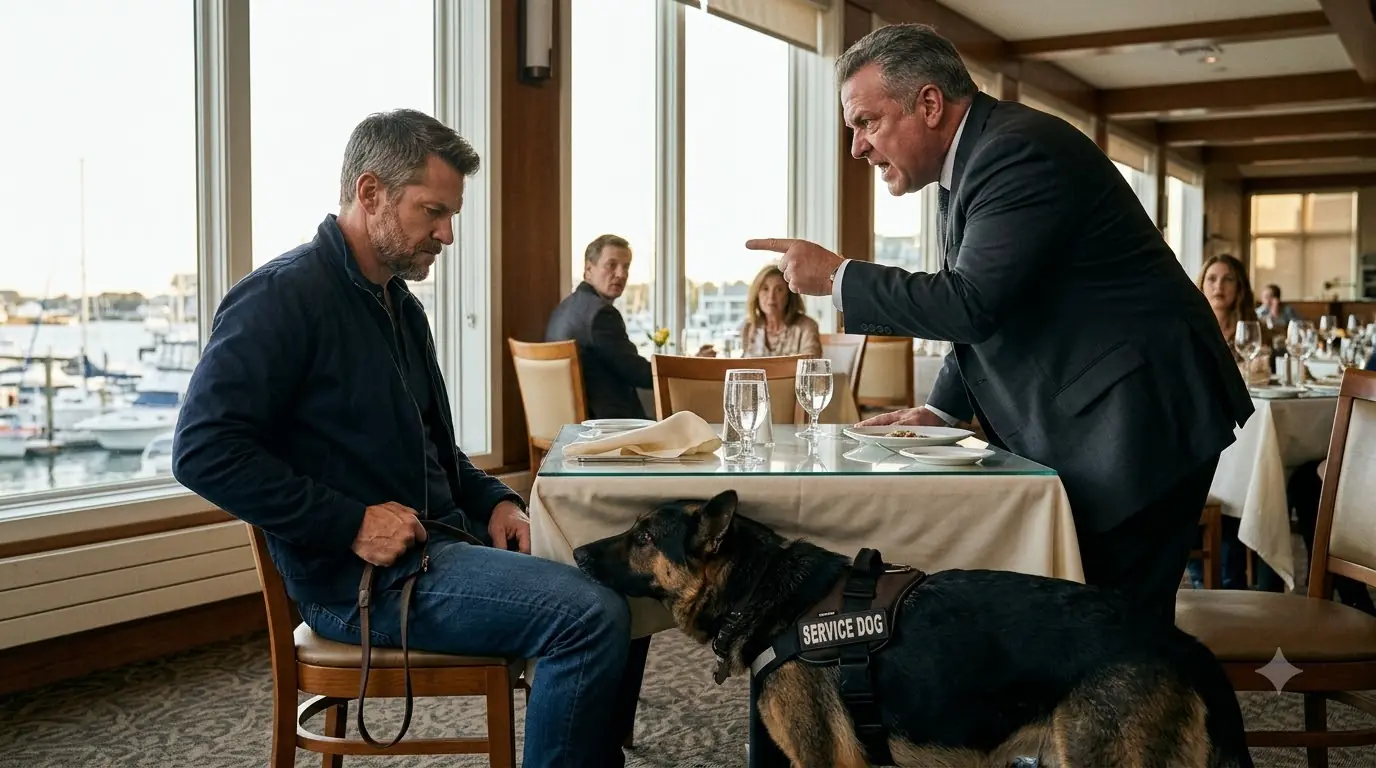
Nathan Cole, forty-five years old and four years removed from a career with the Navy SEALs, lifted his eyes from the menu. He had chosen the restaurant because his sister was celebrating her anniversary there the following month and he wanted to know whether he could manage an evening in a busy dining room without leaving halfway through. He had chosen a weekday, arrived early, and requested a quiet seat with room beneath the table for Ranger, his trained service dog. The dog had entered at heel, ignoring the smell of grilled fish and a dropped bread roll near the host stand. Nathan had been proud of how ordinary the evening felt until the restaurant owner approached.
“He's a service dog,” Nathan replied. “He's trained to assist me with a disability. He is under control, and we aren't obstructing the aisle.” His voice remained level, although his right hand had begun to work slowly along the seam of his jacket. That movement was familiar to Ranger, who raised his head and watched without leaving his place. Nathan knew there was a difference between the fear moving through his chest and the actions he chose to take because of it. He had worked hard to learn that difference.
“I don't care what kind of dog you call him,” the owner said. “The health code doesn't permit animals in my dining room. I'm not turning this into an argument in front of paying customers.” His name was Charles Whitaker, and he had purchased Harbor Point Grill eleven years earlier, when the seafood restaurant was still a struggling tenant beneath a waterfront hotel. He had improved the kitchen, cultivated private events, and convinced himself that every success had come from his willingness to be stricter than anyone else. A large animal on a polished floor looked to him like something that might ruin the image he had sold his investors.
“You may ask me whether Ranger is required because of a disability and what work he's trained to perform,” Nathan said. “I'll answer both. He is required, and he interrupts episodes when I become disoriented. He gives a trained physical cue so I can use my grounding routine.” Charles glanced